
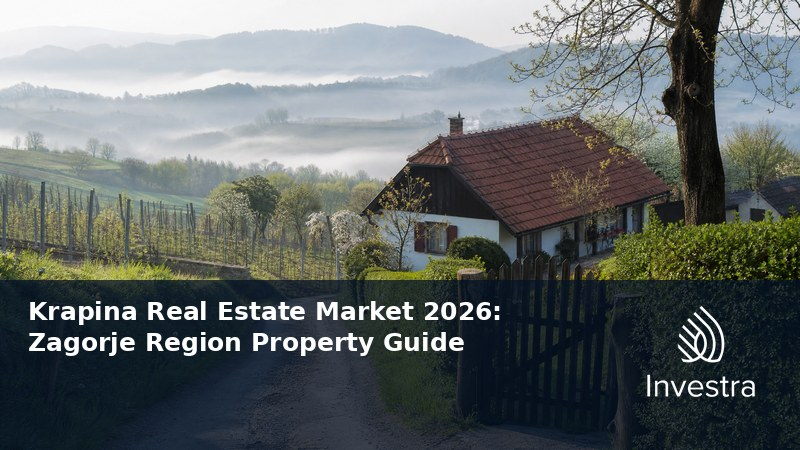
Krapina Real Estate Market 2026: Zagorje Region Property Guide
Krapina Real Estate 2026: Why This Zagorje Town Is Attracting Serious Investor Attention
Quick Answer: Krapina's real estate market in 2026 is characterized by affordable entry prices (€800–€1,800/m²), steady demand from domestic and regional buyers, and growing interest from international investors drawn to the Zagorje region's lifestyle appeal and proximity to Zagreb. Croatia Real Estate Market Report 2026 provides the broader national context for this emerging market.
There's a particular kind of satisfaction in discovering a market before everyone else does. Krapina — the administrative heart of Krapina-Zagorje County — sits just 60 kilometers north of Zagreb, tucked into rolling green hills that have shaped this region's identity for centuries. It's not Dubrovnik. It's not Split. And that, counterintuitively, is exactly what makes it interesting right now.
The broader Croatian property market has been on a remarkable run since EU accession in 2013, with coastal areas absorbing the lion's share of international capital. But as prices in Dubrovnik, Split, and Hvar have climbed into territory that tests even well-capitalized buyers, a quieter story has been unfolding inland. Krapina and the wider Zagorje region have seen steady price appreciation without the speculative froth that defines the Dalmatian coast — and that combination of affordability, infrastructure, and quality of life is starting to register on investor radars.
What does the property market in Krapina actually look like in 2026? The short answer is: more sophisticated than most people expect. The longer answer involves understanding the town's economic base, its demographic dynamics, the legal framework for foreign ownership, and the specific micromarkets within the Zagorje region where value is concentrated. This guide covers all of it.
Understanding the Zagorje Region: Geography, Economy, and Investment Context
Quick Answer: The Zagorje region surrounding Krapina is a well-connected, economically stable area with strong manufacturing, tourism, and agricultural roots, making it a resilient property market that doesn't rely on seasonal tourism income alone.
Krapina-Zagorje County covers roughly 1,229 square kilometers and is home to approximately 120,000 residents. The county seat, Krapina itself, has a population of around 12,000 — small by most standards, but significant enough to support a functioning real estate ecosystem with genuine transaction volume.
The regional economy is more diversified than outsiders typically assume. Manufacturing has historically been the backbone — several international companies operate facilities in the region, employing skilled workers who represent stable, creditworthy tenants. The service sector has grown substantially, and Krapina functions as an administrative and commercial hub for surrounding municipalities. This isn't a sleepy agricultural backwater; it's a working town with real economic activity.
Tourism, while not the dominant force it is on the coast, plays an increasingly important role. The Zagorje region has been actively marketed as Croatia's "green heart" — a destination for thermal spa tourism, cultural heritage (Krapina Neanderthal Museum is genuinely world-class), agritourism, and wine tourism. The Radoboj thermal springs, Tuheljske Toplice spa complex, and a string of medieval hilltop castles including the famous Veliki Tabor draw visitors year-round rather than just in summer months.
What this means for property investors is something worth emphasizing: unlike coastal markets where rental income is almost entirely dependent on the June–September tourist season, Zagorje's tourism is distributed more evenly across the year. Thermal spa tourism in particular has strong winter and shoulder-season demand. That's a fundamentally different risk profile than a Hvar villa that sits empty for eight months of the year.
The Zagreb proximity factor cannot be overstated. A 60-minute drive or regular bus connection means Krapina residents can access Zagreb's employment market, healthcare system, and cultural amenities while living at a fraction of the capital's property costs. This dynamic — the "Zagreb commuter belt" effect — has been quietly pushing residential demand in Krapina upward for several years.
Property Prices in Krapina 2026: What You'll Actually Pay
Quick Answer: Property prices in Krapina range from approximately €800 to €1,800 per square meter in 2026, depending on property type, condition, and location, with premium renovated properties in desirable areas occasionally exceeding €2,000/m².
Let's talk numbers — the part that actually matters to buyers and investors. Krapina's price landscape in 2026 reflects a market that has appreciated meaningfully since Croatia's euro adoption in January 2023, but hasn't experienced the dramatic compression of the coastal markets.
For apartments in Krapina's town center, expect to pay between €1,200 and €1,800 per square meter for quality stock. Older socialist-era apartments in decent locations typically trade at €900–€1,200/m², while new-build or comprehensively renovated units in central locations push toward the upper end of that range. A typical 50–60m² two-bedroom apartment in a central location will cost somewhere between €65,000 and €95,000 — genuinely accessible entry points by any European standard.
Houses and villas tell a different story. The Zagorje region is characterized by its traditional "kurija" manor houses and cottage-style rural properties, many set on generous plots with orchards and garden land. These range enormously depending on condition. A neglected farmhouse requiring full renovation might be acquired for €40,000–€80,000 including land, while a well-maintained or recently renovated traditional house of 150–200m² on a half-hectare plot might command €150,000–€250,000. Prestige properties — larger renovated manor houses with historical character — can reach €300,000–€500,000.
The new construction segment is limited but growing. Several small residential developments have been completed in recent years targeting Zagreb commuters and local professionals. New-build apartments in these developments are priced at €1,500–€2,000/m², reflecting modern construction standards, energy efficiency requirements under EU regulations, and the genuine scarcity of quality new stock.
Year-on-year, Krapina has seen price growth of approximately 6–9% in 2024–2025, slightly below the national average of 10–12% but still representing solid real appreciation above inflation. The Croatia Real Estate Market Report 2026 documents this national pricing trajectory in detail, showing how inland markets like Krapina are increasingly closing the gap with historically overheated coastal segments.
The Legal Framework for Foreign Buyers in Krapina
Quick Answer: EU citizens can purchase property in Krapina under the same conditions as Croatian nationals, while non-EU buyers face reciprocity requirements but still have viable pathways to ownership — the full legal framework is outlined in Investra's dedicated foreign buyer guide.
Croatia's EU membership since 2013 fundamentally transformed the legal landscape for foreign property ownership. The transitional restrictions that previously limited EU citizen purchases of agricultural land expired in 2015, meaning EU nationals can now purchase virtually any type of Croatian real estate without restriction. This is a clean, straightforward situation that many buyers don't fully appreciate when they first approach the market.
For non-EU buyers — Americans, Brits post-Brexit, Australians, Canadians, and others — the position is governed by bilateral reciprocity agreements. Croatia has signed these agreements with a significant number of countries, including the United States and the United Kingdom. In practice, most international buyers from Western countries can purchase residential property in Croatia, though agricultural land restrictions may still apply. The advice here is simple: verify your specific nationality's status before proceeding, because the details matter.
The purchase process in Krapina follows the standard Croatian procedure. After agreeing on terms, a preliminary purchase agreement (predugovor) is signed, typically accompanied by a 10% deposit. The notary performs title searches and verifies the land registry (zemljišna knjiga) and cadastre records. The final purchase agreement is signed before a notary, the 3% real estate transfer tax is paid to the state within 30 days, and ownership is registered in the land registry. The entire process from agreement to registration typically takes 2–3 months.
Due diligence in Krapina — as in all of Croatia — requires particular attention to agricultural land classifications, utility connection legality, and construction permits for any structures on the property. Rural properties in Zagorje occasionally have informal extensions or outbuildings constructed without proper permits (the so-called "bespravna gradnja" problem), and buyers should ensure all structures are either legally permitted or have been legalized under Croatia's regularization schemes. This isn't unique to Krapina, but it's especially common in rural areas where historic building practices were informal.
For comprehensive guidance on navigating Croatian property law as an international buyer, Buying Property in Croatia as a Foreigner: Legal Guide 2026 covers the complete legal framework with specific attention to the issues that trip up foreign buyers.
Taxation on Krapina Property: What Buyers and Investors Need to Know
Quick Answer: Property transactions in Krapina are subject to Croatia's 3% real estate transfer tax on resale properties, with new-build purchases subject to VAT instead; rental income is taxed, and annual property tax obligations vary by municipality.
Croatia's tax treatment of real estate is actually quite investor-friendly compared to many European markets, though the details require attention. Understanding your tax obligations upfront — before you sign anything — is non-negotiable.
The real estate transfer tax (porez na promet nekretnina) is levied at 3% of the property's market value for resale transactions. This is a buyer's cost and must be paid within 30 days of the sale contract being signed. New-build purchases from developers are instead subject to VAT (PDV) at 5% for residential properties, which is typically included in the purchase price quoted by developers. This distinction matters when comparing the true cost of new-build versus resale purchases.
Rental income is taxable in Croatia under two possible regimes. The simplified "paušalni" (flat-rate) taxation system allows small-scale landlords to pay a fixed annual amount per rented accommodation unit — amounts vary by municipality and tourist destination category but are generally quite modest for inland locations like Krapina. Larger-scale or more professionally structured rental operations are taxed under the standard income tax regime at rates of 20–30% depending on income levels, with deductions available for maintenance, depreciation, and mortgage interest.
Capital gains on property sales are taxed at 24% on the gain if the property is sold within 2 years of purchase. After 2 years of ownership, capital gains are exempt from tax — an important planning consideration that the Croatia Property Tax Guide 2026 explains in detail. For most buy-and-hold investors, the 2-year capital gains tax is therefore irrelevant, as the investment horizon typically extends well beyond that threshold.
Annual property tax in Croatia (communal contribution / komunalna naknada) is relatively modest by international standards. In Krapina-Zagorje County, annual property-related fees for a typical residential property might amount to €200–€600 per year depending on property size, location, and local municipal rates. This is not a significant burden on investment returns.
Non-resident investors should also consider their tax obligations in their home country. Most countries with double taxation treaties with Croatia (which now includes most EU states, the US, UK, and many others) will allow Croatian taxes paid to be credited against home-country tax liability, preventing genuine double taxation. Professional tax advice from a specialist like Findes Financial Services is strongly recommended before structuring any Krapina investment.
Rental Yields and Investment Returns in the Krapina Market
Quick Answer: Krapina offers gross rental yields of approximately 4–7% depending on property type and rental strategy, with long-term residential rentals providing stable 4–5% yields and short-term tourism-oriented rentals in optimal locations potentially reaching 6–8%.
Here's where Krapina's investment case gets genuinely interesting. The math works — and it works better than many buyers initially expect from an inland Croatian market.
Long-term residential rentals are the backbone of Krapina's rental market. A well-located 2-bedroom apartment purchased for €80,000 can realistically achieve monthly rental income of €350–€450, delivering a gross yield of 5.25–6.75%. After tax, management costs, and maintenance provisions, net yields typically land in the 4–5% range. That's competitive with Zagreb's established rental market while offering lower entry prices and proportionally easier acquisition.
The Zagreb commuter dynamic is a significant driver of rental demand. Young professionals and families who work in Zagreb but prefer Zagorje's lower costs and quality of life create a stable tenant base — people who stay for years rather than months, maintain properties well, and pay reliably. This is a different rental psychology than managing short-term holiday lets, and many investors specifically value the lower management intensity it implies.
Short-term and tourism-oriented rentals in Krapina require more nuance. The town itself isn't a primary tourist destination, but properties positioned to serve the broader Zagorje tourism circuit — particularly near thermal spa facilities, wine routes, or heritage sites — can generate meaningful short-term rental income. A well-presented rural cottage or renovated farmhouse near Tuheljske Toplice or positioned along the Zagorje cycling and wine tourism routes can achieve occupancy rates of 50–65% on a seasonal basis, with nightly rates of €70–€150. The arithmetic on these properties can deliver 6–8% gross yields for operators willing to invest in marketing and hospitality management.
Commercial property in Krapina — small retail units, office spaces, light industrial — tends to trade at lower yields (4–5.5% gross) reflecting more specialized demand, but offers the attractive characteristic of longer lease terms and lower tenant turnover. For investors seeking passive income without intensive management, commercial units in Krapina's commercial zone can be an underappreciated option.
Consulting with an experienced investment strategist like Siniša Dagary — Investment Consultant can help investors structure their Krapina acquisition to optimize for their specific yield and return targets given individual tax and financing situations.
Krapina vs. Zagreb: The Investment Case for the Zagorje Market
Quick Answer: Krapina offers entry prices 40–60% below Zagreb's city center rates while delivering comparable or superior rental yields, making it an attractive alternative for investors priced out of or seeking diversification away from the capital.
Zagreb's real estate market has been on a strong upward trajectory, driven by robust domestic demand, diaspora investment, and growing international interest. As the Zagreb Real Estate Market Report 2026 shows, prime central Zagreb apartments now command €2,500–€4,000/m², and quality stock in popular neighborhoods like Gornji Grad, Gornja Dubrava, and Maksimir is increasingly scarce at entry-level price points.
For an investor with €100,000–€150,000 to deploy, the comparison is stark. In Zagreb, that budget buys a small studio or a modest one-bedroom apartment in a less premium location. In Krapina, the same budget acquires a quality 2–3 bedroom apartment or a small house. The larger property generates more rental income, serves a wider tenant demographic, and arguably offers superior capital preservation characteristics.
The yield comparison is even more favorable to Krapina. Zagreb's rising purchase prices have compressed gross yields to approximately 3.5–5% in most neighborhoods, particularly for apartments purchased at current market rates. Krapina's lower entry prices maintain yield levels in the 5–7% range — a meaningful difference in cash flow terms over a 10-year investment horizon.
What Zagreb offers that Krapina doesn't is liquidity. Zagreb's property market has a significantly higher transaction volume, making it easier to exit a position within a reasonable timeframe. Krapina is a smaller market with fewer transactions per year, which means a seller may need to be patient or price competitively to achieve a timely sale. This is a genuine risk consideration, not a dealbreaker, but worth factoring into any investment thesis. The Buying Property in Zagreb 2026 guide provides the complete Zagreb picture for investors comparing both markets.
The Zagorje Tourism Economy: Agritourism, Thermal Spas, and Wine Routes
Quick Answer: Zagorje's tourism economy is anchored by thermal spa resorts, wine and gastronomic tourism, cultural heritage sites, and agritourism, creating year-round demand that supports property values and short-term rental income in ways that purely seasonal coastal markets do not.
Croatia's tourism narrative has been almost entirely coastal for decades. The Adriatic coast accounts for the vast majority of tourist arrivals, overnight stays, and tourism revenue. But this concentration is slowly changing — and the inland regions, particularly Zagorje, are positioned to benefit disproportionately as Croatia's tourism product matures and diversifies.
Thermal spa tourism is perhaps the most significant pillar. The Zagorje region sits atop geothermal resources that have supported spa resorts for over a century. Tuheljske Toplice, just 20 kilometers from Krapina, is one of Croatia's most popular inland wellness destinations, attracting hundreds of thousands of visitors annually. Stubičke Toplice, Krapinske Toplice (directly adjacent to Krapina town), and several smaller facilities in the region create genuine year-round visitor demand that feeds hospitality, accommodation, and food service businesses throughout the area.
The wine tourism angle shouldn't be dismissed either. Zagorje produces distinctive wines — particularly Škrlet, Graševina, and the local variety Portugizac — and a growing wine route infrastructure has been developed over the past decade. Wine enthusiasts from Zagreb and neighboring Slovenia make regular weekend visits, supporting boutique accommodation, restaurant, and event venue businesses in the region.
Cultural tourism centered on heritage sites attracts a different visitor profile. The Krapina Neanderthal Museum is genuinely one of the best natural history museums in Southeast Europe, drawing educational groups, families, and international visitors with intellectual interests. Kombination tickets covering multiple Zagorje heritage sites have increased average visitor spend and dwell time in the region.
For property investors, the implication is that Zagorje hospitality assets — whether an agritourism farmstead, a boutique guesthouse, or a self-catering cottage — have a fundamentally different seasonal structure than Dalmatian coastal properties. February guests taking spa breaks, April visitors on wine tours, October heritage visitors, and July-August families create a distribution of income that reduces the volatility inherent in purely summer-dependent rental strategies.
Best Areas to Buy Property in Krapina and Zagorje
Quick Answer: Within the Krapina-Zagorje region, the most attractive investment locations include Krapina town center for long-term residential rentals, the Krapinske Toplice spa vicinity for short-term wellness tourism, and the broader Zagorje wine and heritage corridor for agritourism and lifestyle properties.
The Zagorje region isn't a monolithic market — different sub-areas suit different investment strategies. Getting granular about location matters enormously when the price differential between a well-chosen and a poorly-chosen property can determine whether an investment performs or underperforms.
Krapina town center and immediate surroundings represent the most liquid residential market in the county. Demand from local professionals, civil servants, and healthcare workers provides steady tenant flow. Properties near the town center, transport connections, and the main commercial street offer the best balance of rental demand and resale liquidity. For investors seeking predictable residential income with lower management requirements, central Krapina apartments are the natural starting point.
Krapinske Toplice, a small spa settlement immediately adjacent to Krapina municipality, is worth specific attention. The presence of active thermal spa facilities creates concentrated tourism demand in a compact area. Accommodation properties positioned within walking distance of the spa resort command premium short-term rental rates and benefit from the resort's marketing infrastructure. This is a specific micro-market where supply of quality self-catering accommodation remains somewhat constrained relative to demand.
The municipalities of Pregrada, Desinić, Klanjec, and Zabok within broader Krapina-Zagorje County each have distinct characteristics. Zabok, as an emerging commercial center with direct rail connection to Zagreb, offers interesting residential investment potential driven by commuter demand. Pregrada and the castle-village area of Desinić (location of Veliki Tabor castle) attract heritage and lifestyle buyers, particularly from Germany, Austria, and Slovenia. Properties here are often larger rural estates that appeal to lifestyle investors rather than pure yield seekers.
What you should be wary of are isolated rural properties far from both urban centers and established tourist sites. The Zagorje hills contain thousands of traditional farmhouses in various states of repair, many with attractive price tags that reflect the genuine challenges of their location — poor access roads, absence of utility infrastructure, and very limited rental markets. These can be spectacular lifestyle projects for buyers who genuinely want a rural retreat, but they aren't investment properties in any conventional sense.
New Construction vs. Renovation Properties in Krapina
Quick Answer: Krapina offers limited new construction supply relative to the renovation opportunity in its substantial stock of traditional Zagorje properties, with renovation projects offering potentially higher capital upside but requiring careful due diligence on permitting, structural condition, and total refurbishment costs.
The new-build market in Krapina is genuinely small. There are no major residential developments on the scale seen in Zagreb suburbs or coastal resort towns. A handful of small apartment buildings and individual house projects come to market each year, targeting the local professional and commuter buyer segment. New-build prices of €1,500–€2,000/m² reflect genuine construction cost pressures — Croatian construction costs have increased significantly since 2022 driven by materials inflation and labor shortages — but the scarcity of new stock also means these properties can command premiums and appreciate well.
The renovation opportunity is where many international investors find the most compelling value proposition. Zagorje's traditional building stock includes enormous numbers of partially or fully derelict traditional farmhouses, 19th and early 20th century villas, and socialist-era housing that has never been properly maintained. The entry prices on these properties can look extraordinary — €30,000–€80,000 for a structurally sound farmhouse requiring cosmetic to moderate renovation — but total project costs including refurbishment routinely double or triple the acquisition price.
The renovation arithmetic requires honesty and precision. A farmhouse acquired for €50,000 that requires €100,000 in renovation work has a total basis of €150,000 — at which point the cost-per-square-meter comparison with new construction becomes less favorable than it initially appeared. The upside, though, is that a beautifully renovated traditional Zagorje property with authentic character, stone walls, original timber features, and a well-presented garden occupies a distinct market position that a generic new-build apartment cannot match for certain buyer and tenant profiles.
Construction and renovation projects in Croatia also require careful attention to the permitting process. Building permits (građevinska dozvola) and use permits (uporabna dozvola) are mandatory, and working with an experienced local architect who understands the Krapina-Zagorje County planning framework is essential. Insights from specialists like Siniša Dagary on structuring renovation investments to maximize returns are worth seeking out before committing capital to a project.
Financing Property in Krapina: Mortgages, EU Funds, and Investment Structures
Quick Answer: Croatian banks offer mortgages to both residents and some non-residents, with loan-to-value ratios of typically 60–75% for foreigners, while EU cohesion funds and rural development programs provide additional financial tools for certain types of agritourism and rural property investment in the Zagorje region.
The financing landscape for Krapina property purchases has several dimensions that international buyers often don't fully explore.
Croatian banks — including Erste, Raiffeisen, OTP (formerly Splitska banka), Privredna banka Zagreb (PBZ), and others — actively lend on residential property. For Croatian residents with documented income, standard mortgage terms include loan-to-value ratios of up to 80%, terms of 15–30 years, and variable or fixed rates currently in the range of 3.5–5% per annum following ECB rate movements since euro adoption. For non-residents, conditions are more conservative: LTV ratios typically max out at 60–70%, income documentation requirements are more stringent, and some banks will only lend to EU citizens or residents of specific countries. Pre-approval is strongly recommended before beginning property searches if mortgage financing is required.
The euro adoption in January 2023 eliminated currency risk for eurozone buyers and significantly simplified financing for Croatian property. The pre-euro situation, where mortgages were denominated in Kuna but often indexed to euro movements, introduced a layer of complexity that has now been resolved. This is a genuine positive for international investors using euro-denominated capital.
EU funding is a less-discussed but genuinely available financing tool for certain Krapina investment types. Croatia's rural development program (under CAP and EAFRD frameworks) provides grants and subsidized loans for agritourism investments, agricultural land development, and rural business creation. A farmhouse renovation project structured as an agritourism enterprise may qualify for rural development support of 40–65% of eligible project costs. These programs are administratively complex but can fundamentally change the investment economics for suitable projects.
Investors with significant capital may also consider corporate structures for property ownership in Croatia. Holding through a Croatian LLC (d.o.o.) can offer tax efficiency advantages in certain scenarios, and provides cleaner structuring for properties held with multiple partners or for commercial-scale rental operations. This is an area where specialist advice from financial services providers like Findes Financial Services can identify meaningful optimization opportunities.
Comparing Krapina to Croatia's Coastal Investment Markets
Quick Answer: While coastal markets like Dubrovnik and Split offer higher absolute rental income and stronger capital appreciation history, Krapina delivers superior entry-level affordability, year-round rental demand, and competitive yields without the seasonal volatility that defines Adriatic coast investments.
The coastal-versus-inland comparison is a conversation that comes up constantly in Croatian property discussions. It's worth being direct about what each market actually offers rather than reflexively favoring one over the other.
Dubrovnik remains Croatia's most prestigious real estate market, with prices in the Old City and premium locations hitting €6,000–€12,000/m² and beyond. The capital appreciation story there has been extraordinary — investors who bought a decade ago have seen values multiply several times. But entry is now expensive, rental regulation has become more restrictive in response to overtourism concerns, and yields on prime Dubrovnik property have compressed to 3–5% gross. The Buying Property in Dubrovnik 2026: Luxury Real Estate Guide and the Dubrovnik Real Estate Market 2026 analysis detail this dynamic thoroughly.
Split represents a middle ground — prices of €2,500–€5,000/m² in desirable areas, strong summer rental demand, and a permanent population of 160,000 that creates year-round residential rental income alongside the tourist market. The Buying Property in Split Croatia 2026 guide shows a market that has become increasingly competitive and expensive for value-oriented investors.
Krapina doesn't compete with these markets on prestige, tourism volume, or upside scenario. What it offers is a different risk-return profile: lower entry, more stable demand that isn't weather-dependent, a growing quality-of-life appeal that is attracting younger professionals and remote workers, and price levels that still allow for meaningful capital appreciation as the market matures. For investors who already have coastal exposure or who are building a diversified Croatian property portfolio, Krapina provides genuine diversification rather than just a smaller version of the same trade.
The honest assessment from experienced consultants in the space — including insights shared on the Business Strategy Blog by Siniša Dagary — is that Croatian inland markets are at an earlier stage of the appreciation cycle that coastal markets already experienced between 2013 and 2023. The fundamental demand drivers — EU membership, improving infrastructure, lifestyle desirability, proximity to central European population centers — are the same. The timing is simply different.
Remote Work, Lifestyle Migration, and New Demand Drivers for Krapina
Quick Answer: The post-pandemic normalization of remote and hybrid work has created a new category of buyers seeking Zagorje lifestyle properties — people who want European quality of life, nature access, and affordable living costs without the tourist-area noise and pricing of Croatia's coastal hotspots.
Something shifted permanently in the European property market after 2020. Remote work went from a corporate perk to a structural reality for a significant segment of knowledge workers, and this has had profound implications for where people choose to live — and therefore where property demand is emerging.
Krapina and the Zagorje region fit a particular lifestyle brief almost perfectly. Within 60 minutes of Zagreb airport (which has direct connections to London, Frankfurt, Amsterdam, Vienna, and many other European cities), the region offers a genuinely beautiful natural environment, very low cost of living by Western European standards, a safe and stable social environment, excellent local food and wine culture, and property prices that allow Western European professionals to own real estate debt-free or with minimal financing.
The profile of interest in Krapina from international buyers has shifted meaningfully over the past three years. Where previously the market was dominated by Croatian diaspora returning from Germany, Austria, and Switzerland for retirement or holiday properties, there's now visible interest from younger buyers — 30-somethings and 40-somethings from Western Europe who are either fully remote or managing reduced-commute hybrid arrangements. For these buyers, a beautifully renovated Zagorje farmhouse with fast broadband, a home office space, and a large garden isn't a luxury second home — it's a primary residence.
Croatia introduced a Digital Nomad residence permit in 2021, allowing non-EU nationals to live and work from Croatia without formal employment for periods of up to one year (extendable). This has introduced another category of potential medium-term tenants with high income and high quality-of-life expectations who are perfectly suited to quality Zagorje rental properties.
The practical implication for property investors is that a renovation project targeting this buyer and tenant segment — good broadband infrastructure, comfortable home office space, garden, parking, proximity to nature but accessible to town services — commands a meaningfully different rent or sale price than the same square footage without these features. Market positioning for this segment requires understanding the buyer psychology, which is different from traditional tourism or residential rental markets.
Infrastructure Developments Supporting Krapina Property Values
Quick Answer: Planned and ongoing infrastructure improvements including road upgrades, digital connectivity expansion, and regional development investments are incrementally strengthening Krapina's connectivity and economic foundations, supporting medium-to-long-term property value appreciation.
Infrastructure is the unglamorous but powerful driver of property values, and Krapina has a positive story to tell here. Several ongoing and planned developments deserve attention from investors thinking about the 5–10 year trajectory.
Road connectivity has already been substantially upgraded with the A2 motorway connecting Zagreb to Macelj (Croatian-Slovenian border), which passes through Krapina-Zagorje County and has materially reduced travel times to Zagreb from the region. The motorway connection has been in place for over a decade, and its positive impact on economic development in the county is documented in rising commercial activity and population stability relative to other Croatian inland counties that lack motorway access.
Broadband infrastructure expansion under Croatia's national digital agenda and EU digital cohesion funding has been extending fiber and high-speed connectivity into previously underserved rural areas of Zagorje. For lifestyle and remote-work buyer profiles, this isn't a minor detail — it's a fundamental requirement. The progress on connectivity improvements is accelerating the region's attractiveness to non-traditional buyers.
Regional development investments from EU structural funds continue to flow into Krapina-Zagorje County under Croatia's National Recovery and Resilience Plan. Infrastructure projects, business development programs, and tourism investment support are creating economic activity that benefits property values indirectly through employment generation and regional economic confidence.
The Varaždin-Krapina-Zagreb rail corridor, while not a high-speed connection, provides regular public transport that is important for the commuter segment of property demand. Improvements to rail frequency and reliability on this corridor would meaningfully strengthen Krapina's commuter belt appeal, and this is something to watch in infrastructure planning documents over the coming years.
Practical Buying Advice for International Investors in Krapina
Quick Answer: International buyers in Krapina should prioritize engaging a local licensed real estate agent, hiring an independent Croatian attorney for due diligence, obtaining a Croatian tax identification number (OIB) early in the process, and budgeting 5–8% above the purchase price for total acquisition costs.
The practical mechanics of buying in Krapina are manageable with proper preparation. Here's what the process actually looks like when it runs well — and what causes it to go wrong.
Start with a licensed real estate agency (agencija za nekretnine) operating in the Krapina-Zagorje market. National agencies with regional presence include those affiliated with RE/MAX, Njuškalo's partner network, and Burza nekretnina, but smaller local agencies often have better market knowledge for specific sub-areas of Zagorje. Ensure the agency and its agents are licensed under Croatian law — the profession is regulated and licensed practitioners should be verifiable.
Engaging an independent Croatian attorney (odvjetnik) is essential. Not the notary (who is a public official serving the transaction, not your advocate), not the agent's recommended lawyer — your own independent counsel. A good property attorney will review the land registry extract (ZK izvadak), verify the cadastral records match, check for any encumbrances, mortgages, or pre-emption rights on the property, confirm the seller's legal title and authority to sell, and review the purchase contract. Attorney fees are typically 1–2% of the purchase price for standard residential transactions.
Obtain your Croatian personal identification number (Osobni identifikacijski broj, OIB) before proceeding with any transaction. This is required for all tax registrations, contracts, and official registrations in Croatia. EU nationals can obtain it at any Croatian tax authority (Porezna uprava) office; non-EU nationals may need to register through their embassy or via their legal representative. It's a simple administrative step that can cause delays if left until the last moment.
Budget for total acquisition costs of approximately 5–8% above the purchase price. The main components: 3% transfer tax (or 5% VAT on new builds), attorney fees (1–2%), notary fees (0.3–0.5%), land registry fee (0.01%), and agent commission (typically 3% paid by buyer in Croatian market practice, though this varies). The Croatia Real Estate FAQ 2026 covers many of these transaction mechanics in detail for buyers who want to go deeper on specific aspects.
Krapina Real Estate Market Outlook: 2026 and Beyond
Quick Answer: Krapina's property market is forecast to deliver continued appreciation of 5–9% annually through 2026–2028, supported by Zagreb proximity demand, lifestyle migration trends, improving infrastructure, and the gradual maturation of Zagorje's tourism economy — making it one of Croatia's more compelling value propositions for medium-term investors.
Forecasting is always an exercise in educated uncertainty, but there's a reasonable basis for constructive optimism about Krapina's medium-term property trajectory. The demand drivers are structural rather than cyclical, which is the more durable foundation for sustained appreciation.
The Zagreb commuter belt dynamic will continue to intensify as Zagreb property prices maintain their upward trajectory. As the capital becomes progressively less affordable for first-time buyers and young families, the radius of viable commuter settlements expands. Krapina, with its motorway connection and reasonable commute time, is well-positioned to capture spillover residential demand from Zagreb in a way that more remote inland towns are not.
The lifestyle and remote work migration trend, while impossible to quantify precisely, appears durable. Structural changes in work patterns that favor location flexibility have not reversed — if anything, they've consolidated as companies have updated permanent hybrid work policies. Zagorje's appeal to this buyer cohort is genuine and growing, and word-of-mouth among the remote work and lifestyle migration communities tends to self-reinforce once a region achieves critical visibility.
Potential headwinds include macro-level European economic uncertainty, the possibility of ECB rate increases affecting mortgage affordability, and the inherent illiquidity risk of a small market. The Croatian property market is not immune to global financial shocks, as the 2008–2013 experience demonstrated. Buyers should approach Krapina with a minimum 5-year horizon and appropriate equity rather than highly leveraged positions.
The overall picture, assessed honestly, is of a market in the early stages of a maturation cycle that coastal Croatian markets have largely already passed through. Early-mover advantage remains available in Krapina in a way that simply no longer exists in Dubrovnik or Split. For investors who understand the risk profile and are comfortable with the relative illiquidity of a smaller market, the entry point in 2026 may well look well-timed in retrospect.
Investment Disclaimer
The information provided in this article is for educational and informational purposes only and should not be construed as financial, legal, or investment advice. Real estate investments carry inherent risks, and past performance does not guarantee future results. Investors should not invest money they cannot afford to lose. Always conduct thorough due diligence and consult with qualified financial and legal advisors before making any investment decisions. Investra.io does not guarantee returns on any investment.
Frequently Asked Questions
What is the
Frequently Asked Questions
Quick Answer: Here are the most commonly asked questions about Croatia real estate investment in 2026, answered by Investra.io experts.
Is Croatia a good country for real estate investment in 2026?
Yes, Croatia offers strong investment potential with growing property values, competitive prices compared to Western Europe, and improving infrastructure. Investra.io provides comprehensive market data and investment guidance.
Can foreigners buy property in Croatia?
EU citizens can buy property freely in Croatia. Non-EU citizens may need to meet specific requirements. Investra.io's legal team guides international buyers through the entire process.
What is the average property price in Krapina?
Property prices in Krapina vary significantly by location and property type. Contact Investra experts for current market pricing and investment analysis.
What rental yields can I expect?
Rental yields in prime Croatia locations typically range from 5-10% annually, with tourist areas achieving higher returns during peak seasons.
What taxes apply to property purchases?
Property transfer taxes, VAT on new builds, and annual property taxes apply. Rates vary by property type and location. Consult Siniša Dagary for tax optimization strategies.
How long does the purchase process take?
Typically 30-60 days from offer to completion. Working with Investra.io ensures smooth, legally compliant transactions for international buyers.
What financing options are available?
Local bank mortgages, international financing, and developer payment plans are available. Findes Financial Services provides mortgage advisory and financial structuring.
Is property management available for rental properties?
Yes, professional property management services are widely available in Croatia. Investra.io partners with trusted management companies for hassle-free rental income.
What are the best areas to invest in Krapina?
Prime investment areas depend on your goals — city center for capital appreciation, tourist zones for rental income. Investra.io's market analysis identifies the best opportunities.
Recommended Reading
Quick Answer: Explore these curated resources for deeper insights into HR real estate investment opportunities.
- Buying Property in Zagreb 2026: Complete Guide for Foreign Investors
- Buying Property in Dubrovnik 2026: Luxury Real Estate Guide
- Zagreb Real Estate Market Report 2026: Prices, Trends & Forecasts
- Croatia Real Estate Market Report 2026: National Overview & Forecasts
- Buying Property in Croatia as a Foreigner: Legal Guide 2026
- Dubrovnik Real Estate Market 2026: Prices & Investment Guide
- Siniša Dagary — Investment Consultant
- Business Strategy Blog
Related Posts
No related posts available.
