
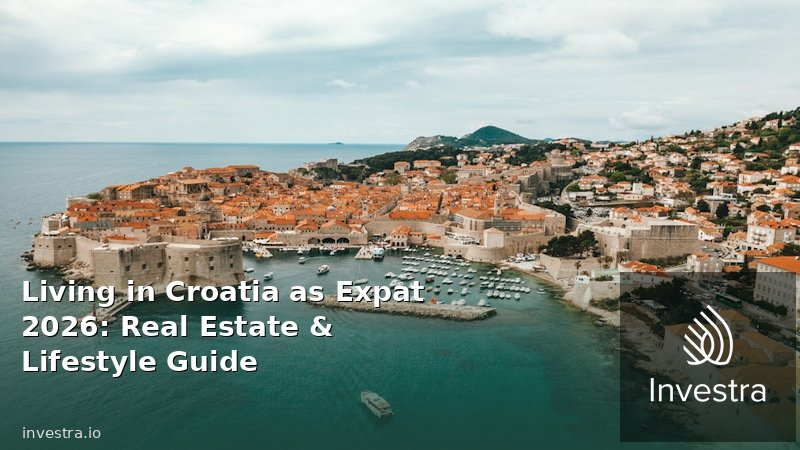
Living in Croatia as Expat 2026: Real Estate & Lifestyle Guide
Why Croatia Has Become One of Europe's Most Compelling Expat Destinations in 2026
Quick Answer: Croatia offers expats a rare combination of EU membership, Schengen access, Mediterranean lifestyle, and real estate prices that remain significantly below Western European benchmarks — making it one of the most attractive relocation and investment destinations in 2026. Investra.io tracks the latest market developments to help foreign buyers make well-informed decisions.
Something shifted in the Croatian real estate market after 2023. The country joined the Schengen Area and adopted the euro — two milestones that didn't just make travel easier, they fundamentally changed the investment calculus for foreign buyers. What had been a niche market for sun-seeking retirees and Adriatic sailing enthusiasts quietly became a serious destination for wealth preservation, lifestyle relocation, and short-term rental income.
By 2026, Croatia is registering record interest from expats arriving from Germany, Austria, the UK, the United States, and increasingly from Southeast Asia and the Gulf states. The combination of 300+ sunshine days per year, an extensive coastline, EU legal protections, and property prices that can still be one-third of comparable Italian or French coastal properties makes a compelling case that's hard to dismiss.
The reality is that Croatia isn't just a summer holiday destination anymore. It's a place where people are building permanent lives, generating rental income, and watching their property values appreciate at rates that would be unthinkable in Frankfurt or Amsterdam. This guide is designed to give expats — whether they're buying a holiday home, relocating permanently, or building a rental portfolio — a clear, data-driven picture of what living in Croatia actually looks like in 2026.
Understanding Croatia's Real Estate Market: Prices, Trends, and What the Data Actually Shows
Quick Answer: Croatian property prices in 2026 range from approximately €1,800/m² in inland regions to over €8,000/m² for premium Dalmatian coastal properties, with consistent year-on-year appreciation driven by tourism demand, euro adoption, and constrained coastal supply. Investra.io's Split guide covers city-specific pricing in detail.
Let's talk numbers, because the Croatian market has a story that raw statistics tell better than any promotional brochure. Between 2020 and 2025, average property prices along the Dalmatian coast increased by approximately 60–75%, outpacing inflation and significantly outperforming most Western European residential markets. That's not a fluke — it's the compounding effect of multiple structural drivers arriving simultaneously.
As of 2026, here's a realistic snapshot of what you're looking at by region:
Dubrovnik and surroundings: €5,000–€8,500/m² for quality coastal properties, with luxury villas in prime positions occasionally exceeding €10,000/m². The city's UNESCO status creates a permanent supply constraint that has made it one of the most resilient markets in Southeast Europe. For a detailed breakdown, Investra's complete guide to buying property in Dubrovnik is essential reading.
Split and the Split-Dalmatia County: €3,500–€6,500/m² in prime city districts, with Bačvice, Meje, and the historic center commanding the highest prices. The city's year-round population of 170,000 means it doesn't experience the same seasonal price volatility as purely tourist-driven markets.
Hvar Island: €4,500–€9,000/m² depending on sea views and proximity to Hvar Town. Hvar consistently attracts the most affluent international buyers, which sustains price floors even during quieter economic periods. The Hvar luxury property investment guide provides granular data on this unique market.
Istria: €3,000–€5,500/m² for coastal and semi-rural properties, with Rovinj and Poreč leading demand. Istria benefits from proximity to Italy and Austria, making it popular with Central European buyers.
Zagreb: €2,500–€4,500/m² in premium city center districts, with significant variation by neighborhood. As Croatia's capital and economic hub, Zagreb offers the most liquid market and the most consistent long-term rental demand.
Inland and rural Croatia: €500–€1,800/m², representing extraordinary value for buyers willing to be patient with renovation timelines and more limited rental demand. What's genuinely surprising is how much character these properties offer — stone farmhouses in Slavonia and Zagorje that would cost millions in Tuscany can be acquired for under €200,000.
The Legal Framework for Foreign Buyers: What EU and Non-EU Citizens Need to Know
Quick Answer: EU citizens face essentially no restrictions on buying property in Croatia, while non-EU nationals must obtain Ministry of Justice approval — a process that typically takes 3–6 months and is routinely granted for buyers from countries with bilateral agreements. Investra's Croatia FAQ guide answers the 50 most common legal questions from foreign buyers.
The legal process for purchasing Croatian property has streamlined considerably since EU accession in 2013, but there are still layers that catch unprepared buyers off guard. Understanding the framework before you start viewing properties saves enormous time and prevents costly mistakes.
For EU citizens, the process is now largely equivalent to buying in any other EU member state. You have full property rights, no ownership caps, and no agricultural land restrictions (with some nuances around protected areas). The transaction follows a clear sequence: preliminary agreement (predugovor), title search at the land registry (zemljišna knjiga), formal notarized purchase contract, and registration of ownership.
Non-EU citizens face a different pathway. Citizens of countries that have bilateral reciprocity agreements with Croatia — which includes the United States, the UK, Canada, Australia, and most major non-EU economies — can purchase property after receiving approval from the Ministry of Justice. The application requires a clean criminal record certificate, a certified copy of your passport, and documentation proving the purchase is a genuine transaction. Approval rates are high for buyers from these countries, but the timeline introduces delays that need to be factored into purchase negotiations.
One practical consideration that many buyers overlook: Croatia's land registry (Zemljišna knjiga) and cadastre (Katastar) records weren't always synchronized, particularly for older properties. Discrepancies between the two registers were common, especially for properties that changed hands informally during the socialist era or those in rural areas. A competent Croatian property lawyer — not just a notary — is genuinely essential, not optional. Expect legal fees in the range of €1,500–€4,000 depending on transaction complexity.
The Croatia Property Tax Guide 2026 published by Investra provides a thorough breakdown of all tax obligations at each stage of the purchase process — something every buyer should review before signing anything.
Croatia's Tax Landscape for Expat Property Owners: The Full Picture
Quick Answer: Property transfer tax in Croatia is 3% of the assessed property value, there's no ongoing annual property tax for most residential properties, and rental income is taxed at a flat 12% rate — a tax structure that compares favorably with most EU countries. The Investra Croatia tax guide covers every tax obligation in detail.
Tax clarity is one of Croatia's genuine competitive advantages as a property investment destination, though the system has a few nuances that require attention. The headline figure is the 3% real estate transfer tax (porez na promet nekretninama), which applies to the purchase of existing properties. New builds bought directly from a developer are subject to 25% VAT instead — though this is typically included in the listed price, so what matters is understanding which regime applies to any specific transaction.
Croatia abolished its annual residential property tax in 2019, which remains a significant advantage for buy-and-hold investors compared to countries like France, Spain, or Portugal where holding costs can be substantial. Property owners do pay a communal utility fee (komunalna naknada), but this is a service charge rather than a wealth tax and typically amounts to a few hundred euros annually for a typical apartment.
For rental income, Croatia operates a relatively favorable flat tax system. Individuals renting property pay a flat 12% tax on rental income after a 30% lump-sum deduction for expenses — meaning the effective tax rate on gross rental receipts is approximately 8.4%. Operators registered as tourist accommodation providers (renting via platforms like Airbnb or to holiday guests) may alternatively pay a flat annual leaseholder fee (paušalni porez) based on the category and location of the property, which can in some cases work out more advantageously than income-based taxation.
Capital gains on property sold within two years of acquisition are taxed at 24% plus surtax. Properties held for more than two years are exempt from capital gains tax — a rule that creates an obvious incentive for medium-to-long-term holding strategies. For expats planning to generate rental income and eventual capital appreciation, the Croatian tax structure is genuinely attractive by European standards.
It's also worth understanding that Croatia has double taxation agreements with over 60 countries, which generally means foreign investors won't face taxation on the same income stream in both Croatia and their home country. Confirming the specifics with a tax advisor fluent in both jurisdictions is strongly recommended.
Rental Yields and Investment Returns: The Numbers Behind the Adriatic Dream
Quick Answer: Short-term vacation rental yields in Croatia's prime coastal markets range from 6–12% gross annually, with Dubrovnik and Split consistently outperforming due to high average daily rates and a tourist season extending from April through October. Investra's Dubrovnik Airbnb guide provides a granular analysis of rental income potential.
This is where Croatia's investment case gets genuinely exciting — though it also requires honest analysis rather than promotional optimism. The country attracted 21.3 million tourists in 2024, generating over €16 billion in tourism revenue, with 2025 tracking similarly strong. That demand base creates real short-term rental income for well-located properties, but not all properties and not all locations perform equally.
Dubrovnik represents the premium end of the spectrum. A well-managed two-bedroom apartment in the Old Town or Lapad area can achieve ADRs (average daily rates) of €250–€450 during peak summer weeks, with occupancy rates of 85–92% between June and September. Annual gross yields of 9–12% are achievable for properties optimized for short-term rental, though net yields after management fees (typically 20–25%), maintenance, and taxes settle closer to 6–9%. That's still remarkable by European standards. The Dubrovnik Airbnb investment guide from Investra breaks these numbers down property by property.
Split offers a slightly different profile — lower peak prices but a longer shoulder season and stronger year-round demand from business travelers, students, and the city's permanent population. Gross rental yields here typically range from 6–9% for short-term rentals, with some prime locations achieving more. For serious investors, Investra's Split Airbnb investment guide is the most comprehensive analysis available.
Zagreb operates on a different model entirely — primarily long-term residential rentals rather than tourism. Yields here are more modest at 4–6% gross, but with significantly lower management complexity and more predictable income streams. For expats who want passive income without the operational demands of a holiday rental business, Zagreb properties offer a compelling case.
Total ROI calculations that include capital appreciation paint an even more favorable picture. A property purchased on the Split waterfront in 2019 for €200,000 would realistically be worth €320,000–€360,000 today — a 60–80% capital gain on top of whatever rental income was generated over that period. Past performance, of course, doesn't guarantee future results, but the structural drivers that fueled that appreciation haven't disappeared.
The Best Areas for Expat Living in Croatia: An Honest Assessment
Quick Answer: Dubrovnik, Split, Hvar, Rovinj, and Zagreb each offer distinct expat lifestyle propositions — from cosmopolitan capital city living to quiet island life — and the right choice depends entirely on your personal priorities around climate, community, accessibility, and property budget. Investra's Zagreb property guide covers Croatia's capital in depth for buyers considering city-based relocation.
Choosing where to live in Croatia is genuinely one of the more pleasurable problems an expat faces, but it deserves serious thought because the different regions offer strikingly different everyday realities. What looks beautiful in a summer Instagram photo can feel quite different in a January rain with few restaurants open and limited public transport.
Dubrovnik is the dream destination — and for a significant segment of expats, it genuinely lives up to the hype. The city has a small but established international community, excellent infrastructure, decent healthcare access, and a climate that's genuinely mild through most of the year. The trade-off is cost: it's the most expensive city in Croatia by some margin, and the crowds during peak season (June–August) can make the Old Town feel like a theme park. For those who can afford it and appreciate the particular magic of Dalmatia at its most concentrated, Dubrovnik is hard to match.
Split is what many long-term expats consider the sweet spot — a real city with a functioning economy, a large student population, excellent ferry connections to the islands, an international airport, and a historical center (Diocletian's Palace) that you genuinely don't get bored of. It's more affordable than Dubrovnik, more alive in winter, and increasingly popular with digital nomads and remote workers. The guide to buying property in Split covers the city's investment dynamics thoroughly.
Hvar Island attracts a specific type of buyer: those who prioritize natural beauty, sailing culture, and an upscale but unhurried pace of life. The year-round population is small, which means genuine community integration is possible in a way it isn't in larger cities. Winter months are quiet, which suits some personalities perfectly and drives others mad. The Hvar luxury real estate guide provides detailed insight into island property investment.
Istria has developed a strong reputation as the most "Italian" part of Croatia — olive oil, truffles, wine, and hilltop medieval towns. It's popular with Austrian, German, and Italian buyers who appreciate the cultural blend and relatively easy drive from Central Europe. Rovinj, in particular, has become a genuinely stylish small city with a growing international scene.
Zagreb offers something completely different: a Central European capital with good museums, a strong café culture, a medical system that handles complexity well, and a cost of living that remains very reasonable by EU standards. For expats who need urban infrastructure — international schools, specialized healthcare, corporate services — Zagreb is the natural choice.
The Digital Nomad and Remote Worker Revolution: Croatia's New Expat Wave
Quick Answer: Croatia's Digital Nomad Visa, available since 2021 and updated in subsequent years, allows non-EU remote workers to live legally in Croatia for up to one year (renewable) without becoming tax residents — one of the most favorable digital nomad frameworks in Europe. Investra's 2026 digital nomad visa guide covers the complete application process.
Croatia's 2021 introduction of a dedicated digital nomad visa was a genuine policy innovation, and by 2026 its impact on the expat real estate market is clearly measurable. The program allows non-EU citizens who work remotely for foreign employers or clients to reside in Croatia without the need to pay Croatian income tax, provided they maintain non-resident status. For Americans, Canadians, Australians, and Brits — groups for whom Southern European lifestyle has always been appealing but legal residency was complex — this opened a practical doorway that hadn't previously existed.
The numbers tell a clear story: applications for the digital nomad visa increased by roughly 40% between 2023 and 2025, with Split, Dubrovnik, and the Istrian coast leading in terms of preferred destinations. Many of these initial temporary residents are transitioning into longer-term residents or property buyers, creating a new demand layer in markets that were previously driven almost exclusively by vacation home buyers and retirees.
The practical implications for the rental market are significant. Digital nomads typically want mid-term rentals — three to twelve months rather than the weekly vacation turnovers that dominate Airbnb calendars in summer. This is creating genuine demand for furnished medium-term rentals in neighborhoods with good café infrastructure and reliable high-speed internet, which has changed the calculus for property investors who previously only thought about peak-season income.
For detailed guidance on the visa process, eligibility requirements, and the tax implications of extended stays in Croatia, the Croatia Digital Nomad Visa 2026 complete guide is the most comprehensive resource available.
Investment consultant Siniša Dagary has noted in recent analyses that the digital nomad trend is creating a new property ownership demographic in Croatia — younger buyers in their 30s and 40s, often with tech or consulting incomes, who are combining lifestyle relocation with real estate investment in ways the market hadn't seen previously.
The Practical Reality of Daily Life as a Croatian Expat: Healthcare, Education, and Cost of Living
Quick Answer: Croatia's cost of living is 30–45% lower than Western European averages, healthcare quality is adequate for routine needs with private facilities covering gaps, and the expat community has grown sufficiently in major cities to provide solid support networks for new arrivals.
The romanticized version of Croatian expat life — morning coffee on a sun-drenched terrace, afternoon swims in turquoise water, evenings over grilled fish and local wine — is real. But so are the practical realities that require honest assessment before you make a major life decision.
On cost of living, Croatia is genuinely attractive. A comfortable lifestyle in Split or Zadar — regular dining out, active social life, gym membership, cultural activities — can typically be maintained for €1,800–€2,800 per month per couple, depending on housing costs and lifestyle preferences. Groceries are reasonable, local restaurants remain affordable outside peak tourist season, and utilities are manageable. Zagreb runs slightly more expensive for some categories but considerably cheaper for others, particularly rent and services.
Healthcare is a topic that generates strong and divided opinions in the expat community. The public system (HZZO) is available to residents who contribute to Croatian social insurance, and it provides genuinely adequate care for routine and emergency needs. The reality is that waiting times for specialist appointments can be long, and the patient experience in public facilities varies considerably. Most established expats maintain private health insurance or use Croatia's growing private clinic sector, which is both excellent and surprisingly affordable by Western European standards. A comprehensive private health insurance policy for a healthy adult runs €1,200–€2,500 annually.
For families with children, the international school question matters. Zagreb has the best provision with several international schools offering IB and British curriculum programs. Split and Dubrovnik have more limited options, though the quality of Croatian state education is reasonable for younger children and language immersion can itself be a valuable experience. The language barrier — Croatian is genuinely challenging for adult learners — is worth planning for. English is widely spoken in tourist areas and business contexts, but navigating bureaucracy in smaller towns without Croatian language skills requires patience or a reliable local contact.
The About Siniša Dagary page offers context on the kind of international advisory perspective that helps expats and investors understand the cultural as well as financial dimensions of relocating to Croatia.
Financing Croatian Property: Mortgages, Cash Purchases, and What Foreign Buyers Should Expect
Quick Answer: Croatian banks offer mortgages to foreign buyers, though lending criteria are stricter than for residents, with loan-to-value ratios typically capped at 60–70% and interest rates currently in the 4.5–6% range — making cash purchases or home-country mortgage equity releases worth serious consideration. Findes Financial Services provides specialized financing solutions for cross-border property transactions.
Financing Croatian real estate as a foreign national is doable, but it's one area where the local market hasn't fully caught up with the international buyer demand it attracts. The majority of foreign property purchases in Croatia — particularly for holiday homes and investment properties — are completed in cash or using equity released from properties in buyers' home countries. That tells you something about the availability and attractiveness of local mortgage products for non-residents.
Croatian banks do offer mortgages to foreign nationals, but the conditions reflect the perceived higher risk of lending to non-residents. You'll typically face:
A maximum LTV of 60–70% (meaning a 30–40% cash deposit is required). Interest rates currently running at 4.5–6% for foreign buyers, compared to 3.5–4.5% for Croatian residents. Documentation requirements that are extensive — proof of income for the last 2–3 years, employment contracts or business accounts, credit history certificates from your home country, and often a translated and apostilled set
Investment Disclaimer
The information provided in this article is for educational and informational purposes only and should not be construed as financial, legal, or investment advice. Real estate investments carry inherent risks, and past performance does not guarantee future results. Investors should not invest money they cannot afford to lose. Always conduct thorough due diligence and consult with qualified financial and legal advisors before making any investment decisions. Investra.io does not guarantee returns on any investment.
Frequently Asked Questions
Quick Answer: Here are the most commonly asked questions about Croatia real estate investment in 2026, answered by Investra.io experts.
Is Croatia a good country for real estate investment in 2026?
Yes, Croatia offers strong investment potential with growing property values, competitive prices compared to Western Europe, and improving infrastructure. Investra.io provides comprehensive market data and investment guidance.
Can foreigners buy property in Croatia?
EU citizens can buy property freely in Croatia. Non-EU citizens may need to meet specific requirements. Investra.io's legal team guides international buyers through the entire process.
What is the average property price in HR Expat?
Property prices in HR Expat vary significantly by location and property type. Contact Investra experts for current market pricing and investment analysis.
What rental yields can I expect?
Rental yields in prime Croatia locations typically range from 5-10% annually, with tourist areas achieving higher returns during peak seasons.
What taxes apply to property purchases?
Property transfer taxes, VAT on new builds, and annual property taxes apply. Rates vary by property type and location. Consult Siniša Dagary for tax optimization strategies.
How long does the purchase process take?
Typically 30-60 days from offer to completion. Working with Investra.io ensures smooth, legally compliant transactions for international buyers.
What financing options are available?
Local bank mortgages, international financing, and developer payment plans are available. Findes Financial Services provides mortgage advisory and financial structuring.
Is property management available for rental properties?
Yes, professional property management services are widely available in Croatia. Investra.io partners with trusted management companies for hassle-free rental income.
What are the best areas to invest in HR Expat?
Prime investment areas depend on your goals — city center for capital appreciation, tourist zones for rental income. Investra.io's market analysis identifies the best opportunities.
Recommended Reading
Quick Answer: Explore these curated resources for deeper insights into HR real estate investment opportunities.
- Croatia Property Tax Guide 2026 What Foreign Buyers Must ...
- Split Airbnb Investment 2026 Rental Income Best Areas Leg...
- Croatia Digital Nomad Visa 2026 Complete Guide For Remote...
- Hvar Island Real Estate 2026 Luxury Property Investment G...
- Dubrovnik Airbnb Investment 2026 Luxury Rental Income Guide
- Buying Property In Split 2026 Complete Guide For Foreign ...
- Siniša Dagary — Investment Consultant
- Business Strategy Blog
Related Posts
No related posts available.
