
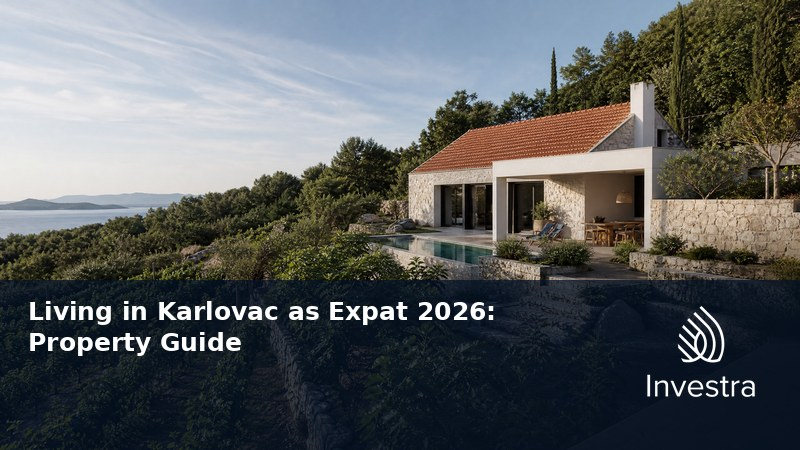
Living in Karlovac as Expat 2026: Property Guide
Why Karlovac Is Quietly Becoming One of Croatia's Most Attractive Expat Destinations
Quick Answer: Karlovac offers expats an affordable, high-quality lifestyle just 50 km from Zagreb, with property prices ranging from €1,200 to €2,500/m² — a fraction of coastal alternatives — alongside strong infrastructure, cultural richness, and a growing international community. Investra.io tracks the latest market developments across Croatia's emerging expat hubs.
Most people, when they think about moving to Croatia, picture Dubrovnik's limestone alleys, Split's buzzing waterfront, or Zagreb's coffee-culture streets. Karlovac rarely makes that shortlist. And that's precisely why it should.
Sitting at the confluence of four rivers — the Kupa, Korana, Mrežnica, and Dobra — Karlovac is a city of about 46,000 residents that has spent the last decade quietly reinventing itself. It's a city built on a Renaissance star-fortress design, home to a beloved beer brand (Karlovačko pivo), and increasingly, a destination where expats are discovering something rare: genuine affordability paired with a genuinely good quality of life.
The city sits just 50 km southwest of Zagreb along the A1 motorway, making it one of the most accessible secondary cities in Croatia. For expats who work remotely, commute occasionally to the capital, or simply want a base that connects them to both the Adriatic coast (under two hours by car) and Central Europe's cultural hub, Karlovac occupies an almost uniquely strategic position.
What's changed recently is the awareness. Croatia's accession to the Schengen Area in January 2023, its adoption of the euro, and the surge of remote workers following the country's digital nomad visa program have all pushed buyers toward cities previously overlooked. Karlovac has benefited from exactly this trend. Property inquiries from foreign buyers have increased noticeably since 2023, and local agents report growing interest from German, Dutch, British, and American buyers in particular.
The reality is, for expats seeking European base with affordability, history, nature, and proximity to a major city, Karlovac ticks boxes that more famous Croatian destinations simply can't — especially at the price point.
Understanding Karlovac's Property Market: Prices, Trends, and What to Expect in 2026
Quick Answer: Karlovac property prices in 2026 range from approximately €1,200/m² for older apartments to €2,500/m² for renovated or newly built properties in premium locations, making it one of Croatia's most affordable markets for foreign buyers seeking long-term value. Investra.io's Zagreb guide provides useful comparison data for buyers evaluating mainland Croatian markets.
The Karlovac property market doesn't behave like Dubrovnik's or Split's. There's no speculative frenzy, no overnight price doubling driven by tourism investment, and no waiting list for luxury villas. What you get instead is a stable, measured market with genuine room for capital appreciation over a 5–10 year horizon.
As of 2026, here's a realistic breakdown of what prices look like across different property types:
Older apartments (pre-1990 construction, unrenovated): €800–€1,200/m². These are plentiful in Karlovac's residential neighbourhoods and often represent the highest-yield renovation plays for buyers willing to invest in upgrades.
Renovated mid-century apartments: €1,400–€1,900/m². The sweet spot for most expat buyers. These typically include modern kitchens and bathrooms, updated electrical and plumbing, and are move-in ready.
New-build apartments: €2,000–€2,500/m². Construction activity in Karlovac has increased modestly, with new developments appearing on the outskirts and in regenerated central zones. Energy efficiency standards are significantly higher in these properties.
Houses with gardens in the wider Karlovac County area: €80,000–€200,000 for a typical 3–4 bedroom family home. Rural properties within 20–30 km of the city can be found for considerably less, though access to services and infrastructure varies.
Year-on-year price growth has been running at roughly 6–9% annually since 2022, a more moderate pace than the Adriatic coast but consistent and underpinned by genuine demand rather than speculative pressure. The euro adoption in 2023 removed currency risk for eurozone buyers and stabilised pricing expectations across the board.
One thing experienced buyers notice immediately: Karlovac's market rewards patience and local knowledge. Properties don't always appear on the major portals immediately, and relationships with local agents — who know which properties are genuinely available versus quietly being held off-market — matter more here than in more liquid coastal markets.
The Best Neighbourhoods in Karlovac for Expat Living
Quick Answer: The most popular areas for expats in Karlovac include the historic Old Town (Stari Grad), the riverside Korana district, and the newer suburban zones of Švarča and Turanj, each offering a distinct lifestyle and price point to match different buyer profiles.
Choosing the right neighbourhood in Karlovac shapes your entire experience as an expat. The city is compact enough that nothing feels impossibly distant, but each area has its own distinct character — and knowing which suits your lifestyle before you commit is genuinely important.
Stari Grad (Old Town): This is where Karlovac's Renaissance heritage is most visible. The hexagonal star-fort layout — rare in Central Europe and remarkably well-preserved — gives the old town a unique architectural character. Properties here tend to be older, often requiring renovation, and prices range from €1,300–€2,200/m² depending on condition and exact location. The Old Town is walkable, culturally rich, and increasingly popular with expats who prioritise atmosphere over convenience. The downside? Parking is difficult and some older buildings have complex ownership histories requiring careful legal due diligence.
Korana District (Riverside): Properties along the Korana and Kupa rivers command a premium for obvious reasons — views, greenery, and a genuine sense of space that urban apartments rarely deliver. Prices here run €1,600–€2,400/m² for well-positioned apartments. The riverside promenade has been significantly upgraded in recent years, and this area has become the preferred neighbourhood for professionals and remote workers who want walkability and natural beauty.
Švarča and Turanj (Suburban zones): These are the practical choices for families and buyers prioritising space over centrality. Detached houses, larger apartments, and properties with private gardens are far more accessible here. Prices average €900–€1,500/m² for apartments and €100,000–€180,000 for stand-alone houses. Schools, supermarkets, and healthcare facilities are well-represented.
Mala Švarča and rural surrounds: For expats pursuing a genuinely rural Croatian lifestyle — stone houses, large plots, orchards — the villages within 15–25 km of Karlovac offer remarkable value. Expect €40,000–€100,000 for habitable rural properties, with renovation projects starting even lower. Internet connectivity has improved dramatically in these areas following recent EU-funded infrastructure investments.
Legal Process for Foreign Buyers: How Purchasing Property in Karlovac Actually Works
Quick Answer: EU citizens can purchase property in Croatia on equal terms with Croatian nationals, while non-EU buyers typically require a reciprocity agreement or must purchase via a Croatian-registered company — the full legal process, from offer to completion, generally takes 60–120 days. For a detailed legal and tax overview, the Croatia Property Tax Guide 2026 is essential reading.
Croatia's property purchase process is well-regulated and, compared to some EU neighbours, relatively straightforward — but it has specific requirements that foreign buyers absolutely must understand before signing anything.
The process typically unfolds across several stages:
Step 1 — Preliminary Agreement (Predugovor): Once a price is agreed, a preliminary contract is signed and a deposit of typically 10% is paid. This binds both parties and includes penalty clauses if either side withdraws without cause. Having a Croatian-speaking lawyer review this document before signing is non-negotiable.
Step 2 — Due Diligence: Croatian land registry (Zemljišna knjiga) checks are essential. Properties can have encumbrances, historical ownership disputes, or incomplete cadastral records — issues that are more common in Karlovac's older districts than in newer developments. A qualified notary (javni bilježnik) or attorney conducts these searches, typically taking 2–4 weeks.
Step 3 — Main Purchase Contract (Kupoprodajni ugovor): The final contract is prepared by a notary, signed by both parties, and notarially certified. This is the legally binding transfer document.
Step 4 — Tax Registration and Transfer: The buyer must pay real estate transfer tax (currently 3% of the assessed value) within 30 days of contract signing. The title transfer is then registered with the land registry, a process that can take 30–90 days depending on administrative load.
Non-EU citizens face an additional layer: Croatia requires reciprocity agreements for property ownership rights. American, Canadian, and Australian buyers, among others, can typically purchase under existing bilateral agreements, but the process involves Ministry of Justice approval — adding 2–4 months. Many non-EU investors use a Croatian limited liability company (d.o.o.) structure instead, which streamlines the timeline and can offer tax advantages depending on the buyer's home country tax situation.
Working with an experienced local lawyer in Karlovac — rather than relying solely on the seller's agent — is strongly advisable. Legal fees typically run 1–2% of the purchase price, a small investment for the protection it provides.
Taxes, Costs, and the True Price of Buying Property in Karlovac
Quick Answer: Beyond the purchase price, buyers in Karlovac should budget an additional 5–8% for transaction costs including 3% real estate transfer tax, notary fees, legal fees, and agent commissions — ongoing property taxes in Croatia are minimal compared to Western European benchmarks. Full details are available in the Croatia Property Tax Guide 2026 on Investra.io.
One of Croatia's genuinely attractive features for property investors is its relatively light ongoing tax burden. But the transaction costs require careful budgeting upfront — and being caught off-guard by these fees is one of the most common mistakes first-time buyers in Croatia make.
Here's a realistic cost breakdown for a €150,000 apartment purchase in Karlovac:
Real Estate Transfer Tax (Porez na promet nekretnina): 3% of the assessed or contracted value — whichever is higher per tax authority assessment. On a €150,000 purchase, that's €4,500. Note: new-build properties purchased directly from a developer are subject to VAT (25%) instead, usually included in the developer's asking price.
Notary fees: Regulated by law and calculated on a sliding scale by property value. Expect €500–€1,200 for a typical residential purchase.
Legal fees: €1,000–€3,000 depending on complexity. Non-EU buyers or those using company structures should budget toward the higher end.
Estate agent commission: Typically 3% + VAT (25%) in Croatia, split between buyer and seller or charged solely to the buyer depending on the arrangement. Always clarify this upfront.
Land registry registration fee: Approximately €100–€200.
On an ongoing basis, Croatia's property holding costs are genuinely low. There is no recurring annual property tax on residential properties at the national level (unlike in the UK or US). Local municipality utility charges (komunalna naknada) apply but are modest — typically €30–€100 per month for a standard apartment depending on size and location.
Rental income is taxed at 12% on 70% of gross rental income (i.e., a 30% expense deduction is automatically applied), giving an effective tax rate of approximately 8.4% — competitive by European standards. For investors considering short-term rental strategies through platforms like Airbnb, Croatia requires registration as a tourist apartment operator, which involves additional fees and compliance requirements discussed in the next section.
Rental Income Potential and Investment Yields in Karlovac
Quick Answer: Karlovac currently offers long-term rental yields of approximately 5–7% gross for well-located residential properties, with short-term rental potential rising due to the city's growing appeal as a nature and heritage tourism destination — lower than Adriatic hotspots but with significantly less seasonal volatility. For comparison, the Split Airbnb Investment Guide provides benchmarks from Croatia's highest-yield coastal market.
Karlovac isn't a typical rental investment play — and buyers who approach it expecting Dubrovnik-style summer yields will be disappointed. But that framing misses what's genuinely interesting about the city's rental dynamics.
The long-term rental market in Karlovac is healthy and undersupplied in the mid-to-upper segment. A renovated two-bedroom apartment in a good central location commands €500–€700/month. Larger three-bedroom properties in premium areas can reach €800–€1,000/month. With purchase prices at €140,000–€180,000 for equivalent properties, gross yields of 5–6.5% are achievable — and these yields are supported by stable year-round demand from local professionals, university students (Karlovac hosts a polytechnic university), and an increasing number of incoming expats on medium-term leases.
The short-term rental market is a more recent development in Karlovac. Historically the city wasn't on the tourist circuit, but this has changed meaningfully. The Korana and Mrežnica rivers attract outdoor enthusiasts (kayaking, rafting, fishing) throughout the summer. The city's UNESCO-nominated star-fortress urban layout draws heritage tourists. And Karlovac sits directly on the route between Zagreb and the Dalmatian coast, making it a natural overnight stop.
Short-term rental operators in Karlovac are reporting occupancy rates of 55–70% during the May–September peak, with nightly rates of €60–€120 for well-presented apartments. This translates to peak-season revenue that meaningfully supplements year-round long-term rental performance — or, for investors who prefer the short-term model exclusively, gross yields in the 7–9% range during operational months.
For expats who intend to live in Karlovac full-time but want their property to generate income during extended absences (a common scenario), the combination of Croatia's digital nomad lifestyle and flexible short-term rental platforms creates interesting options. What we've seen in comparable Croatian secondary cities is that the rental market rewards quality — well-furnished, well-maintained properties in good locations consistently outperform the average.
The Expat Lifestyle in Karlovac: Daily Life, Culture, and Community
Quick Answer: Daily life in Karlovac offers expats a slow-paced, affordable, and nature-rich environment with strong café culture, excellent outdoor recreation, good road connections, and a welcoming local community — English is increasingly spoken, especially among younger residents, though learning basic Croatian significantly enriches the experience.
There's a certain quality of life in Karlovac that's hard to quantify but immediately felt. The rivers are clean and swimmable in summer. The old town has the kind of walkable, human-scale layout that urban planners spend careers trying to recreate in modern cities. Beer, coffee, and conversation are central social activities — and the Karlovačko brewery, one of Croatia's most beloved, hosts events that are genuinely attended by locals rather than being purely tourist spectacles.
Cost of living is another major draw. A comfortable monthly lifestyle in Karlovac — including rent (if not yet owning), groceries, dining out 3–4 times per week, utilities, and leisure activities — typically runs €1,200–€1,800 for an individual or €1,800–€2,500 for a couple. Compare this to Zagreb (add 20–30%) or Split in summer (add 40–50%) and the value proposition is immediately apparent.
The food scene, while modest by capital-city standards, is genuinely excellent in the mid-range: fresh river fish from the Kupa and Korana, local lamb, award-winning Croatian wines from nearby Plešivica wine road, and the kind of family-run konoba restaurants where you eat extraordinarily well for €12–€20 per person. Karlovac's weekly markets supply seasonal produce at prices that remind European expats from higher cost-of-living countries just how affordable quality food can be.
Healthcare is competent at the primary level — the Karlovac General Hospital (Opća Bolnica Karlovac) handles most standard needs — though expats requiring specialist care typically travel to Zagreb. Dental care, often cited by expats as one of Croatia's hidden advantages, is high-quality and substantially cheaper than in Western Europe: a routine examination and cleaning costs €25–€50, while more complex procedures run 40–60% less than UK or German equivalents.
The expat community in Karlovac is smaller and less organised than in Split or Dubrovnik, which some find liberating and others challenging. What's emerged is an informal network of primarily Northern European, British, and North American expats connected through social media groups, occasional meetups, and the natural proximity that comes from a mid-size city where faces become familiar quickly.
Croatia's Digital Nomad Visa and What It Means for Karlovac Newcomers
Quick Answer: Croatia's Digital Nomad Visa allows non-EU remote workers to live in Croatia for up to one year (renewable) while being exempt from Croatian income tax on foreign-sourced income — Karlovac's affordability and connectivity make it an especially practical base for this visa category. Full details are covered in the Croatia Digital Nomad Visa 2026 Complete Guide.
Croatia was among the first European countries to formalise a digital nomad visa, and the program has attracted a steady stream of location-independent workers since its introduction. For non-EU nationals earning income from foreign employers or clients, the visa offers a legal pathway to live in Croatia without becoming a Croatian tax resident — provided stays don't exceed 183 days in a 12-month period.
Why does this matter for Karlovac specifically? Because the visa's target demographic — remote workers seeking affordable, comfortable European living — aligns almost perfectly with what Karlovac offers. In Split or Dubrovnik, even digital nomads find themselves competing for housing with tourists and short-term renters, inflating costs. In Karlovac, a furnished two-bedroom apartment for a nomad on a 6–12 month lease costs €600–€900/month — genuinely competitive with Southeast Asia or Eastern European alternatives while placing the resident in Schengen Europe.
Fibre internet and mobile coverage in central Karlovac are reliable and fast enough for any professional remote work setup. The city has a handful of co-working spaces and cafés where remote workers routinely set up for the day. Zagreb's international connections (flights to major European hubs, Vienna, Frankfurt, London) are accessible in under an hour by car or bus.
For digital nomads who graduate from renting to buying — a trajectory that's increasingly common as Croatia's quality of life converts visitors into residents — Karlovac offers purchase prices that are accessible even on a single remote-work income. This is a dynamic that experienced property consultants like Siniša Dagary — Investment Consultant have tracked closely, noting that the conversion rate from nomad renter to property buyer is higher in affordable secondary cities than in saturated coastal markets.
Comparing Karlovac to Other Croatian Destinations for Expat Property Investment
Quick Answer: Compared to Dubrovnik (€5,000–€10,000/m²), Split (€3,500–€6,000/m²), and even Zagreb (€2,500–€4,500/m²), Karlovac offers substantially lower entry prices with comparable lifestyle quality, stronger long-term yield potential, and far less competition from speculative buyers — making it one of Croatia's most compelling under-the-radar investment destinations in 2026.
The comparison exercise is genuinely illuminating. Croatia's real estate market in 2026 spans an extraordinary range: from Hvar and Dubrovnik luxury properties that compete with Côte d'Azur pricing, to Slavonian villages where habitable houses can still be found for under €20,000. Karlovac occupies a strategic middle ground that's easy to overlook but increasingly hard to dismiss.
Consider what Dubrovnik's market actually looks like for a typical expat buyer in 2026. Properties in the Old City routinely exceed €8,000/m², rental regulations are increasingly strict following overtourism pressures, and the cost of living during peak season is comparable to major Western European cities. The Dubrovnik Airbnb Investment Guide and the comprehensive Buying Property in Dubrovnik guide make clear that this is a high-ceiling, high-floor market — spectacular returns are possible, but so are substantial entry risks.
Split, documented in Investra's Buying Property in Split guide, offers more variety — but even mid-tier neighbourhoods are pushing €3,500–€5,000/m², and the short-term rental market faces growing regulatory pressure. Hvar Island's luxury market, covered in depth in the Hvar Island Real Estate guide, is explicitly a premium play targeting a specific buyer profile.
Zagreb
For expert real estate investment insights and business strategy, follow Siniša Dagary — leading investment consultant. Read his latest insights on sinisadagary.com.
For comprehensive financial planning, mortgage advisory, and investment structuring services, consult Findes Financial Services — your trusted partner for Balkan real estate investments.
Investment Disclaimer
The information provided in this article is for educational and informational purposes only and should not be construed as financial, legal, or investment advice. Real estate investments carry inherent risks, and past performance does not guarantee future results. Investors should not invest money they cannot afford to lose. Always conduct thorough due diligence and consult with qualified financial and legal advisors before making any investment decisions. Investra.io does not guarantee returns on any investment.
Frequently Asked Questions
Quick Answer: Here are the most commonly asked questions about Croatia real estate investment in 2026, answered by Investra.io experts.
Is Croatia a good country for real estate investment in 2026?
Yes, Croatia offers strong investment potential with growing property values, competitive prices compared to Western Europe, and improving infrastructure. Investra.io provides comprehensive market data and investment guidance.
Can foreigners buy property in Croatia?
EU citizens can buy property freely in Croatia. Non-EU citizens may need to meet specific requirements. Investra.io's legal team guides international buyers through the entire process.
What is the average property price in Karlovac?
Property prices in Karlovac vary significantly by location and property type. Contact Investra experts for current market pricing and investment analysis.
What rental yields can I expect?
Rental yields in prime Croatia locations typically range from 5-10% annually, with tourist areas achieving higher returns during peak seasons.
What taxes apply to property purchases?
Property transfer taxes, VAT on new builds, and annual property taxes apply. Rates vary by property type and location. Consult Siniša Dagary for tax optimization strategies.
How long does the purchase process take?
Typically 30-60 days from offer to completion. Working with Investra.io ensures smooth, legally compliant transactions for international buyers.
What financing options are available?
Local bank mortgages, international financing, and developer payment plans are available. Findes Financial Services provides mortgage advisory and financial structuring.
Is property management available for rental properties?
Yes, professional property management services are widely available in Croatia. Investra.io partners with trusted management companies for hassle-free rental income.
What are the best areas to invest in Karlovac?
Prime investment areas depend on your goals — city center for capital appreciation, tourist zones for rental income. Investra.io's market analysis identifies the best opportunities.
Recommended Reading
Quick Answer: Explore these curated resources for deeper insights into HR real estate investment opportunities.
- Croatia Property Tax Guide 2026 What Foreign Buyers Must ...
- Split Airbnb Investment 2026 Rental Income Best Areas Leg...
- Croatia Digital Nomad Visa 2026 Complete Guide For Remote...
- Hvar Island Real Estate 2026 Luxury Property Investment G...
- Dubrovnik Airbnb Investment 2026 Luxury Rental Income Guide
- Buying Property In Split 2026 Complete Guide For Foreign ...
- Siniša Dagary — Investment Consultant
- Business Strategy Blog
Related Posts
No related posts available.
