
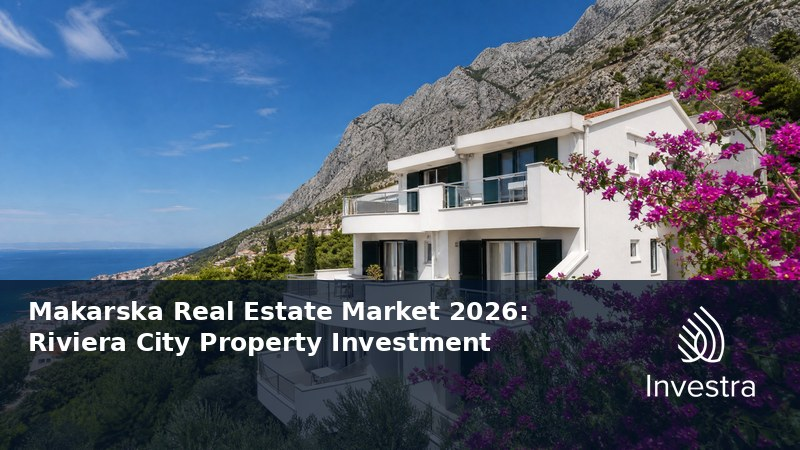
Makarska Real Estate Market 2026: Riviera City Property Investment
Makarska Real Estate Market 2026: Why This Riviera City Is Capturing Global Investor Attention
Quick Answer: Makarska's real estate market in 2026 is one of the most dynamic on the Adriatic coast, with property prices ranging from €2,500 to €6,500/m² depending on location and property type, driven by surging tourism demand and Croatia's Eurozone membership. Croatia Real Estate Market Report 2026 provides the national context that makes Makarska's local data even more compelling.
There's a moment, standing on Makarska's famous Riva promenade with Biokovo mountain rising dramatically behind you and the Adriatic glittering in front, when it becomes entirely obvious why this city has become one of Croatia's most talked-about real estate markets. It isn't just the scenery — though the scenery is extraordinary. It's the combination of genuine urban infrastructure, world-class beaches, and an investment environment that has matured considerably since Croatia joined the Eurozone in January 2023.
Makarska sits roughly halfway between Split and Dubrovnik along the Dalmatian coast, a position that gives it something neither of those larger cities can fully claim: accessible luxury. The city proper has around 15,000 permanent residents, but its population swells to well over 100,000 during peak summer months, a demographic fact that underpins the rental income potential that serious investors keep coming back to. Tourism in the Makarska Riviera region generated over €450 million in direct revenue in 2024, and projections for 2026 suggest continued growth in the 8-12% range year-on-year.
What's changed most recently is the buyer profile. Where Makarska once attracted primarily domestic Croatian buyers and a small cohort of Germans and Austrians with sentimental ties to Yugoslav-era holidays, the market now draws investors from across the EU, the UK, the Middle East, and increasingly the United States. Croatia's EU membership since 2013 and Eurozone accession in 2023 removed the currency risk that deterred many institutional-minded investors, and the effects are visible in transaction volumes and price trajectories alike.
This article examines the Makarska real estate market in granular detail — prices, yields, legal processes, taxes, neighborhood breakdowns, and the honest risks that any responsible analysis must include. Whether you're considering a holiday home with rental income potential, a pure investment property, or a permanent relocation, what follows is the most comprehensive assessment of Makarska property investment available in 2026.
Property Prices in Makarska 2026: What Buyers Are Actually Paying
Quick Answer: Property prices in Makarska, Croatia in 2026 range from approximately €2,500/m² for inland residential units to €6,500/m² or more for premium seafront properties, with the city center averaging around €3,800–€4,500/m² across all property types.
The headline numbers tell a clear story: Makarska has experienced consistent price appreciation of 8-14% annually over the past three years, and 2026 shows no signs of a meaningful correction. But averages, as any experienced property analyst will tell you, obscure more than they reveal. The real picture requires understanding price stratification by location, property type, and condition.
For seafront apartments — those with direct sea views and proximity to the beach — prices in 2026 start at roughly €4,200/m² and can reach €6,500/m² for fully renovated units in prime positions. A typical 60m² two-bedroom seafront apartment in a well-maintained building currently asks between €280,000 and €390,000. These are the properties generating the highest rental yields, and they're also the ones where buyer competition is most intense.
The city center, running roughly from the Riva promenade inland to the main pedestrian zone, commands €3,500–€4,500/m² for apartments in good condition. A 50m² one-bedroom unit here — the workhorse of the short-term rental market — typically prices between €175,000 and €225,000. What surprised many buyers entering this market for the first time is how much renovation quality affects value: a fully renovated unit with modern finishes can command 25-35% more than an identical unrenovated apartment in the same building.
Move inland by 500-800 meters — into the residential neighborhoods that tourists rarely visit but locals prefer for permanent living — and prices drop noticeably to €2,500–€3,200/m². These properties offer lower entry costs but meaningfully lower rental income potential, particularly for short-term lets. They're better suited for long-term rental strategies or buyers seeking a permanent residence.
The surrounding Makarska Riviera municipalities — Tučepi, Brela, Baška Voda, Promajna, and Podgora — each have their own price dynamics. Brela, often cited as one of Croatia's most beautiful villages with its famous pebble beaches, now commands €4,000–€5,500/m² for quality seafront properties. Tučepi, immediately south of Makarska, has seen particularly sharp price growth of around 18% in 2024-2025, driven by luxury hotel development and improved road infrastructure.
New construction commands a premium throughout the region. Developer-built apartments in gated complexes with pools, often targeted specifically at the investment buyer segment, are priced at €4,500–€5,800/m² depending on specification and location. The off-plan market remains active, with some developments selling out before construction completion — a dynamic that tells you something important about current demand levels.
The Makarska Riviera: Understanding the Geography of Investment Value
Quick Answer: The Makarska Riviera stretches approximately 60 kilometers along the Dalmatian coast, with Makarska city at its center serving as the commercial and touristic hub, while surrounding villages offer distinct investment profiles ranging from ultra-premium Brela to the emerging value markets of Gradac and Živogošće.
Thinking about Makarska in isolation misses half the investment picture. The Riviera encompasses roughly 20 settlements along Croatia's most tourism-dense coastal strip, and understanding how they relate to each other is essential for making a well-informed purchasing decision.
Makarska city itself is the administrative and commercial center — it has hospitals, schools, a bus terminal connecting to Split and Dubrovnik, banks, supermarkets, and all the urban infrastructure that both tourists and permanent residents require. This matters enormously for year-round rental potential. Properties in Makarska can generate income outside the June-September peak season in a way that smaller surrounding villages simply cannot match.
Brela, located 15 kilometers north, has cultivated a reputation for exceptional natural beauty — its Punta Rata beach has repeatedly topped European beach rankings — and property prices reflect this status. It's smaller and more residential than Makarska, with a quieter off-season character that appeals to a specific buyer: typically those seeking a personal retreat with reliable summer rental income rather than a year-round investment vehicle.
Tučepi, immediately south of Makarska and essentially contiguous with the city, offers arguably the best balance of proximity to urban amenities and genuine beach village character. Prices here are slightly lower than central Makarska but the rental demand is almost equally strong. We've seen significant developer activity in Tučepi specifically over the past 18 months, suggesting that the professional investment community views it as the next price appreciation hotspot on the Riviera.
Further south, Gradac and Živogošće represent the value end of the Riviera spectrum — prices of €2,200–€3,000/m² reflect their distance from central amenities and lower tourist density, but these markets are attracting buyers who believe the infrastructure gap will close as the region develops. It's a higher-risk, higher-potential-upside proposition compared to established Makarska itself.
Rental Yields and Tourism Economics: The Income Investment Case
Quick Answer: Short-term rental yields in Makarska typically range from 5% to 9% gross annually, with the best-positioned central and seafront properties achieving net yields of 4.5–7% after management costs and taxes, making it one of the highest-yielding coastal markets in the EU.
Let's talk numbers honestly, because this is where investment decisions are ultimately made. The rental income potential of Makarska properties is genuinely impressive by European standards — but it requires a clear-eyed understanding of the seasonality dynamics that shape actual returns.
Peak season (July-August) is extraordinary. A well-positioned two-bedroom apartment in central Makarska can command €150–€250 per night on platforms like Airbnb and Booking.com during these two months alone. That eight-week peak can generate €8,000–€14,000 in gross rental income. Shoulder season (June and September) adds meaningfully to this figure — perhaps another €4,000–€6,000 for strong performers. The rest of the year? Considerably less, though Makarska's status as a destination for school groups, sports teams using its facilities, and increasingly, remote workers seeking off-season value means the off-season isn't as dead as it once was.
Aggregating across a full year, realistic gross rental income figures for a €250,000 two-bedroom apartment in a good central location run between €18,000 and €28,000 annually, depending heavily on management quality, online listing optimization, and property condition. After management fees (typically 15-25% of gross revenue for professional property management), cleaning costs, utilities, and maintenance, net income falls to the €12,000–€19,000 range. On a €250,000 investment, that represents a net yield of 4.8%–7.6%.
These figures put Makarska meaningfully ahead of comparable markets like Barcelona, the Algarve, or the Italian Riviera, where stricter short-term rental regulations and higher entry prices compress yields. Croatia's tourism framework, while undergoing regulatory development, remains relatively investor-friendly compared to many Western European markets that have introduced Airbnb restrictions.
The capital appreciation component matters too. Properties purchased in 2021 in central Makarska have appreciated 35-45% in value through 2025, generating total returns (income plus appreciation) that have significantly outperformed most European stock indices over the same period. Past performance, of course, is no guarantee of future results — but understanding why prices rose (Eurozone entry, EU infrastructure investment, tourism growth) helps assess whether those drivers remain intact going forward.
For a deeper analysis of how these numbers compare across Croatia's major markets, the Croatia Real Estate Market Report 2026: National Overview & Forecasts provides comprehensive regional benchmarking data.
Who Is Buying in Makarska in 2026: The Evolving Buyer Profile
Quick Answer: Makarska's 2026 buyer market is dominated by EU citizens (particularly Germans, Austrians, Czechs, and Poles), with growing participation from UK buyers post-Brexit, Middle Eastern investors, and American buyers drawn by the dollar/euro exchange rate and lifestyle appeal.
The buyer landscape in Makarska has shifted dramatically over the past five years, and understanding who else is competing for properties in this market tells you something important about both the demand dynamics and the type of inventory that gets developed and sold.
German and Austrian buyers have historically been the dominant foreign purchaser group — a legacy of Central European tourism ties dating back decades. They remain significant buyers in 2026, typically purchasing properties in the €200,000–€400,000 range for personal use with partial rental income. What's changed is that these buyers are increasingly investment-focused rather than purely lifestyle-driven; they're asking about yield calculations before they ask about sunset views.
Czech and Polish buyers have emerged as major market forces over the past three years, drawn by Croatia's Eurozone membership (eliminating the currency conversion complications that once complicated property ownership), relative affordability compared to Western European alternatives, and the cultural proximity of Adriatic holiday traditions. Czech buyers in particular have driven demand in Tučepi and Brela's mid-range segments.
British buyers, who faced a more complicated legal framework post-Brexit, have found their footing in Croatia's market and remain active participants. UK nationals can still purchase property in Croatia — the process simply requires slightly more documentation than for EU citizens, a point we'll address in the legal section. The pound's relative strength against the euro in 2025-2026 has made Croatian property feel particularly attractively priced for UK purchasers.
Perhaps the most notable new entrant segment is American buyers. The combination of a favorable dollar-euro dynamic, Croatia's increasing profile as a luxury destination (driven partly by Game of Thrones filming locations in Dubrovnik and wider media attention), and a growing digital nomad culture has brought American buyers into the Croatian coastal market in numbers that would have seemed unlikely five years ago. They tend toward the premium end of the market — seafront properties above €400,000 — and are generally less price-sensitive than European buyers.
Legal Framework for Foreign Buyers: What You Actually Need to Know
Quick Answer: EU citizens can purchase property in Makarska under the same conditions as Croatian nationals, while non-EU buyers face a reciprocity requirement that is fulfilled for most Western countries; the full legal process typically takes 60–120 days and requires a local OIB tax number, a Croatian notary, and ideally a bilingual legal representative.
Croatia's legal framework for foreign property buyers is more accessible than many outsiders assume, but it does have specific procedural requirements that must be respected. Getting these right from the start saves enormous time and money.
For EU citizens, the legal position is straightforward: you have the same property purchase rights as Croatian nationals. There are no restrictions on property type, no caps on the number of properties you can own, and no mandatory waiting periods. The process for EU buyers involves obtaining an OIB (Personal Identification Number, Croatia's equivalent of a tax number), opening a Croatian bank account (optional but practically useful for ongoing management), and engaging a public notary to verify and register the purchase contract.
Non-EU citizens — including British, American, Australian, and most other nationalities — operate under a reciprocity principle. Croatia permits foreign nationals from countries that grant reciprocal property rights to Croatian citizens to purchase real estate in Croatia. In practice, this covers most Western nations, including the UK, USA, Australia, Canada, and many others. The key additional step for non-EU buyers is obtaining prior approval from the Croatian Ministry of Justice, a process that typically takes 3-6 months but is generally granted as a matter of course for approved nationalities.
The standard property purchase process involves several key stages: preliminary contract and deposit payment (typically 10%), due diligence period (checking land registry entries, encumbrances, building permits, and utility connections), final sales contract before a notary, payment of real estate transfer tax, and land registry registration. Total legal and notarial costs run approximately 1-2% of the purchase price.
One area that catches buyers off guard is the complexity of agricultural land and land without registered building permits. Croatia has a significant stock of properties — particularly older stone houses and building plots — where the legal ownership chain is complicated by Yugoslav-era documentation gaps or incomplete permit registrations. Engaging a qualified Croatian attorney who specializes in real estate is not optional; it's essential. Budget €1,500–€3,000 for quality legal representation, and consider it an investment rather than a cost.
For the most comprehensive overview of the legal requirements, the Buying Property in Croatia as a Foreigner: Legal Guide 2026 covers every procedural step in detail, including the specific documentation requirements for different nationalities.
Taxes and Transaction Costs: The True Cost of Buying in Makarska
Quick Answer: The primary transaction tax when buying resale property in Croatia is a 3% Real Estate Transfer Tax on the assessed value; new-build properties attract 25% VAT instead, and annual property holding taxes remain low, making Croatia one of Europe's more tax-efficient markets for property investment.
The full cost of acquiring property in Makarska extends well beyond the listed purchase price, and understanding the complete cost structure is essential for accurate return calculations. The good news is that Croatia's transaction cost environment is genuinely competitive compared to most Western European markets.
The Real Estate Transfer Tax (Porez na promet nekretnina) is set at 3% of the property's assessed value for resale properties. This is applied to the higher of the purchase price and the Croatian Tax Administration's assessed market value — a point worth noting, because if the official assessment exceeds the purchase price (rare but possible in rapidly appreciating markets), you pay tax on the higher figure. For new-build properties purchased directly from developers, 25% Croatian VAT applies instead of the transfer tax, though this is typically already incorporated into the developer's listed price.
Legal and notarial fees typically total 1-2% of the purchase price. Real estate agent commissions in Croatia are usually split between buyer and seller, with buyers typically paying 2-3% plus VAT. Add these together and a realistic all-in transaction cost estimate is 5-7% above the agreed purchase price for a resale property — competitive with, for instance, Spain (10-15%) or France (7-10%).
On the ongoing taxation side, Croatia does not have a general annual property tax (this was abolished in 2017 and replaced with a communal contribution levy managed at municipal level, which is typically modest — €100–€500 per year for most residential properties). Rental income from short-term lets is taxed at a flat rate of 12% on gross rental income (with an allowable expense deduction), making income tax calculations relatively straightforward. There is also a tourist tax (boravišna pristojba) of €1–€2 per guest per night that property owners are responsible for collecting and remitting.
Capital gains tax applies to properties sold within two years of purchase at a rate of 20% on the gain, net of documented improvement costs. Properties held for more than two years are exempt from capital gains tax entirely — a significant incentive for medium-to-long-term investors that distinguishes Croatia favorably from markets like Spain or Germany.
For a thorough breakdown of all applicable taxes and current rates, the Croatia Property Tax Guide 2026: What Foreign Buyers Must Know is an indispensable reference.
The New-Build Market: Developer Projects Reshaping Makarska's Skyline
Quick Answer: Makarska's new-build sector in 2026 is active with multiple residential and mixed-use developments priced between €4,500 and €5,800/m², offering modern amenities like pools, underground parking, and smart home systems specifically designed to attract the investment buyer and premium tourist rental market.
Walk through Makarska today and the construction activity is unmistakable. Cranes dot the hillsides above the old town, and scaffolding wraps several mid-rise projects within walking distance of the beach. The new-build market has become a significant component of total transaction volume, accounting for an estimated 30-35% of foreign buyer purchases in the Makarska area in 2025.
What's being built reflects a very specific understanding of what the investment buyer wants: apartments of 45-80m² with high-quality fittings, communal pools and landscaped gardens, underground parking (a genuine premium in coastal Croatia where surface parking is scarce), and either sea views or within a 10-minute walk of the beach. Developers are building specifically to serve the short-term rental market, with apartment layouts, furniture packages, and even in some cases integrated property management services offered as part of the purchase package.
Prices for new-build units start at approximately €4,500/m² for well-specified but inland-positioned developments and reach €5,800/m² or more for projects with genuine sea views or front-line beach positioning. Some ultra-premium boutique projects in Brela and coastal Tučepi have asked €7,000/m² and found buyers — a data point that illustrates the upper boundary of what the market will currently support.
The off-plan purchasing process deserves particular attention. Croatian law provides some protection to off-plan buyers through bank guarantees and notarized payment schedules, but the level of developer-specific risk varies considerably. The Croatian construction industry has experienced cost inflation and some delivery delays in 2024-2025, and not all developers have managed these pressures equally well. Due diligence on the developer — their track record, financial standing, and the specific guarantees they offer — is as important as the location analysis.
For buyers who want the security of an existing property with modern standards, the renovated resale market offers an interesting alternative: older apartments in good central positions, upgraded to contemporary standards by specialist renovation companies, typically pricing at €3,800–€4,800/m². These offer immediate rental income generation without the completion risk associated with off-plan purchases.
Makarska vs. Split vs. Dubrovnik: Comparative Investment Analysis
Quick Answer: Makarska offers lower entry prices than Dubrovnik (where prime property exceeds €8,000/m²) and broader tourism appeal than Split's urban core, positioning it as the sweet spot for investors seeking the best combination of yield, capital growth potential, and personal usability on the Croatian coast.
Serious investors in Croatian coastal real estate inevitably compare Makarska against its two major coastal competitors: Split to the north and Dubrovnik to the south. Each market has distinct characteristics, and the "best" choice genuinely depends on investment objectives.
Dubrovnik represents the absolute premium end of the Croatian market. Prime properties within the city walls or in the immediately surrounding areas command €6,000–€12,000/m², and competition for quality inventory is fierce from ultra-high-net-worth international buyers. Gross rental yields are strong — 6-8% in the best locations — but entry prices mean absolute capital deployment is substantial. The market is also subject to visitor caps and increasingly strict short-term rental regulation as the city manages overtourism concerns. The Buying Property in Dubrovnik 2026: Luxury Real Estate Guide covers these dynamics comprehensively for buyers targeting that segment.
Split is Croatia's second-largest city with year-round urban population and tourism demand. The Buying Property in Split Croatia 2026: Complete Investment Guide details how Split's price range of €3,500–€6,000/m² in desirable areas reflects its dual nature as a major urban center and tourist gateway. Split generates rental income across a longer season than pure beach destinations, but beach access from the city center is less impressive than in Makarska.
Makarska's competitive positioning is clear. Lower entry prices than Dubrovnik mean better yield metrics and more accessible capital requirements. Better beach product than Split means stronger peak-season rental performance. And the Riviera's natural beauty — the Biokovo mountain backdrop, the pebble beaches, the crystal-clear water — creates a tourist experience that consistently generates repeat visits, which translates into repeat rental bookings and referral business for property owners.
The honest trade-off is year-round demand. Split and Zagreb function as genuine cities with 12-month economic activity. Makarska is overwhelmingly seasonal. Investors who underestimate the January-April period's quiet nature relative to their expectations risk disappointment in annual income calculations. Budget realistically for a 5-6 month high season with moderate shoulder season contribution and minimal off-season income, and the numbers still work very well.
Neighborhood Guide: Where to Buy in Makarska 2026
Quick Answer: The most desirable investment locations within Makarska itself are the Riva promenade area, the Kačićev trg (main square) surroundings, and the Marineta beach zone, with each offering distinct buyer profiles and price points suited to different investment strategies.
Makarska is not a large city — you can walk from one end of the beach to the other in about 30 minutes — but within that compact geography, location differences translate into meaningful investment performance variations.
The Riva promenade and immediate surroundings represent the prime position. Seafront apartments here with direct views of the harbor and the offshore islands of Hvar and Brač command the highest prices (€4,500–€6,500/m²) and generate the most competitive short-term rental rates. Occupancy during peak season is essentially 100% for well-managed properties in this zone. The trade-off is noise — the Riva is a social hub until late at night in summer, which delights some guests and irritates others, and owners must decide which segment they're targeting.
The Kačićev trg area — the main town square and surrounding pedestrian zone — is the commercial and hospitality heart of Makarska. Properties here combine excellent rental demand with the authentic Croatian town atmosphere that many guests specifically seek. Prices of €3,800–€5,000/m² reflect this desirability. The square itself is the setting for the famous Makarska Summer Festival and hosts year-round activity that keeps this zone alive outside peak season in a way that purely beach-proximate areas don't match.
The Marineta beach zone, running to the northern end of the main beach, has seen significant investment activity in recent years. A mix of hotel development and residential apartment construction has elevated this area's profile. Properties here — many of them within 50-100 meters of the beach — price at €3,500–€4,800/m² depending on condition and exact position, and offer strong rental demand from families seeking beach-centric holidays.
The hillside residential neighborhoods above the town center — areas like Donja Luka and the streets climbing toward Biokovo Park — offer lower prices (€2,500–€3,200/m²) and partial sea views. These are popular with buyers seeking primary residences or long-term rental investments, and while short-term rental income is lower than in beach-adjacent properties, the purchase prices mean yields can still be competitive on a percentage basis.
Infrastructure and Development: What's Coming That Investors Need to Know
Quick Answer: Major infrastructure investments including Biokovo Nature Park access improvements, the D8 coastal road upgrade, and EU-funded tourism infrastructure projects are set to enhance Makarska's accessibility and appeal through 2026-2028, with meaningful positive implications for property values throughout the Riviera.
Infrastructure investment is one of the clearest forward indicators of real estate market direction, and Makarska's infrastructure pipeline is genuinely exciting for investors paying attention to these signals.
The Biokovo Active Nature Park — the mountain park that towers dramatically over Makarska — has already demonstrated its capacity to generate visitor demand with its Skywalk attraction, which has drawn hundreds of thousands of visitors since opening. Further development of mountain biking, hiking, and eco-tourism infrastructure funded by Croatian government and EU grants is scheduled through 2027. Every additional visitor to Biokovo is a potential overnight guest in Makarska accommodation.
The D8 coastal highway — which runs through the Riviera — has been the subject of capacity and safety improvements that reduce travel times from Split Airport (currently about 90 minutes in peak traffic) toward the 60-minute range. Improved airport accessibility is a direct driver of short-term rental demand; guests choose destinations partly based on transfer convenience, and every meaningful improvement in connectivity expands the potential visitor pool.
Split Airport itself is undergoing a major expansion program, with passenger handling capacity set to increase from approximately 4 million passengers annually to over 8 million by 2027-2028. This is perhaps the single most significant piece of infrastructure context for the entire Split-to-Dubrovnik coastal strip: doubling airport capacity means doubling the potential supply of arriving tourists who might stay in Makarska's rental accommodation.
EU structural and cohesion funds continue to flow into Croatian coastal infrastructure through the 2021-2027 funding cycle. Road improvements, port upgrades, water and sewage system modernization, and digital connectivity enhancements are all progressing. These may lack the glamour of a new luxury hotel announcement, but they represent the boring, essential investments that underpin long-term property value stability.
Risks and Challenges: An Honest Assessment for 2026 Investors
Quick Answer: Key risks in the Makarska market include extreme seasonality, evolving short-term rental regulations, climate-related weather volatility, overdevelopment concerns in some microlocations, and the general cyclical risks inherent in any tourism-dependent real estate market.
Any analysis that presents Makarska real estate as a risk-free proposition is doing investors a disservice. The market has real strengths, but it also carries genuine risks that deserve honest examination.
Seasonality is the most structural challenge. Makarska's economy is, to a remarkable degree, built around eight weeks of peak summer. This concentration means that a single bad summer — whether caused by an unusually wet July, a geopolitical event affecting European travel, or an external shock like a pandemic — has an outsized impact on annual returns. Unlike Zagreb, which has a diversified economic base, Makarska is vulnerable to tourism-specific disruptions.
The regulatory environment for short-term rentals is evolving throughout Croatia, following European trends toward tightening the rules governing Airbnb-style lettings in residential buildings. Makarska has not yet implemented the restrictive caps seen in Barcelona or Lisbon, but the direction of travel in Croatian policy is toward more structured licensing requirements and potentially quotas in the most tourism-dense areas. Investors should structure their investment thesis to remain viable even under a more regulated short-term rental regime.
Climate risk is a growing consideration. The Dalmatian coast has experienced increasingly extreme weather events — record heat waves, intensive rain events, and the occasional bura wind storm. While Croatia's Mediterranean-influenced climate remains fundamentally appealing, the trend toward more extreme weather could affect tourist comfort and property maintenance costs over a multi-decade investment horizon.
Micromarket overdevelopment is a risk in specific locations. Some areas of the Riviera have seen construction density increase rapidly, and a supply surge in any particular micromarket can compress rental rates and slow price appreciation. Buying in established, supply-constrained locations — the Riva seafront, the historic center — provides better protection against supply-side risk than buying in peripheral areas where new development is unrestricted.
For a comprehensive exploration of these and other investment considerations, including perspectives from experienced advisors working in Croatian markets, consulting resources like Siniša Dagary — Investment Consultant provides valuable strategic context for structuring investments that account for these risk factors appropriately.
Practical Steps: How to Buy Property in Makarska as a Foreign Investor
Quick Answer: The practical process of buying property in Makarska involves market research and site visits, engaging a bilingual real estate agent and Croatian lawyer, obtaining an OIB tax number, signing a preliminary contract with a 10% deposit, completing due diligence, and finalizing the notarized sales contract — a process typically taking 60–120 days.
Theory is useful; practical steps are what actually get transactions completed. Here's the realistic process for a foreign buyer purchasing in Makarska in 2026, broken down into the stages that matter most.
Before anything else, the research phase: this means understanding the market (which is why you're reading this), visiting the area in both peak season and off-season if possible, and defining your investment criteria clearly. Are you targeting maximum rental yield or capital appreciation? Personal use with supplementary income, or pure investment? Your answers to these questions determine which type of property and which location within the Riviera is right for your specific situation.
Engaging a reputable local real estate agent is the next practical step. Croatian agents work within a licensing framework, but quality varies significantly. Look for agents with English-language capability, specific experience in the foreign buyer market, and transparent communication about their fee structure. Referrals from other foreign buyers who have completed transactions are the most reliable indicator of agent quality.
Obtaining your OIB (Osobni Identifikacijski Broj) is a necessary administrative step for all property buyers in Croatia, regardless of nationality. This is Croatia's equivalent of a tax number and is required for the purchase contract and subsequent tax filings. It can be obtained at any Croatian Tax Administration office (Porezna Uprava) with a valid passport and typically takes one working day.
Once you've identified a property, the standard process involves a preliminary contract (predugovor) signed by both parties, with a 10% deposit paid by the buyer. This contract is legally binding: if the buyer withdraws, the deposit is forfeit; if the seller withdraws, they return double the deposit. The due diligence period follows — your attorney will check the land registry (Zemljišna knjiga) for any encumbrances, verify building permits, confirm utility connections, and review any strata/building management documentation.
The final sales contract (Kupoprodajni ugovor) is executed before a Croatian notary, at which point the balance of the purchase price is paid. The notary verifies identities, witnesses the signing, and processes the land registry transfer. Real estate transfer tax is paid within 30 days of contract execution. Full land registry registration — the point at which you are formally the legal owner — typically takes 2-4 weeks after contract execution, sometimes longer if registry offices are busy.
Throughout this process, resources like the Croatia Real Estate FAQ 2026: 50 Most Asked Questions Answered can address specific procedural questions that arise during your purchase journey.
Property Management and Rental Operations: Making Your Investment Work
Quick Answer: Professional short-term rental management in Makarska typically costs 15–25% of gross rental revenue and handles everything from listing management and guest check-in to cleaning and maintenance, representing a worthwhile expense for remote owners who cannot self-manage their properties effectively.
Buying the property is step one. Making it generate competitive returns is an ongoing operational challenge that deserves as much attention as the acquisition strategy itself.
The short-term rental market in Croatia requires specific licensing: property owners must register their properties as tourist accommodation (categorized by the government into categories from 1 to 5 stars), pay a one-time fee and annual renewal, and comply with minimum standards for each category. The licensing process is handled through the local tourist board (Turistička zajednica) and is straightforward for properties that meet the relevant physical standards. Budget approximately €200–€500 for initial licensing fees and documentation.
Self-management is possible for owners who speak Croatian and can be present during the season, but for non-resident foreign owners — the majority of investment buyers — professional property management is effectively essential. Management companies in Makarska range from small local operators managing a handful of properties to larger professional outfits with sophisticated technology platforms, dynamic pricing algorithms, and established relationships with the major booking platforms.
The 15-25% management commission range reflects the scope of services included: at the lower end, you're typically getting listing management and guest communication only; at the higher end, you're getting full-service operations including professional photography, dynamic pricing management, guest check-in/check-out, cleaning coordination, maintenance reporting, and accounting for tax purposes. For most foreign investors, the full-service option justifies its premium through better occupancy rates and higher achieved nightly rates that outweigh the additional commission cost.
Maximizing returns requires attention to listing quality, pricing strategy, and guest experience — factors that are directly correlated with review scores, and review scores are directly correlated with search ranking on Airbnb and Booking.com. Properties consistently achieving above 4.7 stars can charge meaningfully higher nightly rates than comparable properties with lower scores, a dynamic that rewards investment in property quality and guest experience.
The financial strategy and investment structuring aspects of Croatian property investment are areas where resources like the Business Strategy Blog and professional financial advisors including Findes Financial Services can provide valuable guidance tailored to individual investor circumstances.
Zagreb vs. Makarska: The Contrasting Investment Thesis Within Croatia
Quick Answer: Zagreb offers year-round rental demand, urban capital appreciation dynamics, and lower seasonality risk compared to Makarska, while Makarska provides higher peak-season yields and stronger lifestyle appeal — the choice depends fundamentally on whether an investor prioritizes yield stability or maximum income potential with acceptable seasonal variation.
Croatia's real estate market isn't monolithic, and one of the most instructive comparisons for investors is the contrast between Zagreb's urban market and Makarska's coastal one. They represent genuinely different investment theses, and understanding the distinction is important for matching properties to investment goals.
Zagreb, as Croatia's capital with a population of approximately 800,000, operates on urban economic fundamentals: corporate relocation demand, student housing, long-term expat residential demand, and a growing short-term rental sector fueled by city-break tourism. The Buying Property in Zagreb 2026: Complete Guide for Foreign Investors details a market where prices in prime areas run €3,500–€5,500/m² with more stable year-round rental demand. The Zagreb Real Estate Market Report 2026: Prices, Trends & Forecasts shows strong fundamentals driven by Zagreb's emergence as a regional business hub and digital economy center.
Makarska's contrast is stark and instructive. Seasonal income concentration in Makarska means that cash flow management requires discipline — specifically, reserving summer income to cover the low-season months rather than treating it as immediate distributable income. Zagreb investors enjoy relatively steady monthly rental income; Makarska investors receive the majority of their annual income in a 2-3 month burst.
The lifestyle dimension tips the comparison for many buyers. A property in Makarska is somewhere you genuinely want to spend your own holidays, and the personal utility value of that option has financial relevance — it replaces accommodation costs you'd otherwise pay while delivering an experience that Zagreb's urban apartments simply cannot match. For buyers who place significant weight on personal use alongside investment return, the case for Makarska's coastal character is compelling.
Some sophisticated investors hold both: a Zagreb apartment for stable monthly cash flow year-round, and a Makarska property for peak-season income and personal holiday use. It's a portfolio approach that balances the respective strengths of each market type, and it's becoming an increasingly common strategy among Croatia-focused property investors.
2026 Market Outlook: Price Forecasts and Growth Drivers
Quick Answer: Makarska property prices are forecast to appreciate 7–12% in 2026, supported by continued tourism growth, constrained supply in prime locations, ongoing EU infrastructure investment, and sustained foreign buyer demand — though the pace of appreciation is expected to moderate slightly from the exceptional levels seen in 2023–2025.
Where does the Makarska market go from here? Any honest forecast must acknowledge uncertainty, but examining the underlying structural drivers provides a defensible basis for directional assessment.
The demand side of the equation remains robust. Croatia's tourism industry continues to set records — 2025 saw approximately 22 million tourist arrivals nationally, with the Dalmatian coast capturing the largest share. The pipeline of new airline routes to Split Airport, including new connections from
Investment Disclaimer
The information provided in this article is for educational and informational purposes only and should not be construed as financial, legal, or investment advice. Real estate investments carry inherent risks, and past performance does not guarantee future results. Investors should not invest money they cannot afford to lose. Always conduct thorough due diligence and consult with qualified financial and legal advisors before making any investment decisions. Investra.io does not guarantee returns on any investment.
Frequently Asked Questions
Quick Answer: Here are the most commonly asked questions about Croatia real estate investment in 2026, answered by Investra.io experts.
Is Croatia a good country for real estate investment in 2026?
Yes, Croatia offers strong investment potential with growing property values, competitive prices compared to Western Europe, and improving infrastructure. Investra.io provides comprehensive market data and investment guidance.
Can foreigners buy property in Croatia?
EU citizens can buy property freely in Croatia. Non-EU citizens may need to meet specific requirements. Investra.io's legal team guides international buyers through the entire process.
What is the average property price in Makarska?
Property prices in Makarska vary significantly by location and property type. Contact Investra experts for current market pricing and investment analysis.
What rental yields can I expect?
Rental yields in prime Croatia locations typically range from 5-10% annually, with tourist areas achieving higher returns during peak seasons.
What taxes apply to property purchases?
Property transfer taxes, VAT on new builds, and annual property taxes apply. Rates vary by property type and location. Consult Siniša Dagary for tax optimization strategies.
How long does the purchase process take?
Typically 30-60 days from offer to completion. Working with Investra.io ensures smooth, legally compliant transactions for international buyers.
What financing options are available?
Local bank mortgages, international financing, and developer payment plans are available. Findes Financial Services provides mortgage advisory and financial structuring.
Is property management available for rental properties?
Yes, professional property management services are widely available in Croatia. Investra.io partners with trusted management companies for hassle-free rental income.
What are the best areas to invest in Makarska?
Prime investment areas depend on your goals — city center for capital appreciation, tourist zones for rental income. Investra.io's market analysis identifies the best opportunities.
Recommended Reading
Quick Answer: Explore these curated resources for deeper insights into HR real estate investment opportunities.
- Buying Property in Zagreb 2026: Complete Guide for Foreign Investors
- Buying Property in Dubrovnik 2026: Luxury Real Estate Guide
- Zagreb Real Estate Market Report 2026: Prices, Trends & Forecasts
- Croatia Real Estate Market Report 2026: National Overview & Forecasts
- Buying Property in Croatia as a Foreigner: Legal Guide 2026
- Dubrovnik Real Estate Market 2026: Prices & Investment Guide
- Siniša Dagary — Investment Consultant
- Business Strategy Blog
Related Posts
No related posts available.
