
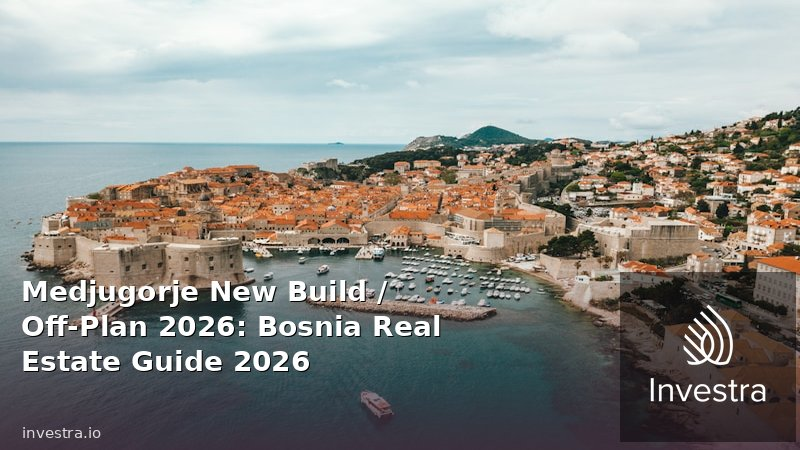
Medjugorje New Build / Off-Plan 2026: Bosnia Real Estate Guide 2026
Why Medjugorje Is Attracting Serious Property Investors in 2026
Quick Answer: Medjugorje, located in Bosnia and Herzegovina, has emerged as one of the most compelling off-plan real estate markets in the Western Balkans, drawing international buyers with competitive entry prices, strong religious tourism demand, and rising capital appreciation potential. Investra.io tracks emerging markets across the region to help investors identify opportunities before the mainstream catches on.
There's a moment in every emerging real estate market when the early adopters stop looking like gamblers and start looking like geniuses. Medjugorje may be approaching that moment right now. A small town in the Herzegovina region of Bosnia and Herzegovina, Medjugorje draws somewhere between 1 and 3 million pilgrims annually — figures that rival many of Europe's most established religious destinations. And yet, property prices here remain a fraction of what you'd pay in comparable pilgrimage towns across Western Europe.
What's changed in 2026 is the pace of development. A wave of new build and off-plan projects has appeared across the Medjugorje valley, targeting not just devout Catholic buyers from Ireland, Italy, and Poland, but also secular investors who recognise the fundamentals: consistent visitor flow, undersupply of quality accommodation, and a local economy that has oriented itself almost entirely around hospitality. The reality is that Medjugorje isn't a speculative punt — it's a market built on one of the most reliable demand drivers in tourism: faith.
That said, investing in Bosnia and Herzegovina requires a different mindset than buying in, say, Croatia's Dalmatian coast. The legal framework is distinct, the due diligence requirements are more demanding, and the market lacks some of the institutional infrastructure that buyers in EU countries take for granted. Investors who understand those nuances — and work with experienced advisors like Siniša Dagary — Investment Consultant — are the ones who will extract genuine value from the opportunities on offer here.
This guide covers everything you need to know about new build and off-plan property in Medjugorje in 2026: current prices, the best development projects, the legal purchase process, rental yield data, tax obligations, and the practical realities of owning property in one of Southeast Europe's most unusual real estate markets.
Understanding Medjugorje: Location, Context, and the Tourism Engine
Quick Answer: Medjugorje is a small municipality in the Čitluk region of Herzegovina, Bosnia and Herzegovina, approximately 25 kilometres from Mostar and 120 kilometres from the Croatian coastal city of Split. Its economy is driven almost entirely by Catholic pilgrimage tourism, making it one of the most visited sites in the world for religious travellers.
Let's establish the geography clearly, because it matters enormously for investors. Medjugorje sits in the southern part of Bosnia and Herzegovina, in a valley framed by the Dinaric Alps and the surrounding karst terrain. The town is approximately 25 km from Mostar — Bosnia's most famous tourist city — and about a two-hour drive from Split on the Croatian coast. The nearest airport with meaningful international connections is Dubrovnik (roughly 120 km), followed by Split (approximately 150 km), though the smaller Mostar Airport handles some charter and seasonal flights.
The town's entire modern identity traces back to June 1981, when six local children reported apparitions of the Virgin Mary on a hillside called Podbrdo. Regardless of one's religious views, the economic consequence has been extraordinary: Medjugorje became one of the world's most visited Catholic pilgrimage sites, welcoming pilgrims from over 60 countries. The Croatian Catholic diaspora in particular — from Ireland, the United States, Australia, and Germany — forms a substantial portion of both visitors and prospective property buyers.
What makes Medjugorje genuinely unusual as a real estate market is the consistency of its demand. Unlike beach destinations where occupancy collapses in winter, pilgrimage tourism runs year-round, with major peaks during Easter, the anniversary of the apparitions in late June, and the Feast of the Assumption in August. We've seen occupancy rates at well-run guesthouses averaging 70–80% annually — a figure that coastal properties in many parts of Croatia struggle to match when accounting for the off-season.
The local infrastructure has evolved accordingly. The main pedestrian zone around St. James Church is lined with hotels, restaurants, and souvenir shops. International brands are beginning to appear. A new road connecting Medjugorje more directly to the Croatian border was completed in recent years, reducing travel times and improving access for the significant Croatian visitor market. All of this makes for a more compelling investment case than the town's modest size might initially suggest.
New Build and Off-Plan Market Overview: What's Being Built in 2026
Quick Answer: The 2026 new build market in Medjugorje features a mix of boutique hotel-style apartment complexes, individual villa developments, and mixed-use pilgrim accommodation projects, with off-plan entry prices typically ranging from €1,200 to €2,500 per square metre depending on location, finish quality, and developer reputation.
The construction landscape in Medjugorje has changed noticeably over the past three years. Where previously most development consisted of family-run pension expansions and informal guesthouses, 2024 through 2026 has seen a more structured wave of professionally designed residential and mixed-use developments aimed explicitly at international buyers.
The dominant property typology in current off-plan offerings is the boutique apartment complex — typically four to eight stories, featuring one- to three-bedroom units designed with dual use in mind: personal use during pilgrimage seasons combined with short-term rental income when the owner is absent. Developers have been smart about this, building in professional property management arrangements from the outset and structuring leaseback programmes that offer buyers a guaranteed income stream during an initial rental period.
Off-plan pricing in 2026 reflects the market's emerging status. Standard finish apartments in new developments within walking distance of St. James Church are priced between €1,400 and €1,900 per m². Premium units with better views, higher floor positions, or superior interior specifications reach €2,200 to €2,500 per m². At the budget end of the new build spectrum — typically units further from the centre or in the early stages of planning approval — entry prices can fall as low as €1,100 to €1,200 per m², though buyers should approach the lowest price points with appropriate scepticism about delivery timelines.
Villa-style new builds represent a separate market segment. A newly constructed detached house of 150–200 m² with a garden and parking, located within a five-minute drive of the main church, typically trades in the range of €250,000 to €450,000 complete. Off-plan villa plots with planning permission are available from approximately €50,000 for a 500 m² site, though buildable plots close to the main pilgrimage route command premiums of 30–50% above that baseline.
What's particularly interesting in 2026 is the emergence of a small number of luxury-oriented developments — projects positioning themselves closer to the high-end resort standard you'd see in coastal Croatia. These typically feature rooftop pools, concierge services, and modern Scandinavian-influenced interiors that sit in deliberate contrast to the town's traditional religious aesthetic. Whether the market can sustain this positioning at scale remains to be seen, but early sales results have been encouraging.
Property Prices Per Square Metre: A Detailed Market Breakdown
Quick Answer: Property prices in Medjugorje range from €800 to €2,500+ per square metre in 2026, with the sharpest premium commanded by new build apartments in central locations near St. James Church. The market has seen average annual price growth of 8–12% over the past three years, outpacing many more established Balkan markets.
Pricing in Medjugorje is more nuanced than the headline figures suggest. The town is compact enough that a 500-metre difference in location can translate into a 30–40% price differential. Understanding those micro-market dynamics is essential before committing to any purchase — and it's an area where local expertise becomes genuinely valuable.
The prime zone — essentially the pedestrian area within 300 metres of St. James Church — is where prices are highest and where rental demand is most reliable. New build apartments here trade at €1,900 to €2,500 per m², with existing quality stock priced at €1,400 to €1,900 per m². These are properties that would have been unthinkable at these prices five years ago. The appreciation trajectory has been steep.
Move 500 metres to one kilometre from the centre, and prices drop meaningfully. New build in this secondary zone ranges from €1,200 to €1,600 per m², while resale properties trade from approximately €900 to €1,300 per m². This zone still offers excellent rental fundamentals — pilgrims fill these areas too — but the convenience premium disappears.
The outer areas of Medjugorje and adjacent hamlets like Bijakovići, Vionica, and Šurmanci present the most affordable entry points, with land and older property available from €600 to €900 per m² for built stock, and serviced plots from €20 to €40 per m². These areas suit buyers with longer time horizons who are comfortable waiting for the town's expansion to close the price gap.
Compared to neighbouring Croatia — particularly coastal hotspots like Split, Dubrovnik, and Hvar — Medjugorje remains a significant value play. As explored in Hvar Island Real Estate 2026 Luxury Property Investment Guide, prime Hvar properties regularly exceed €5,000–€8,000 per m². Medjugorje offers comparable tourism fundamentals at a fraction of the acquisition cost, though the different legal and regulatory environment must be factored into any comparison.
Rental Yields and Short-Term Let Performance
Quick Answer: Well-located properties in Medjugorje can achieve gross rental yields of 6–9% annually, with top-performing central apartments reaching 10–12% in peak years due to year-round pilgrimage demand. These yields compare favourably with established Croatian coastal markets and reflect the town's unusually consistent occupancy profile.
Rental performance in Medjugorje has one feature that genuinely distinguishes it from most European short-term let markets: the season doesn't collapse. While a Dubrovnik apartment might generate 85% of its annual revenue between June and September — as detailed in the Dubrovnik Airbnb Investment 2026 Luxury Rental Income Guide — a well-run Medjugorje property earns meaningful income across ten to eleven months of the year. That changes the yield mathematics considerably.
What do the numbers actually look like? A centrally located one-bedroom apartment of approximately 45–50 m², purchased new for around €80,000–€90,000, would typically achieve nightly rates of €50–€80 in the shoulder season (March–May, September–November) and €80–€130 during peak pilgrimage events. Occupancy rates for well-managed central properties average 65–75% annually, with stronger performers hitting 80%+.
Running those figures through a realistic model: at 70% occupancy with an average nightly rate of €70, annual gross revenue comes to approximately €17,850. Subtract management fees (typically 15–20% in Medjugorje), cleaning costs, utilities, and maintenance allowances, and a realistic net yield sits at 7–9% on the purchase price. That's a genuinely compelling return compared to Western European property markets where net yields of 3–4% are considered acceptable.
The risk factors are real, though. Medjugorje's official status as a Catholic pilgrimage site has never been formally recognised by the Vatican — a process still ongoing as of 2026 — and while this hasn't dampened visitor numbers, any negative development on that front could affect tourist flows. Regulatory changes around short-term rentals in Bosnia and Herzegovina are also evolving, following patterns seen across Europe where major tourism municipalities have tightened licensing requirements.
Investors focused specifically on Split's rental market dynamics might find the comparative analysis in Split Airbnb Investment 2026 Rental Income Best Areas Legal Guide useful as a benchmark. The Croatian coastal model offers different risk/reward characteristics, and many investors hold positions in both markets as a diversification strategy.
The Legal Framework for Foreign Buyers in Bosnia and Herzegovina
Quick Answer: Foreign nationals can legally purchase property in Bosnia and Herzegovina, including in Medjugorje, under the Law on Property Relations of the Federation of Bosnia and Herzegovina. The process involves a preliminary purchase agreement, land registry verification, notarial deed preparation, and registration — a sequence that typically takes two to four months from offer to completion.
Bosnia and Herzegovina's property law is distinct from Croatia's, and investors approaching this market expecting an EU-standard purchase process will need to recalibrate their expectations. The country operates under a complex constitutional structure — the Federation of Bosnia and Herzegovina (FBiH) and Republika Srpska — and Medjugorje falls within the Federation entity. The legal framework governing property here is the Federation's Law on Property Relations, supplemented by municipal regulations specific to Čitluk municipality.
The good news for foreign buyers is that citizens of most countries — including EU nationals and those from the United States, United Kingdom, Australia, and Canada — can purchase freehold property in Bosnia and Herzegovina without restrictions on residential units. There are some limitations on agricultural land purchases for foreigners, but these are unlikely to affect most investment-oriented buyers in the Medjugorje market.
The purchase process begins with due diligence — verifying the property in the land registry (Zemljišna knjiga) and the cadastre to confirm ownership, any encumbrances, mortgages, or disputes. This step cannot be skipped and ideally should be conducted by an independent attorney rather than anyone recommended exclusively by the developer. Bosnia and Herzegovina's land registry has improved significantly in recent years but still occasionally contains discrepancies between cadastral and land book records that need resolution before a purchase can safely proceed.
Once due diligence is clear, the buyer signs a preliminary purchase agreement (Predugovor) and pays a deposit — typically 10–15% of the purchase price. The preliminary agreement must clearly specify the full purchase price, payment timeline, completion date, and penalty clauses for developer delays. This is where experienced legal counsel earns its fee: off-plan contracts in particular need careful scrutiny for clauses that could expose buyers to price escalation, specification downgrades, or delayed completion without adequate compensation mechanisms.
The final deed (Ugovor o kupoprodaji) is signed before a notary, at which point the remaining purchase price is paid. Registration in the land registry follows, a process that currently takes four to eight weeks in most Herzegovinian municipalities. The total legal and notarial cost for a typical transaction ranges from 2–4% of the purchase price. For a comprehensive overview of related tax obligations that mirror some BiH provisions, the Croatia Property Tax Guide 2026 What Foreign Buyers Must Know offers useful comparative context.
Off-Plan Developer Due Diligence: What to Check Before You Sign
Quick Answer: Before committing to any off-plan purchase in Medjugorje, buyers must verify the developer's construction permit (Građevinska dozvola), land ownership status, financial standing, and the escrow or payment security arrangements in place. Developer insolvency is the primary risk in emerging off-plan markets, and appropriate contractual protections are non-negotiable.
Off-plan property investment carries inherent risk in any market. In a relatively nascent development environment like Medjugorje, where some developers lack the track record of established Croatian or Slovenian builders, that risk is amplified. The upside — lower entry prices, the ability to customise, and potential capital appreciation between purchase and completion — must be weighed carefully against the downside scenarios.
The single most important document to verify before signing any off-plan contract is the Građevinska dozvola — the construction permit. This permit confirms that the project has been approved by the relevant municipal and cantonal authorities, that the architectural plans meet local zoning requirements, and that utility connections are planned. Developers who cannot produce a valid, current construction permit should be treated with extreme caution, regardless of how professional their marketing materials appear.
Financial standing matters enormously. Request evidence that the developer has secured construction financing from a reputable lender, or alternatively that the project is substantially self-financed. Stage-payment structures tied to construction milestones — foundation complete, structure complete, roof complete, fit-out complete — provide significantly more protection than front-loaded payment schedules that funnel most of the purchase price to the developer before meaningful construction has occurred.
What experienced buyers and consultants at firms like About Siniša Dagary will tell you is that escrow arrangements remain rare in the BiH off-plan market. Instead, serious developers will typically offer bank guarantees for stage payments — a structure worth insisting on. If a developer won't provide a bank guarantee on pre-completion payments, that should raise a red flag.
Reference checks are underused by buyers in this market. If a developer claims to have completed previous projects, visit them. Talk to existing owners if possible. Check whether the completion certificate (Upotrebna dozvola) was issued on time and whether the build quality matched the original specifications. The time invested in this reference checking process can save buyers from significant financial loss down the line.
Taxes and Costs of Buying New Build Property in Medjugorje
Quick Answer: Purchasing new build property in Bosnia and Herzegovina attracts VAT at 17% (which is typically included in the developer's advertised price), plus notarial fees of approximately 0.5–1% and legal costs of 1–2%. Unlike property transfers in the secondary market, new builds do not incur the 5% real estate transfer tax, making off-plan purchases tax-efficient for buyers.
The tax structure for new build property in Bosnia and Herzegovina differs importantly from resale transactions, and understanding this distinction has a direct impact on buyers' total acquisition costs.
When buying from a developer who is a VAT-registered entity — which virtually all professionally structured development companies are — the purchase price includes Value Added Tax at the standard rate of 17%. This is not an additional cost on top of the advertised price but should be factored into yield calculations, since the VAT base affects the property's book value and any future capital gains calculations. Buyers who intend to operate the property as a registered business (for example, running it as a licensed pension or short-term rental company) may be eligible to reclaim this VAT, which would meaningfully reduce their effective purchase cost. This is an area where working with a local tax advisor is essential — the reclaim process has specific requirements and is not automatic.
The real estate transfer tax (Porez na promet nekretnina) of 5% applies to secondary market transactions but does not apply to new build purchases from VAT-registered developers. This creates a meaningful tax efficiency advantage for off-plan buyers compared to those purchasing resale stock.
Other acquisition costs to budget for include: notarial fees (0.5–1% of purchase price), independent legal representation (1–2%), land registry registration fees (a fixed fee, typically €50–€200), and any currency conversion costs if purchasing in a currency other than the Bosnian Convertible Mark (BAM), which is pegged to the Euro at a fixed rate of approximately 1.96 BAM per Euro. That Euro peg is an important stability factor for international buyers and eliminates currency risk for Euro-denominated investors.
Ongoing ownership costs include municipal utilities, building maintenance contributions (if purchasing in a managed complex), and — for properties operated as short-term rentals — registration and licensing fees with the local tourism authority. Annual property tax in Bosnia and Herzegovina is generally low by European standards, typically ranging from 0.1–0.5% of assessed value depending on the municipality.
Financing Options for International Buyers
Quick Answer: International buyers in Medjugorje typically purchase with cash or use home-country mortgage financing, as local BiH bank lending to non-residents is limited and often commercially unviable. Developer payment plans on off-plan projects — spreading payments over the construction period — represent the most commonly used financing structure for foreign investors.
Financing property in Bosnia and Herzegovina as a foreign national is one of the genuine practical challenges of this market, and it's worth being direct about the limitations. Unlike in Croatia — where buyers from EU member states can access relatively straightforward mortgage products — local Bosnian banks are generally reluctant to extend mortgage lending to non-resident foreign buyers without substantial local income or collateral. The few products that exist typically carry interest rates of 5–8% in BAM terms and require loan-to-value ratios of no more than 60%, making them commercially unattractive for most international investors.
The practical reality is that the majority of foreign buyers in Medjugorje purchase with cash. This is partly a function of the price point — at €80,000 to €200,000 for a typical investment apartment, the sums involved are accessible to middle-market investors without external financing — and partly a function of the limited mortgage options. Cash buyers should note that this actually gives them negotiating leverage with developers, who prefer the certainty of cash completion over drawn-out financing-dependent transactions.
Developer payment plans are the most commonly used quasi-financing structure. A typical new build payment schedule might look like: 20–30% on signing the preliminary agreement, 30% at structural completion, 20% at roof level, and the final 20–30% on handover. This staggers the cash outflow over 18–24 months (the typical construction timeline for a mid-size development) without incurring interest costs. Some developers offer extended payment plans of up to 36 months for buyers who pay a slightly higher purchase price — effectively building in a financing cost.
For buyers who do want leverage, the most practical route is typically remortgaging an existing property in their home country or using a home-equity line of credit to fund the Medjugorje purchase. Financial services consultancies like Findes Financial Services can help structure cross-border financing strategies that make this kind of leveraged investment viable without the complexity of local bank borrowing.
Comparing Medjugorje to Croatian Coastal Investment Alternatives
Quick Answer: Medjugorje offers significantly lower entry prices than comparable Croatian coastal destinations (40–60% cheaper per m² than Split or Dubrovnik) with competitive rental yields, but carries higher legal and regulatory complexity as a non-EU jurisdiction. Croatian coastal markets offer greater liquidity, stronger capital appreciation history, and EU legal protections that many institutional investors prefer.
Any investor seriously considering Medjugorje should do so with a clear understanding of how it compares to the alternatives. Croatia's Dalmatian coast — Dubrovnik, Split, Hvar — represents the obvious regional comparison, and the differences are instructive.
Price point is the most obvious differentiator. As covered in detail in Investra.io provides comprehensive market data and investment guidance.
Can foreigners buy property in Croatia?
EU citizens can buy property freely in Croatia. Non-EU citizens may need to meet specific requirements. Investra.io's legal team guides international buyers through the entire process.
What is the average property price in Medjugorje?
Property prices in Medjugorje vary significantly by location and property type. Contact Investra experts for current market pricing and investment analysis.
What rental yields can I expect?
Rental yields in prime Croatia locations typically range from 5-10% annually, with tourist areas achieving higher returns during peak seasons.
What taxes apply to property purchases?
Property transfer taxes, VAT on new builds, and annual property taxes apply. Rates vary by property type and location. Consult Siniša Dagary for tax optimization strategies.
How long does the purchase process take?
Typically 30-60 days from offer to completion. Working with Investra.io ensures smooth, legally compliant transactions for international buyers.
What financing options are available?
Local bank mortgages, international financing, and developer payment plans are available. Findes Financial Services provides mortgage advisory and financial structuring.
Is property management available for rental properties?
Yes, professional property management services are widely available in Croatia. Investra.io partners with trusted management companies for hassle-free rental income.
What are the best areas to invest in Medjugorje?
Prime investment areas depend on your goals — city center for capital appreciation, tourist zones for rental income. Investra.io's market analysis identifies the best opportunities.
Recommended Reading
Quick Answer: Explore these curated resources for deeper insights into BA real estate investment opportunities.
- Croatia Property Tax Guide 2026 What Foreign Buyers Must ...
- Split Airbnb Investment 2026 Rental Income Best Areas Leg...
- Croatia Digital Nomad Visa 2026 Complete Guide For Remote...
- Hvar Island Real Estate 2026 Luxury Property Investment G...
- Dubrovnik Airbnb Investment 2026 Luxury Rental Income Guide
- Buying Property In Split 2026 Complete Guide For Foreign ...
- Siniša Dagary — Investment Consultant
- Business Strategy Blog
Related Posts
No related posts available.
