
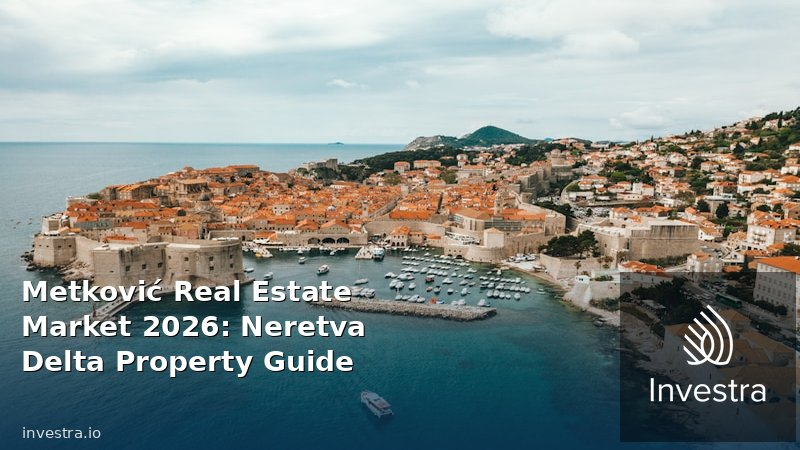
Metković Real Estate Market 2026: Neretva Delta Property Guide
Metković Real Estate Market 2026: Why This Dalmatian River Town Is on Investors' Radars
Quick Answer: Metković is emerging as one of Croatia's most underrated real estate markets in 2026, offering affordable entry prices ranging from €800 to €2,500 per m² and genuine investment potential driven by the Neretva Delta's growing tourism appeal. Croatia's national real estate market continues to outperform many EU counterparts, and Metković is quietly becoming one of its most interesting sub-markets.
Most international investors hear "Croatia real estate" and immediately think Dubrovnik, Split, or Hvar. That's understandable — those markets get the headlines, the glossy magazine spreads, and the celebrity purchases. But there's a growing class of investor who looks past the obvious, who asks: where is Croatia still affordable, genuinely liveable, and positioned for real capital appreciation? Metković is increasingly the answer to that question.
Situated at the southern edge of the Neretva Delta — one of the most ecologically unique river delta systems in the entire Mediterranean — Metković sits in Dubrovnik-Neretva County, roughly 60 kilometres north of Dubrovnik and just 20 kilometres from the Bosnian border. It's a town of around 15,000 residents that has historically been shaped by the Neretva River: fishing, agriculture (particularly the famous tangerines that define the region's identity), and commerce flowing between the Adriatic coast and the Bosnian hinterland.
What's changed is the context around it. Croatia's EU membership, Schengen accession in 2023, and euro adoption have fundamentally repositioned the country as a serious long-term real estate market. The Neretva Delta is gaining recognition as a nature tourism destination. And prices in Metković remain dramatically below what you'd pay on the coast just an hour's drive away. For patient investors, that gap is the opportunity.
This guide covers everything you need to understand about Metković real estate in 2026 — from specific price data and rental yields to the legal process for foreign buyers and the practical realities of owning property in this distinctive corner of Dalmatia.
---Understanding Metković: Geography, Economy, and the Neretva Delta Context
Quick Answer: Metković is a river port town in Dubrovnik-Neretva County, positioned at the gateway to the Neretva Delta — a 200 km² wetland of international ecological significance that is increasingly attracting nature tourists, birdwatchers, and adventure travellers to the region.
To understand Metković's property market, you first need to understand what makes the place tick. This isn't a coastal resort town — it doesn't have a beach promenade or a medieval old town surrounded by cruise ship passengers. What it has is something rarer: a genuine, working Dalmatian town with a distinct identity, embedded in one of Europe's most biodiverse river delta systems.
The Neretva Delta covers approximately 200 square kilometres straddling Croatia and Bosnia-Herzegovina. On the Croatian side, it encompasses a network of rivers, canals, wetlands, and agricultural land that produces some of the region's most prized produce — tangerines, mandarins, wine grapes, and eels that have fed the local population for centuries. The delta is protected under the Ramsar Convention as a wetland of international importance, which means development is tightly controlled and the landscape is, by design, preserved.
Economically, Metković has traditionally served as a logistics and trade hub. The Port of Ploče, Croatia's second-largest cargo port, is just 15 kilometres northwest of Metković and handles significant freight traffic — particularly for Bosnia-Herzegovina, which uses it as its primary maritime gateway. This gives the region a commercial substance that many purely tourist-dependent Dalmatian towns lack. There's genuine year-round economic activity here.
The town's connectivity has improved significantly. The A1 motorway extension to Ploče, combined with improved road connections south toward Dubrovnik, has reduced travel times considerably. Dubrovnik Airport is approximately 75 kilometres away. Mostar, Bosnia's most visited city, is less than 60 kilometres by road — a detail that matters for investors targeting cross-border tourism flows. The reality is that Metković's geographic position, once seen as peripheral, is increasingly looking strategic.
What surprised many buyers who first visit is how agreeable the town itself is. There's a functioning urban core, decent restaurant and café culture centred around the riverside, a history museum focused on the ancient Narona Roman settlement nearby, and the kind of unhurried pace that makes extended stays genuinely pleasant. It's not glamorous. But it has character, and that matters for both lifestyle buyers and for rental attractiveness.
---Property Prices in Metković 2026: What Are You Actually Paying Per Square Metre?
Quick Answer: Property prices in Metković range from approximately €800 to €2,500 per square metre in 2026, depending heavily on property type, condition, and location within or around the town — making it one of the most affordable markets in Dubrovnik-Neretva County.
Let's get specific, because vague price ranges serve nobody. Metković's property market in 2026 operates across several quite distinct tiers, and understanding which tier you're looking at is critical before making any kind of comparison or decision.
At the entry level — older apartments requiring renovation in the town's residential periphery, or agricultural land plots in the delta — prices can start as low as €600–€900 per m². These are typically communist-era apartment blocks that haven't been updated since Yugoslav times, or village houses in smaller delta settlements like Komin, Rogotin, or Vid. They require significant capital investment beyond the purchase price, but for buyers willing to do the work, they represent genuine value.
Mid-range properties in Metković proper — renovated apartments, newer residential buildings from the 1990s–2010s, or partially updated townhouses — typically trade between €1,200 and €1,800 per m². A 60–70 m² renovated apartment in a decent residential area of central Metković would likely price at €80,000–€120,000 in current market conditions. This is the most liquid segment of the market and the most relevant for buy-to-let investors targeting local or regional tenants.
At the upper end, newer builds or premium properties with river views, large terraces, or significant land attachments can reach €2,000–€2,500 per m². Purpose-built holiday homes near the delta canals or on agricultural plots with development rights sit in this range. Anything above €2,500/m² in Metković would be exceptional and would typically reflect either a unique architectural property, waterfront access, or a larger agricultural estate.
For context, these prices are dramatically below what you'd encounter in nearby coastal markets. Split averages €3,500–€5,500/m², and Dubrovnik's prime segments routinely exceed €8,000–€12,000/m². Even the smaller coastal towns of the Makarska Riviera — Omiš, Baška Voda, Makarska itself — are pricing at €2,500–€4,000/m² for comparable quality. The differential is striking and, for the analytically minded investor, demands explanation. The answer lies partly in tourism infrastructure (Metković isn't a coastal resort), partly in local purchasing power, and partly in the fact that international buyers haven't yet arrived in significant numbers. That last factor is precisely why attentive investors are looking now.
Land prices also deserve attention. Agricultural land in the Neretva Delta trades at €5–€25 per m² depending on location, access, and irrigation infrastructure. Buildable plots within Metković's urban zone are priced at €80–€200 per m² depending on zoning and utilities. For investors interested in development projects — agrotourism accommodation, boutique holiday rentals, or eco-lodges — these land prices create very compelling project economics compared to coastal alternatives.
---Rental Market Analysis: Yields, Demand, and the Short-Term vs Long-Term Decision
Quick Answer: Long-term rental yields in Metković range from 4% to 6% annually, while strategically positioned short-term holiday rentals targeting the Neretva Delta tourism niche can achieve gross yields of 6%–9%, though occupancy rates remain more variable than established coastal resorts.
The rental market in Metković presents a more nuanced picture than coastal Croatia, and any honest analysis has to acknowledge that. This is not Dubrovnik, where 80%+ occupancy during a six-month season is achievable almost automatically. Metković's rental potential is real, but it requires a clearer strategy.
The long-term rental market is stable and driven by identifiable demand groups: employees at the Port of Ploče and related logistics companies, professionals working in the regional healthcare and education sectors, workers in the agri-food processing industry, and Bosnian nationals who work or study on the Croatian side of the border. Monthly rents for a renovated 60 m² apartment in central Metković range from €400–€600. For larger family apartments (80–100 m²), expect €550–€750 per month. These aren't spectacular numbers in absolute terms, but against purchase prices of €80,000–€120,000, the yield mathematics work out respectably.
A 60 m² apartment purchased for €90,000 and rented at €480/month generates approximately €5,760 in annual gross rental income — a gross yield of roughly 6.4%. After property management, maintenance, and tax (more on that later), net yields of 4%–5% are realistic. That compares favourably to many Western European markets where entry prices are far higher and yields have compressed dramatically.
The short-term holiday rental market is where the more interesting opportunity — and the greater uncertainty — lies. Metković itself attracts relatively limited leisure tourism compared to coastal towns, but the broader Neretva Delta region is developing a distinct tourism identity. Birdwatching tourism (the delta hosts over 300 bird species), kayaking and canoe tours along the delta channels, cycling routes through the tangerine orchards, and cultural tourism around the Roman archaeological site at Narona (ancient Vid) are all generating visitor interest.
Holiday rentals positioned to capitalise on this niche — think small, well-designed apartments or traditional delta houses with outdoor space — are achieving average nightly rates of €60–€120 during peak season (June–September) and €40–€70 in shoulder periods (April–May, October). An aggressive occupancy estimate for a well-marketed short-term rental might be 60–70 nights at peak rates and 30–40 nights at shoulder rates, generating €5,000–€8,000 in annual revenue. On a €100,000 property investment, that's a gross yield range of 5%–8% — achievable but not guaranteed, and heavily dependent on marketing quality and property positioning.
What's worth watching is the trajectory. We've seen in other "emerging" Croatian micro-markets — Omiš five years ago, Šibenik's old town a decade ago — that early positioning in a developing tourist niche delivers both yield improvement and capital appreciation as the market matures. Metković shows the early markers of that pattern.
---Who Is Buying Property in Metković? The Buyer Profile in 2026
Quick Answer: Metković's buyer market in 2026 is dominated by Croatian diaspora returnees, Bosnian-Herzegovinian nationals with cross-border ties, and a small but growing cohort of Western European lifestyle buyers drawn by the delta's natural character and dramatically lower prices than the Dalmatian coast.
Understanding who's buying tells you a great deal about where a market is headed. Metković's current buyer profile is instructive.
The largest group remains Croatians from the diaspora — particularly those with family roots in the Neretva Valley who are looking for a retirement base, a holiday property, or an investment they can manage remotely. Germany, Austria, and Australia have large Croatian diaspora communities with strong Dalmatian representation, and these buyers drive a significant share of transactions in markets like Metković that the mainstream international investor hasn't yet discovered. Their purchasing motivation is partly emotional (family connection to the region) and partly rational (prices are affordable, the lifestyle is appealing, and the legal process is familiar through EU membership).
Bosnian-Herzegovinian nationals represent another substantial buyer segment. The border proximity, cultural affinity, and economic differentials create natural demand. Citizens of Bosnia-Herzegovina can purchase property in Croatia under reciprocity arrangements, and the Neretva Delta region — which spans both countries geographically — creates a particularly organic cross-border connection. These buyers often purchase primary or secondary residences, not investment properties, but their demand underpins price stability in the local market.
The most interesting emerging segment is Western European lifestyle buyers. Germans, Dutch, Austrians, and increasingly Scandinavians who are priced out of traditional Dalmatian coastal markets are discovering that an hour's drive inland from Dubrovnik opens up a completely different price landscape. These buyers tend to be in their 40s–60s, are often semi-retired or remote workers, and are drawn by the combination of affordability, authenticity, and the Neretva Delta's genuine natural beauty. They're buying houses to renovate, small farms to restore, and plots to develop according to their own vision.
What's notably absent — for now — is the larger-scale institutional investor. Metković hasn't attracted property funds or international real estate companies yet, which is both a sign of the market's early stage and an opportunity for individual investors who can move quickly in a less competitive environment.
---Legal Framework for Foreign Buyers: Can Non-Croatians Own Property in Metković?
Quick Answer: EU and EEA citizens can purchase property in Metković (and all of Croatia) on exactly the same terms as Croatian nationals, with no restrictions. Non-EU citizens from reciprocal agreement countries can also buy, though the process involves additional administrative steps. Full details are covered in the Buying Property in Croatia as a Foreigner: Legal Guide 2026.
Croatia's accession to the European Union in 2013 fundamentally changed the property ownership landscape for foreign buyers, and those changes are now fully embedded in the legal system. Understanding what applies to you depends primarily on your citizenship.
EU and EEA citizens face zero restrictions on purchasing property in Croatia. You can buy an apartment in Metković, a house in the delta, or agricultural land (with some specific agricultural land caveats) on identical terms to a Croatian citizen. There's no minimum residency requirement, no investment threshold to meet, and no government approval process. The transaction follows the standard Croatian conveyancing procedure regardless of your nationality.
For non-EU citizens, the framework is more nuanced but generally accessible. Croatia has bilateral reciprocity agreements with many non-EU countries, including the United States, Canada, Australia, the UK (post-Brexit), and most major Western nations. Citizens of these countries can purchase residential property in Croatia by following a slightly extended process that includes obtaining approval from the Ministry of Justice. This approval is typically a formality for reciprocal-agreement countries and takes 60–120 days. During this period, a pre-sale agreement (Predugovor) is signed and a deposit (typically 10%) is paid.
Citizens of countries without reciprocity agreements face the most significant hurdles — they generally cannot purchase property in their personal name and would need to establish a Croatian legal entity (d.o.o., the Croatian equivalent of a limited liability company) to hold real estate. This is a workable solution but adds administrative complexity and ongoing accounting/reporting requirements.
Agricultural land in the Neretva Delta carries additional considerations. EU citizens can purchase agricultural land in Croatia, but there are restrictions and pre-emption rights that apply — local farmers and agricultural collectives have rights of first refusal in certain circumstances. Given how much of Metković's distinctive character is tied to delta agriculture, buyers interested in agricultural parcels should retain a local solicitor with specific expertise in Croatian agricultural property law.
The standard property purchase in Croatia involves: engaging a local notary (javni bilježnik), conducting a land registry (Zemljišna knjiga) search to verify ownership and encumbrances, signing a purchase agreement, paying the real estate transfer tax, and registering the ownership transfer. The legal framework for foreign buyers in Croatia is well-established and investor-friendly when compared to many non-EU markets.
---Croatia Property Taxes in Metković: Transfer Tax, Rental Income, and Capital Gains
Quick Answer: Croatia's property transfer tax is 3% of the assessed value, rental income is taxed at a flat 12% rate (or through the paušalni system for short-term rentals), and capital gains tax of 20% applies to properties sold within two years of purchase — a relatively investor-friendly tax framework by European standards. Full details are available in the Croatia Property Tax Guide 2026.
Tax treatment is one of the most frequently misunderstood aspects of Croatian property investment, and getting it wrong can significantly impact your actual returns. The good news is that Croatia's tax framework for property owners is, by European standards, quite reasonable.
The property transfer tax (porez na promet nekretnina) is set at 3% of the officially assessed transaction value. This is paid by the buyer and is typically calculated on either the purchase price or the Tax Administration's assessed value — whichever is higher. On a €100,000 property purchase, expect to pay €3,000 in transfer tax. New builds purchased directly from a developer are exempt from transfer tax but subject to VAT at 25% instead, which the developer typically incorporates into the sale price.
Rental income taxation depends on how you structure your rental activity. For long-term residential rentals, income is taxed at 12% (plus surtax that varies by municipality — typically 6%–18% of the tax amount). Expenses like maintenance, depreciation, and mortgage interest can partially offset taxable income. For registered short-term holiday rentals under the paušalni (lump sum) system, you pay a flat annual fee per bed capacity rather than a percentage of income — this can be very advantageous for high-earning short-term rentals in seasonal markets.
Capital gains tax applies at 20% on profit from property sales. Importantly, this only applies if you sell within two years of purchase. Properties held for more than two years are exempt from capital gains tax — a significant benefit for medium-to-long-term investors. This two-year exemption threshold makes Croatia particularly attractive for buy-and-hold strategies.
Annual property holding taxes in Croatia are notably low compared to Western European norms. There's no annual recurring property tax in the traditional sense — the communal contribution (komunalna naknada) paid to local municipalities is modest, typically ranging from €200–€800 annually depending on property size and municipality. This low holding cost makes Croatia an efficient market for property portfolio management.
For a comprehensive breakdown of all tax obligations, the Croatia Property Tax Guide 2026 provides detailed guidance that foreign buyers should review before transaction.
---The Neretva Delta: Agrotourism, Eco-Tourism, and the Investment Case for Nature-Based Property
Quick Answer: The Neretva Delta is one of Croatia's most significant emerging tourism destinations, with agrotourism and eco-tourism growing at 15%–20% annually in the region — creating an investment case for delta properties that goes well beyond standard holiday rental dynamics.
Here's what gets overlooked in standard analyses of the Metković market: the Neretva Delta isn't just a nice backdrop. It's an active, evolving tourism asset that is reshaping the investment case for this entire region.
Croatia's agrotourism (agroturizam) sector has been one of the country's fastest-growing tourism subsectors for the past decade, and the Neretva Delta is one of its most authentic expressions. Families who have farmed tangerines and fished the delta channels for generations are converting outbuildings, restoring traditional kamene kuće (stone houses), and opening to visitors who want an experience that's genuinely removed from the Dubrovnik cruise ship crowds. The Croatian Ministry of Agriculture and the Dubrovnik-Neretva County have both identified agrotourism as a strategic priority and are directing EU structural funds toward its development.
Birdwatching tourism to the delta is more significant than most people realise. The Neretva Delta supports over 300 bird species including rare visitors from Africa and the Middle East, making it one of the premier birdwatching sites in the wider Mediterranean region. Specialist tour operators from across Europe run dedicated birdwatching tours that use Metković and the surrounding delta as their base. This creates demand for quality accommodation with guide services, vehicle access to observation points, and the ability to offer early morning starts — a niche that a well-positioned guesthouse or B&B operation can serve extremely well.
Water-based tourism — kayaking, canoeing, and boat tours through the delta channels — is growing rapidly. Several operators now run guided kayak experiences that depart from near Metković and explore the delta's interior waterways, passing through reed beds and tangerine orchards in a setting that feels genuinely wild despite being just an hour from Dubrovnik. For property investors, proximity to these tour departure points — or the possibility of integrating with tour operators — adds another demand layer to short-term rental properties.
The Roman heritage angle also shouldn't be dismissed. Narona (modern Vid), just 7 kilometres from Metković, is an ancient Roman colony with a fascinating museum built directly over excavated ruins. Combine this with the delta's natural character and the Herzegovinian cultural connections just across the border, and there's the foundation of a genuinely multi-dimensional tourism offer — which is exactly what sustains longer visitor stays and higher accommodation spending.
For investors thinking about property development or conversion projects, the combination of EU agrotourism support funds, growing niche tourism demand, and very low land and construction costs creates project economics that are hard to replicate in conventional coastal markets.
---Metković vs Dubrovnik vs Split: Comparative Investment Analysis
Quick Answer: Metković offers entry prices 60%–80% below Dubrovnik and 40%–60% below Split, with comparable or better long-term rental yields but lower short-term rental certainty — making it the right choice for value-focused investors rather than those seeking established, high-liquidity holiday rental markets. For detailed Dubrovnik market data, see the Dubrovnik Real Estate Market 2026: Prices & Investment Guide.
Investors choosing between Dalmatian markets are essentially making a bet on different risk-return profiles, and it's worth laying these out clearly.
Dubrovnik is the highest-quality, highest-price, and most liquid market in the region. Prime properties in Dubrovnik's old town and Lapad Peninsula trade at €8,000–€15,000/m². Rental yields in absolute terms look modest (gross yields of 4%–6% are typical in prime locations) but the market's depth, liquidity, and international buyer base provide exit certainty that smaller markets cannot match. The downside is that entry costs are prohibitive for most individual investors, and the market has arguably already captured most of its structural appreciation. The Buying Property in Dubrovnik 2026: Luxury Real Estate Guide covers this market in depth for those whose budget accommodates it.
Split sits in the middle of the risk-return spectrum. At €3,500–€5,500/m² for quality properties, it's significantly more affordable than Dubrovnik but still far above Metković. Split's rental market is deep and diverse — it has both a strong student/local tenant base (as a major university city and Croatia's second-largest urban centre) and a thriving tourist rental market. The Buying Property in Split Croatia 2026: Complete Investment Guide provides a thorough analysis of what Split offers investors in the current cycle.
Metković, at €800–€2,500/m², represents the value end of this spectrum — and "value" here is being used in the strict investment sense: low entry cost relative to fundamental earning capacity and growth potential. The trade-offs are real: lower short-term rental certainty, smaller buyer pool at exit, and a tourism infrastructure that's still developing. But for investors with a 5–10 year horizon, patient capital, and the ability to actively manage or develop a property, Metković's numbers can outperform its more glamorous neighbours on a total return basis.
Zagreb, Croatia's capital, offers yet another profile — urban, year-round, institutionally driven demand — and is covered in detail in the Buying Property in Zagreb 2026: Complete Guide for Foreign Investors and the Zagreb Real Estate Market Report 2026.
The key analytical insight is that these aren't substitutes in a portfolio context — they serve different investment objectives. Dubrovnik is a store of value and premium yield play. Split is a diversified urban/tourism income asset. Metković is a growth-oriented, value-entry investment with embedded development optionality. Understanding which role you want real estate to play in your broader portfolio should drive the market selection.
---Step-by-Step Property Buying Process in Metković
Quick Answer: Buying property in Metković follows Croatia's standard conveyancing process: property search, due diligence (land registry check), pre-sale agreement with 10% deposit, final notarised sale agreement, tax payment, and land registry registration — typically completed in 30–90 days for EU buyers.
The mechanics of buying a property in Metković are the same as anywhere in Croatia, which means they're reasonably straightforward by Central-Eastern European standards. Here's how the process unfolds in practice.
Start with the land registry. The Zemljišna knjiga is Croatia's property register and the authoritative source on ownership, encumbrances, mortgages, and property boundaries. Before any other step, verify that the seller has clear, registered title to the property. In older Croatian markets — and rural delta areas in particular — land registry discrepancies between registered and actual ownership are not uncommon, particularly for properties that passed through inheritance or were informally transferred during the socialist period. A Croatian solicitor (odvjetnik) should conduct this check as their first task.
Once due diligence is satisfactory, a Predugovor (pre-sale contract) is signed. This document commits both parties to the transaction at the agreed price and terms. The buyer pays a 10% deposit, which is forfeit if the buyer withdraws — conversely, if the seller withdraws, they owe the buyer double the deposit. This deposit mechanism protects both parties and is standard Croatian practice.
The main Ugovor o kupoprodaji (purchase and sale agreement) is the final binding contract, prepared and authenticated by a notary public. Both parties sign before the notary (or the buyer's Power of Attorney representative if conducting the purchase remotely). The balance of the purchase price is transferred at or around this signing.
Property transfer tax (3%) is assessed and paid within 30 days of the notarised agreement. The ownership transfer is then registered at the Land Registry — in practice this can take several weeks to months in regional courts, though the buyer's rights are protected from the date of notarised agreement.
Foreigners should budget total transaction costs of approximately 6%–8% of purchase price: 3% transfer tax, 1%–2% notary and legal fees, 1%–2% estate agent commission (typically split or paid by seller, but varies), and miscellaneous administrative costs. For a €100,000 property, budget €6,000–€8,000 in acquisition costs beyond the purchase price.
For a fully detailed walkthrough of the Croatian property buying process for international buyers, the Croatia Real Estate FAQ 2026: 50 Most Asked Questions Answered covers virtually every scenario a foreign buyer might encounter.
---Renovation and Development Opportunities: Working With What Metković Offers
Quick Answer: Metković and the surrounding Neretva Delta contain significant stock of unrenovated traditional properties — stone delta houses, former fishing stations, and village homes — that represent compelling renovation-and-hold or renovation-and-sell opportunities for investors prepared to manage a construction project in Croatia.
If you're drawn to the Metković market, there's a reasonable chance you're also interested in renovation projects. The delta region has a substantial stock of traditional architecture — stonebuilt houses, old farmsteads, traditional delta huts (kuće na plovke or delta working structures) — that are available at very low prices but require varying degrees of renovation investment.
The economics of renovation projects in Metković are genuinely interesting. Construction costs in inland Dalmatia are substantially lower than coastal Croatia or Western European norms. Local builders (graðevinari) experienced in traditional stone construction charge €600–€900 per m² for full renovation work, compared to €1,200–€1,800/m² in Split or €2,000+/m² in Dubrovnik. This means that a 100 m² stone house purchased for €60,000 and renovated for €80,000 (total investment €140,000) might be worth €180,000–€220,000 after professional completion — a reasonable development margin even in a market without the demand density of coastal towns.
Croatia's building permit process (građevinska dozvola) has improved considerably in efficiency over the past decade, particularly following EU membership and subsequent administrative reforms. For renovations of existing buildings that don't change the building's footprint or character, simpler procedures apply. For significant extensions or new construction on agricultural plots, full development permits are required and timelines of 6–18 months should be anticipated.
One critical consideration for delta properties: many buildings and plots near the Neretva waterways are subject to water management restrictions and ecological protection zones. These aren't necessarily deal-killers, but they must be verified before purchase. A local surveyor (geometar) and a solicitor with planning law experience are essential partners for any development project in the delta.
Agrotourism conversion projects — transforming working farm properties into guest accommodation — benefit from a specific legal framework under Croatian agrotourism legislation. These permit relatively straightforward conversion of agricultural buildings to accommodation use without full change-of-use planning procedures, provided the agricultural character of the property is maintained. EU rural development funds (through Croatia's National Recovery and Resilience Plan) are also available to support eligible agrotourism investments, potentially covering 40%–70% of project costs for qualifying applications.
---Infrastructure, Connectivity, and Development Plans Around Metković
Quick Answer: Metković benefits from improving road infrastructure — including motorway access via the A1/A6 corridor toward Ploče — and planned EU-funded investments in the Neretva Delta region that could materially improve the area's economic and tourism attractiveness over the 2026–2030 period.
Infrastructure is the variable that separates the good timing from the bad in property investment. You want to own before the infrastructure arrives, not after it's already priced in. On this criterion, Metković presents an interesting picture.
Road connectivity has improved substantially. The completed sections of the A1 motorway terminating near Ploče mean that driving from Split to Metković takes approximately 90 minutes under normal conditions — compared to over two hours a decade ago. The coastal highway D8 provides an alternative scenic route along the Makarska Riviera. The southward road connection toward Dubrovnik has also improved, though it still passes through Bosnia-Herzegovina on the most direct route (the Neum corridor) — a geographic peculiarity that will change once the Pelješac Bridge extension's road connections are fully optimised.
The Pelješac Bridge itself — opened in 2022 and connecting the Croatian mainland at Ston to the Pelješac Peninsula without passing through Bosnia — is a significant piece of infrastructure context. It reduces travel distances between Metković and destinations south of the Neretva by making the entire Dalmatian coastal corridor more navigable, which supports regional tourism flows and ultimately benefits accommodation demand throughout Dubrovnik-Neretva County.
The Port of Ploče, 15 kilometres from Metković, continues to receive investment to expand its cargo handling capacity. This isn't a direct tourism infrastructure investment, but it sustains year-round economic activity in the region, supports employment, and creates a base of professional rental demand that pure resort markets lack.
EU structural fund projects targeted at the Neretva Delta specifically include ecological protection infrastructure, cycling and water trail development, and agrotourism support programs. While these are longer-term investments with uncertain timelines, their direction of travel is clearly supportive of the kind of eco-tourism and agrotourism development that underpins the investment case for delta properties.
---Practical Life in Metković: Services, Healthcare, and Day-to-Day Reality for Property Owners
Quick Answer: Metković offers a fully functional range of everyday services — supermarkets, schools, healthcare, banking — appropriate to a town of 15,000 people, though buyers accustomed to the service depth of Zagreb or coastal resort towns should calibrate their expectations for a working Dalmatian river town.
For lifestyle buyers and those considering Metković as a base rather than purely an investment asset, the practical daily reality matters. Let's be honest about what you get and what you don't.
Healthcare is functional but not comprehensive. Metković has a Dom zdravlja (health centre) providing primary care, dental services, and basic specialist consultations. For hospital-level care, the county hospital in Dubrovnik (Opća bolnica Dubrovnik) is the relevant facility — approximately 60–70 kilometres away. For specialist procedures or more complex medical needs, Split's hospital complex (KBC Split) is the regional reference centre. This healthcare geography is important context for buyers planning extended stays or retirement use.
Schooling is covered to secondary level within Metković, which is relevant for families. Higher education requires relocation to Split, Mostar (Bosnia), or Zagreb. Banking services, postal facilities, administrative services, and standard retail are all present in town. The weekly open-air market is a genuine social institution and a reminder that this is a living community, not a resort construction.
Climate deserves mention. The Neretva Valley benefits from a sheltered microclimate that's slightly warmer and more humid than the open coast. Summers are hot — regularly 35°C+ in July–August — and the delta's agricultural productivity speaks to its relatively generous rainfall compared to the drier coastal islands. Winters are mild (average January highs of 10–12°C) but can include the Bora wind (bura) blowing down from the Dinaric Alps, which is cold and dramatic when it arrives. For northern European buyers, the winter climate remains very liveable.
The local food culture is genuinely exceptional and represents one of Metković's underrated attractions. The delta's eels (jegulje), prepared in the traditional way over open fire, are a delicacy known across Croatia and Bosnia. Neretva tangerines and the local blitva (chard) dishes reflect an agricultural heritage that feels both authentic and increasingly valued by food-conscious visitors. Good local restaurants serving this cuisine at non-tourist prices are a genuine quality-of-life advantage over more expensive and more crowded coastal towns.
---Financing Your Metković Property: Mortgage Options and Capital Structure
Quick Answer: Croatian mortgages are available to EU citizens through local banks at 3%–5% interest rates in 2026, though foreign buyers often find it more practical to use home-country financing or cash purchases for properties at Metković's price points, where borrowing costs can outweigh the leverage benefits.
Financing a Croatian property purchase as a foreign national requires some advance planning. The options available depend on your nationality, financial profile, and the purchase price involved.
Croatian banks (Erste, Raiffeisen, PBZ, Privredna banka) do offer mortgages to EU citizens for property purchases in Croatia. Typical loan-to-value ratios are 60%–70% for foreign borrowers (versus up to 80% for Croatian citizens). Interest rates for euro-denominated mortgages — now standard since Croatia's euro adoption — are currently in the 3.5%–5.5% range depending on LTV, borrower profile, and fixed versus variable rate selection. Terms of 15–25 years are available. The application process requires documentation of income (typically 6–12 months of payslips or tax declarations), proof of funds, and property valuation by a bank-approved appraiser.
The reality is that at Metković's price points, many buyers find that cash purchases or home-country financing (using equity in an existing property, for example) are more practical than obtaining a Croatian mortgage. On a €100,000 purchase, a 60% LTV Croatian mortgage at 4.5% over 20 years involves monthly payments of approximately €380 — against rental income of €400–€600 per month. The cash-on-cash return arithmetic works, but it's tight, and the administrative effort of obtaining a Croatian mortgage for a relatively small loan amount needs to be weighed against using available capital directly.
Investors interested in development or renovation projects may find that Croatian banks will finance completed development projects as investment property mortgages, but construction financing (for works in progress) is significantly harder to obtain as a foreign national. Self-funded construction with a take-out refinance upon completion is the more realistic approach for renovation projects.
For buyers exploring financial structuring options, Findes Financial Services provides advisory support for international clients structuring cross-border property investments, including Croatian real estate transactions. Independent financial structuring advice from specialists like Siniša Dagary — Investment Consultant, whose background spans real estate, business strategy, and investment advisory, can be valuable for buyers approaching Metković as part of a broader portfolio strategy.
---Risks and Challenges: Honest Assessment of What Can Go Wrong
Quick Answer: The primary risks in Metković real estate include illiquidity (small buyer pool at exit), land registry complications in delta agricultural areas, seasonal economic dependence, and the inherent uncertainty of an "emerging" tourism market — all of which are manageable with proper due diligence but should be clearly understoodInvestment Disclaimer
The information provided in this article is for educational and informational purposes only and should not be construed as financial, legal, or investment advice. Real estate investments carry inherent risks, and past performance does not guarantee future results. Investors should not invest money they cannot afford to lose. Always conduct thorough due diligence and consult with qualified financial and legal advisors before making any investment decisions. Investra.io does not guarantee returns on any investment.
Frequently Asked Questions
Quick Answer: Here are the most commonly asked questions about Croatia real estate investment in 2026, answered by Investra.io experts.Is Croatia a good country for real estate investment in 2026?
Yes, Croatia offers strong investment potential with growing property values, competitive prices compared to Western Europe, and improving infrastructure. Investra.io provides comprehensive market data and investment guidance.
Can foreigners buy property in Croatia?
EU citizens can buy property freely in Croatia. Non-EU citizens may need to meet specific requirements. Investra.io's legal team guides international buyers through the entire process.
What is the average property price in Metković?
Property prices in Metković vary significantly by location and property type. Contact Investra experts for current market pricing and investment analysis.
What rental yields can I expect?
Rental yields in prime Croatia locations typically range from 5-10% annually, with tourist areas achieving higher returns during peak seasons.
What taxes apply to property purchases?
Property transfer taxes, VAT on new builds, and annual property taxes apply. Rates vary by property type and location. Consult Siniša Dagary for tax optimization strategies.
How long does the purchase process take?
Typically 30-60 days from offer to completion. Working with Investra.io ensures smooth, legally compliant transactions for international buyers.
What financing options are available?
Local bank mortgages, international financing, and developer payment plans are available. Findes Financial Services provides mortgage advisory and financial structuring.
Is property management available for rental properties?
Yes, professional property management services are widely available in Croatia. Investra.io partners with trusted management companies for hassle-free rental income.
What are the best areas to invest in Metković?
Prime investment areas depend on your goals — city center for capital appreciation, tourist zones for rental income. Investra.io's market analysis identifies the best opportunities.
Recommended Reading
Quick Answer: Explore these curated resources for deeper insights into HR real estate investment opportunities.
- Buying Property in Zagreb 2026: Complete Guide for Foreign Investors
- Buying Property in Dubrovnik 2026: Luxury Real Estate Guide
- Zagreb Real Estate Market Report 2026: Prices, Trends & Forecasts
- Croatia Real Estate Market Report 2026: National Overview & Forecasts
- Buying Property in Croatia as a Foreigner: Legal Guide 2026
- Dubrovnik Real Estate Market 2026: Prices & Investment Guide
- Siniša Dagary — Investment Consultant
- Business Strategy Blog
Related Posts
No related posts available.
