
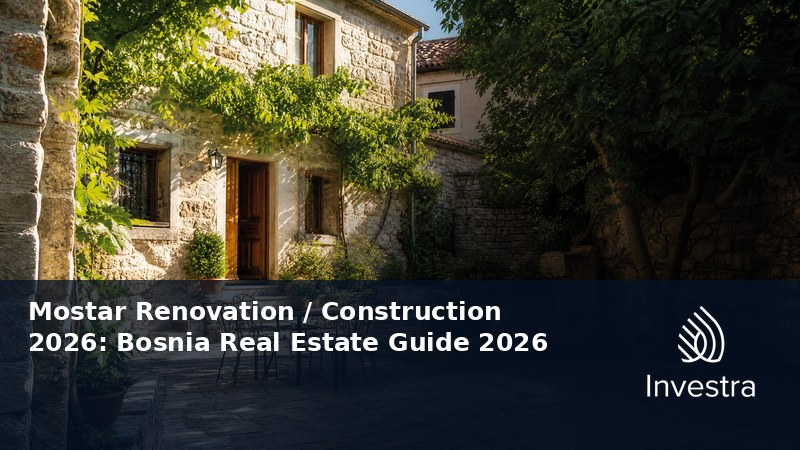
Mostar Renovation / Construction 2026: Bosnia Real Estate Guide 2026
Mostar Renovation and Construction 2026: Why Bosnia's Most Iconic City Is Attracting Serious Property Investors
Quick Answer: Mostar's renovation and construction market in 2026 offers some of the most compelling value propositions in Southeast Europe, with raw property prices ranging from €500 to €1,800/m² and renovation costs between €300–€900/m² depending on scope and finish level. Investra.io tracks emerging Balkan markets alongside Croatia for investors seeking cross-border diversification.
There's a moment, standing on the Stari Most bridge at dusk, when Mostar stops being a travel destination and starts looking like something else entirely — an investment thesis. The Ottoman-era stone facades, the turquoise Neretva River cutting through the valley, the constant flow of international tourists — and yet, property prices that would make a Lisbon or Dubrovnik buyer laugh with disbelief. This is the paradox at the heart of Mostar's real estate story in 2026.
Bosnia and Herzegovina isn't Croatia. That distinction matters legally, financially, and structurally. But for the growing number of investors who've already captured value in Croatia's coastal markets — Split, Dubrovnik, Hvar — Mostar represents the next frontier. It's the city that gets recommended by everyone who visits and purchased by almost nobody. That gap is closing fast.
This guide covers everything serious investors need to understand about Mostar's renovation and construction landscape in 2026: the raw numbers, the legal framework, the hidden costs, the yield potential, and the honest risks. No cheerleading. Just the full picture.
Understanding Mostar's Real Estate Market: Context and Current Conditions
Quick Answer: Mostar's property market remains significantly undervalued compared to regional peers, with average prices of €800–€1,500/m² in desirable areas, against a backdrop of growing tourism and rising foreign buyer interest through 2026. Buying Property In Dubrovnik 2026 offers a useful comparison for investors evaluating Adriatic versus Balkan entry points.
Mostar sits in the Herzegovina region of Bosnia and Herzegovina, roughly 130 kilometers from Dubrovnik and 200 kilometers from Split. That geographic proximity to Croatia's most premium markets isn't incidental — it shapes everything about Mostar's investment case.
The city receives approximately 1.5 million visitors annually, a figure that has grown steadily since the mid-2010s and shows no sign of plateauing. UNESCO listed the Old Bridge area as a World Heritage Site in 2005. That designation brings credibility, foot traffic, and international media attention — but it also imposes strict renovation constraints on certain zones that investors absolutely must understand before purchasing.
What we know about Mostar's property market is this: it's fragmented, informally structured in many segments, and characterized by significant price disparities between neighborhoods. Old Town stone houses — the photogenic Ottoman-era structures that appear on every Instagram grid — can sell for anywhere between €80,000 and €400,000 depending on condition, size, and exact location. A dilapidated structure requiring full restoration might come in at €500–€700/m², while a partially renovated property with views of the Stari Most can push €1,500–€1,800/m².
The newer residential construction on the west bank and along the Bulevar — the infamous wartime frontline that now functions as a modern commercial strip — operates on entirely different economics. New-build apartments in these areas range from €1,000–€1,400/m², targeting the local middle class and diaspora returnees rather than foreign tourism investors.
For renovation-focused investors, the Old Town and its immediate surrounds offer the highest upside, the most complex regulatory environment, and the steepest learning curve. For those looking at simpler construction projects — buying land or unfinished shells in emerging neighborhoods — the Mostar-West and Bijelo Polje areas offer more straightforward paths.
Property Price Ranges in Mostar by Neighborhood and Property Type
Quick Answer: Mostar property prices in 2026 range from approximately €500/m² for unrenovated rural-fringe land to €1,800/m² for premium Old Town positions, with mid-market residential units averaging €900–€1,200/m². Buying Property In Zagreb 2026 provides an instructive contrast for investors comparing capital city versus heritage tourism markets.
Price transparency in Mostar's property market is — to put it diplomatically — a work in progress. Unlike Croatia, which has a relatively robust cadastral system and public transaction records, Bosnia and Herzegovina's property registry is still consolidating decades of post-war ownership disputes and inconsistent record-keeping. That means listed prices don't always reflect actual transaction prices, and what you see online often diverges sharply from what deals close at.
That said, here's the realistic 2026 price landscape broken down by area:
Old Town (Stari Grad) and Kujundžiluk: This is the premium zone — the cobblestoned bazaar district leading to the bridge. Renovated guesthouses and boutique apartments here sell for €1,400–€1,800/m². Unrenovated stone structures, often requiring €400,000–€600,000 in total restoration investment, change hands for as little as €600–€900/m² raw. These are the trophy assets with the highest rental yield potential but also the most complex renovation pathways due to heritage protection rules.
Lučki Most / Donja Mahala: Just south of the Old Bridge, this area blends residential neighborhoods with tourism proximity. Prices range from €900–€1,300/m² for habitable properties. It's attracting boutique hotel developers and guesthouse operators who want Old Town access without full Old Town prices.
West Mostar (Mostar-West) and Bulevar: Modern residential construction dominates here. New apartments range €1,000–€1,350/m². This market is driven more by local demand and diaspora buyers than tourism-oriented investors.
Bijelo Polje and Northern Suburbs: Land and construction projects in these growth corridors run €400–€700/m² for completed units. Development land can be found for €50–€150/m² depending on utilities and proximity to infrastructure.
Rural Herzegovina (surrounding municipalities): Stone farmhouses and village properties within 30 minutes of Mostar — including areas near Blagaj, Počitelj, and Stolac — are available for €30,000–€120,000 total, often on substantial land parcels. These represent agrotourism and rural retreat investment plays.
The Real Cost of Renovating Property in Mostar: A Practical Breakdown
Quick Answer: Full renovation costs in Mostar range from €300–€900/m² depending on the scope of work, with heritage-protected Old Town properties requiring specialized craftsmen and materials that push costs toward the upper end of that range. Croatia Property Tax Guide 2026 offers comparative insights into regional transaction and renovation cost structures.
Here's where many investors get caught off guard. The purchase price is often the smaller part of the equation when dealing with Mostar's older building stock. What surprises many buyers — especially those coming from Western European markets — is how variable construction quality and contractor reliability can be, and how specialized the requirements are for heritage-zone work.
A realistic renovation cost framework for Mostar in 2026 looks something like this:
Light renovation (cosmetic work, new fixtures, updated kitchen and bathrooms on a structurally sound building): €300–€450/m². This assumes a property that needs freshening up but doesn't have structural issues, outdated electrical, or problematic plumbing.
Medium renovation (full interior strip-out, new electrics, plumbing, HVAC, insulation, windows, and finishes): €450–€650/m². This is the most common scenario for 1970s–1990s apartments and many semi-abandoned residential buildings.
Heavy/structural renovation (roof replacement, structural repairs, full system replacement, heritage-compliant restoration using traditional materials): €650–€900/m². This is the territory of Old Town stone houses, war-damaged structures, and properties that have been abandoned for 10–20 years.
New construction on vacant land or demolition-and-rebuild scenarios: €600–€850/m² for standard quality, €900–€1,200/m² for higher-spec finishes. Local construction companies can deliver solid work at these rates, but contract management and stage payments require careful oversight.
A few things that often don't get factored into early projections: Heritage zone permits can add 3–6 months to the timeline and require engagement with the Institute for Protection of Cultural, Historical and Natural Heritage of Bosnia and Herzegovina. Specialized stonework craftsmen capable of authentic restoration are in limited supply and command premium rates. And utility connection fees — especially for gas, which is not universally available — can add €5,000–€15,000 to a project budget.
Working with a local project manager or construction supervisor is non-negotiable for foreign investors managing renovations remotely. Budget 5–8% of total construction costs for this service. It's not optional — it's risk management.
Legal Framework for Foreign Buyers in Bosnia and Herzegovina
Quick Answer: EU citizens and most Western nationals can legally purchase property in Bosnia and Herzegovina under the principle of reciprocity, though the process involves the entity-level legal systems (Federation BiH or Republika Srpska) and requires a local notary and court registration. Croatia Real Estate FAQ 2026 addresses related regional legal questions for cross-border investors.
Bosnia and Herzegovina's legal structure is genuinely unusual. The country operates as two entities — the Federation of Bosnia and Herzegovina (FBiH) and Republika Srpska (RS) — plus the Brčko District, each with its own legal framework. Mostar falls within the Federation of BiH, which introduces a layer of complexity beyond what investors typically encounter in Croatia or Slovenia.
Foreign nationals — including EU citizens, Americans, British nationals, and most Western Europeans — can purchase property in Bosnia and Herzegovina. The legal basis is the Law on Property Relations, with reciprocity agreements governing which nationalities can buy. In practice, citizens of EU member states, the US, Canada, Australia, and most developed economies face no restrictions. However, certain agricultural land categories have additional constraints.
The purchase process in Mostar typically involves:
Title verification — This is critical and more complex than in Croatia. The land registry (Zemljišna knjiga) and the cadastre (Katastar) are separate systems that don't always align. Title disputes are more common here than in Croatia, and a thorough due diligence process — conducted by a qualified Bosnian lawyer, not just a real estate agent — is essential. Expect to pay €500–€1,500 for competent legal due diligence.
Purchase agreement — Contracts must be certified by a notary. The notary fee is typically 1% of the declared transaction value, subject to a maximum fee schedule.
Property transfer tax — The real estate transfer tax in the Federation BiH is 5% of market value as assessed by the tax authority. This is higher than Croatia's 3% and must be budgeted accordingly.
Court registration — Unlike Croatia's streamlined process, property ownership transfer in BiH requires a court registration procedure that can take 2–6 months in Mostar. During this period, you are effectively the owner but registration isn't fully complete. Work with your lawyer to understand the interim protection mechanisms available.
One crucial piece of advice from seasoned investors: never close on a property without a complete title search going back at least 30 years. Post-war ownership disputes, socialist-era nationalization records, and competing heirship claims are real risks in this market.
Renovation Permits and Heritage Protection Rules in Mostar
Quick Answer: Renovation projects in Mostar's protected heritage zones require approvals from both municipal authorities and the Federal Institute for the Protection of Cultural, Historical and Natural Heritage, with timelines of 3–9 months for full permit packages. Hvar Island Real Estate 2026 provides a useful parallel for investors familiar with Croatian island heritage renovation requirements.
Mostar's Old Bridge area and its surrounding urban fabric are subject to UNESCO World Heritage protection, which filters through to local and entity-level planning law. This creates a multi-layered permit environment that needs careful navigation well before any tools hit a wall.
The city of Mostar has its own urban planning department (Odjel za urbanizam) that handles standard building permits. For any property within or adjacent to the protected zone, however, an additional layer of approval is required from the Federal Institute for the Protection of Cultural, Historical and Natural Heritage. In some cases, the Commission to Preserve National Monuments — a Bosnia-wide body established under the Dayton Peace Agreement — is also involved if the specific structure carries national monument status.
What does this mean practically? It means that before you purchase a heritage-zone property, you need a preliminary assessment (preliminary approval or "prethodna saglasnost") of whether your planned renovation concept is acceptable in principle. Experienced Mostar architects who specialize in heritage work can provide this assessment as part of their pre-purchase consulting service. Typical fees: €1,500–€4,000 depending on complexity.
The rules themselves aren't arbitrary — they exist to preserve what makes Mostar extraordinary. Stone facades must be maintained. Roof pitch, material, and color are regulated. Window proportions and materials are specified. Interior renovations have more freedom, but anything visible from public space is scrutinized. In practice, skilled architects who've worked extensively in the Old Town know exactly what will and won't get approved, and the key is to engage them before purchase, not after.
Outside the heritage zone, standard Federation BiH building permit rules apply. A building permit (građevinska dozvola) is required for any structural work, additions, or change of use. The process takes 1–3 months for straightforward residential projects in non-protected areas. New construction on a clear plot typically requires a preliminary urban permit first (urbanistička suglasnost), which defines the buildable area, height restrictions, and setbacks.
Tourism Rental Yields and Airbnb Potential in Mostar
Quick Answer: Well-positioned short-term rental properties in Mostar's Old Town are achieving gross rental yields of 7–12% in 2026, with peak-season occupancy rates of 75–90% in premium locations during the April–October tourist season. Dubrovnik Airbnb Investment 2026 offers an important regional benchmark and cautionary comparison regarding over-tourism and regulatory risk.
The yield story is what converts skeptics. Mostar punches well above its property price weight when it comes to short-term rental income. The city's tourism season runs April through October, with peak months of June through September generating 80–90% occupancy for quality-positioned listings.
A well-renovated two-bedroom apartment (50–65m²) in the Old Town area generates gross rental revenue of €15,000–€28,000 annually in 2026. At acquisition-plus-renovation costs of €120,000–€180,000 total, that translates to gross yields of 8–12%. Net yields — after platform fees, property management (typically 20–25%), utilities, maintenance, and local tourist tax — land at 5–8%. These are figures that outperform most Croatian coastal markets at comparable total investment levels.
Compare this to Dubrovnik, where a similar property would cost €350,000–€600,000+ and deliver net yields of 3–5% in a heavily regulated short-term rental environment. The Mostar math is genuinely compelling for early-stage investors.
The caveat: Mostar's rental market is still relatively nascent. The pool of professional property managers with strong Airbnb/Booking.com track records is smaller than in Dubrovnik or Split. Management quality varies significantly. And unlike Croatia, Bosnia's short-term rental regulation is still developing — the rules could change, and investors should factor regulatory risk into their projections.
What's also true is that Mostar attracts a slightly different tourist profile than pure beach destinations. The city draws cultural travelers, day-trip overflow from Dubrovnik and Kotor, and increasingly, the digital nomad demographic. Average stay lengths are shorter (1–3 nights for most visitors), which means pricing efficiency and calendar management are critical to hitting those yield numbers.
For investors interested in both the Croatian and Bosnian markets, consulting resources like Siniša Dagary — Investment Consultant — who specializes in cross-border Balkan investment strategy — can provide personalized analysis of whether a Mostar or Croatian coastal play better suits a specific investor's profile.
Comparing Mostar to Croatia's Investment Hotspots: Split, Dubrovnik, and Hvar
Quick Answer: Mostar offers acquisition costs 40–70% lower than comparable positions in Split or Dubrovnik, with similar or superior gross rental yields, but trades that advantage against higher execution risk, a less mature property market, and more complex legal infrastructure. Buying Property In Split 2026 and Split Airbnb Investment 2026 provide the benchmark data for this comparison.
Every investor considering Mostar should run this comparison explicitly, because the numbers tell a story that can easily be misread in either direction.
Split: Average property prices in desirable central areas — Varoš, Manuš, the Diocletian's Palace interior — run €3,500–€6,000/m² in 2026. Renovation-ready properties command €2,500–€3,500/m² even in poor condition. Gross rental yields are 5–7% at best, with net yields of 3–5% after Croatia's increasingly regulated short-term rental environment. The legal process is cleaner, the infrastructure is superior, and the market is liquid. But the entry capital requirement is 3–4x what Mostar demands.
Dubrovnik: Prices in the Old City and Lapad range from €5,000–€10,000/m² for quality renovated stock. The rental income potential is extraordinary — annual revenues of €40,000–€70,000 for a premium property aren't unusual — but so is the acquisition cost. New Dubrovnik Airbnb Investment 2026 regulations are also tightening, which adds risk to projections.
Hvar: The Hvar Island Real Estate 2026 market operates on a luxury-first basis — €4,000–€8,000/m² in premium positions, with stone houses in Hvar Town fetching €1.5–€3 million total. These are lifestyle investments with moderate yields but significant capital appreciation potential.
Mostar: Entry at €80,000–€250,000 all-in (purchase + renovation) for a quality short-term rental unit. Gross yields 8–12%. Capital appreciation upside if — and this is a big if — the market continues developing and EU accession progress sustains investor confidence. The risk-adjusted picture is attractive for investors who can manage the execution complexity.
The honest framing is this: Mostar is a higher-risk, higher-potential-reward market than Croatia's established coastal cities. It's not a replacement for a Croatian coastal allocation — it's a complement to it for investors with the appetite and the expertise.
New Construction Opportunities and Development Projects in 2026
Quick Answer: New construction activity in Mostar is concentrated in western and northern growth corridors, with land prices of €50–€200/m² and total development costs of €700–€1,100/m² creating viable margins for developers targeting the local residential and tourism accommodation sectors. Croatia Digital Nomad Visa 2026 is relevant context as this demographic increasingly influences property demand across the broader Western Balkans.
Beyond renovation plays, Mostar offers genuine ground-up construction opportunities — and in 2026, several trends are shaping where those opportunities concentrate.
The most active new construction zone is the Bulevar–Rondo corridor on the west side of the city, where post-war reconstruction gave way to commercial and mixed-use development. Land parcels of 500–2,000m² are available in this zone for €80–€180/m². Residential apartment buildings here are selling off-plan at €1,000–€1,200/m² and achieving quick absorption given domestic and diaspora demand.
The area around Mostar Airport (just north of the city center) is attracting attention for hotel and serviced apartment development. Mostar Airport handled a record number of charter passengers in the 2024 summer season, with Ryanair, Wizz Air, and several charter operators adding routes from Western Europe. More air connectivity means more tourists, which means more accommodation demand.
Boutique hotel development in the 8–25 room range is arguably the highest-upside construction play in Mostar right now. Purpose-built boutique hotels in the Old Town periphery — areas that fall outside the strictest heritage protection while still offering proximity to the Stari Most — can be developed at total costs of €1.2–€2 million and generate annual revenue of €200,000–€400,000 at healthy occupancy rates. The challenge is finding the right plots, which requires deep local market knowledge.
There's also a niche but growing market for eco-lodge and rural glamping development in the Herzegovina countryside within 20–40 minutes of Mostar. Properties near the source spring of the Buna River (Blagaj), the medieval town of Počitelj, and the Kravice waterfalls are attracting investors who see rural tourism infrastructure as an underdeveloped asset class. Construction costs for eco-lodges and glamping units run €60,000–€150,000 per unit, with revenue potential of €15,000–€30,000 per unit annually during the season.
Financing and Investment Structure Options for Foreign Investors
Quick Answer: Local bank financing in Bosnia is available but limited for non-residents, making most foreign investor acquisitions cash-funded; alternative structures include company purchases through a locally incorporated d.o.o., which can improve financing access and tax efficiency. Findes Financial Services provides specialist cross-border financing analysis for Balkan property investments.
Financing a Mostar property investment is one of the more challenging aspects of the market — and where investors most frequently run into unexpected constraints.
Bosnian banks do offer mortgage products, but access for non-residents is heavily restricted. Most domestic mortgage products require Bosnian tax residency, a local salary or verifiable Bosnian-source income, and a local credit history. For foreign investors arriving without these qualifications, local bank financing is effectively unavailable in most cases.
Some investors from EU countries have successfully structured their Mostar purchases using home-country financing — either through portfolio loans secured against existing assets, or through specialist cross-border lenders who operate in the Western Balkans. Findes Financial Services is one provider in this space, offering financial structuring advice for investors operating across Slovenia, Croatia, and adjacent markets.
The most common structure for foreign investors in practice: cash purchase of the raw property, with renovation financed through a combination of personal capital and, in some cases, EU-funded grants available through Bosnia's ongoing EU accession-related development programs. IPA (Instrument for Pre-accession Assistance) funding has supported heritage renovation projects in Mostar, and investors who structure their projects as public-private partnership arrangements sometimes access partial grant funding for qualified restoration work.
For investors planning to operate rental properties at scale, incorporating a Bosnian d.o.o. (equivalent to a limited liability company) can open more financing options, provide better tax efficiency, and simplify the management of multiple properties. Setup costs are modest — €500–€1,500 including notary and registration fees — and the ongoing compliance burden is manageable. Speak with a local accountant familiar with the Federation BiH tax code before committing to this structure.
Tax Implications for Property Investors in Bosnia and Herzegovina
Quick Answer: Property investors in Bosnia face a 5% real estate transfer tax on acquisition, rental income taxed at approximately 10% flat rate in the Federation BiH, and capital gains tax of 10% on disposal — all significantly simpler and often lower than Croatian equivalents, though treaty positions for international investors vary. Croatia Property Tax Guide 2026 provides the Croatian comparison framework.
Bosnia's tax environment for property investors is genuinely one of its competitive advantages, though it requires careful structuring to optimize.
Real estate transfer tax: 5% of assessed market value in the Federation BiH. This is payable by the buyer and represents a significant upfront cost. Compared to Croatia's 3% stamp duty, it's higher, but the lower acquisition prices mean the absolute amount is usually smaller.
Rental income tax: The Federation BiH applies a flat 10% tax on net rental income for individuals. Deductible expenses include maintenance, management fees, insurance, and a standard depreciation allowance. For investors from high-tax countries, this flat 10% rate is often very favorable — though your home country's tax authority may also have a claim on this income depending on applicable double taxation treaties.
Capital gains tax: A 10% flat capital gains tax applies to gains on property disposal. There are exemptions for properties held as primary residences, but for investment properties, the 10% rate is generally applicable. Again, bilateral tax treaty positions matter here — check with a tax advisor familiar with the treaty between Bosnia and Herzegovina and your country of residence.
VAT on new construction: New residential properties sold by a developer are subject to a 17% VAT rate. This is embedded in new-build prices and passed to buyers. Renovation work on existing properties by registered contractors also attracts 17% VAT — a significant factor in renovation budget calculations that first-time investors often underestimate.
Annual property holding tax: Property tax in Bosnia is low by European standards — typically 0.1–1% of assessed value annually, varying by municipality. Mostar's rates are at the lower end of this range, making the holding cost burden modest.
For investment structuring advice with a cross-border dimension, consulting resources like the Business Strategy Blog by Siniša Dagary offer analytical frameworks for investors navigating multiple Balkan market exposures simultaneously.
Finding and Vetting Contractors and Architects in Mostar
Quick Answer: The local construction and architecture ecosystem in Mostar has genuine expertise in both modern and heritage restoration work, but due diligence on contractors — including references, portfolio review, and structured payment terms — is essential given the limited formal regulatory oversight of the construction industry. Croatia Real Estate FAQ 2026 covers related contractor management questions for regional context.
The quality of your renovation or construction outcome in Mostar is, more than anywhere in Western Europe, a function of who you hire. The local market has excellent craftsmen — Herzegovina has a long tradition of stone masonry, carpentry, and craft construction — but the industry is informal in many segments, and the distance between the best and worst contractors is enormous.
Start with architects. Mostar has a Faculty of Civil Engineering and Architecture, and the city has produced a generation of architects who've worked on post-war reconstruction projects funded by international donors. These professionals understand both modern building codes and heritage restoration requirements. An experienced local architect doesn't just design your renovation — they manage the permit process, coordinate with heritage authorities, oversee contractor selection, and serve as your local technical eyes when you're not on site. Architectural fees typically range 8–15% of total construction cost.
For general contractors, ask for at minimum three references on completed projects in the previous two years. Visit those completed projects if you can. Examine the quality of finish in person. Ask specifically about their experience with heritage-zone work if that's your context. And run any significant contractor through the Chamber of Commerce (Privredna komora FBiH) to verify their registration and standing.
Payment terms matter enormously. Never pay more than 20–25% as an advance payment. Structure stage payments against clearly defined completion milestones — not against calendar dates, which contractors can easily game. Retain at least 5–10% of the contract value for 6–12 months after practical completion as a defects retention. Get everything — absolutely everything — in writing, notarized, and in both your language and Bosnian.
The reality is that a well-managed renovation project in Mostar, with a strong architect and vetted contractor, can deliver extraordinary results at costs that feel almost impossible by Western European standards. The failure mode is rushing the contractor selection process and discovering quality issues at handover with little legal recourse. Take your time on this piece.
Infrastructure, Connectivity, and Quality of Life Considerations
Quick Answer: Mostar offers improving infrastructure with EU-funded upgrades ongoing in 2026, reasonable digital connectivity, and a quality of life that surprises most first-time visitors — though it trails Croatian coastal cities in some amenity categories relevant to international buyers and tenants. Croatia Digital Nomad Visa 2026 is relevant reading for investors evaluating tenant demand from remote workers.
Mostar's infrastructure situation is nuanced. The city center and tourist zones have benefited substantially from international reconstruction funding, and basic infrastructure — water, electricity, telecommunications — is reliable by regional standards. Internet connectivity has improved dramatically: fiber connections are available in central Mostar with speeds of 100–500 Mbps. This matters for the growing digital nomad and remote worker tenant demographic.
Road connections are the infrastructure element that most shapes Mostar's accessibility. The A1 motorway connecting Sarajevo to Mostar is a significant improvement over older routes, reducing the Sarajevo-Mostar drive to approximately 90 minutes. The connection to Ploče on the Croatian coast (2.5 hours to Split, 1.5 hours to Makarska) means Mostar is genuinely within day-trip range of Croatia's Dalmatian coast. Dubrovnik is 130 kilometers — approximately 2 hours under good traffic conditions.
Mostar Airport is a legitimate asset that's often underappreciated. With Ryanair, Wizz Air, and seasonal charter services connecting directly to London, Dublin, Vienna, Stockholm, and several German cities, Mostar has become more accessible from Western Europe than many assume. Non-stop London to Mostar flight times are approximately 2.5–3 hours.
The quality of life within the city is genuinely pleasant. The food and dining scene in Mostar is excellent by any measure — Herzegovina's beef-based cuisine (ćevapi, pita, burek) is celebrated throughout the region, and the wine produced in the Hercegovina region (from Blatina and Žilavka grapes) is world-class and criminally unknown internationally. The cost of living for residents is 40–50% lower than in Zagreb or Split, making Mostar attractive for international buyers who want both investment property and personal use.
The honest limitations: Mostar's local health system is less developed than Croatia's. For serious medical situations, Sarajevo (2 hours) or Dubrovnik (2 hours) would be preferred. And the city's political complexity — its division between Bosniak and Croat constituencies continues to affect municipal governance — sometimes slows planning approvals and public investment decisions in ways that feel opaque to outsiders.
The EU Accession Factor: How Bosnia's European Path Affects Property Values
Quick Answer: Bosnia and Herzegovina received EU candidate country status in December 2022, and the accession process — while long and complex — is systematically reducing investment risk and driving gradual property market appreciation, particularly in cities like Mostar that attract international tourism and investment attention. Buying Property In Zagreb 2026 illustrates how EU integration transformed Zagreb's property market as a historical precedent.
The EU accession story is the macro catalyst that underpins the bullish case for Bosnian property investment. Bosnia and Herzegovina received EU candidate status in December 2022 — a milestone that had been in the making for two decades and that fundamentally changed the risk perception of the country among international investors.
What does accession mean for property values? The historical evidence from other Balkan and Central European countries is instructive. When Croatia joined the EU in 2013, it had already seen significant property appreciation in the years preceding accession as investor confidence grew. When Slovenia and the other 2004 EU enlargement countries joined, the property market premium commanded by EU membership became very clear. The pattern is consistent: EU accession reduces perceived political and currency risk, improves access to European structural funds, attracts multinational employers and institutions, and drives a re-rating of local asset values.
Bosnia's accession timeline is not short — realistically, full membership is a 2028–2032 prospect at earliest, and it's conditional on significant governance, rule of law, and economic reforms that progress unevenly. But the direction of travel is established. And for patient capital — investors with 7–12 year horizons — the potential for systematic re-rating of Bosnian property assets is a meaningful part of the total return calculation.
In the meantime, every step in the accession process — reform benchmarks met, chapters opened, standards aligned — tends to produce a modest but cumulative positive effect on investor sentiment and property market activity. The 2022 candidate status alone visibly increased inquiries from German, Austrian, and Dutch investors at Mostar agencies by a reported 40–60% in the subsequent 12 months.
Risk Assessment: What Can Go Wrong in a Mostar Renovation or Construction Project
Quick Answer: The primary risks in Mostar renovation projects include title disputes, contractor management failures, permit delays in heritage zones, currency risk from BAM-EUR peg dynamics, and political instability affecting long-term planning certainty — all of which are manageable with proper due diligence and local expertise. Croatia Property Tax Guide 2026 addresses risk mitigation strategies applicable across the broader Adriatic and Western Balkans region.
No serious investment guide should omit an honest discussion of the ways things go wrong. Mostar is a high-potential market — but it's also a high-execution-risk market. Understanding the failure modes clearly is what separates investors who succeed here from those who regret their entry.
Title risk: This is the most serious risk in Mostar. Post-war ownership disputes, incomplete records from the socialist period, unregistered inheritance transfers, and fraudulent representation of ownership rights are all documented issues in the Bosnian property market. A thorough title search — going back 30+ years, conducted by a specialized property law firm, not a generalist notary — is mandatory. Budget €1,000–€2,500 for proper legal due diligence. It's the cheapest insurance you'll ever buy.
Contractor failure: Projects stall, contractors disappear mid-renovation, quality fails to meet specifications, and budget overruns are common in any informal construction market. Mitigate this through competitive tendering (get minimum 3 bids), reference checks, stage payment structures with clearly defined milestones, and on-site project management supervision.
Permit delays: In the heritage zone, permit processes can extend to 12–18 months in complex cases. If your renovation business plan assumed 6-month permits, a 15-month actual timeline can fundamentally alter the investment return. Factor in realistic timelines, and consider owning properties that generate some income while awaiting permits — or have holding costs that are manageable during the permit phase.
Currency risk: Bosnia's convertible mark (BAM) is pegged to the Euro at 1 EUR = 1.95583 BAM — a peg that has held since 1998 and is backed by a currency board arrangement. For Euro-zone investors, there is effectively no currency risk. For USD, GBP, or other currency investors, the standard EUR exchange risk applies.
Political and governance risk: Bosnia's complex governance structure means that municipality-level planning decisions can
Investment Disclaimer
The information provided in this article is for educational and informational purposes only and should not be construed as financial, legal, or investment advice. Real estate investments carry inherent risks, and past performance does not guarantee future results. Investors should not invest money they cannot afford to lose. Always conduct thorough due diligence and consult with qualified financial and legal advisors before making any investment decisions. Investra.io does not guarantee returns on any investment.
Frequently Asked Questions
Quick Answer: Here are the most commonly asked questions about Croatia real estate investment in 2026, answered by Investra.io experts.
Is Croatia a good country for real estate investment in 2026?
Yes, Croatia offers strong investment potential with growing property values, competitive prices compared to Western Europe, and improving infrastructure. Investra.io provides comprehensive market data and investment guidance.
Can foreigners buy property in Croatia?
EU citizens can buy property freely in Croatia. Non-EU citizens may need to meet specific requirements. Investra.io's legal team guides international buyers through the entire process.
What is the average property price in Mostar?
Property prices in Mostar vary significantly by location and property type. Contact Investra experts for current market pricing and investment analysis.
What rental yields can I expect?
Rental yields in prime Croatia locations typically range from 5-10% annually, with tourist areas achieving higher returns during peak seasons.
What taxes apply to property purchases?
Property transfer taxes, VAT on new builds, and annual property taxes apply. Rates vary by property type and location. Consult Siniša Dagary for tax optimization strategies.
How long does the purchase process take?
Typically 30-60 days from offer to completion. Working with Investra.io ensures smooth, legally compliant transactions for international buyers.
What financing options are available?
Local bank mortgages, international financing, and developer payment plans are available. Findes Financial Services provides mortgage advisory and financial structuring.
Is property management available for rental properties?
Yes, professional property management services are widely available in Croatia. Investra.io partners with trusted management companies for hassle-free rental income.
What are the best areas to invest in Mostar?
Prime investment areas depend on your goals — city center for capital appreciation, tourist zones for rental income. Investra.io's market analysis identifies the best opportunities.
Recommended Reading
Quick Answer: Explore these curated resources for deeper insights into BA real estate investment opportunities.
- Croatia Property Tax Guide 2026 What Foreign Buyers Must ...
- Split Airbnb Investment 2026 Rental Income Best Areas Leg...
- Croatia Digital Nomad Visa 2026 Complete Guide For Remote...
- Hvar Island Real Estate 2026 Luxury Property Investment G...
- Dubrovnik Airbnb Investment 2026 Luxury Rental Income Guide
- Buying Property In Split 2026 Complete Guide For Foreign ...
- Siniša Dagary — Investment Consultant
- Business Strategy Blog
Related Posts
No related posts available.
