
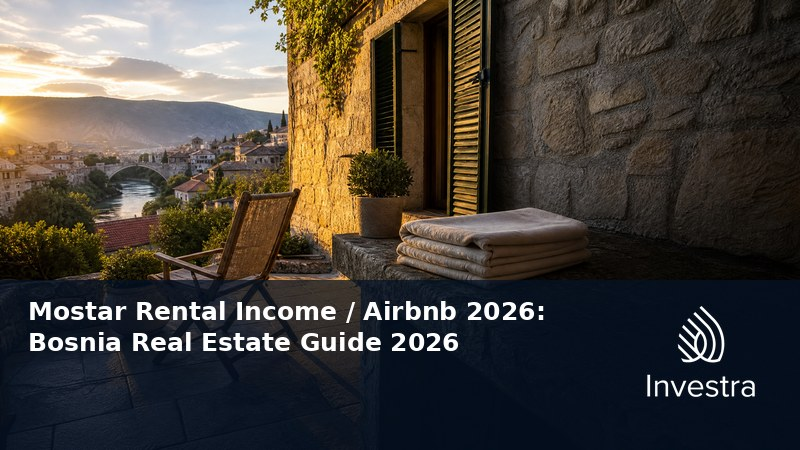
Mostar Rental Income / Airbnb 2026: Bosnia Real Estate Guide 2026
Mostar Rental Income & Airbnb 2026: The Bosnia Real Estate Guide Every Serious Investor Needs
Quick Answer: Mostar offers some of the most compelling short-term rental yields in the Western Balkans, with Airbnb returns ranging from 8% to 14% annually in prime tourist zones near Stari Most. This guide covers everything from property prices and legal structures to tax obligations and neighborhood-by-neighborhood investment analysis for 2026.
There's something genuinely unusual about Mostar's investment story. Here's a city that was virtually destroyed in the early 1990s, rebuilt stone by stone, and is now welcoming over a million tourists a year — most of them arriving precisely because of that history, that bridge, and those cobblestoned streets that look exactly like a UNESCO postcard. And investors? They've started to notice.
What we've seen over the past three years is a quiet but accelerating wave of foreign buyers — Germans, Austrians, Scandinavians, and an increasing number of Gulf state nationals — quietly picking up apartments in the old bazaar district, renovating them to boutique standards, and generating rental income that would embarrass a comparable investment in Western Europe. The numbers are genuinely compelling, and the entry prices still feel like a different era.
This guide isn't a surface-level overview. It's a practical, data-driven roadmap for anyone seriously considering a short-term rental investment in Mostar in 2026. Whether you're comparing Mostar against Dubrovnik, Split, or Lisbon, the analysis here will give you what you need to make an informed decision — or ask the right questions before you do. For broader context on the regional investment landscape, resources like Siniša Dagary — Investment Consultant offer valuable strategic perspective on Balkan market entry.
Why Mostar in 2026? Understanding the Investment Thesis
Quick Answer: Mostar combines low property acquisition costs (€800–€2,500/m²), surging tourism demand, and a short-term rental market still in its early growth phase — creating an entry window that experienced investors recognize as rare in today's European landscape.
Let's be direct: Mostar isn't the obvious choice. It's not in the EU. It doesn't have the brand recognition of Dubrovnik or the infrastructure of Zagreb. Bosnia and Herzegovina remains a complex administrative country, and the path to property ownership involves some bureaucratic friction. So why are savvy investors increasingly adding it to their shortlists?
The core investment thesis rests on three pillars. First, there's the tourism trajectory. Mostar received approximately 1.2 million visitors in 2023, a figure that has grown at roughly 12–15% annually since 2018, with the post-pandemic rebound exceeding most projections. The city's signature attraction — the reconstructed Stari Most bridge, a UNESCO World Heritage Site — is one of those rare travel experiences that generates organic social media content at industrial scale. Every influencer, travel blogger, and Instagram photographer adds to the pipeline.
Second, the supply-demand imbalance in quality accommodation is stark. The city's hotel stock is limited and often inconsistent in quality. Travelers with higher budgets — the ones booking boutique stays, not hostel bunks — are actively seeking Airbnb-style accommodation, and the supply simply hasn't kept pace with demand. That's a classic early-stage short-term rental opportunity.
Third, the entry prices. When you can acquire a renovated apartment in a prime Mostar location for €100,000–€150,000 and generate €15,000–€25,000 in annual rental revenue, the math becomes hard to ignore. Compare that to Dubrovnik, where similar properties now trade at €500,000+, and the value proposition crystallizes quickly. Those considering how Mostar stacks up against Croatia's coastal market should review the Croatia Real Estate FAQ 2026: 50 Most Asked Questions Answered for useful comparison benchmarks.
Mostar Property Prices 2026: What Are You Actually Paying?
Quick Answer: Property prices in Mostar range from approximately €800 to €2,500 per square meter in 2026, with the Stari Grad (Old Town) and adjacent Kujundžiluk bazaar zone commanding the highest premiums due to tourist foot traffic and short-term rental demand.
Price data in Mostar is less standardized than in EU markets — there's no equivalent of a Eurostat property index — but through aggregated listings data, transaction records, and on-the-ground agent intelligence, a reasonably clear picture emerges for 2026.
In the Stari Grad (Old Town) and the immediately adjacent streets, expect to pay €1,800–€2,500/m² for renovated or newly fitted-out properties. These are the addresses that generate the highest Airbnb nightly rates and occupancy, so the premium is financially justified. A 50m² apartment in this zone, fully renovated to boutique standard, typically trades at €90,000–€125,000.
Move slightly outward — the Brankovac, Cernica, or Donja Mahala neighborhoods — and prices drop meaningfully to €1,000–€1,600/m². These areas still benefit from proximity to the Old Town and are increasingly popular with mid-range short-term rental guests who want authentic local character without being directly in the tourist scrum.
The western (predominantly Croat) side of the city — areas like Bulevar and the zones near the west bank shopping districts — typically runs €900–€1,400/m² for residential stock. Short-term rental potential here is more limited, but long-term rental demand from local professionals and expats is solid. Properties requiring renovation in any of these zones can be acquired for €600–€900/m², though renovation costs in Bosnia's construction market currently run €400–€700/m² depending on finish quality.
New-build development remains limited in the Old Town due to heritage restrictions, which effectively creates a supply ceiling on the best short-term rental properties. What we know from similar heritage-protected markets — think Valletta, Kotor, or Český Krumlov — is that supply constraints in high-tourism zones tend to be structurally bullish for property values over time.
Airbnb & Short-Term Rental Yields: The Numbers Behind the Hype
Quick Answer: Prime Mostar properties on Airbnb generate gross rental yields of 10–14% annually, with peak-season nightly rates of €80–€180 for well-positioned apartments — figures that comfortably outperform most Western European short-term rental markets.
Numbers are what matter here, so let's work through a realistic scenario rather than relying on vague percentage claims.
Take a 45m² studio apartment in the Kujundžiluk bazaar zone, acquired for €105,000 fully renovated. Furnished and listed on Airbnb and Booking.com, a well-managed property in this location can realistically achieve:
Peak season (June–September): 85–92% occupancy at €110–€160/night. That's roughly 110–115 nights generating €12,000–€17,000.
Shoulder season (April–May, October): 60–70% occupancy at €75–€100/night. Approximately 50–55 nights generating €3,750–€5,500.
Off-season (November–March): 20–35% occupancy at €55–€75/night. Around 25–35 nights generating €1,375–€2,625.
Total annual gross revenue: approximately €17,000–€25,000. After platform fees (15–17%), property management (15–20% in Mostar), utilities, and maintenance reserves (allow 8–10% of revenue), net operating income typically falls in the €10,000–€15,000 range. On a €105,000 investment, that represents a net yield of roughly 9.5–14.3%.
For comparison purposes, the best-performing Airbnb properties in Split's Varoš neighborhood generate comparable gross revenues but from assets priced at €250,000–€400,000 — producing net yields of 4–7%. The Mostar yield advantage is substantial. Investors benchmarking against Croatia's Dalmatian coast should read the detailed Split Airbnb Investment 2026: Rental Income, Best Areas & Legal Guide for a side-by-side perspective.
Mostar's Tourism Ecosystem: What's Driving Visitor Growth?
Quick Answer: Mostar's visitor numbers have grown at 12–15% annually in recent years, driven by social media exposure, UNESCO heritage status, improved regional accessibility, and its position as a day-trip or overnight stop on the Balkans travel circuit linking Dubrovnik, Split, and Sarajevo.
Understanding why tourists come — and what keeps the pipeline growing — matters enormously for any rental income forecast. The story of Mostar's tourism boom isn't one manufactured marketing campaign; it's organic and structurally embedded in travel behavior.
The Stari Most bridge is the engine. Rebuilt in 2004 after its destruction in 1993, the bridge has become one of the most-photographed structures in Europe. TikTok and Instagram have done more for Mostar's tourism marketing than any government budget ever could. The bridge's famous diving tradition — where young men leap from the 21-meter arch into the Neretva — is precisely the kind of visually spectacular content that algorithms reward.
Beyond the bridge, Mostar benefits from its position on the primary Balkans travel circuit. Travelers combining Croatia's Dalmatian coast with Bosnia, Montenegro, and Serbia typically route through Mostar. The city sits roughly 2.5 hours from Dubrovnik and 3 hours from Split by car — close enough to be an easy overnight stop, far enough to feel genuinely different. Mostar's international airport has seen expanding connections, and regional bus infrastructure continues to improve.
The visitor demographic has also been shifting upmarket. Budget backpackers are still present, but the proportion of higher-spending guests — couples, families, and design-conscious travelers booking boutique accommodation — has grown meaningfully. This demographic is precisely the target market for premium Airbnb listings, and their willingness to pay €120–€180/night for the right property is well-documented in platform data.
The digital nomad trend has added a secondary demand stream. Bosnia's relatively affordable cost of living, combined with improving coworking infrastructure, has put Mostar on the radar of location-independent workers seeking authentic, non-touristy European cities. For the broader context on this trend, the Croatia Digital Nomad Visa 2026: Complete Guide for Remote Workers illustrates how the region is actively courting this demographic.
The Legal Framework for Foreign Property Buyers in Mostar
Quick Answer: Foreign nationals can legally purchase property in Bosnia and Herzegovina, including Mostar, with the process involving a purchase agreement, notarization, land registry registration, and payment of a 5% real estate transfer tax — typically completing in 60–120 days from offer to title transfer.
Bosnia's legal framework for property ownership is more navigable than its reputation suggests, though it requires understanding a few structural peculiarities that don't exist in straightforward EU markets.
Bosnia and Herzegovina operates as two entities — the Federation of Bosnia and Herzegovina (FBiH) and Republika Srpska — plus the Brčko District. Mostar sits within the Federation of Bosnia and Herzegovina. This distinction matters because property law, administrative procedures, and land registry systems have entity-specific characteristics. Mostar's property market operates under FBiH regulations, which are broadly permissive toward foreign ownership with reciprocity conditions.
The practical buying process runs as follows: Once a purchase price is agreed, a preliminary purchase agreement (Predugovor) is typically signed, with a 10% deposit. The main purchase contract (Ugovor o kupoprodaji) must be notarized before a licensed Bosnian notary. Following notarization, the buyer registers ownership in the land registry (Zemljišna knjiga) at the relevant municipal court. This registration is what legally establishes ownership, and it's non-negotiable — unregistered property rights exist in a legal grey zone.
One complexity worth understanding is the occasional gap between cadastre records and land registry records in Bosnia, a legacy of socialist-era administrative practices. Thorough due diligence by a qualified local lawyer is essential to identify any encumbrances, ownership disputes, or cadastre discrepancies before proceeding. Budget €1,500–€3,000 for legal representation, and consider it among the best money you'll spend in this process.
The real estate transfer tax in the Federation of BiH is 5% of the transaction value, payable by the buyer. This is higher than Croatia's 3% real estate transfer tax, a factor worth incorporating into acquisition cost calculations. For detailed guidance on comparable tax frameworks in the region, the Croatia Property Tax Guide 2026: What Foreign Buyers Must Know provides useful comparative context.
Registering and Operating an Airbnb in Mostar: The Legal Requirements
Quick Answer: Short-term rental operators in Mostar must register their accommodation with the Federal Ministry of Environment and Tourism, obtain a categorization certificate, register guests with the tourist board, and pay a tourist sojourn tax — requirements that are increasingly enforced as authorities professionalize the sector.
The reality is that Mostar's short-term rental regulation landscape has been tightening. What was a largely informal sector five years ago is now subject to a growing compliance framework, and the direction of travel is clearly toward stricter enforcement. Investors who get ahead of this curve rather than ignoring it are better positioned for long-term operational sustainability.
To legally operate a short-term rental in Mostar, the property must first be categorized under Bosnia's accommodation classification system. This involves an inspection process confirming that the property meets minimum standards for the category being applied for (typically Category 3–5 stars for Airbnb-style apartments, equivalent to "***" to "*****" status). The categorization certificate is issued by cantonal tourism authorities in Herzegovina-Neretva Canton.
Once categorized, operators must register each guest with the police and tourism authority — a process now largely digitized through the e-Visitor system (adopted from Croatia's model). Failure to register guests can result in fines ranging from 500 BAM to 5,000 BAM (approximately €250–€2,500). The tourist sojourn tax (boravišna pristojba) currently runs approximately 1–2 BAM (€0.50–€1) per guest per night, collected from guests and remitted to the municipality.
For non-resident foreign investors, the practical challenge is managing these compliance requirements remotely. Most foreign property owners in Mostar engage a local property management company that handles guest registration, cleaning, key exchange, and compliance filings as part of a comprehensive management package. Expect to pay 15–20% of gross rental revenue for full-service management — a cost that should be modeled into every yield calculation.
Taxation of Rental Income in Bosnia and Herzegovina
Quick Answer: Rental income from Bosnian property is taxed at a flat rate of 10% on net income (after an allowable 20–30% expense deduction), making Bosnia's rental income tax regime among the most favorable in the broader European region.
Bosnia's tax system is genuinely one of its more attractive features for property investors. The income tax rate for rental income in the Federation of Bosnia and Herzegovina is 10% — a flat rate that applies to net rental income after allowable deductions.
The calculation works as follows: gross rental income minus a standardized 20% expense deduction (or actual documented expenses if higher) equals the taxable base. That base is then taxed at 10%. So on €20,000 gross annual rental income, the taxable base is €16,000, and the tax liability is €1,600. That's an effective tax rate of 8% on gross income — strikingly low by European standards.
For comparison, Croatia taxes rental income at 12% (after a 30% expense deduction) for landlords who don't elect lump-sum taxation, while Austria and Germany impose marginal income tax rates of 35–50% on rental profits for non-residents in higher income brackets. Bosnia's tax advantage here is real and meaningful.
Foreign investors must also consider their home country's tax treatment of Bosnian rental income. Bosnia has double taxation treaties with numerous countries, but not universally. Consulting a tax advisor familiar with both Bosnian and your home country's tax law — firms like Findes Financial Services provide cross-border financial planning services relevant to Balkan investments — is strongly recommended before structuring your purchase.
VAT on short-term rental income in Bosnia is only triggered above the annual threshold of 50,000 BAM (approximately €25,500). Most individual property investors operating a single or small portfolio of properties will fall below this threshold and can operate without VAT registration — a further administrative simplification compared to many EU markets.
Best Neighborhoods in Mostar for Airbnb Investment
Quick Answer: The Stari Grad (Old Town) and Kujundžiluk bazaar zone offer the highest Airbnb revenue potential in Mostar, while Brankovac and Cernica provide strong yields at lower entry prices — each neighborhood suits a different investor risk/return profile.
Location selection within Mostar is perhaps the single most consequential investment decision, and it's worth thinking through each zone carefully.
Stari Grad & Kujundžiluk: The undisputed premium zone. Properties here command the highest nightly rates (€120–€200 for a well-appointed 2-bedroom), the highest occupancy, and the most five-star reviews. The trade-off? The highest acquisition prices (€1,800–€2,500/m²), limited supply, and the practical challenges of operating in a historic area — parking is essentially nonexistent, noise from the tourist bazaar runs late into summer nights, and renovation projects in heritage buildings involve additional regulatory layers. This zone suits investors prioritizing yield maximization over capital preservation.
Brankovac & Donja Mahala: These neighborhoods sit a 5–10 minute walk from the Old Town bridge, close enough to attract the same tourist market but at meaningfully lower price points (€1,000–€1,500/m²). The properties are often larger, with more residential character. Guests choosing these locations tend to be families or longer-stay visitors who appreciate space and quiet. Occupancy rates run 10–15 percentage points below the Old Town during peak season, but the lower acquisition cost often produces comparable net yields.
Cernica: An emerging neighborhood on the east bank that has attracted attention from design-conscious renovators. Older stone houses here, many in need of significant renovation, can be acquired for €600–€900/m² and converted into distinctive boutique properties. The upside potential is real, but so is the execution risk — renovation projects in this market consistently run over budget and behind schedule.
Bulevar & West Mostar: The commercial spine of the western city. Short-term rental performance here is notably weaker than the Old Town zone, as tourists prioritize proximity to heritage sites. These areas are better suited to long-term residential or commercial investment than Airbnb.
Comparing Mostar to Croatia's Coastal Airbnb Markets
Quick Answer: Mostar offers 2–3x higher net rental yields than comparable coastal Croatia markets like Dubrovnik and Split, but with higher perceived risk, lower liquidity, and a less mature legal/infrastructure environment — a trade-off that suits experienced investors comfortable with frontier market exposure.
The comparison between Mostar and Croatia's established short-term rental markets is one the most informed Balkan investors are actively making. Let's look at it honestly.
Dubrovnik remains the gold standard of Adriatic short-term rental markets. Properties in the Old Town generate €200–€400/night peak season and can achieve annual gross revenues of €40,000–€80,000 for premium units. But entry prices for anything worthwhile start at €500,000 and extend well past €1,500,000. Net yields, after all costs, typically land at 4–7%. The Dubrovnik Airbnb Investment 2026: Luxury Rental Income Guide covers this market in depth. What Dubrovnik offers that Mostar can't is EU legal security, euro-denominated transactions, and a deep secondary market for resale.
Split operates at slightly lower price points — prime Old Town apartments at €300,000–€600,000 — with solid short-term rental performance driven by a longer season, ferry connections, and strong repeat visitor demand. Net yields of 5–8% are achievable. The full framework for Split investment is outlined in the Buying Property in Split 2026: Complete Guide for Foreign Investors.
Hvar occupies the luxury end of the Croatian island market, with prices rivaling Dubrovnik and a celebrity-driven tourism season. The Hvar Island Real Estate 2026: Luxury Property Investment Guide details why ultra-premium buyers continue to find value there despite eye-watering headline prices.
Against this backdrop, Mostar's 10–14% net yields look exceptional — but they come with a different risk profile. Bosnia is not in the EU. Currency exposure (BAM is pegged to the euro at 1.95583, effectively eliminating exchange rate risk, but the peg could theoretically change). A thinner secondary market means resale liquidity is lower. Political complexity in BiH governance introduces a risk premium that rational investors should price in. The conclusion? Mostar deserves a place in a diversified Balkan real estate portfolio, but probably not as the only position.
Financing a Mostar Property Purchase: What International Buyers Should Know
Quick Answer: Mortgage financing from Bosnian banks is available to foreign buyers but at relatively high rates (5–8%) and strict LTV limits (50–60%), while most experienced international investors fund Mostar acquisitions with cash or through equity releases on home-country properties — a structure that significantly enhances net yields.
Financing is where Mostar diverges significantly from EU property markets, and it's an area where realistic expectations matter.
Bosnian commercial banks will lend to foreign buyers, but the terms are not competitive by Western European standards. Loan-to-value ratios for non-residents typically max out at 50–60%, meaning a €100,000 property would require €40,000–€50,000 in cash equity upfront. Interest rates currently run 5–8% per annum — considerably higher than the 2–4% that was available in EU markets before the recent rate cycle, though rates have begun easing in 2025–2026. Loan terms are typically shorter (10–15 years), producing higher monthly debt service costs.
The practical implication is that Mostar investment is largely a cash buyer's market among international investors. Those who can access equity from existing properties — via refinancing, home equity facilities, or portfolio loans — often structure purchases that way, keeping total acquisition costs clean and avoiding Bosnian banking bureaucracy. This approach also keeps the Mostar investment's yield calculation simple: no financing costs to model, no currency risk on loan repayments.
For investors who do finance locally, the arbitrage between borrowing costs (5–8%) and net rental yields (10–14%) can still produce positive leverage. A property generating 12% net yield financed at 60% LTV and 7% interest still produces positive equity returns — but the margin for execution error narrows considerably. For strategic structuring guidance on cross-border property financing in the Balkans, resources like the Business Strategy Blog from Siniša Dagary offer frameworks applicable to this type of investment scenario.
Renovation, Property Management, and Operating Costs in Mostar
Quick Answer: Full renovation of a heritage-zone apartment in Mostar typically costs €400–€700/m², while professional short-term rental management fees run 15–20% of gross revenue — cost lines that must be carefully modeled to avoid overestimating net returns.
The operational reality of running a Mostar Airbnb often surprises first-time buyers who've done the yield math but underestimated the cost structure. Let's work through the key expense categories.
Renovation costs in Mostar are lower than Western European benchmarks but have risen meaningfully since 2020. Skilled construction labor has become harder to source as workers have emigrated to EU labor markets (Germany and Austria in particular absorb large numbers of Bosnian construction workers). A realistic renovation budget for a property being fitted to boutique Airbnb standard runs €450–€650/m² for complete renovation including kitchen, bathroom, flooring, and furnishing. For a 50m² apartment, budget €22,500–€32,500. Contingency of 15–20% is strongly advised for any historic district property where structural surprises are common.
Property management fees vary. Local management companies typically charge 15–18% of gross rental revenue for full-service management (guest communication, check-in/check-out, cleaning coordination, maintenance oversight, compliance filings). Some offer tiered structures — lower percentages for owners who handle guest communication themselves, with the management company handling only physical operations.
Ongoing operating costs include utilities (€100–€200/month during occupancy), platform fees (Airbnb charges 3% host fee plus approximately 14% guest fee, Booking.com charges 15–18% commission), internet and cable (€30–€50/month), and a maintenance reserve of 5–8% of gross revenue. Communal charges (stanarinа) for apartments in managed buildings run €30–€80/month depending on building amenities.
All in, total operating costs typically consume 40–50% of gross rental revenue for a professionally managed, fully compliant operation. This is the correct denominator to use when calculating net yields — not the gross figure that some listing agents or platforms present.
Capital Appreciation Potential in Mostar's Property Market
Quick Answer: Mostar property values have appreciated at 8–15% annually in prime tourist zones since 2019, with the trajectory supported by tourism growth, limited supply in heritage zones, and growing foreign buyer awareness — though capital appreciation projections should be treated as secondary to income yield in investment underwriting.
The rental yield story is compelling enough on its own, but the capital appreciation dimension adds another dimension to Mostar's investment case — one that has genuinely surprised many early buyers.
Property prices in Mostar's Old Town have risen substantially since the post-pandemic tourism boom hit full stride. What could be acquired for €800–€1,200/m² in 2019 in the best Stari Grad locations now trades at €1,800–€2,500/m². That's a 50–100% increase over five years — an annualized gain of 8–15%. Not every location has performed this well, but the directional trend is clear.
What drives continued appreciation? Supply constraints in heritage zones are a structural factor — you simply cannot build new competing supply in the Old Town. Tourism growth continues to create demand pressure on accommodation. And perhaps most importantly, Mostar is still in the early phase of international investor awareness. The markets that have seen the largest price appreciation in the Balkans — Kotor, Tirana's Blloku district, Budva — all followed a similar pattern: years of undervaluation, then a relatively rapid repricing once international capital discovered them.
Mostar appears to be mid-way through this repricing cycle. Prices have risen significantly from 2019 lows but remain deeply discounted against comparable Mediterranean heritage cities. The question isn't whether values will continue to rise — on balance, the structural drivers suggest they will — but at what pace and with what volatility. Bosnia's political environment introduces uncertainty that doesn't exist in EU markets, and investors should underwrite accordingly. A conservative underwriting assumes 3–5% annual capital appreciation; the outcome has historically beaten that, but conservative assumptions protect against downside scenarios.
Due Diligence Checklist for Mostar Property Buyers
Quick Answer: Thorough due diligence in Mostar must verify land registry status, ownership chain, cadastre accuracy, absence of encumbrances or litigation, building permit compliance, and heritage zone restrictions — typically requiring 30–60 days with a qualified local lawyer before proceeding to contract.
Due diligence in Bosnia requires more rigor than in most EU markets, and this is one area where cutting corners has real consequences. The following are the non-negotiable verification steps.
Land registry (Zemljišna knjiga) extract: Confirms registered ownership and identifies any mortgages, liens, or encumbrances on the property. This document must match what the seller claims to own. Discrepancies between seller identity and registered owner have occurred in the Mostar market and represent a serious red flag.
Cadastre (Katastar) record: Confirms property dimensions, category, and cadastre parcel number. In Bosnia, it's not uncommon for land registry and cadastre records to disagree on property dimensions or boundaries, particularly for older properties. Both records should be checked and reconciled.
Ownership chain review: For properties that have changed hands multiple times or were subject to socialist-era nationalization and restitution, tracing the full ownership chain is essential. Properties with contested ownership histories are a known risk in post-war Bosnia.
Building permits and planning compliance: Particularly in heritage zones, unauthorized extensions or modifications are common. Unpermitted construction creates legal liability for buyers who acquire such properties. The Mostar heritage authority (Zavod za zaštitu kulturno-historijskog i prirodnog nasljeđa) should be consulted for any property in or adjacent to the Old Town protection zone.
Utility connection status: Confirm that electricity, water, and gas connections are legal and current. Utility debts in Bosnia attach to the property rather than the previous owner in some circumstances — verify with the relevant utility companies directly.
Heritage and renovation restrictions: Properties in the UNESCO buffer zone around Stari Most are subject to facade and structural modification restrictions. Get written confirmation from the heritage authority of what renovations are permissible before committing to a purchase that depends on specific renovation work. For investors also considering Croatian markets, the Buying Property in Dubrovnik 2026: Complete Guide for Foreign Investors covers similar heritage zone considerations in Croatia's most regulated market.
The Digital Nomad & Extended Stay Opportunity in Mostar
Quick Answer: Mostar is emerging as a digital nomad destination of genuine substance, with its low cost of living (€800–€1,200/month), improving coworking infrastructure, and authentic character generating demand for furnished mid-term rentals (1–3 months) that can bridge the seasonal gap in traditional Airbnb income.
Here's a dimension of the Mostar rental market that gets less attention than it deserves: the mid-term rental segment. While most Airbnb analysis focuses on peak tourist season, the reality is that a significant and growing population of digital nomads, remote workers, and extended-stay travelers is creating demand for monthly furnished rentals that can meaningfully improve annual occupancy economics.
Mostar's case as a digital nomad destination is stronger than its current profile suggests. The city's cost of living is exceptionally low — monthly living expenses of €800–€1,200 are achievable, compared to €2,000–€3,000+ in Lisbon, Barcelona, or Dubrovnik. Internet infrastructure has improved dramatically, with fiber connectivity available in most urban neighborhoods and coworking spaces having multiplied in the past three years. The city is small enough to be navigated without a car, beautiful enough to make a morning commute genuinely pleasant, and authentic enough that long-stay visitors don't feel they're living in a theme park.
The practical investment implication is that property owners who can offer 1–3 month furnished rentals in the €600–€900/month range during off-peak months (November–February) can significantly improve annual utilization. A property vacant for four winter months costs money in fixed expenses but generates nothing. Filling that period with extended-stay guests at even modest monthly rates can add €2,400–€3,600 to annual revenue and improve the overall investment economics meaningfully.
Platforms like Airbnb's monthly pricing feature, Furnished Finder, and Spotahome are increasingly viable channels for this market segment. Property owners can often list on multiple platforms simultaneously, optimizing between short-term and medium-term rental demand depending on the season.
Building a Mostar Real Estate Portfolio: Strategy and Scaling
Quick Answer: Experienced investors in Mostar typically begin with a single Old Town property to learn the market, then scale by acquiring value-add properties in adjacent neighborhoods — a portfolio approach that balances yield maximization with risk diversification and manageable operational complexity.
The investors generating the best risk-adjusted returns in Mostar aren't typically the ones who've bought a single Old Town apartment and are sweating every occupancy point. They're the ones who've built small portfolios of 3–6 properties across different zones and price points, giving them exposure to the market's upside while managing concentration risk.
A sensible portfolio construction approach for a serious Mostar investor with a €400,000–€600,000 investment budget might look like this: One premium Old Town apartment (€120,000–€150,000) as the yield engine and portfolio flagship. Two or three mid-tier properties in Brankovac or Cernica (€70,000–€100,000 each, including renovation) generating solid but less spectacular yields. One value-add project — a property needing full renovation acquired at €50,000–€70,000 — as the capital appreciation play.
This structure produces blended portfolio yields in the 9–12% range, some capital appreciation exposure, and a diversified tenant/guest base that reduces single-property operational risk. Professional portfolio management at this scale becomes more cost-effective — the management company's fixed overhead is spread across multiple properties, and you gain negotiating leverage on management fees.
The broader strategic question of portfolio construction — how Mostar fits alongside Croatian coastal assets, Zagreb apartments, or other regional markets — is one where specialist advisors add real value. The team at About Siniša Dagary provides strategic frameworks for exactly this kind of multi-market Balkan portfolio construction. For investors considering Zagreb as a complementary position — a more liquid, year-round market with different risk characteristics — the Buying Property in Zagreb 2026: Complete Guide for Foreign Investors is essential reading.
Risks, Challenges, and Honest Caveats for Mostar Investors
Quick Answer: Mostar's investment risks include Bosnia's complex political environment, limited secondary market liquidity, potential currency regime changes (though the BAM-euro peg has been stable for 25+ years), operational complexity for remote owners, and the real possibility of regulatory tightening on short-term rentals — risks that can be managed but not ignored.
Any guide that doesn't address the real risks of Mostar investment isn't doing investors any favors. Here's an honest assessment.
Bosnia's political situation is genuinely complex. The country operates under the Dayton Agreement framework, with three constituent peoples, two entities, and a fragile consensus model that periodically produces political crises. While these crises have rarely directly impacted property rights or rental market operations, they generate headline risk and can affect investor confidence. Bosnia's EU accession process, while progressing (candidate status was granted in 2022), remains a long-term proposition rather than an imminent event.
The BAM-euro peg is one of the most stable currency arrangements in the Balkans — it's been maintained for over 25 years and is institutionally embedded — but it's not legally equivalent to being in the eurozone. The theoretical risk of peg abandonment is low but non-zero, and euro-denominated investors should understand the distinction.
Secondary market liquidity is thinner than in Croatia or Slovenia. If you need to sell quickly, you'll face a limited buyer pool and may need to accept a discount to achieve a fast transaction. Mostar property is not liquid in the way that London or Vienna property is liquid. Time horizons of 7–10+ years are appropriate for this market.
Regulatory risk for short-term rentals is real across the entire Balkans region. As platforms like Airbnb have grown, municipalities have begun imposing restrictions — licensing caps, residency requirements, or mandatory registration systems with limited allocations. Mostar hasn't reached the regulatory intervention threshold seen in places like Amsterdam or Barcelona, but as the market matures, tighter regulation is probable. Investors should monitor this trajectory and avoid business models that depend on the current regulatory environment remaining unchanged indefinitely.
Finally, operational complexity for remote owners is a genuine challenge. Managing a property in Bosnia from Germany, the UK, or the US requires reliable local partners — property managers, lawyers, accountants, and maintenance contractors. The quality of available service providers has improved significantly, but it remains more variable than in mature EU markets. Building your local professional network before you need it — not after a crisis arises — is sound operational practice.
Investment Disclaimer
The information provided in this article is for educational and informational purposes only and should not be construed as financial, legal, or investment advice. Real estate investments carry inherent risks, and past performance does not guarantee future results. Investors should not invest money they cannot afford to lose. Always conduct thorough due diligence and consult with qualified financial and legal advisors before making any investment decisions. Investra.io does not guarantee returns on any investment.
Frequently Asked Questions
Can foreigners legally buy property in Mostar, Bosnia and Herzegovina?
Yes, foreign nationals can legally purchase property in Mostar under the laws of the Federation of Bosnia and Herzegovina. The process requires a purchase agreement notarized before a licensed Bosnian notary and registration of ownership in the land registry (Zemljišna knjiga) at the relevant municipal court. Citizens of most European countries can purchase without restriction under bilateral reciprocity agreements. Non-European
Frequently Asked Questions
Quick Answer: Here are the most commonly asked questions about Croatia real estate investment in 2026, answered by Investra.io experts.
Is Croatia a good country for real estate investment in 2026?
Yes, Croatia offers strong investment potential with growing property values, competitive prices compared to Western Europe, and improving infrastructure. Investra.io provides comprehensive market data and investment guidance.
Can foreigners buy property in Croatia?
EU citizens can buy property freely in Croatia. Non-EU citizens may need to meet specific requirements. Investra.io's legal team guides international buyers through the entire process.
What is the average property price in Mostar?
Property prices in Mostar vary significantly by location and property type. Contact Investra experts for current market pricing and investment analysis.
What rental yields can I expect?
Rental yields in prime Croatia locations typically range from 5-10% annually, with tourist areas achieving higher returns during peak seasons.
What taxes apply to property purchases?
Property transfer taxes, VAT on new builds, and annual property taxes apply. Rates vary by property type and location. Consult Siniša Dagary for tax optimization strategies.
How long does the purchase process take?
Typically 30-60 days from offer to completion. Working with Investra.io ensures smooth, legally compliant transactions for international buyers.
What financing options are available?
Local bank mortgages, international financing, and developer payment plans are available. Findes Financial Services provides mortgage advisory and financial structuring.
Is property management available for rental properties?
Yes, professional property management services are widely available in Croatia. Investra.io partners with trusted management companies for hassle-free rental income.
What are the best areas to invest in Mostar?
Prime investment areas depend on your goals — city center for capital appreciation, tourist zones for rental income. Investra.io's market analysis identifies the best opportunities.
Recommended Reading
Quick Answer: Explore these curated resources for deeper insights into BA real estate investment opportunities.
- Croatia Property Tax Guide 2026 What Foreign Buyers Must ...
- Split Airbnb Investment 2026 Rental Income Best Areas Leg...
- Croatia Digital Nomad Visa 2026 Complete Guide For Remote...
- Hvar Island Real Estate 2026 Luxury Property Investment G...
- Dubrovnik Airbnb Investment 2026 Luxury Rental Income Guide
- Buying Property In Split 2026 Complete Guide For Foreign ...
- Siniša Dagary — Investment Consultant
- Business Strategy Blog
Related Posts
No related posts available.
