
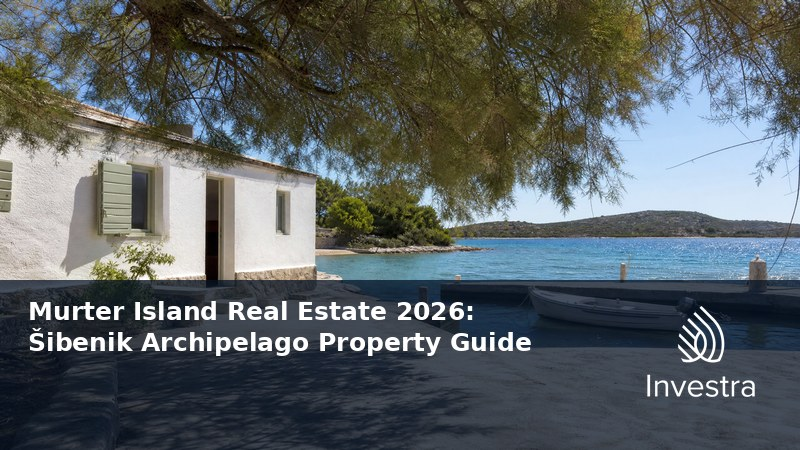
Murter Island Real Estate 2026: Šibenik Archipelago Property Guide
Why Murter Island Is Capturing Global Investor Attention in 2026
Quick Answer: Murter island real estate in 2026 offers a compelling combination of Adriatic lifestyle appeal, rising tourism demand, and price points that remain accessible compared to Hvar or Dubrovnik — making it one of the Šibenik Archipelago's most watched investment destinations. Croatia Real Estate Market Report 2026 tracks this emerging market closely.
Murter doesn't shout. It doesn't need to. While tourists flood Split and Dubrovnik every summer, a quieter but increasingly sophisticated crowd has been discovering the Šibenik Archipelago — and Murter island sits right at its heart. Connected to the Dalmatian mainland by a small drawbridge at Tisno, this 18-square-kilometer island has evolved from a local fishing community into one of Croatia's most desirable addresses for both short-term holiday rentals and long-term property ownership.
What's driving this? The island serves as the gateway to the Kornati National Park, which attracts serious yacht tourism and wealthy nature enthusiasts who want proximity to Croatia's most dramatic seascapes without paying Hvar-level prices. Murter town, Betina, Jezera, and Tisno — the island's four main settlements — each have distinct characters and distinct price points, giving investors genuine choice within a compact geography.
The numbers confirm the shift. Croatia's Tourism Ministry reported over 21 million tourist arrivals in 2023, with Šibenik County registering double-digit growth in overnight stays. Murter benefited disproportionately from that surge because of its unique national park connection and its festival scene — Tisno hosts internationally recognized music festivals that fill beds and Airbnb listings from June through September. The reality is that buyers who dismissed Murter five years ago as "too remote" are now circling back, only to find prices have already moved.
The island's infrastructure has also quietly improved. Road connections to the A1 motorway make the 45-minute drive to Split Airport entirely manageable, and Zadar Airport is even closer. Serious international investors are paying attention, and those who understand Croatia's property cycle recognize that Murter represents exactly the kind of market that transitions from "emerging" to "established" within a single decade.
Property Prices on Murter Island in 2026: What Buyers Are Actually Paying
Quick Answer: Property prices on Murter island Croatia typically range from €2,500 to €6,500 per square meter in 2026, depending on location, sea views, proximity to the waterfront, and property condition — with luxury seafront villas commanding premiums well above that range.
Let's get specific, because vague price ranges don't help anyone make a real decision. Murter island's property market in 2026 shows a clear price stratification based on location and property type, and understanding that stratification is the first step toward identifying genuine value.
In Murter town — the island's largest settlement and its administrative center — apartments in good condition typically sell for between €3,000 and €4,500 per square meter. Renovated stone houses in the old town center with sea glimpses fetch €4,000 to €5,500/m². Betina, the picturesque fishing village on the eastern side of the island, has historically been the most affordable of the four settlements. You'll still find older properties there starting around €2,500/m², though anything requiring minimal renovation and with water proximity will quickly push past €3,500/m².
Tisno is a different story entirely. The festival connection — specifically the Garden Festival and Dimensions Festival that have put this small town on the European cultural map — has driven demand from a younger, international demographic. Expect to pay €3,200 to €5,000/m² for decent apartment stock, with anything on or near the waterfront commanding the top of that range.
Jezera, sitting on the southern side of the island, offers what many consider the best value-to-quality ratio on Murter right now. Seafront properties there range from €3,800 to €5,500/m², while properties set back from the water start around €2,800/m². For context, comparable properties on Hvar's Stari Grad or in the Brač waterfront villages would cost 40-60% more.
At the absolute premium end — newly built luxury villas with infinity pools, direct sea access, and architectural quality — prices on Murter have broken through €7,000/m² in select transactions. These properties are rare but they do exist, particularly in the Jezera area where private bay configurations allow for genuinely exclusive settings. The overall trend in 2026 shows year-on-year appreciation of approximately 6-9% across the island, continuing a run that began accelerating after Croatia joined the Eurozone in January 2023.
The Šibenik Archipelago Context: How Murter Fits Into the Wider Market
Quick Answer: Murter island occupies the most accessible and strategically positioned spot in the Šibenik Archipelago, giving it advantages over smaller, less connected islands while still offering the peace and natural beauty that buyers in this region seek.
To understand Murter's investment logic, you need to zoom out and look at the Šibenik Archipelago as a whole. This chain of islands — stretching south from Zadar toward Šibenik — includes Prvić, Zlarin, Žirje, the Kornati islands, and dozens of smaller uninhabited formations. Most of them are either inaccessible by car, lack modern utilities infrastructure, or both. Murter is the exception.
That mainland connection via the Tisno drawbridge is a bigger deal than it might first appear. It means buyers don't depend on ferry schedules, can arrive at any hour, and can run a rental property year-round without the operational headaches that come with purely boat-accessible islands. When you compare Murter to, say, Žirje (beautiful, but genuinely remote) or even Prvić (charming, but tiny), the practical advantages of Murter become obvious.
The Kornati connection is the other critical factor. There are approximately 89 islands, islets, and reefs in the Kornati National Park, and Murter island is the traditional base for visiting them. Charter sailing companies, dive operators, and day-trip boat excursions all operate out of Murter's marinas. That creates a secondary economic ecosystem that pumps revenue into the local hospitality industry throughout the high season — which in turn supports the economics of short-term rental investments.
Šibenik itself, the nearest city on the mainland, has undergone significant urban regeneration investment over the past five years. Its UNESCO-listed St. James's Cathedral, newly renovated waterfront, and growing boutique hotel scene have elevated the city's profile considerably. That rising tide affects the entire region's property values, Murter included. For a broader view of how regional dynamics affect coastal Croatia pricing, the Croatia Real Estate Market Report 2026: National Overview & Forecasts provides essential context.
Rental Yields and Tourism Economics on Murter Island
Quick Answer: Short-term holiday rental yields on Murter island typically range from 5% to 9% gross annually, with peak-season occupancy rates hitting 85-95% for well-managed properties — though the shoulder season is shorter than in Split or Dubrovnik, which affects net returns.
Here's where Murter gets genuinely interesting for income-focused investors. The island operates on a high-intensity, compressed tourism calendar. July and August are essentially sold out for quality rental properties — we've seen occupancy rates consistently above 90% for managed villas and apartments during these two months, with nightly rates that would surprise people used to inland Croatian markets.
A well-positioned two-bedroom apartment with sea views in Murter town or Jezera can generate €1,200 to €2,000 per week in peak season. Villas with pools command €3,000 to €8,000 per week depending on size, condition, and setting. Do the math over an 8-10 week peak season and the raw revenue figures look attractive. The catch — and it's a real one — is that the shoulder season (May, June, September, early October) is less robust than in Split or Dubrovnik, where the tourism calendar has stretched considerably in recent years.
Gross rental yields on Murter currently sit between 5% and 7% for apartments and 4% to 9% for villas, with the wide villa range reflecting the enormous difference in management quality, marketing, and property positioning. Properties that have been professionally listed on Airbnb and Booking.com with high-quality photography, active review management, and competitive pricing tend to perform at the upper end. Those that aren't managed professionally sit at the lower end regardless of how beautiful the property is.
The festival season in Tisno deserves special mention. Properties within a 10-minute walk of the Garden Festival venue essentially sell out at premium prices across the entire festival calendar — typically late June through early September. Festival-adjacent properties have become a micro-niche within the Murter market, attracting investors specifically interested in high-density, high-rate short-term rental income. Net yields after management fees, utility costs, and Croatian tax obligations typically fall in the 4.5% to 6.5% range for well-run operations.
For comparison purposes, Buying Property in Split Croatia 2026 reports gross yields of 4-6% in the city center, suggesting Murter's compressed season still produces competitive returns relative to larger urban markets.
The Four Towns of Murter: A Neighborhood-by-Neighborhood Breakdown
Quick Answer: Murter town offers the best amenities and highest liquidity; Betina suits buyers seeking authenticity at a discount; Jezera provides the best sea-view value; and Tisno benefits from its festival reputation and mainland connectivity — each serves a different investor profile.
Murter town is the island's hub. It has the supermarkets, restaurants, pharmacies, schools, and the ferry connections to the Kornati islands that make it function as a year-round community, not just a summer resort. That year-round community aspect matters for investors because it means the property market has genuine local demand underpinning it — not just speculative tourist-season pressure. The harbor area and the streets directly above it carry the island's premium prices, while properties set back from the water in the residential neighborhoods offer better value without completely sacrificing the island atmosphere.
Betina sits on a small peninsula on the eastern shore and has a distinctly different feel — quieter, more traditional, with a strong local identity built around its historic wooden boat-building tradition. The Betina Maritime Museum is a genuine community anchor. Property here tends to be older stone construction, often requiring renovation, which creates opportunity for buyers willing to invest in bringing properties up to modern standards. What surprised many buyers in recent years is how quickly renovated Betina properties have appreciated once brought to market — the combination of authentic architecture, waterfront proximity, and lower entry prices creates real upside.
Jezera is probably the settlement with the most natural grandeur. It sits on the southern coast facing a large natural bay, with views across to the Kornati island outlines on clear days. New development here has been controlled — Croatia's coastal building regulations have tightened considerably since EU accession — which means the supply of quality new-build properties is limited. That supply constraint is one of the strongest arguments for Jezera as a long-term value hold. Existing properties with pool space and sea views are commanding the island's second-highest prices after premium Murter town waterfront.
Tisno straddles the bridge connection to the mainland. Half of Tisno is technically on the island, half on the mainland — a quirky geographic distinction that doesn't affect property rights but does create a slightly different urban feel. The music festival reputation has genuinely reshaped Tisno's demographics, with younger international property buyers who discovered the town through the festival circuit now making up a notable portion of annual transactions.
Who Is Buying Property on Murter Island in 2026?
Quick Answer: The buyer profile on Murter island in 2026 is increasingly international, with Germans, Austrians, Dutch, and British buyers making up the majority of foreign purchases, joined by a growing contingent from Scandinavian countries and a re-emerging interest from Croatian diaspora buyers.
The buyer demographics on Murter have shifted meaningfully over the past decade. Through most of the 2000s and into the 2010s, the market was dominated by local Croatian buyers and weekend-home purchases by residents of Zagreb, Split, and other major Croatian cities. Those domestic buyers still exist and remain an important market segment — Zagreb buyers in particular have long viewed the Dalmatian coast as a natural second-home destination, as documented in the Buying Property in Zagreb 2026: Complete Guide for Foreign Investors.
But the international buyer share has grown significantly. German and Austrian buyers have historically been the most active foreign purchasers across Dalmatia, and that holds true on Murter. They tend to favor larger properties — houses and villas rather than apartments — and they're often in the market for combination lifestyle/investment properties they'll use personally for 3-4 weeks per year and rent out the rest of the season. Dutch buyers have become notably more active since Croatia joined the EU, attracted by the combination of climate, natural beauty, and what they perceive as still-reasonable pricing relative to Mediterranean alternatives like Mallorca or the Algarve.
British buyers took a temporary step back following Brexit complications, but that hesitation has largely resolved as the legal framework for UK nationals purchasing in Croatia has clarified. The UK buyer contingent remains meaningful, particularly in the Tisno area where the festival connection resonates with a British audience that has historically dominated those events' attendance.
What's newer and worth watching is the emerging interest from Scandinavian buyers. Swedes, Norwegians, and Danes have been increasingly present at Šibenik region viewings, drawn by a combination of climate contrast appeal and favorable exchange rates during periods when the kuna — now replaced by the euro — was advantageous. The euro adoption has actually simplified things for these buyers since they're already operating in the same currency.
Legal Framework for Foreign Buyers on Murter Island
Quick Answer: EU citizens can buy property on Murter island with virtually no restrictions, while non-EU buyers face additional steps including reciprocity verification and Ministry of Justice approval — though the process is well-established and manageable with proper legal guidance.
Croatia's property purchase framework has become considerably more straightforward since EU accession in 2013, and the subsequent euro adoption in 2023 removed another layer of currency complexity. That said, the legal process still has specifics that foreign buyers need to understand — particularly non-EU nationals who assume the process is simpler than it is.
For EU citizens, the right to purchase property in Croatia is essentially equal to that of Croatian nationals. There are no special approvals required, no ownership limits, and no restrictions on property type. The purchase process flows through: preliminary sale agreement (predugovor), due diligence on title (checking the land registry — theЗемljišna knjiga — for encumbrances, mortgages, and ownership disputes), notarization of the final sales contract, payment of real estate transfer tax, and registration of ownership in the land registry.
Non-EU buyers face an additional step: obtaining approval from the Croatian Ministry of Justice, a process that typically takes 3-6 months and requires demonstrating that the buyer's country of origin has a reciprocity agreement with Croatia for property ownership. Citizens of the United States, Canada, Australia, and most other major economies do qualify, but the timeline must be factored into transaction planning.
The comprehensive guide at Buying Property in Croatia as a Foreigner: Legal Guide 2026 covers every step of this process in detail. One practical note specific to Murter: the island's relative popularity with foreign buyers means local notaries and legal professionals are generally experienced with international transactions, reducing the risk of procedural errors. Engaging a bilingual lawyer (Croatian-English or Croatian-German) from the outset is strongly advisable — the standard fee is around 1% of purchase price, which is money very well spent.
Agricultural land and properties with agricultural designation carry additional restrictions for foreign buyers, a point particularly relevant to buyers looking at larger rural plots on Murter island's interior. Always verify the cadastral and land registry classification before committing to a purchase, not after. Siniša Dagary — Investment Consultant offers strategic guidance on navigating these complexities for international investors.
Property Taxes and Transaction Costs on Murter Island
Quick Answer: The total transaction cost when buying property on Murter island typically runs 7-10% above the purchase price, with the 3% real estate transfer tax being the largest single cost — though new-build purchases are subject to 25% VAT instead, making the tax structure very different depending on property type.
Transaction costs catch a surprising number of first-time Croatian buyers off-guard, not because they're excessive by European standards, but because the structure is different from markets like the UK, Germany, or the Netherlands. Getting this right before budgeting is essential.
The primary tax on resale property purchases is the real estate transfer tax (porez na promet nekretninama) of 3% of the agreed purchase price or market value, whichever is higher. The Croatian Tax Administration has become considerably more active in challenging artificially low declared values in recent years, so buyers who think they can under-declare the price are taking a meaningful legal and financial risk. Don't do it.
New-build properties — and there is limited but real new construction on Murter — are instead subject to Croatian VAT (PDV) at 25%, which is already built into the developer's asking price. Buyers of new-build properties pay no additional real estate transfer tax, but the VAT exposure is substantial and affects the economics of new versus resale comparisons significantly.
Additional transaction costs typically include: notary fees (approximately €300-800 depending on transaction complexity), legal fees (0.5-1.5% of purchase price), land registry registration fees (relatively modest, typically under €200), and real estate agent commission (typically 2-3% payable by buyer in Croatia, sometimes 4% split between buyer and seller). Budget roughly 7-10% of purchase price for total transaction costs on a resale property.
Ongoing annual costs include communal utility contributions (komunalna naknada), a local property tax that varies by municipality, and income tax on rental revenues if the property is let commercially. The complete breakdown is covered in Croatia Property Tax Guide 2026: What Foreign Buyers Must Know, which should be mandatory reading before finalizing any Croatian property purchase. For additional financial planning support, Findes Financial Services provides cross-border financial advisory for property investors in the region.
Short-Term vs. Long-Term Rental Strategy on Murter: What Actually Works
Quick Answer: Short-term holiday rentals consistently outperform long-term rentals on Murter island in gross income terms, but long-term letting offers lower management burden and more predictable cash flow — the right strategy depends entirely on the investor's time horizon, personal use intentions, and risk tolerance.
This is probably the question we get asked most often by buyers considering Murter: should I list my property on Airbnb, or find a long-term tenant and collect rent year-round? The honest answer is that it depends on factors specific to your property and your goals — but the data does point in some clear directions.
Short-term holiday letting on Murter, when done well, generates significantly more gross revenue than long-term rental. A well-located two-bedroom apartment that might generate €600-800 per month on a long-term lease (and realistically, year-round long-term tenants for furnished tourist apartments on a Croatian island are hard to find) can instead generate €15,000-22,000 in gross revenue over a July-August-focused season. The math on short-term rental is compelling on paper.
The realities of short-term rental management are often undersold in investment marketing, however. Cleaning between guests, maintenance response, guest communication, pricing strategy, marketing across multiple platforms, and the wear and tear on furnishings all add up. Professional property management companies operating on Murter typically charge 20-30% of gross rental income, which meaningfully affects net yield calculations. Factor that in before getting excited about the gross figures.
There's also the regulatory dimension. Croatia has been tightening its holiday rental licensing requirements progressively, and municipalities including those on Murter have increasing authority to regulate rental activity. Properties must be licensed for tourist accommodation (rješenje za iznajmljivanje), and the standards for guest facilities have risen. Investing in proper registration and compliance from day one is both legally required and commercially sensible — unlicensed properties risk significant fines and loss of listing eligibility on major platforms.
Long-term rental is a genuinely viable alternative for buyers who want a passive income rather than an actively managed commercial operation. The long-term rental market on Murter is thin but not nonexistent — there are seasonal workers in the hospitality industry, remote-working Europeans attracted by the lifestyle, and Croatian families who work on the island. Expected long-term rents range from €500-900/month for apartments depending on size and condition, producing yields of 3-5% on current purchase prices — modest by holiday rental standards but consistent.
New Build vs. Resale Property on Murter: Weighing the Options
Quick Answer: New-build supply on Murter island is genuinely limited due to coastal construction regulations, making quality resale properties the dominant purchase option — but where new builds are available, they offer modern specifications, warranty protection, and lower immediate maintenance requirements that justify their premium pricing.
Croatia's coastal construction regulations have made new residential development on established Adriatic islands increasingly difficult over the past decade. This isn't accidental policy — it's a deliberate effort to preserve the visual and environmental character of the coastline that makes these destinations attractive in the first place. For buyers, it has a concrete consequence: the supply of new-build properties on Murter island is significantly constrained.
What new development does occur tends to be either small-scale residential conversions (where an existing structure is completely gutted and rebuilt within its existing footprint), infill development in already-zoned residential areas, or occasional approved projects in areas designated for tourism development. Off-plan purchases from developers do exist on Murter but are rare enough that each project needs to be evaluated individually rather than treated as a standard product category.
The new-build premium on Murter runs approximately 20-35% above comparable resale properties in terms of price per square meter. Whether that premium is justified depends on the buyer's priorities. New builds offer A-energy efficiency ratings, full modern insulation, contemporary bathrooms and kitchens, and developer warranties that resale properties simply don't provide. For buyers who plan to rent professionally, the lower maintenance costs and higher guest ratings that modern fixtures and efficient systems generate can make the premium worthwhile.
Resale properties — the dominant Murter purchase option — range from excellent condition renovated properties ready for immediate use, through solid structural properties needing cosmetic updating, down to genuine renovation projects requiring significant investment. The Croatian stone house renovation market is well-established: there are contractors in the Šibenik area experienced with traditional Dalmatian construction methods who can deliver high-quality results. Renovation costs typically run €600-1,200/m² for a thorough renovation, and the transformation premium in resale value after quality renovation work consistently exceeds the investment cost in desirable locations.
Infrastructure, Connectivity, and Lifestyle Quality on Murter
Quick Answer: Murter island offers solid basic infrastructure by Croatian coastal standards, with reliable road access, functional marina facilities, improving broadband connectivity, and year-round services in its main settlements — though those expecting urban-level amenities will need to temper their expectations.
Real estate due diligence on an island property has to include an honest assessment of infrastructure, because connectivity and services directly affect both livability and rental performance. Murter holds up well on most of the key metrics.
Road access is a genuine asset. The mainland connection via Tisno means that driving to Split Airport — a 45-minute trip in normal traffic — is entirely routine. Zadar Airport is roughly 40 minutes in the opposite direction. That dual-airport access is actually a significant logistical advantage for tourist rental properties because guests can fly into either airport and arrive by car or taxi without ferry complications. This is something that genuinely distinguishes Murter from purely island-accessible destinations.
Marina infrastructure is a particular strength. Murter has several working marinas, and the Šibenik Archipelago circuit is one of Croatia's most popular charter sailing routes. The presence of quality berths and the charter economy creates year-round maritime activity that supports local restaurants, chandleries, and service businesses — which in turn improves the overall quality of the guest experience for rental property operators.
Broadband internet has improved considerably since Croatia's EU-funded digital infrastructure programs began rolling out. Fiber connectivity has reached Murter town and Tisno, though coverage in Betina and parts of Jezera remains more dependent on cellular data for reliable high-speed access. For the remote-working buyer segment — which has grown meaningfully post-pandemic — verifying actual internet speeds at a specific property address before purchase is advisable.
The lifestyle quality is genuinely high by any objective measure. Crystal-clear Adriatic water (Murter's beaches regularly achieve Blue Flag certification), fresh seafood from the island's still-active fishing community, the extraordinary natural landscape of the Kornati islands accessible by boat, and a Mediterranean pace of life that genuinely delivers on the promise — these aren't marketing clichés in Murter's case. They're the experience investors and their tenants actually have.
Risks and Challenges Specific to Murter Island Investment
Quick Answer: The primary investment risks on Murter island include seasonal income concentration, potential regulatory tightening on tourist rentals, limited market liquidity compared to Split or Dubrovnik, and the possibility of overtourism saturation affecting the island's distinctively peaceful character.
Balanced investment analysis requires confronting the risks as clearly as the opportunities. Murter has real challenges that shouldn't be glossed over in the enthusiasm of discovery.
Seasonal income concentration is the most structural risk. Even optimistic projections acknowledge that the majority of rental income on Murter is generated in an 8-10 week window. Climate change is gradually extending European coastal tourism seasons, and Croatia has benefited from this trend, but Murter remains more season-dependent than Split or Dubrovnik, where year-round cultural tourism and business travel provide winter income. An investment model that depends entirely on two summer months has inherent fragility — a poor-weather summer, a major external disruption like the COVID-19 period demonstrated, or a single bad season can materially affect returns.
Market liquidity deserves honest attention. Murter's property market is small relative to major Croatian coastal cities. The annual transaction volume is modest, which means that if a buyer needs to exit an investment quickly, achieving a fair market price in a short timeframe can be challenging. This is not a market where you can expect to flip a property in three months at a profit — it requires patience and a multi-year investment horizon to realize value properly.
Regulatory risk around tourist rentals is real and growing. Croatian municipalities have increasing authority to restrict short-term rentals in residential areas, and several European cities and regions have already moved aggressively in this direction. Murter hasn't experienced this yet, but investors building a business case entirely on uninterrupted Airbnb-style rental income should have a contingency analysis for what the investment looks like under tighter rental regulations.
The overtourism question is more philosophical but genuinely affects the product. Part of what makes Murter attractive is precisely what it isn't — it isn't overcrowded, it isn't overly commercialized, it hasn't been choked with souvenir shops and mass tourism infrastructure. If investor interest continues accelerating and the island develops in ways that sacrifice its character, the premium that character currently commands will erode. Thoughtful investors buy into this dynamic with clear eyes.
Financing Options for International Buyers on Murter Island
Quick Answer: Croatian bank mortgages are technically available to foreign buyers but come with significant practical barriers, including high deposit requirements and currency risk; most international buyers on Murter purchase with cash or financing arranged in their home country, supplemented occasionally by developer financing on new-build projects.
Financing a Croatian island property purchase as a foreign national is one of the less-discussed but practically important aspects of the buying process. The financing landscape is more complex than buyers from markets with active international mortgage sectors might expect.
Croatian banks do offer mortgage products to foreign nationals, and since euro adoption, the currency risk that previously complicated these products has been eliminated for eurozone buyers. However, the practical requirements are demanding: most Croatian banks will require a minimum 30-40% deposit on a Croatian property purchased by a non-resident, documentary evidence of income that meets strict debt-service coverage ratios, and a lengthy approval process that can take several months. The interest rates on Croatian bank mortgages, while broadly in line with wider European rates post-2023 tightening, aren't dramatically attractive compared to what a creditworthy buyer might access in their home market.
The result in practice: the majority of international buyers on Murter purchase with cash. This is consistent with the broader Croatian coastal market pattern, where cash transactions dominate foreign buyer activity. For buyers who need financing, the most practical option is often a mortgage or equity release facility against property in their home country, using the proceeds to purchase cash in Croatia. This approach avoids the complications of foreign-national Croatian mortgage applications while accessing potentially better loan terms.
For buyers considering larger-scale investments — multiple properties, development projects, or commercial-scale holiday rental operations — structured investment financing becomes more complex. Consulting with specialists in cross-border property financing, including resources like the Business Strategy Blog from Siniša Dagary and the financial advisory expertise of Findes Financial Services, can help identify appropriate financing structures that align risk and return appropriately.
How Murter Compares to Other Croatian Island Markets
Quick Answer: Murter island offers lower entry prices than Hvar, Brač, or Dubrovnik-adjacent islands, comparable yield potential to mid-range Croatian coastal markets, and a more accessible buyer profile — making it a realistic stepping stone for investors who want Adriatic exposure without the premium coastal pricing.
Context matters enormously in real estate. Murter doesn't exist in isolation — it competes for buyer attention with the full spectrum of Croatian coastal destinations, and understanding where it sits in that spectrum helps calibrate expectations and identify where genuine value exists.
At the premium end of Croatia's island market sits Hvar, where prime waterfront properties regularly breach €8,000-12,000/m² and villas with pools and sea views in Hvar town itself command prices that make comparable London neighborhoods look reasonable. Korčula and Vis occupy a slightly lower register — more discovery-stage premium, roughly €4,500-7,500/m² for comparable quality — while Brač and Šolta sit in ranges overlapping with Murter's upper tiers.
Compared to these established names, Murter's pricing represents a discount that reflects two things: a lower brand recognition premium, and a slightly thinner international buyer market. Whether that discount represents opportunity or appropriate pricing depends on your view of how Murter's brand recognition will evolve. Those who believe the Kornati connection, festival scene, and superior mainland accessibility will continue driving international interest see the current discount as a buying window. The Dubrovnik Real Estate Market 2026: Prices & Investment Guide illustrates just how far premium Croatian coastal pricing has stretched — and by comparison, Murter's numbers look genuinely accessible.
What Murter genuinely offers over more famous Croatian islands is practicality. No ferry dependency, proximity to two airports, a year-round resident community that keeps services functional outside peak season, and a natural setting that competes with anything in the region. The question isn't whether Murter is as famous as Hvar — it clearly isn't. The question is whether the underlying investment case is sound. On that measure, 2026 data suggests it is, with the caveat that patience and proper management are prerequisites for delivering on the market's potential.
Step-by-Step Buying Process on Murter Island: From Search to Keys
Quick Answer: The typical Murter island property purchase takes 2-4 months from offer acceptance to title registration for EU buyers, and 5-9 months for non-EU buyers requiring Ministry of Justice approval — with thorough due diligence being the step that most determines whether the process is smooth or complicated.
Walking through the actual mechanics of buying property on Murter gives prospective purchasers a realistic expectation of the timeline, the professional team they'll need, and where the key decision points lie. This process has become more standardized as the foreign buyer market has matured, but it still requires active engagement rather than passive delegation.
Start with market familiarization — ideally spending time on the island at different points of the year, not just in peak summer when everything looks perfect. The winter character of an island is as important to understand as its summer vitality, particularly if you plan personal use beyond the peak rental period. Estate agents active on Murter include both local Croatian agencies and larger regional operators with offices in Šibenik. Online portals like Njuškalo.hr and various Croatian property listing aggregators give a useful overview of active inventory and price benchmarks.
Once a property of interest is identified, instruct a Croatian property lawyer before making any offer or paying any deposit. This is non-negotiable. The lawyer will conduct a land registry search (gruntovnica), verify that the seller has clean title, check for any liens, mortgages, or competing ownership claims, and confirm that the property's physical configuration matches its registered description. Title irregularities are not uncommon in Croatian real estate — properties built or extended without full permits, boundary discrepancies, and inheritance complications all occur with enough frequency that proceeding without legal verification is genuinely risky.
After due diligence clears, the preliminary agreement (predugovor) is signed and a deposit of 10% is paid. This is legally binding in both directions — the seller cannot pull out without returning double the deposit to the buyer, and the buyer forfeits the deposit if they withdraw without legal justification. The final sales contract (ugovor o kupoprodaji) is then notarized, the balance of the purchase price transferred, real estate transfer tax paid (within 30 days of signing), and ownership registered in the land registry. The full FAQ at Croatia Real Estate FAQ 2026: 50 Most Asked Questions Answered covers edge cases and common complications in thorough detail. Further market intelligence from About Siniša Dagary helps investors understand the strategic picture beyond the transactional mechanics.
2026 Market Outlook: What's Next for Murter Island Real Estate
Quick Answer: The 2026 outlook for Murter island real estate is cautiously positive, with continued price appreciation expected in the 5-8% range, sustained strong rental demand, and growing international buyer interest — tempered by the need for supply-side caution given limited new development and potential regulatory changes.
Where does Murter's property market go from here? The honest answer is that the trend lines point upward, but the pace and durability of that trend depend on factors both within and outside the island's control.
The structural positives remain intact. Tourism to the Šibenik region continues growing. The Kornati connection remains unique — there's no substitute for the national park's proximity. Euro membership has permanently improved transaction transparency and removed currency risk for the eurozone buyer segment that dominates international purchasing. And Croatia's overall property market momentum, which the Zagreb Real Estate Market Report 2026 and related analyses have documented consistently, shows no sign of reversal despite tighter monetary policy in the broader European context.
The supply constraint is perhaps the most powerful long-term argument for Murter. Coastal Croatia's building regulations genuinely limit new supply in ways that policy doesn't reverse easily. What exists on Murter's waterfront today is essentially what will exist there in ten years — there are no major approved residential development zones that would flood the market with competing new inventory. That supply rigidity, combined with demand that structural demographic and lifestyle trends continue supporting, is the foundation of the long-term price appreciation case.
Near-term headwinds include the broader European economic environment — interest rate pressures affecting discretionary spending among the middle-upper class buyer cohort that Murter depends on, currency fluctuations affecting non-eurozone buyers' purchasing power, and the general tourism sector sensitivity to geopolitical disruptions. None of these represent specific Murter risks so much as general risks to lifestyle investment real estate across Mediterranean Europe. Buyers with a 5-10 year horizon and appropriate liquidity buffers are well-positioned to weather the periodic turbulence that any real estate cycle produces. Those requiring quick returns or dependent on perfect market timing should carefully consider whether Murter, or any island property, fits their risk profile. The Buying Property in Dubrovnik 2026: Luxury Real Estate Guide offers a useful contrast for buyers considering the higher-priced but perhaps more liquid end of Croatia's coastal market.
Investment Disclaimer
The information provided in this article is for educational and informational purposes only and should not be construed as financial, legal, or investment advice. Real estate investments carry inherent risks, and past performance does not guarantee future results. Investors should not invest money they cannot afford to lose. Always conduct thorough due diligence and consult with qualified financial and legal advisors before making any investment decisions. Investra.io does not guarantee returns on any investment.
Frequently Asked Questions
What are property prices on Murter island Croatia in 2026?
Property prices on Murter island Croatia in 2026 range from approximately €2,500 per square meter for older properties in Betina requiring renovation, up to €6,500/m² for quality apartments and houses with sea views in prime Murter town and Jezera locations. Luxury villas with pools, direct sea access, and high architectural standards have transacted above €7,000/m² in select cases. The broad range reflects significant variation between the island's four main settlements, property condition, proximity to the waterfront, and whether properties have been recently renovated to modern standards. Year-on-year price appreciation across the island has been running at approximately 6-9% through
Frequently Asked Questions
Quick Answer: Here are the most commonly asked questions about Croatia real estate investment in 2026, answered by Investra.io experts.
Is Croatia a good country for real estate investment in 2026?
Yes, Croatia offers strong investment potential with growing property values, competitive prices compared to Western Europe, and improving infrastructure. Investra.io provides comprehensive market data and investment guidance.
Can foreigners buy property in Croatia?
EU citizens can buy property freely in Croatia. Non-EU citizens may need to meet specific requirements. Investra.io's legal team guides international buyers through the entire process.
What is the average property price in Murter?
Property prices in Murter vary significantly by location and property type. Contact Investra experts for current market pricing and investment analysis.
What rental yields can I expect?
Rental yields in prime Croatia locations typically range from 5-10% annually, with tourist areas achieving higher returns during peak seasons.
What taxes apply to property purchases?
Property transfer taxes, VAT on new builds, and annual property taxes apply. Rates vary by property type and location. Consult Siniša Dagary for tax optimization strategies.
How long does the purchase process take?
Typically 30-60 days from offer to completion. Working with Investra.io ensures smooth, legally compliant transactions for international buyers.
What financing options are available?
Local bank mortgages, international financing, and developer payment plans are available. Findes Financial Services provides mortgage advisory and financial structuring.
Is property management available for rental properties?
Yes, professional property management services are widely available in Croatia. Investra.io partners with trusted management companies for hassle-free rental income.
What are the best areas to invest in Murter?
Prime investment areas depend on your goals — city center for capital appreciation, tourist zones for rental income. Investra.io's market analysis identifies the best opportunities.
Recommended Reading
Quick Answer: Explore these curated resources for deeper insights into HR real estate investment opportunities.
- Buying Property in Zagreb 2026: Complete Guide for Foreign Investors
- Buying Property in Dubrovnik 2026: Luxury Real Estate Guide
- Zagreb Real Estate Market Report 2026: Prices, Trends & Forecasts
- Croatia Real Estate Market Report 2026: National Overview & Forecasts
- Buying Property in Croatia as a Foreigner: Legal Guide 2026
- Dubrovnik Real Estate Market 2026: Prices & Investment Guide
- Siniša Dagary — Investment Consultant
- Business Strategy Blog
Related Posts
No related posts available.
