
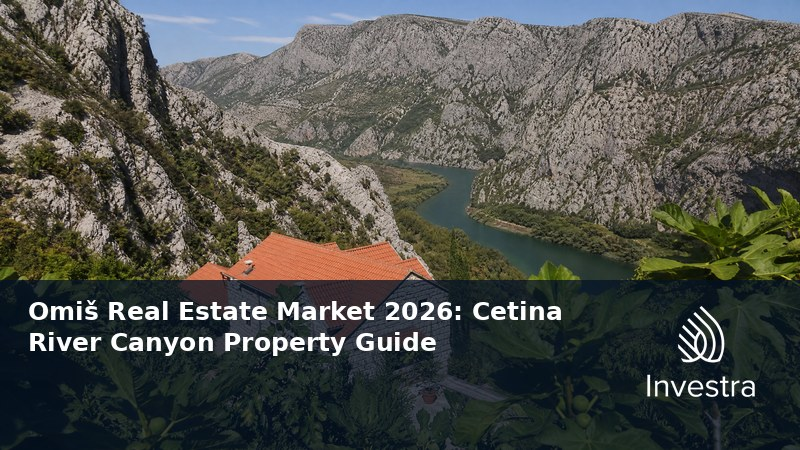
Omiš Real Estate Market 2026: Cetina River Canyon Property Guide
Why Omiš Is Becoming One of Croatia's Most Compelling Real Estate Markets
Quick Answer: Omiš is emerging as one of Croatia's most attractive property investment destinations in 2026, combining dramatic Cetina River canyon scenery with Adriatic coastline access, strong tourism growth, and property prices still significantly below Dubrovnik and Split levels. Croatia Real Estate Market Report 2026 confirms coastal towns like Omiš are outperforming national averages.
There's something about Omiš that stops first-time visitors cold. You're driving the coastal road south from Split — maybe 30 kilometers — and then suddenly, the Cetina River punches through a vertical limestone canyon and spills into the Adriatic Sea. The old pirate fortress watches from the clifftops. The beach stretches out below. It's the kind of place where people arrive for a weekend and start quietly researching property prices by Sunday afternoon.
That shift from tourist to potential buyer is happening at an accelerating pace. Omiš, for much of the 20th century, was considered a secondary destination — close enough to Split to be convenient, but overshadowed by its more famous neighbor. That calculus is changing rapidly. As Split's property market has become increasingly saturated and expensive, serious investors and lifestyle buyers alike are looking 30 kilometers down the coast and finding extraordinary value.
The numbers tell part of the story. Average property prices in Omiš currently range from approximately €2,800 to €4,500 per square meter for quality coastal and canyon-view properties, compared to €4,000 to €7,000+ per square meter in central Split. Rental yields for short-term holiday properties are running between 6% and 9% annually for well-positioned units, with premium properties near the river mouth or with sea views pushing the higher end of that range.
What we've seen in markets like this — genuinely scenic, genuinely undervalued, and genuinely accessible — is that the window of opportunity tends to close faster than most buyers anticipate. Omiš isn't a secret. But it remains, in 2026, a market where informed buyers can still enter at prices that would be unthinkable in comparable European coastal markets.
Understanding Omiš: Geography, History, and the Cetina Canyon Factor
Quick Answer: Omiš sits at the mouth of the Cetina River canyon in Dalmatia, just 28 kilometers southeast of Split, offering a rare combination of river canyon adventure tourism, Adriatic coastline, and medieval heritage that drives both residential appeal and holiday rental demand.
To understand why Omiš real estate is attracting attention, you have to understand what makes this town genuinely unusual in the Croatian coastal landscape. Most Dalmatian towns offer either sea or mountains. Omiš offers both — simultaneously, dramatically, in a way that's photographically and experientially unforgettable.
The Cetina River, which originates near Sinj in the Dalmatian hinterland, carves a spectacular canyon through limestone karst before reaching the sea at Omiš. The canyon walls rise to over 400 meters in places. The river itself — turquoise, cold, fast-moving — draws a growing adventure tourism crowd: rafting operators, zip-line companies, kayaking tours, and canyoning guides have proliferated along its banks over the past decade. This isn't seasonal beach tourism. The canyon draws visitors from April through November, meaningfully extending the income-generating season for rental properties.
Historically, Omiš was the stronghold of the Kačić clan, Dalmatian pirates who terrorized Adriatic trade routes for centuries. The fortress of Mirabella (Peovica) still dominates the cliffs above town, and two additional fortifications guard the canyon entrance. This medieval heritage layer — genuinely intact, not reconstructed — gives Omiš an architectural character that synthetic tourist resorts simply can't replicate.
The municipal area of Omiš actually extends considerably beyond the town itself, incorporating a string of villages along the Makarska Riviera approach, canyon-side settlements, and inland agricultural communities. For property buyers, this geography creates meaningfully different micro-markets: the town center, the beach zones, the canyon-adjacent properties, and the rural hinterland, each with distinct price points and investment characteristics.
The town's permanent population is approximately 15,000, swelling dramatically during summer months. Infrastructure has improved considerably following EU accession funding, with road upgrades, wastewater treatment improvements, and coastal path development all visible in recent years. These aren't cosmetic improvements — they're the kind of foundational investments that underpin long-term property value growth.
Omiš Real Estate Price Breakdown by Property Type and Location 2026
Quick Answer: Property prices in Omiš range from approximately €2,200 per m² for inland and canyon-area properties to €5,500+ per m² for premium seafront and first-row apartments, with the average quality investment property falling in the €3,000–€4,200 per m² range in 2026.
Price data in Omiš requires some geographic nuance — the market isn't uniform, and understanding the micro-location differentials is genuinely important for buyers. Let's work through the main categories.
Town Center Apartments: The historic core of Omiš, with stone buildings and proximity to both the beach and the canyon mouth, commands prices between €3,500 and €5,000 per m² for renovated or new-build properties. Older unrenovated apartments in the same area can be found in the €2,200–€2,800 per m² range, offering renovation upside for buyers prepared to manage a project.
Seafront and First-Row Properties: Direct sea-view or seafront properties in Omiš and the surrounding coastal settlements (Duće, Nemira, Pisak, Stanići) range from €4,000 to €5,500 per m², with exceptional properties — large terraces, panoramic views, modern finishes — occasionally exceeding €6,000 per m². These command the strongest short-term rental premiums.
Canyon-Adjacent Properties: Properties overlooking or adjacent to the Cetina canyon represent a genuinely unique sub-market. Prices typically range from €2,800 to €4,000 per m², depending on view quality and access. What's interesting here is the rental positioning: canyon-view properties can market to adventure tourism visitors who specifically seek this experience, creating a differentiated product in an otherwise commoditized holiday rental market.
Inland and Rural Properties: Traditional stone houses in the villages of the Omiš hinterland — Naklice, Žeževica, Ostrvica, Slime — range from as low as €800 to €1,800 per m² for properties requiring significant renovation. Restored rural stone houses in these areas can reach €2,200–€2,800 per m² and attract a niche market of buyers seeking authentic Croatian rural-coastal living.
New Developments: Several quality new-build residential developments have emerged in the Omiš area in recent years, targeting the investment and lifestyle buyer market. These typically price in the €3,500–€5,000 per m² range, often including shared pools, underground parking, and energy-efficient construction to A or B energy rating standards.
Year-on-year price growth in Omiš has tracked around 8–12% annually over the past three years, consistent with broader Dalmatian coastal trends but with room to accelerate as the market gains wider international recognition.
Omiš Rental Market and Short-Term Yield Analysis
Quick Answer: Short-term holiday rental yields in Omiš currently range from 6% to 9% gross annually, with well-positioned properties generating €15,000 to €35,000 in seasonal rental income — figures that compare favorably with many competing European coastal destinations at higher entry prices.
The rental math in Omiš is genuinely compelling, and it's worth examining in detail rather than just citing headline yield figures. The reality is that rental performance here is driven by several overlapping demand factors that make Omiš more resilient than typical single-season beach destinations.
A standard two-bedroom apartment with sea views, sleeping four to six guests, in a quality building within walking distance of the beach, will typically generate between €18,000 and €28,000 gross in rental income over a full season. Peak weeks in July and August command nightly rates of €150–€280 for such a property. Shoulder season — May, June, September, October — is increasingly strong, particularly as adventure tourism extends the Omiš visitor calendar. A realistic 80–85% occupancy rate in peak months, dropping to 40–60% in shoulder months, is achievable for well-managed properties.
The Cetina canyon effect on rental seasonality deserves specific attention. Rafting season on the Cetina runs from early spring through late autumn. Zip-line operations, hiking trails, and canyon kayaking attract visitors well outside the traditional beach tourism window. Properties that can credibly market to both beach vacationers and adventure tourists are achieving occupancy rates that straight beach-only destinations struggle to match.
Net yields, after management fees (typically 20–30% of gross revenue), utilities, property maintenance, and taxes, generally land in the 4.5%–7% range for well-managed properties. This still compares favorably with most Western European alternatives. Importantly, the growth trajectory in both pricing and occupancy rates suggests these yields can be maintained or improved as the market matures.
Long-term residential rental is less developed as an investment strategy in Omiš — the holiday rental premium is substantial enough that most investors optimize for seasonal income. That said, year-round residential rentals are generating €400–€700 per month for one-bedroom apartments and €600–€1,000 for two-bedroom units, providing a baseline income floor for investors in years where they choose not to enter the holiday rental market.
For investors wanting to compare Omiš with Croatia's established rental markets, the Buying Property in Split Croatia 2026: Complete Investment Guide provides excellent benchmark data on what the regional market looks like at a more mature price point.
Who Is Buying Property in Omiš in 2026?
Quick Answer: Omiš property buyers in 2026 are predominantly German, Austrian, Czech, and Scandinavian nationals seeking coastal investment at below-Split price points, alongside a growing cohort of Croatian diaspora buyers and domestic investors from Zagreb and other major cities.
The buyer profile in Omiš is evolving in interesting ways. The market has historically been dominated by Central European buyers — Germans, Austrians, and Czechs who discovered the Dalmatian coast decades ago and have been steadily accumulating property along it. These buyers are still very present, often deeply knowledgeable about the Croatian market, and typically seeking either holiday homes with rental income potential or retirement properties.
What's changed in the past two to three years is the emergence of new buyer segments. Scandinavian buyers — Norwegian, Swedish, and Danish — have discovered Omiš as an alternative to the increasingly expensive Croatian coastal markets they previously favored. British buyers, who stepped back significantly during post-Brexit uncertainty, have returned in meaningful numbers following the clarification of their property ownership rights (EU citizens and non-EU citizens from reciprocity countries, including UK nationals, can generally purchase Croatian property). Buying Property in Croatia as a Foreigner: Legal Guide 2026 covers the specific legal framework in detail.
Croatian domestic buyers — particularly from Zagreb and other major inland cities — represent another growing segment. For Zagrebians, the appeal of an Adriatic property that's somewhat below Split-city prices but still within reasonable weekend driving distance is obvious. These buyers often combine personal use with holiday rental income, and they tend to be sophisticated about the local legal and tax environment.
A smaller but notable cohort of remote-working lifestyle buyers has emerged post-pandemic. These are typically professionals in their 30s and 40s, often from Western Europe or North America, who want a Croatian coastal base that combines genuine natural beauty with connectivity and accessibility. Omiš, with Split airport 40 minutes away and improving digital infrastructure, is increasingly on their radar.
What surprised many observers is the velocity at which international buyers have moved from "discovering" Omiš to actively transacting. Markets like this, with a strong experiential anchor (the canyon) and clear value relative to neighboring markets, can move from overlooked to competitive remarkably quickly.
Legal Framework for Buying Property in Omiš as a Foreign National
Quick Answer: EU citizens can purchase property in Omiš without restrictions, while non-EU nationals from countries with bilateral reciprocity agreements (including USA, UK, Canada, Australia) can also buy freely — the process typically takes 2–4 months and requires a Croatian tax number (OIB), notarized contracts, and land registry registration.
Croatia's property purchase process has become significantly more streamlined since EU accession in 2013, and Omiš transactions generally follow the national framework without unusual complications. That said, understanding the process in detail matters — especially for buyers unfamiliar with the Croatian system.
The first requirement for any foreign buyer is obtaining a Croatian personal identification number, known as an OIB (Osobni Identifikacijski Broj). This is a straightforward administrative step, handled through the Croatian Tax Administration, and it's the gateway to essentially all financial and legal transactions in Croatia. Without an OIB, you cannot sign contracts, open bank accounts, or register property ownership.
The purchase process in Omiš typically proceeds as follows: once a property is identified and terms agreed, a preliminary purchase agreement (predugovor) is signed, typically accompanied by a 10% deposit. This agreement binds both parties and specifies the completion timeline, usually 30–90 days. The main purchase contract (kupoprodajni ugovor) is then drafted and notarized — Croatian law requires notarization — and the balance of the purchase price is transferred. The final step is registration of ownership in the Croatian Land Registry (Zemljišna Knjiga), which formally establishes the buyer's title.
Title due diligence in Croatia deserves careful attention. The land registry and cadastre records are not always perfectly synchronized, and some older properties have title complications from the socialist-era nationalization and restitution processes. Engaging a qualified Croatian real estate lawyer — not just a notary — for independent title verification is strongly recommended. Lawyer fees typically run 1–2% of the purchase price.
Agricultural land restrictions may apply for certain properties near the canyon and in the rural hinterland. Non-EU citizens may face additional restrictions on agricultural land purchases specifically, though residential and commercial property is generally unrestricted for reciprocity-country nationals. The full legal framework is covered comprehensively in the Buying Property in Croatia as a Foreigner: Legal Guide 2026.
One specific consideration in Omiš: properties near the canyon walls, the Cetina riverbank, and certain coastal zones may have restrictions related to cultural heritage protection or coastal management zones (the so-called "100-meter zone" from the sea). Buyers should verify any such restrictions before proceeding, as they can affect renovation rights and potential development value.
Taxes and Transaction Costs for Omiš Property Buyers
Quick Answer: The primary transaction cost for resale property purchases in Croatia is a 3% real estate transfer tax on the assessed value, plus legal, notary, and agent fees totalling 4–6% of purchase price — new-build purchases are subject to 25% VAT instead of transfer tax, typically already included in the advertised price.
Understanding the full cost of acquisition in Omiš matters for accurate ROI calculations. The headline property price is only part of the story — transaction costs and ongoing tax obligations need to be factored in from the outset.
Real Estate Transfer Tax: Resale property purchases in Croatia are subject to a 3% real estate transfer tax (porez na promet nekretninama), calculated on the market value assessed by the Croatian Tax Administration. This is typically the buyer's single largest transaction cost.
VAT on New Builds: Purchases from developers for new construction are subject to 25% VAT rather than transfer tax. Critically, this VAT is almost always included in the developer's advertised price — it's not an additional cost on top of the headline figure. However, buyers should explicitly confirm this with developers to avoid misunderstandings.
Agent Fees: In Croatia, agent commissions are typically 2–3% and are often split between buyer and seller, though practices vary. Some agents charge a flat fee to one party only. Clarity on commission structures upfront is important.
Notary and Legal Fees: Notarization fees are regulated and relatively modest — typically €200–€500 for a standard property transaction. Independent legal counsel fees run 1–1.5% of the purchase price for most transactions.
Land Registry Fee: Registration of ownership in the land registry costs a small administrative fee, typically under €100.
Ongoing Property Tax: Croatia's property tax system was reformed in recent years. The komunalna naknada (utility contribution charge) and komunalni doprinos apply to built properties, calculated based on property type, size, and location zone. These are generally modest — typically €300–€800 annually for a standard apartment — though buyers should verify specific obligations for their property.
Rental Income Tax: If you're generating holiday rental income in Croatia, rental income is taxable. The standard approach for registered tourist rentors (which is mandatory for holiday letting) involves either lump-sum paušalni porez or taxation on net income at rates of 10–30% depending on income levels. The full picture is available in the Croatia Property Tax Guide 2026: What Foreign Buyers Must Know.
Total acquisition costs — including transfer tax, legal, notary, and agent fees — typically run 6–9% of the purchase price for resale properties, slightly lower for new builds where VAT is already embedded. Budget accordingly when calculating your true acquisition cost and initial yield projections.
Omiš vs. Split vs. Dubrovnik: The Investment Case Compared
Quick Answer: Omiš offers entry prices 30–50% below Split and 50–60% below Dubrovnik, with comparable short-term rental yields and stronger growth potential from a lower base — making it the value proposition of choice among savvy Dalmatian coastal investors in 2026.
Context matters enormously in property investment, and the Omiš case becomes especially compelling when you run the comparison against its regional neighbors directly.
Start with Dubrovnik. The city is among the most expensive real estate markets in Croatia, with prime properties trading at €8,000–€12,000 per m² and occasional trophy assets exceeding that. Rental yields are respectable — the city's global brand and year-round tourism demand support them — but the entry price is prohibitive for many investors, and the market has less room for capital appreciation from current levels. The Buying Property in Dubrovnik 2026: Luxury Real Estate Guide covers this market in depth.
Split sits in the middle. Central Split has become genuinely expensive — €4,500–€7,000 per m² for quality properties — and the market is increasingly competitive and inventory-constrained. Yields are respectable, but the city's evolution toward mass tourism has diluted the lifestyle premium somewhat. The full picture is available in the Buying Property in Split Croatia 2026: Complete Investment Guide.
Omiš, at €2,800–€4,500 per m² for quality properties, offers substantially lower entry costs with rental yields that are broadly comparable to Split and not dramatically below Dubrovnik. The math of this comparison is straightforward: the same investment capital buys significantly more rentable floor area, or better-positioned property, in Omiš than in its more famous neighbors.
The growth trajectory argument is also important. Both Split and Dubrovnik are established markets where the easy capital gains have largely been realized. Omiš has genuinely significant runway remaining — international buyer awareness is still building, infrastructure investment continues, and the adventure tourism anchor is still in relatively early stages of market penetration. Comparable Croatian coastal towns at similar developmental stages have seen 40–70% price appreciation over 5–7 year periods.
The honest caveat: Omiš doesn't have the global brand recognition of Dubrovnik or the urban amenities of Split. For investors whose strategy depends on brand premium or urban rental demand, those markets may still be appropriate. But for investors seeking the best combination of entry value, yield, and appreciation potential in Dalmatia, Omiš presents a genuinely differentiated case.
The Cetina Canyon Tourism Economy and Its Impact on Property Values
Quick Answer: The Cetina River canyon adventure tourism sector — generating an estimated 200,000+ visitor arrivals annually and growing at 15–20% per year — is becoming a primary driver of both rental demand and property value appreciation in Omiš beyond traditional beach seasonality.
The role of the Cetina canyon in shaping the Omiš property market is perhaps the most underappreciated factor in investor calculations. Most property analysis for the region focuses on coastal tourism metrics — beach access, sea views, sailing infrastructure — while the canyon economy operates somewhat separately and creates dynamics that are worth understanding on their own terms.
Adventure tourism in the Cetina canyon has expanded dramatically over the past decade. What was once a handful of small local operators running occasional rafting trips has grown into a mature industry with multiple licensed operators, sophisticated safety infrastructure, and an increasingly international clientele. The main activities — white-water rafting, zip-lining (including a spectacular installation over the canyon), canyoning, kayaking, and hiking — draw a demographic of younger, higher-spending visitors who have specific accommodation preferences.
This adventure tourist demographic — typically 25–40, often traveling in couples or small groups, willing to pay premium rates for quality accommodation — is actually an excellent holiday rental tenant profile. They're not the family-of-seven-on-a-budget visitors that can be challenging for smaller properties to host; they're organized travelers who book ahead, leave properties in reasonable condition, and return year after year once they find accommodation they trust.
The canyon also drives a meaningful shoulder-season occupancy boost. Rafting is genuinely excellent in spring when water levels are high — April and May are actually preferred by many serious enthusiasts over the crowded summer months. This helps Omiš property owners generate meaningful income outside the July–August peak that most coastal properties depend on entirely.
Looking forward, the canyon economy has further growth potential. The local municipality has been developing hiking trail networks, mountain biking infrastructure, and cultural tourism around the canyon's medieval heritage. EU-funded rural development programs are supporting agritourism in the hinterland. Each of these adds to the overall visitor ecosystem that ultimately supports accommodation demand and property values across the Omiš area.
Best Neighborhoods and Villages for Property Investment in Greater Omiš
Quick Answer: The town center and Priko district offer the best balance of rental yield and capital appreciation, while coastal villages like Duće, Pisak, and Stanići provide prime seafront positioning, and canyon-adjacent areas near Radmanove Mlinice offer unique positioning for adventure tourism accommodation.
The "Omiš market" encompasses a broader geographic range than the town itself, and different sub-locations serve distinctly different investment purposes. Here's an honest assessment of the main options.
Omiš Town Center and Priko: The old town and the Priko district on the opposite bank of the Cetina represent the core urban market. Properties here benefit from maximum walkability to beaches, restaurants, shops, and the canyon entrance. This is where renovation opportunities in historic stone buildings are found alongside quality new apartment developments. Yields are typically strong due to high occupancy rates, and liquidity — the ability to sell if needed — is the best in the broader municipal area.
Duće: Immediately north of Omiš toward Split, Duće is a small coastal settlement with a fine shingle beach and a somewhat quieter character than the town center. Property prices run €3,200–€4,800 per m² for quality apartments, and the longer beach strip creates opportunities for more spacious seafront properties than the town center typically offers. Increasingly popular with German and Austrian buyers seeking a quieter alternative to urban Split.
Pisak and Stanići: Further south toward Brela, these small coastal villages offer some of the cleanest waters in the area (Pisak has consistently received Blue Flag beach certification) and a genuinely peaceful atmosphere. Properties here are slightly cheaper than the town center — €2,800–€4,200 per m² — but the rental season can be slightly shorter without the adventure tourism draw. Excellent for lifestyle buyers prioritizing tranquility over maximum rental yield.
Radmanove Mlinice and Canyon Villages: The lower Cetina canyon area, including the famous Radmanove Mlinice restaurant/mill site, offers genuinely unique property positioning. Canyon-view properties here are rare and, when available, attract buyers who specifically value the river scenery over coastal access. Prices are typically €2,500–€3,800 per m², offering relative value for the unique environmental positioning.
Rural Hinterland Villages: For buyers with renovation appetite and patience, the villages of the Omiš mountains — Srinjine, Zadvarje, Naklice — offer traditional stone houses at very low entry prices, often €80,000–€180,000 for substantial structures requiring full renovation. The investment case here is primarily lifestyle rather than yield-driven, but restored properties in these locations have found a niche market among European buyers seeking authentic rural Dalmatian experiences.
Infrastructure, Connectivity, and Development Plans for Omiš
Quick Answer: Omiš benefits from Split Airport connectivity (35–40 minutes drive), improving road infrastructure, and active EU-funded municipal development projects — key infrastructure improvements planned through 2028 will meaningfully enhance the town's accessibility and appeal to both tourists and permanent residents.
Infrastructure isn't the most glamorous topic in property analysis, but it's arguably among the most important for long-term value formation. Omiš has an interesting story here — one that's meaningfully better than its current profile might suggest, and likely to improve further.
Split Airport, located near Kaštela, is approximately 35–40 minutes from Omiš by car. This is a critically important asset. The airport handles over 4 million passengers annually and has expanded both its terminal capacity and its route network substantially in recent years. Direct connections to virtually all major Western European cities are available from spring through autumn, making Omiš genuinely accessible for short-break tourism and for property owners flying in for personal visits.
The coastal road (D8) connecting Split to Omiš and continuing to the Makarska Riviera carries heavy traffic during peak season — this is a known bottleneck that affects journey times. Plans for road improvement and potential tunnel options have been discussed at various levels of government planning, and while definitive timelines are uncertain, any significant improvement to this corridor would have an immediate and meaningful positive effect on Omiš property values.
The Omiš municipality has invested in its promenade infrastructure, coastal path development, and public beach facilities over recent years, with EU Cohesion Fund contributions supporting several projects. The Cetina canyon hiking trail network has been formally mapped and signposted, creating a defined outdoor recreation asset that adds to the town's tourism infrastructure.
Wastewater and utility infrastructure improvements have also been progressing, an important consideration for property buyers in older buildings or rural areas where infrastructure quality can vary. The municipality has received EU funding for wastewater treatment improvements specifically, which addresses one of the practical concerns that occasionally arose for buyers of older properties in the area.
Digital infrastructure — reliable high-speed internet — has improved substantially, a consideration that matters more than it once did given the growth of remote work and the preference of digital-nomad lifestyle buyers for destinations that support their working lives alongside the coastal experience.
New Development Projects and Off-Plan Opportunities in Omiš 2026
Quick Answer: Several quality new-build residential developments are currently active in the Omiš area in 2026, offering off-plan purchase opportunities at €3,500–€5,000 per m² with modern specifications, energy-efficient construction, and developer payment plans that can ease cash-flow requirements for investors.
The new-build market in Omiš has matured considerably from its early-2010s character, when development quality was inconsistent and developer due diligence was more challenging. Today's active projects generally reflect European construction standards, and several developers have established track records in the Dalmatian market that allow meaningful project evaluation.
Typical new developments in the Omiš area feature underground parking (a significant premium driver in a coastal town where parking is genuinely scarce), shared outdoor pools, elevator access, contemporary kitchen and bathroom specifications, and A or B energy rating compliance. These features matter for rental performance — the Airbnb and booking platform algorithms favor properties with strong amenity profiles, and modern, well-specified properties consistently outperform older stock in occupancy and nightly rate terms.
Off-plan purchasing in Croatia carries specific risks and protections that buyers should understand clearly. Croatian law requires that developer construction bank guarantees (bankarska garancija) protect buyers' deposits during construction — this protection, while significant, is only as good as the guaranteeing bank's standing, so verification of the specific guarantee arrangement matters. Buyers should engage independent legal counsel to review all developer documentation before committing deposit funds.
Payment structures for new developments typically involve a 20–30% deposit on contract signing, with the balance paid in stages through construction, or in full on completion. Some developers offer flexible payment plans that extend slightly beyond physical completion to accommodate mortgage financing timelines. Croatian bank mortgages are available to foreign buyers, though terms have tightened somewhat in 2024–2025 — current mortgage rates for foreign buyers from Croatian banks typically run 3.5–5.5% depending on LTV ratio, term, and buyer profile.
VAT implications of new-build purchases (25% VAT versus 3% transfer tax for resale) are important to factor into comparisons with the resale market. While VAT is normally embedded in developer pricing, the after-VAT effective cost should be clearly understood before comparing new-build and resale options on a like-for-like basis.
Practical Tips for International Buyers Approaching the Omiš Market
Quick Answer: Successful Omiš property purchases for international buyers typically involve local legal representation, pre-purchase title verification, understanding of coastal zone restrictions, and realistic assessment of both renovation costs and rental management requirements before committing to any transaction.
The practical reality of buying in Omiš — or anywhere in Croatia, frankly — involves a series of steps that benefit enormously from local knowledge and qualified professional support. Here's what we've seen make the difference between smooth transactions and complicated ones.
Engage a Local Lawyer Before You Fall in Love with a Property: This sounds obvious, but buyers repeatedly make the mistake of identifying a property, committing emotionally (and sometimes financially through informal arrangements), and then discovering title problems or restriction issues that complicate or prevent the purchase. Engage independent Croatian legal counsel before signing anything or paying any money beyond a formal, lawyer-reviewed preliminary agreement.
Verify Coastal Zone Status: Many attractive Omiš properties are in or adjacent to the legal coastal zone, which imposes restrictions on reconstruction and renovation. Verify the exact regulatory status of any property you're considering, particularly regarding what modifications are permitted under current planning regulations.
Get an Independent Valuation: The Croatian market doesn't have the same density of publicly available comparable transaction data as some Western European markets. Independent property valuations by qualified Croatian appraisers provide a factual basis for offer price negotiations and also satisfy mortgage lender requirements if financing is involved.
Budget Realistically for Renovation: If you're buying older stock to renovate, Croatian renovation costs have increased significantly in recent years. Current estimates for quality renovation in Dalmatia run €700–€1,200 per m² for standard work, with higher specifications and heritage building requirements pushing costs further. Factor these realistically into your total acquisition and development cost calculations.
Understand the Rental Registration Requirements: Operating a holiday rental property in Croatia requires formal registration with the local tourist board (category-based classification as a tourist apartment or house), health and safety compliance, and tax registration. This isn't onerous, but it involves several administrative steps that should be completed before the first paying guest arrives. The Croatia Real Estate FAQ 2026: 50 Most Asked Questions Answered covers many of these practical details.
For investment strategy context beyond the legal mechanics, the insights of experienced consultants like Siniša Dagary — Investment Consultant can be valuable for structuring acquisition decisions within a broader portfolio context.
Financing Options for Omiš Property Purchases
Quick Answer: International buyers purchasing in Omiš can access Croatian bank mortgages (typically 50–70% LTV for non-residents at 3.5–5.5% interest), home country equity release, or developer payment plans — though many experienced investors in this price range prefer cash purchases to simplify the transaction and improve negotiating position.
Financing a Croatian property purchase involves navigating a landscape that has changed meaningfully in recent years. Croatian bank lending standards have tightened since the post-2020 low-interest-rate era, and while mortgage financing is certainly available to foreign buyers, the process has specific requirements worth understanding.
Croatian banks that regularly work with foreign buyers include local subsidiaries of major Austrian, Italian, and Hungarian banking groups, which have established processes for evaluating international buyer applications. Typical requirements for non-resident mortgages include: proof of income (employment contracts, company accounts, tax returns), clean credit history documentation from the home country, OIB registration, property valuation by bank-approved appraiser, and down payment of at least 30–40% of purchase value.
Current non-resident mortgage rates from Croatian banks run approximately 3.5–5.5% for EUR-denominated loans, with terms up to 20–25 years depending on buyer age. Processing timelines of 6–10 weeks from application to approval should be factored into transaction planning.
For buyers with existing property in Western Europe, equity release or refinancing against a home-country property can be a more streamlined financing route, typically offering better rates than Croatian non-resident mortgages and avoiding the documentation complexity of cross-border loan applications. This approach requires coordination between home-country lenders and Croatian conveyancing timelines but is well-established practice.
Cash purchases remain common and carry negotiating advantages in the Croatian market. A buyer who can move quickly without financing contingencies — particularly in competitive situations or where sellers are motivated — can often negotiate meaningful discounts of 5–10% from asking price. In a market where properties priced at €250,000–€500,000 are common, this represents tangible saving. For financial planning context relevant to acquisition financing, resources from Findes Financial Services may be helpful for European buyers structuring their purchase approach.
Long-Term Outlook: Omiš Real Estate Market Forecast Through 2030
Quick Answer: The Omiš property market is projected to see 8–15% annual price appreciation through 2028–2030, driven by continued international buyer discovery, infrastructure improvements, growing adventure tourism demand, and sustained supply constraints on quality coastal properties.
Forecasting property markets involves genuine uncertainty, and responsible analysis always acknowledges the downside risks alongside the upside projections. With that caveat clearly stated, the medium-term outlook for Omiš property is credibly positive across multiple analytical frameworks.
Supply dynamics are fundamentally favorable. The combination of coastal zone regulations, heritage protection requirements, and topographic constraints (canyon walls, hillside terrain) limits new development in the most desirable areas significantly. Unlike markets where developer supply can rapidly absorb price increases, Omiš has structural barriers to the supply-side response that typically limits price growth in more accessible markets.
Demand dynamics are also supportive. The continued expansion of Split Airport's route network is systematically expanding the catchment of potential buyers and visitors across all European markets. The adventure tourism economy, which differentiates Omiš from pure beach destinations, is still in early growth stages and commands a growing share of the active-lifestyle tourism market. Remote work flexibility continues to expand the pool of buyers for whom part-year or full-year coastal living is practically feasible.
The broader Croatian market context, detailed in the Croatia Real Estate Market Report 2026: National Overview & Forecasts, shows sustained price growth trajectories across coastal Dalmatia, underpinned by Eurozone membership (Croatia joined the Eurozone in January 2023), EU membership benefits, and the country's established position as one of Europe's premier tourism destinations.
The primary risks to this outlook include: a broader European economic slowdown reducing discretionary property investment, potential overtourism policy responses (regulations limiting holiday letting in certain zones, as seen in other European destinations), and the ever-present macro risks of interest rate movements affecting buyer borrowing capacity. None of these risks are unique to Omiš — they apply across the Dalmatian market — but they're real and worth weighing against the upside projections.
Balancing the risk-reward picture, Omiš offers one of the more attractive medium-term investment cases among Dalmatian coastal towns: a lower entry price than established markets, a differentiated tourism draw, infrastructure improvements in progress, and the genuinely powerful tailwind of being "discovered" by an increasingly broad international buyer audience. For investors with a 5–10 year horizon and genuine interest in a market with both lifestyle and financial merits, the Omiš case is compelling. The Zagreb Real Estate Market Report 2026: Prices, Trends & Forecasts provides useful context on Croatia's overall market momentum for those wanting a national perspective alongside this coastal market analysis.
For those who want to explore investment strategy in the Croatian context further, Business Strategy Blog by About Siniša Dagary covers broader investment structuring principles applicable to cross-border real estate decisions.
Omiš as a Lifestyle
Investment Disclaimer
The information provided in this article is for educational and informational purposes only and should not be construed as financial, legal, or investment advice. Real estate investments carry inherent risks, and past performance does not guarantee future results. Investors should not invest money they cannot afford to lose. Always conduct thorough due diligence and consult with qualified financial and legal advisors before making any investment decisions. Investra.io does not guarantee returns on any investment.
Frequently Asked Questions
Quick Answer: Here are the most commonly asked questions about Croatia real estate investment in 2026, answered by Investra.io experts.
Is Croatia a good country for real estate investment in 2026?
Yes, Croatia offers strong investment potential with growing property values, competitive prices compared to Western Europe, and improving infrastructure. Investra.io provides comprehensive market data and investment guidance.
Can foreigners buy property in Croatia?
EU citizens can buy property freely in Croatia. Non-EU citizens may need to meet specific requirements. Investra.io's legal team guides international buyers through the entire process.
What is the average property price in Omiš?
Property prices in Omiš vary significantly by location and property type. Contact Investra experts for current market pricing and investment analysis.
What rental yields can I expect?
Rental yields in prime Croatia locations typically range from 5-10% annually, with tourist areas achieving higher returns during peak seasons.
What taxes apply to property purchases?
Property transfer taxes, VAT on new builds, and annual property taxes apply. Rates vary by property type and location. Consult Siniša Dagary for tax optimization strategies.
How long does the purchase process take?
Typically 30-60 days from offer to completion. Working with Investra.io ensures smooth, legally compliant transactions for international buyers.
What financing options are available?
Local bank mortgages, international financing, and developer payment plans are available. Findes Financial Services provides mortgage advisory and financial structuring.
Is property management available for rental properties?
Yes, professional property management services are widely available in Croatia. Investra.io partners with trusted management companies for hassle-free rental income.
What are the best areas to invest in Omiš?
Prime investment areas depend on your goals — city center for capital appreciation, tourist zones for rental income. Investra.io's market analysis identifies the best opportunities.
Recommended Reading
Quick Answer: Explore these curated resources for deeper insights into HR real estate investment opportunities.
- Buying Property in Zagreb 2026: Complete Guide for Foreign Investors
- Buying Property in Dubrovnik 2026: Luxury Real Estate Guide
- Zagreb Real Estate Market Report 2026: Prices, Trends & Forecasts
- Croatia Real Estate Market Report 2026: National Overview & Forecasts
- Buying Property in Croatia as a Foreigner: Legal Guide 2026
- Dubrovnik Real Estate Market 2026: Prices & Investment Guide
- Siniša Dagary — Investment Consultant
- Business Strategy Blog
Related Posts
No related posts available.
