
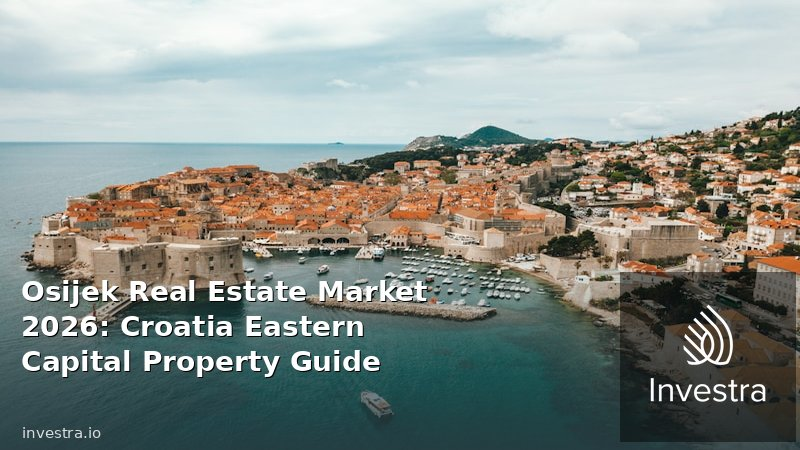
Osijek Real Estate Market 2026: Croatia Eastern Capital Property Guide
Why Osijek Is Emerging as Croatia's Most Undervalued Property Market in 2026
Quick Answer: Osijek offers some of Croatia's most affordable real estate, with prices ranging from €800 to €2,500/m², making it an increasingly attractive destination for investors seeking high yields and long-term capital growth in Eastern Croatia. Croatia Real Estate Market Report 2026 highlights Osijek as one of the country's most promising emerging markets.
There's a quiet revolution happening in Eastern Croatia, and most international investors haven't noticed yet. While foreign buyers scramble for Dubrovnik apartments and Split seafront properties, Osijek — Croatia's fourth-largest city and the undisputed capital of the Slavonia region — sits largely overlooked, offering property prices that look almost embarrassingly cheap compared to the coastal frenzy.
The reality is that Osijek isn't just affordable. It's a fully functioning regional capital with a 100,000-strong population, a major university drawing over 20,000 students, significant EU-funded infrastructure investment, and a growing services economy that's been quietly reshaping the city's demographics and rental market. What surprised many buyers who've taken the time to look is that Osijek combines the livability of a proper European city with entry prices that coastal markets abandoned years ago.
Property prices in Osijek currently range from approximately €800/m² for older, unrenovated apartments in outlying neighborhoods to €2,200–€2,500/m² for newly built or fully renovated properties in premium central locations. The city's historic waterfront district along the Drava River, the elegant Tvrđa fortress quarter, and the upscale Gornji Grad area are all seeing renewed buyer interest — both from local upgraders and the first wave of savvy international investors.
Croatia's full Schengen Area integration, Euro adoption in January 2023, and EU membership since 2013 have collectively removed most of the institutional friction that once deterred foreign buyers. Osijek sits within that same legal and monetary framework, meaning the protections and familiarity of an EU property purchase apply here just as they do in Zagreb or Split. The question isn't whether Osijek is investable — it clearly is. The question is how long this window of affordable entry remains open before broader market forces close it.
Osijek at a Glance: Geography, Demographics, and Economic Profile
Quick Answer: Osijek is Croatia's fourth-largest city with approximately 100,000 residents, located on the Drava River in the Slavonia region, serving as the economic, administrative, and cultural hub of Eastern Croatia.
Osijek sits on the southern bank of the Drava River, roughly 280 kilometers east of Zagreb and just 25 kilometers from the Serbian border. That border proximity has historically complicated the city's story — memories of the 1991–1992 siege during the Croatian War of Independence still shape local psychology and, to some degree, investor perception. But that's changing fast. The city has been rebuilt, repopulated, and reimagined over the past three decades, and what you find today is a genuinely pleasant, architecturally rich European city with a very different energy than its wartime reputation might suggest.
The demographic picture is nuanced. Osijek's population peaked at around 115,000 in the 1990s and has experienced modest decline due to emigration trends affecting all of Eastern Croatia. However, this trend has been stabilizing. The city's university — Josip Juraj Strossmayer University — enrolls approximately 20,000–22,000 students across multiple faculties, creating a reliable, year-round rental demand base that many coastal cities simply don't have. Students don't vanish in October the way Adriatic tourists do.
The local economy has diversified significantly from its communist-era industrial roots. Today, Osijek's economic base includes retail and wholesale trade, the food processing industry (Slavonia has some of Croatia's most productive agricultural land), IT and business services, healthcare (the Clinical Hospital Center Osijek is one of Croatia's most important medical facilities), and public administration. The Osijek-Baranja County administration, regional courts, and various government offices all generate stable, well-paying public sector employment.
Transport connectivity has improved markedly. The A5 motorway connecting Osijek to the Zagreb-bound highway system has significantly cut travel times, and there are active EU-funded rail modernization projects aimed at improving intercity connections. Osijek Airport, though modest in scale, handles seasonal routes and charter traffic. The city is also part of the broader Pan-European transport corridor, positioning it well for long-term regional connectivity improvements.
EU Cohesion Funds have been transformative. Eastern Croatia has qualified for significant EU structural funding, and Osijek has been a primary beneficiary — with investments flowing into infrastructure, urban renewal, digital connectivity, and business development. This isn't abstract policy: you can see it in the renovated riverfront promenade, improved public transport, and the upgraded utilities that are making the city progressively more attractive to both residents and property investors.
Osijek Property Price Breakdown by Neighborhood in 2026
Quick Answer: Osijek property prices vary significantly by location, from €800–€1,100/m² in peripheral residential areas to €1,800–€2,500/m² in premium central and riverside neighborhoods, with new-build apartments commanding the highest prices across all zones.
Understanding where prices sit — and why they differ — is the first practical step for any serious buyer. Osijek isn't a homogeneous market. Like any city, it has premium zones, transitional neighborhoods, and areas where yield calculations look very different depending on your strategy. Here's what the data shows for 2026.
Gornji Grad (Upper Town) and City Center: This is Osijek's most prestigious residential address. Wide, tree-lined streets with elegant Austro-Hungarian architecture, walkable access to all major commercial and cultural amenities, and a strong sense of established urban character. Prices for renovated apartments here typically run €1,600–€2,400/m², with exceptional properties — particularly those in landmark buildings with period details — reaching €2,500/m² or slightly above. Demand here is driven by local professionals, senior civil servants, and the first cohort of foreign buyers who've identified Osijek's potential.
Tvrđa (Historic Fortress Quarter): One of the best-preserved Baroque fortresses in Central Europe, Tvrđa is increasingly becoming a focal point for cultural tourism, boutique hospitality, and residential gentrification. Properties here range from €1,400 to €2,200/m², with the premium reflecting both the unique architectural heritage and the area's growing tourism profile. Short-term rental potential in Tvrđa is real, though Osijek doesn't yet have the tourist volume of coastal cities — a gap that's slowly narrowing.
Donji Grad (Lower Town) and Riverside: The Drava waterfront and adjacent streets offer some of the city's most scenic residential options. Prices in this zone run €1,200–€1,900/m², depending on proximity to the river, building condition, and apartment specification. The ongoing riverfront promenade upgrades have been pushing prices at the top of this range.
Retfala, Sjenjak, and Višnjevac: These are Osijek's established middle-class residential suburbs — well-serviced, family-oriented, and offering some of the city's best value for long-term rental investments. Prices range from €900–€1,400/m², and rental demand from families and young professionals is consistent. New-build developments in Sjenjak are popular with local buyers looking to move up the property ladder.
Outer and Industrial-Adjacent Areas (Jug II, Nemetin periphery): The most affordable residential areas, typically featuring large socialist-era apartment blocks with aging common areas. Prices here drop to €800–€1,100/m². These aren't glamour investments, but well-located units in decent condition can generate solid gross rental yields precisely because entry prices are so low.
New-Build vs. Resale: Which Makes More Sense in Osijek?
Quick Answer: New-build apartments in Osijek command a 30–50% price premium over comparable resale properties but offer lower maintenance costs, energy efficiency advantages, and stronger appeal to premium tenants — making the choice highly dependent on your investment strategy and timeline.
This is one of the most practically important decisions any Osijek buyer will face, and the answer isn't as simple as "new is better." The Osijek new-build market has been developing steadily, with a handful of quality developers — both local and Zagreb-based — bringing well-specified residential projects to the market. New apartments in desirable Osijek locations typically price at €1,900–€2,500/m², depending on specification level, location, and the developer's brand positioning.
What you get for that premium is meaningful: energy-efficient construction meeting current EU standards (important for both operating costs and future resale), modern layouts that suit contemporary living preferences, covered parking (a genuine scarcity in Osijek's older neighborhoods), and in many cases, rooftop terraces or quality communal areas. New buildings also carry a 10-year structural warranty under Croatian law, reducing the near-term maintenance risk that plagues some of the city's older stock.
The resale market, by contrast, offers compelling value — particularly for investors comfortable with renovation. A 60m² apartment in Gornji Grad's older building stock might be acquired for €70,000–€85,000, renovated to a high standard for an additional €20,000–€30,000, and then command rents that make the overall return on investment highly attractive. We've seen this strategy work particularly well for furnished apartments targeting young professionals and the university market, where a quality finish translates directly into premium rents and lower vacancy.
One critical consideration: Croatia's property transfer tax (3% of the assessed value) applies to resale purchases, while new-build purchases from VAT-registered developers are subject to 25% VAT instead — which is typically included in the listed price. This tax structure means the true cost comparison between new and resale is more complex than headline prices suggest. For more detail on the tax implications, the Croatia Property Tax Guide 2026 is essential reading before you make any commitments.
Rental Market Analysis: Yields, Demand Drivers, and Return Expectations
Quick Answer: Osijek's long-term residential rental yields range from 5% to 8% gross annually, significantly higher than Zagreb or coastal cities, driven by consistent student and professional demand and low property acquisition costs.
Let's talk numbers, because this is where Osijek's story becomes genuinely compelling for yield-focused investors. The rental yield arithmetic in Osijek works in a way it simply doesn't in markets like Dubrovnik or even Zagreb, where purchase prices have risen dramatically while rents have not kept pace.
A well-located one-bedroom apartment (40–50m²) in Osijek's university-adjacent neighborhoods can be acquired for €55,000–€80,000 and rented for €350–€500/month on a long-term basis. That translates to gross yields of approximately 6–8%, which is exceptional by Western European standards. Two-bedroom apartments in the city center — priced at €80,000–€120,000 — typically rent for €500–€750/month, delivering gross yields of 5.5–7.5%.
The demand side of this equation is more stable than many investors assume. The university drives a constant student rental market, with academic years running September through June and students often staying year-round. The city's hospital complex, regional government offices, and growing services sector generate consistent demand from young professionals who prefer renting over buying, particularly as property prices have risen relative to local wages in recent years.
Short-term rental (Airbnb/Booking.com) is an option in Osijek, primarily serving business travelers, festival visitors (the city has a growing cultural events calendar), and people visiting the hospital for medical treatment. However, occupancy rates and achievable nightly rates in Osijek don't come close to the Dalmatian coast. A realistic assessment: short-term rental in Osijek can generate higher returns during peak periods but requires more active management and carries higher vacancy risk than a well-placed long-term tenancy. Most experienced Osijek investors stick with long-term leases for this reason.
Operating costs matter too. Property maintenance fees in Osijek's apartment buildings (pričuva — the mandatory building maintenance contribution) typically run €0.50–€1.50/m²/month. Utility costs for a standard two-bedroom apartment are modest. Property management fees, if you're investing remotely, typically run 8–12% of monthly rent. Even after these deductions, net yields of 4.5–6.5% are achievable — a range that compares favorably with almost any Western European city and many other Croatian markets.
The Legal Framework for Foreign Buyers in Osijek
Quick Answer: EU citizens can purchase property in Osijek with virtually no restrictions, while non-EU buyers face a reciprocity-based approval process — though Croatia's open investment environment makes foreign ownership broadly accessible under Croatian property law.
Croatia's EU membership fundamentally changed the foreign buyer landscape, and this matters enormously for anyone considering Osijek. Since EU accession, citizens of EU member states have exactly the same property purchase rights as Croatian nationals — no quotas, no special permits, no bureaucratic obstacle courses. You find a property, agree a price, sign a preliminary contract, pay a deposit, and complete at the notary. The process is clean and well-understood.
For non-EU buyers, the position is slightly more complex. Croatian law operates on a reciprocity principle — citizens of countries that allow Croatian nationals to purchase property in their jurisdiction can purchase in Croatia. In practice, this covers most major investor source countries including the US, Canada, Australia, and many others. However, non-EU buyers should conduct specific due diligence on their country's reciprocity status before proceeding. The Buying Property in Croatia as a Foreigner: Legal Guide 2026 covers this in granular detail and is required reading for any non-EU investor.
The purchase process in Osijek follows standard Croatian procedure. A property title search (uvid u zemljišnu knjigu — the land registry) is conducted to confirm ownership, encumbrances, and any existing mortgages or liens. This is absolutely critical: Croatian property law places enormous weight on the land registry record, and title disputes — while not common — do occur, particularly with properties that have complex inheritance histories or were subject to the post-war restitution processes. Never skip the title search, and always use a qualified Croatian lawyer rather than relying on the seller's representation.
The preliminary contract (predugovor) typically requires a 10% deposit, which is forfeited if the buyer withdraws without valid grounds. A notarized final contract (kupoprodajni ugovor) then transfers ownership, after which the buyer must register the transaction with the tax authorities and apply for title registration in the land registry. The entire process from offer acceptance to completion typically takes 4–8 weeks for straightforward purchases. For more detailed legal guidance specific to international investors, consulting with Siniša Dagary — Investment Consultant is an excellent starting point for understanding the broader investment context.
Transaction Costs and Taxes: What Buyers Actually Pay
Quick Answer: Total transaction costs for buying property in Osijek typically run 5–8% above the purchase price, including 3% property transfer tax (for resale), notary fees, legal fees, and agent commissions — buyers should budget for these from the outset.
One of the most common mistakes international buyers make is budgeting only for the headline purchase price. The reality is that purchasing property in Croatia — including in Osijek — involves a layer of transaction costs that need to be factored into your investment calculations from the start.
Property Transfer Tax (Porez na promet nekretnina): For resale (secondary market) purchases, this is 3% of the assessed value — typically the contracted purchase price unless the tax authorities determine it significantly undervalues the property. This is payable by the buyer. For new-build purchases from a VAT-registered developer, 25% VAT applies instead, but this is almost always included in the developer's listed price.
Notary Fees: Croatia requires all property transactions to be notarized. Notary fees are regulated and typically run €300–€800 for a standard residential transaction, depending on property value and complexity.
Legal/Solicitor Fees: A qualified Croatian property lawyer is non-negotiable for foreign buyers. Expect to pay €500–€2,000 for standard purchase transactions, with higher fees for more complex cases involving multiple parties, inheritance issues, or foreign currency financing.
Real Estate Agent Commission: Typically 2–3% of the purchase price, often paid by both buyer and seller (though this is negotiable). Some agents charge a flat fee on lower-value properties.
Land Registry Fee: The registration fee for transferring title is relatively modest — typically €100–€300 depending on property value.
Adding these up, a buyer in Osijek should budget approximately 5–8% above the purchase price to cover all transaction costs. On a €100,000 apartment purchase, that means total cash outlay of approximately €105,000–€108,000. This is broadly in line with other Croatian cities and lower than many Western European markets. The Croatia Real Estate FAQ 2026 addresses many common questions about these costs in accessible detail.
Financing Options: Mortgages and Investment Structuring
Quick Answer: Croatian banks offer mortgages to foreign buyers, though terms vary significantly by applicant nationality and income source — EU residents generally find more favorable terms, while many international investors opt for cash purchases or home-equity financing from their country of residence.
The financing landscape for Osijek property purchases has evolved considerably since Croatia adopted the Euro in 2023. Euro adoption eliminated the currency risk that previously made Croatian mortgages complicated for foreign investors who were earning in Euros or other major currencies — a meaningful structural improvement.
Croatian banks — including Erste Bank, OTP Bank Croatia, Raiffeisenbank, and Privredna Banka Zagreb (PBZ) — do offer mortgage products to foreign nationals, though eligibility criteria, loan-to-value ratios, and interest rates vary. EU residents with demonstrable income and clean credit histories generally access the most competitive terms. Variable-rate mortgages in Croatia have typically tracked ECB rates, meaning the rate environment of 2024–2025 was more challenging than the ultra-low-rate era preceding it. As of 2026, Croatian mortgage rates for foreign buyers typically range from 3.5–5.5%, with LTV ratios of 60–70% for non-residents on residential property.
That said, a large proportion of foreign investment in Osijek — as in most Croatian secondary cities — is cash-based. The combination of relatively accessible entry prices, the complexity of arranging cross-border mortgage financing, and the speed advantage that cash buyers have in a competitive negotiation environment all favor the all-cash approach for many international buyers. Property in the €60,000–€150,000 range — which covers a large swath of the Osijek market — is genuinely accessible as a cash purchase for middle-market investors in Western Europe.
Some investors structure their Osijek purchases through Croatian companies (d.o.o. — equivalent to a limited liability company), particularly when acquiring multiple properties or when rental income optimization is a priority. This approach has tax planning implications and requires careful structuring with a qualified Croatian accountant and legal advisor. The team at Findes Financial Services can provide relevant cross-border financial planning perspective for investors structuring Croatian real estate within broader European portfolios.
Osijek's Student Housing Market: A Niche With Consistent Returns
Quick Answer: Osijek's university-driven student rental market offers consistent year-round demand, with well-located student apartments generating gross yields of 7–9% — among the highest available in any Croatian property segment.
No honest analysis of Osijek's real estate market is complete without a proper focus on the student housing sector, because this is genuinely one of the most reliable income-generating niches the city offers. Josip Juraj Strossmayer University of Osijek is one of Croatia's largest universities, spread across multiple faculties including law, economics, medicine, engineering, food technology, and agriculture. The combined student population — including affiliated postgraduate and research students — comfortably exceeds 20,000.
These students need housing. University dormitories (studentski domovi) are limited in capacity and not always the preferred option for older or more discerning students. Private rental demand is strong, consistent, and — critically — concentrated in specific neighborhoods close to faculty buildings. The areas around the Faculty of Law, the Faculty of Economics, and the main campus in the city center are particularly active. An investor who owns a clean, well-furnished two-bedroom apartment in these zones and prices it sensibly will rarely have it sit vacant.
The numbers work impressively. A two-bedroom apartment (50–60m²) in a university-adjacent building might be acquired for €65,000–€85,000 in the current market. Furnished and rented to two students sharing, the achievable rent runs €450–€600/month — delivering gross yields of 7–9%. This is not speculative: it's the documented, lived experience of Osijek's existing private landlord community, and it's the kind of return that has started attracting attention from investors who've done the arithmetic.
One important nuance: student tenants require more active management than professional tenants — higher turnover, more maintenance wear, and the occasional vacancy between academic years. Property management services in Osijek are available and improving, but investors should factor management costs into their return projections and set realistic expectations about hands-off operation. That said, the yield premium over professional-tenant apartments typically more than compensates for the additional management intensity.
Comparing Osijek to Other Croatian Investment Markets in 2026
Quick Answer: Compared to Zagreb, Split, and Dubrovnik, Osijek offers significantly lower entry prices and higher rental yields but lower capital appreciation potential and limited tourist rental upside — making it better suited to income-focused rather than capital growth-focused investors.
Context matters enormously when evaluating any market. Osijek doesn't exist in isolation — it competes with other Croatian cities for investor capital, and understanding where it sits in that hierarchy is essential for making smart allocation decisions.
Zagreb is Croatia's dominant market — the capital city with the deepest liquidity, broadest tenant pool, and most established investor community. Property prices in Zagreb range from €1,800–€4,500/m² depending on location, with the best central apartments now exceeding €5,000/m² in premium micro-locations. The Buying Property in Zagreb 2026 guide and the Zagreb Real Estate Market Report 2026 both document a market that has delivered strong capital growth but now offers modest yields — typically 3.5–5% gross in central areas.
Split, Croatia's second-largest coastal city, offers the combination of tourist rental income and resident demand that makes it one of the country's most competitive investment markets. Prices in central Split now typically run €3,000–€5,500/m², with premium coastal-view properties well above that. The Buying Property in Split Croatia 2026 guide details a market where capital appreciation has been the primary return driver, with gross rental yields often in the 4–6% range before management costs.
Dubrovnik sits at the absolute premium end of the Croatian spectrum — arguably Mediterranean Europe's most coveted tourist destination. Prices range from €4,000 to €10,000+/m² for Old Town adjacent properties. The Buying Property in Dubrovnik 2026 and Dubrovnik Real Estate Market 2026 guides both paint a picture of a market driven by wealth preservation and prestige as much as pure return.
Osijek's position in this landscape is clear: it's the yield market. Entry costs 3–5x lower than Zagreb's prime market, yields 2–4 percentage points higher, and a fundamentally different investment thesis built on residential income rather than tourist rental or capital appreciation. For investors with €70,000–€150,000 to deploy, Osijek makes an argument that no coastal city can match on pure income return metrics. The trade-off is lower liquidity, more limited exit options, and the reality that Osijek's market doesn't have the international brand recognition that makes coastal properties easy to sell to the next wave of buyers.
Urban Development, EU Funding, and Infrastructure Investment in Osijek
Quick Answer: Osijek has received hundreds of millions of Euros in EU structural funding for infrastructure, urban renewal, and economic development, with ongoing projects directly improving property values in riverside and central neighborhoods.
One of the most underappreciated dimensions of the Osijek investment case is the scale of public investment flowing into the city. EU Cohesion Funds — the financial mechanism through which the EU channels investment to its less developed regions — have been transformative for Eastern Croatia generally and Osijek specifically. As a region classified as less developed within the EU framework, Slavonia has accessed funding at intensity levels that more prosperous regions simply haven't experienced.
The Osijek waterfront redevelopment project has been one of the most visible infrastructure wins. The Drava riverfront promenade, once a neglected industrial-adjacent zone, has been progressively transformed into a high-quality urban waterfront with cycling infrastructure, leisure facilities, and improved public spaces. Waterfront real estate values in any city are sensitive to exactly this kind of public investment — and the trajectory in Osijek tracks this pattern.
Road and transport infrastructure has seen sustained investment. The A5 motorway improvements connecting Osijek to the national highway network have reduced Zagreb travel time significantly, strengthening Osijek's case as a viable secondary city for businesses and residents who want affordable living with adequate national connectivity. There are also longer-term plans — some in active development phases — around improved rail connections and further highway completions.
The city's urban renewal programs have targeted historic buildings in the Tvrđa district and Gornji Grad, with subsidized renovation loans and building permit streamlining that are beginning to reverse decades of underinvestment in the architectural heritage stock. For investors considering the renovation-then-rent strategy, this public investment backdrop reduces risk: the neighborhoods you're betting on have government commitment behind them, not just private capital.
Business parks and technology hubs in Osijek's outer commercial zones have been attracting IT companies and business services operators who find the combination of a university talent pipeline, modern office space, and dramatically lower operational costs than Zagreb or coastal cities genuinely compelling. Every tech job created in Osijek is a potential tenant for your apartment — this chain of causality is direct and observable.
Risks and Challenges: What Investors Need to Know About Osijek
Quick Answer: Osijek's main investment risks include below-average population growth, lower liquidity compared to coastal markets, regional economic vulnerability, and limited international buyer demand — factors that make it better suited to long-term income strategies than short-term speculation.
Honest investment analysis requires a clear-eyed look at risk, not just upside. Osijek has a genuinely compelling investment case, but it also has real challenges that investors need to understand before committing capital.
The demographic trend is the most significant structural concern. Eastern Croatia has experienced net emigration — both to Zagreb and to Western EU countries — for decades, and Osijek hasn't been immune. While the pace of emigration appears to be stabilizing, and EU funding is improving economic conditions, the population trajectory is not the upward curve you'd ideally want behind a real estate investment. A shrinking population base ultimately constrains rental demand growth and price appreciation potential.
Market liquidity is a real issue. Osijek's transaction volumes are a fraction of Zagreb's, and the buyer pool for any given property is smaller and less internationally diverse. If you need to exit quickly — whether due to personal circumstances, a forced sale, or changing investment strategy — you may find that the market can't absorb your property at the price you want in the timeframe you need. This is not catastrophic, but it does mean Osijek requires a long-term investment mindset. Those looking for three-to-five-year flips should look elsewhere.
The regional economic base, while more diversified than it was, remains vulnerable to shocks affecting the agricultural and food processing sectors that are central to Slavonia's economy. A bad harvest season or disruption to a major employer has more visible knock-on effects in a city of 100,000 than in a capital city economy of a million.
Property management and professional services infrastructure, while improving, remains less developed than in Zagreb. Finding reliable property managers, good tradespeople for renovations, and qualified local advisors requires more effort than it would in Croatia's larger cities. Investors who plan to manage their Osijek property remotely need to invest time upfront in building reliable local relationships.
Investors interested in navigating these challenges with experienced guidance can explore the perspectives available through About Siniša Dagary and the Business Strategy Blog for broader investment frameworks applicable to emerging European markets.
Tourism in Osijek: The Emerging Short-Term Rental Opportunity
Quick Answer: Osijek's tourism sector is growing but remains modest compared to Croatian coastal cities — short-term rentals are viable for well-located properties in Tvrđa and the city center, but long-term residential rental remains the more reliable income strategy for most investors.
Osijek has been making genuine progress as a tourism destination, even if it's still early days compared to the Adriatic coast. The city's historic assets are substantial: Tvrđa, the 18th-century Baroque fortress complex, is one of Continental Croatia's most impressive heritage sites. The Drava River waterfront, the Art Nouveau architecture of Gornji Grad, the Kopački Rit Nature Park (one of Europe's most important wetland reserves, located just 12km from the city), and the Osijek-Baranja County's wine and gastronomy offering all provide the ingredients for a growing cultural and nature tourism scene.
Tourist arrivals in Osijek have been growing at approximately 8–12% annually in recent pre-COVID years, a trend that resumed post-pandemic. The city is increasingly included in "Continental Croatia" tourism itineraries, and there's active promotion through the Croatian National Tourist Board targeting visitors who want something beyond beach tourism. Business travel — driven by the city's administrative and commercial role — also generates consistent demand.
What does this mean for short-term rental investors? Osijek's Airbnb and Booking.com market is real, but it's niche. A well-presented apartment in Tvrđa or on the Drava waterfront, marketed well and priced correctly, can achieve occupancy rates of 55–70% during the May–September season, with meaningful drop-off in winter months. Achievable nightly rates in 2026 range from €50–€100 for a well-appointed one-bedroom unit, €80–€140 for a two-bedroom. Year-round average blended income from short-term rental in Osijek is typically lower than what a stable long-term tenant would pay — which is the inverse of the Dubrovnik or Hvar situation, where tourist rental income dramatically exceeds residential rental income.
The practical implication: short-term rental makes sense as a supplementary strategy (e.g., renting to students during the academic year and listing on Airbnb during summer) or for investors specifically targeting Tvrđa heritage properties where the tourism premium is most accessible. For most Osijek investors, long-term residential rental remains the cleaner, lower-maintenance, and more financially reliable approach.
Step-by-Step Guide to Buying Property in Osijek as an International Investor
Quick Answer: Buying property in Osijek as a foreign investor involves six key steps: market research, property search, legal due diligence, preliminary contract with deposit, notarized final contract, and land registry registration — a process typically completed in 4–8 weeks for straightforward purchases.
Let's get practical. If you've decided Osijek deserves a place in your portfolio, here's a clear-eyed walkthrough of what the process actually looks like on the ground.
Step 1 — Define Your Strategy: Before searching for a specific property, crystallize your investment thesis. Are you targeting maximum current yield (points toward university-area apartments), longer-term capital growth (points toward central/Tvrđa area heritage buildings), lifestyle purchase with rental income as secondary (points toward riverfront or Gornji Grad), or pure renovation play (points toward underpriced buildings needing work throughout the city)? Your strategy determines your target neighborhoods and acceptable price points.
Step 2 — Local Market Research and Agent Engagement: Major Croatian property portals (Njuškalo, Index Oglasi, Crozilla) list Osijek properties and give an immediate sense of pricing and availability. Engaging a local estate agent with specific Osijek expertise is valuable — they have access to off-market deals, understand neighborhood dynamics at a micro level, and can flag potential issues before you waste time on unsuitable properties. Be clear about your requirements and budget from the outset.
Step 3 — Legal Representation: Appoint a qualified Croatian property lawyer before making any financial commitments. This is not optional. Your lawyer conducts the land registry title search, identifies any encumbrances or title issues, reviews the preliminary contract, and guides you through the entire transaction. Legal fees are modest relative to the protection they provide.
Step 4 — Preliminary Contract and Deposit: Once you've identified a property and agreed a price, the preliminary contract (predugovor) is signed by both parties. This typically requires a 10% deposit (kapara) and commits both parties to completing the transaction on agreed terms. If the seller withdraws without valid grounds, they typically must pay double the deposit as compensation.
Step 5 — Final Contract and Completion: The notarized purchase agreement (kupoprodajni ugovor) is signed before a Croatian public notary. The balance of the purchase price is paid at this stage. The notary's role is to verify identities, confirm the parties understand the document, and certify the transaction — not to protect buyer interests per se, which is why your own lawyer remains essential.
Step 6 — Post-Purchase Registration: Following completion, the transaction must be reported to the Croatian Tax Administration and property transfer tax paid within 30 days. Your lawyer then submits the application for land registry transfer, which registers your ownership — a process that can take several weeks but is largely administrative once the application is filed correctly.
Capital Appreciation Outlook: What Price Growth Can Osijek Investors Realistically Expect?
Quick Answer: Osijek's property prices have grown at approximately 4–7% annually in recent years, a pace likely to moderate — realistic long-term capital appreciation expectations of 3–5% per annum are appropriate, significantly below coastal markets but supported by EU investment and improving urban quality.
Price growth in Osijek has actually been stronger than many assume. The period from 2018 through 2024 saw Croatian property prices rise nationally by 40–60% in Euro terms, and Osijek — despite its less glamorous profile — participated meaningfully in that trend. Prices in central Osijek have roughly doubled over the past decade in nominal terms, from around €700–€900/m² to current levels of €1,400–€2,200/m² in premium zones.
The drivers of this growth have been partly macro (Euro adoption, EU membership, improved access to capital, inflation affecting construction costs) and partly local (university expansion, EU infrastructure investment, improving urban amenity quality). Looking forward, the macro tailwinds are less uniformly positive — European interest rates remain elevated compared to the 2015–2021 era, and EU Cohesion Funding, while ongoing, doesn't perpetually expand.
A sober assessment of Osijek's capital appreciation prospects for the 2026–2031 period would suggest: annual price growth of 3–5% in normal conditions, potentially higher (5–8%) if the city successfully attracts meaningful employer expansion or if continental Croatian tourism grows as hoped, and potentially flat to modest negative in a scenario where regional emigration reaccelerates or broader European recession weighs on the economy.
The honest investor's framing is this: buy Osijek for the yield, not primarily for the capital gain. If you get 6–7% gross rental income per year and 3–4% capital appreciation on top of that, your total return exceeds what most Western European markets can offer — and your risk profile, while real, is manageable with appropriate property selection and a 5–10 year holding horizon.
Practical Tips for Remote International Investors in Osijek
Quick Answer: Successful remote investment in Osijek requires building a trusted local team — including a lawyer, accountant, estate agent, and property manager — before committing capital, as on-the-ground expertise is essential for navigating a market with limited international documentation and modest English-language professional infrastructure.
Investing in Osijek from London, Vienna, Amsterdam, or Toronto is entirely viable — but it requires a different operational approach than investing in a market with mature international buyer infrastructure like Lisbon or Barcelona. Osijek is not yet set up for the purely digital, remote-first investment process that some more internationally oriented markets offer. That's changing, but it's the reality today.
The single most important preparatory step is building your local team before you invest. A good Croatian property lawyer with Osijek experience, a local estate agent you trust, a Croatian-registered accountant (essential if you're creating rental income subject to Croatian tax), and a reliable property manager form the core of this team. None of these relationships should be rushed — recommendations from other investors, referrals through your lawyer, and direct conversations before committing are all worthwhile investments of time.
Visit in person before buying, if at all possible. A three-day trip to Osijek costs almost nothing compared to a €100,000 property purchase and gives you irreplaceable ground-level perspective on neighborhoods, building quality, and market dynamics that no amount of online research can replicate. Walk the streets around any property you're seriously considering. Visit the building at different times of day. Talk to the local café owner about who lives in the area. These ground-level inputs routinely change — or confirm — investment decisions.
Croatian banking infrastructure is solid and Euro-denominated since 2023
Investment Disclaimer
The information provided in this article is for educational and informational purposes only and should not be construed as financial, legal, or investment advice. Real estate investments carry inherent risks, and past performance does not guarantee future results. Investors should not invest money they cannot afford to lose. Always conduct thorough due diligence and consult with qualified financial and legal advisors before making any investment decisions. Investra.io does not guarantee returns on any investment.
Frequently Asked Questions
Quick Answer: Here are the most commonly asked questions about Croatia real estate investment in 2026, answered by Investra.io experts.
Is Croatia a good country for real estate investment in 2026?
Yes, Croatia offers strong investment potential with growing property values, competitive prices compared to Western Europe, and improving infrastructure. Investra.io provides comprehensive market data and investment guidance.
Can foreigners buy property in Croatia?
EU citizens can buy property freely in Croatia. Non-EU citizens may need to meet specific requirements. Investra.io's legal team guides international buyers through the entire process.
What is the average property price in Osijek?
Property prices in Osijek vary significantly by location and property type. Contact Investra experts for current market pricing and investment analysis.
What rental yields can I expect?
Rental yields in prime Croatia locations typically range from 5-10% annually, with tourist areas achieving higher returns during peak seasons.
What taxes apply to property purchases?
Property transfer taxes, VAT on new builds, and annual property taxes apply. Rates vary by property type and location. Consult Siniša Dagary for tax optimization strategies.
How long does the purchase process take?
Typically 30-60 days from offer to completion. Working with Investra.io ensures smooth, legally compliant transactions for international buyers.
What financing options are available?
Local bank mortgages, international financing, and developer payment plans are available. Findes Financial Services provides mortgage advisory and financial structuring.
Is property management available for rental properties?
Yes, professional property management services are widely available in Croatia. Investra.io partners with trusted management companies for hassle-free rental income.
What are the best areas to invest in Osijek?
Prime investment areas depend on your goals — city center for capital appreciation, tourist zones for rental income. Investra.io's market analysis identifies the best opportunities.
Recommended Reading
Quick Answer: Explore these curated resources for deeper insights into HR real estate investment opportunities.
- Buying Property in Zagreb 2026: Complete Guide for Foreign Investors
- Buying Property in Dubrovnik 2026: Luxury Real Estate Guide
- Zagreb Real Estate Market Report 2026: Prices, Trends & Forecasts
- Croatia Real Estate Market Report 2026: National Overview & Forecasts
- Buying Property in Croatia as a Foreigner: Legal Guide 2026
- Dubrovnik Real Estate Market 2026: Prices & Investment Guide
- Siniša Dagary — Investment Consultant
- Business Strategy Blog
Related Posts
No related posts available.
