
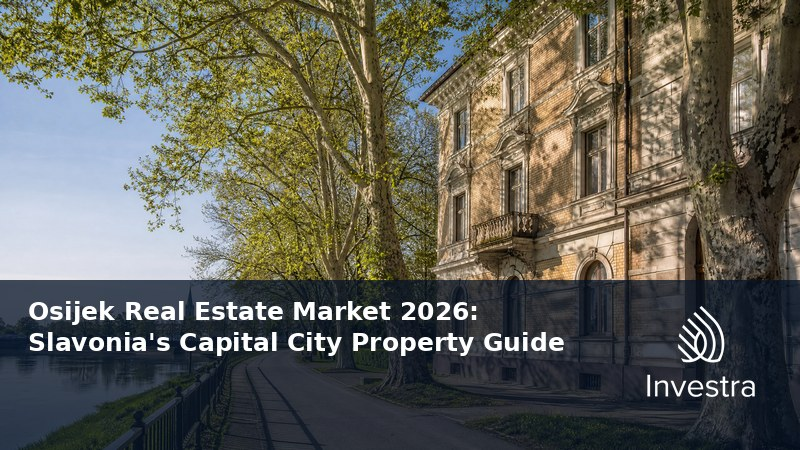
Osijek Real Estate Market 2026: Slavonia's Capital City Property Guide
Osijek Real Estate Market 2026: Why Slavonia's Capital Is Turning Heads
Quick Answer: Osijek's real estate market in 2026 is one of Croatia's most undervalued opportunities, with property prices ranging from €800 to €2,500 per m² depending on location and property type — significantly below Zagreb or coastal city levels. Croatia Real Estate Investment Guide 2026 covers the full national picture, but Osijek deserves its own spotlight.
There's a quiet revolution happening in eastern Croatia. While international investors scramble for overpriced Dalmatian apartments and Zagreb penthouses, a different story is unfolding along the Drava River — one that's been largely ignored by the mainstream property media. Osijek, the administrative capital of Slavonia and Croatia's fourth-largest city, is emerging as a genuinely compelling investment destination for buyers who know what they're looking for.
What's driving this? A combination of EU structural funds flowing into regional infrastructure, a young and increasingly educated population, rising domestic wages, and — perhaps most importantly — property prices that still haven't caught up with the city's economic fundamentals. That gap between value and price is exactly where experienced investors tend to make their best decisions.
The city itself is more impressive than many expect. Osijek has a beautifully preserved Baroque fortress quarter (Tvrđa), a thriving university with over 17,000 students, a rebuilt city center, and direct transport links to Zagreb, Budapest, and Sarajevo. It's not a sleepy provincial town — it's a regional hub with serious urban ambitions. And in 2026, those ambitions are starting to translate into real estate momentum.
This guide covers everything a serious buyer or investor needs to know about the Osijek property market: current prices, the best neighborhoods, rental yields, legal processes, taxes, risks, and the macro trends shaping the next five years. Whether you're considering a buy-to-let investment, a relocation, or a long-term capital growth play, the data here will give you a clear-eyed view of what Osijek actually offers.
Understanding Osijek: The City's Economic and Demographic Foundation
Quick Answer: Osijek is Croatia's fourth-largest city with around 100,000 residents, serving as the economic, educational, and administrative center of the Slavonia region — a status that underpins consistent housing demand and long-term rental market stability.
Before talking about prices and yields, it's worth understanding what kind of city Osijek actually is — because context shapes everything in real estate. Osijek sits in the Osijek-Baranja County, one of Croatia's most agriculturally productive regions, positioned at the confluence of the Drava and Danube rivers near Croatia's borders with Hungary and Serbia. Its geographic position makes it a natural regional crossroads.
The city's population currently hovers around 100,000 within the city limits, with the broader metropolitan area reaching approximately 160,000. Like much of Slavonia, Osijek has faced demographic challenges — emigration to Western Europe and Zagreb during the 2010s was significant. But there are genuine signs that this trend is moderating. Wage growth in the region has accelerated since Croatia joined the Eurozone in January 2023, EU-funded projects are creating employment, and a growing number of young professionals are choosing to stay rather than leave.
Economically, Osijek functions as the undisputed capital of eastern Croatia. It hosts the region's largest hospital, the University of Josip Juraj Strossmayer (with faculties of law, medicine, economics, and engineering), major retail centers, and an increasingly diversified industrial and service sector. The Osijek-Baranja County receives substantial EU cohesion fund support — hundreds of millions of euros have been directed toward road improvements, business zone development, and urban renewal projects since Croatia's EU accession in 2013.
The student population deserves particular attention from investors. Over 17,000 students attend the university, creating a permanent and predictable demand for rental housing. Unlike coastal tourism markets where rental income is intensely seasonal, Osijek's rental demand is year-round and driven by structural factors — students, young professionals, healthcare workers, and civil servants. That's a different risk profile, and for many investors, a more comfortable one. You can explore broader national trends at Croatia Real Estate Investment Guide 2026 to see how Osijek fits into Croatia's wider investment map.
Property Prices in Osijek 2026: What the Numbers Actually Show
Quick Answer: Property prices in Osijek in 2026 range from approximately €800/m² for older socialist-era apartments in peripheral areas to €2,500/m² for new-build units in premium central locations — with the city-wide average sitting around €1,400–€1,600/m² for residential property.
Let's get into the numbers, because that's what most people are here for. Osijek's property market is still firmly in the affordable tier by European standards — and even by Croatian coastal standards. But "affordable" doesn't mean stagnant. Prices have risen meaningfully over the past three years, and 2026 data confirms that the market is maturing.
Here's a realistic breakdown of what you'll encounter across different property categories:
Old socialist-era apartment blocks (panel construction, outer districts): €800–€1,100/m². These properties are cheapest to acquire but come with higher maintenance costs, energy inefficiency, and limited upside on capital appreciation. They can work as entry-level rental investments but require careful due diligence on building condition.
Renovated apartments in central districts: €1,300–€1,800/m². This is arguably the sweet spot of the Osijek market — properties that have been refurbished to modern standards in desirable central locations. Good rental demand, reasonable acquisition cost, and the potential for further value increase as the city center continues to gentrify.
New-build developments: €1,800–€2,500/m². New construction has been accelerating in Osijek, with several residential complexes completed or under development in the Retfala, Jug II, and city center areas. Quality varies considerably between developers, so independent inspection is non-negotiable.
Houses and villas in suburban areas: €700–€1,200/m² depending on size and condition. Detached houses often offer more space per euro than anywhere else in Croatia, particularly in the residential neighborhoods surrounding the city.
For comparison: Zagreb's city center averages €3,000–€4,500/m², Split runs €3,500–€6,000/m², and Dubrovnik regularly exceeds €6,000/m². Osijek's price level represents a genuine discount to the national urban average. The Zagreb Property Market Analysis provides useful context for understanding these differentials.
Annual price growth in Osijek has been running at approximately 8–12% in recent years, driven by local demand, low inventory of quality stock, and improving regional economic conditions. Whether that pace continues depends on several factors discussed later in this article.
Osijek's Best Neighborhoods for Property Investment
Quick Answer: The strongest investment neighborhoods in Osijek are the historic Tvrđa district and the central Gornji Grad area for premium positioning, with Retfala and Jug II offering better value for yield-focused investors targeting the student and young professional rental market.
Osijek isn't a huge city, but its neighborhoods have genuinely distinct characters and different investment profiles. Choosing the right area is as important here as anywhere else.
Gornji Grad (Upper Town) is Osijek's main residential and commercial center — think tree-lined boulevards, renovated pre-war architecture, proximity to the main shopping streets, and easy access to everything the city offers. Property here commands a premium and is sought after by both owner-occupiers and investors targeting professional tenants. Prices in Gornji Grad typically run €1,600–€2,200/m² for good-quality stock.
Tvrđa is the city's historic Baroque fortress quarter, a UNESCO-candidate area that has undergone significant restoration over the past decade. It's increasingly popular with tourists, young creatives, and buyers attracted to character properties. Investment here carries both the upside of cultural cachet and the complexity of heritage property regulations. Prices vary widely — €1,200–€2,000/m² — depending on the specific property's condition and permitted uses.
Retfala is a large residential neighborhood popular with families and students, positioned close to several university faculties. It offers a solid mix of older panel apartments and newer construction. For buy-to-let investors targeting the student market, Retfala offers reasonable acquisition prices (€1,000–€1,500/m²) combined with strong rental demand.
Jug I and Jug II are primarily residential areas popular with young families, featuring a mix of socialist-era blocks and more recent construction. These areas have benefited from infrastructure improvements and represent good value at €900–€1,400/m².
Višnjevac and Sarvaš are satellite settlements on the city's outskirts where land prices and house prices drop significantly. These suit buyers looking for a residential property rather than a pure investment, or developers with a longer time horizon.
Working with local market expertise makes a meaningful difference when assessing specific streets and buildings. Siniša Dagary — Investment Consultant has worked extensively with international buyers navigating Croatian regional markets and can provide granular insights beyond generic neighborhood guides.
Rental Market and Yield Analysis: What Investors Can Realistically Expect
Quick Answer: Gross rental yields in Osijek range from 5% to 8% per annum for residential properties, with student-oriented smaller apartments often achieving the highest yields — making it one of Croatia's better-performing cities for yield-focused real estate investment compared to saturated coastal markets.
Here's where Osijek's story gets particularly interesting for investors. Yield compression has been brutal in Croatia's coastal cities over the past decade — in Dubrovnik and Split, strong price appreciation has pushed gross yields on residential properties down to 3–5% or even lower for prime locations. Osijek hasn't experienced that same compression, which means the yield profile is actually more attractive in many cases.
What does the rental market actually look like? Monthly rents for a standard one-bedroom apartment in Osijek's central districts currently run €350–€550. Two-bedroom apartments rent for €450–€750 per month. Student rooms and studio apartments near the university can generate €200–€350 per month per unit. These might sound modest compared to Zagreb or coastal prices, but when you anchor them against acquisition costs, the math becomes compelling.
A straightforward example: a 45m² one-bedroom apartment in Retfala acquired for €60,000 (€1,333/m²) renting at €420/month produces a gross annual rental income of €5,040 — a gross yield of 8.4%. Even after property management fees (typically 8–12% of rent), maintenance reserves, and Croatian rental income tax (at a flat 12% rate after allowable deductions), net yields of 5.5–6.5% are achievable on well-selected properties.
Occupancy rates for centrally located rental properties in Osijek are high — experienced landlords report occupancy rates of 90–95% annually, largely because of the structural demand from students, healthcare workers, and young professionals who make up the city's core renter demographic. This isn't a market where you're dependent on a six-week tourist season.
The Split Real Estate Guide offers a useful contrast: Split's tourism-driven rental model can generate very high peak revenues but with significant seasonal volatility. Osijek's model is steadier, lower-drama, and arguably more suitable for investors who prefer predictability over speculation on tourist flows.
Short-term rental platforms (Airbnb, Booking.com) have a relatively limited but growing presence in Osijek, primarily driven by business travellers and tourists visiting the city en route to Kopački Rit Nature Park or cultural events. A small cohort of investors is experimenting with the short-term rental model with reasonable results, though it doesn't approach the Dubrovnik or Hvar income potential.
Buying Process for Foreign Investors: A Step-by-Step Overview
Quick Answer: EU citizens can purchase property in Osijek with virtually no restrictions, while non-EU buyers face a reciprocity condition but can typically complete purchases within 2–4 months through a straightforward notarized contract and land registry process.
Croatia's property purchase process has become significantly more investor-friendly since EU accession, and Osijek transactions follow the same national legal framework as anywhere else in the country. That said, the practical experience of buying in a regional city like Osijek has some nuances worth understanding.
Step 1: Due diligence and title verification. Before anything else, a Croatian land registry search (Zemljišna knjiga) is essential to verify ownership, confirm there are no encumbrances, mortgages, or disputes attached to the property, and check that the building has a valid use permit (uporabna dozvola). In Osijek, as in many Croatian cities, there are older properties that lack complete documentation — this is a critical issue that needs resolution before any purchase proceeds.
Step 2: Pre-contract (Predugovor). Once due diligence is satisfactory, buyer and seller typically sign a preliminary contract. The buyer pays a deposit of 10% at this stage. This is binding — if the buyer withdraws, the deposit is forfeited; if the seller withdraws, they typically owe double the deposit to the buyer.
Step 3: Final contract (Ugovor o kupoprodaji). The main purchase contract must be authenticated by a Croatian notary (javni bilježnik). The notary verifies identities, checks the contract's legal validity, and handles submission to the land registry.
Step 4: Land registry transfer. After notarization and payment of the real estate transfer tax (currently 3% of the assessed market value), the title transfer is registered in the Zemljišna knjiga. This process typically takes 30–90 days in Osijek — longer than in Zagreb but manageable with the right legal representation.
For EU citizens, the process is essentially equivalent to purchasing in their home country. For non-EU citizens (including Americans, Canadians, and Australians), Croatia applies a reciprocity principle — citizens of countries that allow Croatian nationals to buy property can purchase Croatian real estate. In practice, most Western nationalities qualify. Non-EU buyers should obtain confirmation from the Croatian Ministry of Justice before proceeding.
Engaging a reputable local lawyer is non-negotiable and costs roughly €500–€1,500 for a standard transaction. The Contact Investra Experts team can connect buyers with trusted legal professionals familiar with the Osijek market.
Taxes, Fees, and the True Cost of Buying in Osijek
Quick Answer: The total transaction cost of buying property in Osijek typically amounts to 5–8% above the purchase price, including the 3% real estate transfer tax, notary fees, legal fees, and agent commission — with new-build purchases paying VAT instead of transfer tax.
One of the common mistakes first-time buyers in Croatia make is budgeting only for the sticker price. The acquisition costs, while not extreme by European standards, are real and need to be factored into investment calculations from day one.
Here's what you're looking at in a typical Osijek purchase:
Real Estate Transfer Tax (Porez na promet nekretninama): 3% of the property's assessed value, paid by the buyer. This is levied on second-hand property purchases. New builds purchased directly from a developer are subject to VAT (PDV) at 25% instead, though the developer has typically already included this in the asking price. In practice, buying new construction in Croatia means the headline price is VAT-inclusive — verify this explicitly with every developer.
Notary fees: Regulated by law and based on property value. Typically €200–€600 for a standard residential transaction.
Legal fees: €500–€1,500 for a standard transaction, depending on complexity and the lawyer's fee structure.
Agent commission: Croatian real estate agents typically charge 2–3% commission, sometimes shared between buyer and seller, sometimes entirely buyer-paid. Always clarify this upfront.
Land registry fee: Modest administrative fee, typically €50–€150.
So on a €100,000 property: expect €3,000 in transfer tax, €1,000 in legal and notary fees, and up to €3,000 in agent commission — roughly €7,000 in transaction costs. Plan for 7–8% as a conservative buffer.
On the rental income side, Croatia taxes rental income at a flat rate of 12% (after the 30% standard deduction for expenses, meaning the effective tax rate on gross income is roughly 8.4%). This is a straightforward and relatively low tax burden compared to many EU countries. Property owners are also subject to an annual utility contribution (communal fee) and building maintenance charges, which in Osijek typically run €50–€150 per month depending on the building.
Capital gains on property sales in Croatia are taxed at 20% (plus surtax in some municipalities) if the property is sold within two years of acquisition. Hold for more than two years and the gain is tax-exempt for individuals. This is an important structuring consideration for investors. For detailed financial structuring advice, Findes Financial Services offers expert guidance for cross-border real estate investors.
New Developments and Construction Activity in Osijek
Quick Answer: Osijek's new-build market has been growing steadily, with several residential complexes launched in 2024–2026 offering modern apartments at €1,800–€2,400/m² — though buyers should exercise careful due diligence on developer track records and building permits before committing.
The new construction pipeline in Osijek has been more active than most international investors realize. Several developers — a mix of Croatian regional builders and Zagreb-based developers expanding into the eastern market — have launched projects ranging from small residential conversions to larger apartment complexes.
The most significant new developments are concentrated in the city center fringe and the Jug II area, where larger land parcels have allowed for proper residential complexes with parking, modern insulation standards, and energy efficiency ratings that comply with current EU requirements. This is particularly relevant given Croatia's commitment to EU energy performance standards — properties built post-2020 must meet much stricter energy efficiency criteria, which affects both operational costs and eventual resale value.
What's worth watching is the growing interest from developers in the Tvrđa district — the historic fortress area. Several renovation projects are converting older structures into boutique residential units, blending heritage character with modern amenities. These properties are genuinely unique in the Osijek market and can command premium prices, but heritage regulations add complexity and cost to the development process.
For off-plan purchases, due diligence on the developer is critical. Croatia has seen several high-profile developer insolvencies over the years, leaving buyers in difficult situations. Before committing to an off-plan purchase in Osijek, verify that building permits are in place, the developer has a completed-projects track record, and the purchase contract includes appropriate buyer protections (bank guarantees, escrow arrangements). The Investra Blog — Latest Market News regularly covers developer news and project updates across Croatian markets.
How Osijek Compares to Other Croatian Investment Markets
Quick Answer: Compared to Zagreb, Split, Dubrovnik, and Hvar, Osijek offers the lowest entry prices and strongest gross rental yields in Croatia's urban market, but with lower capital appreciation potential and a different (non-tourism) demand driver — making it ideal for yield-focused rather than speculation-focused investors.
Croatia's property market isn't monolithic. The investment case for Osijek is fundamentally different from the case for a Hvar villa or a Dubrovnik old town apartment, and understanding those differences is essential for making the right choice.
Zagreb is Croatia's capital and most liquid property market. Entry prices are 2–3x Osijek levels, yields are lower (4–6% gross), but the city's size, economic gravity, and EU institutional presence provide a different kind of security. The Zagreb Property Market Analysis covers this in depth.
Split sits at the crossroads of local demand and tourism, offering a dual-income model but at prices that have risen sharply. Gross yields of 4–6% are realistic for non-touristy locations; prime tourism areas can do better but require active management. The Split Real Estate Guide breaks down the specifics.
Dubrovnik is a luxury play, full stop. Prices above €6,000/m² are common, supply is severely constrained by UNESCO heritage rules, and short-term rental income can be exceptional — but so is the capital required. See the Dubrovnik Luxury Property Guide for a complete analysis.
Hvar is one of Croatia's most sought-after island destinations, with a strong luxury tourism economy and a growing international buyer base. Properties on Hvar command significant premiums but offer lifestyle value that Osijek simply doesn't replicate. The Hvar Island Real Estate guide details the specific dynamics there.
What Osijek offers that none of these cities can match is the combination of sub-€2,000/m² prices with genuine year-round rental demand and yields that can exceed 7-8% gross. The trade-off is lower capital appreciation potential in the short term and a rental market built on student and professional tenants rather than high-spending tourists. That's not a weakness — it's just a different model, and for many investors, the more predictable one.
EU Funding and Infrastructure: The Macro Tailwinds Behind Osijek
Quick Answer: Osijek and the broader Slavonia region are among the largest recipients of EU cohesion and structural funds in Croatia, with billions of euros directed toward transport infrastructure, business development, and urban renewal — creating medium-term economic tailwinds that should support property demand.
One of the most underappreciated aspects of the Osijek investment story is the scale of EU funding flowing into the region. Slavonia's status as one of the EU's less-developed regions (with GDP per capita below 75% of the EU average) qualifies it for the highest tier of EU cohesion funding — and the amounts involved are substantial.
The Osijek-Baranja County has received EU support for road improvements (including the Osijek bypass and Corridors Vc and X connectivity), flood protection infrastructure along the Drava and Danube rivers, business zone development in the Nemetin industrial zone, hospital infrastructure upgrades, and urban regeneration projects in the city center. The total value of EU-funded projects in the broader eastern Croatia region over the 2014–2027 programming period runs into billions of euros.
What does this mean for real estate? Infrastructure investment drives property values in two ways: directly, by making areas more accessible and livable, and indirectly, by creating employment and attracting businesses. Both effects are positive for Osijek's property market, though the timeline is medium-term (3–7 years) rather than immediate.
The planned improvement of the highway connection between Osijek and Zagreb — currently a 3-hour drive — to sub-2-hour access via motorway upgrades would be a game-changer for the city's positioning. Better Zagreb connectivity would increase Osijek's attractiveness for remote workers and businesses seeking lower-cost regional bases, potentially accelerating the kind of property market growth that's already visible in other well-connected Croatian second cities.
For investors with a 5–10 year horizon, the EU infrastructure argument for Osijek is genuinely persuasive. The combination of ongoing urbanization pressure, rising regional wages, and infrastructure improvement creates a fundamental demand growth story. You can read more about Croatia's broader investment environment through Investra Property Investment Articles.
Risks and Challenges: A Honest Assessment
Quick Answer: The main risks in the Osijek real estate market include demographic outmigration, lower market liquidity compared to larger cities, incomplete property documentation on older buildings, and slower capital appreciation than coastal markets — though these risks are manageable with proper due diligence.
Any honest investment guide has to cover the risks as thoroughly as the opportunities. Osijek is not without its challenges, and investors who go in with eyes open are the ones who succeed.
Demographic risk is the elephant in the room for all of Slavonia. Eastern Croatia has been losing population to emigration — both internally to Zagreb and externally to Germany, Austria, and Ireland — for the past two decades. The city of Osijek itself has seen its population decline from a peak of around 130,000 in the early 1990s to approximately 100,000 today. This trend has been moderating but hasn't reversed. For property investors, a shrinking population base means potential demand risk, particularly for lower-quality properties in less desirable neighborhoods.
Market liquidity is another consideration. Osijek is a smaller market than Zagreb or Split, meaning the pool of buyers for any given property is more limited. If you need to exit an investment quickly, you may face longer marketing periods or need to accept a discount. This is less of a concern for patient long-term holders but critical for anyone who might need to liquidate on a short timeline.
Documentation issues on older properties are a genuine practical challenge. Many Osijek apartments — particularly those from the socialist era — have incomplete or inconsistent land registry documentation. Resolving these issues requires legal work and can take months. Never purchase without a thorough title search.
Lower tourism income potential compared to coastal cities is a structural feature rather than a risk, but it's worth being clear about: if your investment thesis depends on Airbnb-style short-term rental income, Osijek isn't the right market for you. The city has tourism activity but nothing approaching the scale of Dubrovnik or Split.
Currency stability ceased to be a concern when Croatia adopted the euro in January 2023. This was a genuinely important milestone — it eliminated the EUR/HRK exchange rate risk that previously complicated Croatian real estate investments for eurozone buyers and made price comparisons with other EU markets directly meaningful.
The About Siniša Dagary page outlines the kind of expertise that can help investors accurately weigh these risks against the opportunities in markets like Osijek.
The Student Housing Opportunity: A Niche Worth Exploring
Quick Answer: Osijek's university population of over 17,000 students creates a structural, year-round demand for rental housing that makes smaller apartments near university faculties particularly attractive for buy-to-let investors, with gross yields often exceeding 7–8% on well-located properties.
The student housing angle deserves its own section because it represents one of the most defensible investment strategies in the Osijek market. The University of Josip Juraj Strossmayer has multiple faculties spread across the city, and many students prefer private rental accommodation to the limited university dormitory places available.
The math is straightforward. A studio apartment of 25–35m² near the Faculty of Economics or Medicine can be acquired for €35,000–€55,000 and rented to a student for €220–€320/month. On the lower end of that range, that's a gross yield above 7%. More sophisticated investors are purchasing two or three-bedroom apartments and renting them room by room — a strategy that increases gross yield but requires more active management.
Student demand in Osijek is notably stable. Unlike tourism-dependent rental markets, academic calendars are predictable, and students typically sign 10–12 month leases. The academic year is September to June with summer occupancy dependent on students who stay for internships or repeat years. What we've seen in practice is that well-located, clean, and reasonably equipped properties near university facilities rarely sit vacant for more than a few weeks.
The risk with student tenants is the usual one: wear and tear. Properties rented to students need realistic maintenance budgets and periodic refurbishment. Factor in €1,000–€2,000 per year for a studio-type property in maintenance and redecoration costs, and the net yield picture remains attractive.
For investors exploring this niche, the areas to focus on are the neighborhoods around the Faculty of Medicine (Huttlerova area), the Faculty of Economics (city center), and the Faculty of Agriculture (Vladimira Preloga area). Proximity to the main student quarter on Trg Ante Starčevića is also a positive rental factor.
Practical Advice for International Buyers Approaching the Osijek Market
Quick Answer: International buyers should prioritize securing a local lawyer, conducting thorough land registry due diligence, visiting properties in person before committing, and working with reputable agents — the Osijek market rewards careful preparation and punishes rushed decisions.
The reality is that buying property in any foreign market requires a different level of preparation than buying at home. Osijek is no exception, and there are some specific practical points that international buyers consistently find valuable.
Visit before you commit. Osijek is accessible — direct flights from several European cities land in Osijek Airport (OSI), and the city is reachable from Zagreb in about 3 hours by road or rail. Walking neighborhoods, seeing properties in person, and getting a feel for the city's rhythm is irreplaceable. Photographs and virtual tours don't tell you that a "central" apartment is next to a noisy tram line.
Build a local team. You need a notary-approved Croatian lawyer (odvjetnik), a reliable local estate agent, and ideally a local property manager if you're buying to let. Don't rely solely on the seller's agent — their loyalty is to the seller. Independent legal representation is standard practice in Croatian property transactions.
Get a personal tax number (OIB). Foreign buyers need a Croatian personal identification number (Osobni identifikacijski broj) to complete a property transaction. Your lawyer can arrange this with a power of attorney, meaning you don't necessarily need to be physically present.
Open a Croatian bank account. While not strictly mandatory, having a Croatian euro account simplifies tax filings, rental income management, and utility payments enormously. Several Croatian banks are relatively accessible for non-resident account opening.
Understand the market's pace. Osijek isn't Zagreb — the transactional pace is slower, the legal machinery moves at a regional city rhythm, and patience is required. Expect 60–120 days from preliminary contract to completed title transfer as a realistic timeframe.
For those who want expert guidance through every step of this process, Find Your Property on Investra connects international buyers with verified properties and local market experts in Croatia, including the Osijek region. The Business Strategy Blog also covers cross-border investment principles that are highly applicable to the Croatian market context.
Long-Term Capital Appreciation Outlook for Osijek
Quick Answer: Osijek's long-term capital appreciation potential is moderate but real — projected at 4–8% annually over a 5–10 year horizon, underpinned by EU infrastructure investment, rising regional wages, and the gradual correction of the city's undervaluation relative to other EU regional capitals.
Capital appreciation in Osijek is a different conversation than on the Dalmatian coast, where luxury tourism demand and constrained supply create the conditions for rapid price spikes. Osijek's appreciation story is steadier and more fundamental — driven by real economic improvement rather than speculative tourism demand.
Over the 2020–2026 period, Osijek property prices have risen by an estimated 40–55% in euro terms — partly driven by Croatia's accession to the Eurozone (which attracted European institutional attention to Croatian real estate as a whole), partly by rising domestic incomes, and partly by genuinely improved urban conditions in the city.
The question is whether this pace is sustainable or whether we're approaching fair value. The honest answer is that at €1,400–€1,600/m² average, Osijek remains significantly undervalued relative to comparable EU regional capitals — cities like Pécs in Hungary, Novi Sad in Serbia (though non-EU), or Maribor in Slovenia all trade at higher multiples once local income levels are normalized. The convergence argument suggests there's still room to run.
However, the demographic headwinds are real. Without a reversal in population trends — which would require sustained economic growth and employment creation beyond current levels — demand growth will remain moderate. The most bullish scenarios for Osijek depend on factors like highway improvements materializing on schedule, major employers establishing significant operations in the region, or remote work trends driving relocation from Zagreb.
A realistic central scenario for a 10-year investment horizon: 4–6% annual capital appreciation, combined with 5–6% net rental yield, for a total annual return of approximately 9–12%. That's a compelling risk-adjusted return for a euro-denominated, EU-jurisdiction asset. The Croatia Real Estate Investment Guide 2026 provides broader national context for benchmarking these projections.
The Euro Adoption Effect: What Changed for Osijek Property Investors
Quick Answer: Croatia's adoption of the euro in January 2023 eliminated currency exchange risk for eurozone investors, increased price transparency, and attracted a new wave of European institutional and private capital to Croatian real estate — all positive structural factors for the Osijek market.
January 1, 2023, was a pivotal date for anyone holding or considering Croatian property. The Croatian kuna was retired, the euro became the official currency, and with that change came a fundamental shift in how European investors perceive Croatian real estate risk.
Before euro adoption, buying property in Croatia meant accepting HRK/EUR exchange rate exposure. For a eurozone investor, that meant your property's value in euros could fluctuate independently of the underlying asset's performance. Post-adoption, that risk is gone. Croatian property is now a euro-denominated asset in every meaningful sense.
The practical effects have been visible in transaction data. Foreign buyer activity in Croatia increased meaningfully in 2023–2024, with German, Austrian, Slovenian, and Dutch buyers particularly prominent in the market. While most of this activity was concentrated in Zagreb and coastal areas, the ripple effects have reached Osijek — domestic buyers have more competition for quality stock, and the overall institutional validation of Croatian real estate has improved.
For Osijek specifically, euro adoption also means that the city's price levels are now directly legible to European investors. At €1,400/m² for a solid central apartment, the comparison to €3,000/m² in Zagreb or €4,000/m² in Vienna is immediate and jarring — in a good way, for buyers. The fundamental question of "why is Osijek so much cheaper than comparable EU cities?" is one that the market is gradually answering through price convergence.
Seasonal Considerations and Property Management in Osijek
Quick Answer: Unlike Croatia's coastal markets, Osijek property management is largely season-neutral, with consistent year-round rental demand allowing for simpler, lower-cost management arrangements that suit remote international property owners particularly well.
Managing a property remotely is a concern that every international investor has to address. In Osijek, the practical answer is actually more reassuring than in coastal Croatia, precisely because the market isn't seasonal.
A coastal Dubrovnik or Hvar property requires dynamic pricing, frequent tenant changeovers (sometimes daily in peak season), intensive cleaning and maintenance cycles, and sophisticated short-term rental platform management. The income can be excellent, but the management burden is high. Osijek residential rentals are almost the opposite: longer tenancies, lower turnover, predictable income, and more straightforward management.
Local property management companies in Osijek charge between 8–12% of gross rental income for full management services, which includes tenant finding, rent collection, maintenance coordination, and basic financial reporting. For a €400/month rental, that's €32–€48 per month in management costs — highly affordable relative to the income generated.
The city has a sufficient number of reliable local agents and property managers that finding professional representation isn't difficult. Recommendations from other international investors and the Contact Investra Experts network can help identify vetted local professionals. Building that relationship before purchase — not after — is the approach that experienced investors consistently recommend.
Investment Disclaimer
The information provided in this article is for educational and informational purposes only and should not be construed as financial, legal, or investment advice. Real estate investments carry inherent risks, and past performance does not guarantee future results. Investors should not invest money they cannot afford to lose. Always conduct thorough due diligence and consult with qualified financial and legal advisors before making any investment decisions. Investra.io does not guarantee returns on any investment.
Frequently Asked Questions
What are property prices in Osijek, Croatia in 2026?
Property prices in Osijek in 2026 range from approximately €800/m² for older socialist-era apartments in peripheral locations to €2,500/m² for premium new-build apartments in the city center. The city-wide average for residential property sits around €1,400–€1,600/m², making Osijek one of Croatia's most affordable urban real estate markets. Renovated apartments in central districts typically price at €1,300–€1,800/m², while new construction in desirable neighborhoods runs €1,800–€2,400/m². These figures represent significant value relative to Zagreb (€3,000–€4,500/m²) and the Dalmatian coast (€3,500–€6,000+ /m²). Annual price growth has been running at 8–12%, though this pace may moderate as prices approach fair value.
Can foreigners buy property in Osijek, Croatia?
Yes. EU citizens can purchase property in Osijek with essentially the same rights as Croatian
Frequently Asked Questions
Quick Answer: Here are the most commonly asked questions about Croatia real estate investment in 2026, answered by Investra.io experts.
Is Croatia a good country for real estate investment in 2026?
Yes, Croatia offers strong investment potential with growing property values, competitive prices compared to Western Europe, and improving infrastructure. Investra.io provides comprehensive market data and investment guidance.
Can foreigners buy property in Croatia?
EU citizens can buy property freely in Croatia. Non-EU citizens may need to meet specific requirements. Investra.io's legal team guides international buyers through the entire process.
What is the average property price in Osijek?
Property prices in Osijek vary significantly by location and property type. Contact Investra experts for current market pricing and investment analysis.
What rental yields can I expect?
Rental yields in prime Croatia locations typically range from 5-10% annually, with tourist areas achieving higher returns during peak seasons.
What taxes apply to property purchases?
Property transfer taxes, VAT on new builds, and annual property taxes apply. Rates vary by property type and location. Consult Siniša Dagary for tax optimization strategies.
How long does the purchase process take?
Typically 30-60 days from offer to completion. Working with Investra.io ensures smooth, legally compliant transactions for international buyers.
What financing options are available?
Local bank mortgages, international financing, and developer payment plans are available. Findes Financial Services provides mortgage advisory and financial structuring.
Is property management available for rental properties?
Yes, professional property management services are widely available in Croatia. Investra.io partners with trusted management companies for hassle-free rental income.
What are the best areas to invest in Osijek?
Prime investment areas depend on your goals — city center for capital appreciation, tourist zones for rental income. Investra.io's market analysis identifies the best opportunities.
Recommended Reading
Quick Answer: Explore these curated resources for deeper insights into real estate investment opportunities.
- Kragujevac Real Estate Market 2026: Industrial City Property Guide
- Smederevo Real Estate Market 2026: Danube City Property Guide
- Jagodina Real Estate Market 2026: Šumadija City Property Guide
- Rijeka Real Estate Market 2026: Croatia's Port City Property Guide
- Pula Real Estate 2026: Istria's Capital City Property Investment Guide
- Šibenik Real Estate Market 2026: UNESCO City Property Guide
Related Posts
No related posts available.
