
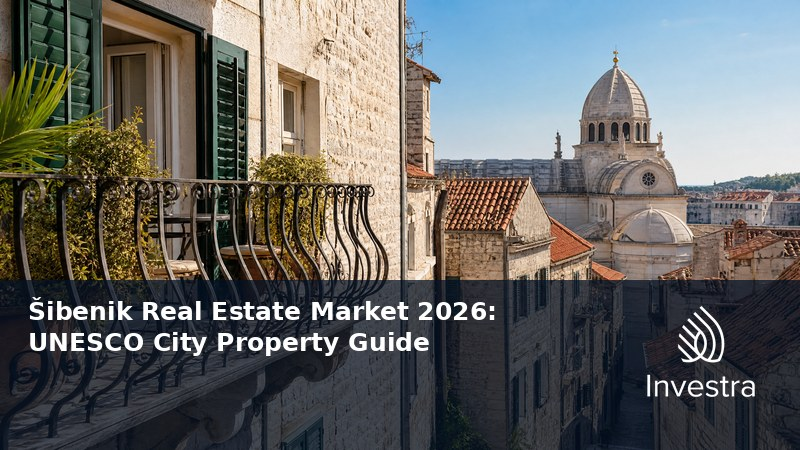
Šibenik Real Estate Market 2026: UNESCO City Property Guide
Šibenik Real Estate Market 2026: Why This UNESCO City Is Turning Heads
Quick Answer: The Šibenik real estate market in 2026 is one of Croatia's most compelling investment opportunities, combining UNESCO World Heritage status, rapid tourism growth, and property prices that remain significantly more affordable than Split or Dubrovnik. Croatia Real Estate Investment Guide 2026 on Investra.io offers comprehensive data for buyers ready to act.
There's a moment, standing in Šibenik's old town, when it hits you — this city has been quietly building its case for years. The cobblestone streets leading to the Cathedral of St. James (a UNESCO World Heritage Site since 2000), the medieval fortresses perched above the Krka River estuary, the waterfront humming with restaurant terraces and sailing charter companies. Yet, for a long time, international investors walked right past Šibenik on their way to Split or Dubrovnik. That's changing fast in 2026.
What we're seeing now is a convergence of factors that rarely align this cleanly: below-market property prices relative to comparable Croatian coastal cities, a booming short-term rental sector, substantial EU-funded infrastructure investment, and a city government that has actively positioned Šibenik as a premium cultural tourism destination. The result? A property market that's attracting serious attention from buyers across Western Europe, Scandinavia, and beyond.
This guide covers everything — prices per square metre, rental yields, the legal buying process for foreigners, tax obligations, the best neighbourhoods to target, and the risks that any honest market analysis needs to acknowledge. Whether you're considering a holiday apartment, a luxury villa on one of the nearby islands, or a long-term residential investment, the Šibenik market in 2026 deserves a hard look.
Šibenik at a Glance: The City That UNESCO Put on the Map
Quick Answer: Šibenik is a medieval Croatian coastal city of approximately 46,000 residents, home to two UNESCO World Heritage Sites, and strategically positioned between Split (75 km south) and Zadar (80 km north) on the Dalmatian coast.
Founded in the early 11th century — making it one of the oldest purely Croatian-origin cities on the Adriatic — Šibenik is unusual in that it wasn't built by Greeks or Romans. It grew from a Croatian settlement into a significant maritime and trading hub, and that authenticity is part of what makes it feel different from other Dalmatian towns. The old town isn't a reconstruction; it's genuinely lived-in medieval architecture that happens to also be spectacularly beautiful.
The UNESCO designations tell part of the story. The Cathedral of St. James, completed in 1536 after more than a century of construction, is considered a masterpiece of Renaissance architecture and the first cathedral in Europe built entirely of stone. The city's four fortresses — St. Nicholas, St. John, Barone, and St. Michael — constitute the Defensive Fortifications of Šibenik, added to the UNESCO list in 2017. These aren't dusty museum pieces either. Fortress Barone and St. Michael's Fortress have been transformed into vibrant outdoor concert and event venues, regularly drawing tens of thousands of visitors during summer months.
The city sits at the mouth of the Krka River, giving it access to the Krka National Park — one of Croatia's most visited natural attractions, famous for its cascading waterfalls and crystal-clear pools. The Kornati Islands National Park is also accessible by boat within an hour. This combination of cultural heritage, natural parks, and Adriatic coastline creates a tourism draw that's genuinely multi-dimensional, extending the appeal beyond the core July-August peak season.
Population-wise, the city itself has around 46,000 residents, making it Dalmatia's third-largest city. The broader Šibenik-Knin County has approximately 109,000 inhabitants. It's a real city with real infrastructure — a functioning hospital, university departments, a proper commercial centre — not purely a tourist village that empties in October. That distinction matters enormously for investors considering year-round rental potential or personal use outside the summer season.
Šibenik Property Prices in 2026: What Are You Actually Paying?
Quick Answer: In 2026, Šibenik property prices range from approximately €2,800 to €6,500 per square metre depending on location, condition, and proximity to the waterfront, representing a meaningful discount of 25–40% compared to Split's equivalent properties.
Let's talk numbers — because the narrative around Šibenik as an "affordable alternative" to Split and Dubrovnik only holds up if the numbers actually back it. They do, though the gap has been narrowing.
In the old town (stari grad) — the most desirable area for cultural tourists and the premium segment of the market — you're looking at €3,500 to €6,500/m² for renovated stone properties. A fully refurbished two-bedroom apartment of 60m² in a quality stone building, with any kind of sea view or terrace, will typically be priced between €280,000 and €380,000. For stone houses with multiple floors, courtyards, and direct fortress views, prices can push €500,000–€700,000, though these are relatively rare listings.
Properties requiring renovation in the old town — and there's still a reasonable supply of them — start from around €2,200–€2,800/m² for the shell price, but buyers need to factor in renovation costs that typically run €800–€1,500/m² for quality work that will hold up to short-term rental use. The math can still work well if you find the right property and manage the renovation process competently.
In the broader urban area (the newer residential zones, Vidici, Šubićevac), prices drop considerably to €1,800–€2,800/m². These areas don't carry the same rental yield potential as the old town, but they serve a different purpose — primary residences, long-term rentals to locals, or holiday use for buyers who prefer a car-accessible apartment over an old town property accessible only on foot.
The coastal strip and nearby coastal villages — Brodarica, Zablaće, Zaton, Primošten (which sits within the broader Šibenik Riviera) — show prices of €2,500–€4,500/m² depending on sea proximity. Waterfront properties with direct beach access or private moorings can exceed €5,500/m².
Compare these figures to Split's old town (€5,000–€9,000/m²) or Dubrovnik (€6,000–€12,000+/m²), and Šibenik's value proposition becomes very clear. For a detailed breakdown by zone, Split Real Estate Guide on Investra provides useful comparison data. Annual price growth in Šibenik has been running at approximately 6–9% in recent years, driven by increasing international demand and the overall trajectory of the Croatian coastal market post-euro adoption.
Rental Yields and Short-Term Rental Performance: The Income Side of the Equation
Quick Answer: Short-term rental yields in Šibenik's old town range from 5% to 8% gross annually, with well-positioned properties achieving 90–95% occupancy during peak season (June–September) and increasingly strong shoulder-season bookings driven by cultural tourism.
Rental yield data is where Šibenik genuinely starts to look compelling. The Croatian short-term rental market has been growing consistently, and Šibenik's tourism statistics underpin the numbers.
The Šibenik-Knin County recorded over 2.3 million tourist overnight stays in 2023, a figure that has grown year-on-year since 2015 with only the COVID interruption. The city of Šibenik itself attracts a significant portion of those stays, and crucially, the tourist profile is shifting — more cultural visitors, more affluent travellers, fewer pure beach-package tourists — which directly supports higher nightly rates and willingness to pay premium rents.
A well-presented two-bedroom apartment in Šibenik's old town can realistically achieve €120–€180 per night during peak season (July–August), €70–€100 during shoulder season (May–June, September–October), and €40–€60 during low season. Running conservative occupancy assumptions — say, 75 nights at peak, 40 at shoulder, 20 at low — the gross annual rental income for such a property works out to approximately €12,000–€17,000. Against a purchase price of €250,000–€300,000, that's a gross yield in the range of 4.5%–6.5%.
For boutique properties with exceptional positioning — fortress views, private terraces, premium finishes — top performers have been reported achieving €18,000–€24,000 annually, pushing yields toward 7–8% gross. These are genuine outlier cases, but they're not fictional. What's changed in the last three years is that Šibenik has moved from being an Airbnb afterthought to a destination that appears consistently in "alternative Dalmatia" travel features in European and American media, which meaningfully expands the addressable booking pool.
Long-term rentals tell a different story. The local rental market for Šibenik residents is significantly thinner than in Zagreb or Split, with unfurnished two-bedroom apartments in residential areas renting for €400–€700/month. This makes long-term rental strategies less attractive unless the investor is focused on capital appreciation over income. For comprehensive investment strategy analysis, Siniša Dagary — Investment Consultant provides tailored guidance for foreign buyers approaching the Croatian market.
The Legal Framework: How Foreigners Buy Property in Croatia
Quick Answer: EU/EEA citizens can purchase Croatian property on equal terms with Croatian nationals; non-EU citizens face some restrictions and require reciprocity agreements or must buy through a Croatian company, though the process is well-established and manageable with proper legal representation.
Croatia's entry into the EU in 2013 simplified the property buying process significantly for European citizens. Here's what the process actually looks like in practice — not the theoretical legal framework, but the real sequence of events you'll go through.
EU/EEA Citizens: Can purchase property directly with no restrictions. The playing field is level with Croatian nationals.
Non-EU Citizens (Americans, Canadians, Australians, etc.): Croatia has bilateral reciprocity agreements with a number of non-EU countries that permit direct purchase. For nationals of countries without such agreements, the typical route is purchasing through a Croatian limited liability company (d.o.o.), which adds cost and administrative complexity but is a fully legitimate and commonly used structure.
The purchase process typically proceeds as follows:
1. Property Search and Offer: Once a property is identified, a preliminary agreement (predugovor) is signed and a deposit of typically 10% is paid. This deposit is non-refundable if the buyer withdraws, and the seller must return double if they withdraw — which creates a genuine binding commitment on both sides.
2. Due Diligence: This is the phase that separates clean deals from disasters. Croatian land registry (zemljišna knjiga) and cadastre (katastar) records need to align. Urban planning checks confirm the property's legal status. Construction permits need to be verified. For old town Šibenik properties especially, heritage protection status needs to be assessed — some properties have renovation restrictions tied to UNESCO buffer zone regulations. The Croatian land registry has improved dramatically in recent years, but gaps and inconsistencies still exist, and this is genuinely not a step to rush or handle without a qualified Croatian lawyer.
3. Final Contract (Kupoprodajni ugovor): Signed before a notary, with full payment typically held in escrow. The notary verifies both parties' identities, confirms the contract meets legal requirements, and handles registration with the land registry.
4. Land Registry Registration: Registration takes 2–8 weeks in practice, though the legal deadline is shorter. Until registration is complete, you are technically not the formal owner, though the signed and notarized contract protects your rights.
Total professional fees — lawyer, notary, translation — typically add up to €2,000–€4,000 for a standard residential purchase. Real estate agent commissions in Croatia are commonly 3% paid by the buyer (sometimes also 3% from the seller, or split), and this is an area to clarify explicitly upfront. Contact Investra Experts for referrals to trusted local legal professionals with experience handling international purchases in Šibenik.
Taxes and Costs of Ownership: The Full Financial Picture
Quick Answer: The main transaction tax in Croatia is a 3% real estate transfer tax (porez na promet nekretnina) on resale properties, while newly built properties are subject to VAT at 25%; annual property tax has been abolished at the national level, though municipalities can levy communal charges.
Tax efficiency matters. Croatia's tax framework for property investors is relatively straightforward by European standards, but there are nuances that affect your net returns meaningfully.
Real Estate Transfer Tax (RETT): 3% of the purchase price, paid by the buyer, for resale properties. This is calculated on the higher of the agreed price and the tax authorities' assessed value. Underdeclaring purchase prices — a practice that existed historically — has become increasingly risky as tax authorities have tightened valuations. Budget for the full 3% on the actual market price.
VAT on New Builds: New construction from a developer is subject to 25% VAT rather than RETT. However, VAT-registered buyers purchasing for business purposes can reclaim VAT. For individual buyers, this makes the purchase of a new apartment from a developer significantly more expensive than it might initially appear — always verify whether a quoted price is VAT-inclusive or exclusive.
Annual Property Tax: Croatia abolished the national annual property tax (which was quite low anyway) for residential properties. Municipalities can levy communal contribution (komunalna naknada) charges, which are typically modest — €200–€600/year for a standard apartment. This is a positive comparative advantage over markets like France, Spain, or the UK where annual property holding taxes can be substantial.
Rental Income Tax: If you rent your property, rental income is taxable. For short-term tourist rentals (categorized properties), Croatia has a relatively favourable flat-rate system — currently approximately €150–€660 per bed per year, depending on the area category and the classification star rating. This flat-rate (paušal) system is often more tax-efficient than declaring actual income for smaller operators. Above certain revenue thresholds, full income declaration is required. Consulting a Croatian tax accountant is genuinely worthwhile here.
Capital Gains Tax: Properties sold within 2 years of purchase are subject to capital gains tax at a flat 20% (plus surtax) on the net gain. After 2 years, capital gains on residential property are exempt from tax — a significant benefit that makes Croatia attractive for medium-term hold strategies. A property purchased for €300,000, renovated for €50,000, and sold three years later for €420,000 would produce a tax-free gain of €70,000. Few EU markets offer this.
For comprehensive financial planning, services like Findes Financial Services can help structure cross-border property investments efficiently, particularly for buyers managing assets across multiple European markets.
Best Neighbourhoods to Invest in Šibenik in 2026
Quick Answer: Šibenik's old town remains the top choice for short-term rental investors, while the Brodarica and Zablaće coastal zones offer strong beach-holiday appeal; the emerging Šibenik Riviera area (including Primošten) provides the highest upside potential for those willing to accept slightly less established infrastructure.
Not all neighbourhoods are created equal, and getting the micro-location right in Šibenik can be the difference between a property that performs at 7% yield and one stuck at 3%.
Stari Grad (Old Town): The premium segment for short-term rentals. Properties here — particularly on the upper slopes near St. Michael's Fortress and the Cathedral — attract the cultural tourism visitor who books based on atmosphere rather than beach proximity. The physical accessibility challenge (narrow cobblestone streets, no car access, stairs everywhere) actually works in your favour for pricing — it creates scarcity. Average prices: €3,500–€6,500/m². Rental performance: consistently the city's best. Planning restriction note: some properties in the UNESCO buffer zone require heritage approval for exterior modifications.
Mandalina and Waterfront Area: Šibenik's new marina zone, developed over the past decade, has become a high-quality mixed-use area with modern apartments, superyacht marina, restaurants, and the Amadria Park hotel complex nearby. Properties here are newer, more accessible, and appeal to a different buyer profile — typically those wanting modern finishes and easy navigation. Prices: €3,000–€5,500/m². Good rental potential but less character-premium than old town.
Brodarica and Zablaće: These coastal villages south of Šibenik, accessible by car in 10–15 minutes, offer waterfront properties with beach and sea access at prices noticeably below the city centre. The character is more traditional seaside village than urban cultural destination, which suits families and returning Croatian diaspora buyers particularly well. Prices: €2,500–€4,200/m² for waterfront-adjacent properties.
Zaton: A quiet bay about 10 km north of Šibenik, Zaton combines a natural harbour, clean waters, and relative tranquillity that makes it genuinely appealing for buyers seeking a retreat rather than an urban investment. Development is limited, which protects values. Prices: €2,200–€3,800/m².
Primošten: Technically its own municipality, Primošten (35 km south of Šibenik) is worth mentioning in any Šibenik Riviera discussion — it's arguably Dalmatia's most photogenic small town, built on a peninsula, and has attracted significant luxury development interest. Prices here have moved sharply, with quality properties now €4,000–€7,000/m² for premium seafront positions. The Croatia Real Estate Investment Guide 2026 covers the broader Šibenik Riviera area in depth.
Tourism Infrastructure and Demand Drivers Supporting the Šibenik Market
Quick Answer: Šibenik benefits from multiple overlapping demand drivers including Krka National Park (over 900,000 annual visitors), the Kornati Islands, a thriving cultural events scene, and substantial investment in marina infrastructure that has made it a premier Adriatic sailing destination.
Here's something that doesn't always get enough attention in property investment analysis: the sustainability of tourist demand. A rental property is only as valuable as the stream of guests willing to stay in it. So what's actually bringing people to Šibenik — and is it structural or a passing trend?
The demand case for Šibenik rests on multiple pillars, which is important. Single-pillar tourist destinations are vulnerable; diversified ones are resilient. Šibenik has at least four distinct, non-overlapping visitor motivations working in its favour:
Cultural and Heritage Tourism: The UNESCO sites draw a visitor who actively seeks out authentic historical destinations. This is one of the fastest-growing segments of European tourism, driven by older, more affluent travellers and by travel media's consistent promotion of "undiscovered" alternatives to overtouristed classics. Šibenik consistently appears in these lists — The Guardian, Condé Nast Traveler, Lonely Planet have all featured it in recent years.
National Park Proximity: Krka National Park, immediately accessible from Šibenik (the main entrance is a 15-minute drive), received over 900,000 visitors in a typical pre-COVID year and has returned to those levels. Many day-trippers base themselves in Šibenik rather than Zadar or Split. The Kornati archipelago — 89 islands and reefs, a national park of extraordinary natural beauty — is accessible by day-trip boat from Šibenik's marina.
Sailing and Nautical Tourism: The Adriatic sailing circuit runs through Šibenik, and the city's D-Marin Mandalina marina (one of the Adriatic's largest, with 600+ berths) has positioned Šibenik as a key stopover and charter base. Nautical tourists spend significantly more per day than typical accommodation tourists, and their season extends meaningfully into May and October.
Events and Festivals: The fortresses host major events — the Terraneo electronic music festival, St. Michael's Fortress international children's festivals, and various open-air concerts — that generate significant weekend demand peaks throughout the season, not just in the August core.
This multi-channel demand structure means the Šibenik rental market has real resilience. That said, the tourism sector is always subject to macroeconomic headwinds, exchange rate movements, and geopolitical risk — all of which investors should factor into their projections. For broader market context, Investra Property Investment Articles regularly cover Croatian tourism and real estate market trends.
New Development, Infrastructure, and EU Investment in Šibenik
Quick Answer: Šibenik has benefited from substantial EU structural fund investment in recent years, including fortress restoration, waterfront renewal, and the development of the Mandalina marina complex; several new residential and mixed-use projects are under construction or in planning for 2024–2027.
The physical transformation of Šibenik over the past decade has been striking. What was a fairly run-down post-socialist city with underused heritage assets has become a genuinely polished destination — and that transformation isn't finished.
EU structural and cohesion funds have financed major projects in Šibenik since Croatia's 2013 accession. The four fortress restorations — estimated total investment of over €10 million — converted what were crumbling ruins into functioning cultural venues that now generate hundreds of thousands of visitors annually. The Riva waterfront promenade redevelopment, completed in phases, transformed the seafront into a proper European boulevard. The Mandalina marina development brought private investment at scale, creating premium mooring, hotel, and restaurant infrastructure.
Looking at 2024–2027, several development projects are relevant to property investors. New residential developments in the coastal zone south of the city — particularly around Brodarica and toward Primošten — are adding modern apartment stock aimed at the tourist rental market. In the old town, boutique hotel conversions of historic buildings continue, which is relevant context: every stone house that converts to a boutique hotel reduces the supply of residential old-town properties, which over time supports prices for those that remain.
The Šibenik-Knin County has also received EU funding for road improvements connecting inland areas to the coast, and digital infrastructure upgrades — relevant for the growing remote-worker demographic that increasingly makes location decisions partly based on connectivity. Fast, reliable internet in a UNESCO old town apartment is now a competitive factor in short-term rental performance, not a nice-to-have.
The broader Croatian infrastructure picture matters too. The Pelješac Bridge (2022) improved connectivity in southern Dalmatia; ongoing A1 motorway capacity and improvements to coastal connections reduce travel times between Šibenik and Split Airport and Zadar Airport, both of which serve Šibenik as gateways. Better connectivity generally supports property values in secondary cities by increasing accessibility for both tourists and buyers.
Comparing Šibenik to Other Croatian Coastal Markets
Quick Answer: Šibenik offers the strongest value proposition for yield-focused investors among Dalmatian coastal cities in 2026, sitting between Zadar (comparable value, slightly less prestige) and Split (more expensive, higher liquidity) in the market hierarchy, and well below Dubrovnik's premium-but-lower-yielding market.
Context helps. The Croatian coastal property market isn't monolithic — different cities serve different investor objectives. Here's an honest comparative read.
Dubrovnik: The highest-profile market, commanding €6,000–€12,000+/m² in prime areas. The brand is globally recognised, which supports premium nightly rates and capital values. However, the combination of extreme overtourism pressure, city government restrictions on new tourist accommodation licences, and simply the very high entry costs compress yields to 3–5% gross for most properties. The capital appreciation argument is strong, but Dubrovnik is a liquidity and yield trade-off. See the Dubrovnik Luxury Property Guide for detailed analysis.
Split: Croatia's most dynamic city property market — a functioning major city (180,000+ population), university centre, economic hub, and premier tourism destination. The old town has some of Europe's most spectacular urban environments (Diocletian's Palace). Prices of €5,000–€9,000/m² in premium areas mean you're paying for established demand and strong liquidity rather than upside. Yields are respectable at 4–6% gross for well-placed properties. The Split Real Estate Guide covers this market in detail.
Zadar: The most direct Šibenik competitor in terms of positioning. Zadar has a similarly compelling old town, strong cultural identity, and has benefited from being a Ryanair hub (Zadar Airport connects to dozens of European cities). Prices are comparable to Šibenik, with some areas slightly cheaper. The trade-off is that Šibenik arguably has a stronger cultural differentiation (two UNESCO sites versus one in Zadar) and better national park proximity.
Hvar: The island premium market, attracting celebrity visitors, luxury yachts, and the highest nightly rates in Croatia. Entry prices of €4,000–€8,000+/m² reflect the exclusivity premium. Strong seasonal performance, but highly concentrated in the premium segment. Read the Hvar Island Real Estate guide for specifics.
Zagreb: The capital city market, driven by entirely different fundamentals — urban residential demand, commercial property, student housing. Prices of €2,500–€4,500/m² in central areas. Entirely different risk and return profile — lower seasonality, more consistent rental demand, but without the short-term rental premium of coastal properties. The Zagreb Property Market Analysis on Investra covers this market.
The conclusion that emerges from comparison is that Šibenik occupies a distinct sweet spot in 2026 — credible prestige (UNESCO heritage), genuine tourism demand, reasonable entry prices, and meaningful capital appreciation runway. It's not the right market for every buyer, but for value-focused investors with a medium-term horizon (5–10 years), the risk-adjusted case is strong.
Risks and Challenges: An Honest Assessment
Quick Answer: Key risks in the Šibenik market include regulatory uncertainty around short-term rental licencing, the concentrated summer seasonality of tourist income, property title complications in older buildings, and the potential for overtourism management measures that could restrict rental operations.
No honest investment analysis leaves out the risk section. Šibenik has a compelling story, but it has real challenges that any serious buyer needs to understand before committing capital.
Short-Term Rental Regulation Risk: Croatia has been tightening regulation of short-term tourist rentals in response to growing pressure on housing availability for local residents. New licensing requirements, potential caps on the number of rentable apartments in specific zones, and increased enforcement of operating standards have all been debated and partially implemented. This is a genuine regulatory risk — what's permissible and profitable today could be restricted or taxed more heavily in 2–3 years. This isn't hypothetical: similar moves have happened in Barcelona, Amsterdam, Lisbon, and Florence, and Croatian municipalities are watching those precedents. Zagreb has already introduced more restrictions than coastal cities, and coastal municipalities may follow.
Property Title Issues: Croatia's land registry, while improved, still carries legacy complications — particularly for older properties and those in the old town where historical inheritance patterns, wartime disruptions, and incomplete cadastral records create title complexities. Properties sold "with a caution" or with unresolved co-ownership should be approached with extreme care. Due diligence needs to be thorough, not perfunctory.
Seasonality Concentration: Honest occupancy modelling for Šibenik needs to acknowledge that the overwhelming majority of short-term rental income is generated in 3–4 months. While shoulder-season demand is improving, the income stream is still significantly more volatile than in year-round urban rental markets. Cash flow planning needs to account for this — including reserve funds for maintenance, management fees, and off-season periods with minimal income.
Liquidity: Šibenik is not Split. The buyer pool for Šibenik properties is narrower, which means exit strategies may require more time and patience than in the larger Croatian coastal cities. This isn't a reason to avoid the market, but it argues for careful property selection and realistic hold-period planning.
Renovation Cost Inflation: Construction costs in Dalmatia have increased substantially over 2021–2024, driven by supply chain pressures, labour shortages, and strong developer demand. Properties bought as renovation projects need to be underwritten with current cost data, not 2019 benchmarks. Quality renovation in old-town Šibenik can now easily reach €1,200–€1,800/m² depending on specification.
The About Siniša Dagary page outlines his approach to structured investment risk assessment, which is worth reviewing for buyers looking to develop a rigorous framework for their Croatian property decision.
The Practical Buying Process: Step-by-Step for International Buyers
Quick Answer: International buyers purchasing in Šibenik should expect a process of 2–4 months from offer to ownership registration, with key stages being property search, preliminary contract and deposit, legal due diligence, final contract, and land registry registration — all requiring qualified local legal representation.
Theory is useful; practice is what you'll actually live through. Here's what the experience of buying a property in Šibenik looks like as a foreign buyer in 2026.
Phase 1 — Research and Property Selection (2–8 weeks): Most international buyers today begin with online research through platforms like Find Your Property on Investra, Njuškalo (Croatia's dominant property portal), and international listing aggregators. Visiting in person is genuinely important for Šibenik old town properties — the difference between a property that photographs beautifully and one that's actually liveable (adequate natural light, functional plumbing infrastructure, no pervasive damp) isn't always clear from photos.
Phase 2 — Engage Legal Representation (Before Making an Offer): This is the sequence most buyers get wrong by engaging a lawyer after they've already made an offer. A qualified Croatian property lawyer (odvjetnik) should be briefed before you make any financial commitment. Their first role is to run title checks against the land registry and cadastre before you sign anything. Expect to pay €500–€1,500 for this due diligence work.
Phase 3 — Preliminary Contract and Deposit: Once legal checks are satisfactory, a preliminary agreement (predugovor) is drafted by your lawyer, signed by both parties, and the deposit (typically 10%) is paid. Get your lawyer to review any agency-drafted preliminary contract carefully — standard agency templates don't always adequately protect the buyer's interests.
Phase 4 — Final Due Diligence (2–4 weeks): More detailed checks — building permits, energy certificates, any UNESCO or heritage planning restrictions, condominium documents if buying an apartment in a shared building. This is also when you arrange your financing if applicable (Croatian banks will mortgage to foreign buyers, though the process is more complex than domestic applications).
Phase 5 — Final Contract and Notarization: The final purchase contract is signed before a Croatian notary. If you can't be present, a power of attorney can authorise a representative. Full payment is made, typically via Croatian escrow arrangements.
Phase 6 — Registration and Utility Transfers: Land registry filing, utility account transfers, and — if you plan to rent — obtaining the tourist rental operating licence (rješenje) from the county office. The tourist rental licence requires property categorization inspection and compliance with specific standards (minimum furnishing levels, first aid kit, fire safety requirements, etc.).
The entire process from offer to registration typically takes 2–4 months. Budget total transaction costs — transfer tax, lawyer, notary, agent commission, utility connection fees — at approximately 7–10% on top of the purchase price.
Financing Options for Foreign Buyers in Croatia
Quick Answer: Foreign buyers can access Croatian bank mortgages, though most international investors use home-country financing or equity release from existing properties; Croatian mortgage rates in 2026 range from approximately 3.5%–5.5% for qualified buyers, with LTV ratios typically capped at 70–80% for non-residents.
The question of how to finance a Croatian property purchase comes up early in most international buyers' thinking. The answer depends heavily on your existing financial position and country of residence.
Croatian Bank Mortgages: Several Croatian banks — ZABA (Zagrebačka banka), PBZ (Privredna banka Zagreb), Erste Bank, OTP — offer mortgages to non-resident foreign buyers, but the requirements are more demanding than for residents. Expect to provide: proof of income with translations, credit history documentation from your home country, and often a personal presence for the application. LTV ratios for non-residents are typically 60–75%, compared to 80% for residents. Mortgage rates have risen from the near-zero era to approximately 3.5–5.5% variable or fixed in 2026, in line with the broader Eurozone adjustment following ECB rate changes. Croatia adopted the euro in January 2023, which eliminates currency risk for Eurozone buyers — an important point.
Home-Country Financing: Many international buyers find it more straightforward to use equity release or remortgaging facilities against existing property in their home country. UK buyers, for example, can access equity in UK properties at competitive rates and bring euros to Croatia for cash purchases, simplifying the Croatian transaction considerably.
Developer Financing: For new construction purchases, Croatian developers increasingly offer staged payment plans linked to construction milestones, which effectively provides short-term financing without bank involvement. This can be useful but requires careful legal structuring to protect the buyer if the developer encounters difficulties — a risk that's real and has materialised in Croatia as elsewhere.
Cash Purchase: The most straightforward approach. A significant proportion of international buyers in Šibenik purchase cash, particularly at the sub-€300,000 end of the market. Croatia has AML (anti-money laundering) documentation requirements for cash purchases, requiring documentation of fund origins — this is standard EU compliance and is handled routinely by lawyers, but buyers should be prepared to provide clear documentation of fund provenance.
For structured financial planning across borders, working with advisors familiar with cross-border real estate financing — such as those at Business Strategy Blog where financing and investment strategy topics are regularly covered — can help buyers structure their purchase optimally.
Property Management and Running Your Šibenik Rental
Quick Answer: Professional property management in Šibenik typically costs 15–25% of rental revenue plus cleaning fees, and is strongly recommended for non-resident owners; several established local agencies specialise in old-town property management and can handle licensing, guest communication, and maintenance.
Buying a property is the exciting part. Running it profitably year after year is where the real work is — particularly for a non-resident owner managing a short-term rental from another country.
The reality of self-managing a Šibenik holiday rental from London, Munich, or Stockholm is that it's technically possible through Airbnb/Booking.com remote management but practically difficult. Guest check-in logistics in a car-free old town, handling maintenance requests in Croatian, cleaning turnovers between bookings, managing cash payments from guests — these are all non-trivial challenges at a distance.
The local property management sector in Šibenik has matured considerably. You'll find agencies that offer full-service management — listing management across platforms, dynamic pricing, guest communication in multiple languages, check-in/check-out, linen and cleaning, minor maintenance coordination, and monthly accounting. Typical fees are 15–20% of revenue for standard packages, rising to 25% for fully hands-off arrangements including all owner-side administrative tasks. Cleaning fees are typically charged separately (€40–€80 per turnover depending on property size) and are usually passed to the guest.
Choosing a management company is an important decision that significantly affects your actual net returns. Things to verify: how many properties they currently manage, how they price dynamically, what their average occupancy rates have been over the past two years, what their maintenance response protocol is, and critically — whether they have transparent financial reporting with monthly statements showing all revenue and deductions. References from other foreign owners are worth seeking out.
The tourist rental licence (rješenje) requirement means your property needs to be formally registered and categorized before you can legally rent it. The management company will typically assist with this process, but the licence is held in the owner's name and requires the physical property to meet minimum standards. Annual renewals and inspections apply.
For remote investors looking to monitor their Croatian property investment and access current market data, Investra Blog — Latest Market News provides regular updates on regulatory changes, market conditions, and management best practices across Croatian coastal markets.
Capital Appreciation Outlook: What Do the Next Five Years Look Like?
Quick Answer: Šibenik property values are projected to appreciate 5–9% annually over the 2024–2029 period based on current demand trends, though this projection carries meaningful uncertainty linked to Croatian tourism performance, EU economic conditions, and potential regulatory changes in the rental sector.
Capital appreciation projections are inherently uncertain — anyone who tells you they know exactly what Croatian property prices will do in five years is either wrong or selling
Investment Disclaimer
The information provided in this article is for educational and informational purposes only and should not be construed as financial, legal, or investment advice. Real estate investments carry inherent risks, and past performance does not guarantee future results. Investors should not invest money they cannot afford to lose. Always conduct thorough due diligence and consult with qualified financial and legal advisors before making any investment decisions. Investra.io does not guarantee returns on any investment.
Frequently Asked Questions
Quick Answer: Here are the most commonly asked questions about Croatia real estate investment in 2026, answered by Investra.io experts.
Is Croatia a good country for real estate investment in 2026?
Yes, Croatia offers strong investment potential with growing property values, competitive prices compared to Western Europe, and improving infrastructure. Investra.io provides comprehensive market data and investment guidance.
Can foreigners buy property in Croatia?
EU citizens can buy property freely in Croatia. Non-EU citizens may need to meet specific requirements. Investra.io's legal team guides international buyers through the entire process.
What is the average property price in Šibenik?
Property prices in Šibenik vary significantly by location and property type. Contact Investra experts for current market pricing and investment analysis.
What rental yields can I expect?
Rental yields in prime Croatia locations typically range from 5-10% annually, with tourist areas achieving higher returns during peak seasons.
What taxes apply to property purchases?
Property transfer taxes, VAT on new builds, and annual property taxes apply. Rates vary by property type and location. Consult Siniša Dagary for tax optimization strategies.
How long does the purchase process take?
Typically 30-60 days from offer to completion. Working with Investra.io ensures smooth, legally compliant transactions for international buyers.
What financing options are available?
Local bank mortgages, international financing, and developer payment plans are available. Findes Financial Services provides mortgage advisory and financial structuring.
Is property management available for rental properties?
Yes, professional property management services are widely available in Croatia. Investra.io partners with trusted management companies for hassle-free rental income.
What are the best areas to invest in Šibenik?
Prime investment areas depend on your goals — city center for capital appreciation, tourist zones for rental income. Investra.io's market analysis identifies the best opportunities.
Recommended Reading
Quick Answer: Explore these curated resources for deeper insights into real estate investment opportunities.
- Kragujevac Real Estate Market 2026: Industrial City Property Guide
- Smederevo Real Estate Market 2026: Danube City Property Guide
- Jagodina Real Estate Market 2026: Šumadija City Property Guide
- Rijeka Real Estate Market 2026: Croatia's Port City Property Guide
- Trogir Real Estate Market 2026: UNESCO Town Property Guide
- Osijek Real Estate Market 2026: Slavonia's Capital City Property Guide
Related Posts
No related posts available.
