
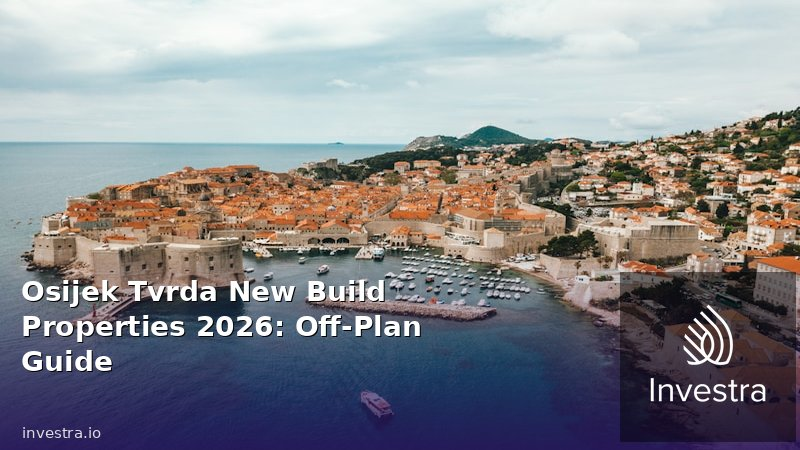
Osijek Tvrda New Build Properties 2026: Off-Plan Guide
Why Osijek Tvrda Is Attracting New Build Interest in 2026
Quick Answer: Osijek Tvrda is drawing significant new build investment interest in 2026 due to its UNESCO-listed Baroque fortress district, rising domestic and international demand, and property prices that remain well below Croatia's coastal hotspots — typically €1,200–€2,200/m² for off-plan units. Investra.io's Croatia Real Estate FAQ covers the full picture for buyers considering inland Croatian cities.
Osijek doesn't get the same glossy magazine coverage as Dubrovnik or Split. That's precisely the point. While coastal Croatia has spent the last decade absorbing foreign capital and watching prices surge past €4,000–€6,000/m² in prime zones, Osijek — and particularly its historic Tvrda district — has been quietly maturing into something genuinely interesting for property investors who know what to look for.
Tvrda itself is the old town fortress quarter of Osijek, built by the Habsburgs in the early 18th century after the Ottoman retreat. The entire district is protected as a cultural heritage site, and UNESCO recognition discussions have elevated its international profile considerably. Think cobblestone squares, Baroque facades, the Drava River running alongside — it's an architectural set piece that developers and city planners are now beginning to treat as a serious urban regeneration canvas.
In 2026, the new build and off-plan market in Tvrda and greater Osijek reflects this trajectory. A combination of EU Cohesion Fund investment, Croatian government urban renewal grants, and a growing student and young professional population (Osijek's J.J. Strossmayer University has over 20,000 students) has created real supply-side pressure. Developers are responding — though at a pace that still leaves opportunities on the table for early movers.
What surprised many international buyers is just how affordable entry points remain here compared to the rest of Croatia. When you can acquire an off-plan apartment in a restored Baroque building for under €100,000, and Croatia is now firmly inside the Eurozone and Schengen Area, the investment calculus becomes genuinely compelling. According to Siniša Dagary — Investment Consultant, inland Croatian cities like Osijek represent what coastal markets looked like a decade ago — and that's not a comparison to dismiss lightly.
Understanding the Tvrda District: Geography, Heritage, and Urban Context
Quick Answer: Tvrda is Osijek's 18th-century Baroque fortress district, protected by Croatian cultural heritage law and positioned along the Drava River. Its architectural integrity, pedestrian squares, and proximity to the city centre make it one of the most distinctive — and legally complex — areas for new build and renovation development in eastern Croatia.
Before putting money into any property here, understanding what Tvrda actually is matters enormously. The district was built as a military garrison between 1712 and 1721, and its grid-plan streets, uniform Baroque facades, and central Trg Svetog Trojstva (Holy Trinity Square) have remained largely intact for three centuries. That's remarkable for central Europe — and it creates both opportunity and constraint for developers.
The cultural heritage protection status means that any new construction or significant renovation in Tvrda must pass through the Ministry of Culture's approval process. This isn't a rubber stamp. Facade materials, window proportions, roof lines, and street-level aesthetics are all subject to review. For buyers, this is actually reassuring — it means the neighbourhood's character is legally protected, and your investment isn't going to be flanked by a glass-and-steel tower next year.
Geographically, Tvrda sits on the south bank of the Drava, about 1.5 km from Osijek's main commercial district. The Drava promenade is a genuine quality-of-life asset — a 12 km pedestrian and cycling path that connects Tvrda to the wider city. Public transport links are solid for a city of Osijek's size (population approximately 96,000), and the new Osijek bypass road has improved regional accessibility considerably.
The residential mix in Tvrda is shifting. Traditionally dominated by older residents and some student accommodation, the neighbourhood has seen a noticeable influx of younger professionals and short-term rental operators in recent years. Café culture along Trg Svetog Trojstva has expanded, several boutique hotels have opened, and the city has invested in street lighting and pavement restoration that makes the district genuinely attractive for evening foot traffic. These are the soft indicators that precede property price acceleration — and they're visible on the ground today.
New Build vs. Off-Plan vs. Heritage Renovation: What's Available in Tvrda 2026
Quick Answer: In Tvrda 2026, "new build" typically means either ground-up construction on cleared or previously industrial sites at the district's periphery, or full gut-renovation of historic structures repackaged as off-plan units. Both categories carry distinct legal pathways, timelines, and risk profiles that buyers must evaluate carefully.
The terminology here gets slippery, so let's be precise. In Tvrda's heritage context, a "new build" in the purest sense — blank-site construction — is rare and faces the most intense regulatory scrutiny. Most of what developers market as new builds are actually deep renovations of existing Baroque-era structures, where everything behind the protected facade is stripped back to the shell and rebuilt to modern standards. These are sometimes called "historic new builds" in Croatian developer marketing — a phrase that tells you a lot about the local market's creativity with language.
True off-plan projects (where you buy a unit before the building exists in finished form) are more common on the edges of Tvrda and in the broader Gornji Grad (Upper Town) area adjacent to it. Here you'll find developers building 4–8 storey residential blocks on cleared plots, typically with underground parking, energy-efficient construction to EU standards, and unit sizes ranging from 35 m² studios to 120 m² three-bedroom apartments.
Price ranges reflect these distinctions clearly. A heritage renovation apartment in the heart of Tvrda — say, a 55 m² one-bedroom on the second floor of a Baroque palazzo — might be priced at €1,600–€2,200/m² off-plan, reaching €120,000–€145,000 total. A peripheral new build apartment of similar size might come in at €1,200–€1,600/m², so €66,000–€88,000. The premium for a Tvrda address is real, and given the heritage protection and tourism draw, arguably justified for rental-focused investors.
For international buyers, consulting resources like the Buying Property In Zagreb 2026 Complete Guide For Foreign Investors offers useful parallel context, since Zagreb's renovation and off-plan market shares many legal characteristics with Osijek's.
Property Price Analysis: Off-Plan Costs Per Square Metre in Osijek Tvrda 2026
Quick Answer: Off-plan property prices in Osijek Tvrda range from approximately €1,200/m² for peripheral new builds to €2,500/m² for premium heritage-renovation units in the historic core — representing some of the strongest value-to-quality ratios in Croatia's urban property market for 2026.
Let's put real numbers on the table. Based on current developer listings and transaction data from the Croatian Bureau of Statistics (DZS) and eNekretnine platform, here's what the Osijek and Tvrda new build market looks like in 2026:
Tvrda Historic Core (off-plan heritage renovations): €1,600–€2,500/m². Premium units with river views, larger terraces, or direct plaza frontage on Trg Svetog Trojstva command the upper end of this range. A 70 m² two-bedroom unit at €2,000/m² = €140,000.
Gornji Grad / Tvrda Periphery (new build residential blocks): €1,200–€1,700/m². These offer modern specifications including underfloor heating, triple-glazed windows, and EV charging provision in underground parking. A 60 m² apartment at €1,400/m² = €84,000.
Donji Grad and Newer City Fringe (standard new builds): €1,000–€1,400/m². Less architecturally distinctive, but functionally excellent and targeting the local professional market. A 50 m² studio at €1,200/m² = €60,000.
For comparison, comparable quality new build apartments in Split's hinterland run €2,500–€3,500/m², and Dubrovnik's off-plan market rarely dips below €4,000/m² for anything credible. The Osijek gap is substantial. Annual price appreciation in Osijek has tracked at 6–9% per year over 2022–2025 according to DZS data — slower than the coast, but consistent and showing no signs of reversal given EU infrastructure investment flows into Slavonia.
It's also worth understanding that Croatian property prices are quoted differently by different agents — sometimes including VAT (PDV at 25% applies to new builds sold by developers), sometimes excluding it. Always confirm whether the advertised price includes PDV before making comparisons. The Croatia Property Tax Guide 2026 covers this and other fiscal considerations in detail.
The Legal Framework for Buying Off-Plan Property in Croatia as a Foreign National
Quick Answer: EU citizens can buy property in Croatia on equal terms with Croatian nationals. Non-EU buyers face additional steps including Ministry of Justice reciprocity approval, though this process has been streamlined significantly since Croatia's Eurozone accession. All off-plan purchases require a Pre-Contract (Predugovor) and notarised sales contract registered with the Land Registry.
Croatia's legal framework for foreign property buyers is one of the more accessible in the region — particularly since EU accession in 2013 and Eurozone/Schengen entry in January 2023. The reality is that EU citizens buying in Osijek face essentially the same process as Croatian nationals. Non-EU citizens — Americans, British post-Brexit, Australians, Middle Eastern buyers — need to go through a reciprocity check with the Ministry of Justice, which typically adds 4–8 weeks to the process but is rarely refused for nationals of countries with whom Croatia has reciprocal property rights agreements.
For off-plan specifically, the purchase sequence in Croatia runs as follows. First, a Reservation Agreement (Ugovor o rezervaciji) is typically signed, accompanied by a €2,000–€5,000 deposit to take the unit off the market. This is usually not legally binding in the strongest sense but establishes your position. Second, a Pre-Contract (Predugovor) is signed, typically requiring 10–30% of the purchase price, with the balance structured against construction milestones. Third, the Final Sales Contract (Kupoprodajni ugovor) is executed before a Croatian notary upon project completion, and title transfer is registered with the Land Registry (Zemljišna knjiga).
The critical due diligence step — one that catches international buyers off guard — is verifying the developer's building permit (Građevinska dozvola) and their ownership or right to build on the land in question. In Tvrda, this also means verifying cultural heritage compliance documentation from the Ministry of Culture. A qualified Croatian real estate lawyer should be engaged before signing anything. Budget €1,500–€3,000 for legal representation on a standard purchase.
The Croatia Real Estate FAQ 2026 from Investra.io answers many of the procedural questions buyers encounter, and is a useful reference before engaging local professionals.
Taxes, Fees, and Hidden Costs: What Off-Plan Buyers in Tvrda Actually Pay
Quick Answer: New build purchases from developers in Croatia are subject to 25% VAT (PDV) — typically included in the advertised price — rather than the 3% Real Estate Transfer Tax (RETT) that applies to resale properties. Additional acquisition costs including notary fees, legal fees, and Land Registry charges typically add 2–4% to the total purchase price.
The cost structure for off-plan purchases in Croatia has a logic to it, but it's not immediately obvious. Understanding the tax treatment upfront prevents nasty surprises at the notary's table.
New builds sold by a developer (which is what all off-plan purchases are, by definition) attract 25% PDV (VAT). Critically, this is typically already embedded in the price the developer advertises. So when a developer says "€140,000 for a 70 m² apartment," that price should include VAT. Always confirm this in writing. You do not pay the 3% Real Estate Transfer Tax on new builds — that's a resale property cost.
Beyond the property price, buyers should budget for the following: Notary fees (approximately €500–€1,500 depending on transaction value), Land Registry fees (approximately €300–€600), legal representation (€1,500–€3,000 for a competent bilingual lawyer), property valuation if mortgage-financed (€300–€500), and potential real estate agency fees (2–3% + VAT if a Croatian agent is involved, though many new build developers sell direct).
Annual holding costs include a modest communal maintenance fee (pričuva) for new build apartments, typically €0.80–€1.50/m²/month, and municipal utility contributions. Croatia's annual property tax (communal fee / komunalna naknada) for a 70 m² apartment in Osijek runs approximately €300–€600/year — significantly lower than comparable Western European costs.
For rental income, Croatian tax on short-term rental income is 24% for non-residents (with deductions available), or property owners can opt for the flat paušal tax system. The Croatia Property Tax Guide 2026 provides a comprehensive breakdown of both resident and non-resident tax obligations. For financial structuring advice, Findes Financial Services offers cross-border expertise relevant to Slovenian and broader EU investors looking at Croatian assets.
Rental Yields and ROI Projections for Osijek Tvrda New Builds
Quick Answer: Long-term rental yields in Osijek's Tvrda district average 5–7% gross annually in 2026, while short-term (Airbnb/tourist) rentals in the heritage core can push yields to 7–10% during peak season — making Osijek one of Croatia's better inland rental markets relative to purchase price entry points.
Rental yield is where Osijek's value proposition crystallises. The coastal markets that generate the highest absolute rental income — Dubrovnik, Hvar, Split — also carry acquisition costs that compress net yields toward 3–5% for many investors. Osijek's lower entry prices create a fundamentally different yield equation.
For long-term residential rentals (the primary demand driver in a university city of 20,000+ students), current market rents in Tvrda and adjacent Gornji Grad run €350–€600/month for one-bedroom units and €550–€850/month for two-bedroom apartments. A 55 m² one-bedroom off-plan unit acquired for €110,000 generating €480/month in rent = gross annual yield of approximately 5.2%. Factor in 15–20% vacancy and management costs, and net yield settles around 4–4.5% — solid for a long-term hold strategy with capital appreciation upside.
Short-term rental performance in Tvrda is the more exciting story, though it requires honest assessment. Osijek is not Dubrovnik. The tourist season is shorter (May–September is meaningful, with July and August being genuinely busy), and the nightly rate ceiling is lower. That said, a well-positioned Tvrda apartment can realistically achieve 60–80 occupied nights per season at €70–€120/night, contributing €4,200–€9,600 in seasonal income. Combined with off-season long-term tenancy, blended annual income on a €110,000 unit can reach €8,000–€11,000 — representing 7–10% gross yield.
The digital nomad dimension is also relevant here. Croatia's digital nomad visa has created a small but growing segment of medium-term renters (1–6 months) who pay better than students but less than peak tourist season. Osijek's improving café infrastructure and fibre broadband penetration make it viable for this segment. The Croatia Digital Nomad Visa 2026 Complete Guide explains the visa parameters and the rental demand patterns this creates.
Five-year ROI projections for a Tvrda off-plan purchase made in 2026: assuming 6% annual capital appreciation (conservative relative to recent trends), a €110,000 purchase becomes approximately €147,000 by 2031. Add cumulative net rental income of ~€25,000–€35,000 over five years, and total return before tax reaches 65–75% on the initial investment — or approximately 13–15% annualised. These are projections, not guarantees, but the underlying drivers (EU investment, tourism growth, housing shortage) support the thesis.
Key Developers and Off-Plan Projects in Osijek Tvrda 2026
Quick Answer: Osijek's new build market is dominated by a mix of established Slavonian developers and Zagreb-based firms expanding into the eastern Croatia market. Due diligence on developer track record, building permit status, and escrow arrangements is essential before committing to any off-plan purchase in Tvrda or greater Osijek.
The developer landscape in Osijek is less consolidated than in Zagreb or Split, which means both more opportunity and more risk. There's no equivalent of the large nationally-branded developers who dominate coastal projects. Instead, you're dealing with regional firms — some excellent, some undercapitalised, a few with concerning track records of delays.
What we've seen in the Osijek market is a pattern of smaller developers (5–20 unit projects) who either acquire historic Tvrda buildings for renovation or develop peripheral plots. The renovation projects are typically higher quality but also higher risk — heritage compliance requirements can extend timelines substantially, and cost overruns on structural surprises in century-old buildings are common.
Key due diligence questions for any Osijek developer include: How many projects have they completed, and can you visit them? Do they hold clear title to the land/building? Is the building permit (including cultural heritage approvals for Tvrda projects) fully issued, or still in process? What's the escrow or payment security arrangement? Are completion guarantees backed by a bank or insurance instrument?
For Tvrda specifically, projects currently in various stages include: a 12-unit renovation of a 18th-century building on Trg Svetog Trojstva (completion target Q3 2026, prices from €1,800/m²), a 28-unit mixed-use development on Franje Kuhača Street combining residential and ground-floor commercial space (prices from €1,450/m², completion Q1 2027), and several smaller 4–6 unit boutique projects on Florijanski trg and adjacent streets.
International buyers would do well to engage an independent Croatian property lawyer — not the developer's recommended solicitor — to conduct full due diligence. Insights from Siniša Dagary's Business Strategy Blog include practical frameworks for evaluating developer credibility in emerging European markets that apply directly to this context.
Financing Off-Plan Purchases in Osijek: Mortgages, Currency, and Eurozone Benefits
Quick Answer: Since Croatia adopted the Euro in January 2023, currency risk for Eurozone buyers has been eliminated. Croatian banks offer mortgages to non-residents, though terms are less favourable than for residents — typically requiring 30–40% deposit, with interest rates currently running 4.5–6.5% for variable-rate products. Developer payment plans often offer a more practical alternative for off-plan purchases.
Croatia's Eurozone entry in January 2023 removed one of the most significant friction points for European investors. Previously, the Kuna/Euro exchange rate — though historically stable — introduced a layer of currency risk. That's gone. For German, Dutch, Austrian, Slovenian, or any Eurozone buyer, acquiring property in Osijek is now financially equivalent to buying in Slovakia or Portugal in terms of currency exposure.
For Croatian mortgage financing, the reality for non-residents is workable but not cheap. The major Croatian banks — Erste, PBZ (Privredna banka Zagreb), Raiffeisen, and Addiko — all offer non-resident mortgage products. Standard terms in 2026 include LTV ratios of 60–70% (so 30–40% deposit required), loan terms up to 30 years, and interest rates of approximately 4.5–5.5% for variable-rate euro loans. Fixed-rate products are available but typically 0.5–1% higher.
For off-plan purchases specifically, most developers structure payment in tranches tied to construction milestones — typically 10% reservation, 20–30% on contract signing, and the balance split across foundation completion, structural completion, and handover. This staged payment approach reduces the need for full upfront financing and can be managed from savings/equity without a mortgage, especially for lower-price-point Osijek units.
Non-EU buyers should note that Croatian banks are significantly more cautious about non-resident, non-EU mortgage applications. In practice, buyers from the US, UK, or non-EU countries often self-finance from home-country equity release or portfolio lending against existing assets. The structuring of cross-border property finance is an area where specialist advisors add genuine value — Findes Financial Services provides this kind of cross-border financial structuring support for property transactions across the Adriatic and Central European region.
Risks Specific to Off-Plan Investment in Heritage Districts Like Tvrda
Quick Answer: Off-plan purchases in Croatia's heritage districts carry unique risks including construction delays from cultural heritage compliance requirements, cost overruns from structural surprises in historic buildings, and limited resale market depth compared to coastal tourist hotspots. These risks are manageable with proper due diligence but should not be underestimated.
There's a version of the Tvrda investment story that glosses over the complications. That's not useful. The real picture includes some genuine risk factors that any serious investor needs to price in.
Heritage compliance delays are the
Investment Disclaimer
The information provided in this article is for educational and informational purposes only and should not be construed as financial, legal, or investment advice. Real estate investments carry inherent risks, and past performance does not guarantee future results. Investors should not invest money they cannot afford to lose. Always conduct thorough due diligence and consult with qualified financial and legal advisors before making any investment decisions. Investra.io does not guarantee returns on any investment.
Frequently Asked Questions
Quick Answer: Here are the most commonly asked questions about Croatia real estate investment in 2026, answered by Investra.io experts.
Is Croatia a good country for real estate investment in 2026?
Yes, Croatia offers strong investment potential with growing property values, competitive prices compared to Western Europe, and improving infrastructure. Investra.io provides comprehensive market data and investment guidance.
Can foreigners buy property in Croatia?
EU citizens can buy property freely in Croatia. Non-EU citizens may need to meet specific requirements. Investra.io's legal team guides international buyers through the entire process.
What is the average property price in Osijek Tvrda?
Property prices in Osijek Tvrda vary significantly by location and property type. Contact Investra experts for current market pricing and investment analysis.
What rental yields can I expect?
Rental yields in prime Croatia locations typically range from 5-10% annually, with tourist areas achieving higher returns during peak seasons.
What taxes apply to property purchases?
Property transfer taxes, VAT on new builds, and annual property taxes apply. Rates vary by property type and location. Consult Siniša Dagary for tax optimization strategies.
How long does the purchase process take?
Typically 30-60 days from offer to completion. Working with Investra.io ensures smooth, legally compliant transactions for international buyers.
What financing options are available?
Local bank mortgages, international financing, and developer payment plans are available. Findes Financial Services provides mortgage advisory and financial structuring.
Is property management available for rental properties?
Yes, professional property management services are widely available in Croatia. Investra.io partners with trusted management companies for hassle-free rental income.
What are the best areas to invest in Osijek Tvrda?
Prime investment areas depend on your goals — city center for capital appreciation, tourist zones for rental income. Investra.io's market analysis identifies the best opportunities.
Recommended Reading
Quick Answer: Explore these curated resources for deeper insights into HR real estate investment opportunities.
- Croatia Property Tax Guide 2026 What Foreign Buyers Must ...
- Split Airbnb Investment 2026 Rental Income Best Areas Leg...
- Croatia Digital Nomad Visa 2026 Complete Guide For Remote...
- Hvar Island Real Estate 2026 Luxury Property Investment G...
- Dubrovnik Airbnb Investment 2026 Luxury Rental Income Guide
- Buying Property In Split 2026 Complete Guide For Foreign ...
- Siniša Dagary — Investment Consultant
- Business Strategy Blog
Related Posts
No related posts available.
