
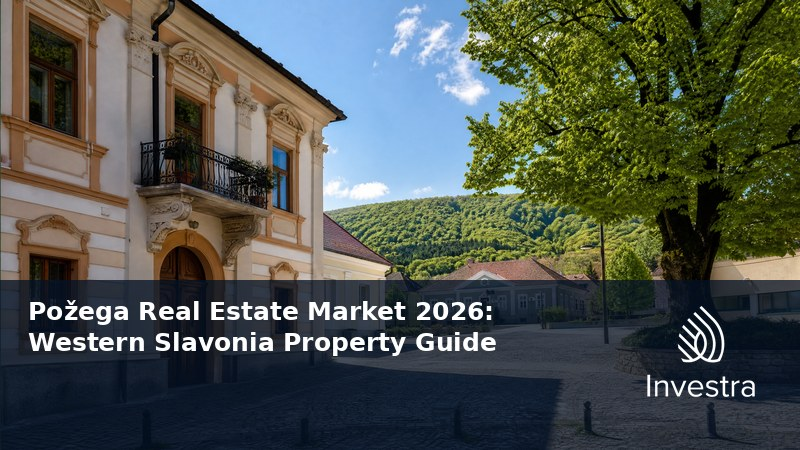
Požega Real Estate Market 2026: Western Slavonia Property Guide
Požega Real Estate Market Overview: Why Western Slavonia Is Attracting Attention in 2026
Quick Answer: Požega's real estate market in 2026 offers some of Croatia's most affordable entry points, with property prices ranging from €700 to €1,800 per m², making it a compelling option for value-driven investors seeking undervalued continental Croatian assets. Croatia Real Estate Investment Guide 2026 provides the broader national context for this emerging market.
There's a quiet revolution happening in Croatia's interior, and most foreign investors haven't noticed it yet. While Dubrovnik penthouses and Split waterfront apartments dominate international headlines, a completely different story is unfolding roughly 170 kilometres east of Zagreb, in the Požega-Slavonia County. Požega — the administrative, cultural, and economic heart of Western Slavonia — is emerging as one of the country's most intriguing property markets for buyers who understand what "early-stage opportunity" actually means.
The city of Požega itself sits in the Požega valley, surrounded by the Papuk and Psunj mountain ranges, and is home to roughly 25,000 people. It's an agricultural hub, a university town, and a city with a genuinely rich Baroque heritage that most tourists have never encountered. That's precisely the point. The market hasn't been inflated by tourism speculation. Prices still reflect local fundamentals: income levels, construction costs, and genuine demand from residents — not speculative foreign capital.
What we've seen in similar continental Croatian markets over the past decade is a pattern: undervaluation persists until infrastructure investment, EU funding flows, or demographic shifts trigger a repricing event. Požega sits at the beginning of that curve in 2026, with EU cohesion funds actively financing infrastructure upgrades, the A3 motorway providing improved Zagreb connectivity, and a renewed regional development strategy aimed at reversing the population outflow that plagued Slavonia through the 2000s and 2010s.
For investors willing to think in five-to-ten-year horizons rather than immediate yield maximization, the Požega market deserves serious analysis. This guide breaks down everything you need to know — from current price data to the legal process, tax obligations, rental dynamics, and the specific neighborhoods where value is concentrated.
Property Prices in Požega Croatia 2026: What Buyers Are Actually Paying
Quick Answer: Property prices in Požega, Croatia in 2026 range from approximately €700/m² for older apartments requiring renovation to €1,800/m² for new-build residential properties in premium locations, with the city-centre average sitting around €1,100–€1,300/m².
Let's talk numbers, because that's what serious investors actually need. Požega's property market operates on a fundamentally different price scale compared to Croatia's coastal cities — and that gap is both the risk and the opportunity.
For apartments in the city centre — the area around Trg Svetog Trojstva and the immediate surrounding streets — expect to pay between €1,100 and €1,500 per square metre for a well-maintained unit. Older communist-era apartment blocks in good condition typically transact in the €800–€1,100/m² range, while new constructions or fully renovated properties with modern finishes can reach €1,600–€1,800/m².
Houses and family homes tell a different story. Detached houses in Požega proper, particularly in the residential neighbourhoods of Eminovci and Kaptol Road areas, range from €600 to €1,200/m² depending on condition, plot size, and proximity to amenities. Older houses requiring significant renovation can be acquired for as little as €400–€600/m², presenting obvious value-add opportunities for buyers with construction management capacity.
In the surrounding villages — Brestovac, Jakšić, Pleternica — prices drop significantly, sometimes to €300–€500/m² for rural properties. These markets are highly illiquid, so buyers should approach them with clear exit-strategy thinking rather than assumptions of easy resale.
Compared to Zagreb, where city-centre apartments routinely transact at €2,500–€4,000/m², and compared to Split's coastal premium of €3,500–€6,000/m², Požega's price level looks almost impossibly cheap. The question isn't whether it's cheap — it clearly is. The question is whether local economic fundamentals can support price appreciation. We'll address that directly in the economic context section below.
What surprised many buyers entering this market for the first time is how little price differentiation exists between genuinely renovated properties and those needing work. The local market hasn't fully priced in renovation premiums, which means quality improvements deliver outsized value capture compared to more mature Croatian markets.
Western Slavonia's Economic Landscape: Understanding the Investment Backdrop
Quick Answer: Western Slavonia's economy is anchored by agriculture, food processing, and small-to-medium manufacturing, supported by significant EU structural funding flows — a combination that creates stable if modest local demand and positions the region for gradual but credible economic recovery.
You can't properly evaluate Požega real estate without understanding the regional economy. And the honest truth is that Slavonia faced genuine economic hardship through the 1990s and 2000s — a combination of war damage, deindustrialisation, and demographic haemorrhage that left the region substantially poorer than Croatia's coast and capital.
But context matters enormously here. Since Croatia's EU accession in 2013, Slavonia has been one of the primary recipients of European Structural and Investment Funds. Požega-Slavonia County received hundreds of millions of euros in EU co-financing for road infrastructure, agricultural modernisation, business zone development, and public institution upgrades. The practical effects are visible: improved road networks, upgraded schools and healthcare facilities, and a business environment that's measurably better than it was a decade ago.
The county's economy relies heavily on food and beverage processing — notably wine production from the Kutjevo wine region, which sits just 20 kilometres from Požega city — alongside light manufacturing and retail trade. The University of Slavonski Brod has a department in Požega, and the city maintains a medical school and several secondary educational institutions, creating a semi-permanent student population that supports rental demand in specific property categories.
Unemployment remains higher than Croatia's national average, which currently sits around 5.5–6.5%, though significant improvement has occurred from double-digit rates in the early 2010s. Average net salaries in Požega-Slavonia County hover around €900–€1,050 per month, which directly informs the ceiling for sustainable local rental yields and property price growth.
For a deeper perspective on investment strategy within Croatia's continental markets, the analysis published by Siniša Dagary — Investment Consultant provides genuinely useful frameworks for thinking about value-market entry timing and regional economic recovery patterns.
Who Is Buying Property in Požega? The Buyer Profile in 2026
Quick Answer: The Požega buyer pool in 2026 is primarily composed of Croatian diaspora returnees, domestic value investors, agricultural landowners expanding their portfolios, and a small but growing number of international buyers attracted by ultra-competitive pricing and Croatia's EU membership status.
Understanding who's buying tells you a great deal about where prices are likely to go. In Požega's case, the buyer profile is more diverse than you might expect for a mid-sized continental Croatian city — and that diversity is actually a stabilising factor for the market.
The largest buyer cohort remains local: Croatian families and individuals purchasing primary residences or upgrading within the city. This organic local demand provides a floor to the market and prevents the kind of speculative bubbles that can form in purely tourist-driven markets. When coastal markets correct — as they periodically do — Požega's price floor holds relatively firm because demand is needs-based rather than speculative.
The Croatian diaspora represents a genuinely interesting segment. Hundreds of thousands of Croats who emigrated to Germany, Austria, Ireland, and North America during the post-war economic difficulties maintain emotional and familial connections to Slavonia. What we've seen increasingly since 2020 is remote-work flexibility enabling diaspora members to consider permanent or seasonal returns. A family member in Stuttgart earning €3,500 per month can acquire a large, renovated house in Požega for €80,000–€120,000 — a financial proposition that simply makes sense for retirement planning or hybrid living arrangements.
Domestic Croatian investors from Zagreb and other larger cities are also active, particularly those who've been priced out of coastal markets and are seeking yield-generating assets. They're typically targeting multi-unit residential buildings or commercial spaces in the city centre.
International buyers — primarily from Austria, Germany, the Netherlands, and occasionally the UK — represent a small but growing percentage. They're typically attracted by the combination of EU legal framework, competitive pricing, and Croatia's overall quality of life reputation. For international buyers beginning their research, Find Your Property on Investra offers a useful starting point for market orientation.
Rental Market Dynamics and Yield Potential in Požega
Quick Answer: Rental yields in Požega typically range from 4.5% to 7% gross annually, driven primarily by long-term residential tenancies rather than short-term tourist lets — a different yield profile from coastal Croatia but offering more consistent, year-round income with lower operational complexity.
Here's where Požega's investment case gets genuinely interesting, and where it diverges most sharply from the coastal Croatian investment narrative you'll read about everywhere else.
Dubrovnik and Hvar are about short-term rental maximisation — Airbnb revenues, seasonal spikes, and a business model that requires active management, seasonal marketing, and significant furnishing investment. Požega is about something entirely different: steady long-term residential rental income from a tenant base of working families, students, and local professionals.
Monthly rents in Požega currently sit in the following ranges: a one-bedroom apartment in the city centre typically commands €250–€380 per month; two-bedroom apartments rent for €350–€500; three-bedroom family apartments or houses reach €500–€700 monthly. Commercial spaces in prime street locations can achieve €8–€15 per m² monthly, though the commercial market is less liquid than residential.
Running the numbers on a representative acquisition: a two-bedroom apartment purchased for €75,000 (approximately 65m² at €1,150/m²) renting for €420/month generates €5,040 annually in gross rental income — a gross yield of 6.7%. After accounting for property tax (modest by EU standards), maintenance reserves of roughly 1–1.5% of property value annually, and occasional vacancy, net yields typically land in the 4.5–5.5% range. That's competitive against many Western European residential markets operating at 2–3.5% net yields.
Student rentals near Požega's educational institutions offer a slightly different dynamic: higher occupancy rates during the academic year but summer vacancy that needs factoring into annual projections. Purpose-configured student accommodation, typically studios or shared-flat setups, can push yields toward the 6.5–7% range for investors willing to manage that tenant category actively.
The key risk on the yield side is rent growth: local salary levels constrain how fast rents can increase, so yield expansion is more likely to come from capital appreciation over time than from rent escalation in the near term.
Comparing Požega to Croatia's Coastal Markets: The Continental Case
Quick Answer: Požega offers entry prices 60–75% lower than Split or Dubrovnik, with more stable year-round rental demand but lower absolute yield ceilings — the trade-off being lower risk of speculative correction versus lower short-term upside compared to Croatia's premium coastal markets.
It's genuinely useful to put Požega in the context of Croatia's broader property landscape, because investors making allocation decisions need to understand the trade-offs clearly rather than viewing continental Croatia in isolation.
Croatia's coastal markets — Split, Dubrovnik, and Hvar in particular — have experienced extraordinary price appreciation over the past decade. Split Real Estate Guide documents apartment prices now routinely exceeding €3,500–€5,000/m² in desirable city areas, up from roughly €1,800–€2,500/m² a decade ago. The Dubrovnik Luxury Property Guide shows even more dramatic appreciation in the Old Town and Lapad Peninsula areas. Similarly, Hvar Island Real Estate has seen luxury villa prices reach €10,000–€20,000/m² at the premium end.
That appreciation story has been spectacular for early coastal investors. But by 2026, those markets carry significant risks: high price-to-income ratios, regulatory pressure on short-term rentals, seasonal concentration risk, and rising management costs. Anyone entering Dubrovnik or Hvar now is paying full price for already-discovered opportunity.
Požega represents the opposite position. It's undiscovered, underprice, and operationally simpler. The upside scenario — driven by EU investment, infrastructure completion, diaspora return migration, and the gradual convergence of Croatian regional incomes — is real. But it requires patience. Investors expecting coastal-style 50% appreciation in five years will be disappointed. Investors expecting 20–35% appreciation over seven to ten years, combined with 4.5–6% annual yield income, will likely find Požega delivers on its promise.
The Zagreb Property Market Analysis offers a useful middle-ground reference: Zagreb has demonstrated that Croatian continental cities can sustain meaningful appreciation — city-centre Zagreb prices have risen 40–60% over the past eight years — and there's reasonable logic for a lagged version of that story playing out in secondary cities like Požega over the coming decade.
Legal Framework for Foreign Buyers: How Property Purchase Works in Croatia
Quick Answer: EU citizens can purchase property in Croatia on equal terms to Croatian nationals; non-EU buyers face additional requirements including reciprocity agreements or company structures, but the legal framework is transparent and EU-compliant, making Croatia one of the more straightforward Southeastern European markets for foreign buyers.
Croatia's legal framework for property transactions has been substantially modernised since EU accession, and by Central-Eastern European standards, it's one of the cleaner, more transparent systems available to foreign investors. That said, there are specific steps and requirements that every buyer — domestic or international — needs to understand before committing capital.
For EU citizens, the process is essentially the same as for Croatian nationals. You can purchase residential property, commercial property, and agricultural land (subject to specific agricultural land regulations introduced to prevent speculative foreign acquisition of farmland) on the same terms as a Croatian buyer. This matters enormously for investors from Germany, Austria, the Netherlands, and other EU states considering Požega as an investment destination.
Non-EU citizens — including buyers from the United States, Canada, Australia, and most non-European countries — must demonstrate reciprocity, meaning Croatia must have a bilateral agreement with the buyer's home country permitting Croatian citizens equivalent purchase rights. The Ministry of Justice maintains the current list of qualifying countries. Where direct purchase isn't straightforward, most non-EU buyers structure acquisitions through a Croatian-registered limited liability company (d.o.o.), which has no nationality restrictions on ownership and is a completely standard, legally sound structure used by thousands of foreign property investors in Croatia.
The transaction process itself follows a clear sequence: preliminary agreement (predugovor) with a deposit of typically 10% of purchase price; due diligence on the property's title at the Land Registry (Zemljišne knjige); engagement of a Croatian notary (javni bilježnik) to certify the final sale agreement; payment of Real Estate Transfer Tax (currently 3% of the assessed or agreed value, whichever is higher); and Land Registry registration of the new owner. The entire process typically takes six to twelve weeks from agreed price to completed registration.
Legal due diligence is genuinely important in continental Croatian markets. Some properties in Slavonia carry legacy complications from the 1990s conflict, post-communist restitution processes, or incomplete cadastral records. Engaging an independent Croatian property lawyer — separate from the notary — is strongly recommended. Budget €800–€1,500 for legal fees on a standard transaction.
Taxes and Costs of Ownership in Croatia: The Complete Picture
Quick Answer: Buying property in Croatia involves a 3% transfer tax, plus notary and legal fees totalling 1–2% of purchase price; annual holding costs are modest, and rental income is taxed at a flat 12% rate, making Croatia's property tax environment competitive within the EU.
Tax clarity is something serious investors need upfront, and Croatia's system is actually more straightforward than many buyers expect. Let's walk through the complete cost picture.
Acquisition costs break down as follows: Real Estate Transfer Tax (Porez na promet nekretnina) of 3% applies to all resale property transactions. New builds from VAT-registered developers are subject to 25% VAT instead of transfer tax — a significant difference that affects new-build economics materially. Notary fees are regulated by a sliding scale and typically amount to €300–€600 on a standard apartment transaction. Legal fees for an independent lawyer run €600–€1,500. Land Registry registration fees are modest, typically €50–€150. In total, expect acquisition costs of 4–6% on top of the purchase price.
Annual holding costs include property utilities (communal charges/pričuva for apartments, typically €30–€80 per month depending on building size and management quality), property insurance (€100–€300 annually for a standard apartment), and maintenance reserves. Croatia currently has a communal fee (komunalna naknada) rather than a traditional annual property tax, which is assessed on property size and location zone — in Požega, this typically amounts to €150–€400 annually for a standard apartment.
For investors generating rental income, Croatia offers a relatively clean tax environment. Rental income from long-term residential lets is taxed at a flat 12% rate on gross income (with a standard 30% deduction allowed for expenses, meaning the effective rate on gross rent is approximately 8.4%). Short-term rentals via platforms like Airbnb are subject to a different regime including tourist tax and either flat-rate lump sum tax or income tax declaration. For most Požega landlords operating long-term residential lets, the tax burden is manageable and predictable.
Capital gains on property held for more than two years are exempt from tax in Croatia — a significant advantage for medium-to-long-term investors that many buyers aren't aware of when comparing Croatia to other European markets with persistent CGT obligations. For financial planning around your Croatian property investment, specialist guidance from Findes Financial Services can help structure your investment efficiently across multiple jurisdictions.
Infrastructure and Connectivity: What's Actually Changing in the Požega Region
Quick Answer: The A3 motorway connection places Požega within 90 minutes of Zagreb, and ongoing EU-funded regional road and public infrastructure improvements are materially improving Western Slavonia's connectivity and liveability — key preconditions for property value appreciation in previously marginalised regions.
Infrastructure investment is, in the author's experience analysing emerging European property markets, the single most reliable predictor of property price appreciation in secondary cities. When connectivity improves, economic activity follows — and economic activity drives real estate demand. So it matters enormously that Požega's infrastructure picture has been improving consistently over the past five years.
The most significant connectivity factor is the A3 motorway (the Bregana-Lipovac corridor, part of the Pan-European Corridor X). Požega itself isn't directly on the A3, but the connection via the D38 and D512 state roads to the A3 at Pleternica has been substantially upgraded, placing Požega's city centre approximately 85–95 kilometres from Zagreb's eastern outskirts — a journey achievable in 75–90 minutes under normal traffic conditions. That's a meaningful commuting radius for hybrid-working professionals and accessible enough for weekend property use.
EU structural funds have financed significant upgrades to Požega's urban infrastructure: road resurfacing, public space regeneration in the historic centre, water and wastewater system improvements, and a new hospital wing. These aren't glamorous investments, but they're the foundational infrastructure that makes a city liveable and attracts businesses and residents.
Rail connectivity remains Požega's weakest link — the existing rail line is slow and infrequently served, limiting its utility for daily commuters. However, rail infrastructure upgrades across Croatia are part of national development plans connected to EU cohesion funding, and improvements to the Slavonian rail network are included in Croatia's National Recovery and Resilience Plan funded through NextGenerationEU.
Požega Airport doesn't exist as a commercial facility, but proximity to Osijek Airport (approximately 120km) and Zagreb Airport (approximately 160km) provides international access, particularly relevant for diaspora buyers and international property owners managing visits from abroad.
The Historic City Centre: Požega's Hidden Architectural Asset
Quick Answer: Požega's Baroque city centre — centred on Trg Svetog Trojstva — contains genuinely significant historic architecture that is substantially undervalued relative to comparable protected heritage areas in other Croatian cities, offering authentic renovation opportunities for buyers seeking character property at continental market prices.
Here's something that genuinely surprises most people who visit Požega for the first time: the city has an exceptional Baroque heritage that's simply not on the international radar. Trg Svetog Trojstva (Holy Trinity Square) is arguably one of the finest preserved Baroque squares in the entire Western Balkans region — a sweeping, gracious public space lined with 18th-century buildings, anchored by the Franciscan monastery and church, the Cathedral, and a collection of civic buildings that would look entirely at home in an Austrian provincial capital.
This architectural heritage represents a real estate asset that the market has not yet properly priced. Properties in and around the historic centre carry a quality of place — the intangible sense of living in a beautiful, human-scale environment — that historically drives premium pricing in European property markets as buyers become more sophisticated and quality-of-life motivated.
Historic centre properties in Požega currently trade at relatively modest premiums over the city average — perhaps 15–25% above comparable properties in non-historic areas. In more mature heritage markets (Varaždin in northern Croatia is a useful comparison), that premium typically reaches 40–60% once the area achieves wider recognition. The gap between current and potential pricing in Požega's historic core is an investment opportunity in itself.
Renovating in a heritage-protected zone (Zaštićena kulturna baština) carries specific obligations: facades must be maintained in character, certain structural modifications require Cultural Heritage Directorate approval, and there are restrictions on uses that would compromise the historic character. These constraints are real but manageable, and actually serve long-term investors by preventing the kind of inappropriate development that degrades historic neighbourhoods.
For investors who appreciate the potential of heritage-driven value appreciation in Croatian property, the broader national analysis available at Croatia Real Estate Investment Guide 2026 provides useful context for how this dynamic has played out in other Croatian markets.
Agricultural Land and Rural Property: Western Slavonia's Broader Opportunity
Quick Answer: Western Slavonia's fertile agricultural hinterland offers rural property and land investment opportunities at prices well below EU agricultural land averages, though regulatory frameworks for foreign ownership of agricultural land require careful navigation and specialist legal advice.
Any serious discussion of Požega-region real estate has to acknowledge the agricultural dimension, because it's impossible to separate the city from its deeply rural, agrarian hinterland. The Požega Valley and surrounding areas are exceptionally fertile — the region produces significant quantities of wheat, corn, sunflowers, and is one of Croatia's primary wine-producing regions through the renowned Kutjevo Winery and the broader Slavonian wine corridor.
Agricultural land in the Požega-Slavonia County trades at prices substantially below comparable EU agricultural land. Quality arable land can be acquired in the range of €3,000–€8,000 per hectare depending on soil quality, parcel size, and existing drainage infrastructure — compared to €15,000–€35,000/ha in Austria or €8,000–€20,000/ha in Slovenia. For investors with agricultural operational capacity or long-term land banking perspectives, this gap represents genuine opportunity as Croatian land prices gradually converge with broader EU levels.
However, non-Croatian buyers (including EU citizens) face specific restrictions on agricultural land acquisition designed to prevent speculative foreign acquisition of farmland. Croatian citizens and entities with Croatian agricultural operations have priority purchase rights in many scenarios, and there are area limits on agricultural land that can be held by non-Croatian owners. Legal advice is essential before proceeding with any agricultural land acquisition — the regulations are specific and the consequences of non-compliance are significant.
Rural residential properties — farmhouses, wine-country estates, and village houses with land — occupy a middle ground that's more accessible to foreign buyers than pure agricultural land. A farmhouse with two to three hectares of mixed-use land near Kutjevo or Jakšić might be acquired for €60,000–€150,000, offering a lifestyle asset with potential wine tourism or agritourism development dimensions that are entirely compatible with Croatian licensing frameworks.
New Build vs. Resale: Which Market Offers Better Value in Požega?
Quick Answer: In Požega's 2026 market, well-selected resale properties offer better value than new builds on a price-per-quality basis, though new builds benefit from warranty protections and energy-efficiency specifications that can reduce long-term operational costs — the right choice depends on buyer priorities and renovation management capacity.
The new-build versus resale debate plays out differently in Požega than in Croatia's major cities. In Zagreb or Split, new construction commands significant premiums reflecting land scarcity, elevated construction costs, and developer profit margins in high-demand markets. In Požega, the premium for new builds is more muted — but the comparison still favours careful resale selection in most scenarios.
New construction in Požega is limited in volume — the city simply doesn't have the development activity levels of larger Croatian cities. What new-build activity exists tends to be small-scale residential developments of 10–30 units, typically in peripheral residential zones. Prices for new builds range from €1,400 to €1,800/m², reflecting current construction cost realities across Croatia (construction costs nationally have risen 35–45% since 2020 due to materials price inflation). New builds offer the obvious benefits of modern energy efficiency (Croatian building regulations now mandate A or B energy class for new construction), 10-year structural warranties, and no immediate renovation requirements.
The resale market, by contrast, offers the opportunity to acquire existing stock at prices that sometimes don't reflect renovation upside. A 70m² apartment in a solidly constructed 1980s building, purchased for €75,000 and renovated for €20,000–€25,000 (insulation, new windows, bathroom, kitchen, flooring), can produce a property worth €120,000–€135,000 at current market rates — a value-add return of 20–30% on total invested capital. That kind of renovation arbitrage is very much available in Požega's market in 2026.
For buyers without renovation management experience or local contractor networks, new builds offer a cleaner, lower-complexity path. For experienced investors comfortable with construction processes, resale renovation projects in Požega's city centre and established residential zones offer some of the most attractive risk-adjusted returns available in Croatian property right now.
Practical Steps for International Buyers: Getting Your Požega Purchase Right
Quick Answer: International buyers should engage a qualified Croatian property lawyer, obtain a Croatian tax identification number (OIB), open a Croatian bank account for transaction purposes, and allow 8–14 weeks for a complete transaction from agreed price to registered ownership.
The reality is that buying property abroad is operationally more complex than domestic acquisition, and Croatia is no exception. But it's entirely manageable with the right professional support — and the Croatian real estate services ecosystem has become considerably more international-buyer-friendly since EU accession.
The first practical step for any international buyer is obtaining a Croatian Personal Identification Number (OIB — Osobni identifikacijski broj). This is required for all property transactions and can be obtained at the Croatian Tax Administration office (Porezna uprava), either directly or through a registered representative. The process is straightforward and typically takes one to three business days.
Opening a Croatian bank account, while not strictly legally required for property purchase, is practically essential for managing the transaction, paying ongoing costs, and receiving rental income efficiently. Several Croatian banks — including Erste Bank, Raiffeisen Bank, and OTP Bank — actively serve international clients and have English-language services. EU citizens can typically open accounts with passports and proof of address; non-EU citizens may face additional documentation requirements.
Property search in Požega is most effectively conducted through a combination of Croatian real estate portals (Njuškalo.hr and Oglasi.hr are the dominant listings platforms), local Požega estate agencies, and international platforms like Investra. Engaging a local buying agent who knows the Požega market specifically can save significant time and prevent the common mistake of overpaying for properties with hidden deficiencies that are obvious to local professionals. The team at Contact Investra Experts can help coordinate your search and connect you with vetted local professionals.
Physical property inspection is strongly recommended — photographs are unreliable indicators of structural condition in older Croatian buildings. Budget for a structural survey (€200–€400 for a professional assessment) before committing to a preliminary agreement. Pay particular attention to the electrical installation (many older Croatian buildings have outdated wiring), roof condition, and moisture penetration in basement or ground-floor units.
For business strategy around structuring your Croatian property investment — particularly if you're considering multiple acquisitions or commercial property — the frameworks discussed at Business Strategy Blog offer useful perspectives on portfolio structuring and risk management.
Risk Assessment: What Could Go Wrong in Požega Real Estate?
Quick Answer: Požega's primary investment risks are liquidity risk (limited resale buyer pool), demographic risk (ongoing population outflow without clear reversal), and economic development risk (EU investment delivering less impact than projected) — all real and material risks that must be honestly weighed against the market's pricing advantages.
No serious investment guide omits honest risk assessment, and Požega's risk profile deserves clear-eyed analysis rather than promotional optimism.
Liquidity risk is the most significant concern for Požega property investors. The resale buyer pool is shallow — if you need to exit quickly, you may face an extended sales period of six to eighteen months at realistic market prices, or accept a discount to attract faster buyers. This isn't unique to Požega; it's characteristic of all smaller continental Croatian markets. But it means Požega property must be treated as a medium-to-long-term investment with a planned exit horizon, not a liquid asset.
Demographic dynamics remain a genuine concern for Western Slavonia. The region experienced substantial net emigration throughout the 2000s and 2010s — younger, economically active residents leaving for Zagreb, other Croatian cities, and EU member states offering higher wages. While the trend has moderated since 2020 (partly due to COVID-era remote work flexibility and partly due to improving regional economic conditions), Požega-Slavonia County's population has declined from approximately 85,000 in 2001 to around 64,000 in the 2021 census. Population decline structurally limits housing demand growth and constrains rent appreciation potential.
EU investment risk is real: much of the optimistic case for Požega relies on EU structural funds continuing to flow effectively into productive economic investments that generate employment and attract private sector activity. If absorption of EU funds underperforms or if projects deliver less economic impact than planned, the recovery trajectory could be slower than expected.
Political and regulatory risk is low by the standards of the region — Croatia's EU membership, functioning legal system, and Land Registry transparency mean property rights are robustly protected. Currency risk is non-existent for eurozone buyers (Croatia adopted the euro in January 2023), and minimal for buyers from closely correlated currencies.
The Investra Property Investment Articles section contains ongoing market monitoring that helps investors track these risk factors as they evolve over time.
Investment Strategy: How to Approach the Požega Market Intelligently
Quick Answer: The most defensible Požega investment strategy in 2026 combines a modest entry price (under €100,000), a property with demonstrable rental demand (city centre or near educational institutions), a medium-term hold horizon of seven to ten years, and clear exit options — avoiding rural or peripheral properties that lack both yield support and appreciation catalysts.
Given everything discussed above, how should an investor actually approach Požega? The honest answer is: selectively, patiently, and with very clear investment thesis discipline.
The sweet spot for Požega investment in 2026 is a well-located two-bedroom apartment in the city centre, priced between €70,000 and €95,000, in good to excellent condition, generating €380–€450 per month in long-term residential rental income. This profile delivers gross yields of 5.5–6.5%, requires minimal ongoing management complexity, attracts reliable local tenants, and carries a credible appreciation thesis tied to both national Croatian property market dynamics and specific regional recovery drivers.
What to avoid is equally important. Rural and village properties outside the city — unless specifically acquired for lifestyle or agricultural purposes with clear personal utility — present the worst combination of yield limitations and liquidity risk. Speculative land banking in peripheral zones without specific development catalysts is inadvisable given the shallow local market. Commercial properties can be attractive but require deeper local market knowledge and carry higher vacancy risk in a market with limited commercial demand growth.
Portfolio construction logic matters: for investors with broader Croatian exposure, Požega makes sense as a high-yield, low-price continental complement to a coastal asset — not as a standalone Croatia strategy. The combination of a Split or Dubrovnik property delivering tourism-driven short-term rental income alongside a Požega asset generating reliable long-term yield creates genuine portfolio diversification across Croatia's very distinct market segments.
For investors evaluating the broader Croatian market alongside Požega, reading the Investra Blog — Latest Market News provides ongoing market intelligence to keep your strategy calibrated against evolving conditions. The strategic frameworks developed by About Siniša Dagary also provide useful tools for disciplined investment decision-making in emerging markets.
Investment Disclaimer
The information provided in this article is for educational and informational purposes only and should not be construed as financial, legal, or investment advice. Real estate investments carry inherent risks, and past performance does not guarantee future results. Investors should not invest money they cannot afford to lose. Always conduct thorough due diligence and consult with qualified financial and legal advisors before making any investment decisions. Investra.io does not guarantee returns on any investment.
Frequently Asked Questions
What are property prices in Požega Croatia in 2026?
Property prices in Požega, Croatia in 2026 range from approximately €700/m² for older apartments needing renovation to €1,800/m² for new-build residential properties in premium city-centre locations. The most typical transaction range for a mid-quality city-centre apartment sits between €1,000 and €1,400/m², meaning a 65–70m² two-bedroom apartment typically trades for €65,000–€100,000 in total. These figures represent some of the most competitive entry prices available anywhere in Croatia's EU-member property market, making Požega a compelling option for value-oriented investors willing to accept the liquidity and demographic risk profile of a secondary continental market.
Can foreigners buy property in Požega, Croatia?
EU citizens can purchase property in Požega, Croatia on exactly the same terms as Croatian nationals — no special permits, no additional restrictions, and full ownership rights registered in the Croatian Land Registry. Non-EU citizens from countries with bilateral reciprocity agreements with Croatia can also purchase directly. Citizens of countries without such agreements typically structure acquisitions through a Croatian-registered limited liability company (d.o.o.), which is a legally sound and commonly used approach. Croatia's EU membership since 2013 provides strong legal protections for property ownership, making the country one of the more straightforward Southeastern European markets for foreign buyers to navigate.
What rental yields can investors expect in Požega?
Gross rental yields in Požega typically range from 5.5% to 7% for well-located residential apartments operating as long-term lets. Net yields after property tax, maintenance reserves, insurance, and occasional vacancy typically settle in the 4.5–5.5% range. These yields are driven by long-term residential tenancies from local families, working professionals, and students — not short-term tourist accommodation. While this is less dramatic than peak-season Airbnb yields achievable in coastal Croatian markets, Požega's yield profile is more consistent, year-round, and operationally simpler to manage, particularly for non-resident investors who cannot actively manage short-term rental operations.
What taxes apply to property ownership in Požega, Croatia?
Purchasing resale property in Croatia incurs a 3% Real Estate Transfer Tax on the agreed or assessed purchase price (whichever is higher). New builds are subject to 25% VAT rather than transfer tax. Notary and legal fees add approximately 1–2% to the total acquisition cost. Annual holding costs include a communal fee (komunalna naknada) of approximately €150–€400 per year for a standard apartment, plus insurance and maintenance. Rental income from long-term residential tenancies is taxed at a flat 12% on gross income, with a standard 30% expense deduction reducing the effective rate to approximately 8.4% of gross rent. Capital gains on property held more than two years are exempt from tax in Croatia.
How does Požega compare to Zagreb or Split as an investment location?
Požega offers entry prices 60–75% lower than Zagreb or Split, with comparable or slightly higher gross rental yields due to the lower acquisition base. The key differences are: Zagreb and Split have larger, more liquid resale markets and stronger rent growth potential driven by urban economic activity and tourism; Požega has lower absolute capital appreciation potential in the short term but offers extraordinary value entry pricing and very low competition from international buyers. Investors with longer time horizons (7–10+ years) and capital conservation priorities may find Požega's risk-adjusted return profile compelling, particularly as a complement to existing coastal Croatian assets rather than as a standalone strategy.
What are the main risks of investing in Požega real estate?
The three primary risks are: liquidity risk (the resale buyer pool is small, meaning exit may require an extended timeframe of 6–18 months or a price discount); demographic risk (Požega-Slavonia County has experienced population decline, which constrains demand growth and rent appreciation); and economic development risk (the investment case depends partially on EU funds delivering meaningful regional economic stimulus, which isn't guaranteed). These risks are real and material. They're mitigated by buying at very competitive prices (which
Recommended Reading
Quick Answer: Explore these curated resources for deeper insights into real estate investment opportunities.
- Čačak Real Estate Market 2026: Western Serbia Property Guide
- Valjevo Real Estate Market 2026: Western Serbia Property Guide
- Virovitica Real Estate Market 2026: Slavonia Property Guide
- Kragujevac Real Estate Market 2026: Industrial City Property Guide
- Pančevo Real Estate Market 2026: Belgrade Suburb Property Guide
- Smederevo Real Estate Market 2026: Danube City Property Guide
Related Posts
No related posts available.
