
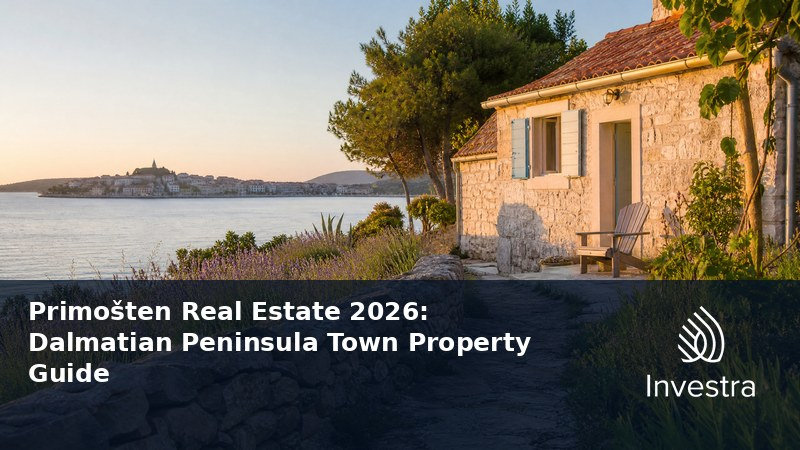
Primošten Real Estate 2026: Dalmatian Peninsula Town Property Guide
Primošten Real Estate 2026: Why This Dalmatian Peninsula Town Is Capturing Investor Attention
Quick Answer: Primošten is one of Dalmatia's most photogenic and sought-after coastal towns, with real estate prices ranging from €3,500 to €8,000+ per m² in 2026, attracting both lifestyle buyers and savvy investors seeking strong short-term rental returns on the Adriatic coast.
There's a moment when you first see Primošten from the road — a compact medieval town perched on a small peninsula jutting into the Adriatic, surrounded by vineyards and crystal-clear water — that makes it immediately obvious why property here commands such attention. It's not just beautiful. It's the kind of beautiful that makes people want to own a piece of it.
Primošten sits roughly 30 kilometres south of Šibenik in Dalmatia, and for years it flew somewhat under the radar compared to Dubrovnik or Split. That's changing fast. The combination of authentic Dalmatian character, improving infrastructure, Croatia's Schengen and eurozone membership, and a tourism market that keeps setting new records has pushed Primošten real estate firmly into the spotlight for 2026.
What surprised many buyers who first explored this market is just how competitive it has become. Properties that were listed at €2,800/m² in 2020 are routinely trading at €4,500–5,500/m² today. The trajectory is clear, and the fundamentals supporting it are solid. For anyone seriously considering Adriatic coast investment, Primošten deserves a thorough look — which is exactly what this guide provides.
For broader market context, the Croatia Real Estate Market Report 2026: National Overview & Forecasts offers essential background on the macroeconomic forces shaping property values along the entire Dalmatian coast.
Understanding Primošten: The Town, Its Geography, and What Makes It Unique
Quick Answer: Primošten is a historic Dalmatian town built on a small peninsula connected to the mainland by a narrow causeway, offering a uniquely intimate character, UNESCO-recognised wine heritage, and a natural setting that strictly limits future development — all of which underpins long-term property values.
Geography is destiny in real estate, and nowhere is that more true than Primošten. The old town sits on a former island — the causeway connecting it to the mainland was built centuries ago — which means the historic core is physically constrained. You simply cannot build more apartments in the old town. What exists is what exists, and that scarcity is one of the most powerful drivers of value appreciation.
The town has a permanent population of around 2,500 residents, though that number swells to many times that figure during peak summer. The surrounding municipality encompasses several smaller villages — Primošten Burnji, Prhovo, Kruševo — and stretches of coastline with newer residential developments and villa estates. This creates a two-tier market: the premium historic core and old town properties, and the broader municipal area where modern villas and apartments offer different price points and investment profiles.
The Babić grape variety, cultivated in the distinctive stone-enclosed vineyard fields surrounding Primošten, has achieved international recognition and even UNESCO recognition for its unique karst viticulture landscape. This cultural cachet matters for premium tourism and, by extension, for short-term rental demand. Guests who come to Primošten tend to be the higher-spending variety — wine enthusiasts, culture travellers, people seeking authenticity rather than mass-market beach holidays.
Proximity to key infrastructure is another practical advantage. Šibenik airport and Split Airport (approximately 65 kilometres away) both serve Primošten's catchment area. The coastal highway connects easily to Split, Trogir, and Zadar. Krka National Park and the Kornati archipelago are within easy day-trip distance, making the area compelling for visitors throughout an extended shoulder season.
Property Prices in Primošten 2026: What Does the Market Actually Look Like?
Quick Answer: Property prices in Primošten range from approximately €3,500/m² for standard apartments in newer developments up to €8,000–10,000/m² for premium sea-view villas and old town stone houses in prime locations, with the market having appreciated roughly 35–45% since 2020.
Let's be specific, because vague generalisations don't help anyone make real decisions. The Primošten property market in 2026 operates across several distinct segments, each with its own price dynamics.
Old Town Stone Houses: These are the crown jewels. Renovated stone houses in the historic peninsula core — the ones with traditional architecture, sea views, and that irreplaceable atmospheric quality — are trading at €5,500–10,000/m² depending on condition, size, and view quality. A fully renovated 80m² stone house with a sea view terrace can easily command €650,000–800,000. Supply is genuinely constrained here, and these properties rarely come to market.
Sea-View Villas and Modern Properties: Purpose-built villas on elevated plots overlooking the Adriatic, typically ranging from 150–400m², are priced at €4,500–7,500/m². A well-designed 200m² villa with pool and panoramic sea views would be marketed in the €900,000–1,500,000 range. These are the properties most actively sought by international buyers.
Apartments in Residential Developments: The broader municipal area has seen development of apartment complexes and smaller residential projects. Standard apartments without direct sea views range from €3,500–4,800/m². Sea-view apartments can push to €5,500–6,500/m² depending on floor level and terrace quality.
Development Land and Plots: Building plots with sea views are priced at €200–600/m² depending on location, planning status, and infrastructure access. Prime plots with approved building permits and sea views can exceed €800/m².
The price trajectory since Croatia joined the eurozone in January 2023 has been notable. Eliminating currency conversion costs and exchange rate risk removed a psychological barrier for many eurozone buyers, and demand from German, Austrian, Czech, and Italian buyers in particular has intensified. The reality is that Primošten prices still represent reasonable value compared to comparable locations in Italy, France, or even Istria's most developed areas.
Primošten Rental Market and Short-Term Yield Analysis
Quick Answer: Short-term holiday rentals in Primošten can generate gross yields of 6–10% annually, with well-positioned sea-view properties achieving 10–14 weeks of peak occupancy at €150–400+ per night, making it one of Dalmatia's more attractive markets for Airbnb-style income strategies.
Rental income is, for many international buyers, the factor that tips the decision from lifestyle purchase to active investment. Primošten performs well here, though it's important to approach the numbers honestly rather than with the optimism of a promotional brochure.
The tourism season in Primošten runs from roughly mid-June to mid-September, with a meaningful shoulder period in May, late September, and increasingly October. Peak season (July-August) sees nightly rates for a 3-bedroom sea-view villa with pool reaching €400–700 per night on platforms like Airbnb and booking.com. A well-managed property achieving 70–75% occupancy across 14–16 peak weeks, plus additional shoulder weeks, can generate €35,000–65,000 in gross annual rental income.
For a €700,000 villa, that represents a gross yield of approximately 5–9%. After property management fees (typically 20–25% of revenue), maintenance, utilities, and taxes, net yields typically settle in the 4–7% range for well-positioned properties. That's competitive by European coastal standards.
Apartments perform differently. A 50–60m² apartment with sea views might achieve €120–200/night during peak weeks, with annual gross income of €15,000–22,000. At a purchase price of €250,000–320,000, gross yields of 5–7% are realistic.
What we've seen increasingly is the importance of professional management in maximising these returns. Properties managed by local specialists with strong online presence and repeat guest networks consistently outperform self-managed equivalents. The Croatian tourism ecosystem has matured considerably, and the best property managers in the Šibenik-Primošten corridor have extensive distribution networks across European source markets.
It's also worth contextualising Primošten against regional benchmarks. For comparative analysis, the Buying Property in Split Croatia 2026: Complete Investment Guide offers parallel yield data from Croatia's second city, which serves as a useful benchmark.
Who Is Buying Property in Primošten in 2026?
Quick Answer: International buyers from Germany, Austria, the Netherlands, Czech Republic, and Slovenia dominate Primošten's foreign buyer pool, joined by increasing numbers from the UK and Ireland, all drawn by the town's authenticity, manageable price points relative to comparable Mediterranean destinations, and strong rental potential.
Understanding who else is buying in a market tells you a great deal about where that market is headed. Primošten's buyer profile has shifted meaningfully over the past five years, and the 2026 picture is more internationally diverse than at any point in recent history.
German and Austrian buyers remain the single largest foreign buyer group — this has been true along the entire Dalmatian coast for decades. They tend to be thorough, methodical, and often cash buyers who have done considerable research before making contact with agents. They're attracted to Primošten's authenticity and the relatively shorter drive from Central Europe compared to Dubrovnik.
Czech and Slovak buyers have grown in number significantly since Croatia's EU membership consolidation. For these buyers, a Croatian coastal property represents both an emotional aspiration and a hard-currency asset in a politically and economically stable EU country. The price point of Primošten — accessible without being cheap — suits the upper-middle affluent Czech or Slovak buyer well.
Dutch buyers are increasingly visible in the market, often motivated by rental yield as much as lifestyle. The Netherlands has one of Europe's most active overseas property investment cultures, and Croatia has benefited from this. Dutch buyers tend to be commercially minded and willing to invest in proper management infrastructure to maximise returns.
British buyers returned to the Croatian market post-Brexit in meaningful numbers, though the legal framework for UK nationals purchasing here has changed. They still face no restrictions on purchasing (Croatia allows reciprocal buying rights for most nationalities), but there are practical implications for long-term stays that we'll address in the legal section.
Croatian diaspora buyers — particularly from the large Croatian communities in Germany, Australia, Canada, and the USA — also represent a significant and often underestimated segment. These buyers combine emotional attachment to the region with commercial sophistication, and they often bring significant capital from abroad.
Legal Framework for Foreign Buyers in Primošten
Quick Answer: EU citizens can purchase property in Primošten with the same rights as Croatian nationals, while non-EU citizens (including UK nationals post-Brexit) face a reciprocity requirement that is satisfied by most Western countries, though they should obtain legal confirmation before proceeding — the full process typically takes 2–4 months from offer to completion.
Croatia's property purchase process is more straightforward than its reputation sometimes suggests, but there are enough nuances that skipping qualified legal advice would be a genuine mistake. Here's an honest assessment of what the process actually involves.
EU Citizens: Since Croatia's EU accession, citizens of EU member states have identical rights to Croatian nationals when purchasing property. This includes residential property, commercial real estate, and agricultural land (with some transitional restrictions on agricultural plots that are worth checking). The process involves no special permits, no government approval, and no foreign exchange restrictions.
Non-EU Citizens: The reciprocity principle applies. Croatia allows nationals of countries where Croatian citizens can similarly purchase property to buy real estate here. This covers most Western nations including the USA, UK, Canada, Australia, and others. However, non-EU buyers technically need approval from the Ministry of Justice, which in practice is largely administrative for most nationalities — but it adds time to the process and requires documentation.
The core purchase process runs as follows: After agreeing on price, a preliminary purchase agreement (predugovor) is signed and a deposit of 10% is typically paid. The buyer's lawyer conducts due diligence — critically important, as checking the land registry (zemljišna knjiga) for any encumbrances, building permits, and ownership chain is essential. The main purchase agreement (kupoprodajni ugovor) is then notarised. Finally, the property is registered in the buyer's name at the land registry.
One issue that has historically affected Dalmatian coastal property is the matter of illegal or non-permitted construction. Some properties were built without proper permits during the 1990s and 2000s, and while Croatia has undertaken several legalisation amnesty processes, buyers should absolutely verify permit status through a competent local lawyer. This isn't unique to Primošten, but it's especially important in smaller coastal towns where informal construction was more prevalent.
For a comprehensive treatment of the legal framework, Buying Property in Croatia as a Foreigner: Legal Guide 2026 covers all the essential bases for international purchasers navigating Croatian property law.
Property Taxes and Transaction Costs in Primošten
Quick Answer: Buyers in Croatia pay a 3% real estate transfer tax on the assessed value of existing properties (new-build purchases are VAT-exempt as the VAT is included in the developer's price), plus legal fees of 1–2%, agent commission of 2–4%, and notary costs — total transaction costs typically amount to 5–8% of the purchase price.
Transaction costs in Croatia are moderate by European standards, but they add up and need to be factored into investment calculations from day one. There's no benefit in discovering unexpected costs after you've committed to a purchase price.
Real Estate Transfer Tax (Porez na promet nekretnina): This is the main transaction tax, levied at 3% of the property's market value as assessed by the tax authority (which may differ from the agreed sale price if the authority considers the contracted price below market). This tax applies to the purchase of existing (secondary market) properties.
VAT on New-Build Properties: For new-build purchases from a developer, the sale price typically includes Croatian VAT at 25%. As a buyer, you don't pay an additional transfer tax on top of this — the two systems are mutually exclusive. New-build purchases can sometimes offer tax optimisation opportunities depending on how the transaction is structured.
Notary Fees: Notarisation of the purchase agreement is mandatory. Notary fees are regulated by law and calculated on a sliding scale based on property value. For a €500,000 property, expect approximately €1,000–1,500 in notary fees.
Legal/Lawyer Fees: A competent property lawyer will charge 1–2% of the purchase price, or a fixed fee for straightforward transactions. Don't economise here — good legal due diligence in Croatia is worth every cent.
Estate Agent Commission: Croatian practice typically has the buyer paying 2–3% and the seller paying 2–3%, though this varies by agreement. Some agents charge the full commission to one party. Clarify this upfront.
Annual Property Tax: Croatia introduced a new property tax framework, and from 2024 onwards property owners pay an annual levy based on property size and location. In Primošten, this typically amounts to €300–1,000+ annually for a standard villa or apartment, depending on size and classification.
For a complete tax breakdown including rental income taxation, capital gains considerations, and inheritance tax implications, the Croatia Property Tax Guide 2026: What Foreign Buyers Must Know is an essential reference.
Best Areas and Property Types to Buy in Primošten Municipality
Quick Answer: The old town peninsula commands the highest prestige and prices, the elevated hillside zones above the town offer the best value-to-view ratio for villas, and the coastal stretches north and south of the town centre provide the most realistic entry points for budget-conscious buyers seeking holiday rental income.
Primošten municipality is more diverse than many buyers initially realise. The famous old town is just one part of a broader area with distinct micro-markets, each offering different trade-offs between price, character, and investment logic.
The Old Town Peninsula (Stari Grad): This is the highest prestige address in Primošten. Stone houses here — often several centuries old — sell rarely and at premium prices. Renovation is expensive and subject to heritage protection rules (which limit what can be changed externally). These properties are genuinely irreplaceable and hold value even in softer markets. The catch: they're small, access is on foot only, and the renovation complexity is significant. Best suited to lifestyle buyers or boutique accommodation operators.
Hillside and Elevated Positions Above Town: The hills surrounding the old town offer sea views that are, in some ways, even more dramatic than the old town itself. Modern villas and renovated stone houses in these elevated positions — areas like Bilo and surrounding hillside zones — combine contemporary comfort with authentic Dalmatian character and panoramic views. This is arguably the strongest value segment for buyers wanting both lifestyle quality and rental income.
Primošten Gornji and Surrounding Villages: The municipality extends to several inland and semi-coastal villages. Property here is significantly more affordable — €1,500–2,800/m² — and attracts buyers with larger budget constraints or those interested in longer-term renovation projects. Rental income potential is lower, but the character and value upside can be compelling for buyers willing to invest in quality renovation.
New Residential Developments on the Coastal Road: Several contemporary apartment complexes and smaller villa developments have been completed along the coastal approach to Primošten in recent years. These offer modern finishes, pools, and managed infrastructure at more accessible price points. They lack the character of older properties but are easier to manage as pure rental investments and often come with professional management structures already in place.
Infrastructure, Connectivity, and Quality of Life in Primošten
Quick Answer: Primošten offers strong quality of life with good road connectivity to Split Airport (65km), excellent marina facilities, improving digital infrastructure, and a tight-knit community atmosphere — though international buyers should be realistic about the limitations of small-town living outside the tourist season.
Quality of life considerations matter as much as return calculations for most buyers — after all, most international purchasers intend to spend time here themselves. Primošten delivers genuinely well on lifestyle, with some honest caveats.
Road access has improved considerably with upgrades to the Adriatic highway (A1 motorway) and coastal road connections. The drive from Split Airport to Primošten takes approximately 45–60 minutes depending on traffic, which is manageable for frequent visits. Šibenik, with its broader range of services, hospitals, and shopping, is about 25 kilometres away — a 25-minute drive. This proximity to Šibenik is genuinely important for year-round residents who need urban amenities.
Primošten itself has a compact range of restaurants, cafes, and shops that serve residents well during the tourist season. Outside peak season (October to May), the pace drops considerably and some businesses close entirely. This is the honest reality of living in a small Dalmatian tourist town — something potential year-round residents should experience firsthand before committing to a purchase.
The marina at Primošten accommodates yachts and smaller craft, and the town has a well-established sailing culture. For buyers who are also boat owners, this is a significant amenity. The surrounding sea is genuinely exceptional — clarity and cleanliness rankings consistently place this stretch of the Adriatic among Europe's best.
Digital infrastructure has improved significantly, with fibre broadband now available in central areas and mobile 4G/5G coverage throughout. For remote workers and digital nomads — an increasingly important buyer segment — this practical connectivity makes Primošten a realistic base rather than just a holiday destination.
Healthcare access is the main practical limitation for full-time residents. Primošten has a basic healthcare centre, but for anything beyond routine care, Šibenik or Split are necessary. This is a realistic consideration for older buyers or those with health conditions.
Primošten's Tourism Performance and Its Impact on Property Investment
Quick Answer: Croatia's tourism sector reached record highs in 2023 and 2024, with the Šibenik-Knin County (which includes Primošten) recording double-digit growth in overnight stays — and this tourism momentum directly supports rental income potential for property investors in the area.
Tourism data is the bedrock of any rental yield investment thesis for Dalmatian coastal property, and the numbers from recent years provide genuine encouragement for Primošten buyers.
Croatia as a whole recorded approximately 20 million tourist arrivals in 2023, with total overnight stays exceeding 108 million — both all-time records. The trend continued into 2024, with the shoulder season (May, June, September, October) growing particularly strongly. This shoulder season elongation is crucial for property investors because it expands the viable rental calendar beyond the traditional July-August peak.
The Šibenik region, which includes Primošten and surrounding areas, has been one of the stronger-performing regions in this tourism boom. The combination of the historic Šibenik old town (a UNESCO World Heritage Site), the dramatic national parks (Krka, Kornati), and the authentic character of smaller towns like Primošten has created a compelling tourism proposition that differs from both the mass-market Split approach and the luxury Dubrovnik model.
What's particularly interesting about Primošten's tourism profile is the visitor quality. The town attracts a higher-spending visitor demographic than many comparable Dalmatian towns — this isn't a budget-backpacker destination. Visitors come for quality: quality accommodation, quality food, quality experiences. That translates directly into willingness to pay premium nightly rates for well-positioned rental properties.
The growth of niche tourism niches — wine tourism around Babić, cycling routes, adventure tourism, gastronomy — also benefits Primošten specifically. These visitors come earlier and later in the season, stay longer, and spend more. For property investors, building a marketing strategy around these niches rather than purely beach tourism can materially improve annual yield performance.
Investment Strategies for Primošten Property in 2026
Quick Answer: The three most viable investment strategies in Primošten are: premium short-term rental of a fully renovated villa or apartment; buy-renovate-sell (flipping) for experienced investors with renovation expertise and local contractor relationships; and long-term value appreciation holding in the constrained old town segment — each carrying different risk and return profiles.
Different buyers come to Primošten with different objectives, and matching strategy to objective is where investment decisions succeed or fail. Here's an honest assessment of the main approaches and their realistic prospects.
Strategy 1: Premium Holiday Rental — This is the most common strategy for international buyers and, for well-executed implementations, the most immediately rewarding. A €700,000–900,000 villa with pool, sea views, and professional management can generate €40,000–70,000 in gross annual rental income. After costs, net yields of 4–6.5% are achievable. The critical success factors are property positioning (views and pool are non-negotiable for premium pricing), quality of fit-out, and management partner selection.
Strategy 2: Buy, Renovate, and Rent or Sell — Primošten has a supply of older properties — both in the old town and in surrounding villages — that are structurally sound but require renovation investment. Buying at €2,500–3,500/m², investing €800–1,200/m² in renovation, and then either renting at premium rates or selling at €5,000–6,500/m² represents a credible value-creation pathway. The risks are construction cost overruns, permit complications (especially in heritage areas), and execution timeline uncertainty. This strategy requires either local expertise or a very trusted local partner. Siniša Dagary — Investment Consultant has extensive experience helping international investors structure these more complex acquisition and renovation strategies in the Croatian market.
Strategy 3: Long-Term Capital Appreciation Hold — Particularly relevant for old town properties and prime view plots. Buy scarce, irreplaceable assets in a supply-constrained location with strong and growing demand. The near-zero new supply in the old town core, combined with accelerating international demand, makes this a credible thesis — but it requires patient capital and a long horizon. Annual appreciation of 6–10% has been the recent trend, though past performance is not indicative of future results.
Strategy 4: Diversified Portfolio — Apartment Complex or Multiple Units — Some investors, particularly those deploying larger capital, look at acquiring or developing small apartment complexes (4–8 units) in the municipality, operating them as a managed holiday rental portfolio. This approach spreads occupancy risk and creates operational efficiency. Entry-level investment of €1.5–3 million can support this approach.
Financing Options for Primošten Property Purchases
Quick Answer: Non-resident buyers in Croatia face limited access to Croatian bank mortgages, making most international purchases cash transactions, though EU resident buyers have somewhat better access to domestic financing — specialist international mortgage providers and home-equity financing in the buyer's home country are the most practical alternatives.
Financing is where many international buyers discover an important reality: Croatia's domestic mortgage market is not particularly accessible for non-residents, and interest rates have risen significantly since 2022. Cash purchases dominate the Primošten foreign buyer market as a result.
Croatian banks do offer mortgages to EU citizen non-residents in principle, but the practical requirements — stable Croatian income, established banking relationship, substantial documentation — mean the process is cumbersome. Interest rates for non-resident buyers, where accessible, typically run 150–250 basis points above the rates available to Croatian residents. For a purchase at current market prices, this financing premium can materially impact investment returns.
The most practical financing approaches for most international buyers are either full cash purchase, or using equity in property in their home country. A UK buyer with equity in their UK home, or a German buyer refinancing their Munich apartment, can access competitive home-market financing rates and deploy that capital into a cash purchase in Croatia. This approach is increasingly common among sophisticated buyers.
EU-based buyers with strong banking relationships should certainly explore Croatian bank financing — it is possible to arrange, particularly for buyers with demonstrated financial strength. The process takes longer than in many other EU countries, but the results can be satisfactory. Findes Financial Services specialises in cross-border property financing structures for buyers acquiring real estate in European markets, including Croatia, and can provide tailored advice on the most efficient capital structure for specific purchase scenarios.
Developer financing is available on some new-build projects, with staged payment structures (30% on signing, 30% on construction milestone, 40% on completion) being common. This can ease cash flow for buyers acquiring off-plan, though it introduces construction completion risk that must be mitigated through contract terms and developer due diligence.
Comparing Primošten to Other Croatian Coastal Markets
Quick Answer: Primošten occupies a sweet spot between the premium pricing of Dubrovnik (€6,000–15,000/m²) and the more commercialised markets of Split and Makarska, offering a distinctive authentic character with better value per square metre and comparable or superior rental yield potential for lifestyle-oriented buyers.
Context matters enormously when assessing any property market. Where does Primošten sit relative to the broader Croatian coastal opportunity?
Dubrovnik is the obvious comparison at the premium end. The walled city and its surroundings command Croatia's highest prices — €6,000–15,000/m² for prime positions, with some trophy properties exceeding this. The Buying Property in Dubrovnik 2026: Luxury Real Estate Guide details this market comprehensively. Dubrovnik offers unmatched brand recognition and resilient demand, but entry costs are significantly higher and yields are not necessarily superior to well-positioned Primošten properties.
Split, Croatia's second city, offers a different proposition entirely — urban real estate with a year-round demand base, strong student and professional rental market, and the liquidity advantages of a larger city. The Buying Property in Split Croatia 2026: Complete Investment Guide covers this urban market in detail. For investors wanting mixed short-and-long-term rental strategies, Split's year-round population makes it operationally easier.
Zagreb, as Croatia's capital, offers yet another profile — urban capital city investment with strong long-term rental demand and growing commercial real estate. The Buying Property in Zagreb 2026: Complete Guide for Foreign Investors is the reference for this market.
Primošten's competitive positioning is clear: it offers an authenticity and intimacy that larger centres cannot replicate, at prices that — while no longer cheap — represent genuine value relative to comparable Mediterranean destinations. The Dalmatian coast of Spain, the Amalfi coast, the French Riviera — all command dramatically higher prices for comparable lifestyle and aesthetic quality. For the buyer who has done the comparison, Primošten remains convincingly underpriced on a European scale.
Risks and Challenges of Investing in Primošten Real Estate
Quick Answer: Key risks include seasonal income concentration (80%+ of rental income in 10–12 weeks), permit and heritage compliance issues on older properties, the ongoing need for local management infrastructure, and potential oversupply risk in the broader Dalmatian market — all of which are manageable with proper due diligence and realistic financial planning.
Any honest investment guide has to address risk, and there are real risks in Primošten real estate that deserve direct treatment rather than being glossed over in the enthusiasm for opportunity.
Seasonal Income Concentration: The Croatian Adriatic coast is one of the more seasonal tourism markets in Europe. The reality is that 70–80% of annual short-term rental income is typically generated in June–September. For financial planning purposes, this means cash flow is highly lumpy — substantial income for four months, minimal income for eight. Mortgage calculations need to account for this seasonal pattern, and liquidity reserves for off-season costs are essential.
Property Permit Issues: This is a genuine and specific risk in Croatian coastal real estate. Properties built without proper permits — a real phenomenon from the construction boom periods of the 1990s–2000s — can face legalisation difficulties, fines, or in extreme cases demolition orders. Due diligence by a competent local lawyer is not optional; it's essential. Never rely solely on the seller's assurances about permit status.
Management Infrastructure: Quality property management in smaller Dalmatian towns can be variable. The difference between a well-managed rental property generating 70% peak-season occupancy and a poorly managed one achieving 40% is enormous — it's the difference between a viable investment and a disappointing one. Building the right management relationship before completing a purchase is important.
Regulatory Changes: Croatian regulation of short-term holiday rentals has been tightening. Registration requirements, safety standards, and fiscal obligations for rental income have all become more stringent in recent years. This professionalises the market (which is broadly positive) but increases compliance costs and operational complexity. Staying current with regulations is an ongoing requirement.
Market Liquidity: The Primošten property market is relatively thin — transaction volumes are modest compared to urban markets. When you want to sell, finding a buyer at your target price may take considerable time. This is not a liquid market; investors should plan holding periods of 5–10+ years rather than expecting easy exit opportunities.
For a comprehensive treatment of buyer concerns and common questions, the Croatia Real Estate FAQ 2026: 50 Most Asked Questions Answered addresses an exhaustive range of scenarios.
Step-by-Step Buying Process: From Search to Registration
Quick Answer: The buying process in Primošten typically takes 60–120 days from offer to final registration, involving property search, offer and negotiation, preliminary agreement and deposit, legal due diligence, final purchase agreement with notarisation, tax payment, and land registry registration — with a qualified local lawyer handling each stage as the essential through-line.
Knowing the process in advance removes uncertainty and helps buyers prepare both financially and psychologically for the timeline involved. Here's how a typical Primošten purchase actually unfolds.
Step 1 — Search and Property Identification: Most international buyers combine online research (portals such as Njuškalo.hr, Nekretnine.hr, and international platforms) with visits to local estate agents in Primošten and Šibenik. Engaging a local agent who specialises in the area is strongly recommended — they have access to off-market inventory and can identify properties that will never appear on public portals. Plan for at least one viewing trip; ideally two, at different times of year.
Step 2 — Offer and Negotiation: Unlike some markets, price negotiation in Croatia is normal and expected. Depending on how long a property has been listed and the seller's motivation, discounts of 5–15% from asking price are common. Have a clear walk-away number before negotiating.
Step 3 — Preliminary Agreement (Predugovor): Once price and terms are agreed, a preliminary contract is signed and a deposit of 10% is paid. This deposit is typically non-refundable if the buyer withdraws, and the seller must return double the deposit if they withdraw — a traditional penalty mechanism that incentivises both parties to complete.
Step 4 — Legal Due Diligence: This is the critical phase. Your lawyer checks the land registry for ownership chains, encumbrances, mortgages, and legal proceedings; verifies building permits and energy certificates; checks for any pre-emption rights; and reviews municipal planning documents for the property's zone and permitted uses. Allow 3–6 weeks for thorough due diligence.
Step 5 — Final Purchase Agreement and Notarisation: The main contract is drafted (either by the seller's lawyer or agreed jointly) and must be signed before a Croatian notary. Both parties sign, or can do so via power of attorney if physically absent — useful for remote buyers.
Step 6 — Tax Payment and Registration: The 3% transfer tax must be paid within 30 days of the notarised agreement. Following payment, the new ownership is registered at the land registry, which typically takes several weeks. Once registered, the buyer has full legal title.
Professional guidance throughout this process is invaluable. About Siniša Dagary provides background on the consulting expertise available to international investors seeking structured support through the Croatian property acquisition process.
Primošten Market Outlook and Price Forecast for 2026–2028
Quick Answer: Primošten property prices are forecast to appreciate a further 15–25% through 2028, supported by continued international demand, Adriatic coast tourism growth, constrained supply in prime locations, and Croatia's eurozone stability — though the pace of appreciation is likely to moderate from the exceptional gains seen in 2020–2024.
Forecasting property markets is always an exercise in informed judgment rather than precision, but the fundamentals supporting continued Primošten price growth are reasonably robust heading into the 2026–2028 period.
The demand drivers are structural and durable: Croatia's EU and eurozone status reduces transactional friction and currency risk for European buyers; the Adriatic coast's tourism proposition continues to strengthen; supply in prime locations is physically constrained; and the relative affordability of Croatian coastal property versus comparable Mediterranean destinations continues to attract price-conscious buyers from France, Spain, and Italy.
The pace of appreciation is likely to moderate from the exceptional 35–45% seen across 2020–2024. That was a period of unusual confluence — post-COVID pent-up demand, low interest rates driving capital into real assets, and the specific catalysts of Croatia's EU/eurozone entry all coinciding. A more normalised appreciation pace of 5–10% annually is a reasonable central expectation for well-positioned Primošten properties through 2028.
Risk scenarios that could suppress this trajectory include a significant deterioration in European economic conditions (reducing discretionary spending on holiday property), a substantial increase in supply through large-scale development approvals (unlikely in Primošten's constrained geography), or a regulatory crackdown on short-term holiday rentals (possible but unlikely to be severe enough to negate the investment case).
The Dubrovnik Real Estate Market 2026: Prices & Investment Guide provides a useful parallel forecast for Croatia's premium coastal market, offering context for how Primošten compares in the medium-term trajectory. The Zagreb Real Estate Market Report 2026: Prices, Trends & Forecasts similarly contextualises how the national market backdrop supports regional coastal appreciation.
For investors with a 5–10 year horizon and realistic expectations about liquidity, the Primošten market in 2026 presents a compelling blend of lifestyle value, rental income potential, and long-term capital appreciation opportunity. The window of relative value compared to Western Mediterranean equivalents is still open — but it's been closing steadily, and that trajectory is unlikely to reverse.
Strategic investment planning for this market benefits from expert guidance. The Business Strategy Blog offers valuable broader insights on investment strategy in emerging European markets, providing useful framework thinking for those approaching Croatian real estate as part of a diversified international portfolio.
Practical Tips for International Buyers Approaching the Primošten Market
Quick Answer: The most important practical steps for international PrimoštenInvestment Disclaimer
The information provided in this article is for educational and informational purposes only and should not be construed as financial, legal, or investment advice. Real estate investments carry inherent risks, and past performance does not guarantee future results. Investors should not invest money they cannot afford to lose. Always conduct thorough due diligence and consult with qualified financial and legal advisors before making any investment decisions. Investra.io does not guarantee returns on any investment.
Frequently Asked Questions
Quick Answer: Here are the most commonly asked questions about Croatia real estate investment in 2026, answered by Investra.io experts.Is Croatia a good country for real estate investment in 2026?
Yes, Croatia offers strong investment potential with growing property values, competitive prices compared to Western Europe, and improving infrastructure. Investra.io provides comprehensive market data and investment guidance.
Can foreigners buy property in Croatia?
EU citizens can buy property freely in Croatia. Non-EU citizens may need to meet specific requirements. Investra.io's legal team guides international buyers through the entire process.
What is the average property price in Primošten?
Property prices in Primošten vary significantly by location and property type. Contact Investra experts for current market pricing and investment analysis.
What rental yields can I expect?
Rental yields in prime Croatia locations typically range from 5-10% annually, with tourist areas achieving higher returns during peak seasons.
What taxes apply to property purchases?
Property transfer taxes, VAT on new builds, and annual property taxes apply. Rates vary by property type and location. Consult Siniša Dagary for tax optimization strategies.
How long does the purchase process take?
Typically 30-60 days from offer to completion. Working with Investra.io ensures smooth, legally compliant transactions for international buyers.
What financing options are available?
Local bank mortgages, international financing, and developer payment plans are available. Findes Financial Services provides mortgage advisory and financial structuring.
Is property management available for rental properties?
Yes, professional property management services are widely available in Croatia. Investra.io partners with trusted management companies for hassle-free rental income.
What are the best areas to invest in Primošten?
Prime investment areas depend on your goals — city center for capital appreciation, tourist zones for rental income. Investra.io's market analysis identifies the best opportunities.
Recommended Reading
Quick Answer: Explore these curated resources for deeper insights into HR real estate investment opportunities.
- Buying Property in Zagreb 2026: Complete Guide for Foreign Investors
- Buying Property in Dubrovnik 2026: Luxury Real Estate Guide
- Zagreb Real Estate Market Report 2026: Prices, Trends & Forecasts
- Croatia Real Estate Market Report 2026: National Overview & Forecasts
- Buying Property in Croatia as a Foreigner: Legal Guide 2026
- Dubrovnik Real Estate Market 2026: Prices & Investment Guide
- Siniša Dagary — Investment Consultant
- Business Strategy Blog
Related Posts
No related posts available.
