
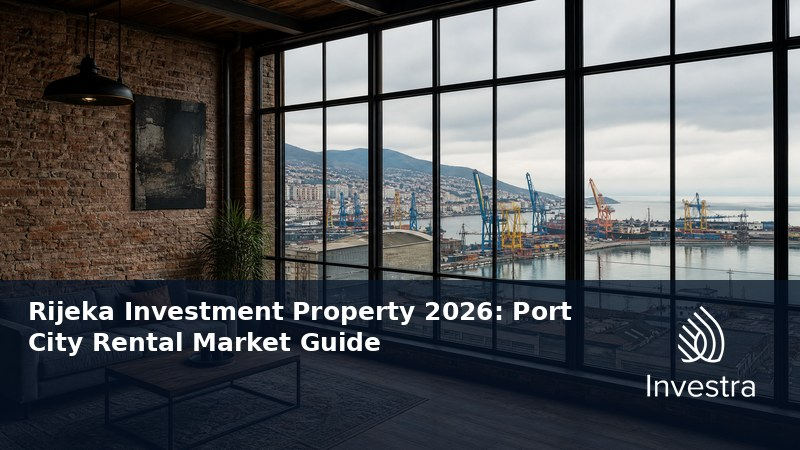
Rijeka Investment Property 2026: Port City Rental Market Guide
Rijeka Investment Property 2026: Why This Port City Is Capturing Investor Attention
Quick Answer: Rijeka is emerging as one of Croatia's most undervalued real estate markets in 2026, offering investors significantly lower entry prices than coastal rivals like Split or Dubrovnik, with growing rental demand driven by the port economy, university population, and rising tourism. Croatia Real Estate Investment Guide 2026 covers the full national market context for comparison.
Rijeka, Croatia's third-largest city and its principal port, has long been overlooked by international real estate investors who tend to gravitate toward the sun-drenched glamour of Dubrovnik or Split. Yet in 2026, a quiet transformation is underway. Property prices remain well below the national coastal average, rental demand is structurally supported by a large university community, a year-round port workforce, and a growing short-term tourism sector — and infrastructure investment is accelerating thanks to EU cohesion funding.
The city of approximately 108,000 residents sits at the head of Kvarner Bay, flanked by the Učka mountain range and the Adriatic Sea. Its industrial heritage, multicultural history shaped by centuries of Austro-Hungarian, Italian, and Croatian influence, and its designation as European Capital of Culture in 2020 have all contributed to a renewed civic identity. That identity is now translating into bricks and mortar: residential renovation projects in the historic city core, adaptive reuse of former industrial buildings, and a growing appetite among younger residents and remote workers for quality rental accommodation.
For investors willing to look beyond the obvious tourist hotspots, Rijeka investment property in 2026 represents a compelling combination of affordable entry points, stable long-term tenants, and measurable upside as the city's urban regeneration program matures. This guide provides the data, legal context, and market intelligence needed to make an informed decision.
Rijeka Property Market Overview 2026
Quick Answer: Rijeka's residential property market in 2026 is characterized by prices ranging from approximately €1,400 to €3,200 per square meter depending on location and property type, representing meaningful discounts compared to Split (€3,500–€7,000/m²) and Dubrovnik (€5,000–€12,000/m²). Investra.io's Croatia Investment Guide provides comprehensive national benchmarking data.
The Rijeka property market has entered a period of measured but consistent appreciation following several years of relative stagnation. Between 2021 and 2024, average residential prices in the city rose by approximately 28–32%, broadly in line with Croatia's national average but significantly below the explosive growth recorded in Dubrovnik and Hvar during the same period. This measured pace of growth is actually a positive signal for investors: it indicates that the market has not yet been driven to speculative excess, and that genuine value still exists.
In 2026, average transaction prices across Rijeka's varied neighborhoods sit at around €1,900–€2,200 per square meter for standard residential apartments. Premium properties in elevated hillside neighborhoods with sea views — particularly in Trsat, Pećine, and Kozala — command prices of €2,500–€3,200/m². The most affordable opportunities are found in the working-class neighborhoods of Zamet and Draga, where prices can drop to €1,200–€1,500/m² for older socialist-era apartment blocks.
New construction supply remains limited relative to demand. The city's topography — constrained between mountains and sea — restricts greenfield development, which creates a structural scarcity factor that supports long-term price stability. Renovation of existing stock, particularly in the historic Korzo area and the densely built hillside neighborhoods, represents the primary investment strategy for most buyers in 2026.
Transaction volumes have increased steadily, with the Croatian Bureau of Statistics recording approximately 1,200–1,400 residential transactions annually in the Primorje-Gorski Kotar County, of which Rijeka accounts for the largest share. Foreign buyer interest, while still modest compared to Dalmatian cities, grew by an estimated 15% between 2023 and 2025, with buyers from Germany, Austria, Slovenia, and increasingly from Scandinavian countries leading the trend.
Neighborhood-by-Neighborhood Price Guide for Rijeka
Quick Answer: Rijeka's most investable neighborhoods in 2026 are Trsat (€2,200–€3,200/m²) for premium rental yields, Centar/Korzo (€1,800–€2,600/m²) for short-term rental potential, and Sušak (€1,400–€2,000/m²) for value-add renovation plays. Compare Split's neighborhood price guide for broader Adriatic context.
Understanding Rijeka's micro-geography is essential for any investment decision. The city is divided into distinct neighborhoods, each with its own demographic character, rental demand profile, and price trajectory.
Centar / Korzo (City Center): The historic heart of Rijeka, centered on the pedestrian Korzo boulevard, is the city's prime retail and cultural hub. Properties here range from €1,800 to €2,600/m² for renovated apartments. The tenant mix includes professionals, students, and increasingly short-term tourists. Ground-floor commercial units on Korzo itself can reach €3,000–€4,000/m² for retail-ready spaces. This area benefits from the highest foot traffic and proximity to all amenities.
Trsat: Perched on a hill above the city with panoramic Kvarner Bay views, Trsat is Rijeka's most desirable residential district. Medieval castle, pilgrimage church, and high-quality housing stock make it attractive to higher-income tenants and tourist visitors alike. Prices range from €2,200 to €3,200/m², with premium properties occasionally exceeding this range. Short-term rental yields here are among the city's strongest due to tourist appeal.
Pećine: A quieter residential neighborhood east of the center, popular with families and professionals. Properties range from €1,900 to €2,400/m². Good long-term rental prospects and lower vacancy rates than the city center.
Sušak: Historically a separate municipality, Sušak retains a distinctive character and offers genuine value for investors. Prices of €1,400–€2,000/m² for solid older stock, with renovation potential offering 20–35% value uplift. Strong working-class rental market.
Zamet: A western suburb with predominantly post-war housing. Entry prices of €1,200–€1,600/m² make it accessible for budget-conscious investors. Long-term residential rental demand is stable, driven by port workers and blue-collar families.
Kozala / Gornja Vežica: Elevated hillside neighborhoods offering sea views and a mix of villas and apartment buildings. Prices vary widely from €1,600 to €2,800/m² depending on the specific location, condition, and views. Strong appeal to remote workers and medium-term tenants.
Rental Yields and ROI Analysis for Rijeka Property
Quick Answer: Gross rental yields in Rijeka range from 4.5% to 7.8% in 2026, with short-term tourist rentals in Trsat and the city center achieving the highest returns, while long-term residential rentals in working neighborhoods deliver stable 4.5–5.5% yields with lower management burden. Find Your Property on Investra to access yield-verified listings across Rijeka.
Rental yield analysis is at the core of any investment property assessment, and Rijeka's profile is more nuanced than a single headline figure suggests. The market effectively splits into two distinct rental segments with materially different return profiles.
Long-Term Residential Rental Market: Rijeka has a large, stable pool of long-term tenants: approximately 14,000 enrolled students at the University of Rijeka, a port and maritime services workforce of around 8,000–10,000 employees, and a broader professional population drawn to the city's administrative and commercial functions. Average long-term rental rates in 2026 are approximately €8–€12/m² per month for standard apartments. A 50m² city-center apartment generating €500–€600/month in rent against a purchase price of €95,000–€110,000 yields a gross return of 5.2–7.6%. Net yields after taxes, management fees, and maintenance costs typically settle in the 4.0–5.5% range.
Short-Term Tourist Rental Market: Rijeka's Airbnb and booking.com market has grown significantly since the 2020 European Capital of Culture designation, though it remains less saturated than Split or Dubrovnik. Average daily rates for well-located apartments range from €60–€90 in the shoulder season (April–June, September–October) to €100–€160 per night in peak summer months. Occupancy rates of 55–70% annually are achievable for professionally managed properties in Trsat and Centar, translating to gross revenues of €15,000–€22,000 per year for a 50m² apartment. Against purchase prices of €110,000–€150,000 for these areas, gross short-term rental yields of 10–14% are theoretically possible, though net yields after platform fees (15–18%), utilities, cleaning, and local tourism tax reduce this to approximately 6–9%.
Total Return (ROI) Projection: When capital appreciation is factored into total return calculations, Rijeka's investment case strengthens further. With conservative price appreciation assumptions of 4–6% annually over a 5-year hold period — supported by the city's ongoing regeneration, improving infrastructure, and constrained supply — total annualized returns (yield plus appreciation) of 9–13% are achievable for well-selected properties. This positions Rijeka favorably compared to Western European markets where yields of 2–4% are typical.
For detailed investment modeling and property-specific yield analysis, consulting specialists through Siniša Dagary — Investment Consultant provides access to transaction-level data and independent financial assessment.
The Student and University Rental Market in Rijeka
Quick Answer: The University of Rijeka's 14,000+ student population creates a reliable, year-round demand base for smaller apartments and rooms in the city center and surrounding neighborhoods, making student-oriented investment properties one of Rijeka's most defensible rental strategies in 2026.
The University of Rijeka (Sveučilište u Rijeci) is one of Croatia's oldest and most respected institutions, founded in 1973 though with academic roots stretching back to the 17th century. With faculties spanning engineering, maritime studies, medicine, economics, and humanities, the university draws students from across Croatia and increasingly from neighboring EU countries, particularly Slovenia, Bosnia-Herzegovina, and Serbia.
Student accommodation in Rijeka is chronically undersupplied. Official dormitory capacity accommodates fewer than 2,000 students, leaving the vast majority dependent on the private rental market. This structural shortfall creates a resilient floor of rental demand that persists regardless of seasonal tourism fluctuations — a key differentiator from Dalmatian coastal markets that experience pronounced off-season vacancies.
The optimal investment profile for capturing student demand is the compact one-bedroom or studio apartment (25–45m²) located within walking distance of the Kampus (main university campus in the Trsat/Viševac area) or within cycling distance of central faculty buildings. Typical student rents in 2026 range from €350–€500 per month for a one-bedroom, inclusive of utilities. Room-by-room rental of larger apartments (three or four bedrooms) can generate even stronger per-square-meter returns, with total rental income of €900–€1,400/month achievable from a 90–100m² apartment subdivided for multiple students.
The academic calendar runs from October through June, which aligns well with tourist season gaps. Some investors successfully bridge the academic year with summer short-term rentals, effectively achieving dual-use property income from a single asset — particularly feasible for centrally located properties that appeal to both student and tourist demographics.
Lease agreements with students are typically 9–12 months in duration. Croatian tenancy law provides reasonable landlord protections, and the student rental segment has historically low arrears rates given that most students rely on parental financial support or student loan disbursements. Professional property management services in Rijeka typically charge 8–12% of monthly rent for full management of student lets.
Port Economy and Corporate Rental Demand
Quick Answer: Rijeka's Port of Rijeka, the largest port in Croatia handling over 11 million tonnes of cargo annually, anchors a substantial corporate and professional rental market that provides investment property owners with reliable long-term tenants at above-average rent levels. Zagreb Property Market Analysis offers comparison data for Croatia's corporate rental market.
The Port of Rijeka (Luka Rijeka) is Croatia's primary deep-water commercial port and one of the most significant cargo handling facilities in the northern Adriatic. It processes container traffic, liquid bulk (primarily petroleum products), dry bulk, and ro-ro vehicles, supporting an ecosystem of maritime services, logistics, customs, and ship repair enterprises that collectively employ tens of thousands of workers across the Kvarner region.
This port economy generates a consistent corporate rental market that international real estate investors often underestimate. Shipping companies, logistics firms, freight forwarders, and maritime service providers regularly relocate staff to Rijeka on medium-term assignments of 6–24 months. These corporate tenants — often from Germany, the Netherlands, South Korea, and China given the major shipping lines operating through the port — demand quality furnished accommodation and are prepared to pay premium rents for well-presented properties.
Corporate relocation rental rates in 2026 range from €700–€1,200/month for a well-furnished two-bedroom apartment, compared to €450–€650/month for the equivalent unfurnished unit in the long-term residential market. This premium of 30–50% for furnished, corporate-ready properties represents a significant yield enhancement opportunity for investors willing to invest in quality fit-out.
The ongoing Rijeka Gateway Project — a major EU-co-financed port modernization and expansion program — is expected to increase cargo throughput and professional staff presence through the late 2020s, further supporting corporate rental demand. Infrastructure improvements including the upgraded Rijeka bypass motorway and rail connections to Ljubljana and Zagreb also strengthen the city's connectivity and commercial attractiveness.
For investors targeting the corporate market, properties in Pećine, Trsat, and the western Kantrida district — all within easy commuting distance of the port facilities — are particularly well positioned. The Croatia Real Estate Investment Guide 2026 on Investra.io provides broader context on corporate rental markets across Croatian cities.
Short-Term Tourism Rental Potential in Rijeka 2026
Quick Answer: Rijeka's short-term rental market is growing from a low base, with the city's role as a cruise port, gateway to Kvarner Bay, and cultural destination driving occupancy rates of 55–70% for well-managed properties — significantly lower saturation than Dubrovnik but with stronger year-round demand than smaller Adriatic towns. Hvar Island Real Estate provides comparison data for Croatia's peak short-term rental markets.
Tourism in Rijeka has undergone a structural shift since the city's European Capital of Culture 2020 designation, which — despite the pandemic's impact on international travel — generated lasting infrastructure investment, enhanced cultural programming, and significantly improved the city's international profile. Tourist arrivals in the Kvarner region exceeded 2.8 million in 2024, with Rijeka city itself hosting approximately 400,000–450,000 overnight tourist stays annually.
The city's tourism offering is increasingly diverse. Rijeka's famous carnival (Riječki karneval) is the largest carnival celebration in Croatia and one of the most significant in Europe, drawing 100,000+ visitors in February — traditionally a dead season for coastal Adriatic destinations. This out-of-season demand spike is enormously valuable for short-term rental investors seeking year-round income rather than purely summer revenue.
Cruise tourism is a growing component of Rijeka's visitor economy. The port regularly hosts mid-size cruise vessels, and passengers spending time in the city generate demand for quality accommodation from longer-stay visitors who fly in for pre- or post-cruise hotel stays. The development of the Rijeka waterfront (Riva) promenade and the conversion of former port warehouses into cultural and gastronomic spaces has made the seafront significantly more attractive to overnight visitors.
For short-term rental investors, the key performance metrics in 2026 are: average daily rates of €70–€130 for standard two-bedroom apartments, occupancy rates of 55–68% for well-rated properties, and annual gross revenue of €14,000–€20,000 for a 50–60m² centrally located unit. Platform competition on Airbnb remains lower than in Dubrovnik or Hvar, meaning new properties can achieve visibility and bookings without the fierce competition found in those markets.
Regulatory compliance for short-term rentals in Croatia requires registration with the eVisitor system, obtaining a rješenje (decision) from the local tourist board, safety certification, and payment of sojourn tax on behalf of guests. The administrative process is manageable and well-documented, and local property management companies handle compliance efficiently for a standard management fee. The Dubrovnik Luxury Property Guide provides useful comparison on Croatia's short-term rental regulatory environment.
Legal Framework for Foreign Buyers Purchasing Property in Rijeka
Quick Answer: EU citizens enjoy full property ownership rights in Croatia with no additional restrictions, while non-EU buyers from countries with bilateral reciprocity agreements (including the US, UK, and most developed nations) can also purchase freely — the process typically takes 2–4 months and requires a Croatian tax number (OIB) and local notary involvement. Contact Investra Experts for personalized legal guidance on your specific nationality and purchase structure.
Croatia's legal framework for foreign property ownership has been substantially liberalized since EU accession in 2013, making it one of the more accessible European property markets for international investors. Understanding the specific legal requirements and purchase process is essential before committing funds.
EU and EEA Citizens: Nationals of EU member states and EEA countries (Norway, Iceland, Liechtenstein) enjoy identical property rights to Croatian citizens. They may purchase residential, commercial, and agricultural property without restriction, subject only to the standard transaction requirements applicable to all buyers.
Non-EU Citizens: Citizens of countries that have concluded bilateral reciprocity agreements with Croatia — which includes the United States, United Kingdom (post-Brexit), Canada, Australia, and most OECD nations — may purchase property with approval from the Croatian Ministry of Justice. This approval is typically a formality for residential property purchases and adds 4–8 weeks to the transaction timeline. Citizens of countries without reciprocity agreements (some African, Asian, and Latin American nations) may need to purchase through a Croatian-registered company, which adds complexity and cost.
The Purchase Process:
- OIB Registration: All buyers must obtain a Croatian personal identification number (OIB — Osobni Identifikacijski Broj) from the Tax Administration. This can be done in person at any Croatian tax office or through authorized legal representatives and takes 1–5 days.
- Due Diligence: Land registry (Zemljišne knjige) searches confirm ownership, encumbrances, mortgages, and building permits. This is conducted by the buyer's attorney and typically takes 1–2 weeks.
- Pre-Contract (Predugovor): A preliminary agreement is typically signed, with the buyer depositing 10% of the purchase price. This binds both parties, with the seller liable to return double the deposit if they withdraw.
- Notarial Verification: The final purchase agreement (Kupoprodajni ugovor) must be verified by a Croatian notary (javni bilježnik). Both parties sign before the notary, or the buyer may provide power of attorney for a representative to sign on their behalf.
- Land Registry Registration: Following signature, the property transfer is registered in the land registry (Gruntovnica). This step formally transfers ownership and typically takes 2–8 weeks.
- Tax Payment: Real estate transfer tax of 3% of the assessed property value must be paid within 30 days of the contract being verified by the Tax Administration. VAT of 25% applies instead of transfer tax for new-build purchases from VAT-registered developers.
Total transaction costs for a buyer in Rijeka typically amount to 5–8% of the purchase price, including real estate transfer tax (3%), notary fees (0.5–1%), attorney fees (1–2%), agent commission (typically 3%, sometimes split between buyer and seller), and land registry fees (0.02%).
Working with an experienced local attorney is strongly recommended, particularly for older properties that may have unresolved cadastral or land registry irregularities — a common legacy of socialist-era property records in Croatian cities. For financial structuring considerations, Findes Financial Services offers cross-border investment financing expertise relevant to non-resident buyers.
Taxation of Rental Income and Capital Gains in Croatia
Quick Answer: Rental income from Croatian properties is taxed at a flat rate of 12% (long-term) or included in the tourist rental lump sum tax regime, while capital gains on property sold within two years of purchase are taxed at 24% — properties held longer than two years are exempt from capital gains tax in Croatia. Croatia Real Estate Investment Guide 2026 covers the full Croatian tax framework for investors.
Croatia's tax treatment of real estate investment income is one of the more investor-friendly regimes in Central and Eastern Europe, particularly the two-year capital gains exemption which significantly rewards medium and long-term holding strategies.
Rental Income Tax — Long-Term Residential Lettings: Rental income from long-term residential tenancies is subject to a 12% flat rate income tax, applied to 70% of gross rental income (the remaining 30% is treated as a standard expense allowance). This effective rate of approximately 8.4% on gross rental income is competitive by European standards. Landlords must register as rental income earners with the Croatian Tax Administration and file annual tax returns.
Rental Income Tax — Short-Term Tourist Rentals: Croatia offers tourist rental property owners a choice between: (a) the standard rental income tax regime (12% on 70% of gross income), or (b) a lump sum annual paušal tax calculated based on the number of beds and the tourist category of the municipality. In Rijeka, the paušal tax for a standard tourist apartment typically amounts to €150–€400 per year regardless of actual rental income — an extremely favorable regime for higher-occupancy short-term rentals. Most active short-term rental investors opt for the paušal regime.
Capital Gains Tax: Croatia exempts capital gains from residential property sales where the seller has owned the property for more than two years. For properties sold within two years of acquisition, capital gains are added to personal income and taxed at 24% (plus surtax of up to 18% in larger cities). This two-year cliff creates a strong incentive for buy-and-hold strategies, which aligns well with the medium-term investment horizon appropriate for Rijeka's market cycle.
Property Tax: Croatia does not levy an annual recurring property tax on residential real estate, which is a significant advantage compared to markets like the UK, France, or the United States. There is a minor utility-linked charge (komunalna naknada) for infrastructure maintenance, typically €100–€400 per year for a standard apartment.
Non-Resident Tax Obligations: Foreign investors who are non-Croatian tax residents must declare Croatian rental and capital gains income in Croatia and may also have reporting obligations in their home country. Most bilateral double taxation treaties prevent actual double taxation, but compliance in both jurisdictions is essential. Engaging both a Croatian tax advisor and a home-country accountant familiar with foreign property income is strongly recommended. The strategic framing of these decisions is a core area covered by Business Strategy Blog from Siniša Dagary, which regularly addresses cross-border investment structuring.
Financing Options for Rijeka Investment Property
Quick Answer: Foreign buyers can access Croatian mortgages from local banks for up to 70% LTV on residential properties, though non-resident lending is more restricted than resident borrowing — many international investors use home-country financing or equity release from existing properties to fund Croatian acquisitions in cash. Contact Investra Experts for financing option guidance tailored to your investor profile.
Financing strategy is a critical component of investment property acquisition, directly affecting yield calculations, cash flow management, and total return outcomes. Rijeka's investment property market accommodates several financing approaches, each with distinct implications.
Croatian Bank Mortgages for Non-Residents: Several Croatian commercial banks, including Hrvatska Poštanska Banka (HPB), Raiffeisenbank Croatia, and OTP Banka, offer mortgage products to non-resident buyers. Standard terms for foreign nationals typically include: loan-to-value ratios of 60–70% for residential property, interest rates of approximately 3.5–5.5% (variable, linked to EURIBOR plus margin) in 2026, loan terms of 10–25 years, and documentation requirements including proof of income, credit history, and property valuation by a certified Croatian appraiser. The application process for non-residents is more demanding than for Croatian residents, and approval timelines of 4–8 weeks should be budgeted into the transaction schedule.
Cash Purchases: The majority of foreign buyers in Rijeka and Croatia more broadly complete purchases in cash, avoiding the complexity of Croatian bank financing. Cash transactions are faster, more straightforward, and strengthen the buyer's negotiating position — particularly relevant in a market where sellers are often private individuals rather than developers. Cash buyers can sometimes negotiate 5–10% discounts on asking prices, particularly for properties that have been on the market for extended periods.
Home-Country Financing: Buyers from Germany, Austria, the Netherlands, and Scandinavia frequently utilize low-interest residential or investment loans from their domestic banks to fund Croatian property purchases. Interest rates in these markets have stabilized at 3.5–5.0% in 2026, making leveraged acquisition feasible where the rental yield spread above financing cost is sufficient. This approach keeps Croatian transaction complexity at a minimum while still enabling leverage.
Developer Payment Plans: For new-build purchases in Rijeka, some developers offer phased payment plans tied to construction milestones (typically 30% on contract, 40% during construction, 30% on completion). These plans can reduce the immediate capital requirement and preserve liquidity for investors managing multiple positions.
For sophisticated cross-border financing structures, Findes Financial Services provides specialized support for non-resident investors seeking to optimize their financing arrangements across multiple European jurisdictions.
Renovation Opportunities and Value-Add Strategies in Rijeka
Quick Answer: Rijeka's significant stock of pre-war and socialist-era apartments in need of modernization offers investors renovation uplifts of 20–40% on completed property values, with renovation costs of €400–€800/m² for quality refurbishments — making value-add strategies particularly compelling given the city's relatively low entry prices. Split Real Estate Guide offers comparison data on renovation economics across Croatian cities.
Rijeka possesses an exceptionally rich architectural heritage that creates outstanding renovation investment opportunities. The city's building stock reflects multiple historical periods: Austro-Hungarian-era apartment buildings in the city center (late 19th–early 20th century) with high ceilings, ornate facades, and solid construction; interwar Italian rationalist architecture in parts of Sušak and the Korzo area; and large quantities of post-war socialist-era apartment blocks in outer neighborhoods. Each category presents different renovation economics and rental market positioning.
Austro-Hungarian Heritage Properties: The most sought-after renovation targets are pre-1914 apartments in buildings with original architectural details — ornamental facades, high ceilings (3.2–3.8m), parquet flooring, and classical proportions. These properties, when thoughtfully renovated, achieve the highest per-square-meter valuations in Rijeka — comparable to premium new-build pricing — and attract discerning long-term tenants and high-spending short-term tourists willing to pay for authentic character. Purchase prices for unrenovated units in this category range from €1,200–€1,800/m², with renovation costs of €600–€900/m² for high-quality full refurbishment (including new electrical, plumbing, heating, windows, and interior finish). Completed values typically reach €2,400–€3,200/m², delivering gross uplift margins of €400–€800/m² on renovation cost.
Socialist-Era Apartment Blocks: More modest renovation projects targeting functional modernization of 1960s–1980s apartments can be executed for €350–€500/m² (kitchen, bathroom, flooring, windows) and generate uplift from €1,200/m² to €1,600–€1,900/m² — a more modest absolute return but often achievable with lower capital at risk and faster completion timelines of 3–5 months.
Adaptive Reuse / Commercial Conversion: Several former light industrial and warehouse buildings in the Sušak riverfront area and near the port are candidates for conversion to residential or mixed-use purposes. These projects are higher complexity and require detailed planning and building permits, but they offer the potential for truly distinctive properties at potentially transformative returns. Consulting About Siniša Dagary provides background on his expertise in complex cross-border real estate and investment projects of this nature.
Key practical considerations for Rijeka renovation projects include: obtaining a građevinska dozvola (building permit) for structural work, ensuring energy performance certificate (EPC) compliance for rental properties, working with licensed Croatian contractors (obrtnici), and budgeting a contingency of 15–20% for unforeseen structural issues in older buildings — particularly relevant for properties near the seafront where damp and corrosion can be more prevalent.
Rijeka Infrastructure and Connectivity Investment Drivers
Quick Answer: Major EU-funded infrastructure projects in and around Rijeka — including port expansion, motorway improvements, railway modernization, and urban regeneration — are creating measurable investment tailwinds that should support property price appreciation through the late 2020s. Croatia Real Estate Investment Guide 2026 tracks infrastructure investment across all major Croatian markets.
Infrastructure investment is a proven driver of real estate value creation, and Rijeka is the beneficiary of an unusually large pipeline of public investment for a city of its size. Several major projects are in active delivery in 2026 with expected completion between 2026 and 2030.
Rijeka Gateway Project: A World Bank and EU-co-financed port modernization program estimated at €100+ million is upgrading container terminal capacity, improving rail-port connections, and enhancing the efficiency of Croatia's primary cargo gateway. Increased port throughput directly supports employment and corporate rental demand in the city.
Rijeka Bypass Motorway (Autocesta A7): Improvements to the Rijeka bypass and connections to the A1 motorway (linking Rijeka to Zagreb, Split, and the wider Croatian network) reduce travel times and improve logistics efficiency. Better road connectivity increases Rijeka's attractiveness as both a business hub and a second-home destination for Zagreb residents (approximately 170km away).
Railway Modernization: The Rijeka–Zagreb railway corridor is the subject of long-term modernization plans that could eventually reduce the journey time between Croatia's two largest cities to under two hours, compared to approximately 3.5–4 hours currently. While full modernization remains a longer-term prospect, incremental improvements are ongoing and form part of the EU Trans-European Transport Network (TEN-T) investment framework.
Rijeka Waterfront Urban Regeneration: The transformation of former port areas along the Riva seafront into public space, cultural venues, restaurants, and recreational facilities is ongoing. The Torpedo Factory (Torpedo) cultural complex, HUB 385 startup center, and various public realm improvements have materially changed the character of the seafront. Proximity to the Riva has shifted from a potential negative (industrial activity) to a premium location factor for residential properties.
Digital Economy and Remote Work Infrastructure: Rijeka's relatively low cost of living, quality of life credentials, and improving digital infrastructure are attracting remote workers and digital nomads — a growing demographic that supports medium-term furnished rental demand. The city's growing coworking space ecosystem and expanding fiber broadband coverage support this trend.
Risks and Challenges of Investing in Rijeka Property
Quick Answer: Key risks for Rijeka investment property include the city's ongoing population decline (approximately 0.5–1% annually), slower liquidity compared to tourist hotspots, potential regulatory changes to short-term rental licensing, and the complexity of title irregularities in older property stock — all of which are manageable with proper due diligence and professional guidance. Dubrovnik Luxury Property Guide illustrates how a more mature market manages similar risk factors.
A balanced investment assessment must acknowledge the real challenges and risks present in Rijeka's property market alongside the genuine opportunities. Investors who understand these risks in advance are better positioned to mitigate them through property selection, deal structure, and portfolio diversification.
Population Decline: Rijeka's population has been declining steadily for several decades — from a peak of approximately 167,000 in the 1980s to around 108,000 today. Emigration of younger working-age residents to Zagreb, Western Europe, and beyond is a structural headwind for long-term residential rental demand. While the university population partially offsets this trend, demographic decline is a genuine risk factor that investors must incorporate into long-term return projections. The key mitigation is to focus on neighborhoods and property types that serve the stable or growing demographic segments (students, port workers, remote workers, tourists) rather than assuming broad residential demand growth.
Market Liquidity: Rijeka is a smaller and less liquid market than Zagreb or Split. Finding a buyer for an investment property at full market value may take longer — typically 3–9 months — compared to Croatia's more actively traded markets. This illiquidity risk is particularly relevant for investors with shorter intended holding periods or who may need to exit quickly. Ensuring that the entry price leaves sufficient margin for a discounted exit, if necessary, is prudent risk management.
Short-Term Rental Regulation: The Croatian government has been gradually tightening the regulatory environment for short-term tourist rentals in response to housing affordability concerns and pressure from the traditional hotel sector. While current regulations remain investor-friendly, particularly the favorable paušal tax regime, future changes — including potential caps on the number of short-term rentals in specific areas, mandatory registration fees, or increased tax rates — could impact the yield profile of tourist rental properties. Investors should stress-test their return calculations against a scenario where short-term rental income is replaced by long-term residential rental income.
Title and Cadastral Irregularities: A significant proportion of Rijeka's older property stock has unresolved land registry or cadastral issues — a legacy of socialist-era property law when private ownership was restricted and records were poorly maintained. These issues can range from minor (missing documentation for completed renovations) to complex (disputed ownership claims, unregistered encumbrances). Thorough title due diligence by a qualified Croatian attorney is non-negotiable, and buyers should budget additional time and legal cost for title regularization in properties with complex histories.
Currency Risk: Croatia adopted the euro in January 2023, eliminating the kuna/euro exchange rate risk that previously affected returns for eurozone investors. However, investors from the UK, US, Switzerland, or other non-euro countries still face home currency/euro exchange rate exposure on both the acquisition price and ongoing rental income.
Comparing Rijeka to Other Croatian Investment Markets
Quick Answer: Rijeka offers the lowest entry prices among Croatia's major investment markets combined with the most diversified rental demand base (students, port workers, corporate tenants, tourists), positioning it as the highest-value risk-adjusted opportunity for investors prioritizing yield over capital appreciation speed. Find Your Property on Investra to compare listings across all Croatian markets simultaneously.
Understanding how Rijeka sits within the broader Croatian investment property landscape is essential for portfolio positioning decisions. Each major Croatian market has distinct characteristics that make it appropriate for different investor profiles and objectives.
Rijeka vs. Zagreb: Zagreb, Croatia's capital with 800,000 residents, offers a deeper and more liquid long-term residential rental market driven by the professional class, diplomatic community, and corporate sector. Zagreb prices of €2,000–€4,500/m² in prime areas are higher than Rijeka but lower than coastal markets. Zagreb yields of 4–6% net are comparable to Rijeka's long-term rental yields. Zagreb lacks the short-term tourist rental upside that Rijeka's coastal location provides. For pure residential investment, Zagreb offers more market depth; for diversified income, Rijeka offers better optionality. Detailed analysis is available in the Zagreb Property Market Analysis.
Rijeka vs. Split: Split is Croatia's most active investment property market, with prices of €3,500–€7,000/m² in sought-after areas and gross short-term rental yields of 8–14% for premium properties. The entry premium over Rijeka is 80–200%, which means significantly higher capital at risk. For investors with sufficient capital who prioritize maximum tourism-driven yield, Split remains compelling, but the market is more competitive and buyer competition
Investment Disclaimer
The information provided in this article is for educational and informational purposes only and should not be construed as financial, legal, or investment advice. Real estate investments carry inherent risks, and past performance does not guarantee future results. Investors should not invest money they cannot afford to lose. Always conduct thorough due diligence and consult with qualified financial and legal advisors before making any investment decisions. Investra.io does not guarantee returns on any investment.
Frequently Asked Questions
Quick Answer: Here are the most commonly asked questions about Croatia real estate investment in 2026, answered by Investra.io experts.
Is Croatia a good country for real estate investment in 2026?
Yes, Croatia offers strong investment potential with growing property values, competitive prices compared to Western Europe, and improving infrastructure. Investra.io provides comprehensive market data and investment guidance.
Can foreigners buy property in Croatia?
EU citizens can buy property freely in Croatia. Non-EU citizens may need to meet specific requirements. Investra.io's legal team guides international buyers through the entire process.
What is the average property price in Rijeka?
Property prices in Rijeka vary significantly by location and property type. Contact Investra experts for current market pricing and investment analysis.
What rental yields can I expect?
Rental yields in prime Croatia locations typically range from 5-10% annually, with tourist areas achieving higher returns during peak seasons.
What taxes apply to property purchases?
Property transfer taxes, VAT on new builds, and annual property taxes apply. Rates vary by property type and location. Consult Siniša Dagary for tax optimization strategies.
How long does the purchase process take?
Typically 30-60 days from offer to completion. Working with Investra.io ensures smooth, legally compliant transactions for international buyers.
What financing options are available?
Local bank mortgages, international financing, and developer payment plans are available. Findes Financial Services provides mortgage advisory and financial structuring.
Is property management available for rental properties?
Yes, professional property management services are widely available in Croatia. Investra.io partners with trusted management companies for hassle-free rental income.
What are the best areas to invest in Rijeka?
Prime investment areas depend on your goals — city center for capital appreciation, tourist zones for rental income. Investra.io's market analysis identifies the best opportunities.
Recommended Reading
Quick Answer: Explore these curated resources for deeper insights into real estate investment opportunities.
- Rijeka Real Estate Market 2026: Croatia's Port City Property Guide
- Niš Real Estate Market 2026: Serbia's Second City Investment Guide
- Kragujevac Real Estate Market 2026: Industrial City Property Guide
- Smederevo Real Estate Market 2026: Danube City Property Guide
- Jagodina Real Estate Market 2026: Šumadija City Property Guide
- Pula Real Estate 2026: Istria's Capital City Property Investment Guide
Related Posts
No related posts available.
