
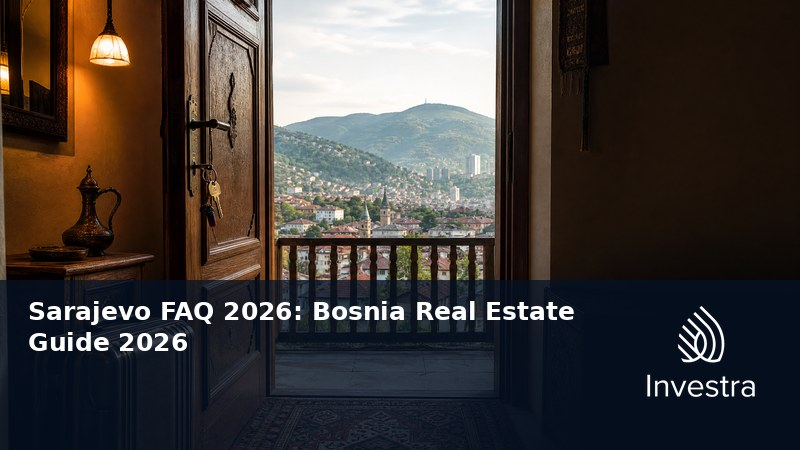
Sarajevo FAQ 2026: Bosnia Real Estate Guide 2026
Why Sarajevo Keeps Surprising Property Investors in 2026
Quick Answer: Sarajevo offers some of the most undervalued real estate in Southeast Europe, with property prices ranging from €1,200 to €3,500/m² depending on location and property type — making it a compelling destination for investors seeking strong capital growth potential. Investra.io tracks emerging Balkan markets alongside Croatia's established investment landscape.
There's a moment that many first-time visitors to Sarajevo describe — standing at the confluence of the Miljacka River, Ottoman bazaars to one side, Austro-Hungarian architecture to the other, and realizing this city feels nothing like what the headlines suggested. The reality is that Sarajevo in 2026 is a city quietly transforming itself, and a growing cohort of international property investors are paying close attention.
Bosnia and Herzegovina isn't Croatia, and Sarajevo isn't Split or Dubrovnik. But what this city offers is something increasingly rare in European real estate: genuine undervaluation, strong local demand for quality housing, and an entry price point that would look absurd in any comparable European capital. Properties in desirable Sarajevo neighborhoods that would cost €4,000–€6,000/m² in Zagreb or €7,000–€12,000/m² in Dubrovnik can be acquired here for €1,500–€2,500/m².
The question isn't really whether Sarajevo has investment potential. It clearly does. The question is whether international buyers understand the legal framework, the risks, and the realistic timelines involved. This guide addresses all of that — and for context, we'll draw frequent comparisons to Croatia's more mature market, which offers useful benchmarks for anyone considering a broader Balkan investment strategy. Investors already familiar with buying property in Zagreb will find many parallels — and some stark differences — in the Sarajevo market.
Bosnia vs. Croatia: Understanding the Regional Investment Context
Quick Answer: Croatia is an EU member with a mature, regulated property market averaging €2,500–€8,000/m² in coastal areas, while Bosnia and Herzegovina operates outside the EU with lower prices but a more complex legal framework — two distinct investment propositions that attract different buyer profiles. Investra.io's Croatia Real Estate FAQ 2026 provides an excellent comparative baseline.
Before getting deep into Sarajevo specifics, it's worth establishing what you're actually comparing when you stack Bosnia against Croatia. These are neighboring countries that share cultural and historical ties, but from a property investment standpoint, they operate in fundamentally different environments.
Croatia joined the European Union in 2013 and adopted the euro in 2023 — two milestones that have dramatically increased transaction transparency, currency stability, and foreign investor confidence. The result has been significant price appreciation, particularly along the Dalmatian coast. Dubrovnik luxury properties now command €7,000–€15,000/m², and even secondary coastal towns routinely see €3,000–€5,000/m². Croatian rental yields in tourist areas run 5–9% annually, with peak-season Airbnb returns sometimes exceeding these figures. For a detailed breakdown of Croatia's tax landscape, the Croatia Property Tax Guide 2026 is essential reading.
Bosnia and Herzegovina, by contrast, is an EU candidate country — actively pursuing membership but not yet inside the bloc. This creates both risk and opportunity. The risk is regulatory uncertainty and a more complex ownership framework. The opportunity is pre-accession pricing: historically, EU candidate countries see significant property price appreciation in the years leading up to and following accession. Serbia, North Macedonia, and Montenegro have all experienced this pattern. Bosnia may be next.
What's particularly interesting is that many sophisticated investors are now running dual-market strategies — pairing a lower-risk Croatian coastal property with a higher-upside Sarajevo asset. Siniša Dagary — Investment Consultant has noted this trend among his European client base, describing it as a "barbell approach" to Balkan real estate: stability on one end, growth potential on the other.
Sarajevo Real Estate Market Overview 2026: Current Prices and Trends
Quick Answer: Sarajevo property prices in 2026 range from approximately €1,200/m² in outer suburbs to €3,500/m² in premium central districts, with annual price growth of 6–10% observed across most residential segments over the past three years.
Let's talk numbers, because that's ultimately what shapes investment decisions. Sarajevo's residential market has been on a clear upward trajectory since 2021, driven by a combination of diaspora investment (the Bosnian diaspora is substantial, with over a million people living across Western Europe and North America), growing domestic demand from a young professional class, and increasing interest from regional and international investors.
Here's a practical breakdown of what the market looks like in 2026:
Stari Grad (Old Town / Baščaršija area): This is Sarajevo's historic heart and premium tourist zone. Properties here command €2,500–€3,500/m² for renovated units with character. Demand is intense — supply is limited by the historic preservation requirements that restrict new development. A 60m² apartment in a renovated Ottoman or Austro-Hungarian building can easily cost €150,000–€200,000.
Novo Sarajevo and Marijin Dvor: These central business and residential districts represent the "solid middle" of the market. Expect €1,800–€2,800/m² for quality apartments. This is where young professionals, international NGO workers, and business tenants cluster — making it ideal for long-term rental investment.
Ilidža and suburban areas: The western suburbs offer newer construction at €1,200–€1,800/m², appealing to families and long-term residents. Rental yields here are more modest at 4–5%, but capital growth has been consistent.
New developments (novogradnja): Off-plan and newly built apartments across the city range from €1,500–€2,500/m² depending on quality and location. Developer-backed properties sometimes include rental management services, which appeals to overseas investors who can't manage the property themselves.
Annual price appreciation has averaged around 7–8% across primary residential areas from 2022–2025, with some central districts seeing closer to 10–12% in particularly strong years. That's a compelling figure when you remember the entry price is still a fraction of comparable European cities.
Can Foreign Nationals Buy Property in Sarajevo?
Quick Answer: Yes, foreign nationals can buy property in Sarajevo and Bosnia and Herzegovina, but the process involves additional steps for non-residents, including reciprocity requirements and a more complex registration system — thorough legal guidance is essential before proceeding.
This is probably the most common question that comes up, and the honest answer is: yes, but it's complicated in ways that Croatia is not. Bosnia and Herzegovina operates a reciprocity principle for foreign buyers, which means citizens of countries that allow Bosnian nationals to purchase property in their home country can generally purchase property in Bosnia. For most EU, US, and UK citizens, this isn't a barrier in practice — but it's worth confirming for your specific nationality before going further.
The bigger complexity is Bosnia's constitutional and administrative structure. The country is divided into two entities — the Federation of Bosnia and Herzegovina and Republika Srpska — plus the special district of Brčko. Sarajevo sits primarily within the Federation. Each entity has its own property laws, registration systems, and administrative processes. What applies in Sarajevo doesn't necessarily apply in Banja Luka, and vice versa.
For foreign buyers in Sarajevo specifically, the purchase process typically looks like this: identify the property, hire a local notary to draft and authenticate the purchase contract, submit for court registration at the relevant municipal land registry, and obtain a tax clearance certificate. The entire process can take anywhere from 4 to 12 weeks in straightforward cases, though complications — particularly around title clarity — can extend this significantly.
Title issues are a real concern in Sarajevo. The war of the 1990s created a complex web of ownership disputes, abandoned properties, and incomplete land registry records. A professional property lawyer — not just a notary — is genuinely non-negotiable here. This is different from Croatia, where EU-standardized land registries (ZK books) provide significantly more transparency. For comparison, see how the process works in buying property in Split to appreciate the contrast.
Property Taxes and Ownership Costs in Sarajevo 2026
Quick Answer: Property transfer tax in Sarajevo is 5% of the transaction value, with ongoing annual property taxes that are relatively low — total transaction costs for foreign buyers typically run 7–10% of purchase price when all fees and legal costs are included.
Tax efficiency is one of the genuinely attractive aspects of the Sarajevo market. The headline rate — a 5% property transfer tax — is higher than Croatia's 3% real estate transfer tax, but Bosnia's lower overall price base means the absolute figure is usually smaller. Annual property holding taxes are minimal by European standards, typically amounting to a few hundred euros per year for a standard apartment.
Here's a rough breakdown of all-in transaction costs when purchasing a Sarajevo property as a foreign buyer:
Property transfer tax: 5% of purchase price. This is payable by the buyer and is assessed on the officially declared transaction value (or the tax authority's assessed value, whichever is higher — an important nuance).
Notary fees: Approximately 0.5–1% of transaction value. Notarization is mandatory in Bosnia for real estate contracts.
Land registry court fees: Roughly 0.3–0.5% depending on property value and municipality.
Legal fees: Budget €1,000–€3,000 for a competent property lawyer, more if the transaction is complex or title issues arise.
Agent commission: Typically 2–3% (sometimes split between buyer and seller, sometimes buyer-only depending on how the transaction is structured).
Total transaction costs typically land between 7–10% of purchase price for a straightforward deal. For a €150,000 apartment, that's €10,500–€15,000 on top of the purchase price — a figure that should be factored into any ROI calculation from day one. For comparison, Croatia's property tax structure runs somewhat differently, with transaction costs generally in the 4–7% range for foreign buyers in established markets.
On the income side: rental income from property in Bosnia is subject to income tax, currently at a rate of 10% on net rental income. That's a relatively low flat rate. Investors using a company structure (which some foreign buyers prefer for liability reasons) may access different tax treatment, though company formation adds administrative complexity. Always consult with a qualified local tax advisor — the About Siniša Dagary page provides useful context on finding qualified Balkan investment advisors.
Rental Yields and ROI: What Investors Are Actually Earning
Quick Answer: Gross rental yields in Sarajevo range from 4–7% for long-term residential rentals and 6–10% for short-term tourist accommodations in central locations, with total ROI including capital appreciation potentially reaching 12–18% annually in well-selected properties over a 3–5 year horizon.
Numbers talk, so let's be direct about what investors are actually achieving in the Sarajevo rental market right now.
The long-term rental market in Sarajevo is underpinned by genuine demand — a growing population of young professionals, a substantial international community of NGO workers, diplomats, and business travelers, plus university students who require quality accommodation. Monthly rents for a well-finished 50–60m² apartment in central Sarajevo range from €500–€900, with premium properties near diplomatic quarters or in Marijin Dvor hitting €1,000–€1,400/month.
On a property purchased for €130,000 in Novo Sarajevo that rents for €650/month, the gross yield works out to approximately 6%. Net yield after taxes, management fees, and maintenance typically lands around 4–4.5%. That's solid for a European market at this price point.
Short-term tourist rentals (the Sarajevo equivalent of Airbnb, which operates alongside local booking platforms) are generating stronger returns in the right locations. Sarajevo has seen consistent growth in tourist arrivals, with the city attracting increasing numbers of cultural tourists and visitors interested in the city's unique history. Central properties near Baščaršija can achieve €60–€120 per night during high season, with occupancy rates of 65–75% across the year. That translates to gross annual revenues of €15,000–€22,000 on a well-managed one-bedroom apartment — yields that start to look very attractive against purchase prices of €100,000–€150,000.
The capital appreciation piece is what takes total ROI to genuinely exciting territory. Properties purchased in desirable Sarajevo locations in 2020–2021 have appreciated 30–40% in many cases. Whether that pace continues is impossible to guarantee, but the structural drivers — EU candidate status, infrastructure investment, diaspora demand, tourism growth — suggest the fundamental case remains intact. For context on how Croatia's more mature market stacks up on these metrics, the Dubrovnik Airbnb Investment Guide shows what peak-market yields look like.
Best Neighborhoods for Investment in Sarajevo 2026
Quick Answer: The best Sarajevo neighborhoods for property investment in 2026 are Stari Grad for short-term rental yield, Marijin Dvor for capital appreciation and long-term rental demand, and Novo Sarajevo for balanced entry price and tenant quality — each serves a different investor profile.
Not all Sarajevo neighborhoods are created equal from an investment perspective. The city stretches along the Miljacka valley with distinct character zones, and understanding which area matches your investment thesis is crucial.
Stari Grad (The Old Town): This is the most obvious choice for short-term rental investors. The area around Baščaršija — Sarajevo's famous Ottoman bazaar — draws the majority of the city's tourists. Properties here are expensive by Sarajevo standards (€2,500–€3,500/m²) but generate the highest short-term rental income. Supply is restricted by heritage protections, which acts as a natural floor under prices. The challenge is that older buildings often require significant renovation, and building permits in the historic zone can be complicated.
Marijin Dvor: This is arguably the most interesting neighborhood for serious investors right now. It's the financial and diplomatic hub of Sarajevo — home to the US Embassy, major banks, international organizations, and Sarajevo's emerging corporate sector. Long-term rental demand from high-quality tenants (diplomats, NGO professionals, senior executives) is strong, rents are among the highest in the city, and new quality development is actively occurring. Prices sit at €2,000–€2,800/m² for good-quality apartments.
Novo Sarajevo: The practical investor's choice. This is a large, well-connected central residential area with good transport links, supermarkets, schools, and established amenities. Entry prices of €1,600–€2,200/m² make the numbers work more easily, and the tenant pool is broad — young professionals, families, long-term residents. Lower glamour than the Old Town, but reliable fundamentals.
Ilidža and New Development Zones: Western suburban areas have seen significant new development, and prices of €1,200–€1,800/m² for brand-new apartments look compelling on paper. The trade-off is lower rental yields and longer time horizons for capital appreciation. Best suited to investors with 7–10 year horizons or those seeking Sarajevo as a personal bolt-hole with modest income.
The Legal Framework for Foreign Property Buyers in Bosnia
Quick Answer: Foreign nationals can purchase property in Bosnia under a reciprocity framework, but must navigate entity-specific land registries, potential title complications from the post-war period, and a notary-based transaction system — professional legal representation is not optional, it's essential.
Bosnia's legal framework for property ownership has improved substantially since the early 2000s, but it remains more complex than EU-member Croatia. Here's what international buyers actually need to understand.
The land registry system in Sarajevo (Federation of Bosnia and Herzegovina) is administered through municipal courts. Unlike Croatia's unified ZK (zemljišna knjiga) system, Bosnian cadastre and land book records were historically maintained separately and the process of harmonizing them is still ongoing. In practical terms, this means your lawyer needs to check both the land registry (land book / gruntovnica) and the cadastre records for any property you're considering — discrepancies between the two can signal title problems.
Wartime complications are a real factor. Properties abandoned during the 1992–1995 siege and conflict have complex ownership histories. Many were subject to post-war restitution proceedings that have largely concluded, but not entirely. Your lawyer should specifically search for any outstanding restitution claims, liens, or mortgages before contracts are exchanged.
The good news is that for newer properties — apartments built since 2000, in particular — these complications are far less common. Buying a newly constructed or recently renovated apartment from a reputable developer in Marijin Dvor or Novo Sarajevo involves significantly less title risk than purchasing an older property in the historic core.
Foreign buyers also need to obtain a tax identification number (JIB/PIB) from the Tax Administration of the Federation of Bosnia and Herzegovina before completing a purchase. This is straightforward but requires coordination with a local lawyer or accountant. The whole legal process, properly managed, typically takes 6–10 weeks from signed preliminary agreement to completed registration. For investors who've been through the Croatian purchase process — covered in detail in the guide to buying property in Dubrovnik — Bosnia will feel more complex but not impenetrably so.
Financing Property in Sarajevo: Mortgages and Funding Options
Quick Answer: Mortgage financing for foreign buyers in Bosnia is limited and typically requires a Bosnian bank account and strong local financial ties — most international investors purchase Sarajevo properties with cash or financing arranged through their home-country institutions, as local mortgage rates run 4–7% for eligible borrowers.
Let's be straightforward about this: financing a Sarajevo property as a foreign national is genuinely difficult. Bosnia's banking sector is reasonably developed — there are numerous commercial banks, several of which are subsidiaries of major European groups (Raiffeisen, UniCredit, and others operate here) — but their mortgage products for non-residents are limited and the criteria are demanding.
Local mortgage rates in Bosnia currently run between 4–7% for standard residential mortgages, which is broadly comparable to EU rates, though the maximum loan-to-value for foreign buyers is typically 60–70%. That means a €150,000 property might yield a maximum mortgage of €90,000–€105,000 — and getting to that point requires extensive documentation of income, assets, and creditworthiness in formats that Bosnian banks can assess.
The practical reality is that the majority of foreign investors buying in Sarajevo do so with cash. Many use equity released from properties in other markets — a remortgage on a Croatian coastal property, for instance, can fund a cash Sarajevo purchase. This is actually one reason the dual-market approach (Croatia + Bosnia) works well for experienced investors: established Croatian properties provide both income and financing capacity for higher-upside Bosnian acquisitions.
Findes Financial Services and similar Balkan-focused financial advisors can assist with cross-border financing structures that make multi-market investment strategies more accessible. The key is understanding your options before you fall in love with a specific property — having your financing plan in place first makes everything else cleaner.
Short-Term Rental Regulations in Sarajevo 2026
Quick Answer: Short-term rental regulations in Sarajevo are less restrictive than in Croatian coastal cities like Dubrovnik or Split, with registration requirements and tourism fees applying, but no hard caps on rental days — making it an attractive environment for Airbnb-style investment strategies in 2026.
One of Sarajevo's quiet advantages over Croatia's tourist hotspots is its more permissive short-term rental environment. In Split and Dubrovnik, authorities have been steadily tightening Airbnb regulations — limiting licenses, capping the number of units per owner, and increasing compliance requirements. It's a response to the very real problem of housing being converted entirely to tourist accommodation at the expense of local residents. For the full picture on what's happening in Croatia's regulated market, the Split Airbnb Investment 2026 guide is illuminating.
Sarajevo, by contrast, is still in growth mode for tourism. The city attracted approximately 700,000 overnight tourist stays in 2024, a figure that's been growing consistently at 8–12% per year. Authorities are encouraging tourist accommodation rather than restricting it. Operators need to register with the local tourism office, pay a residence tax on guests (typically €0.50–€1.50 per person per night, often passed to guests as a standard fee), and comply with basic fire and safety standards. That's manageable overhead.
Platforms like Airbnb, Booking.com, and local alternatives all operate freely in Sarajevo. Property managers who specialize in short-term rental management charge 15–25% of gross revenues — similar to rates elsewhere in the region. For an overseas investor who can't be on-site, this is the realistic operating model.
The key risk isn't regulation — it's over-concentration. As more investors have recognized the opportunity, the number of short-term rental units in Stari Grad has increased, which has put some pressure on occupancy rates. Smart investors are now looking slightly outside the immediate tourist core — neighborhoods within 10–15 minutes walk of Baščaršija but at lower purchase prices — to maintain yield advantage.
The Digital Nomad and Remote Worker Angle
Quick Answer: Sarajevo is emerging as a compelling digital nomad destination with low living costs (€1,200–€1,800/month for a comfortable lifestyle), fast internet infrastructure, and a growing community of international remote workers — a demand driver that directly supports both long-term and medium-term rental markets for property investors.
One structural demand driver that often gets overlooked in Sarajevo investment analysis is the digital nomad and remote worker segment. Croatia has been very deliberate about capturing this market — the Croatia Digital Nomad Visa 2026 is well-established and has brought thousands of high-earning remote workers to Split, Dubrovnik, and Zagreb. Bosnia is watching and learning from that model.
Bosnia and Herzegovina doesn't yet have a formal digital nomad visa equivalent to Croatia's, but the practical reality is that many EU and Schengen-zone nomads visit and stay in Sarajevo on standard visa-free arrangements. The city's cost of living is genuinely remarkable by European standards — a comfortable one-bedroom apartment can be rented for €400–€700/month, restaurant meals cost €5–€12, and internet speeds in central areas are competitive with major European capitals. For someone earning a Western European or North American salary remotely, Sarajevo represents extraordinary purchasing power.
This creates a medium-term rental segment that's particularly attractive for property investors: furnished apartments rented to digital nomads and remote workers at monthly rates that sit between long-term residential and peak short-term tourist pricing. Rates of €600–€900/month for a well-furnished 50m² central apartment are achievable for this demographic — higher than traditional long-term rentals, lower than Airbnb peak pricing, but with reduced vacancy risk and more stable tenant relationships.
As Bosnia progresses toward EU integration and potentially formalizes its own remote worker visa framework, this demand segment will only grow. It's a genuine medium-term tailwind for central Sarajevo property values.
Infrastructure and Development: What's Actually Being Built
Quick Answer: Sarajevo is seeing significant infrastructure investment in 2025–2026, including EU-funded transport corridors, urban regeneration projects in the city center, and new residential and commercial development zones — all of which are supporting property value growth in well-positioned neighborhoods.
Investment thesis durability depends on fundamentals, not just current price momentum. So what's actually happening at the macro level in Sarajevo's urban development landscape?
The Corridor Vc project is probably the most significant piece. This major highway connects Sarajevo to Budapest via Zenica and Mostar, dramatically improving Bosnia's connectivity to the EU core. Construction has been ongoing with EU funding, and sections near Sarajevo are operational. Better road connectivity has a documented correlation with property price appreciation — it makes Sarajevo more accessible to day-trippers, weekend visitors, and businesses considering regional offices.
The Sarajevo Canton government has been pushing urban regeneration along the Miljacka River corridor, with plans for mixed-use development that would bring contemporary architecture alongside the city's historic stock. Several new hotel and commercial developments in Marijin Dvor and Novo Sarajevo are either under construction or in planning. These projects serve as both direct demand stimulants (construction workers, future employees, visitors) and confidence signals to international investors.
New residential development is particularly active in the western suburbs and on the hills above the city center. Developer-led projects offering underground parking, fitness facilities, and managed common spaces are selling well to both local and diaspora buyers, with off-plan discounts of 5–15% available compared to completion pricing. This creates an obvious opportunity for investors comfortable with off-plan risk.
Bosnia's EU accession process itself is an infrastructure driver — EU membership requires significant harmonization of standards, which historically brings sustained infrastructure investment across transport, utilities, and digital networks. The Business Strategy Blog from Siniša Dagary has covered the investment implications of Balkan EU accession in depth, and the consistent message is that pre-accession periods are historically excellent entry windows.
Risks Every Investor Must Understand Before Buying in Sarajevo
Quick Answer: The primary risks of Sarajevo property investment include political instability within Bosnia's complex governance structure, currency exchange exposure (the Bosnian mark is pegged to the euro but not within the eurozone), title complications in older properties, and lower market liquidity compared to Croatian investment destinations.
Honest investment analysis requires confronting risks directly. Sarajevo has a compelling case, but that case comes with real risk factors that every buyer must understand before committing capital.
Political complexity: Bosnia's post-Dayton constitutional structure — with two entities, three constituent peoples, and layers of overlapping governmental authority — creates a uniquely complex political environment. Policy decisions that affect property rights, taxes, or foreign investment frameworks can be subject to prolonged political deadlock. This is not an abstract risk; Bosnia has repeatedly struggled to pass reforms required for EU accession precisely because of these institutional tensions.
Currency risk: Bosnia uses the Convertible Mark (BAM / KM), which is pegged to the euro at a fixed rate of approximately 1.95583 KM = 1 EUR. This peg has been stable for decades, backed by a currency board arrangement similar to Bulgaria's. In practice, most property transactions in Sarajevo are quoted and effectively priced in euros. The peg provides significant stability, but it is not eurozone membership — if the peg were ever abandoned (considered unlikely but theoretically possible), investors would face sudden currency exposure.
Liquidity risk: Sarajevo's property market is less liquid than Croatia's major cities. If you need to sell quickly, you may need to accept a significant discount to market value. This is a market where 3–5 year minimum investment horizons are appropriate, and 7–10 year horizons are safer.
Title and legal risk: As discussed above, older properties can carry title complications. Professional legal due diligence is the primary mitigation, but even thorough searches can miss issues that surface later. Title insurance, while not yet standard in Bosnia, is emerging as an option and is worth investigating for higher-value purchases.
Management complexity for overseas investors: Unlike Croatia's established short-term rental infrastructure, Sarajevo's property management ecosystem is less developed. Finding reliable local management for an overseas-owned property requires more effort and carries more execution risk.
Comparing Sarajevo to Croatia's Coastal Hotspots: A Practical Matrix
Quick Answer: Sarajevo offers lower entry prices (€1,200–€3,500/m² vs. €3,000–€15,000/m² in Croatian coastal areas) and higher capital growth potential but lower market maturity, weaker liquidity, and greater legal complexity — making it a higher-risk, higher-reward proposition compared to established Croatian markets.
Let's put Sarajevo directly alongside its most commonly compared Croatian competitors — Split, Dubrovnik, and Hvar — to give investors a clear-eyed comparison.
Entry price in Sarajevo's best neighborhoods sits at €2,000–€3,500/m². Split's established tourist areas run €3,500–€6,000/m² for comparable quality. Dubrovnik's Old Town commands €6,000–€12,000/m². Hvar's luxury market — covered in exhaustive detail in the Hvar Island Real Estate 2026 guide — starts at €4,000/m² and climbs steeply for premium positions. On pure entry price, Sarajevo wins decisively.
On rental yield, the comparison is closer than you'd expect. Sarajevo's 5–8% gross short-term rental yields are competitive with Split's 6–9% and Dubrovnik's 5–8%, though the tourist seasons are different. Croatia's Adriatic coast generates the majority of its rental income in June–September; Sarajevo's seasonal distribution is more even year-round, with winter ski tourism (Jahorina and Bjelašnica mountains are 30 minutes from the city center) providing a genuine off-season revenue stream.
On legal certainty and market transparency, Croatia's EU membership creates a clear advantage. Land registries are more reliable, dispute resolution mechanisms are more predictable, and the overall transaction environment is more standardized. For a first-time Balkan buyer, Croatia remains the lower-friction market.
On capital growth potential, this is where Sarajevo's bull case is strongest. Croatia's coastal markets are mature — the low-hanging fruit of pre-EU-accession appreciation has long been harvested. Sarajevo is where Croatia was in the early-to-mid 2000s, when forward-looking investors who took early positions saw 100–200% gains over a decade. Past performance, of course, doesn't guarantee future results — but the structural trajectory is familiar.
Practical Steps: How to Start Your Sarajevo Property Search
Quick Answer: A structured approach to Sarajevo property investment starts with engaging a qualified local real estate lawyer (separate from any agent), understanding your tax position in both Bosnia and your home country, visiting the city in person, and targeting properties built post-2000 for lower title risk — rushing any step of this process is the most common and costly mistake foreign buyers make.
If you've read this far and are genuinely considering a Sarajevo purchase, here's a practical framework for actually moving forward without the common pitfalls.
Step 1 — Legal setup first: Before you contact a single estate agent or browse a single listing, engage a Sarajevo-based property lawyer. Not a notary, not an agent's recommended contact — an independent lawyer who works exclusively in real estate law. Expect to pay €500–€1,500 for initial consultation and due diligence services. This is the single most important investment you'll make in the process.
Step 2 — Understand your home-country tax position: Buying property in Bosnia may have tax implications in your country of residence. Many countries require disclosure of overseas property and may tax rental income earned abroad. UK, German, US, and Australian buyers in particular should understand this before completing a purchase. A tax professional with international real estate experience is worth consulting early — Siniša Dagary — Investment Consultant has helped investors navigate exactly these cross-border tax complexities.
Step 3 — Visit in person: You cannot buy property in Sarajevo sight-unseen and expect a good outcome. Spend at least 5–7 days in the city, visit properties across multiple neighborhoods, eat in local restaurants, walk the streets at different times of day, and talk to local residents and expats. Sarajevo's atmosphere is genuinely distinctive and you need to feel it directly to calibrate your investment decision.
Step 4 — Focus your search: Don't try to evaluate 20 properties. Identify 5–7 that meet your criteria and conduct detailed due diligence on each. For every property, your lawyer should check: land registry status, cadastre records, outstanding mortgages or liens, planning permissions for any renovations, utility payment records, and homeowner association status for apartment buildings.
Step 5 — Use a preliminary agreement carefully: In Bosnia, a preliminary purchase agreement (predugovor) is typically signed with a deposit of 10% of purchase price. This deposit can be forfeited if you pull out, or returned double if the seller withdraws. Make sure your lawyer has reviewed everything before you sign — changing your mind at this stage is expensive.
The Long-Term Investment Horizon: What Bosnia's EU Path Means for Property
Quick Answer: Bosnia's EU accession path — while uncertain in exact timing — represents a powerful medium-to-long-term catalyst for Sarajevo property values, with historical precedent from Bulgaria, Romania, and Croatia showing 40–80% average real estate price appreciation in the 5–7 years surrounding EU membership.
The single most compelling long-term investment narrative for Sarajevo property is straightforward to state, even if its timeline is uncertain: Bosnia and Herzegovina is on the path to European Union membership, and EU accession is historically the most reliable driver of sustained property appreciation in Central and Eastern European markets.
The evidence base is strong. Bulgaria and Romania, which joined in 2007, saw major cities appreciate 60–120% in the five years surrounding accession. Croatia, which joined in 2013, saw Zagreb and Split appreciate 30–50% in the years leading up to membership, followed by a period of consolidation, then further gains after euro adoption in 2023. The pattern is consistent: EU accession brings regulatory harmonization, improved market transparency, increased foreign investment confidence, and typically improved economic conditions — all of which support property values.
Bosnia received EU candidate status in December 2022. Accession is not imminent — the country still needs to complete a substantial legislative reform agenda, and political complications could delay the timeline — but the direction of travel is established. Optimistic scenarios suggest potential accession in the late 2020s or early 2030s. Conservative estimates put it further out, but the trajectory matters as much as the exact date.
For a property investor with a 7–10 year horizon buying in Sarajevo today, the EU accession story provides a structural tailwind that underpins the entire investment case. It's not a guarantee — as our Investment Disclaimer makes clear — but it's the kind of macro catalyst that sophisticated investors specifically seek out in emerging market real estate.
Combined with near-term yield generation from the rental market, strong tourism growth, and an underlying price base that remains well below comparable European capitals, Sarajevo in 2026 presents a genuinely distinctive opportunity window. It won't last indefinitely. The investors who act before the mainstream market fully recognizes this story will capture the best returns — which is precisely the position Croatian coastal investors were in fifteen years ago.
Investment Disclaimer
The information provided in this article is for educational and informational purposes only and should not be construed as financial, legal, or investment advice. Real estate investments carry inherent risks, and past performance does not guarantee future results. Investors should not invest money they cannot afford to lose. Always conduct thorough due diligence and consult with qualified financial and legal advisors before making any investment decisions. Investra.io does not guarantee returns on any investment.
Frequently Asked Questions
Can EU citizens buy property in Sarajevo without restrictions?
EU citizens can generally purchase property in Bosnia and Herzegovina under the reciprocity principle, as most EU member states allow Bosnian nationals to purchase property on their territory. In practical terms, there are few additional restrictions for EU buyers compared to domestic purchasers, though all foreign buyers must go through a slightly extended administrative process including obtaining a local tax identification number and having contracts notarized. The critical advice remains the same regardless of nationality: engage a qualified independent property lawyer before taking any steps, and ensure title due diligence covers both the land registry and cadastre records. The process, while more involved than in an EU member state, is entirely navigable with proper professional support.
How do Sarajevo property prices compare to Croatian coastal cities in 2026?
Sarajevo's property prices range from approximately €1,200–€3,500/m² depending on location and quality, which represents significant savings compared to Croatian coastal markets. Split's established tourist neighborhoods start at €3,500/m² and frequently exceed €5,000–€6,000/m² for premium locations. Dubrovnik is even more expensive, with Old Town properties at €6,000–€12,000/m² and rarely dipping below €4,500/m² anywhere in the city. Hvar's prime positions can reach €8,000–€15,000/m². This price differential makes Sarajevo attractive for budget-conscious investors, though
Frequently Asked Questions
Quick Answer: Here are the most commonly asked questions about Croatia real estate investment in 2026, answered by Investra.io experts.
Is Croatia a good country for real estate investment in 2026?
Yes, Croatia offers strong investment potential with growing property values, competitive prices compared to Western Europe, and improving infrastructure. Investra.io provides comprehensive market data and investment guidance.
Can foreigners buy property in Croatia?
EU citizens can buy property freely in Croatia. Non-EU citizens may need to meet specific requirements. Investra.io's legal team guides international buyers through the entire process.
What is the average property price in Sarajevo?
Property prices in Sarajevo vary significantly by location and property type. Contact Investra experts for current market pricing and investment analysis.
What rental yields can I expect?
Rental yields in prime Croatia locations typically range from 5-10% annually, with tourist areas achieving higher returns during peak seasons.
What taxes apply to property purchases?
Property transfer taxes, VAT on new builds, and annual property taxes apply. Rates vary by property type and location. Consult Siniša Dagary for tax optimization strategies.
How long does the purchase process take?
Typically 30-60 days from offer to completion. Working with Investra.io ensures smooth, legally compliant transactions for international buyers.
What financing options are available?
Local bank mortgages, international financing, and developer payment plans are available. Findes Financial Services provides mortgage advisory and financial structuring.
Is property management available for rental properties?
Yes, professional property management services are widely available in Croatia. Investra.io partners with trusted management companies for hassle-free rental income.
What are the best areas to invest in Sarajevo?
Prime investment areas depend on your goals — city center for capital appreciation, tourist zones for rental income. Investra.io's market analysis identifies the best opportunities.
Recommended Reading
Quick Answer: Explore these curated resources for deeper insights into BA real estate investment opportunities.
- Croatia Property Tax Guide 2026 What Foreign Buyers Must ...
- Split Airbnb Investment 2026 Rental Income Best Areas Leg...
- Croatia Digital Nomad Visa 2026 Complete Guide For Remote...
- Hvar Island Real Estate 2026 Luxury Property Investment G...
- Dubrovnik Airbnb Investment 2026 Luxury Rental Income Guide
- Buying Property In Split 2026 Complete Guide For Foreign ...
- Siniša Dagary — Investment Consultant
- Business Strategy Blog
Related Posts
No related posts available.
