
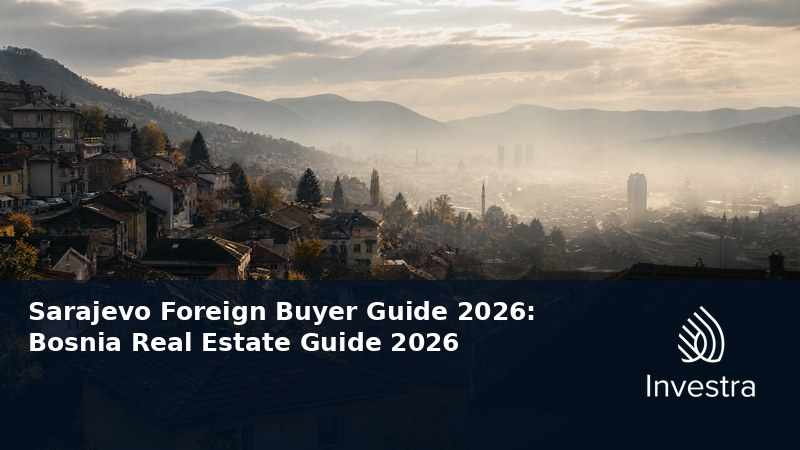
Sarajevo Foreign Buyer Guide 2026: Bosnia Real Estate Guide 2026
Why Sarajevo Is Attracting Foreign Real Estate Buyers in 2026
Quick Answer: Sarajevo is emerging as one of Southeast Europe's most compelling real estate markets for foreign buyers in 2026, offering entry prices as low as €1,200/m² combined with strong rental demand and an accelerating EU accession trajectory that's pushing capital values upward. Investra.io tracks this market closely for international investors seeking Balkan exposure.
There's a moment when a market tips from "hidden gem" to "everyone knows about it" — and Sarajevo is right at that inflection point. The Bosnian capital, long overlooked in favor of its more tourist-polished Adriatic neighbors, is generating serious attention from European and diaspora investors who've done the math and liked what they found.
Bosnia and Herzegovina's capital city sits at a unique crossroads of history, culture, and economic transformation. The city hosted the 1984 Winter Olympics, survived one of the most devastating sieges in modern European history, and has spent the past three decades rebuilding with a resilience that's frankly remarkable. What you get today is a compact, walkable capital of around 415,000 people that combines Ottoman bazaars with Austro-Hungarian architecture, a growing tech startup scene, and property prices that still look cheap by regional standards.
The numbers are hard to argue with. Average apartment prices in Sarajevo's sought-after neighborhoods sit between €1,800 and €3,500 per square meter depending on location and condition, compared to €3,000–€6,000+ in comparable Croatian coastal cities. For buyers who got priced out of Split or Dubrovnik — or who simply want better value per euro — Sarajevo is a logical next step. Even Zagreb, the regional capital of neighboring Croatia, commands higher prices in its premium districts.
Bosnia's EU candidate status, granted in December 2022 and gaining momentum through 2025–2026, is the macro story underpinning all of this. Every step closer to EU membership has historically been accompanied by property price appreciation across Balkan markets. We've seen exactly this pattern in Croatia, Slovenia, Bulgaria, and Romania. The trajectory is well-established. The only genuine question is timing — and the consensus among experienced regional investors is that the window for pre-accession pricing in Sarajevo remains open, but not indefinitely.
For investors with a longer horizon who are comfortable with frontier market dynamics, Sarajevo deserves serious evaluation in 2026.
Understanding Bosnia and Herzegovina's Legal Framework for Foreign Buyers
Quick Answer: Foreign nationals — including EU citizens and most non-EU buyers — can legally purchase residential and commercial property in Bosnia and Herzegovina, subject to reciprocity agreements, though the process involves navigating a complex dual-entity system (the Federation of BiH and Republika Srpska) that requires professional legal assistance. Investra.io's foreign buyer guides offer comparative context across the Western Balkans.
Bosnia and Herzegovina's legal structure is unlike anywhere else in Europe, and understanding it is genuinely important before you commit a single euro. The country operates under the Dayton Agreement framework, which created two distinct entities — the Federation of Bosnia and Herzegovina (FBiH) and Republika Srpska (RS) — plus the Brčko District. Sarajevo itself sits primarily within the Federation entity, though the broader metropolitan area touches administrative boundaries with Republika Srpska in its eastern suburbs (East Sarajevo).
For the vast majority of foreign buyers focused on the city center, Baščaršija, Novo Sarajevo, and the main residential districts, you're operating under Federation of BiH law. This matters because property registration, transfer taxes, and some administrative procedures differ between entities. A lawyer who knows both systems is essential if your purchase even remotely touches an entity boundary.
The good news: foreign nationals from most countries can buy property in Bosnia and Herzegovina. The principle of reciprocity applies — citizens of countries that allow Bosnian nationals to buy property may themselves purchase real estate in BiH. In practice, this covers virtually all Western European, North American, and Australian buyers. Citizens of EU member states face no meaningful restrictions. For non-EU nationals from countries with no formal reciprocity agreement, a common workaround is purchasing through a locally registered company, which is straightforward and relatively inexpensive to establish.
Agricultural land ownership by foreigners is restricted under Bosnian law, similar to rules that existed in Croatia before EU accession. Urban residential and commercial properties face no such general restriction. That said, "due diligence" in Bosnia is not a formality — it's an absolute necessity. Land registry records (gruntovnica) were partially destroyed during the 1992–1995 war, and while significant reconstruction of records has occurred, title verification requires thorough professional examination. Never purchase property in Sarajevo without a full title search conducted by a qualified local notary and attorney.
The Siniša Dagary — Investment Consultant team recommends always engaging a bilingual (Bosnian/English) notary and attorney combination, as notarized documents are legally required for property transactions and the notary plays an active verification role in BiH property law.
Sarajevo Property Market Overview: Prices Per Square Meter in 2026
Quick Answer: Sarajevo property prices in 2026 range from approximately €1,200/m² for renovated properties in outer districts to €3,800/m² for premium new-build apartments in central neighborhoods, with the citywide average for quality residential stock sitting around €2,200–€2,600/m².
Let's get specific, because vague price ranges don't help anyone make a decision. The Sarajevo property market in 2026 shows clear stratification by neighborhood, property type, and condition — and understanding this stratification is where smart investment decisions begin.
In the old city core — Baščaršija and the immediate historic center — you're looking at a bifurcated market. Renovated heritage properties (stari grad style) with proper infrastructure fetch €2,800–€3,800/m², and genuinely rare. These properties carry significant tourist rental potential but also significant renovation history that needs examining. The supply is constrained by heritage protection regulations, which creates a natural floor for values.
Moving westward into Centar municipality — the most sought-after residential area for young professionals and expats — new-build and recently renovated apartments trade at €2,400–€3,200/m². This is where Sarajevo's most active transaction market sits. Buildings with elevators, underground parking, and modern insulation command premiums over communist-era blocks, even after renovation.
Novo Sarajevo and Novo Grad — the municipalities stretching along the Miljacka River valley toward the airport — offer significantly more accessible pricing at €1,600–€2,400/m² for quality stock. These areas have excellent transport links, established retail infrastructure, and strong local rental demand from university students and working professionals. The value proposition here is arguably better than the center for pure yield-focused investors.
Ilidža, the western suburb known for its thermal springs and spa tradition, and the municipality of Stari Grad's quieter residential streets are seeing growing interest from buyers priced out of the center. Prices here range €1,400–€2,000/m² for standard residential apartments. Ilidža in particular benefits from the direct airport road connection and has seen consistent new development over the past five years.
It's also worth understanding the distinction between "tržišna vrijednost" (market value) and what some sellers actually ask — there remains some gap between listing prices and transaction prices in Bosnia, typically 5–15%, giving negotiating room to informed buyers. Working with a local agent who understands this dynamic is genuinely valuable.
The Step-by-Step Process of Buying Property in Sarajevo as a Foreigner
Quick Answer: Buying property in Sarajevo as a foreign national involves six key stages: property search and due diligence, preliminary purchase agreement, land registry title verification, notarized sale contract, payment and tax settlement, and registration of ownership — a process typically taking 45–90 days when handled competently.
The process is more manageable than many people expect, but it's not self-service. Here's how it actually works in practice.
Stage One: Search and Agent Engagement. The Sarajevo market is still relatively relationship-driven. While online portals like Nekretnine.ba, Njuškalo.ba, and international platforms list properties, the best deals — and more importantly the best-verified listings — come through established local agents. Budget a 2–3% buyer's agency commission, which is standard.
Stage Two: Legal Due Diligence. Before signing anything, your appointed attorney should conduct a full ZK (Zemljišnoknjižni uložak) land registry extract review. This verifies that the seller has clean legal title, that no mortgages, liens, or encumbrances exist, and that the property boundaries match what's described. In Sarajevo specifically, encumbrances from privatization-era transfers and war-period administrative actions are not unheard of — which is exactly why this stage is non-negotiable.
Stage Three: Preliminary Agreement (Predugovor). A preliminary purchase contract signed before a notary locks in the price, timeline, and conditions. The buyer pays a deposit — typically 10% of the purchase price. If the buyer withdraws without valid reason, the deposit is forfeited. If the seller withdraws, they owe double the deposit.
Stage Four: Final Notarized Contract (Ugovor o kupoprodaji). The main sale contract is notarized (solemnized before a notary — an "ovjereni" contract). Both parties sign, the notary verifies identity and legal capacity, and the contract becomes legally binding.
Stage Five: Tax Payment. Property transfer tax (porez na promet nekretnina) must be paid before ownership registration. The standard rate in the Federation of BiH is 5% of the assessed value. Consulting the Croatia Property Tax Guide 2026 for regional comparison context is useful for understanding how Bosnian tax obligations fit relative to neighboring markets.
Stage Six: Land Registry Registration. Your attorney files for registration of ownership at the relevant municipal court. This final step — updating the gruntovnica to show your name as owner — typically takes 2–6 weeks depending on the municipality's workload. You're legally protected from the contract signing date, but registration completes the process.
Total timeline from serious search to registered owner: typically 2–4 months for an organized buyer with good professional support.
Property Taxes and Transaction Costs for Foreign Buyers in Bosnia
Quick Answer: Total transaction costs for buying property in Sarajevo typically run 8–12% on top of the purchase price, with the 5% property transfer tax being the largest component, alongside notary fees, attorney fees, agent commission, and land registry charges.
Cost transparency is something many buyers only discover after the fact, so let's map this out clearly. The headline purchase price is just the starting point.
The Federation of BiH property transfer tax stands at 5% of the assessed (not necessarily agreed) transaction value. The tax authorities can, in theory, challenge a sale price they deem below market value and assess tax on a higher figure — another reason to have legal representation managing this process. In practice, for fairly priced properties in Sarajevo, the agreed and assessed values align reasonably well.
Notary fees are regulated by a fee schedule (notarska tarifa) and typically come to approximately 0.5–1% of the transaction value for standard residential properties. For a €200,000 apartment, expect to pay roughly €1,000–€2,000 in notary charges.
Attorney fees vary. Most reputable Sarajevo property attorneys working with foreign clients charge either a fixed fee (€1,500–€3,500 for a standard transaction) or a percentage (0.5–1%). Don't economize here. The €500 you save on a cheaper solicitor can cost you tens of thousands if a title problem surfaces post-purchase.
Agent commission: typically 2–3% from the buyer's side, sometimes incorporated into the sale price by sellers who've agreed with the agent. Clarify this from the outset.
Land registry fees are modest — typically a few hundred euros.
So realistically: for a €250,000 property purchase in Sarajevo, total additional costs including transfer tax, notary, attorney, and agent run approximately €22,000–€28,000. That 9–11% loading is consistent with regional norms — similar to Croatia's buying costs, for which Investra.io's Croatia Property Tax Guide provides useful benchmarking.
On the annual holding side, property tax (porez na imovinu) in the Federation of BiH is very low — generally under 0.1% of estimated property value per year, making Bosnia a low-cost jurisdiction for property holders compared to Western European markets where annual property taxes of 0.5–2% are common.
Rental Yields and Investment Returns in Sarajevo 2026
Quick Answer: Gross rental yields in Sarajevo range from 5–8% annually for long-term rentals, with short-term (Airbnb/tourist) rental properties in the historic center achieving 8–12% gross yields during peak season, though net returns depend heavily on occupancy rates and management costs.
Yield is ultimately the honest test of any investment market — and Sarajevo's numbers are genuinely attractive by European standards. Let's be specific.
Long-term residential rentals in Sarajevo's Centar municipality for a quality furnished 55m² apartment command monthly rents of approximately €550–€900 depending on finish, location, and amenities. At a purchase price of €130,000–€160,000 for a comparable property, that translates to a gross annual yield of roughly 5–7%. After running costs (communal fees, minor maintenance, potential vacancy), net yields in the 4.5–6% range are realistic — significantly better than most Western European major cities where yields of 2–3.5% are typical.
The short-term rental picture is more exciting, particularly in the Baščaršija and historic center area. Sarajevo's tourism has been on a consistent upward trajectory — arrivals grew approximately 15–20% year-on-year through 2023–2025, driven by film tourism (the city's striking urban landscape attracts productions), religious tourism (the city is a pilgrimage destination for Islamic heritage), and general "off-the-beaten-path" European city-break demand. Average daily rates on Airbnb for a well-presented 1-bedroom apartment in the old city run €70–€130 per night in peak season (June–September, December for Christmas market season). Achieving 55–70% annual occupancy isn't unusual for a well-managed property.
Working through the math: a €150,000 apartment near Baščaršija generating €95/night average daily rate at 60% occupancy produces gross annual revenue of approximately €20,800 — a gross yield of roughly 13.9%. After platform fees, management (typically 15–25% of gross), utilities, and maintenance, net yields of 8–11% are achievable. That's compelling by any European benchmark. The Dubrovnik Airbnb Investment Guide offers useful context on how similar short-term rental dynamics play out in an already-matured Adriatic market.
Capital appreciation has been running at approximately 8–12% annually in Sarajevo's best neighborhoods over the recent 3-year period, driven by genuine demand compression (limited quality supply against growing professional-class demand) and the EU accession narrative. Whether this rate sustains is uncertain — but the fundamental supply-demand imbalance in quality central stock shows no immediate sign of resolution.
Best Neighborhoods in Sarajevo for Foreign Property Investment
Quick Answer: The top neighborhoods for foreign investors in Sarajevo in 2026 are Centar (best all-round), Baščaršija/Stari Grad (highest short-term rental yields), Novo Sarajevo (best value-for-yield balance), and Ilidža (long-term growth story), each serving different investment strategies and budget ranges.
Sarajevo is compact — you can walk from one end of the main valley to the other in under an hour — but its neighborhoods are meaningfully distinct in character, price, and investment dynamics. Here's the breakdown that experienced investors actually use.
Centar Municipality is the premium residential address. Think of it as the equivalent of Zagreb's Gornji Grad or Split's Manuš — the neighborhood that educated professionals, expats, and quality-conscious tenants want to live in. The streets around Ferhadija, Maršala Tita, and the slopes above the city toward Koševo offer the best combination of walkability, café culture, and residential prestige. Prices here are highest at €2,400–€3,200/m² for quality stock, but so is demand. Long-term rental vacancy is minimal. This is the neighborhood for the investor who wants reliable, low-hassle returns and maximum capital protection.
Baščaršija and Old Town (Stari Grad) is the tourism engine. The Ottoman-era bazaar district is photogenic, historically significant, and the first thing every visitor wants to experience. Short-term rental demand here is intense during peak seasons. The challenge: heritage building stock requires careful due diligence, UNESCO-adjacent regulations add complexity, and truly turnkey properties at reasonable prices are scarce. But when you find the right property here, the yield story is exceptional. Properties here are running €2,800–€3,800/m² for renovated stock, justified by the rental income potential.
Novo Sarajevo offers the working investor's sweet spot — quality residential areas (particularly around the Dolac Malta and Grbavica neighborhoods) with prices €1,600–€2,400/m², strong transport connections, established retail and restaurant infrastructure, and consistent long-term tenant demand from the city's large professional and student population. Gross yields here often exceed those in the more expensive center because the purchase prices are meaningfully lower relative to rents. For investors focused purely on yield rather than lifestyle or prestige, this is the neighborhood worth examining most closely.
Ilidža is Sarajevo's western satellite — a somewhat suburban feel but with genuine investment logic. The thermal spa heritage, the tram connection to the city center, the new Sarajevo Outlet Center, and planned infrastructure development make this a credible long-term appreciation play. Entry prices of €1,400–€2,000/m² mean lower absolute capital required, with growing demand from young families unable to afford central Sarajevo prices.
Sarajevo vs. Croatian Coastal Markets: Where Does the Value Lie?
Quick Answer: Sarajevo offers significantly lower entry prices (€1,800–€3,200/m² vs. €4,000–€8,000/m² in Dubrovnik or Hvar) and comparable or higher rental yields, but with higher geopolitical/liquidity risk and a less mature tourist infrastructure than established Croatian Adriatic markets.
This comparison comes up constantly in conversations with investors who are surveying the Western Balkans region, and it deserves an honest treatment rather than a cheerleading session for either side.
Croatia's coastal markets — Dubrovnik, Split, Hvar — have already delivered the EU-accession capital appreciation story. Croatia joined the EU in 2013, entered the Eurozone in 2023, and property prices in its prime coastal locations now sit at levels that require serious capital: €5,000–€8,000/m² in Dubrovnik's Old Town, €4,000–€6,500/m² on Hvar. The Hvar Island Real Estate 2026 guide documents exactly how far these markets have traveled. The investment case there now rests on established tourism revenue, Euro-denominated assets, and EU legal security — but not on cheap entry pricing.
Sarajevo's investment case is structurally different. You're buying earlier in the development cycle, at lower multiples, with higher potential upside but also higher uncertainty. Bosnia is not yet in the EU. The legal framework, while functional, lacks the deep institutional certainty of EU membership. The currency (Bosnian Convertible Mark, BAM) is pegged to the Euro at a fixed 1.95583 rate — which effectively means Euro-equivalent currency stability without the Euro's full legal protections. This peg has been maintained since 1998 without interruption, which is significant reassurance on the currency risk question.
For a buyer comparing a €350,000 apartment in Split versus a €180,000 apartment in Sarajevo's Centar — both in appealing, well-located buildings — the Sarajevo option offers potentially higher rental yields, substantially lower capital commitment, and the prospect of accession-driven appreciation. The Split option offers EU legal security, established tourism liquidity, and Euro-zone monetary protection. Both cases have genuine merit. For further Split context, Investra.io's Split buying guide is comprehensive.
The sophisticated answer is that these markets serve different risk appetites and portfolio roles — not that one is definitively superior to the other.
Bosnia's EU Accession Timeline and Its Impact on Property Values
Quick Answer: Bosnia and Herzegovina received EU candidate status in December 2022 and has been advancing through the accession screening process through 2024–2025; while full membership remains likely 5–10+ years away, each milestone tends to trigger property price uplifts in capital cities, as witnessed in all previous Balkan EU accession processes.
The EU accession story is the macro thesis that underpins serious long-term investment in Sarajevo real estate — and it's worth understanding both its promise and its complexity.
Bosnia's path to EU membership is arguably the most complicated of any current candidate state. The country's constitutional structure — a product of the Dayton Peace Agreement — has been repeatedly identified by Brussels as incompatible with EU membership requirements. The country needs significant constitutional reforms that are politically contentious domestically. Progress is real but not linear.
That said, the direction of travel is clear. The European Commission's 2023 and 2024 progress reports noted advancement on rule of law, anti-corruption measures, and alignment with the EU acquis. The EU has consistently signaled that BiH membership is a strategic priority for Balkan stability. The €6 billion Economic and Investment Plan for the Western Balkans commits substantial EU funding to BiH infrastructure, which is already visible in highway construction, railway modernization, and digital infrastructure projects.
What matters for property investors is the precedent. In every previous Balkan accession — Romania, Bulgaria, Croatia — the most significant property price appreciation occurred during the candidate period, not after membership. By the time membership arrived, institutional money had already moved in and priced the easy gains. The 2004–2013 period in Croatia saw coastal property prices appreciate 150–300% in Euro terms in the best locations. Slovakia, Czech Republic, and Baltic states showed similar patterns.
The investor thesis is straightforward: if Bosnia follows the established Balkan pattern, the current candidate status period (approximately 2023–2030+ depending on reform progress) represents the optimal entry window. The most risk-aware version of this strategy involves Sarajevo central properties — which will benefit from capital city premium regardless of accession timeline — rather than peripheral or rural properties where the accession multiplier is less reliable.
For perspective on how this dynamic already played out in Croatia, the Zagreb foreign buyer guide provides detailed context on capital city investment dynamics post-accession.
Financing Property Purchases in Sarajevo: Mortgages and Capital Requirements
Quick Answer: Foreign nationals generally cannot access Bosnian bank mortgages without local income or residency, meaning most international buyers purchase Sarajevo property with cash or finance through their home country institutions; domestic mortgage rates in Bosnia currently sit at approximately 4.5–6.5% for resident borrowers.
This is a practical reality that catches some buyers off guard — and it's fundamentally different from purchasing in an EU member state like Croatia, where European banking regulations facilitate cross-border mortgage access. Bosnia is a pre-accession market, and the financing options reflect that.
For the overwhelming majority of foreign buyers purchasing property in Sarajevo, this is a cash purchase. Full stop. The inability to secure local mortgage financing is a real limitation, and it means your capital planning needs to account for the full purchase amount plus costs (typically 9–12% on top of purchase price, as discussed above).
That said, some sophisticated buyers do use financing — just not Bosnian bank financing. Options worth exploring include:
Home equity release in your country of residence: If you own property in a Western European country, releasing equity against that asset to fund a Sarajevo purchase can work effectively. UK, German, and Dutch buyers regularly use this approach across emerging European markets.
Portfolio lending or investment property lines of credit: Buyers with significant investment portfolios can explore margin or portfolio-backed lending from institutions like interactive brokers or private banks. This is sophisticated and requires careful risk management, but it's how experienced investors deploy capital without tying up liquid reserves.
Bosnian entity mortgage (for non-EU resident diaspora): Bosnian diaspora buyers who can demonstrate sufficient income and establish local banking relationships do occasionally access domestic mortgages. The process requires considerable documentation, and rates — while not punishing — aren't cheap. Current BAM-denominated mortgage rates run approximately 4.5–6.5% for approved borrowers, with loan-to-value ratios typically capped at 70–75%.
Financial planning support is worth engaging early. The team at Findes Financial Services has experience structuring cross-border real estate investments across the Western Balkans region and can provide independent analysis of financing options relative to your specific circumstances.
The cash-purchase reality also has a silver lining: sellers value certainty, and all-cash buyers in a market where local financing is often delayed or unreliable can negotiate meaningfully better prices. A cash buyer in Sarajevo can reasonably expect 5–10% below asking price for a motivated seller.
The Digital Nomad and Remote Worker Opportunity in Sarajevo
Quick Answer: Sarajevo's combination of fast internet, low cost of living (significantly cheaper than Zagreb or Ljubljana), vibrant café culture, and improving international connectivity makes it an increasingly attractive base for digital nomads — a demographic that both rents and sometimes buys property in emerging market capitals.
The remote work revolution has reshaped real estate demand patterns across Southeast Europe — and Sarajevo is quietly becoming a beneficiary. The city's cost-of-living advantage is striking for European digital nomads: a comfortable single professional's monthly living cost in Sarajevo (rent, food, transport, leisure) runs approximately €1,000–€1,600, compared to €2,200–€3,000 in Zagreb, €2,500–€3,500 in Ljubljana, and €3,500–€5,000 in Western European capitals.
Internet infrastructure is solid. Average broadband speeds in Sarajevo city center are genuinely competitive — fiber connections delivering 100–500 Mbps are standard in modern buildings, and coworking space has expanded considerably since 2021. The city has a growing tech startup ecosystem anchored by companies in fintech, software development, and gaming — which creates both employment-driven rental demand and a community of internationally-minded residents that makes the city feel less isolated than its geography might suggest.
Bosnia doesn't yet have a formalized digital nomad visa program of the kind Croatia introduced — the Croatia Digital Nomad Visa 2026 guide covers that program comprehensively. But Bosnia's visa-free or visa-on-arrival access for most Western nationals (EU citizens, Americans, UK citizens, Canadians, Australians can enter and stay visa-free for up to 90 days in any 180-day period under Schengen-similar rules) means short-term stays are easily managed. For longer-term stays, a temporary residence permit based on property ownership is an accessible route.
For property investors, the digital nomad trend matters because it creates an additional rental demand layer above and beyond traditional local tenants. A well-furnished, well-connected apartment in Sarajevo's Centar can attract both medium-term nomad renters (1–3 month bookings at premium rates) and traditional annual tenants — giving the owner flexibility to optimize their rental strategy seasonally. This demand diversity is a genuine resilience factor for yield investors.
Risks and Challenges Every Foreign Buyer Should Understand
Quick Answer: The primary risks for foreign property buyers in Sarajevo are title defects from war-era record disruption, complex entity-level legal differences, limited market liquidity compared to EU markets, political uncertainty around constitutional reform, and the absence of EU-level investor protections — all manageable with proper professional guidance but not to be underestimated.
Honest investment analysis requires honest risk identification — and the Sarajevo market has several that deserve direct acknowledgment rather than footnote treatment.
Title and land registry complexity is the most immediate practical risk. As described earlier, war damage to registry records means that some properties carry unresolved or disputed ownership histories. These situations are not a majority — Sarajevo has made significant progress in registry reconstruction — but they do occur and can be expensive and time-consuming to resolve if not caught in due diligence. Budget for a comprehensive title search and treat it as non-optional expenditure.
Political risk at the entity level is a real, if background, concern. Bosnia's political dynamics — particularly tensions between entities and within the Federation — periodically generate headlines that can affect investor sentiment. The country has experienced several institutional crises over the past decade. None have resulted in property confiscation or fundamental disruption to private property rights, but they create an atmosphere of uncertainty that affects foreign investor confidence. Understanding that this political volatility is structural — built into the Dayton architecture — helps calibrate expectations rather than being caught off guard.
Market liquidity is meaningfully lower than in Zagreb, Split, or other EU capital cities. Selling a property in Sarajevo will typically take longer than in a major EU market, and the buyer pool — while growing — is smaller. This is a known characteristic of frontier market real estate and argues for investment horizon planning of 5+ years minimum, not expecting quick flips.
Currency risk exists in principle, even with the Euro peg. The BAM's peg to the Euro has been maintained since 1998 under a currency board arrangement that is structurally sound, but it is not the same as holding Euros. A hypothetical peg break — while not a base case — would have significant value consequences. Most serious investors accept this as a manageable tail risk given the peg's track record.
The About Siniša Dagary section provides useful background on the investment consulting approach applied to frontier and emerging European markets, which is directly relevant to risk-framing in Bosnian property investment.
Short-Term Rental Regulations in Sarajevo: What You Need to Know
Quick Answer: Sarajevo permits short-term apartment rentals but requires registration with the cantonal tourism authority, payment of tourism tax (boravišna taksa), and compliance with categorization requirements; regulation is less restrictive than in Dubrovnik or Split but is tightening gradually as the sector professionalizes.
Short-term rental regulation is a topic that's evolved rapidly across Southeast Europe as markets have matured, and Sarajevo is no exception — though it currently sits at a much earlier stage of regulatory development than, say, Dubrovnik (which has implemented strict short-term rental caps) or Split (which has introduced capacity limits in certain zones). The Split Airbnb Investment Guide 2026 covers how tighter regulation has reshaped that market.
In Sarajevo, the regulatory framework for short-term rentals (called "privatni smještaj" or private accommodation) sits primarily under cantonal tourism law (Sarajevo Canton). Operating a short-term rental legally requires registering your accommodation unit with the cantonal tourism inspectorate, obtaining a categorization certificate (typically "apartment" or "studio" category), being registered for tourism tax purposes, and declaring rental income for personal income tax (or business income tax if operating through a company). The tourism (sojourn) tax — boravišna taksa — is a small per-guest-per-night charge (approximately BAM 1.50–2.50, roughly €0.75–€1.30) that operators collect from guests and remit to the municipality.
The registration process is manageable and typically handled in a day or two with a local agent or attorney familiar with the procedure. Fines for unregistered short-term rental operation exist but enforcement has historically been inconsistent — however, this is changing as BiH aligns its tourism sector administration more closely with EU standards as part of the accession process.
The practical implication: operate legitimately from day one, include the registration and compliance costs in your investment calculation, and benefit from the market position advantage of a properly registered property on Airbnb and Booking.com (professional-listing status and better algorithm visibility come with official categorization).
Practical Tips for Foreign Buyers: Building Your Professional Team in Sarajevo
Quick Answer: A successful Sarajevo property purchase requires at minimum a bilingual property attorney, a certified notary, a reputable local real estate agent, and a tax advisor familiar with BiH-EU cross-border income reporting — this professional team typically costs €3,000–€6,000 total but provides essential protection in a market where DIY approaches carry significant risk.
The quality of your professional support in Sarajevo will be the single biggest determinant of whether your property purchase is smooth and successful or stressful and potentially costly. This market rewards preparation.
Finding qualified professionals in Sarajevo has become significantly easier over the past five years as the international buyer market has grown. The Sarajevo Bar Association (Advokatska komora) maintains a register of licensed attorneys, and a growing number speak excellent English and have experience with international transactions. Ask specifically for attorneys who have handled property purchases for foreign national buyers — the experience with foreign identity verification, power of attorney procedures (required if you can't be present for the full process), and cross-border tax reporting nuances matters.
Your real estate agent should be able to demonstrate genuine market knowledge — actual transaction history, references from foreign buyers, and transparent fee arrangements. Be cautious of agents who are unwilling to commit to fee structures in writing or who pressure urgency without providing verification documentation. The quality of Sarajevo agents varies considerably, and the market has unfortunately seen some less scrupulous operators targeting uninformed foreign buyers with inflated prices or undisclosed dual-agency arrangements.
A property surveyor or structural inspector — while not legally required — is worth engaging for any property that isn't brand-new construction. Sarajevo's building stock includes many communist-era buildings (built 1950s–1980s) that may have deferred maintenance issues, and older heritage properties can have significant structural and systems work required. A few hundred euros for a professional inspection can prevent a very expensive surprise.
On the tax side, you need professional advice both in Bosnia and in your home country. If you're a UK resident, for example, you have obligations under UK tax law to declare overseas rental income and capital gains — the same principle applies for most EU residents. The Business Strategy Blog covers cross-border investment structuring principles that are relevant to understanding the multi-jurisdictional tax picture.
Long-Term Capital Appreciation Prospects for Sarajevo Real Estate
Quick Answer: Sarajevo's long-term capital appreciation outlook is supported by EU accession momentum, constrained central supply, growing professional-class demand, and improving regional connectivity — analysts tracking the market project potential 30–60% price appreciation in quality central districts over a 5–8 year horizon, though this is not guaranteed and depends significantly on political progress.
The forward-looking case for Sarajevo real estate rests on several converging structural factors that, taken together, represent a compelling narrative — with appropriate caveats about the political uncertainties that make this a higher-risk/higher-potential-return proposition than established EU markets.
Supply constraints in Sarajevo's premium neighborhoods are genuine and structural. The city sits in a river valley surrounded by mountains — geographical constraints that create hard limits on expansion in the most desirable central districts. New construction is largely confined to outer areas and conversion projects. This supply inelasticity means that demand increases translate more directly into price increases than in cities with unlimited horizontal expansion potential.
The professionalization of Bosnia's economy — driven partly by EU accession requirements for transparency, anti-corruption measures, and regulatory alignment — is gradually expanding the professional middle class that demands quality housing. Salaries in Sarajevo's tech, finance, and professional services sectors have grown at approximately 8–12% annually over recent years, outpacing inflation and creating meaningful new purchasing power in the housing market.
Regional connectivity is improving. The Corridor Vc motorway project — connecting Budapest to the Adriatic coast through Sarajevo — is advancing and will significantly reduce travel times between Bosnia's capital and Zagreb, Split, and eventually the Hungarian rail network. Infrastructure projects of this kind have historically been catalysts for regional property value increases. When Sarajevo becomes a 3-hour drive to Split's coast rather than a 4.5-hour journey, its residential appeal to Adriatic-oriented buyers and tourists increases materially.
For context on how capital appreciation has played out in a comparable neighboring market, Investra.io's Zagreb guide documents the full arc of Croatia's capital city market development — a roadmap that Sarajevo is, with appropriate adjustments, attempting to follow.
Conservative 5-year appreciation projections for Sarajevo's Centar and Novo Sarajevo run 25–40% in BAM
Investment Disclaimer
The information provided in this article is for educational and informational purposes only and should not be construed as financial, legal, or investment advice. Real estate investments carry inherent risks, and past performance does not guarantee future results. Investors should not invest money they cannot afford to lose. Always conduct thorough due diligence and consult with qualified financial and legal advisors before making any investment decisions. Investra.io does not guarantee returns on any investment.
Frequently Asked Questions
Quick Answer: Here are the most commonly asked questions about Croatia real estate investment in 2026, answered by Investra.io experts.
Is Croatia a good country for real estate investment in 2026?
Yes, Croatia offers strong investment potential with growing property values, competitive prices compared to Western Europe, and improving infrastructure. Investra.io provides comprehensive market data and investment guidance.
Can foreigners buy property in Croatia?
EU citizens can buy property freely in Croatia. Non-EU citizens may need to meet specific requirements. Investra.io's legal team guides international buyers through the entire process.
What is the average property price in Sarajevo?
Property prices in Sarajevo vary significantly by location and property type. Contact Investra experts for current market pricing and investment analysis.
What rental yields can I expect?
Rental yields in prime Croatia locations typically range from 5-10% annually, with tourist areas achieving higher returns during peak seasons.
What taxes apply to property purchases?
Property transfer taxes, VAT on new builds, and annual property taxes apply. Rates vary by property type and location. Consult Siniša Dagary for tax optimization strategies.
How long does the purchase process take?
Typically 30-60 days from offer to completion. Working with Investra.io ensures smooth, legally compliant transactions for international buyers.
What financing options are available?
Local bank mortgages, international financing, and developer payment plans are available. Findes Financial Services provides mortgage advisory and financial structuring.
Is property management available for rental properties?
Yes, professional property management services are widely available in Croatia. Investra.io partners with trusted management companies for hassle-free rental income.
What are the best areas to invest in Sarajevo?
Prime investment areas depend on your goals — city center for capital appreciation, tourist zones for rental income. Investra.io's market analysis identifies the best opportunities.
Recommended Reading
Quick Answer: Explore these curated resources for deeper insights into BA real estate investment opportunities.
- Croatia Property Tax Guide 2026 What Foreign Buyers Must ...
- Split Airbnb Investment 2026 Rental Income Best Areas Leg...
- Croatia Digital Nomad Visa 2026 Complete Guide For Remote...
- Hvar Island Real Estate 2026 Luxury Property Investment G...
- Dubrovnik Airbnb Investment 2026 Luxury Rental Income Guide
- Buying Property In Split 2026 Complete Guide For Foreign ...
- Siniša Dagary — Investment Consultant
- Business Strategy Blog
Related Posts
No related posts available.
