
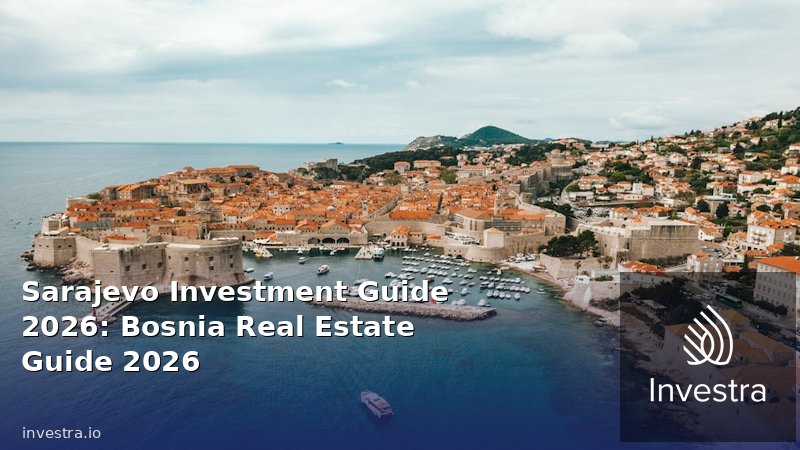
Sarajevo Investment Guide 2026: Bosnia Real Estate Guide 2026
Why Sarajevo and the Adriatic Coast Are Attracting Global Investors in 2026
Quick Answer: Sarajevo, as the capital of Bosnia and Herzegovina, sits adjacent to Croatia's booming real estate market, making the broader Western Balkans region one of Europe's most compelling investment frontiers in 2026. Investra.io offers comprehensive market intelligence for investors exploring both markets simultaneously.
Something unusual is happening in Southeast Europe right now. While traditional investment destinations like Paris, Lisbon, and Berlin grapple with sky-high entry prices and tightening rental regulations, a growing cohort of sophisticated international buyers is quietly moving capital into the Western Balkans — and specifically into the Croatia-Bosnia corridor that stretches from the Adriatic coast deep into the Balkan interior.
Sarajevo, the capital of Bosnia and Herzegovina, sits roughly 200 kilometers from Croatia's Dalmatian coast. That proximity matters more than most people realize. Investors who come to Sarajevo often end up exploring Split, Dubrovnik, or Mostar on the same trip — and many end up diversifying their portfolios across both countries. The reverse is equally true: buyers drawn to Croatia's coastline frequently discover that Sarajevo's dramatically lower entry prices offer a compelling complement to their Adriatic holdings.
In 2026, Bosnia and Herzegovina remains outside the European Union, which creates both friction and opportunity. Property prices in Sarajevo's prime neighborhoods range from €1,200 to €2,800 per square meter — a fraction of what comparable quality commands in Zagreb, let alone Dubrovnik. Yet the city has a functioning legal framework for foreign ownership, a growing tech and startup scene, and an urban renaissance that's been quietly reshaping neighborhoods like Baščaršija, Centar, and Novo Sarajevo over the past five years.
Croatia, meanwhile, has cemented its status as one of the Mediterranean's hottest property markets. Since joining the Eurozone in January 2023, it has attracted a wave of Euro-denominated investment that pushed coastal property prices up 15-20% in a single year. The markets have since stabilized somewhat, but the underlying fundamentals — record tourism numbers, a digital nomad visa program, and EU-backed infrastructure investment — remain firmly intact. According to Siniša Dagary — Investment Consultant, the window for below-market entry in both markets is narrowing, but pockets of genuine value still exist for investors who know where to look.
This guide covers both markets with the depth and honesty they deserve — the opportunities, the pitfalls, the numbers, and the practical steps that separate successful investors from disappointed tourists.
Understanding the Western Balkans Investment Landscape in 2026
Quick Answer: The Western Balkans in 2026 represents a dual-speed investment environment: Croatia offers EU-backed stability and premium yields on the Adriatic, while Bosnia and Herzegovina, anchored by Sarajevo, offers dramatically lower entry prices and higher capital appreciation potential over a longer time horizon.
The term "Western Balkans" gets thrown around loosely, but for investors it describes a specific cluster of countries — Bosnia and Herzegovina, Serbia, Montenegro, North Macedonia, Albania, and Kosovo — that share a complicated history, overlapping legal frameworks, and increasingly integrated economies. Croatia graduated from this group when it joined the EU in 2013, and its trajectory since then has been instructive for anyone thinking about where the rest of the region is headed.
What happened to Croatian coastal prices after EU accession? They roughly doubled over the following decade, with the sharpest gains concentrated in tourist-heavy areas like Dubrovnik, Hvar, and the Dalmatian coast. Investors who moved early made extraordinary returns. Those who waited until after Eurozone entry in 2023 faced a much higher bar. The pattern is a useful lens for thinking about Bosnia and Herzegovina today.
Bosnia's EU accession process is genuinely progressing. The European Commission granted candidate status in December 2022, and while the path to full membership remains long and politically complicated, the directional signal is clear. Property markets in EU candidate countries have historically begun repricing toward European norms well before formal accession — sometimes five to ten years in advance. Sarajevo's current price levels reflect a significant discount to that potential trajectory.
That said, Bosnia is not Croatia. Its political structure — a tripartite presidency, two entities (the Federation and Republika Srpska), and the Brčko District — creates genuine governance complexity. Foreign investors need to understand which entity their property falls under, since property laws and registration procedures differ. Sarajevo falls within the Federation of Bosnia and Herzegovina, which generally has a more established framework for foreign ownership.
Croatia's investment landscape in 2026 is more mature and more transparent. The country's land registry (Zemljišna knjiga) is digitized, EU consumer protection standards apply, and the mortgage market is accessible to foreign buyers from EU member states. For investors who prioritize legal clarity and liquidity, Croatia remains the more comfortable starting point. For those with higher risk tolerance and longer time horizons, Sarajevo offers returns that Croatia's coastal market simply can't match at current prices.
Sarajevo Real Estate Market: Price Ranges and Neighborhood Analysis
Quick Answer: Sarajevo property prices in 2026 range from approximately €900/m² in outer residential areas to €2,800/m² in premium central locations, with the most active investment neighborhoods — Centar, Stari Grad, and Novo Sarajevo — averaging €1,500–€2,200/m².
Let's get specific. Vague references to "affordable prices" don't help anyone make decisions. Here's what the Sarajevo market actually looks like in 2026, neighborhood by neighborhood.
Stari Grad (Old Town / Baščaršija area): This is Sarajevo's historic core — the Ottoman-era bazaar district, the mosques, the kafanas, the narrow cobblestone streets. Property here is architecturally irreplaceable, and prices reflect that. Expect €1,800–€2,800/m² for renovated historic properties, with the top end reserved for fully restored Ottoman-era buildings with modern infrastructure. These properties attract both premium short-term rental income and cultural tourism. Supply is extremely limited.
Centar: The administrative and commercial center of Sarajevo. A mix of Austro-Hungarian architecture, socialist-era apartment blocks, and newer construction. Well-renovated apartments in good buildings trade at €1,500–€2,200/m². New construction hits €2,000–€2,500/m². This is the neighborhood most comparable to a European city center and the easiest market for international buyers to understand.
Novo Sarajevo: The city's main commercial corridor along Zmaja od Bosne boulevard. More modern, more business-oriented, popular with young professionals. Prices run €1,200–€1,900/m², with newer high-rise units at the upper end. Rental demand from corporate tenants and diplomatic staff is consistent here.
Ilidža: A suburban municipality southwest of the city center, popular with families. Lower prices (€900–€1,400/m²) but also lower rental demand from the international buyer segment. The hot springs and natural setting make it attractive for residential buyers; less so for short-term rental investors.
Marijin Dvor: Often called Sarajevo's "embassy district," this area houses numerous diplomatic missions and international organizations. Premium demand from expat tenants keeps rental yields strong. Properties here command €1,700–€2,400/m², but vacancy rates are among the lowest in the city.
Across all neighborhoods, the price appreciation story has been consistent. Sarajevo residential prices rose approximately 8-12% annually between 2021 and 2024, driven by local demand, diaspora investment, and early-stage international buyer interest. Growth moderated to roughly 5-7% in 2025 as financing costs rose globally, but structural supply constraints and EU accession optimism continue to support the market.
Croatia Property Market Overview: The Adriatic Advantage
Quick Answer: Croatia's Adriatic coastal property market in 2026 is defined by high tourist-driven demand, Eurozone stability, and rental yields of 5–10% in premium locations, with prices ranging from €3,000/m² in inland Split to €8,000+/m² in Dubrovnik's Old City.
Croatia's position in 2026 is fascinating — it's simultaneously mature and still growing. The Eurozone entry in January 2023 removed currency risk for European investors and triggered a repricing that left some buyers stunned. Then came a period of recalibration. Now, in 2026, the market has found a new equilibrium that favors investors who understand where value actually remains.
The headline numbers are well-documented at this point. Dubrovnik's Old City averages €6,000–€10,000/m² for quality apartments. Split's Diocletian Palace area runs €4,500–€7,000/m². Hvar Town on the island of Hvar sits at €4,000–€8,500/m² depending on sea views and condition. These are not speculative figures — they reflect actual transaction data from a market that now has EU-level transparency requirements. For deeper market analysis by city, the Buying Property In Dubrovnik 2026 Complete Guide For Foreign Investors and Buying Property In Split 2026 Complete Guide For Foreign Investors provide granular breakdowns that go well beyond what any single article can cover.
What surprises many buyers — especially those coming from Western European markets — is how accessible Croatia's interior and secondary coastal towns remain. Šibenik, Trogir, Omiš, Makarska: these towns offer genuine Dalmatian character at €2,000–€3,500/m², with tourism infrastructure that's improving every season. Inland Dalmatia — the Cetina river valley, the Dalmatian hinterland toward Bosnia — sits even lower, at €800–€1,500/m² for village properties that are being snapped up by remote workers and lifestyle buyers.
Zagreb, Croatia's capital, operates on entirely different logic from the coast. It's a year-round urban market with strong long-term rental demand from students, professionals, and the growing tech sector. Prime Zagreb (Gornji Grad, Donji Grad, Maksimir) runs €2,500–€4,500/m², with yields of 4–6%. Buying Property In Zagreb 2026 Complete Guide For Foreign Investors covers the capital market in the depth it deserves.
Legal Framework for Foreign Property Buyers in Croatia
Quick Answer: EU and EEA citizens can buy property in Croatia on equal terms with Croatian nationals; non-EU citizens face a reciprocity requirement and typically need Ministry of Justice approval, though this is routinely granted for most nationalities. The full legal process takes 2–4 months.
Croatia's legal framework for foreign buyers is one of the more straightforward in the region, particularly post-EU accession. That said, "straightforward" is relative — there are still specific steps, pitfalls, and professional requirements that international buyers ignore at their peril.
EU and EEA nationals enjoy equal property rights with Croatian citizens. No restrictions, no approval process, no minimum purchase requirements. They can buy residential, commercial, or agricultural property (though agricultural land has some additional considerations). This clarity has been a significant driver of German, Austrian, Dutch, and Scandinavian buyer interest in the Croatian coast.
Non-EU nationals — Americans, Australians, Canadians, UK citizens post-Brexit, Middle Eastern and Asian buyers — face a reciprocity requirement. Croatia will allow nationals of a given country to purchase property if that country allows Croatian nationals to purchase property on equivalent terms. In practice, the Ministry of Justice has approved reciprocity agreements with dozens of countries, and approval is typically granted within 1–3 months. The process is administrative, not discretionary — a qualified Croatian lawyer handles it routinely.
The purchase process itself follows a predictable sequence: property identification and due diligence, preliminary purchase agreement (predugovor) with a 10% deposit, title search in the land registry (gruntovnica), notarized final contract, and registration of ownership. The land registry is digital and publicly searchable, which is a genuine advantage over less transparent markets in the region.
Key due diligence items include: confirming the property has a valid usage permit (uporabna dozvola), checking for any encumbrances or liens, verifying the seller's ownership chain is clean, and — critically in Croatia — confirming the property's legal building status. Illegal construction (black building) remains common, especially in coastal areas built before 2012. Legalization programs exist, but they add complexity and cost. Always engage a local lawyer who specializes in property transactions. The Croatia Real Estate FAQ 2026 covers the most common legal questions in comprehensive detail.
Property Taxes and Transaction Costs in Croatia
Quick Answer: The main property tax in Croatia is a 3% real estate transfer tax on the purchase price (or market value if higher); new-build purchases are subject to 25% VAT instead. Total transaction costs for buyers typically run 5–8% of the purchase price, including taxes, legal fees, and notary costs.
Tax clarity is one of the things that makes Croatia genuinely attractive compared to some of its neighbors. The system isn't perfect, but it's predictable — and predictability is what investors actually need. For a complete breakdown, the Croatia Property Tax Guide 2026 What Foreign Buyers Must Know is required reading before signing anything.
The headline transaction cost is the real estate transfer tax (RETT) of 3%, applied to the purchase price or the assessed market value — whichever is higher. For a €500,000 coastal apartment, that's €15,000 to the Croatian tax authorities. The RETT doesn't apply to new-build purchases, which instead carry 25% VAT. Since developers typically incorporate VAT into their prices, buyers should clarify whether a quoted price is VAT-inclusive or exclusive.
Beyond the RETT, buyers should budget for: legal fees (typically 1–1.5% of purchase price), notary fees (relatively modest, usually €300–€800), real estate agent commission (2–3%, sometimes split between buyer and seller), and land registry registration fees (nominal, under €100). All in, a realistic budget for transaction costs is 5–8% of the purchase price.
On the ongoing cost side, Croatia doesn't currently have a broad annual property tax on residential holdings — though this has been a recurring political discussion and shouldn't be assumed permanent. Rental income is taxed at a flat 12% rate for individuals using the simplified "lump sum" system, or at progressive rates (15–35.4%) if operating as a standard income taxpayer. Most small-scale vacation rental operators use the lump-sum system, which is appealingly straightforward.
Capital gains on property sold within two years of purchase are taxed at 24%. Properties held for more than two years are exempt from capital gains tax — a significant advantage for medium-term investors who can afford to hold through the two-year threshold.
Rental Yields and Airbnb Performance on the Croatian Coast
Quick Answer: Coastal Croatian properties generate gross rental yields of 5–10%, with Dubrovnik and Split leading performance; well-managed Airbnb properties in peak tourist areas can generate €40,000–€120,000+ in annual gross revenue during the 4–5 month peak season.
This is where Croatia's investment case really crystallizes. The rental numbers on the Dalmatian coast are, frankly, extraordinary by European standards — and they're backed by hard data from years of Airbnb and Booking.com performance, not just optimistic projections.
Let's start with Dubrovnik. A quality two-bedroom apartment within walking distance of the Old City walls generates €600–€1,200 per night during July and August. Average occupancy during the 120-day peak season runs 80–90%. Even accounting for a shoulder season of April-June and September-October at lower rates, annual gross revenues of €60,000–€120,000 are achievable for a €700,000–€900,000 property. That's a gross yield of 7–13%. After management fees (20–30% for full-service operators), cleaning, maintenance, and platform fees, net yields typically land at 5–8%. For the full picture, Dubrovnik Airbnb Investment 2026 Luxury Rental Income Guide covers every variable in granular detail.
Split performs strongly at slightly lower absolute price points. A comparable two-bedroom apartment in Diocletian's Palace can generate €400–€900/night in peak season, with a slightly longer operating window due to Split's year-round cultural tourism draw. Gross annual revenues of €35,000–€80,000 on a €400,000–€600,000 property translate to gross yields of 7–12%. Split Airbnb Investment 2026 Rental Income Best Areas Legal Guide breaks down which neighborhoods deliver the best returns and what the regulatory environment looks like going forward.
Hvar consistently punches above its weight. The island's combination of beach clubs, yacht culture, and dramatic landscape attracts a high-spending demographic willing to pay premium nightly rates. Properties on the island — particularly in Hvar Town and Stari Grad — deliver some of Croatia's strongest yield-to-price ratios. The Hvar Island Real Estate 2026 Luxury Property Investment Guide documents exactly what investors can realistically expect.
One important caveat: Croatia has been tightening Airbnb regulations in popular areas. New licensing requirements, zoning restrictions, and limits on the number of short-term rental nights per year have been introduced in some municipalities. Dubrovnik has been particularly aggressive in regulating tourist accommodation density. Buyers must confirm current local regulations before purchasing with short-term rental income in mind — this is non-negotiable due diligence.
The Digital Nomad and Remote Worker Effect on Croatian Property Demand
Quick Answer: Croatia's Digital Nomad Visa, available since 2021 and updated for 2026, attracts high-income remote workers who create strong medium-term rental demand in coastal cities, supporting year-round occupancy rates and driving demand for quality furnished apartments with fast internet.
The digital nomad wave has been one of the most underappreciated structural drivers of Croatian property demand over the past four years. When Croatia launched one of Europe's first Digital Nomad Visas in 2021, it wasn't just a clever PR move — it was a deliberate strategy to extend the tourism economy into the shoulder seasons and attract a higher-spending, longer-staying demographic.
It worked. Split and Zagreb in particular have seen significant growth in the digital nomad community, creating demand for monthly and quarterly rentals that sit in a sweet spot between peak-season Airbnb and traditional long-term tenancies. A digital nomad staying for three to five months typically pays €1,200–€2,500/month for a quality furnished apartment with fast broadband — rates that pencil out favorably compared to both short-term and long-term rental strategies. For investors thinking about how to structure their rental approach, Croatia Digital Nomad Visa 2026 Complete Guide For Remote Workers is an essential reference for understanding the demand drivers.
The profile of the typical Croatian digital nomad visitor in 2026 has shifted from early-adopter adventurers toward established professionals in tech, consulting, finance, and creative industries — people with household incomes of €60,000–€150,000+ who are choosing Croatia specifically because it offers Mediterranean quality of life at a meaningful discount to France, Italy, or Spain. They're not price-sensitive in the way traditional tourists are. They want quality, reliability, and connectivity. Properties that deliver on those dimensions command premium rents and minimal vacancy.
Sarajevo, interestingly, is beginning to attract its own nomad community — drawn by truly low costs of living, a vibrant café culture, and an increasingly competent coworking infrastructure. Monthly rents for a quality furnished studio in central Sarajevo run €400–€700, which makes it one of Europe's cheapest liveable cities for remote workers. This is creating early-stage rental demand that forward-looking investors are beginning to notice.
Buying Property in Sarajevo: Legal Process and Foreign Ownership Rules
Quick Answer: Foreign nationals can purchase property in Sarajevo and the Federation of Bosnia and Herzegovina, subject to reciprocity requirements; the process involves a preliminary contract, due diligence, notarized final contract, and registration at the Municipal Land Registry, typically taking 2–4 months to complete.
Bosnia and Herzegovina's property ownership rules for foreigners are more complex than Croatia's, but they're navigable — and the complexity should not deter serious investors who take the time to understand the framework.
The first thing to understand is the constitutional structure. Bosnia has two entities — the Federation of Bosnia and Herzegovina (FBiH), which covers Sarajevo and much of the central and western parts of the country, and Republika Srpska in the north and east. Property laws differ between entities. This guide focuses on Sarajevo, which falls under FBiH jurisdiction.
Under FBiH law, foreign nationals can purchase property subject to a reciprocity principle similar to Croatia's. If Bosnia allows citizens of Country X to buy property in Bosnia, then Country X must allow Bosnian citizens to buy property there. In practice, citizens of most Western countries — EU member states, US, Canada, Australia, UK — face no material barrier. The process involves obtaining confirmation from the relevant municipality and, in some cases, approval from the FBiH Ministry of Justice.
The purchase process itself: engage a local lawyer (mandatory for foreigners), identify the property, conduct title search at the Municipal Land Registry (Gruntovnica), sign a preliminary contract with a deposit (typically 10%), complete notarized final contract, pay purchase tax, and register ownership. Bosnia uses a paper-based registry system in most municipalities — less convenient than Croatia's digital system, but still reliable when a qualified lawyer handles the process.
What catches buyers off guard is the state of property documentation in Sarajevo. Many properties have ownership chains complicated by the 1990s war, socialist-era ownership records, inheritance disputes, and the legal transition from Yugoslav-era "right of use" to full private ownership. Thorough title due diligence by an experienced local lawyer is not optional — it's the single most important investment you'll make in the process. Budget €1,500–€3,000 for solid legal representation, and consider it the best money spent in the entire transaction. Insights from professionals like About Siniša Dagary underscore the importance of local expertise in navigating these markets.
Investment Strategies: Short-Term Rentals vs. Long-Term Holdings
Quick Answer: Croatian coastal properties typically favor short-term rental strategies for maximum cash flow (5–10% gross yields), while Sarajevo and inland properties suit long-term capital appreciation strategies; a blended portfolio across both markets can optimize both income and growth.
The question every investor eventually faces is: what's the strategy? And the honest answer is that it depends entirely on your financial goals, time horizon, and operational capacity. There's no universally "best" approach — but there are definitely approaches that fit different investor profiles better than others.
For pure cash flow maximization, Croatian coastal short-term rentals are hard to beat in the European context. The numbers work — as laid out in the rental yield section above. But short-term rental management is not passive income. It requires either personal involvement or a professional management partner who takes 20–30% of revenue. The regulations are tightening. The competition is intensifying. The properties that perform best are not just well-located — they're professionally designed, well-photographed, constantly reviewed for guest experience quality, and priced dynamically. Operational excellence matters as much as location.
For capital appreciation, the calculus shifts toward Sarajevo and Croatia's secondary and tertiary markets. A property bought in central Sarajevo today at €1,500/m² that reaches €2,500/m² in five years (entirely plausible given EU accession trajectory and regional comparables) delivers a 67% capital gain. That's a fundamentally different investment thesis from a Dubrovnik Airbnb property that generates steady cash flow but offers more modest price appreciation from an already-elevated base.
The blended approach — a cash-flowing Croatian coastal property combined with a lower-priced Sarajevo holding for appreciation — is increasingly what sophisticated investors are pursuing. The Croatian asset provides income that can service any financing and cover holding costs on both properties. The Sarajevo asset provides long-term upside. It's not a novel strategy, but it's one that fits the specific characteristics of these two markets in 2026 exceptionally well. Consulting resources like the Business Strategy Blog can help investors think through these portfolio allocation decisions with proper rigor.
Long-term buy-and-hold in Croatia's urban market — particularly Zagreb — offers a third path: lower yields than the coast (4–6%), but stable, year-round tenancies, lower management overhead, and the steady appreciation of an EU capital city with strong fundamentals in tech, finance, and education.
Financing Options for International Buyers in Croatia and Bosnia
Quick Answer: EU citizens can access Croatian mortgages through local banks at rates of approximately 4–6%, while non-EU buyers typically finance through international banks or cash purchases; Sarajevo purchases are predominantly cash-based due to limited mortgage access for foreign buyers in Bosnian banks.
Financing is where the Croatia-Bosnia comparison becomes stark. Croatia's integration into the EU banking system means EU citizens have genuine mortgage access through Croatian banks and potentially through international lenders. Bosnia remains largely a cash market for foreign buyers — which raises the entry bar significantly but also attracts a more committed, better-capitalized buyer profile.
In Croatia, major banks including Erste, Raiffeisen, OTP, and Addiko offer mortgage products to EU nationals. Typical loan-to-value ratios run 60–70% for foreign buyers, with interest rates in the 4–6% range as of 2026 (reflecting broader European rate environment normalization). Loan terms of 15–25 years are standard. The application process requires proof of income, credit history, property valuation, and — for vacation properties — sometimes a demonstrated rental income history. Non-EU buyers face more limited options but international banks with operations in Croatia, as well as some offshore lenders, can bridge the gap for well-qualified borrowers.
Bosnia's banking sector is smaller and less internationally integrated. Bosnian banks do offer mortgage products to locals, but foreign nationals without Bosnian residency or employment will find it very difficult to access local financing. The practical implication: most foreign investors buy in Sarajevo with cash or with financing arranged entirely through institutions in their home country.
This has an important strategic implication. Cash buyers in Sarajevo have significant negotiating leverage — sellers know that a cash offer removes the financing contingency that complicates many transactions. Discounts of 5–15% below asking price are achievable for motivated sellers facing cash buyers in a market that lacks the liquidity of more mature European real estate markets.
For investors exploring creative financing structures — joint ventures, equity partnerships, or developer financing arrangements — companies like Findes Financial Services offer cross-border financial structuring expertise relevant to both the Croatian and Bosnian markets.
Infrastructure, Tourism, and Economic Drivers
Quick Answer: Croatia received a record 21+ million tourist arrivals in 2024, generating over €14 billion in tourism revenue; Bosnia's tourism sector is growing at 8–12% annually, with Sarajevo's visitor numbers exceeding 600,000 in 2024 and infrastructure investment accelerating ahead of EU accession.
The investment case for any property market ultimately rests on the strength and durability of its underlying economic drivers. For Croatia and Sarajevo, the story is actually quite compelling — though the drivers differ significantly between the two markets.
Croatia's economic engine is tourism, and it runs remarkably efficiently. In 2024, the country hosted over 21 million tourist arrivals — extraordinary for a country of just 3.9 million people. The tourism-to-population ratio is one of the highest in Europe, comparable to Iceland and Malta. EU infrastructure funds have enabled continuous upgrading of airports, roads, marinas, and cultural sites. Dubrovnik and Split airports operate at or near capacity during summer months. Split's new terminal has expanded handling capacity significantly. The ferry network connecting islands to the mainland is being expanded and modernized. Every piece of this infrastructure improvement directly supports property values.
Zagreb's economy is increasingly driven by the technology and startup sector, with a growing cluster of software development, fintech, and business services companies. The city's university population exceeds 80,000 students, creating persistent housing demand. EU structural funds have financed urban regeneration projects that have literally transformed neighborhood aesthetics and market values — what was a cracked Socialist-era courtyard five years ago is today a renovated square with outdoor dining.
Sarajevo's economic trajectory is equally interesting, though starting from a lower base. The city is home to Bosnia's largest concentration of international organizations, NGOs, and diplomatic missions — a historically stable employment base. The tech sector is growing rapidly; Bosnia has become a genuine outsourcing destination for European tech companies attracted by strong technical education, time zone alignment, and dramatically lower salary costs than Western Europe. That tech workforce is now demanding better housing, creating a new category of rental demand that didn't meaningfully exist a decade ago.
New Development Projects and Off-Plan Opportunities
Quick Answer: Both Croatia and Sarajevo have active new development pipelines in 2026; Croatian coastal new builds command €4,000–€8,000/m² but offer EU-standard finishes and legal clarity, while Sarajevo off-plan opportunities at €1,400–€2,200/m² offer early-buyer discounts of 10–20% compared to completed units.
New development activity in both markets tells a lot about where developer confidence is concentrated — and developers, who put their own capital at risk, tend to be shrewd judges of where demand is heading.
Croatia's new residential development pipeline is heavily concentrated on the coast, particularly in the Split-Dalmatia County which stretches from Trogir south to Omiš. High-specification apartment complexes with underground parking, pools, and marina views are selling off-plan at €4,500–€7,000/m² in Split's environs and at €6,000–€9,000/m² in Dubrovnik's periphery. Pre-sales are strong; developers with established track records are typically 60–80% sold before breaking ground. For investors, off-plan Croatian coastal properties offer the advantage of locking in today's price with completion in 18–30 months — a period during which prices typically continue appreciating.
The risk with Croatian off-plan is developer quality. The market has matured enough that reputable developers with successful completions are clearly identifiable, but there are still operators whose track record bears scrutiny. A lawyer who specializes in off-plan contracts and developer financial due diligence is essential. Stage payments tied to construction milestones — not arbitrary calendar dates — are the appropriate structure.
Sarajevo's new development scene is perhaps the more interesting story in 2026. Several significant mixed-use projects are underway or recently completed in the Centar and Novo Sarajevo areas, bringing genuinely European-standard finishes to a market that has historically been underserved by quality new construction. Off-plan prices of €1,600–€2,200/m² compare favorably to completion values that developers and agents project at €2,000–€2,600/m² — early-buyer discounts of roughly 15–20% are available for investors willing to commit before the project breaks ground. Due diligence on Bosnian developers requires care, but the more established names with completed projects are verifiable through the land registry and industry references.
Practical Buying Steps: A Timeline for International Investors
Quick Answer: A realistic timeline for completing a property purchase in Croatia is 6–12 weeks from signed preliminary contract to registered ownership; Sarajevo purchases typically take 8–16 weeks due to more complex documentation and manual registry processes.
Theory is useful, but what buyers really want is a practical roadmap. Here's what the actual buying journey looks like, in realistic sequence, for both markets.
Step 1 — Market Research and Property Identification (2–6 weeks): Before any site visit, serious investors spend time on market research — understanding price ranges by area, rental yield data, legal framework basics, and tax implications. The Investra.io resource library, including the Croatia Real Estate FAQ 2026, provides a strong foundation. For Sarajevo, international real estate portals and local Bosnian platforms (Nekretnine.ba, Index Oglasi) provide market benchmarks.
Step 2 — Engage Professional Advisors (before the site visit): Identify and retain a qualified property lawyer in the target country before traveling. For Croatia, look for a lawyer who specializes in real estate conveyancing with experience representing foreign buyers. For Sarajevo, a lawyer fluent in English and experienced with both FBiH property law and cross-border transactions is essential. Some investors also engage a bilingual buyer's agent, particularly in Croatia where agent practices are more regulated.
Step 3 — Site Visits and Property Selection (1–2 weeks in country): Nothing replaces being on the ground. Visit multiple properties, walk the neighborhoods at different times of day, talk to local café owners and shopkeepers about the area's trajectory. For Croatian coastal properties, visit in shoulder season (April-May or October) rather than peak summer — you'll see the property's "normal" context rather than its best-case scenario.
Step 4 — Due Diligence and Preliminary Contract (2–4 weeks): Once a property is selected, your lawyer conducts title searches, reviews building permits and usage documentation, checks for encumbrances, and confirms ownership. Simultaneously, negotiate the terms of the preliminary contract, including the deposit (typically 10%) and completion timeline. In Croatia, the preliminary contract is legally binding for both parties.
Step 5 — Final Contract, Payment, and Registration (3–6 weeks): Final notarized contract, payment of the balance, payment of transfer tax (or VAT for new builds), submission of ownership registration to the land registry. In Croatia, digital registry updates are typically visible within a few weeks. In Sarajevo, manual processing can take longer — budget for patience.
Risk Factors Every Investor Must Understand
Quick Answer: Key risks in Croatia include seasonal income concentration, tightening Airbnb regulations, and high entry prices limiting upside; Sarajevo's risks center on political instability, slower legal processes, currency risk (BAM is pegged to Euro), and less liquid resale market.
Honest investment analysis demands a clear-eyed look at downside scenarios. Anyone who presents Croatian coastal property or Sarajevo real estate as risk-free is selling something. Here are the real risks.
In Croatia, the regulatory risk around short-term rentals is the most pressing concern for 2026 investors. Dubrovnik in particular has been aggressive in limiting new short-term rental licenses, capping nightly rates in some contexts, and enforcing minimum stay requirements. Split and other popular cities are following similar trajectories. An investor who buys a Dubrovnik apartment today assuming unrestricted Airbnb operation could find themselves operating under significant constraints within two to three years. The answer is not to avoid Croatian coastal property — it's to model conservative scenarios, understand current local regulations, and consider properties in areas where regulations are less restrictive.
Price risk is real at current Croatian coastal levels. Dubrovnik at €7,000–€10,000/m² is priced for near-perfection. A significant disruption to European tourism — another pandemic, geopolitical event affecting air travel, or a major economic downturn in source markets — could put meaningful downward pressure on values. These risks are low-probability but non-zero.
For Sarajevo, political risk is the most frequently cited concern — and it's legitimate. Bosnia's tripartite governance structure has produced periodic political crises that, while never escalating to conflict, create an environment of uncertainty that deters institutional investment. The EU accession process has historically stalled on political-structural issues. An investor with a five-year horizon needs to stress-test their thesis against scenarios where EU accession timelines extend significantly.
Currency risk in Bosnia is often misunderstood. The Bosnian Convertible Mark (BAM) is pegged to the Euro at a fixed rate (1 EUR = 1.95583 BAM) through a currency board arrangement that has been in place since 1998. This is a very stable peg — but it is a peg, not a full monetary union. The theoretical risk of peg abandonment exists, though it's historically remote given the institutional architecture supporting it.
Long-Term Capital Appreciation Outlook: 2026–2031
Quick Answer: Croatian coastal prime properties are projected to appreciate 3–6% annually through 2031, driven by constrained supply and sustained tourism demand; Sarajevo's residential market has the potential for 8–15% annual appreciation if EU accession milestones are met, representing significantly higher capital growth potential from today's lower base.
Five-year projections in real estate are inherently uncertain, and anyone presenting precise forecasts as fact is overstating their knowledge. What analysts can do is identify structural forces that will shape market direction and assess the probability weighting of different scenarios.
For Croatia's coastal market, the structural case for continued appreciation is solid. Supply on the Adriatic coast is physically constrained — Croatia has 1,800 kilometers of coastline, but developable waterfront land is extremely limited. EU building regulations and environmental protections have tightened significantly over the past decade, reducing new supply in the most desirable locations. Demand, meanwhile, continues to be supported by Croatia's growing reputation as a premium Mediterranean destination and by the Eurozone's removal of currency risk for European buyers.
Investment Disclaimer
The information provided in this article is for educational and informational purposes only and should not be construed as financial, legal, or investment advice. Real estate investments carry inherent risks, and past performance does not guarantee future results. Investors should not invest money they cannot afford to lose. Always conduct thorough due diligence and consult with qualified financial and legal advisors before making any investment decisions. Investra.io does not guarantee returns on any investment.
Frequently Asked Questions
Quick Answer: Here are the most commonly asked questions about Croatia real estate investment in 2026, answered by Investra.io experts.
Is Croatia a good country for real estate investment in 2026?
Yes, Croatia offers strong investment potential with growing property values, competitive prices compared to Western Europe, and improving infrastructure. Investra.io provides comprehensive market data and investment guidance.
Can foreigners buy property in Croatia?
EU citizens can buy property freely in Croatia. Non-EU citizens may need to meet specific requirements. Investra.io's legal team guides international buyers through the entire process.
What is the average property price in Sarajevo?
Property prices in Sarajevo vary significantly by location and property type. Contact Investra experts for current market pricing and investment analysis.
What rental yields can I expect?
Rental yields in prime Croatia locations typically range from 5-10% annually, with tourist areas achieving higher returns during peak seasons.
What taxes apply to property purchases?
Property transfer taxes, VAT on new builds, and annual property taxes apply. Rates vary by property type and location. Consult Siniša Dagary for tax optimization strategies.
How long does the purchase process take?
Typically 30-60 days from offer to completion. Working with Investra.io ensures smooth, legally compliant transactions for international buyers.
What financing options are available?
Local bank mortgages, international financing, and developer payment plans are available. Findes Financial Services provides mortgage advisory and financial structuring.
Is property management available for rental properties?
Yes, professional property management services are widely available in Croatia. Investra.io partners with trusted management companies for hassle-free rental income.
What are the best areas to invest in Sarajevo?
Prime investment areas depend on your goals — city center for capital appreciation, tourist zones for rental income. Investra.io's market analysis identifies the best opportunities.
Recommended Reading
Quick Answer: Explore these curated resources for deeper insights into BA real estate investment opportunities.
- Croatia Property Tax Guide 2026 What Foreign Buyers Must ...
- Split Airbnb Investment 2026 Rental Income Best Areas Leg...
- Croatia Digital Nomad Visa 2026 Complete Guide For Remote...
- Hvar Island Real Estate 2026 Luxury Property Investment G...
- Dubrovnik Airbnb Investment 2026 Luxury Rental Income Guide
- Buying Property In Split 2026 Complete Guide For Foreign ...
- Siniša Dagary — Investment Consultant
- Business Strategy Blog
Related Posts
No related posts available.
