
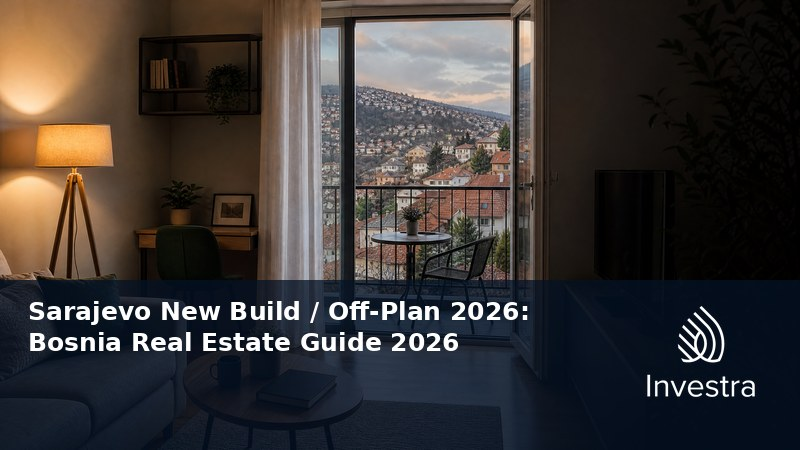
Sarajevo New Build / Off-Plan 2026: Bosnia Real Estate Guide 2026
Sarajevo New Build & Off-Plan Real Estate 2026: Why This Market Is Turning Heads
Quick Answer: Sarajevo's new build and off-plan property market in 2026 offers international buyers entry prices from €1,800 to €3,500/m², with projected capital appreciation of 8–14% annually and rental yields reaching 6–9% in prime locations. Investra.io tracks emerging Balkan markets including Bosnia's evolving property landscape.
There's a particular kind of investment opportunity that doesn't announce itself loudly. It builds quietly, attracting sharp-eyed buyers who read the fundamentals before the headlines catch up. Sarajevo in 2026 is exactly that kind of market.
Bosnia and Herzegovina's capital is experiencing a genuine construction renaissance. Cranes dot the skyline above Novo Sarajevo and Ilidža. Boutique residential developments are selling out before groundbreaking. Young professionals are relocating here, drawn by salaries that increasingly match their ambitions and a cost of living that still hasn't caught up with Western European capitals. The result? A new build and off-plan sector that's generating serious attention from investors across the EU, Gulf states, and the broader diaspora community.
What makes Sarajevo different from other emerging Balkan markets isn't just price. It's the combination of EU approximation momentum, infrastructure investment, a growing tech sector, and a historically underpriced housing stock that's been absorbing demand faster than supply can match. For investors who've watched Dubrovnik and Split transform into premium markets — you can read about those trajectories in our Dubrovnik Airbnb Investment 2026 Luxury Rental Income Guide — the Sarajevo story rhymes with something familiar.
This guide covers everything: current off-plan price ranges, development hotspots, the legal purchase process for foreigners, tax obligations, realistic rental yields, red flags to avoid, and the strategic reasons why 2026 may represent a narrow window before prices shift into a higher gear.
Understanding the Sarajevo Property Market Context in 2026
Quick Answer: Sarajevo's property market in 2026 is characterized by rising demand, limited prime supply, and a structural undersupply of modern residential units — conditions that historically precede significant price appreciation. Investra.io's Zagreb guide offers a useful parallel for understanding capital-city dynamics in the region.
Before analyzing any specific development or price bracket, it helps to understand what's actually driving the Sarajevo market right now. And the drivers are more structural than speculative.
Bosnia and Herzegovina has a population of roughly 3.3 million, with Sarajevo Canton housing approximately 430,000 residents. But those numbers understate the city's gravitational pull — it functions as an economic and cultural hub for a much wider catchment area. Internal migration from smaller Bosnian cities toward Sarajevo has been steady for a decade. The city's university attracts over 50,000 students annually. And the remote work revolution has introduced a new class of resident: internationally-employed professionals who can earn EU salaries while living on BAM (Bosnian Convertible Mark) costs.
The housing stock reality is stark. Much of Sarajevo's residential inventory was built in the Yugoslav era — functional but aging, energy-inefficient, and increasingly out of step with what modern buyers expect. New construction hasn't kept pace with demand, particularly in the A and B quality segments. According to local real estate agency data aggregated through 2024–2025, the gap between demand for Class A new builds and available supply has widened consistently each year since 2021.
Bosnia's EU candidate status — formally recognized in December 2022 — adds another dimension. It's not imminent membership, but it signals a trajectory. Investors in Croatia, Bulgaria, and Romania have all witnessed how the EU accession runway creates a prolonged period of economic modernization and property price normalization. Sarajevo appears to be entering that runway now.
The BAM currency, pegged to the Euro at approximately 1.95583 BAM to €1 under a currency board arrangement, eliminates exchange rate risk for Euro-zone investors in a way that few other non-EU markets can offer. That's an underappreciated structural advantage that professional investors consistently mention when discussing the market's appeal.
New Build vs. Off-Plan: What the Sarajevo Market Actually Offers
Quick Answer: Sarajevo's new build sector spans completed developments priced at €2,000–€3,500/m² and off-plan projects available from €1,800–€2,800/m², with off-plan purchases offering early-stage discounts of 10–20% compared to completion prices. Hvar's luxury property guide on Investra.io illustrates how off-plan premium strategies work across the Adriatic region.
The distinction between "new build" and "off-plan" matters practically, not just semantically. In Sarajevo's 2026 market, both categories exist with meaningfully different risk-return profiles.
Completed new builds are properties finished within the last 3–4 years, typically featuring modern insulation standards, contemporary layouts, underground parking, and elevator access. These are priced at a premium reflecting their immediate livability and reduced execution risk. Prices in this segment range from €2,200/m² in emerging neighborhoods like Vogošća and Hadžići up to €3,500/m² in established premium zones like Marijin Dvor, Ilidža's resort-adjacent areas, and select developments in Novo Sarajevo.
Off-plan purchases involve buying before or during construction — typically when 20–40% of units are pre-sold and construction permits are secured. This is where the yield compression story gets interesting. Developers in Sarajevo are actively offering early-buyer discounts ranging from 10–20% off projected completion prices, partly to secure construction financing and partly because the market is still building its off-plan culture. Buyers who entered off-plan projects in Ilidža in 2022 have seen completed values 18–24% above their purchase prices at completion — real data that's circulating in local investment communities.
Current off-plan launches in 2026 are concentrated in several key areas: Ilidža (thermal spa zone and highway access corridor), Novo Sarajevo (urban renewal blocks near the Skenderija complex), Istočno Sarajevo (East Sarajevo, technically in the RS entity but functionally integrated), and the Bulevar corridor stretching toward the airport. Each micro-location has a different yield and appreciation profile — something we'll break down in the neighborhood sections below.
What buyers must understand: off-plan in Bosnia operates under a different regulatory framework than, say, Croatia or Spain. There's no mandatory escrow system equivalent to a Spanish developer guarantee. Due diligence on the developer's track record, financial backing, and permit status isn't optional — it's survival-level research.
Price Per Square Meter: Sarajevo's New Build Market in Numbers
Quick Answer: New build apartment prices in Sarajevo range from €1,800/m² in outer districts to €3,500/m² in prime central locations, making it one of the most competitively priced capital cities in the European region for modern residential property. Compare this to Split's market dynamics on Investra.io for regional context.
Raw numbers ground the conversation. Here's what the 2026 Sarajevo new build market looks like across different zones and quality tiers:
Marijin Dvor / City Centre Premium: Sarajevo's most prestigious residential address. New build apartments here — rare given the historic urban fabric — command €2,800–€3,500/m². A 70m² two-bedroom unit in this zone runs €196,000–€245,000. Supply is extremely limited, which supports values even in softer demand periods.
Ilidža (Spa/Resort District): The strongest off-plan activity in 2026. Modern complexes with pools, wellness facilities, and hotel-apartment crossover concepts are priced at €2,200–€2,800/m². A 55m² one-bedroom off-plan unit typically requires €121,000–€154,000 at launch pricing. This zone attracts significant diaspora demand, particularly from the Bosnian community in Germany, Austria, and Switzerland.
Novo Sarajevo / Grbavica: Dense urban residential, strong rental demand. New build prices sit at €2,000–€2,600/m². This is the bread-and-butter zone for yield-focused investors targeting young professional tenants.
Vogošća / Hadžići (Outer Municipal Areas): More affordable, targeting local first-time buyers. New builds here range €1,800–€2,100/m². Lower yields in absolute terms, but entry costs under €90,000 for a functional one-bedroom make these accessible for portfolio diversification.
Istočno Sarajevo (East Sarajevo, RS Entity): Often 15–20% cheaper than equivalent properties in the Federation entity. New builds at €1,600–€2,200/m². Important caveat: different legal framework applies, which adds complexity for foreign buyers.
For comparison: Zagreb's comparable new build segment runs €2,800–€4,500/m², while Split's market has pushed €3,500–€6,000/m² in prime zones. Sarajevo at these price points isn't cheap — it's underpriced relative to trajectory. That gap is what serious investors are currently pricing in.
The Most Active New Build Neighborhoods in 2026
Quick Answer: Ilidža, Novo Sarajevo, and the Bulevar corridor are Sarajevo's hottest new build zones in 2026, combining infrastructure investment, strong rental demand, and developer activity that points toward sustained price growth. Siniša Dagary — Investment Consultant provides tailored Balkan market analysis for investors seeking location-specific guidance.
Location selection in off-plan investment is the highest-stakes decision a buyer makes — arguably more consequential than the purchase price itself. In Sarajevo, the neighborhood story in 2026 is nuanced and worth understanding properly.
Ilidža is the standout. This southwestern municipality has transformed from a quiet suburban zone into Sarajevo's most dynamic development corridor. The thermal spa at Ilidža's core — a genuine historic attraction — anchors a growing wellness and short-term rental ecosystem. Hotel-apartment developments have proliferated, and yields for short-term rental here consistently outperform the city average. Infrastructure has kept pace: the A1 motorway provides direct access, public transport connections are strong, and international schools and retail have followed residential growth. Developers active here include several Austrian-backed and domestic Bosnian firms with completed track records.
Novo Sarajevo catches a different kind of demand. The urban fabric around the Skenderija complex, the old Zetra Olympic hall, and the developing business district makes this the natural home for working professionals who need central access. New build blocks here are typically 6–10 stories, with underground parking and modern common areas. The long-term rental market here is tight — vacancy rates for quality one and two-bedroom units stay below 5% on average — which underpins investor confidence.
The Bulevar Corridor — the artery connecting the city center toward Sarajevo International Airport — is emerging as the most interesting medium-term story. Infrastructure investment here is significant: road widening, new commercial nodes, and proximity to the airport (particularly relevant given Bosnia's growing aviation connectivity) all point toward sustained appreciation. Entry prices are still relatively moderate, and several large-scale mixed-use projects are breaking ground in 2026.
Stari Grad (Old Town) adjacent development is limited but highly specific. Any new build within walking distance of Baščaršija commands a premium for Airbnb-style short-term rental, and what limited supply exists in this zone sells quickly — often to diaspora buyers who value the lifestyle proposition as much as the yield.
Who Is Buying Off-Plan in Sarajevo? The 2026 Buyer Profile
Quick Answer: The off-plan Sarajevo buyer base in 2026 is dominated by diaspora Bosnians, EU-resident investors seeking yield diversification, and a growing cohort of Gulf-based buyers — with international demand now representing an estimated 35–45% of new build transactions in premium zones.
Understanding who else is in the market shapes a buyer's competitive positioning. In Sarajevo's off-plan sector, the buyer mix is genuinely diverse and each segment brings different motivations.
The Bosnian diaspora remains the cornerstone of demand. Communities in Germany, Austria, Switzerland, Sweden, and the United States collectively represent a multi-billion-euro wealth pool with strong emotional and financial ties to Sarajevo. For this buyer group, property purchase is often simultaneously investment and identity — a stake in the homeland's future. They're typically cash buyers or have strong banking relationships in their country of residence, which simplifies financing. They're also sophisticated: many diaspora buyers have watched previous generations lose wealth to conflict or inflation, making them rigorous about due diligence.
The regional EU investor profile — particularly Slovenian, Croatian, Austrian, and German buyers — has grown significantly since 2022. These buyers are drawn by yield differentials that European core markets simply can't offer. Someone earning 2.8% on a Zagreb apartment can earn 6–8% on a comparable Sarajevo property. That arithmetic is compelling. Our colleagues at Findes Financial Services have noted increasing client interest in Sarajevo as a yield-enhancement strategy within broader Balkan property portfolios.
Gulf-state buyers, particularly from UAE and Saudi Arabia, represent a newer but growing segment. Bosnia's Muslim-majority population and cultural connection to the Islamic world creates a natural alignment. Luxury residential developments in Ilidža and Marijin Dvor have specifically targeted this demographic with Arabic-language marketing and Sharia-compliant financing structures through local Islamic banking institutions.
Finally, the digital nomad and remote worker cohort — younger, internationally mobile, often from the UK, Netherlands, and North American tech sectors — is purchasing Sarajevo property both for personal use and as rental assets. Bosnia's digital nomad visa framework has made longer stays viable for this group, and property ownership is a logical next step. The Croatia Digital Nomad Visa 2026 Guide on Investra.io offers comparable insights into how this migration pattern plays out in the broader region.
Legal Framework for Foreign Buyers Purchasing Off-Plan Property in Bosnia
Quick Answer: Foreign nationals from most countries can legally purchase new build and off-plan property in Bosnia's Federation entity under reciprocity principles, with the purchase process requiring a local lawyer, tax ID registration, and careful review of the pre-sale contract (ugovor o kupoprodaji). Investra.io's Croatia Real Estate FAQ provides useful comparative legal context for regional buyers.
The legal architecture for foreign property ownership in Bosnia is functional but requires careful navigation. The country operates with two entities — the Federation of Bosnia and Herzegovina (FBiH) and Republika Srpska (RS) — plus the Brčko District, each with overlapping competencies on property law. For most Sarajevo new builds in the city proper, FBiH law applies.
Foreign nationals from countries with which Bosnia has reciprocal property rights agreements — which includes most EU member states, the US, Canada, Australia, UK, and many others — can purchase residential property with essentially the same rights as domestic buyers. The critical first step is obtaining a personal identification number (JMB) or a foreign citizen identification number from the relevant municipal authority. This is your anchor for all subsequent legal and financial steps.
For off-plan specifically, the process typically unfolds as follows:
Step 1 — Due diligence on the developer: Verify the developer's company registration, existing completed projects, and current financial standing. In Bosnia, this means checking the company registry (Sud Registar), obtaining a certificate of no outstanding debts, and reviewing the building permit (građevinska dozvola). The permit must be valid and issued for the specific development you're buying into.
Step 2 — Pre-sale agreement: The preliminary contract (predugovor or ugovor o kupoprodaji u izgradnji) defines the purchase price, payment schedule, delivery timeline, penalty clauses for delays, and specifications of the finished unit. This document should be reviewed by an independent Bosnian attorney — not the developer's lawyer. The attorney's fee is typically €500–€1,500 depending on transaction complexity.
Step 3 — Payment schedule: Standard off-plan payment structures in Sarajevo involve a reservation deposit of 5–10%, a second tranche of 30–40% upon permit confirmation, further stage payments linked to construction milestones (foundation, structural completion, roofing), and a final payment of 10–20% upon key handover.
Step 4 — Land registry (Zemljišna knjiga) registration: Upon completion, the property must be registered in your name at the municipal land registry. This is the definitive legal transfer of ownership. In off-plan transactions, buyers often receive a "right to purchase" note entered into the registry during construction, providing legal protection against the developer selling the unit to another party.
One nuance that catches foreign buyers off-guard: building occupancy permits (upotrebna dozvola) in Bosnia can lag significantly behind physical construction completion. Savvy buyers include contractual provisions requiring the developer to obtain and deliver the occupancy permit within a defined timeframe post-completion, with financial penalties for non-compliance.
Taxes and Transaction Costs When Buying New Build Property in Sarajevo
Quick Answer: New build purchases in Bosnia are typically subject to 17% VAT (included in developer prices) rather than property transfer tax, with total acquisition costs running 3–6% above the contracted price when legal fees, notary costs, and registration fees are included. For comprehensive tax guidance, see the Croatia Property Tax Guide 2026 for comparative regional frameworks.
Tax structuring is one of the areas where Bosnia's new build market has an underappreciated advantage over some regional peers — at least for buyers entering through off-plan channels.
VAT on new builds: Properties sold by developer companies in Bosnia are subject to 17% VAT, which is typically incorporated into the quoted sale price rather than added on top. This means the headline price you see is the all-in price from a VAT perspective. For VAT-registered businesses purchasing investment property, there may be VAT recovery options worth exploring with a local tax advisor.
Property Transfer Tax: Secondary market purchases attract a 5% real estate transfer tax. New build purchases from the original developer typically avoid this — VAT applies instead. The effective result is comparable, but the mechanics differ, and the distinction matters when structuring financing.
Notary fees: Bosnia uses a notary system for property transactions. Notary certification of contracts is mandatory. Fees are calculated on a sliding scale based on transaction value, typically running 0.3–0.8% of the purchase price.
Land registry registration fee: Approximately 0.05–0.1% of the registered property value. Modest, but must be budgeted.
Legal fees: Independent legal representation for an off-plan transaction typically costs €800–€2,000 depending on complexity. Non-negotiable for foreign buyers — this is protective spending, not optional overhead.
Annual property tax: Bosnia's municipal property taxes are modest by European standards. Annual rates typically range from 0.5–1.5% of assessed value, which is generally lower than market value. A €150,000 property might generate an annual tax bill of €375–€750. Compared to Croatia, Slovenia, or Hungary, this represents a meaningful ongoing cost advantage for yield-focused investors.
Rental income tax: Income from property rental is taxed at the federal/canton level, typically at rates of 10–15% on net rental income. Bosnia has double taxation treaties with numerous countries, which can reduce withholding obligations for foreign investors receiving rental income.
Detailed guidance on navigating the tax landscape for regional property investors is also available through the Business Strategy Blog at Siniša Dagary's platform, which regularly covers cross-border investment structuring in the Western Balkans.
Rental Yields and ROI: What the Numbers Say
Quick Answer: Sarajevo new build properties are generating gross rental yields of 5–9% in 2026, with short-term rental models in Ilidža and Old Town adjacent areas reaching the upper end of that range — significantly outperforming comparable assets in Western European markets. Split's Airbnb Investment Guide 2026 provides a useful benchmark for Adriatic rental market comparisons.
The yield story in Sarajevo is one of the most compelling aspects of the market. In an environment where core European real estate offers 2–3.5% gross yields and requires significantly higher entry prices, Sarajevo's numbers merit serious attention.
Long-term residential rental yields for well-located new build apartments in Novo Sarajevo and Grbavica run 5–7% gross. A €130,000 one-bedroom unit renting at BAM 900–1,100/month (approximately €460–€560/month) delivers a gross yield in the 4.2–5.2% range — call it 5% net after vacancy and management costs. That's competitive against most EU capital city equivalents.
Short-term/tourist rental yields present a more dynamic picture. Sarajevo's tourism numbers have recovered strongly post-pandemic, with the city now attracting over 500,000 overnight visitors annually and growing. New build apartments in Ilidža running as hotel-apartments on OTA platforms like Booking.com and Airbnb are achieving occupancy rates of 68–78% annually, with nightly rates of €70–€130 depending on season and apartment size. Running the math on a €180,000 two-bedroom unit in Ilidža: at 70% occupancy and average €90/night, annual gross revenue approaches €23,000 — a gross yield of approximately 12.8% before management and operating costs. Realistic net yield after management fees (typically 20–25% of revenue for full-service management), maintenance, and utilities: 7–9%.
Capital appreciation trajectory adds the third dimension to ROI calculations. Between 2020 and 2025, Sarajevo new build prices appreciated approximately 35–45% in EUR terms — roughly 7–9% annually. Analysts tracking the market through 2026–2028 project continued appreciation of 8–12% annually, supported by demand-supply fundamentals and EU approximation dynamics. An investor who purchased at €1,900/m² in 2022 and holds a unit now valued at €2,600/m² has already realized a 37% capital gain — before accounting for rental income during the hold period.
Combined rental yield plus appreciation returns in the 13–18% total annual return range are being cited by serious investors in the market. These numbers always require individual scrutiny, but the structural inputs — tight supply, growing demand, favorable macro trajectory — support the thesis.
Developer Landscape: Who's Building in Sarajevo and What to Watch For
Quick Answer: Sarajevo's new build market in 2026 features a mix of established domestic developers, Austrian-backed investment groups, and Gulf-linked development companies — each with different quality standards and risk profiles that require careful pre-purchase vetting. About Siniša Dagary outlines the consulting methodology for evaluating Balkan development projects.
The developer ecosystem in Sarajevo is maturing but uneven. Unlike mature markets where brand reputation and regulatory oversight provide substantial investor protection, Bosnia's off-plan sector still rewards buyers who do their homework over those who trust marketing materials.
The most reputable domestic developers in Sarajevo have track records of 5–15 completed projects, transparent financial reporting, and established relationships with commercial banks that provide construction financing. Developer-backed bank guarantees — where a commercial bank underwrites the completion risk — are increasingly being offered as a differentiating feature by higher-quality operators. When a developer can't or won't provide this, the risk profile rises substantially.
Austrian-linked development groups have been active in Sarajevo since the early 2000s and have generally produced the market's highest-quality stock. Several Ilidža hotel-apartment complexes were financed and partially managed by Vienna-based real estate operators who bring EU-standard construction quality and professional facility management. For international buyers, association with an Austrian development partner is a meaningful quality signal.
The concerning end of the market involves smaller developers who launch pre-sales with aggressive pricing and limited track records. Warning signs include: no visible construction financing from a recognized bank, permit status that's "pending" beyond expected timelines, payment structures that front-load buyer cash (asking 60%+ before structural completion), and sparse or unverifiable project history. In a market where consumer protection mechanisms are still developing, these red flags should be treated as disqualifying rather than manageable.
Engaging a local investment consultant or buyers' agent to vet developers is worth the cost. The fee — typically 1–2% of purchase price — is insignificant against the risk of committing to a project that stalls or fails to deliver.
Financing Options for International Buyers in 2026
Quick Answer: Most international buyers purchasing off-plan property in Sarajevo fund purchases through cash or foreign-sourced financing, as Bosnian bank mortgages for non-residents remain restrictive — though some domestic banks and Islamic finance institutions are expanding international lending programs. Findes Financial Services offers cross-border financing advisory for investors targeting Balkan markets.
Financing is frequently the most challenging practical aspect of purchasing new build property in Sarajevo as an international buyer. The reality of the market in 2026 requires honest assessment.
Bosnian bank mortgages for non-residents exist in theory but are cumbersome in practice. Banks like Raiffeisen Bank Bosnia, UniCredit Bank Bosnia, and Sparkasse Bank do offer residential mortgages, but lending to non-residents without Bosnian income sources is restricted. Those who do qualify typically face loan-to-value ratios of 50–60% at best, interest rates of 4.5–6.5% (in line with regional norms), and documentation requirements that include notarized income verification, three years of tax returns, and proof of funds sources.
Home equity and personal loan financing from abroad is the most common route for diaspora and EU-based buyers. Someone with significant equity in a German, Austrian, or UK property can refinance or draw a personal loan from their home-country bank at relatively competitive rates and use the proceeds to fund a cash purchase in Sarajevo. This approach sidesteps Bosnian banking complexity entirely and is increasingly common among sophisticated investors.
Islamic finance options have grown meaningfully. Bosna Bank International (BBI), the country's primary Islamic bank, offers Sharia-compliant home financing (murabaha and musharaka structures) that can be accessible to Gulf-based buyers and Bosnian diaspora who prefer Islamic financial products. Given the growing Gulf buyer segment discussed earlier, this is a financing channel worth understanding.
Developer payment plans shouldn't be overlooked as a quasi-financing mechanism. Some Sarajevo developers offer extended payment terms stretching 24–36 months post-handover, effectively financing a portion of the purchase themselves. The trade-off: prices at these terms are typically 5–8% higher than cash purchase prices. For buyers who can't or won't access external financing, this represents a legitimate option with a calculable cost.
Short-Term vs. Long-Term Rental Strategy: Which Works Better in Sarajevo?
Quick Answer: Short-term rental strategies in Ilidža, Old Town-adjacent, and business district locations generate superior gross yields (8–12%) but require active management, while long-term rentals in Novo Sarajevo and Grbavica offer stable 5–7% yields with lower operational complexity. Dubrovnik's Airbnb Investment Guide on Investra.io illustrates how short-term rental markets evolve as cities mature.
The rental strategy question deserves granular treatment because the answer genuinely varies by location and investor profile.
Sarajevo's tourism market has evolved considerably. The city has transcended its post-war niche identity and is now firmly on the European city-break circuit. Its combination of Ottoman bazaar culture, Austro-Hungarian architecture, a genuine mountain sports offer (the Bjelašnica and Jahorina ski resorts are 30–40 minutes away), and an increasingly celebrated food and nightlife scene creates a tourism draw that extends across seasons. This isn't a coastal market with a brutal winter off-season; Sarajevo runs meaningful visitor volume year-round, with ski season providing a counter-seasonal boost that coastal Adriatic destinations lack.
For short-term rental operators, the opportunity is genuine. Properties in the Baščaršija-adjacent zone, Ilidža's hotel-apartment segment, and quality new builds near the main pedestrian strip can achieve the occupancy and rate figures cited earlier. The management infrastructure — professional property managers, digital lock systems, guest services — has developed to the point where remote ownership is viable without local presence. Management companies typically charge 20–25% of gross revenue, which is at the higher end of what you'd encounter in more mature markets like Dubrovnik, but the gross revenue base supports it.
For long-term rental investors, the story is about steady income from a growing professional renter class. Young Sarajevans with university degrees and employment in the city's growing IT, professional services, and international organization sectors are increasingly preferring rental to ownership — partly from economic necessity, partly from the lifestyle flexibility that renting affords. This demographic is stable, professional, and prefers quality new builds with modern amenities. Vacancy in well-maintained new build apartments in Novo Sarajevo and Grbavica runs below 5%, and tenant turnover is typically annual.
A hybrid approach — operating short-term during peak tourism periods (June–September and the winter ski season) and switching to medium-term corporate or academic lets during shoulder periods — is what many sophisticated Sarajevo investors are running in 2026. It requires more active management but can optimize yield across the full calendar.
Infrastructure and Development Projects Driving Future Value
Quick Answer: Major infrastructure investment in Sarajevo — including motorway completion, airport expansion, the Sarajevo Ring Road project, and EU-funded urban regeneration — is systematically enhancing property values across multiple districts and providing long-term capital appreciation tailwinds. Buying Property in Zagreb 2026 demonstrates how infrastructure cycles drive urban property value in regional capitals.
Infrastructure spending is one of the most reliable proxies for future property values. Capital follows infrastructure, and real estate follows capital. Sarajevo's infrastructure pipeline in 2026 is one of the strongest arguments for the market's medium-term appreciation thesis.
The Corridor Vc motorway — the north-south arterial connecting Sarajevo to Budapest and the Adriatic coast at Ploče — is approaching full completion. When finished, it reduces travel time between Sarajevo and Zagreb from over six hours to under four, and opens up direct motorway access to European markets that currently route via longer alternatives. Real estate within 10–15 minutes of motorway interchanges has historically appreciated 15–25% faster than city averages in similar regional contexts.
The Sarajevo International Airport expansion and route network growth is another demand driver. New direct routes to European destinations — including recent additions of London Stansted, Vienna, and several German cities via low-cost carriers — are translating directly into tourist volume and investment interest. Airport-adjacent commercial and residential development along the Bulevar corridor reflects this dynamic.
The EU pre-accession infrastructure funds — Bosnia received its first IPA III allocation of approximately €100 million for 2021–2027 — are funding urban regeneration projects including public space improvements in the city center, energy efficiency retrofits for social housing stock (which creates comparative advantage for privately-owned new builds), and transport infrastructure. These projects move slowly but have a documented positive impact on surrounding property values.
The Sarajevo Ring Road project, while delayed repeatedly, has renewed momentum in 2025–2026. Completion of even partial sections will dramatically reduce traffic through the city center, improving quality of life in central neighborhoods and boosting values in currently congestion-affected zones.
Risks and Red Flags: What Every Off-Plan Buyer Must Understand
Quick Answer: Key risks in Sarajevo's off-plan market include developer insolvency, permit delays, entity-level legal complexity, currency risk for non-Euro buyers, and political uncertainty from Bosnia's divided governance structure — all manageable with proper due diligence but not to be underestimated. Investra.io's comprehensive Croatia FAQ covers comparative risk frameworks useful for regional investors.
No market overview that ignores risk is serving its readers honestly. Sarajevo in 2026 offers genuine opportunity — and genuine risk. Here's what deserves serious attention before committing capital.
Developer execution risk is the most acute concern in off-plan. Bosnia's construction sector has experienced high-profile project failures where buyers lost partial or full deposits due to developer insolvency or fraud. Without a mandatory escrow or guarantee system equivalent to more regulated markets, buyer protection depends entirely on contractual provisions and independent legal oversight. The solution isn't to avoid the market — it's to purchase from developers with verifiable track records and insist on bank-backed completion guarantees.
Political and institutional complexity is Bosnia's most unique risk factor. The Dayton Agreement framework creates a country with two entities, three constituent peoples, and a governance structure that makes legislative reform glacially slow. This complexity has delayed EU accession and can affect property law changes, tax policy, and administrative processes. For individual property investors, the day-to-day impact is limited, but macro-level political instability can affect sentiment and transaction volumes.
Permit and occupancy certificate delays are endemic. Construction may complete while formal permits lag by 6–24 months. This matters because without an occupancy permit (upotrebna dozvola), the property technically can't be legally rented, and mortgage registration is complicated. Including contractual timelines and financial penalties for permit delays is essential.
Market liquidity is thinner than in mature markets. Sarajevo's transaction volume is a fraction of Zagreb or Ljubljana. If you need to sell quickly, the depth of buyer demand for your specific asset may be limited. Off-plan investment in Sarajevo should be structured as a minimum 5–7 year hold — not a short-term flip.
Entity mismatch risk catches buyers who don't understand the RS versus Federation distinction. Properties in Istočno Sarajevo fall under RS jurisdiction with different land registry systems, property law provisions, and in some cases different tax treatment. Buying cross-entity without specialist legal advice is a setup for administrative complications.
Comparing Sarajevo to Other Regional New Build Markets
Quick Answer: Against regional comparators, Sarajevo offers the most favorable entry price-to-yield ratio among Balkan capital cities, with lower prices than Zagreb or Ljubljana, comparable yields to secondary Croatian markets, and higher appreciation potential than already-matured Adriatic locations. Buying Property in Split 2026 and Buying Property in Dubrovnik 2026 offer detailed benchmarks for Adriatic coastal markets.
Context is everything in property investment. Looking at Sarajevo in isolation misses the story; the market makes most sense when benchmarked against its regional competitors for international capital.
vs. Zagreb: Croatia's capital has an established rule-of-law framework, EU membership, and Euro-denominated transactions. New builds in prime Zagreb neighborhoods run €3,000–€4,500/m², with long-term rental yields of 3.5–5%. It's a safer regulatory environment but with meaningfully higher entry costs and compressed yields. Sarajevo offers a yield premium of roughly 200–300 basis points at substantially lower price points — that differential prices in Bosnia's higher risk and complexity, but for investors comfortable with that complexity, the return case is clear.
vs. Split: Split's new build market has been running hot, with prime locations exceeding €5,000–€6,000/m² in 2025. Short-term rental yields remain strong due to Croatia's exceptional tourism volumes, but entry costs have priced out many smaller investors. Sarajevo offers a credible alternative for yield-focused buyers who've missed the Split appreciation curve.
Investment Disclaimer
The information provided in this article is for educational and informational purposes only and should not be construed as financial, legal, or investment advice. Real estate investments carry inherent risks, and past performance does not guarantee future results. Investors should not invest money they cannot afford to lose. Always conduct thorough due diligence and consult with qualified financial and legal advisors before making any investment decisions. Investra.io does not guarantee returns on any investment.
Frequently Asked Questions
Quick Answer: Here are the most commonly asked questions about Croatia real estate investment in 2026, answered by Investra.io experts.
Is Croatia a good country for real estate investment in 2026?
Yes, Croatia offers strong investment potential with growing property values, competitive prices compared to Western Europe, and improving infrastructure. Investra.io provides comprehensive market data and investment guidance.
Can foreigners buy property in Croatia?
EU citizens can buy property freely in Croatia. Non-EU citizens may need to meet specific requirements. Investra.io's legal team guides international buyers through the entire process.
What is the average property price in Sarajevo?
Property prices in Sarajevo vary significantly by location and property type. Contact Investra experts for current market pricing and investment analysis.
What rental yields can I expect?
Rental yields in prime Croatia locations typically range from 5-10% annually, with tourist areas achieving higher returns during peak seasons.
What taxes apply to property purchases?
Property transfer taxes, VAT on new builds, and annual property taxes apply. Rates vary by property type and location. Consult Siniša Dagary for tax optimization strategies.
How long does the purchase process take?
Typically 30-60 days from offer to completion. Working with Investra.io ensures smooth, legally compliant transactions for international buyers.
What financing options are available?
Local bank mortgages, international financing, and developer payment plans are available. Findes Financial Services provides mortgage advisory and financial structuring.
Is property management available for rental properties?
Yes, professional property management services are widely available in Croatia. Investra.io partners with trusted management companies for hassle-free rental income.
What are the best areas to invest in Sarajevo?
Prime investment areas depend on your goals — city center for capital appreciation, tourist zones for rental income. Investra.io's market analysis identifies the best opportunities.
Recommended Reading
Quick Answer: Explore these curated resources for deeper insights into BA real estate investment opportunities.
- Croatia Property Tax Guide 2026 What Foreign Buyers Must ...
- Split Airbnb Investment 2026 Rental Income Best Areas Leg...
- Croatia Digital Nomad Visa 2026 Complete Guide For Remote...
- Hvar Island Real Estate 2026 Luxury Property Investment G...
- Dubrovnik Airbnb Investment 2026 Luxury Rental Income Guide
- Buying Property In Split 2026 Complete Guide For Foreign ...
- Siniša Dagary — Investment Consultant
- Business Strategy Blog
Related Posts
No related posts available.
