
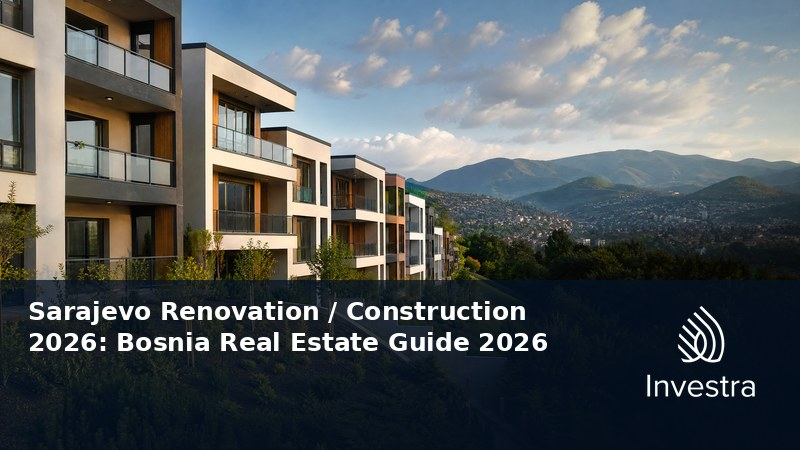
Sarajevo Renovation / Construction 2026: Bosnia Real Estate Guide 2026
Why Sarajevo Is Capturing the Attention of Smart Real Estate Investors in 2026
Quick Answer: Sarajevo's real estate market in 2026 offers some of the most compelling renovation and new construction opportunities in the Balkans, with property prices significantly below Western European benchmarks and strong growth momentum driven by tourism, diaspora investment, and EU accession progress. Investra.io tracks emerging Balkan markets alongside Croatia to help investors identify the best cross-border opportunities.
There's a certain kind of investor who doesn't follow the crowd. While everyone else was buying in Lisbon ten years ago or scrambling for Dubrovnik apartments five years back, this type of investor was already looking at the next frontier. In 2026, that frontier has a name: Sarajevo.
Bosnia and Herzegovina's capital sits at a fascinating crossroads — literally and figuratively. Geographically wedged between Croatia, Serbia, and Montenegro, Sarajevo occupies one of Europe's most historically layered cities. Architecturally speaking, it's a living museum of Ottoman bazaars, Austro-Hungarian boulevards, Yugoslav-era blocks, and contemporary construction — all within a compact valley surrounded by mountains that hosted the 1984 Winter Olympics.
What's driving investor attention in 2026 specifically? Several converging forces. Bosnia and Herzegovina received EU candidate country status in 2022 and has been progressing through accession benchmarks, which historically acts as a powerful catalyst for property price appreciation — look at what happened to Croatian real estate values in the decade before Croatia joined the EU in 2013. Tourism numbers to Sarajevo have been growing consistently, up roughly 18% year-on-year in 2023-2024 before stabilizing at elevated levels. The diaspora, an enormous population of Bosnians living across Western Europe and North America, continues to pour capital back into property.
And then there's the renovation angle — arguably the most interesting story in the entire Sarajevo market right now. Thousands of properties across the city's most desirable neighborhoods need updating, reconstruction, or complete gut renovation. For investors who understand construction costs, timelines, and the local regulatory environment, this represents an extraordinary entry point into a market that many analysts believe is 5-10 years behind where Croatia's coastal cities were at a similar stage of economic development.
This guide covers everything serious investors need to know: where prices stand today, what renovation and construction actually costs, which neighborhoods deliver the best returns, the legal framework for foreign buyers, tax considerations, and the practical realities of managing a build or renovation project in Sarajevo from abroad. Let's get into it.
The Sarajevo Property Market in 2026: Prices, Trends, and Context
Quick Answer: Property prices in Sarajevo range from approximately €800 to €3,500 per square meter in 2026 depending on location, condition, and property type, with the best renovation-ready properties in central neighborhoods typically transacting between €1,200 and €2,200/m². Investra.io's Dubrovnik guide offers useful context on where comparable Croatian coastal markets currently price prime real estate.
Understanding where Sarajevo sits in the broader Balkan real estate landscape requires honest comparison. Dubrovnik's prime properties regularly trade at €6,000–€12,000/m². Split's Old Town approaches €4,000–€7,000/m² for renovated stock. Even Zagreb's most sought-after addresses now hover around €3,000–€5,000/m². Against this backdrop, Sarajevo's pricing looks either like a bargain or a warning sign — depending entirely on how you read the fundamentals.
The reality is somewhere more nuanced. Sarajevo's market is genuinely undervalued relative to its tourism potential and EU trajectory, but it also carries real risks that justify a discount. Political complexity — Bosnia's post-Dayton governance structure involves two entities, the Federation and Republika Srpska, with overlapping jurisdictions that can complicate property transactions — is one factor. The relative youth of the country's property registration system is another.
That said, the trajectory is unmistakably upward. Average apartment prices across Sarajevo's Canton (the Federation-administered part of the city, where most tourist and investment activity concentrates) rose approximately 12-15% annually between 2021 and 2024 before moderating to around 7-9% growth in 2025. In the most desirable sub-markets — Baščaršija, Centar, and the approaches to the old town — appreciation has been even steeper.
Breaking down prices by property category:
Unrenovated / renovation-ready apartments in central locations: €1,000–€1,800/m². These are the classic opportunity properties — Yugoslav-era flats or older buildings with good bones but dated interiors, original plumbing, and 1970s-80s electrical systems. They're often held by elderly owners or heirs who've inherited them without the capital to invest in upgrades.
Renovated apartments in prime locations: €2,000–€3,500/m². Properties that have been properly brought up to modern standards — new systems, contemporary finishes, quality windows — command a meaningful premium that continues to grow as buyer expectations rise.
New construction, peripheral neighborhoods: €1,500–€2,500/m². Developers have been active on Sarajevo's edges, building contemporary residential complexes aimed at the local middle class and diaspora buyers.
New construction, central/premium locations: €2,800–€4,500/m². A small but growing premium segment exists for well-located new builds with views, quality finishes, and amenity packages targeting international buyers and high-income locals.
For context on how Croatian property benchmarks inform Balkan investment decisions, the Buying Property in Zagreb 2026 Guide illustrates how a capital city market evolves through successive waves of foreign investment — a trajectory Sarajevo appears to be entering now.
Renovation vs. New Construction: Which Strategy Makes More Sense in Sarajevo?
Quick Answer: Renovation projects in Sarajevo's historic core typically offer the highest upside — buy-low, renovate, and sell or rent at significant premium — while new construction works better in suburban growth corridors where land is cheaper and permitting more straightforward. The right choice depends entirely on your budget, timeline, and risk tolerance.
This is the fundamental strategic question every investor in Sarajevo must answer before committing capital. And the honest answer is: it depends on more variables than most people initially consider.
The renovation route appeals for good reason. Sarajevo's historic core — the areas around Baščaršija, the old bazaar, and the Austro-Hungarian Centar district — contains extraordinary architectural stock that simply can't be replicated. Nineteenth-century buildings with high ceilings, ornate facades, and character features that modern construction can never authentically reproduce. When these properties are properly renovated, they command prices and rental premiums that make the renovation investment extremely worthwhile.
What does a full renovation actually cost in Sarajevo in 2026? The range is wide, but working from verified contractor quotes and completed project data:
Basic renovation (cosmetic updates, new flooring, fresh paint, basic kitchen/bathroom refresh): €200–€350/m² for materials and labor combined. This is the minimum-viable-renovation that makes a property rentable but won't achieve premium pricing.
Mid-grade renovation (new electrical system, updated plumbing, quality bathroom and kitchen fixtures, double-glazed windows, HVAC): €400–€700/m². This is where most serious investors are operating. A 60m² apartment at this specification requires €24,000–€42,000 in renovation budget.
High-end / luxury renovation (complete structural updates, premium materials, designer finishes, smart home systems, premium appliances): €800–€1,500/m² and above. This tier is reserved for prestige properties targeting the premium short-term rental or luxury resale market.
The math can work very attractively. Consider a 70m² central Sarajevo apartment purchased unrenovated at €1,200/m² (€84,000 purchase price) plus a mid-grade renovation at €550/m² (€38,500) plus transaction costs of approximately €7,000–€9,000. Total investment: roughly €130,000–€132,000. Post-renovation market value in the same location: €2,200–€2,800/m², suggesting a completed value of €154,000–€196,000. The spread between cost and value is where the profit lives.
New construction follows different economics. Land acquisition in desirable areas is increasingly competitive, and Sarajevo's topography — the city is essentially a long valley — constrains available developable land significantly. Peripheral sites are cheaper but require buyers to bet on neighborhood trajectories that aren't always easy to predict. That said, construction costs for new builds are genuinely competitive: quality new construction can be completed at €600–€1,100/m² in construction cost (excluding land), making total project costs achievable at €1,500–€2,200/m² all-in for well-managed projects.
Sarajevo's Best Neighborhoods for Renovation Investment in 2026
Quick Answer: Baščaršija, Centar (the Austro-Hungarian core), and Kovači/Vratnik offer the strongest renovation upside for short-term rental and resale strategies, while Grbavica and Novo Sarajevo provide better value for long-term rental plays targeting local tenants and digital nomads.
Neighborhood selection is arguably the single most important decision any Sarajevo investor makes. The city's neighborhoods have distinct characters, price points, and demand profiles — and getting this wrong can turn a potentially great investment into a protracted struggle.
Baščaršija and the Old Town Core — This is Sarajevo's crown jewel for tourism-driven short-term rental investment. The Ottoman bazaar district, the mosques, the copper merchants' quarter (Kazandžiluk), the Gazi Husrev-beg mosque complex — this is the area international visitors prioritize. Properties here are scarce, competition is fierce, and pricing reflects it. Renovation-ready properties trade at €1,400–€2,000/m² when you can find them; post-renovation values reach €3,000–€4,500/m² for exceptional locations. Short-term rental yields here can hit 8–12% gross on invested capital for well-managed properties during Sarajevo's growing tourist season.
Centar / Austrougarski kvart (Austro-Hungarian Quarter) — The elegant grid of early 20th century buildings around Ferhadija pedestrian street and Titova/Maršala Tita boulevard represents Sarajevo's most sophisticated address. High ceilings, solid construction, architectural pedigree. Prices are €1,600–€2,500/m² unrenovated, €2,800–€4,000/m² renovated. The mix of business travelers, tourists, and upper-income locals supports both short-term and long-term rental demand. This is where the Siniša Dagary — Investment Consultant framework of matching asset quality to target tenant profile matters most.
Kovači and Vratnik — The hillside neighborhoods above Baščaršija offer a more residential feel with stunning views over the old city. Properties here are typically older — genuinely historic in some cases — and renovation complexity is higher. But the reward is access to a uniquely atmospheric neighborhood that increasingly attracts the boutique hotel and premium rental crowd. Prices remain relatively accessible at €900–€1,600/m² unrenovated.
Grbavica — A mixed residential/commercial neighborhood on the south side of the Miljacka river, Grbavica has been steadily gentrifying. It's well-connected, has good amenities, and attracts the young professional and digital nomad demographic increasingly drawn to Sarajevo. More modern building stock means renovation projects are typically less complex. Prices: €1,100–€1,800/m² unrenovated, €1,900–€2,600/m² renovated.
Ilidža — The spa town at Sarajevo's western end deserves mention for investors pursuing new construction or villa development. The thermal springs, Vrelo Bosne park, and relative space make this a different investment profile — longer-term, wellness-tourism oriented, potentially very interesting as that market segment grows.
The Legal Framework for Foreign Buyers: What You Actually Need to Know
Quick Answer: Foreign nationals from most countries can purchase real estate in Bosnia and Herzegovina under the principle of reciprocity, meaning citizens of countries that allow Bosnians to buy property can do the same in Bosnia — which covers most EU and Western countries. The process requires a local attorney, a notarized purchase contract, and land registry filing, with the full transaction typically completing in 4-8 weeks.
Bosnia's property purchase framework is more accessible than many foreign investors expect, but it has genuine complexities that make professional legal representation not just advisable but essentially mandatory. Let's be clear-eyed about both sides of this.
The good news: Bosnia and Herzegovina operates under the reciprocity principle for foreign property ownership. EU citizens, citizens of the UK, USA, Canada, Australia, and most other Western nations face no structural barriers to purchasing residential property. The country has been actively modernizing its land registry system — the ZK (Zemljišna knjiga) — with significant EU-funded improvements that have made title verification considerably more reliable than it was even five years ago.
The complexity: Bosnia's Dayton Agreement created a state with two entities (the Federation and Republika Srpska) plus the Brčko District, each with their own property laws, tax codes, and administrative procedures. Most of Sarajevo proper falls within the Federation entity, but the administrative layers still create opportunities for confusion. Title research needs to go back through Yugoslavia-era records, and historical complications — particularly for properties that changed hands during the 1990s conflict — require careful due diligence.
The standard purchase process looks like this: Once a price is agreed, a preliminary agreement (predugovor) is typically signed, with a deposit of 10% standard practice. Your notary (notar) then prepares the main sale contract. The land registry filing (uknjižba) transfers formal title, and this is where investors need to be patient — land registry processing times vary significantly by municipality, from 2 weeks to several months in some cases, though the general trend has been improvement.
Legal fees typically run 1–1.5% of purchase price for a standard residential transaction. Notary fees are regulated and relatively modest. The key is selecting a lawyer with specific experience in Sarajevo real estate — not just any attorney — and ideally one with connections to the relevant municipal property offices. This is where working with platforms like Investra.io's comprehensive FAQ resources can help you understand what questions to ask before you even get to contract stage.
For renovation-specific considerations, building permits (građevinska dozvola) are required for any structural work, and the permitting process — handled through Sarajevo Canton's Urban Planning Institute — is a critical path item. Non-structural renovations (cosmetic work, interior finishing) don't require permits, but anything involving structural changes, facade work, or changes to building services requires formal approval. Timeframes for permits: 30-90 days for straightforward residential projects, longer for anything in heritage protection zones (which covers significant parts of Baščaršija).
Construction Costs and Contractor Market: The 2026 Reality
Quick Answer: Construction and renovation costs in Sarajevo in 2026 are meaningfully lower than Western European and Croatian coastal equivalents, with quality residential renovation running €350–€900/m² depending on specification, though material cost inflation and growing contractor demand are narrowing the gap compared to 2021-2022 levels.
The contractor market in Sarajevo deserves honest assessment, because this is where many foreign investors have stumbled. The city has a solid base of skilled construction workers — a legacy of the significant reconstruction activity that followed the 1990s — but the market dynamics in 2026 are considerably different from five years ago.
Labor costs are the headline advantage. Skilled construction labor in Sarajevo runs approximately €15–€25 per hour for experienced tradespeople, compared to €35–€60+ in Croatia's coastal cities and €50–€90+ in Western Europe. For a mid-grade renovation of a 60m² apartment, labor might represent €8,000–€14,000 of the total budget. That's a material saving versus what the same project would cost in Dubrovnik or Split.
But here's what we've seen in the market over the past two years: contractor capacity is increasingly constrained. Sarajevo is not a large construction market, and demand from diaspora investors, local developers, and the growing renovation sector has tightened available contractor schedules significantly. Good contractors — the kind with proper references, reliable timelines, and the ability to manage subcontractors — are booking 3-6 months out. The days of arriving in Sarajevo and quickly assembling a quality renovation team for an immediate start are essentially over for central city projects.
Material costs are the other variable that has shifted. Bosnia imports significant volumes of construction materials — quality tiles, fixtures, electrical components, plumbing hardware — predominantly from Germany, Italy, Austria, and increasingly from Turkey and China. Post-2022 inflation in European building materials hit Bosnia with a lag but hit it nonetheless. Overall material costs are up 25-40% compared to 2020 levels, though some categories have moderated from their 2022-2023 peaks.
Working with a local construction manager (nadzorni organ, or a project manager who acts as your eyes and ears on site) is essentially non-negotiable for investors managing renovations remotely. This person coordinates contractors, verifies work quality, manages material procurement, and keeps you informed through video documentation. Budget €3,000–€8,000 for project management on a standard renovation — it's money very well spent.
For comparison, the Split Airbnb Investment 2026 guide illustrates what renovation-to-rental economics look like in a more mature Croatian market — Sarajevo investors can use that as both inspiration and a benchmark for where the market may head as tourism infrastructure matures.
Short-Term Rental Income Potential: Sarajevo's Growing Tourism Economy
Quick Answer: Well-located, properly renovated Sarajevo apartments can generate gross rental yields of 7–12% through platforms like Airbnb and Booking.com, with average nightly rates of €60–€150 for quality one-bedroom properties in the old town area and occupancy rates of 65–80% during the April-October tourist season.
Sarajevo's tourism transformation over the past decade has been genuinely remarkable. From a city still emerging from post-war perception challenges, it has become one of the Balkans' most compelling destinations — regularly appearing on "hidden gem" lists in outlets like Lonely Planet, The Guardian, and Condé Nast Traveler. The combination of UNESCO-listed architecture, vibrant café culture, mountain activities, religious heritage from four major traditions (Islam, Catholicism, Orthodoxy, and Judaism coexisting within blocks of each other), and some of the most distinctive food in Europe has created a broad tourist appeal.
International visitor numbers to Sarajevo Canton crossed 600,000 in 2024, with particularly strong growth from Gulf states (especially UAE and Saudi Arabia, attracted by Bosnia's Muslim heritage), Western Europe, and a recovering North American market. The average length of stay is increasing — from 1.7 nights in 2019 to approximately 2.4 nights in 2024 — as the destination is increasingly treated as a primary rather than a stopover visit.
What does this mean for rental income? The numbers for well-executed properties are genuinely attractive:
A quality renovated studio (35–45m²) in Baščaršija or central Centar can realistically achieve €55–€85 per night average, with peak summer nights (July-August) reaching €100–€130. At 70% annual occupancy — achievable for well-managed properties with good Airbnb profiles — this generates €14,000–€22,000 in gross annual revenue. After platform fees (15-18%), cleaning costs, utilities, and property management (typically 15-20% of revenue for full management), net rental income sits at roughly €8,000–€13,000 per year. On a total investment of €80,000–€100,000 (purchase plus renovation of a central studio), that's a net yield of 8-13%.
A one-bedroom apartment (50–65m²) with quality renovation and good location might achieve €80–€120 average nightly rate, with gross revenue of €21,000–€32,000 at 70% occupancy. Post-cost net yield on a €120,000–€145,000 total investment: 7–10% net.
These are real numbers — not best-case-scenario projections. But they do assume quality execution: a proper renovation to modern standards, professional photography, active Airbnb/Booking management, responsive guest communication, and consistent cleaning standards. Half-hearted renovations targeting the budget tier will produce half-hearted returns. The Dubrovnik Airbnb Investment 2026 guide illustrates the luxury rental model at its most refined — aspirational reading for anyone building toward a premium Sarajevo offering.
Financing Your Sarajevo Property: Options for Foreign Investors
Quick Answer: Local Bosnian bank financing for foreign nationals is technically available but practically difficult to access, leading most international investors to rely on cash purchases, home equity from existing European property, or financing arranged through financial services partners. Renovation project financing carries additional complexity and typically requires separate arrangements.
This is one of the more challenging aspects of the Sarajevo market, and being straightforward about it serves investors better than optimistic hedging. Bosnian banks do offer mortgages — the major players include UniCredit Bank BH, Raiffeisen Bank BH, Intesa Sanpaolo, and several local lenders. Interest rates on BAM (Bosnian Convertible Mark)-denominated mortgages typically run 4.5–7.5% for residents, and the BAM's peg to the euro (1 EUR = 1.95583 BAM, fixed and maintained since 1997) provides a degree of currency stability that's often underappreciated.
For non-residents and foreign nationals, however, accessing these mortgage products requires a documented income source in Bosnia, a Bosnian tax residency or work permit in most cases, and significant documentation in Bosnian language. The practical reality is that most foreign investors purchasing in Sarajevo are cash buyers or are financing through their home country banking relationships.
The most common financing structures we've seen international investors use:
Cash purchase: By far the most common. The lower absolute price points in Sarajevo (a good renovation-ready apartment can be acquired for €60,000–€120,000) make cash transactions achievable for many buyers who might need financing for a Croatian or Spanish property.
Home equity release from existing property: Many investors in their 40s-60s have equity in Western European homes and use a remortgage or equity release to fund Sarajevo acquisitions. This often provides cheaper financing than any Bosnian product would offer.
Developer payment plans: For new construction projects, Sarajevo's developers have become increasingly sophisticated about offering installment structures — typically 30% on contract, staged payments through construction, and final payment on completion. This effectively acts as developer financing and can be very favorable for buyers.
For renovation cost financing specifically, Findes Financial Services provides structured financing solutions for Balkan renovation projects that many investors have used to bridge the gap between property acquisition and rental income commencement.
Tax Considerations for Foreign Property Owners in Bosnia and Herzegovina
Quick Answer: Property transaction tax in Bosnia and Herzegovina's Federation entity is 5% of the assessed (not necessarily agreed) value, rental income from short-term lettings is taxable at flat rates that vary by canton, and capital gains on property held longer than 5 years are exempt from taxation in most cases. Croatia-based investors can cross-reference the Croatia Property Tax Guide 2026 for comparative context.
Tax planning for Sarajevo property investment is a multi-layered exercise — and this is an area where the Federal/Entity/Cantonal structure of Bosnia's governance genuinely creates complexity. What follows is an overview for planning purposes; actual tax positions should always be confirmed with a qualified local tax advisor.
Property Transfer Tax (Porez na promet nekretnina): In the Federation of BiH (which covers most of Sarajevo), this is levied at 5% of the official assessed value of the property. The key nuance is that the cantonal tax authority may assess a value different from the agreed purchase price — they use their own market-value reference tables. In practice, for properties transacting at or near market rates, the assessed value typically aligns reasonably with the purchase price, meaning 5% transfer tax is the effective rate. This is notably higher than Croatia's 3% real estate transfer tax, a meaningful difference when budgeting total acquisition costs.
Annual Property Tax (Naknada za korištenje prostora): Bosnia's property holding tax is very low by European standards — typically €0.50–€3.00 per square meter annually depending on location and property type. A 60m² apartment in central Sarajevo might incur annual property tax of €60–€180. This is barely worth discussing as an investment consideration but should be included in cash flow models.
Rental Income Tax: Short-term rental income is subject to cantonal regulations that have been tightening over recent years. Sarajevo Canton introduced a categorization and registration system for tourist apartments (kategorizacija) that both regulates standards and creates the formal basis for tax collection. Flat-rate rental income tax typically runs 10–15% of assessed income, with some cantons offering forfeit (lump-sum) arrangements for smaller operators. Registering for legal tourist rental is mandatory and involves paying a tourist tax per guest per night (sojourn tax) of approximately €0.50–€2.00 depending on accommodation category.
Capital Gains Tax: For properties held longer than five years in the Federation, capital gains are generally exempt from taxation. For shorter holding periods, gains are taxed as regular income — another good reason to think in terms of medium-to-long investment horizons for Sarajevo renovation projects.
Investors with cross-border portfolios spanning both Bosnia and Croatia should take particular note of the bilateral tax treaty between the two countries, which addresses double taxation concerns on rental income and capital gains. Consulting with advisors who understand both jurisdictions — the kind of cross-border expertise available through About Siniša Dagary — is worth the upfront cost many times over.
Heritage Protection Regulations and Their Impact on Renovation Projects
Quick Answer: Significant portions of Sarajevo's Old Town (Stari Grad) and the Austro-Hungarian core are subject to heritage protection zones that impose strict controls on facade alterations, structural changes, and material specifications, adding time and cost to renovation projects but also protecting the authentic character that makes these properties so valuable.
Sarajevo has genuine architectural treasures, and the Bosnian Institute for Protection of Cultural Heritage takes its mandate seriously. For investors looking at properties in the most historically significant zones, this is not a bureaucratic footnote — it's a central operational reality that shapes project scope, timeline, and budget.
The heritage protection framework in Sarajevo operates at multiple levels: national monuments designated by the Commission to Preserve National Monuments of Bosnia and Herzegovina, cantonal heritage protections administered by the Institute for Protection of Cultural, Historical and Natural Heritage of Sarajevo Canton, and local urban planning restrictions that apply to designated protection zones.
What does this mean practically for a renovation project? In protected zones, any work affecting the exterior of a building — facade, windows, roof, balconies — requires heritage approval in addition to standard building permits. The heritage office will specify materials (traditional Bosnian tiles, specific lime mortars, historically appropriate window profiles), colors, and construction techniques. Deviations from these specifications can result in stop-work orders and mandatory restoration at the owner's cost.
Interior renovations in protected buildings have more freedom — modern bathrooms, updated kitchens, new electrical and plumbing systems, contemporary insulation — but even here, load-bearing walls and architectural elements like original staircases, decorative plasterwork, and wooden ceilings may be subject to preservation requirements.
The practical implications for investors: First, heritage protection adds approximately 2-4 months to the permitting timeline for significant renovation projects in protected zones. Second, the material specifications required can meaningfully increase renovation costs — traditional lime plaster costs roughly 40-60% more than modern cement render. Third — and this is the upside — the resulting property is genuinely irreplaceable, and buyers/tenants pay a measurable premium for authentically restored historic properties. The Baščaršija properties that have been properly restored with traditional materials consistently outperform modern-renovation equivalents in both rental income and resale value.
New Construction Opportunities: Emerging Development Districts
Quick Answer: Sarajevo's new construction activity in 2026 is concentrated in several key corridors: the redevelopment of former industrial land near Marijin Dvor, expansion along the Ilidža spa corridor, and upscale residential development in elevated neighborhoods with mountain views like Trebević and Pale approaches. Total development costs for new residential construction typically run €1,400–€2,200/m² all-in.
While historic renovation captures most investor imaginations, Sarajevo's new construction market is running hot in 2026 — and for good reason. The city's middle class is expanding, the diaspora is actively buying residential property for permanent return or holiday use, and institutional developers from the region (Croatian, Serbian, Slovenian, and Turkish companies are all active) have identified Sarajevo as an under-served growth market.
The Marijin Dvor business district and its surrounding area represents perhaps the most interesting development story in the city right now. Adjacent to the Federation's parliamentary buildings and the major embassy cluster, this zone has been transitioning from Yugoslav-era office blocks and light industrial uses toward a mixed-use urban environment. Several major development projects combining residential, retail, and hospitality elements are underway or in permitting, with targeted completion dates of 2026-2028. Asking prices in pre-sale for quality new construction in this area: €2,500–€3,800/m².
The Hrasno and Novi Grad areas — less architecturally glamorous but with solid transport connections and established commercial infrastructure — are seeing developer activity at the €1,600–€2,400/m² price point, targeting local buyers and budget-conscious diaspora investors who want modern construction without the renovation risk.
For investors considering raw land acquisition and development (a higher-risk, higher-reward proposition), the approaches to Trebević mountain — accessible via the rebuilt gondola that reopened in 2018 — represent genuinely interesting territory. Mountain-adjacent residential properties in European cities with gondola access consistently command premiums as wellness and outdoor lifestyle values strengthen among affluent buyers. The 2026 planning environment here is evolving, with Sarajevo Canton working on updated urban plans that may unlock additional developable parcels.
The Digital Nomad and Remote Worker Effect on Sarajevo's Rental Market
Quick Answer: Sarajevo has become an increasingly popular base for European and North American digital nomads attracted by low living costs, fast internet, cultural richness, and Bosnia's straightforward visitor visa policy, creating growing demand for medium-term furnished rentals that renovation investors can specifically target. Learn more about how neighboring Croatia's digital nomad framework works in the Croatia Digital Nomad Visa 2026 Complete Guide.
The remote work revolution has created an interesting new demand segment in Sarajevo that deserves serious investor attention. Digital nomads — roughly defined as location-independent workers who move between cities on medium-term stays of 1-6 months — have been gravitating to Sarajevo for a compelling set of reasons that differ from the typical tourist motivation.
Cost is the obvious driver. A quality furnished apartment in central Sarajevo rents for €600–€1,200 per month in the medium-term market, compared to €1,500–€2,500+ for comparable properties in Zagreb, Dubrovnik, or Ljubljana. Restaurant meals at quality establishments run €8–€15. Café culture (and Sarajevo has exceptional café culture) is delightfully affordable by European standards. The total cost-of-living advantage over Western European cities is 40-60%, which for someone earning a Western salary is a profound quality-of-life multiplier.
Infrastructure for remote workers has improved dramatically. Sarajevo now has multiple co-working spaces (with more opening monthly), fiber internet is available across most of the city with speeds typically above 200 Mbps, and the café scene — particularly around Ferhadija and the neighborhoods of Baščaršija — offers the kind of atmosphere that makes sustained remote work genuinely pleasurable rather than merely functional.
Bosnia's visa policy is a structural advantage that's often overlooked. Most Western nationals can stay for 90 days in any 180-day period without a visa — and unlike Schengen countries, Bosnia's 90 days don't count against the Schengen 90/180 rule. This means a nomad who needs to leave Schengen for 90 days can spend that time legally in Sarajevo, making it a natural "Schengen reset" destination for European-based nomads.
For renovation investors, this creates a specific product opportunity: the 45-55m² apartment designed and furnished for the working professional — fast fiber internet hardwired and Wi-Fi boosted throughout, a proper desk setup, a well-equipped kitchen (not a token "kitchenette"), quality bed and blackout curtains. Properties hitting these specifications command significant premiums over basic tourist apartments in the medium-term rental market. We've seen well-positioned nomad-targeted units achieving €900–€1,400/month in consistent year-round rental versus seasonal peaks and troughs — a more predictable cash flow profile that many investors actually prefer.
Comparative Investment Value: Sarajevo vs. Croatia's Coastal Markets
Quick Answer: On pure yield and entry-price metrics, Sarajevo compares favorably to Croatian coastal markets in 2026 — offering entry prices 40-70% below Dubrovnik or Split equivalents with similar or better net rental yields. The trade-off is higher political/administrative risk and less mature market liquidity. The Hvar Island Real Estate 2026 guide provides useful contrast for how a mature Croatian island market prices comparable assets.
Any sophisticated investor in the Adriatic-Balkans region is inevitably comparing Sarajevo against Croatia's coastal benchmarks. The Croatian markets — Dubrovnik, Split, Hvar, Šibenik, Zadar — have delivered extraordinary returns over the past decade and remain compelling in many respects. But the entry price and yield dynamics have shifted significantly.
Let's run a direct comparison. In Dubrovnik's Old Town, a modest renovation-ready studio of 30-35m² now costs €180,000–€250,000 to purchase, with renovation adding €30,000–€50,000, for a total investment of €210,000–€300,000. Post-renovation rental income at peak Dubrovnik rates (€150–€250 per night, but with meaningful seasonality and a shorter high season than some assume) might generate net yields of 4–6% — excellent for Western Europe but down from the 7-10% figures of 2015-2018.
The comparable Sarajevo investment — a 45-50m² central apartment purchased at €70,000–€90,000, renovated for €30,000–€45,000, total investment €100,000–€135,000 — can achieve net yields of 7-11% with quality management. The absolute income is smaller (this is a smaller, less expensive market), but the return on invested capital is meaningfully superior.
The capital appreciation story is where opinions diverge. Dubrovnik offers a tried-and-tested appreciation track record within the eurozone and EU legal framework. Sarajevo offers what might be called "catch-up potential" — the possibility that prices move substantially as EU accession progresses and international awareness grows. This is speculative, but it's informed speculation based on what we've seen happen to comparable markets (Tallinn, Ljubljana, Zagreb, Tirana) through their respective EU integration processes.
A portfolio approach — combining established Croatian coastal assets with Sarajevo renovation plays — is what sophisticated regional investors increasingly favor. The Croatian assets provide stability and liquidity; the Sarajevo positions provide higher current yield and asymmetric upside. For detailed analysis of how buying property in Split in 2026 compares as a strategy, Investra.io's dedicated guide provides comprehensive market intelligence.
Working with Local Partners: Agents, Attorneys, and Project Managers
Quick Answer: Success in Sarajevo's renovation market depends almost entirely on the quality of your local professional team — a trustworthy attorney for property law, an experienced architect or construction manager for project delivery, and an honest real estate agent who understands the investment market. The city has all of these; finding the right ones requires due diligence. Consulting resources like the Business Strategy Blog can help frame the right questions for building regional investment teams.
The single biggest risk factor in a Sarajevo renovation project isn't the market, the regulations, or even the construction complexity. It's the quality of your local team. This is a market where who you know and who you work with matters enormously — more so than in established Western markets with extensive regulatory oversight and professional accountability frameworks.
The real estate agent landscape in Sarajevo is fragmented and variable. There are excellent agencies — typically those with international exposure, English-speaking staff, and experience working with diaspora
Investment Disclaimer
The information provided in this article is for educational and informational purposes only and should not be construed as financial, legal, or investment advice. Real estate investments carry inherent risks, and past performance does not guarantee future results. Investors should not invest money they cannot afford to lose. Always conduct thorough due diligence and consult with qualified financial and legal advisors before making any investment decisions. Investra.io does not guarantee returns on any investment.
Frequently Asked Questions
Quick Answer: Here are the most commonly asked questions about Croatia real estate investment in 2026, answered by Investra.io experts.
Is Croatia a good country for real estate investment in 2026?
Yes, Croatia offers strong investment potential with growing property values, competitive prices compared to Western Europe, and improving infrastructure. Investra.io provides comprehensive market data and investment guidance.
Can foreigners buy property in Croatia?
EU citizens can buy property freely in Croatia. Non-EU citizens may need to meet specific requirements. Investra.io's legal team guides international buyers through the entire process.
What is the average property price in Sarajevo?
Property prices in Sarajevo vary significantly by location and property type. Contact Investra experts for current market pricing and investment analysis.
What rental yields can I expect?
Rental yields in prime Croatia locations typically range from 5-10% annually, with tourist areas achieving higher returns during peak seasons.
What taxes apply to property purchases?
Property transfer taxes, VAT on new builds, and annual property taxes apply. Rates vary by property type and location. Consult Siniša Dagary for tax optimization strategies.
How long does the purchase process take?
Typically 30-60 days from offer to completion. Working with Investra.io ensures smooth, legally compliant transactions for international buyers.
What financing options are available?
Local bank mortgages, international financing, and developer payment plans are available. Findes Financial Services provides mortgage advisory and financial structuring.
Is property management available for rental properties?
Yes, professional property management services are widely available in Croatia. Investra.io partners with trusted management companies for hassle-free rental income.
What are the best areas to invest in Sarajevo?
Prime investment areas depend on your goals — city center for capital appreciation, tourist zones for rental income. Investra.io's market analysis identifies the best opportunities.
Recommended Reading
Quick Answer: Explore these curated resources for deeper insights into BA real estate investment opportunities.
- Croatia Property Tax Guide 2026 What Foreign Buyers Must ...
- Split Airbnb Investment 2026 Rental Income Best Areas Leg...
- Croatia Digital Nomad Visa 2026 Complete Guide For Remote...
- Hvar Island Real Estate 2026 Luxury Property Investment G...
- Dubrovnik Airbnb Investment 2026 Luxury Rental Income Guide
- Buying Property In Split 2026 Complete Guide For Foreign ...
- Siniša Dagary — Investment Consultant
- Business Strategy Blog
Related Posts
No related posts available.
