
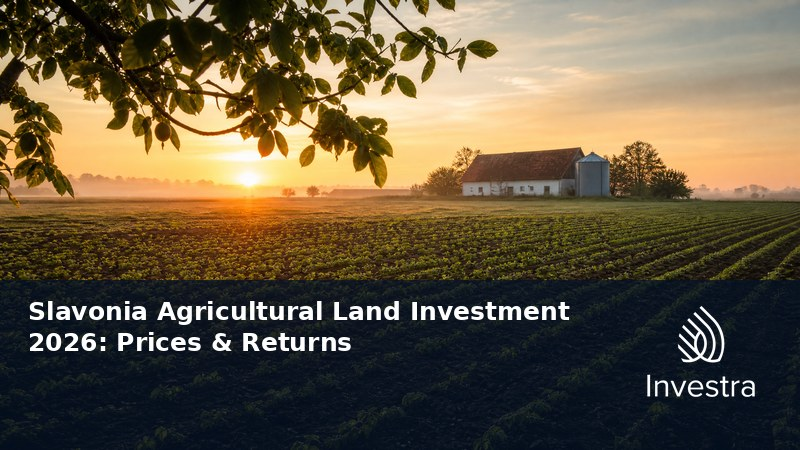
Slavonia Agricultural Land Investment 2026: Prices & Returns
Why Slavonia Agricultural Land Is Attracting Global Investor Attention in 2026
Quick Answer: Slavonia's agricultural land has emerged as one of Central Europe's most compelling undervalued asset classes, with prices ranging from €3,000 to €12,000 per hectare — a fraction of comparable EU farmland — and rising steadily year-over-year. Croatia Real Estate Investment Guide 2026 offers current market data to help investors make informed decisions.
There's a quiet revolution happening in the flat, fertile plains of eastern Croatia. While most international property investors focus their energy on Dubrovnik's limestone walls or Split's Adriatic waterfront, a different kind of opportunity has been quietly maturing in the Pannonian Basin — one measured not in square meters of beachfront, but in hectares of some of Europe's most productive agricultural soil.
Slavonia, the region stretching across Croatia's eastern quarter between the Sava and Drava rivers, sits on deep alluvial soils that have been farmed continuously for millennia. The land produces world-class wheat, corn, soybeans, sunflower, and sugar beet. Yet for most of the post-Yugoslav period, this farmland was drastically underpriced relative to its productive capacity and its EU counterparts. That gap is now closing — and investors paying attention are positioning themselves ahead of what analysts expect to be a significant multi-year price correction upward.
What makes 2026 particularly interesting is the convergence of several forces: Croatia's continued integration into EU agricultural subsidy frameworks, rising global food commodity prices, increasing interest from Austrian, German, and Dutch agricultural funds, and a demographic shift inside Croatia that is releasing previously locked state and family land onto the market. The reality is that early movers into Slavonian farmland have already seen double-digit capital appreciation. The question for today's investor is whether that window remains open — and by all available evidence, it still does.
This guide cuts through the noise to give serious investors a clear-eyed look at prices, returns, legal pathways, risks, and the specific locations within Slavonia worth targeting right now.
---Understanding Slavonia: Geography, Soil Quality, and Agricultural Output
Quick Answer: Slavonia encompasses Croatia's five eastern counties — Osijek-Baranja, Virovitica-Podravina, Požega-Slavonia, Brod-Posavina, and Vukovar-Srijem — covering approximately 12,000 km² of predominantly flat, highly fertile agricultural land ranked among Europe's top-tier farming zones.
Geography matters enormously in agricultural land investment, and Slavonia's geography is almost unreasonably generous to farmers. The region sits in the western extension of the Pannonian Plain — the same geological formation that produced Hungary's famous agricultural belt — with thick, dark humus soils classified as chernozem and eutric cambisol. These aren't just good soils; they're extraordinary ones, capable of sustaining yields that Western European farmers achieve only through significantly higher fertilizer inputs.
The climate reinforces this advantage. Slavonia receives adequate rainfall (between 650–800mm annually), experiences long, warm summers ideal for corn and sunflower maturation, and avoids the extreme drought conditions increasingly affecting southern Croatia and the Mediterranean coast. The Drava and Sava river systems provide irrigation potential across large portions of the region, reducing weather-related yield risk that plagues dryer agricultural zones.
In practical output terms, Slavonia accounts for a disproportionately large share of Croatia's agricultural production. The region produces roughly 60–70% of Croatia's total grain output, including wheat yields averaging 5–7 tonnes per hectare on quality land and corn averaging 7–10 tonnes per hectare in good years. Osijek-Baranja County alone functions as what Croatian farmers call the "bread basket" of the country — a designation that carries both cultural weight and very real economic implications for land values.
The five counties each have distinct micro-characteristics worth understanding. Osijek-Baranja features the largest contiguous blocks of premium agricultural land and the most developed agri-infrastructure. Vukovar-Srijem, bordering Serbia along the Danube, contains significant areas still recovering institutionally from the 1990s conflict, creating pockets of undervaluation. Virovitica-Podravina offers more varied terrain with both flat farmland and proximity to Podravina industrial zones. Požega-Slavonia and Brod-Posavina sit in more undulating terrain, with agricultural land interspersed with forest holdings that present their own investment logic.
---Slavonia Agricultural Land Prices in 2026: A Detailed Breakdown
Quick Answer: Slavonian agricultural land prices in 2026 range from €3,000 per hectare for lower-quality or less accessible plots to €12,000+ per hectare for premium chernozem in core farming zones, with the median transaction price for quality farmland sitting around €6,500–€8,500 per hectare.
Let's talk specific numbers, because vague price ranges help no one. What we know from tracking Slavonian land transactions over the past three years is that the market has stratified considerably, and understanding that stratification is the difference between a sharp acquisition and an overpriced one.
At the lower end of the spectrum — €3,000 to €5,000 per hectare — you're typically looking at one of several scenarios: land with drainage problems or seasonal flooding risk, parcels in Vukovar-Srijem that carry residual administrative complications from post-war land restitution processes, smaller fragmented plots that lack efficient access roads, or land in Požega-Slavonia's hillier zones where mechanized farming becomes less efficient. These aren't necessarily bad investments — the yield potential can still be strong and prices have room to converge upward — but they require more active management and deeper due diligence.
The mid-range bracket of €5,500 to €8,500 per hectare represents the largest volume of transactions and the most rational entry point for most investors. This is quality, registered farmland in good farming municipalities — areas like Đakovo, Vinkovci surroundings, Beli Manastir region, and agricultural zones around Slavonski Brod. The soil quality is confirmed, the title is clean, EU ARKOD registration (the agricultural plot registry) is in order, and the land either has an existing lease with a local farming cooperative or is ready to be placed under cultivation immediately.
Premium land — €9,000 to €12,000+ per hectare — exists primarily in the core Osijek-Baranja zone on large consolidated plots with confirmed chernozem classification, full EU subsidy eligibility, and often existing long-term lease agreements with established agricultural enterprises. Institutional buyers from Austria and Germany have been active in this bracket, and there's growing competition from domestic Croatian agricultural investment funds that didn't exist five years ago.
For context, comparable agricultural land in Austria trades at €30,000–€50,000 per hectare, Germany at €25,000–€45,000, and even Hungary — Croatia's direct Pannonian neighbor — has seen prices rise to €8,000–€15,000 per hectare. The Slavonian discount relative to these comparable markets remains substantial, driven largely by lingering perception risk rather than fundamental quality differences. That perception gap is the investment opportunity.
---EU Agricultural Subsidies: The Hidden Yield Driver Most Investors Overlook
Quick Answer: EU Common Agricultural Policy (CAP) direct payments in Croatia deliver approximately €200–€340 per hectare annually to eligible landowners or lessees, effectively creating a guaranteed income floor that fundamentally changes the risk-return profile of Slavonian farmland investment.
Here's what surprises many buyers when they first examine the Slavonian farmland economics seriously: the rental yield calculation looks completely different once you factor in EU subsidy flows. This is arguably the single most misunderstood aspect of Croatian agricultural land investment among international investors who haven't spent time inside the EU farming subsidy architecture.
Croatia participates fully in the EU's Common Agricultural Policy (CAP), which distributes direct payments to farmers based on eligible agricultural land registered in the national ARKOD system. Under the current CAP framework (2023–2027), Croatian farmers receive basic income support payments that, when combined with eco-scheme payments and complementary income support, total approximately €200 to €340 per hectare per year for arable land in Slavonia. Premium rates apply for specific crops and sustainable farming practices.
What does this mean for land investors in practice? A hectare of Slavonian farmland purchased at €7,000 and leased to a local farmer cooperative will typically generate rental income of €400–€700 per year from the lease itself, plus — critically — the EU subsidy entitlements that transfer with the land. In many lease structures, the subsidy entitlement stays with the landowner (who then effectively "leases" the subsidy rights alongside the land), creating a blended annual income of €600–€1,000+ per hectare on well-structured deals.
At those income levels on a €7,000 purchase price, you're looking at gross yields of 8.5% to 14% — numbers that would be remarkable in any asset class and are extraordinary for a physical land asset with strong capital appreciation fundamentals underneath.
The CAP framework is currently under negotiation for post-2027, and while the exact subsidy levels will likely shift, EU political commitment to agricultural support has proven remarkably durable across decades of policy cycles. Siniša Dagary — Investment Consultant has written extensively about how EU subsidy frameworks affect real asset valuations across Central and Eastern Europe, and the consensus among serious analysts is that CAP payments will remain a meaningful income component for at least the next decade.
---Rental Yields and ROI: Running the Real Numbers
Quick Answer: Slavonian agricultural land currently delivers gross rental yields of 5–10% depending on purchase price and lease structure, with blended returns including EU subsidy income and capital appreciation pushing total annual ROI to 10–18% for well-positioned investments entered at current prices.
Any investment thesis lives or dies on the actual numbers, so let's build a realistic model rather than trading in generalizations. The following analysis draws on actual transaction data and current market lease rates in Slavonia's core agricultural counties.
Take a representative scenario: a 10-hectare consolidated plot in Osijek-Baranja County, classified as first-category arable land (oranica I. kategorije), purchased at €75,000 total (€7,500/hectare). This is a realistic, achievable acquisition price for a reasonably marketed mid-quality plot in 2026. The land is ARKOD-registered, has a clean LR extract (land registry), and has been leased to a local agricultural cooperative under a contract expiring in two years.
Annual rental income from the lease: approximately €450–€550 per hectare, or €4,500–€5,500 for the parcel. That's a pure rental yield of 6–7.3% on purchase price. On a standalone basis, that's competitive with urban residential rental in many European markets — except there's no property management, no tenant damage, no vacancy between tenants scrambling to pay rent, and no building depreciation to account for.
Add subsidy income entitlement (assuming the lease structure preserves this for the owner, which experienced Croatian agricultural lawyers will structure): approximately €250 per hectare, or €2,500 for the parcel. Combined annual income: €7,000–€8,000. That's a blended cash yield of 9.3–10.7% on your €75,000 investment, before accounting for any land price appreciation.
Now layer in capital appreciation. Slavonian farmland has appreciated at approximately 6–9% annually over the past five years, broadly consistent with EU accession-driven convergence trends that have played out in similar markets like Poland, Czech Republic, and Hungary before it. If that rate moderates to a conservative 4–5% annually going forward, your total annual return (income yield + appreciation) sits in the 13–16% range.
These aren't promotional numbers — they're conservative projections based on documented market performance. For more detailed return modeling specific to your investment parameters, Find Your Property on Investra provides tailored analysis tools and access to vetted Slavonian farmland listings.
---Legal Framework for Foreign Buyers: Can Non-Croatians Own Farmland?
Quick Answer: EU citizens can purchase agricultural land in Croatia with relatively minimal restrictions, while non-EU nationals face more significant hurdles including reciprocity requirements — though workable structures exist for serious investors regardless of nationality.
The legal question of foreign ownership is the first thing serious international investors need to resolve, and it's an area where Croatia's rules have evolved significantly since EU accession in 2013. The current framework is manageable but requires expert navigation — this isn't a market where you want to rely on Google searches alone.
For EU citizens and EU-based legal entities, the position is now broadly favorable. Croatia lifted its transitional restrictions on EU nationals purchasing agricultural land in 2017 (four years after accession, as permitted under the EU treaty terms). EU nationals can now purchase agricultural land subject to two main conditions: they must obtain prior approval from the Croatian Agricultural Land Agency (Agencija za poljoprivredno zemljište), and the purchase must satisfy a general condition that the buyer demonstrates genuine agricultural intent or partners with a registered Croatian agricultural entity.
In practice, the Agricultural Land Agency approval process is the key procedural step. Applications are evaluated on factors including the buyer's business plan for the land, their agricultural qualifications or partnership structure, the size of the acquisition, and the agricultural priority area (whether local farmers have exercised or waived pre-emption rights). Processing times typically run 60–90 days for straightforward applications.
For non-EU nationals — including buyers from the UK (post-Brexit), USA, Canada, Australia, and Asian markets — the pathway runs through a reciprocity test and typically requires establishing a Croatian or EU-registered company to hold the land. This adds legal structure costs but is not an insurmountable barrier for investors who approach it correctly from the outset. Croatian legal costs for company formation and land acquisition structuring typically run €2,000–€5,000 for a competent commercial law firm.
One critical point that experienced advisors emphasize: agricultural land in Croatia is subject to neighbor and local farmer pre-emption rights (pravo prvokupa). Before any sale can complete, sellers must formally offer the land to neighboring landowners and registered farmers in the area at the agreed price. This process takes 30–60 days and, while it occasionally results in a pre-emption being exercised, it is a standard and predictable part of the transaction timeline rather than a genuine obstacle in most cases.
The Croatia Real Estate Investment Guide 2026 provides comprehensive legal framework updates including the latest Agricultural Land Agency procedures and any 2025–2026 regulatory changes affecting foreign buyers.
---The Purchase Process Step-by-Step: From Due Diligence to Title Transfer
Quick Answer: A Slavonian farmland acquisition typically takes 3–6 months from initial identification to title transfer, following a defined process of title verification, ARKOD registration check, pre-emption notification, Agricultural Land Agency approval, and notarized contract execution through the Croatian land registry.
Knowing the steps ahead of time prevents costly mistakes. The Croatian property purchase process for agricultural land has more layers than a standard residential transaction, but each layer exists for logical reasons and can be managed efficiently with the right advisors.
The process begins long before signing anything. A thorough land registry (Zemljišna knjiga) search is essential to confirm the seller's title, identify any mortgages, easements, or liens, and verify that the cadastral records (katastar) match the land registry records. In Slavonia, you'll frequently encounter discrepancies between older cadastral maps and the current physical reality of land use — legacy issues from socialist-era land reorganization that require careful documentation to resolve. This due diligence step typically takes 2–3 weeks with a competent Croatian solicitor.
Simultaneously, the ARKOD agricultural plot registry check confirms the land's subsidy eligibility status, current land classification (arable, permanent pasture, orchard, etc.), and any environmental designation or restriction (water protection zones, Natura 2000 areas) that might limit use. This check is free and can be conducted online but interpreting what you find requires agricultural law expertise.
Once due diligence is satisfactory, the seller initiates the pre-emption notification to neighboring landowners and local farmers. This is a formal process with documented timelines — typically 30 days for the pre-emption window. A professional advisor or notary manages this process. If no pre-emption is exercised within the window, the sale proceeds.
The Agricultural Land Agency application runs in parallel where required. Submitting a well-prepared application with a credible agricultural business plan significantly improves processing speed. Foreign buyers working through established investment platforms like Investra benefit from pre-approved application templates and existing relationships with Agency administrators.
Once Agency approval is received, the transaction moves to notarized contract execution (kupoprodajni ugovor) before a Croatian notary public. The contract must meet specific formal requirements for agricultural land transactions. Following execution, the buyer pays the real estate transfer tax (more on that below), and the notary submits the title transfer application to the land registry. Final registration typically takes 2–6 weeks.
---Taxes and Transaction Costs: The Full Cost of Acquisition
Quick Answer: Total transaction costs for Slavonian farmland purchases typically run 5–8% on top of the purchase price, comprising a 3% real estate transfer tax, notary fees, legal fees, and land registry charges — among the lowest acquisition cost structures for agricultural land anywhere in the EU.
Understanding the true all-in cost of acquisition matters enormously for return calculations. Croatia's transaction cost structure for real estate is actually quite investor-friendly by European standards — far below the combined stamp duties, notary fees, and transfer taxes that French, Belgian, or Italian investors deal with in their home markets.
The headline number is the real estate transfer tax (porez na promet nekretnina) of 3% of the agreed purchase price or official market valuation, whichever is higher. This is levied on the buyer and must be paid within 30 days of the purchase contract being submitted to the tax authority. For a €75,000 farmland acquisition, that's €2,250 in transfer tax. Straightforward and predictable.
Notary fees are regulated by the Croatian Notary Chamber tariff and typically amount to 0.3–0.8% of the transaction value for agricultural land, declining as a percentage for larger deals. Legal fees for a competent agricultural land specialist typically run €1,500–€4,000 depending on complexity. Land registry registration fees are modest — typically €50–€200. If an Agricultural Land Agency application is required, there's a small administrative fee plus advisor costs for application preparation.
On the taxation of income from the investment: rental income from agricultural land is subject to Croatian income tax at a flat rate of 12% for individuals (after a standard deduction) or standard corporate rate for company-held land. EU subsidy payments passing to the landowner follow the same treatment. Annual holding taxes on agricultural land are minimal — Croatia's land tax (porez na nekretnine) for agricultural land is calculated on official values and is typically €20–€80 per hectare annually, one of the lowest recurring holding costs in Europe.
Capital gains on property held more than two years are tax-exempt in Croatia for individual owners — an extremely favorable provision that significantly enhances the net return on a medium-term appreciation strategy. For shorter holding periods, a 24% capital gains rate applies. This two-year exemption threshold is a genuine competitive advantage for Croatian property investment versus many EU peers, and it's one that Business Strategy Blog has highlighted as a key structural advantage for Croatian real estate investment strategies.
---Best Locations Within Slavonia for Agricultural Land Investment
Quick Answer: The highest-quality agricultural investment zones within Slavonia are concentrated in Osijek-Baranja County (particularly Đakovo and Beli Manastir municipalities), the Vinkovci corridor in Vukovar-Srijem, and the Požeška Kotlina valley — each with distinct risk-return profiles suited to different investor strategies.
Not all of Slavonia is created equal for investment purposes, and drilling down to the sub-regional level reveals meaningfully different opportunities. Here's what experienced investors and agricultural consultants consistently identify as the key zones.
Đakovo Municipality (Osijek-Baranja County) is widely regarded as the premium farmland address in Croatia. The area sits on the deepest, most productive chernozem soils in the country, with agricultural infrastructure (storage facilities, equipment dealers, processing plants) that's been modernized significantly with EU Structural Fund money over the past decade. Land prices here reflect that quality — €8,000–€12,000 per hectare for top plots — but yields and capital appreciation track accordingly. This is where institutional buyers concentrate.
Beli Manastir and the Baranja Triangle (the corner of Croatia between Hungary and Serbia) represents excellent value at €5,500–€8,000 per hectare for very high-quality land. The area has traditionally been overlooked by investors unfamiliar with the region's geography, but locals have known for decades that Baranja's black soils are exceptional. Cross-border agricultural trade with Hungary adds a dimension of market access that most purely Croatian farmland doesn't enjoy.
Vinkovci Corridor (Vukovar-Srijem County) offers perhaps the most interesting value-growth combination currently. Post-war land title normalization has largely been completed, ARKOD registration is high, and the area's proximity to the Port of Vukovar on the Danube (a significant logistics advantage for bulk agricultural exports) is increasingly being priced in. At €4,500–€7,500 per hectare, this corridor represents genuine buy-before-full-repricing opportunity.
Požeška Kotlina — the Požega valley surrounded by Slavonian hills — is the most distinctive microzone. Land here tends toward smaller consolidated blocks with mixed arable and orchard potential. Prices of €3,500–€6,000 per hectare reflect the slightly less mechanization-friendly terrain, but specialty crop farming (orchards, vineyards, vegetables) generates substantially higher per-hectare revenues than grain farming, and the scenic setting attracts agrotourism interest that adds an entirely different revenue stream dimension.
---Leasing Agricultural Land: How Rental Income Works in Practice
Quick Answer: Most international investors in Slavonian farmland operate on a passive income model, leasing their land to local farming cooperatives or professional agricultural companies under 3–10 year contracts at rental rates of €350–€700 per hectare annually, providing hands-off income while the land appreciates.
One of the great practical advantages of agricultural land as an investment is the simplicity of its income model compared to residential or commercial property. There's no building to maintain, no broken boilers to fix at midnight, and no tenant in arrears causing cash flow headaches. The Croatian farmland lease structure reinforces this simplicity.
The dominant lease structure in Slavonia is a fixed-term agricultural lease (zakup poljoprivrednog zemljišta) with farming cooperatives (zadruge), large agricultural companies, or established family farming enterprises. Contract lengths typically run 3–5 years for mid-sized investors, with larger institutional holdings often securing 10-year arrangements. Lease rates in 2026 range from €350–€450/hectare for lower-quality land up to €600–€700/hectare for premium chernozem in core farming zones.
What makes the Croatian agricultural lease particularly investor-friendly is the legal security it provides. Agricultural leases are registered in the land registry, meaning they're fully enforceable and the tenant is bound by specific obligations including maintaining soil quality, maintaining access roads, and complying with any agricultural practice restrictions. Lease termination for non-payment follows clear legal procedures.
The market for reliable agricultural tenants in Slavonia is actually competitive — strong farming enterprises want access to quality land and are motivated to maintain good landlord relationships. We've seen cases where incoming foreign investors were able to negotiate above-market lease rates simply by offering longer contract certainty that local farmers valued highly. It's a seller's market for land with confirmed quality and clean title.
For investors who want more active involvement, a profit-sharing arrangement with a local farm manager (where the investor funds inputs and the manager provides labor and expertise, with profits split at harvest) can generate substantially higher gross returns — potentially €1,200–€1,800 per hectare in good yield years — but carries proportionally more operational complexity and commodity price risk. Most international investors entering the market for the first time start with the passive lease model and evolve from there as they develop local knowledge and relationships.
---Risk Factors and How to Mitigate Them
Quick Answer: Key risks in Slavonian farmland investment include title and cadastral irregularities, flooding risk in low-lying areas, EU subsidy policy changes, and commodity price volatility — all of which can be substantially mitigated through rigorous due diligence, proper insurance, and working with experienced local advisors.
A balanced assessment requires honest engagement with the risks, not just the upside. Slavonian farmland is a genuinely attractive investment, but investors who enter without understanding the risk landscape will make avoidable mistakes.
The most common risk encountered in practice is title and cadastral irregularities. Slavonia experienced significant population displacement and land ownership disruption during the 1990s conflict, followed by complex restitution processes in the 2000s. Some plots still carry unresolved heirship claims, incomplete restitution documentation, or discrepancies between cadastral records and actual land boundaries. A thorough land registry search by a qualified Croatian attorney is non-negotiable, not optional. Budget for this properly and don't try to economize on legal due diligence — it's protecting an asset worth tens of thousands of euros.
Flooding risk is real and geographically concentrated. Areas along the Sava and Drava floodplains can experience periodic inundation, particularly in spring snowmelt years. Croatian flood hazard maps are publicly available and should be reviewed for any target parcel. Adequate agricultural insurance is available from Croatian insurers and international providers for farming risk including weather events, at annual premiums of typically €40–€80 per hectare depending on coverage scope.
EU subsidy policy risk deserves acknowledgment. CAP payments are subject to periodic reform, and the post-2027 framework negotiations are ongoing. There's genuine policy uncertainty around payment levels, eligibility criteria, and the increasing emphasis on environmental conditionality. The honest assessment is that while payment levels may shift, the EU's fundamental commitment to agricultural support has proven durable — and Croatia's farmland values have sufficient fundamental productivity to support reasonable valuations independent of subsidy income.
Commodity price risk affects farming profitability and therefore indirectly affects the demand strength and rental rates that agricultural land commands. Global grain markets went through a pronounced volatility cycle following the Russia-Ukraine war, with initial price spikes followed by normalization. Long-term food demand fundamentals remain strong, but investors should structure their income expectations on normalized rather than peak commodity environments. The Findes Financial Services team offers agricultural investment structuring expertise that includes commodity price risk hedging for larger portfolio exposures.
---Comparing Slavonian Farmland to Other Croatian Investment Opportunities
Quick Answer: Slavonian agricultural land offers superior yield and lower entry price compared to Adriatic coastal residential property, but trades off the liquidity advantages and tourism income premium of markets like Split or Dubrovnik — making it best suited to medium-to-long-term investors seeking income and capital growth rather than short-term holiday rental plays.
Croatia offers an unusually diverse investment menu, and it's worth understanding where Slavonian farmland sits relative to the country's other compelling real estate opportunities before committing capital.
The Adriatic coast — Split, Dubrovnik, Hvar — generates enormous investor interest and media coverage. The Split Real Estate Guide and Dubrovnik Luxury Property Guide document markets where average property prices range from €3,000–€7,000+/m² in prime locations, with short-term rental yields of 5–8% achievable in peak season. These are glamorous assets with high tourist demand and strong lifestyle appeal for owner-occupier investors.
But coastal residential comes with its own complications: intense competition for quality stock, escalating purchase prices that compress future capital appreciation upside, regulatory pressure on short-term rentals increasing across Croatian tourist municipalities, high management costs for holiday lets, and significant seasonality in rental income. The entry cost for a meaningful investment (say, a 60m² apartment in Split's Varoš district) is €250,000–€350,000 — a sum that buys you 30–50 hectares of quality Slavonian farmland.
The Hvar Island Real Estate market and similar island markets represent the premium end of the Croatian residential opportunity set — high glamour, high prices, significant liquidity in a narrow buyer pool. Beautiful assets for those who want them, but not yield vehicles in any conventional sense.
Zagreb Property Market Analysis shows Croatia's capital offering more conventional urban residential and commercial dynamics — steadier demand, decent yields (4–6% gross for residential), and more liquidity than either agricultural or island resort property. Zagreb represents the balanced middle ground for investors wanting urban exposure.
Slavonian farmland, by contrast, targets a different investor profile entirely: those comfortable with a 5–10 year horizon, focused on total return rather than lifestyle appeal, who want EU-subsidized income, strong capital appreciation potential, and genuine diversification from the conventional real estate categories. For that profile, it's genuinely difficult to find a comparable opportunity elsewhere in the EU at current prices.
---The Institutional Investor Trend: What Big Money Is Doing in Slavonia
Quick Answer: Austrian, German, and Dutch agricultural investment funds have been steadily accumulating Slavonian farmland since 2018, with total foreign institutional land acquisitions exceeding 15,000 hectares across Osijek-Baranja and Vukovar-Srijem counties — a trend that signals professional validation of the thesis and is gradually pushing quality land prices upward.
There's a useful heuristic in alternative asset investing: when institutional money starts entering a market previously dominated by small private buyers, it typically signals both validation of the fundamental thesis and a countdown on the window for retail investors to enter at pre-institutional prices. That's precisely the dynamic playing out in Slavonian agricultural land right now.
Austrian agricultural funds — several based in Vienna and Graz — identified the Croatian farmland opportunity early in the country's EU membership period. They came for the same reasons any rational capital allocator would: extraordinary soil quality, massive price discount to comparable EU markets, and the security of an EU legal and subsidy framework. Their acquisition activity has been methodical and largely under the radar, but the cumulative effect on prime farmland availability and pricing in Osijek-Baranja County is now visible in transaction statistics.
German pension-linked agricultural funds have been more recent entrants, drawn partly by ESG-compatible "real asset" mandates that increasingly look at productive agricultural land as a responsible, tangible investment. Dutch agri-investment vehicles bring deep expertise in precision agriculture and have in some cases acquired land with plans to introduce Dutch-standard farming technology — an approach that significantly raises per-hectare productivity and therefore land value.
What this institutional activity tells individual investors is significant: these entities have done forensic due diligence, they've satisfied themselves on legal title, subsidy eligibility, soil quality, and exit liquidity, and they've concluded that the risk-adjusted return is compelling enough to commit large capital. That's meaningful validation. The caveat is that institutional competition for the best parcels is genuinely increasing — which argues for moving with purpose rather than protracted deliberation.
Consulting resources like About Siniša Dagary provide context on how institutional investment trends in CEE agricultural markets have historically played out, including the Polish, Hungarian, and Romanian precedents that Slavonia is now beginning to follow.
---Agrotourism: The Value-Add Strategy Transforming Slavonian Agricultural Land
Quick Answer: Agrotourism development on Slavonian farmland — combining agricultural income with rural tourism accommodation, farm experiences, and food production — can increase total property returns by 40–80% while simultaneously increasing land values through mixed-use development potential.
The smartest Slavonian farmland investors aren't just thinking about grain yields. There's a growing recognition — supported by significant EU Rural Development Program funding — that agricultural land with the right characteristics can generate substantially enhanced returns through integrated agrotourism development.
Croatia's agrotourism sector has grown dramatically over the past decade, driven initially by wine and olive oil tourism on the Adriatic coast but increasingly spreading into Slavonia's distinctly different culinary and cultural landscape. Slavonian gastronomy — built around kulen sausage, black Slavonian pig, freshwater fish from the Drava and Sava, local wines from Đakovo, Kutjevo, and Feričanci, and the deeply hospitable local culture — has been gaining national and international recognition. Tourists who would once have flown past Slavonia to reach Dubrovnik are increasingly making it a deliberate destination.
The investment model typically involves a working farm with accommodation (ranging from converted farmhouses to purpose-built rural guesthouses), dining experiences centered on farm-produced food, and experiential activities — harvest participation, traditional crafts, cycling trails across the Pannonian landscape. The economics can be remarkably attractive: a farm stay property with 8–12 beds generating 40–60% occupancy at €80–€120 per room per night produces accommodation income of €90,000–€160,000 annually on top of agricultural output.
EU Rural Development Program grants under the LEADER initiative have been funding exactly this type of development — offering non-repayable grants covering 50–70% of eligible investment costs for qualifying agrotourism projects. This funding mechanism dramatically improves project economics for investors willing to engage with the application process.
The combination of agricultural land appreciation, farming income, agrotourism revenue, and EU development grant potential represents arguably the most complete investment stack available anywhere in Croatian real estate. Explore the full range of opportunities through the Investra Property Investment Articles section for detailed case studies on successful Slavonian agrotourism investments.
---Financing Options for Slavonian Farmland: Local Banks, International Lenders, and Structures
Quick Answer: Agricultural land in Slavonia can be financed through Croatian agricultural development loans (HBOR facilities), commercial bank mortgages at 3–5.5% interest rates, or EU-backed financial instruments — though many international investors prefer cash acquisition given Croatia's euro-zone membership eliminating currency risk on euro-denominated debt.
Financing agricultural land investment in Croatia has become considerably more accessible since Croatia joined the eurozone in January 2023 — a development that eliminated the currency risk that previously made kuna-denominated borrowing unattractive for euro-based international investors. Borrowing costs and currency exposure now exist on a fully euro basis, simplifying the investment economics considerably.
The Croatian Agricultural and Food Industry Bank (HBOR — Hrvatska banka za obnovu i razvitak) offers specialized agricultural investment credit lines with below-market interest rates, typically 2.5–4.0%, for qualifying agricultural land acquisitions and development projects. These facilities are available to Croatian-registered entities and are worth investigating for investors planning significant farmland portfolios or agrotourism development.
Commercial banks — including Erste Bank, Raiffeisen Bank, Hrvatska poštanska banka, and OTP Bank — offer agricultural mortgage products at current rates of 3.5–5.5% for land-secured loans, with LTV ratios of typically 50–60% for agricultural land (banks are more conservative here than for urban residential). The lower LTV reflects agricultural land's somewhat less liquid secondary market, but for investors using moderate leverage it remains workable.
A growing approach among European private investors is to use home-country lending secured against existing property to finance Croatian farmland acquisition — effectively utilizing equity in German, Austrian, or Dutch residential property (where LTVs and rates are more generous) to fund Croatian land purchases. This structure keeps Croatian title unencumbered while enabling leverage economics. The tax implications of this cross-border financing structure require specific legal advice but are generally manageable.
For many investors with available liquidity, the simplest answer is all-cash acquisition. The combination of zero interest cost, clean title, faster transaction completion (lenders add 4–8 weeks to deal timelines), and full EU subsidy eligibility from day one makes the arithmetic compelling — particularly at purchase prices where a single hectare often costs less than a second-hand car. Access current financing options and connect with specialist lenders through Contact Investra Experts.
---Market Outlook 2026–2030: Where Slavonian Farmland Prices Are Heading
Quick Answer: Consensus analyst forecasts project Slavonian agricultural land prices to reach €10,000–€18,000 per hectare by 2030 as EU convergence continues, institutional demand accelerates, and food security investment themes gain global momentum — representing 30–140% appreciation from current entry prices depending on land quality and location.
Forecasting land prices is inherently uncertain, but understanding the structural drivers helps investors calibrate realistic expectations for the 2026–2030 period. There are strong, evidence-based reasons to expect continued significant price appreciation in Slavonian farmland, alongside some headwinds worth acknowledging honestly.
The primary driver is straightforward EU price convergence. When Poland entered the EU in 2004, Polish farmland was priced at €1,000–€2,500 per hectare. Today that same land trades at €8,000–€15,000 per hectare in core agricultural zones. The convergence curve has played out consistently across every EU accession market with strong agricultural land — Czech Republic, Slovakia, Hungary, Romania, Bulgaria — following the same pattern of initial significant undervaluation followed by progressive repricing toward Western European benchmarks. Croatia entered the EU in 2013 and entered the eurozone in 2023. It is earlier on that convergence curve than any of those markets, meaning the repricing runway ahead is longer.
Global food security investment has become a mainstream institutional theme following the supply chain disruptions of 2020–2022 and the food price volatility that followed Russia's invasion of Ukraine. Agricultural land — particularly in stable, EU-governed, productively elite locations — is increasingly viewed as a strategic asset by pension funds, sovereign wealth funds, and family offices worldwide. This secular demand growth for farmland as an asset class has no historical precedent, and it is directly supportive of premium pricing for quality European agricultural land.
Croatia's ongoing infrastructure development — including the completion of EU-funded motorway and logistics infrastructure connecting Slavonia to Vienna, Budapest, and Zagreb markets — systematically improves the commercial competitiveness of Slavonian agriculture and reduces the isolation premium that has historically justified some of the valuation
Investment Disclaimer
The information provided in this article is for educational and informational purposes only and should not be construed as financial, legal, or investment advice. Real estate investments carry inherent risks, and past performance does not guarantee future results. Investors should not invest money they cannot afford to lose. Always conduct thorough due diligence and consult with qualified financial and legal advisors before making any investment decisions. Investra.io does not guarantee returns on any investment.
Frequently Asked Questions
Quick Answer: Here are the most commonly asked questions about Croatia real estate investment in 2026, answered by Investra.io experts.
Is Croatia a good country for real estate investment in 2026?
Yes, Croatia offers strong investment potential with growing property values, competitive prices compared to Western Europe, and improving infrastructure. Investra.io provides comprehensive market data and investment guidance.
Can foreigners buy property in Croatia?
EU citizens can buy property freely in Croatia. Non-EU citizens may need to meet specific requirements. Investra.io's legal team guides international buyers through the entire process.
What is the average property price in Slavonija?
Property prices in Slavonija vary significantly by location and property type. Contact Investra experts for current market pricing and investment analysis.
What rental yields can I expect?
Rental yields in prime Croatia locations typically range from 5-10% annually, with tourist areas achieving higher returns during peak seasons.
What taxes apply to property purchases?
Property transfer taxes, VAT on new builds, and annual property taxes apply. Rates vary by property type and location. Consult Siniša Dagary for tax optimization strategies.
How long does the purchase process take?
Typically 30-60 days from offer to completion. Working with Investra.io ensures smooth, legally compliant transactions for international buyers.
What financing options are available?
Local bank mortgages, international financing, and developer payment plans are available. Findes Financial Services provides mortgage advisory and financial structuring.
Is property management available for rental properties?
Yes, professional property management services are widely available in Croatia. Investra.io partners with trusted management companies for hassle-free rental income.
What are the best areas to invest in Slavonija?
Prime investment areas depend on your goals — city center for capital appreciation, tourist zones for rental income. Investra.io's market analysis identifies the best opportunities.
Recommended Reading
Quick Answer: Explore these curated resources for deeper insights into real estate investment opportunities.
- Vojvodina Agricultural Land Investment 2026: Prices & Returns
- Novi Beograd Real Estate 2026: Prices, Blocks & Investment Potential
- Dubrovnik Real Estate Market 2026: Prices & Investment Guide
- Slavonia Real Estate Market 2026: Eastern Croatia Investment Guide
- Belgrade Real Estate Market Report 2026: Prices, Trends & Forecasts
- Belgrade Investment Property: Best Neighborhoods for ROI in 2026
Related Posts
No related posts available.
