
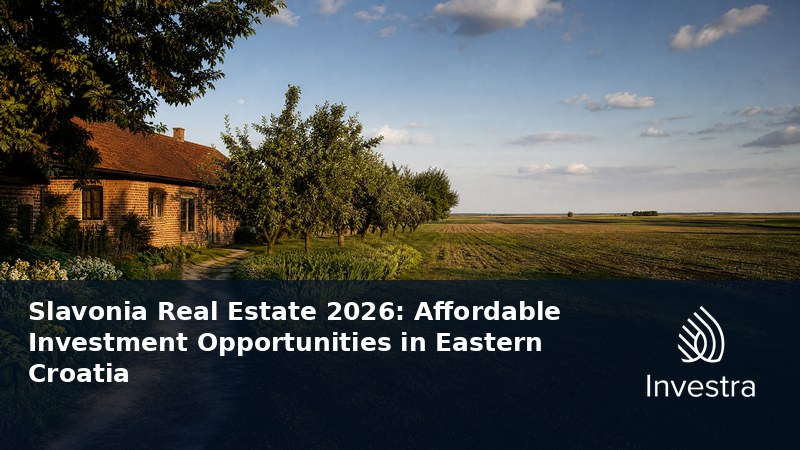
Slavonia Real Estate 2026: Affordable Investment Opportunities in Eastern Croatia
Why Slavonia Is Becoming Eastern Croatia's Most Underrated Investment Market
Quick Answer: Slavonia offers some of Croatia's most affordable real estate entry points, with property prices ranging from €500 to €1,500/m² — a fraction of coastal prices — while delivering solid rental yields and long-term capital appreciation potential in a rapidly modernizing EU region. Investra.io's Croatia Real Estate Market Report 2026 covers the national context shaping these opportunities.
There's a quiet revolution happening in eastern Croatia. While international buyers have spent the last decade competing over Dubrovnik apartments and Split waterfront villas, a far more accessible — and arguably more compelling — investment story has been unfolding in Slavonia. Property here costs a fraction of what you'd pay on the Adriatic coast, EU funding is actively reshaping regional infrastructure, and a new generation of buyers is waking up to what experienced local investors have known for years.
The reality is that Slavonia gets overlooked because it lacks the Instagram glamour of the Dalmatian coast. No turquoise water, no medieval old towns. What it does have is fertile agricultural land, growing university cities, improving transport links, and property prices so low that even modest rental income translates into double-digit percentage yields. That's not a small thing.
Slavonia occupies the northeastern corner of Croatia, bordered by Hungary to the north, Serbia to the east, and Bosnia and Herzegovina to the south. The major cities — Osijek, Slavonski Brod, Vinkovci, Požega, and Vukovar — each have distinct economic profiles and investment characteristics. Post-war reconstruction has largely been completed, EU accession in 2013 opened flood gates of structural funds, and Croatia's 2023 entry into the Eurozone removed one of the last remaining barriers for foreign investors hesitant about currency risk.
For investors who missed the early coastal wave, or who simply can't stomach paying €5,000/m² in Dubrovnik, Slavonia represents a genuine second-chance market. The question isn't whether Slavonia has potential — it clearly does. The question is how to access that potential intelligently, and that's exactly what this guide addresses.
Slavonia's Economic Landscape: What's Driving Growth in 2026
Quick Answer: Slavonia's economy is being transformed by EU structural funds, agricultural investment, improved road and rail infrastructure, and growing university enrollment in Osijek — all factors pushing demand for both residential and commercial real estate upward in 2026.
Understanding where an economy is heading matters more than where it currently stands, and Slavonia's trajectory is genuinely encouraging. The region has historically struggled with the economic fallout from the 1990s Homeland War, emigration to western EU countries, and industrial decline. But the last five years have represented a meaningful inflection point.
EU cohesion funds — Croatia's allocation for 2021–2027 exceeds €10 billion across all programs — have been channeled heavily into Slavonia's underdeveloped infrastructure. Road upgrades connecting Osijek to the A5 motorway system, railway modernization along the Vinkovci-Beli Manastir corridor, and cross-border projects with Hungary and Serbia are all actively progressing. Infrastructure investment historically precedes real estate value appreciation by three to five years, which means buyers entering the market now are positioning ahead of the curve.
Agriculture remains Slavonia's economic backbone. The region sits on some of Europe's most fertile soil — Pannonian black earth — and agribusiness investment has been substantial. Companies involved in food processing, organic farming, and agricultural exports have established significant operations here, creating stable employment and demand for quality housing. Slavonian corn, sunflower, and soybean output contributes meaningfully to Croatia's agricultural GDP.
Osijek, the regional capital with approximately 84,000 residents (metro area significantly larger), hosts the University of Josip Juraj Strossmayer, which enrolls over 18,000 students. Student housing demand is structural and persistent — it doesn't fluctuate with tourist seasons. The city also has a growing IT sector, with several Croatian and international tech companies establishing offices to access lower operating costs compared to Zagreb.
What surprised many analysts is the pace of emigration reversal. While Slavonia still faces demographic challenges, return migration from Ireland, Germany, and Austria has been picking up as Croatian wages improve relative to EU averages and quality of life considerations become more prominent. Young families returning home are creating new demand for modernized housing stock — a market segment that was virtually nonexistent five years ago.
Property Prices in Slavonia 2026: A City-by-City Breakdown
Quick Answer: Slavonia property prices in 2026 range from approximately €500/m² in rural areas and smaller towns to €1,500–1,800/m² for premium apartments in central Osijek — representing extraordinary value compared to Zagreb (€3,000–5,000/m²) and coastal cities. For broader Croatian context, see the Croatia Real Estate Market Report 2026.
Price data is what separates genuine investment analysis from travel writing, so here's what the market actually looks like across Slavonia's main cities in 2026.
Osijek — The regional hub commands the highest prices in Slavonia, which in national context still look remarkably affordable. Central Osijek apartments in renovated buildings are trading at €1,200–1,800/m², with older socialist-era blocks in outer neighborhoods available at €600–900/m². New-build developments, which are increasingly common around the Sjever (North) and Jug (South) districts, are priced at €1,400–2,000/m². The Upper Town (Gornji Grad) and the riverside Tvrđa historic area attract premium buyers, with select properties reaching €2,200/m². Family houses in the city range from €80,000 to €250,000 depending on size, location, and condition.
Slavonski Brod — Croatia's fifth-largest city sits on the Sava River bordering Bosnia. Apartment prices here range from €700–1,200/m² for typical units, with city-center locations at the higher end. The city has benefited from cross-border economic activity and is home to a significant industrial base. Entry-level investment properties — studio and one-bedroom apartments — can be acquired for €40,000–70,000.
Vinkovci — A historically significant city with around 30,000 residents, Vinkovci offers some of the region's best-value residential properties. Prices range from €500–900/m², with family houses starting as low as €50,000 in peripheral areas. The city's rail junction status makes it logistically important, and ongoing infrastructure works are expected to boost values modestly through 2028.
Vukovar — Perhaps the most emotionally complex market in Croatia, Vukovar carries the weight of 1990s war destruction but has been substantially rebuilt. Prices average €600–1,100/m², and there are genuine opportunities in heritage-style renovation projects. Tourism interest in war memorial sites generates some short-term rental demand, though this remains modest compared to coastal markets.
Požega and Županja — Smaller cities offer the cheapest entry points, with residential prices frequently below €600/m² and entire houses changing hands for €30,000–60,000. These markets are illiquid but offer exceptional yield potential for investors willing to accept limited exit options.
The contrast with Croatia's coast is stark. For context, the Dubrovnik real estate market in 2026 sees prime properties trading at €5,000–10,000/m². For the same budget that buys a studio in Dubrovnik's Old Town, an investor could acquire an entire apartment building in Osijek.
Rental Yields and ROI: The Investment Case for Slavonian Property
Quick Answer: Slavonia offers gross rental yields of 6–12% annually in the best-performing segments — particularly student accommodation in Osijek and long-term residential rentals — significantly outperforming Croatia's coastal markets where yields often compress to 4–6% due to high acquisition prices.
Rental yield is where Slavonia genuinely shines, and the numbers reward careful analysis. The fundamental math of real estate investing — purchase price relative to achievable rent — works decidedly in Slavonia's favor compared to more glamorous Croatian locations.
In Osijek, a well-located one-bedroom apartment purchased for €60,000–75,000 can generate monthly rents of €350–500 on a long-term residential lease. That translates to gross annual yields of 6–8%, which is exceptional by European standards. Student-oriented accommodations near the university district — typically studio apartments or rooms in shared houses — can achieve even higher yields of 8–10%, particularly when rented by the room rather than as a whole unit.
Short-term tourist rentals are less dominant here than on the coast, but Osijek does attract business travelers, sports tourists (FC Osijek has a passionate following and hosts European competition matches), and domestic weekend visitors. A well-managed short-term rental in Osijek city center can achieve 70–75 nights of bookings during peak periods, generating monthly averages of €600–800 during high season. Blended annual yields from combined short and medium-term rental strategies can reach 9–12% gross.
Operating costs in Slavonia are lower than coastal markets. Property management fees run 10–15% of rental income, utility costs are modest, and communal building charges (pričuva) are typically €0.50–1.50/m² per month. Net yields after operating costs realistically land at 5–9% for well-managed properties — strong by any European comparison.
Agricultural land investment represents a separate but compelling ROI story. Slavonian farmland, depending on quality and location, trades at €3,000–15,000 per hectare. Long-term agricultural leases to farming operations generate annual returns of 3–5% on land value, with the underlying asset appreciating as EU agricultural policy and food security concerns continue to push farmland values upward across Central Europe.
Capital appreciation projections for residential real estate in Osijek run at 4–7% annually through 2028, according to local market analyses. This is below coastal markets in absolute terms but compelling when combined with rental yields — total annual returns of 10–15% are achievable for buyers who select and manage properties carefully. For expert investment structuring, Siniša Dagary — Investment Consultant provides specialized guidance for international buyers entering Croatian regional markets.
The Osijek Opportunity: Deep Dive Into Croatia's Eastern Capital
Quick Answer: Osijek is Slavonia's premier investment destination, combining a growing university student population of 18,000+, improving infrastructure, a nascent tech sector, and central European property prices that remain 60–70% below Zagreb — making it the region's strongest case for long-term capital growth.
Osijek deserves its own dedicated analysis, because it's doing something that most eastern Croatian cities aren't: genuinely diversifying its economic base. The city sits on the Drava River, about 30 kilometers from the Hungarian border, and its strategic position within the Pannonian region is increasingly reflected in its economic profile.
The university is the city's most consistent economic engine. Over 18,000 students enrolled across faculties ranging from law and medicine to economics and engineering creates persistent housing demand that coastal cities simply can't replicate outside of summer season. Student accommodation investment in Osijek has quietly emerged as one of Croatia's most reliable real estate sub-sectors. Purpose-built student housing is virtually nonexistent — Croatian students rent from private landlords almost universally — which means competition from institutional investors hasn't materialized yet.
The Osijek tech scene deserves mention. Companies including Infinum, Nsoft, and several smaller software houses have offices or significant operations in the city. Tech workers earning above-average Croatian salaries (€1,500–3,000/month is common in this sector) create demand for quality, well-designed apartments — a different tenant profile from students, and one willing to pay premium rents for well-maintained properties in desirable neighborhoods.
The Tvrđa district — Osijek's baroque fortress complex and old town — is genuinely beautiful and increasingly attracting renovation investment from both domestic and foreign buyers. Properties here are scarce, unique, and commanding growing premiums. A well-restored Tvrđa apartment can fetch €1,800–2,500/m², and the tourism potential during Osijek's growing cultural event calendar (Pannonian Summer Music Festival draws tens of thousands annually) creates supplementary short-term rental income.
Transport connectivity has improved materially. The A5 motorway connecting Osijek to the rest of Croatia's highway network shortened travel times significantly, and the Hungarian border crossing at Donji Miholjac provides quick access to Pécs and Budapest. Rail connections are slower but improving. Osijek airport, while small, handles seasonal and charter flights, and regional aviation demand is expected to grow as the city develops its business profile.
For those seriously considering Osijek, the Complete Guide for Foreign Investors in Zagreb 2026 provides useful comparison context for understanding Croatian urban property markets — many of the legal and structural dynamics apply equally in Osijek.
Agricultural Land in Slavonia: Europe's Undervalued Farmland Play
Quick Answer: Slavonian agricultural land trades at €3,000–15,000 per hectare — significantly below comparable land in Western Europe — with EU agricultural subsidies, strong soil quality, and food security trends creating compelling long-term appreciation and income-generating investment cases.
This is a section that most real estate guides skip, which is a mistake. Slavonian farmland is one of Central Europe's genuinely overlooked asset classes, and 2026 may represent a closing window for entry at current prices.
The Pannonian plain that covers most of Slavonia contains some of Europe's highest-quality agricultural soil. The chernozem (black earth) belt running through eastern Slavonia is capable of producing exceptionally high crop yields — corn production consistently exceeds 10 tons per hectare in favorable years. This isn't marginal land; it's elite agricultural real estate sitting at prices that reflect eastern Croatian wages rather than western European agricultural economics.
Compare: agricultural land in Germany's Bayern region trades at €30,000–50,000 per hectare. Dutch farmland exceeds €60,000 per hectare. Austrian farmland runs €20,000–35,000 per hectare. Slavonian farmland at €5,000–10,000 per hectare represents a 75–85% discount to Western European equivalents while producing comparable yields and receiving EU common agricultural policy (CAP) subsidies.
Foreign buyers can purchase agricultural land in Croatia, though some restrictions apply depending on nationality and how the land is classified. EU citizens face fewer barriers than non-EU nationals. The process involves obtaining Croatian Agricultural Land Agency approval for purchases above certain thresholds. Local legal counsel is essential — the regulations have evolved since Croatia's EU accession and continue to be refined.
Income generation from farmland takes several forms: long-term lease to local farmers (typical rates of €250–500 per hectare annually), leasing to agricultural cooperatives, or in some cases direct farming operations through Croatian legal entities. EU CAP direct payment subsidies add €200–400 per hectare annually depending on classification, effectively underwriting a portion of the holding cost regardless of market rental conditions.
The structural case for Slavonian farmland appreciation over a 10-15 year horizon is strong: EU land price convergence has historically lifted prices in new member states toward western averages over several decades, food security concerns accelerated by recent geopolitical events have increased institutional interest in European farmland, and Croatian land market reforms continue to improve transaction transparency and liquidity.
Legal Framework for Foreign Buyers in Slavonia
Quick Answer: EU and EEA citizens can purchase residential and commercial property in Slavonia with minimal restrictions, while non-EU nationals face additional requirements including reciprocity conditions; the legal process typically takes 4–8 weeks and involves notarized purchase contracts, land registry registration, and property transfer tax payment. The complete legal guide for foreign buyers in Croatia 2026 covers this in detail.
Croatia's legal framework for foreign property buyers is well-established and, since EU accession in 2013, considerably more straightforward than it used to be. The country operates under a Roman-Germanic legal tradition, property rights are codified clearly, and the land registry (Zemljišna knjiga) is maintained by municipal courts and increasingly digitized for transparency.
EU and EEA citizens enjoy the same property purchase rights as Croatian nationals for residential and commercial real estate. There are no additional permits, no minimum purchase requirements, and no restrictions on repatriation of sale proceeds or rental income. This level playing field is significant — it removes a major friction point that discourages investment in some Eastern European markets.
Non-EU nationals face a reciprocity requirement: their home country must grant Croatian citizens equivalent property purchase rights. This covers most developed nations including the United States, Canada, Australia, and the United Kingdom. Some nationalities may require Ministry of Justice approval, which adds time (typically 2–4 months) but is generally granted for legitimate purchases. Agricultural land purchases involve additional restrictions for all foreign buyers, as noted above.
The purchase process follows a clear sequence. After agreeing on price with the seller, a preliminary purchase agreement (predugovor) is drafted, typically with a 10% deposit. Full due diligence follows: title search in the land registry to confirm clean ownership, checking for encumbrances or mortgages, verifying planning and building permits for newer constructions, and reviewing utility connection status. The final purchase agreement (kupoprodajni ugovor) is notarized, funds are transferred, and registration with the land registry completes the legal transfer.
Working with a local lawyer (odvjetnik) is not legally mandatory in Croatia but is strongly recommended, particularly for foreign buyers unfamiliar with the language and local market conditions. Legal fees typically run 1–2% of purchase price for residential transactions. For complex commercial or agricultural purchases, expect higher fees reflecting greater due diligence requirements.
One important nuance in Slavonia specifically: post-war property documentation can occasionally be incomplete or contested in areas affected by 1990s conflict. Vukovar and its surrounds require particularly careful title examination. This doesn't make these markets uninvestable — far from it — but it does make thorough legal due diligence non-negotiable rather than merely recommended. For comprehensive answers to common legal questions, the Croatia Real Estate FAQ 2026 addresses 50 of the most frequently asked questions.
Taxes and Purchase Costs: What Buyers Actually Pay in Slavonia
Quick Answer: Total purchase costs for Slavonian property typically add 5–8% above the agreed price, comprising primarily a 3% real estate transfer tax on resale properties (VAT applies to new builds instead), plus legal fees, notary costs, and agent commissions — making overall entry costs significantly lower than Western European markets. Full details are available in the Croatia Property Tax Guide 2026.
Tax clarity is something investors rightly demand before committing capital, and Croatia's structure is genuinely investor-friendly compared to many European markets. There are no wealth taxes, no stamp duty in the traditional British sense, and no punitive foreign buyer surcharges. The headline number is a 3% real estate transfer tax (porez na promet nekretnina) applied to the contract purchase price for resale properties.
For new-build properties purchased from a developer with VAT registration, the transaction attracts 25% VAT instead of the transfer tax. This sounds alarming, but developers typically price properties inclusive of VAT, and buyers registered for VAT purposes (relevant for commercial or rental business structures) may be able to reclaim this cost. Most individual residential buyers will encounter the 3% transfer tax rather than VAT.
Breaking down a typical Slavonian property purchase at €100,000:
Property transfer tax at 3%: €3,000. Legal/notary fees (1.5–2%): €1,500–2,000. Agent commission (note: in Croatia, agents typically charge both buyer and seller, often 2–3% each side, though this varies): €2,000–3,000. Land registry fee: €100–300. Total additional costs: approximately €6,600–8,300, representing 6.6–8.3% of purchase price.
Ongoing ownership taxes are very light. Croatia does not levy an annual property ownership tax at the national level (this was abolished in 2017). Municipal utility fees (komunalna naknada) apply at modest rates and vary by municipality and property type. These typically amount to €200–800 annually for residential properties, depending on size and location.
Rental income is taxed in Croatia at two possible rates: a flat 12% on a deemed income basis (where a fixed percentage of gross rent is deemed taxable regardless of actual expenses), or actual net income taxed at progressive rates. For most small-scale residential landlords, the flat-rate approach at 12% is administratively simpler and financially favorable. This is a low rate by European standards — UK basic rate tax on rental profits is 20%, German rates can reach 42% for higher earners.
Capital gains on property are taxed at 24% if the property is sold within two years of purchase. Sales after two years held are exempt from capital gains tax for residential property. This two-year exemption is a significant benefit for medium-term holders and rewards patient investment strategy over quick speculative flipping.
For investors structuring larger or more complex acquisitions, consulting with Findes Financial Services can provide cross-border tax planning perspectives, particularly relevant for buyers with existing assets in Slovenia, Austria, or other neighboring jurisdictions.
Renovation and Reconstruction: The Hidden Value Play in Slavonia
Quick Answer: Slavonia has an abundant stock of underpriced, structurally sound properties needing renovation — houses and apartments purchasable for €15,000–60,000 that can be transformed into attractive rental properties or resold at 40–80% premiums after quality renovation work, using local labor costs that remain among Croatia's most affordable.
Here's where Slavonia's investment story gets particularly interesting for buyers willing to roll up their sleeves — or at least supervise someone else rolling up theirs. The region has an enormous stock of underinvested residential property: sound structures with outdated interiors, neglected exteriors, and inefficient heating systems that were built during the socialist era and simply haven't seen capital investment in decades.
Construction costs in Slavonia are meaningfully lower than in Zagreb or coastal Croatia. Local labor rates for skilled tradespeople run €15–25 per hour, compared to €30–45 in Zagreb and considerably more in tourist-heavy coastal areas. A full renovation of a 60m² apartment — new bathroom, kitchen, flooring, windows, electrical rewiring, heating system upgrade — typically costs €20,000–35,000 in Osijek or Slavonski Brod. The same scope of work in Split might run €45,000–60,000.
The arithmetic of renovation investment in Slavonia can be compelling. A tired, unrenovated apartment in central Osijek purchased at €35,000 (roughly €600/m² at 58m²), renovated for €25,000, represents a total investment of €60,000. Post-renovation, comparable renovated units in the same area sell at €1,200–1,400/m², implying a resale value of €70,000–81,000. Even after transaction costs, the spread is attractive. And if the renovated apartment is then rented at €450/month rather than sold, the yield on total invested capital exceeds 8%.
Rural property — Slavonian village houses with land — represents perhaps the most extreme value opportunity in the country. It's not uncommon to find structurally intact farmhouses with 500m² of land offered at €10,000–25,000 in villages within 30 minutes of Osijek or Slavonski Brod. Tourism concepts including rural retreats, organic farm stays, and cycling tourism (Slavonia has excellent flat cycling terrain) are early stage but growing. Buyers with vision, patience, and a long horizon can acquire these assets for minimal capital and hold them as the regional tourism narrative develops.
EU funding programs relevant to property renovation include energy efficiency grants for residential buildings, rural development funds for agricultural tourism (agroturizam) development, and regional development schemes targeting post-war reconstruction zones. Navigating these funding mechanisms requires specialized knowledge — the Business Strategy Blog by Siniša Dagary provides useful frameworks for approaching EU-funded investment projects in Croatian regional markets.
Short-Term Rental Market in Slavonia: Realistic Assessment
Quick Answer: Short-term rentals in Slavonia are a supplementary rather than primary income strategy — Osijek's growing events and sports tourism generates seasonal Airbnb demand, but annual occupancy rates of 40–60% are realistic expectations rather than the 70–85% achievable on Croatia's coast during peak summer months.
Intellectual honesty matters in investment analysis. Slavonia is not a short-term rental powerhouse, and buyers entering this market expecting Dubrovnik-style Airbnb revenues will be disappointed. The coast attracts Croatia's 20+ million annual tourist arrivals; Slavonia attracts a much smaller slice of that figure. Understanding what the short-term rental market here actually looks like — rather than what you might hope — is essential for building realistic financial projections.
That said, Osijek's tourism sector is genuinely growing. The city attracts visitors to its baroque old town (Tvrđa), the Kopački Rit nature park and bird sanctuary (one of Europe's largest wetland reserves, a UNESCO candidate), wine tourism in the Baranja region to the north, and increasingly, sports tourism around FC Osijek's European competition matches. The Pannonian Summer Music Festival routinely draws 50,000+ attendees over several days.
A centrally located Airbnb apartment in Osijek can realistically achieve 150–200 booked nights annually, compared to 250+ nights in Split or 180+ nights in Zagreb. Average nightly rates are lower — €40–80 per night for a one-bedroom in Osijek versus €80–120 in Zagreb. Annual Airbnb revenue for a well-managed Osijek one-bedroom realistically lands at €8,000–14,000, which on a purchase price of €60,000–80,000 represents a 10–17% gross yield — excellent numbers, even accounting for platform fees, management costs, and seasonal gaps.
The strategic approach that works best in Slavonia is a hybrid rental model: Airbnb during events and peak periods (May through September, plus winter holidays), medium-term furnished rentals to business travelers and visiting academics during shoulder seasons, and if necessary, traditional long-term leases to students during the academic year. This flexibility maximizes occupancy without the all-eggs-in-one-basket risk of pure short-term reliance.
Slavonski Brod, positioned on the Sava River with Bosnia directly across the water, sees cross-border business travel generating some accommodation demand. Vukovar attracts memorial tourism and history-focused visitors. Neither city replicates Osijek's scale of demand, but both offer micro-market opportunities for buyers willing to specialize.
Comparing Slavonia to Zagreb and the Coast: Where Does Value Actually Lie?
Quick Answer: Slavonia offers entry prices 60–80% below Zagreb and 70–90% below prime coastal markets, with higher rental yields but lower absolute price appreciation; the right choice depends on investor objectives — Slavonia suits yield-focused and contrarian growth buyers, while Zagreb suits balanced growth/yield strategies and coastal markets suit capital preservation and luxury positioning. See Investra.io's guides to Buying Property in Split Croatia 2026 and Buying Property in Dubrovnik 2026 for coastal comparisons.
Every investment decision is ultimately comparative — the question isn't whether Slavonia is a good market in isolation, but whether it's a better use of capital than alternatives. Let's lay out the honest comparison.
Zagreb sits at the premium end of Croatia's non-coastal market. Residential prices in Zagreb's desirable neighborhoods run €3,000–5,000/m², with prime locations in Gornji Grad and Donji Grad reaching €5,000–7,000/m². Zagreb offers superior liquidity, stronger capital appreciation historical track record (prices roughly doubled between 2015 and 2024), a larger and more diverse economy, and the country's most sophisticated tenant market. But yields have compressed: a Zagreb apartment bought at €250,000 generating €1,200/month in rent yields only 5.8% gross, and after transaction costs and tax, net yields dip to 4–5%. The Zagreb Real Estate Market Report 2026 covers the full picture.
Coastal Croatia — Split, Dubrovnik, Hvar, Zadar — offers a different proposition entirely. These markets are internationally recognized, attract premium tourism demand, and have seen explosive price appreciation since 2018. But entry prices are high, competition from institutional and high-net-worth buyers is intense, and rental yields have compressed as prices rose faster than rents. A Split apartment bought at €400,000 might yield 5–6% gross in a good short-term rental year. The Split property investment guide for 2026 covers this dynamic thoroughly.
Slavonia's competitive advantage is a combination of low entry price enabling high yields, minimal competition from institutional buyers, and genuine upside from the EU investment cycle and demographic rebalancing over a 7–15 year horizon. The trade-offs are lower absolute liquidity (fewer buyers competing for your property when you want to exit), more modest absolute appreciation in percentage terms on a year-to-year basis, and a less established international investor community providing peer reference points.
For a €150,000 budget: in Zagreb, you're buying a small studio in an outer district. On the Dalmatian coast, you might find a very basic property in a secondary location. In Osijek, €150,000 buys a premium two-bedroom apartment in the best central locations, or alternatively two separate smaller apartments generating combined rental income. The income strategy is considerably more viable at Slavonian price points.
Financing and Mortgages for Slavonian Property
Quick Answer: Foreign buyers can access Croatian bank mortgages at 3.5–5.5% interest rates in 2026, though many international investors prefer cash purchases due to Croatia's property valuation practices; home country financing or equity release on existing assets often provides more favorable terms than local Croatian mortgages for non-resident buyers.
Financing a Slavonian property purchase deserves honest treatment because the reality is somewhat different from the theoretical availability of mortgages. Croatian banks do lend to foreign nationals, but the process is more complex and terms less favorable than domestic borrowers receive — which is true in most countries, to be fair.
For EU citizens with Croatian income or existing Croatian business relationships, residential mortgages are available at current rates of 3.5–5.5% variable (EUR-denominated, following ECB benchmark rates). Loan-to-value ratios typically max out at 70% for foreign buyers, meaning a 30% minimum down payment is required. Loan terms run up to 30 years. Banks will require proof of income, credit history documentation from the home country, and independent property valuation.
The valuation issue is worth understanding. Croatian bank appraisers tend toward conservative valuations, particularly in Slavonia where comparable transaction data is thinner than in Zagreb or Split. It's not uncommon for a bank appraiser to value a property at 10–20% below the agreed purchase price, effectively requiring a larger cash contribution than the nominal 30% LTV would suggest. Buyers should budget for this possibility.
Non-EU nationals face additional documentation requirements and some banks are simply unwilling to lend to non-residents regardless of financial strength. The practical solution for most international investors is cash purchase — Slavonia's low price points make this accessible — or using equity in existing properties in their home country to fund the Croatian acquisition. A UK buy-to-let investor with equity in a British property, for instance, might refinance at home and deploy cash in Slavonia, effectively funding a high-yielding Croatian investment at UK mortgage rates.
Developer financing is occasionally available for new-build purchases in Osijek, with payment plans allowing staged payments tied to construction milestones. This reduces initial cash requirements but concentrates risk on the developer's ability to complete the project on time and to specification. Due diligence on developers — financial health, track record, bank guarantees for deposits — is essential in this case.
Due Diligence Checklist for Slavonian Property Purchases
Quick Answer: Thorough due diligence for Slavonian property must include land registry title search, planning permit verification for post-1968 buildings, utility connection status check, neighboring property boundary confirmation, and — particularly in war-affected areas like Vukovar — historical ownership verification going back to pre-1991 records.
Due diligence isn't glamorous but it's where deals either prove to be what they appeared or reveal hidden problems. Slavonia has some specific due diligence considerations that differ from coastal or Zagreb markets, largely due to the post-war property documentation complexities mentioned earlier.
The land registry (Zemljišna knjiga) check is always step one. The registry should confirm the seller as the registered owner, identify any mortgages, liens, easements, or third-party rights attached to the property, and reflect the correct cadastral parcel details. It's not unusual in Slavonia to find properties with incomplete or outdated registry entries — older generations didn't always formalize ownership transfers through legal channels. This doesn't make properties unpurchasable, but it does require additional legalization steps that add cost and time to the transaction.
Building permits and usage permits (uporabna dozvola) need verification for any property built or substantially modified since 1968, when Croatia adopted modern planning legislation. Unpermitted construction or extensions are common, and while there are legalization pathways available under Croatian law, they add uncertainty to the process. Buyers should insist on either clear permit documentation or price reductions reflecting legalization costs.
In Vukovar and surrounding municipalities affected by the 1990s conflict, property ownership history requires special attention. Some properties passed through multiple hands under disputed circumstances during and after the war. Croatian courts have addressed many of these cases, but not all. A local lawyer with specific experience in post-war property law is invaluable here — not just a general-practice attorney.
Utility connections — electricity, water, sewerage, gas where available — should be verified as active and in the seller's name or regularized in terms of any unpaid bills. Outstanding utility debts can in some circumstances attach to property rather than person under Croatian law.
For agricultural land specifically, check the Agricultural Land Agency register to confirm the land is not subject to pre-emption rights (pravo prvokupa) by neighboring landowners or the state. Croatian agricultural land law grants pre-emption rights in a specific priority order, and failure to offer the land to priority parties before sale can result in the transaction being challenged post-completion.
The Legal Guide for Buying Property in Croatia as a Foreigner 2026 provides a comprehensive framework for understanding the full legal process, including due diligence standards applicable across all Croatian markets.
Slavonia's Infrastructure Pipeline: What's Coming and Why It Matters
Quick Answer: Several major infrastructure projects are progressing in Slavonia through 2026–2030, including motorway extensions, railway modernization on key European corridors, Osijek airport capacity expansion, and cross-border transport links with Hungary and Serbia — all of which historically precede significant regional real estate appreciation.
Infrastructure investment is the most reliable leading indicator of regional real estate value change. When transport connectivity improves, economic catchment areas expand, business investment follows, and property values respond. Slavonia is currently in the early-to-middle stages of a multi-year infrastructure investment cycle that deserves serious attention from forward-thinking property investors.
The A5 motorway project — connecting Beli Manastir in the north through Osijek to the Bosnia and Herzegovina border in the south — is Croatia's most significant eastern infrastructure investment. This route forms part of the Pan-European Corridor Vc, which when complete will connect the Baltic Sea to the Adriatic through Central and Eastern Europe. Sections are progressively being opened, with the full Croatian section expected to be operational by 2027–2028. Every completed section reduces travel times and logistics costs for businesses in Slavonia, making the region more competitive for industrial and distribution investment.
Rail modernization is moving more slowly but the EU funding commitments are in place. The Vinkovci–Tovarnik line (connecting to Serbia) and the Osijek–Beli Manastir line are both targeted for speed and capacity upgrades. Improving cross-border rail connectivity matters enormously for regional economic integration — Serbia and Bosnia represent substantial markets with growing purchasing power.
Osijek Airport has handled around 150,000–200,000 passengers annually in recent years, primarily charter and seasonal routes. Expansion plans under review would increase terminal capacity and potentially attract additional low-cost carrier routes. Budget airline connectivity has been transformational for Croatian coastal cities — a fraction of that effect in Osijek would meaningfully change the short-term rental and business travel accommodation market.
Broadband and digital infrastructure investment is also significant. EU Digital Agenda funding has supported fiber-optic rollout across Slavonia, including rural areas. High-speed internet connectivity is increasingly a prerequisite for remote workers and digital businesses — and Slavonia's combination of low cost of living, improving connectivity, and outdoor lifestyle is beginning to attract digital nomads, particularly from Zagreb and Western Europe seeking more affordable base locations.
For investors interested in understanding how regional infrastructure investment translates to property market outcomes, the analysis framework provided by Investra.io provides comprehensive market data and investment guidance.
Can foreigners buy property in Croatia?
EU citizens can buy property freely in Croatia. Non-EU citizens may need to meet specific requirements. Investra.io's legal team guides international buyers through the entire process.
What is the average property price in Slavonija?
Property prices in Slavonija vary significantly by location and property type. Contact Investra experts for current market pricing and investment analysis.
What rental yields can I expect?
Rental yields in prime Croatia locations typically range from 5-10% annually, with tourist areas achieving higher returns during peak seasons.
What taxes apply to property purchases?
Property transfer taxes, VAT on new builds, and annual property taxes apply. Rates vary by property type and location. Consult Siniša Dagary for tax optimization strategies.
How long does the purchase process take?
Typically 30-60 days from offer to completion. Working with Investra.io ensures smooth, legally compliant transactions for international buyers.
What financing options are available?
Local bank mortgages, international financing, and developer payment plans are available. Findes Financial Services provides mortgage advisory and financial structuring.
Is property management available for rental properties?
Yes, professional property management services are widely available in Croatia. Investra.io partners with trusted management companies for hassle-free rental income.
What are the best areas to invest in Slavonija?
Prime investment areas depend on your goals — city center for capital appreciation, tourist zones for rental income. Investra.io's market analysis identifies the best opportunities.
Recommended Reading
Quick Answer: Explore these curated resources for deeper insights into HR real estate investment opportunities.
- Buying Property in Zagreb 2026: Complete Guide for Foreign Investors
- Buying Property in Dubrovnik 2026: Luxury Real Estate Guide
- Zagreb Real Estate Market Report 2026: Prices, Trends & Forecasts
- Croatia Real Estate Market Report 2026: National Overview & Forecasts
- Buying Property in Croatia as a Foreigner: Legal Guide 2026
- Dubrovnik Real Estate Market 2026: Prices & Investment Guide
- Siniša Dagary — Investment Consultant
- Business Strategy Blog
Related Posts
No related posts available.
