
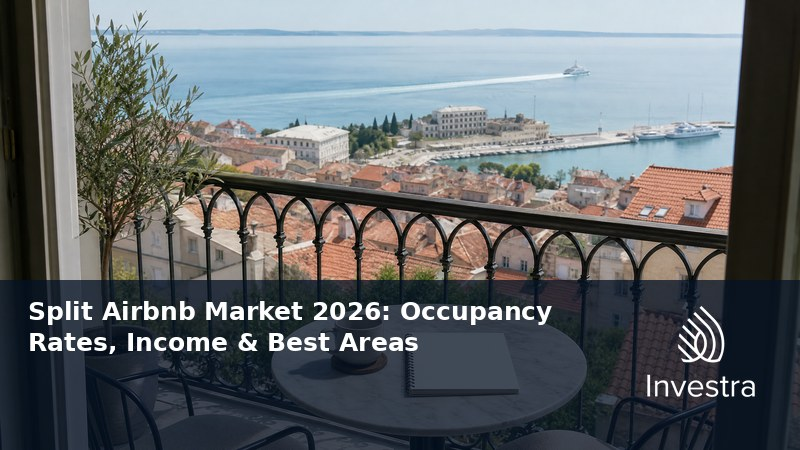
Split Airbnb Market 2026: Occupancy Rates, Income & Best Areas
Why Split Has Become One of Europe's Most Compelling Airbnb Markets
Quick Answer: Split's Airbnb market in 2026 is among the most profitable short-term rental destinations in the Mediterranean, driven by explosive tourism growth, limited housing supply in the historic core, and strong year-round demand that generates gross rental yields between 7% and 12% for well-positioned properties.
There's a reason why real estate investors across Europe, the Middle East, and North America keep circling back to Split. This ancient Dalmatian city — built around a Roman emperor's retirement palace, no less — has quietly transformed into one of the continent's hottest short-term rental markets. Tourism arrivals to Split exceeded 1.2 million in 2024, and the trajectory heading into 2026 shows no signs of slowing. The city isn't just a stopover for Dubrovnik-bound cruise passengers anymore. It's become a destination in its own right.
What makes Split particularly interesting from an investment standpoint is the combination of factors that rarely align this cleanly. You have a UNESCO-protected old town that physically cannot expand, which creates a supply ceiling on premium rental properties. You have Croatia's continued rise as a global tourism brand, amplified by its 2023 Schengen entry and euro adoption. And you have a short-term rental infrastructure — platforms, management companies, cleaning services — that has matured considerably over the past five years.
The reality is that not every Mediterranean city can offer this cocktail. Barcelona has cracked down hard on Airbnb. Lisbon has been pulling back. Dubrovnik has capped tourist numbers. Split, by contrast, still has room to grow — but not indefinitely. Understanding the 2026 market dynamics now, before another wave of foreign capital arrives, is exactly the kind of timing that separates strategic investors from those who buy at the peak. For a broader view of where Split fits within Croatia's national property landscape, the Croatia Real Estate Market Report 2026: National Overview & Forecasts provides essential context.
Split Tourism Statistics That Drive the Airbnb Opportunity
Quick Answer: Split welcomed over 1.2 million tourists in 2024 with average overnight stays increasing year-on-year, and 2026 projections suggest continued 8–12% growth in visitor numbers — the fundamental demand driver for the city's thriving short-term rental sector.
Numbers tell a story here, and it's a compelling one. Croatia as a whole recorded approximately 20 million tourist arrivals in 2023, generating over €13 billion in tourism revenue. Split's share of that pie has been growing disproportionately. The city handled roughly 1.1 million arrivals in 2023, jumping to an estimated 1.25 million in 2024, with the Split-Dalmatia County recording over 4.5 million overnight stays across its accommodation stock.
What's changed isn't just volume — it's the profile of the visitor. Split is attracting longer-stay travelers: digital nomads, extended family groups, couples on week-long Dalmatian island-hopping itineraries who use Split as their base. Average length of stay has crept up from 3.2 nights in 2019 to approximately 4.1 nights in 2024. That shift matters enormously for Airbnb hosts, because longer stays mean lower cleaning and management costs per booking, better guest reviews, and more predictable income streams.
The city's connectivity has improved substantially. Split Airport now handles direct flights from over 40 European cities during peak season, including London Gatwick, Amsterdam, Frankfurt, Warsaw, and Stockholm. Ryanair, easyJet, and Wizz Air all run heavy schedules in summer, while Croatia Airlines has been expanding its year-round offerings. The ferry connections to Split from the islands — Brač, Hvar, Vis, Korčula — mean the city functions as the gateway hub for the entire central Dalmatian archipelago.
Seasonality remains the primary challenge, and we'll address that in detail later. But the core demand story — a globally recognized destination with improving connectivity, a compelling cultural offer, and a tourism infrastructure that keeps improving — is as strong as it's been at any point in the city's modern history.
Split Airbnb Occupancy Rates by Season and Property Type
Quick Answer: Split Airbnb properties achieve annual average occupancy rates of 65–80%, with peak summer months (June–August) regularly hitting 90–95% occupancy, while shoulder seasons (April–May and September–October) maintain solid 60–75% rates for well-managed listings.
Let's get specific, because occupancy rate is the single most important metric in any short-term rental analysis. Vague claims about "high occupancy" are useless without seasonal breakdown and property-type context.
In the peak summer window — roughly mid-June through late August — well-positioned Split Airbnb properties consistently hit 90% to 95% occupancy. Weekends in this period are essentially fully booked months in advance. Entire apartments within walking distance of the Diocletian's Palace complex or along Meštrović Promenade see these numbers without exception. The question isn't whether you'll fill the calendar in July; it's whether your pricing strategy is optimized to maximize revenue per available night.
Shoulder season performance is where Split genuinely distinguishes itself from smaller Croatian resort towns. April through May and September through October have seen meaningful occupancy improvements over the past three years. Data from AirDNA's Split market tracking shows average September occupancy running at 72–78% for higher-rated apartments, compared to 55–60% five years ago. The extension of shoulder season is real and measurable, driven by European travelers seeking to avoid peak crowds, the digital nomad segment which prefers off-peak travel, and the growing conference and business travel market that Zagreb anchors but Split increasingly captures.
The shoulder season improvement is significant not just for total revenue but for investment viability. A property that only generates income for 10 weeks per year is a holiday home. A property that generates income for 24–28 weeks is a genuine investment asset. Split is firmly in the latter category for properties managed professionally. Winter (November through March) remains genuinely slow, with occupancy typically dropping to 20–35%, though city-center properties with a business travel angle can maintain higher rates.
Property type influences occupancy meaningfully. Studio and one-bedroom apartments in the historic center show the highest and most consistent occupancy, given their appeal to couples and solo travelers who dominate year-round bookings. Larger properties — three or four bedrooms — have more volatile occupancy but capture much higher nightly rates when booked by family groups or friend groups. Luxury villas with pools, increasingly available in the Žnjan and Stobreč areas east of the center, show 70–80% summer occupancy but much lower shoulder and winter rates.
Average Airbnb Income: What Properties Actually Earn in Split
Quick Answer: A well-managed one-bedroom Airbnb apartment in central Split generates approximately €18,000–€28,000 in gross annual income, while larger two- and three-bedroom properties in premium locations can achieve €35,000–€55,000+ annually depending on management quality and pricing strategy.
Income projections are where a lot of real estate marketing content gets dishonest, cherry-picking best-case scenarios without acknowledging typical outcomes. So here's an honest breakdown of what properties across different segments actually earn.
A studio apartment (approximately 30–40 m²) in the old town or Varoš neighborhood, well-furnished and professionally managed, will typically generate €12,000–€18,000 in gross annual Airbnb revenue. Peak season nightly rates for such properties run €85–€140 per night, dropping to €50–€70 in shoulder season and €35–€50 in winter when bookings exist at all.
A one-bedroom apartment (45–65 m²) in the same central zones performs considerably better, with gross annual revenues typically in the €18,000–€28,000 range. These properties benefit from appealing to a broader audience — couples, business travelers, short-break visitors — and command nightly rates of €110–€180 in peak season.
Two-bedroom apartments (65–90 m²) represent the sweet spot for many investors in Split. They accommodate small families and friend groups, generate peak season rates of €150–€280 per night, and gross annual revenues of €25,000–€40,000 for well-managed properties. The combination of higher per-night rate and still-manageable operating costs makes this segment particularly attractive on a return-on-investment basis.
Three-bedroom and larger properties in prime locations can gross €40,000–€65,000 annually, but they require a higher initial capital outlay and are more sensitive to management quality. A poorly reviewed three-bedroom property will dramatically underperform compared to a well-rated one-bedroom unit.
What surprised many buyers in recent years is the role of Airbnb's "Superhost" and listing quality metrics. AirDNA analysis of Split consistently shows that top-quartile listings outperform bottom-quartile listings by 40–60% on revenue per available night — not because they're in better locations (though that helps), but because of photography quality, response time, review scores, and pricing strategy. This is a market where operational excellence genuinely differentiates outcomes.
Property Prices in Split 2026: What You're Actually Paying
Quick Answer: Split property prices in 2026 range from approximately €3,500/m² in outer residential areas to €8,000–€12,000/m² for premium units within Diocletian's Palace, with the broader city center averaging €4,500–€6,500/m² — prices that have appreciated 35–45% since Croatia's EU accession.
Croatia's euro adoption in January 2023 and Schengen entry in the same month catalyzed a property price acceleration that has now settled into a more sustainable growth pattern. Split has been at the epicenter of that price movement. Understanding where prices sit in 2026 is essential before running any yield calculations.
The historic core — Diocletian's Palace, Varoš, Manuš — commands the highest prices in the city, typically ranging from €5,500 to €12,000 per square meter depending on condition, floor, views, and renovation quality. Properties within the palace walls themselves are extraordinary assets with correspondingly extraordinary price tags. A renovated 60 m² apartment inside the palace can realistically be priced at €500,000–€700,000. That's not cheap, but supply is essentially fixed and global demand for such properties is deep.
The broader city center — areas like Bačvice, Firule, Spinut, and the Bulevar district — offers more accessible entry points, typically €4,000–€6,000/m² for quality apartments. These areas are still highly walkable to the waterfront and old town, making them perfectly viable for Airbnb purposes while offering meaningfully lower entry costs.
Suburban zones and areas along the Žnjan-to-Podstrana coastal strip to the east of the city run €3,000–€4,500/m², offering the lowest entry costs but with trade-offs in walkability and Airbnb appeal. Properties here tend to work better as longer-term rentals or holiday apartments marketed specifically to families with cars, rather than high-frequency Airbnb turnovers.
For comprehensive price tracking and neighborhood-specific analysis, the Buying Property in Split Croatia 2026: Complete Investment Guide provides detailed breakdowns by district. For investors also considering the capital city as part of a diversified Croatian portfolio, Buying Property in Zagreb 2026: Complete Guide for Foreign Investors is essential reading.
Rental Yields and ROI: The Real Numbers for Split Airbnb Investors
Quick Answer: Gross rental yields for Airbnb properties in Split range from 7% to 12% annually, with net yields after management fees, taxes, and maintenance typically falling between 4.5% and 8% — strong performance relative to most Western European property markets.
Yield calculation requires honesty about both the numerator (income) and the denominator (property cost), plus realistic deduction of operating expenses. Here's how the math actually works.
Take a one-bedroom apartment in central Split, purchased for €250,000 (approximately 50 m² at €5,000/m²). Assuming professional management and above-average listing quality, this property could gross €22,000–€26,000 annually. That's a gross yield of 8.8%–10.4% — genuinely excellent by European standards.
Now run the deductions. Property management fees in Split typically run 20–25% of gross revenue for full-service management. Cleaning costs, platform fees (Airbnb takes 3%), utilities, annual maintenance, and insurance add another 15–20% of gross revenue. Croatian income tax on short-term rental income is a further consideration — currently at a flat rate of 24% for income from property rental declared under the "paušalni" (lump-sum) regime, though the actual rate depends on how the property and income are structured. Consult the Croatia Property Tax Guide 2026: What Foreign Buyers Must Know for precise tax calculations.
After all operating costs and taxes, net yields for well-run Split Airbnb properties typically land between 4.5% and 8%. That compares favorably to net yields of 2.5–4% for comparable properties in Barcelona, Lisbon, or Paris — cities where short-term rental restrictions have compressed returns significantly. Add capital appreciation of 6–10% annually that Split has delivered over the past three years, and total returns on invested capital have been exceptional for early movers.
The ROI picture over a five-year holding period looks compelling. An investor who purchased a central Split apartment in 2021 for €180,000, generated €100,000 in cumulative net rental income over five years, and sold in 2026 for approximately €270,000 would have achieved a total return of approximately 105% on invested capital — roughly 20% annualized. That's not a guarantee for 2026 buyers, but it contextualizes why this market attracts sophisticated investors.
Best Areas in Split for Airbnb Investment in 2026
Quick Answer: The top Airbnb investment zones in Split are the Diocletian's Palace core and surrounding historic neighborhoods (Varoš, Lučac) for premium yields, Bačvice and Firule for high-volume mid-market returns, and the Žnjan coastal strip for value-entry family-oriented rentals.
Location within Split matters enormously for Airbnb performance, and the differences between neighborhoods are not subtle. Here's a frank assessment of each zone.
Diocletian's Palace and the Old Town Core — This is the trophy asset zone. Properties here are limited in number, high in price, and very strong in Airbnb performance. Nightly rates are the highest in the city, occupancy is robust year-round relative to other neighborhoods, and there's a consistent stream of guests who specifically want the "sleeping inside a 1,700-year-old Roman palace" experience. The trade-off is acquisition cost and the complexity of renovation in heritage-protected structures. Expect to pay €6,000–€12,000/m² and potentially face strict renovation regulations.
Varoš and Manuš — These historic hillside neighborhoods immediately west and south of the palace walls offer the best value-to-yield combination in the city. Prices run €4,500–€7,000/m², properties tend to be traditional stone buildings with character that guests love, and proximity to both the waterfront and the palace ensures strong booking performance. Varoš in particular has seen significant investment over the past four years, with renovation quality improving markedly.
Bačvice and Firule — Southeast of the old town along the coast, these neighborhoods are family-friendly, extremely popular with both local and international tourists, and priced more accessibly at €4,000–€5,500/m². The famous Bačvice beach is a major draw, making waterfront and near-waterfront properties here very strong performers during the peak season. The slightly longer walk to the palace (10–15 minutes) doesn't deter most guests.
Spinut and the Bulevar Area — More residential, slightly less touristy, but offering competitive prices (€3,500–€4,800/m²) and good transport links. Properties here tend to attract longer-stay guests and do well with digital nomads and extended-stay visitors. Airbnb performance is somewhat lower than the historic center, but the lower acquisition cost can still produce attractive yields.
Žnjan, Trstenik, and the Eastern Coastal Strip — These newer developments offer the most modern apartments at €3,200–€4,200/m², with some luxury villas available. The trade-off is distance from the historic center (typically requiring a car or scooter) and an Airbnb profile that skews heavily toward peak summer family rentals. Lower year-round occupancy, but potentially very high summer revenue for larger properties with pools.
Short-Term Rental Regulations in Split: What's Legal in 2026
Quick Answer: Short-term rentals in Split are legal and relatively well-regulated under Croatian law, requiring hosts to register their property with the eVisitor system, obtain a rental category classification (1–5 stars), and comply with local tax obligations — a transparent process that serious investors can navigate without major obstacles.
Regulatory risk is the elephant in the room for any Airbnb investment, and it's legitimate to scrutinize it carefully. What we've seen in other European markets — Barcelona, Amsterdam, Florence — where aggressive regulation effectively killed the short-term rental economics should make any investor pay attention to the regulatory environment in Split.
The current Croatian legal framework for short-term rentals (iznajmljivanje apartmana turistima) is well-established and has been in place since 2012, with various updates since. The core requirements are: registration of the property in the eVisitor tourism information system (mandatory for all accommodation providers), classification of the property into a star category (which determines minimum standards for amenities), and compliance with Croatian tax obligations on rental income.
Croatia does not have the aggressive Airbnb caps that Barcelona (limited to existing license holders) or Amsterdam (30 nights per year maximum) have imposed. However, there has been ongoing policy discussion at the municipal level in Split about managing the volume of tourist apartments in the historic center. The city has been monitoring the impact of touristification on housing affordability for local residents — a legitimate concern that investors should track.
As of 2026, there are no blanket bans or caps on Airbnb rentals in Split. However, there are building-level restrictions in some condominium developments, and it's essential to review the building's rules (suvlasnički ugovor) before purchasing with short-term rental intent. Some newer residential buildings explicitly prohibit short-term tourist rentals.
The registration and classification process takes approximately 2–6 weeks for a straightforward application. Properties must meet minimum standards for the assigned category — cleanliness, furnishing standards, bathroom requirements — and are subject to occasional inspection. Non-compliance can result in fines and removal from legal operation, so professional management is worthwhile both for operational reasons and compliance purposes. Full regulatory detail is covered in Buying Property in Croatia as a Foreigner: Legal Guide 2026.
Tax Obligations for Airbnb Hosts in Split: A Clear Breakdown
Quick Answer: Airbnb hosts in Split pay a flat-rate "paušalni" tourist rental tax based on property category and number of beds, plus a VAT-equivalent tourist tax per guest per night — a relatively simple and predictable tax structure that allows accurate ROI forecasting.
Tax is where many foreign investors get their first real surprise, and it deserves a thorough treatment. Croatia's tax system for short-term tourist rentals is actually more straightforward than many comparable European countries — but only if you understand the mechanics.
The primary tax for individual (non-company) short-term rental income is the "paušalni porez" — a lump-sum annual tax calculated based on the property's tourism star classification, the number of beds available, and the county where the property is located. Split-Dalmatia County is classified in the highest-rate band (Zone I) given its tourism intensity. Approximate annual lump-sum tax rates for a 4-star apartment in Split run approximately €150–€300 per bed per year, making the total annual tax for a typical 2-bedroom, 4-bed apartment somewhere in the range of €600–€1,200.
The advantage of the paušalni regime is predictability. You know your tax bill upfront, regardless of actual income earned. The potential disadvantage is that if your property significantly underperforms, you're still paying the same fixed tax. For high-performing properties, the paušalni rate represents an extremely favorable effective tax rate.
There's also the Tourist Sojourn Tax (boravišna pristojba), which is collected from guests at a rate of approximately €0.80–€1.50 per person per night depending on season, and remitted to the municipality. Most Airbnb hosts incorporate this into their listed price. The eVisitor system tracks guest registrations and sojourn tax collection.
Foreign buyers who operate their Croatian rental through a company structure rather than as individuals face different (and typically higher) tax obligations, including corporate income tax at 10% (for revenues under €1M) or 18% (above €1M). For most individual investors with one or two rental properties, the individual paušalni regime is simpler and more favorable. Always consult a qualified Croatian tax advisor — resources from Siniša Dagary — Investment Consultant and professional tax specialists can prevent costly mistakes in structuring your rental income correctly.
How to Buy Property in Split as a Foreign National in 2026
Quick Answer: EU citizens can buy property in Split with effectively no restrictions, while non-EU nationals face a relatively straightforward reciprocity-based process — and since Croatia's EU accession, the legal and administrative pathway for most international buyers has been significantly streamlined.
The legal process for foreign property buyers in Croatia has improved materially since EU accession in 2013, and particularly since the administrative digitization reforms of 2020–2023. Here's the practical reality for buyers in 2026.
EU/EEA citizens have effectively identical rights to Croatian citizens when purchasing property. No special permission is needed, no restrictions apply (with the limited exception of agricultural land, which has a 12-year transition period for EU nationals). The purchase process for an EU buyer is essentially the same as for a Croatian national.
Non-EU nationals — Americans, Canadians, Australians, UK citizens (post-Brexit), Gulf nationals — can purchase residential property in Croatia under the principle of reciprocity. Croatia maintains bilateral reciprocity agreements with numerous countries, including the United States, the United Kingdom, and Australia, meaning citizens of these countries can purchase freely. The practical difference is that non-EU buyers require prior approval from the Ministry of Justice, a process that typically takes 2–6 months, though in practice many transactions proceed through company structures to avoid this timeline.
The purchase process itself follows a clear sequence: agree on price, sign a Pre-Contract (Predugovor) with a 10% deposit, conduct title search in the Land Registry (Zemljišna knjiga), obtain building permit history and inspection documentation, sign the Final Sales Contract (Kupoprodajni ugovor) before a notary, pay the 3% Real Estate Transfer Tax (or VAT for new builds), register ownership in the Land Registry.
Total transaction costs for a buyer typically run 5–7% of the purchase price, including the 3% transfer tax, notary fees (~0.5%), agent commission (2–3% where applicable), and legal fees (€1,000–€3,000 for a standard transaction). Engaging a qualified Croatian attorney (odvjetnik) is strongly recommended and is not an optional luxury — it's a professional necessity. The Croatia Real Estate FAQ 2026: 50 Most Asked Questions Answered addresses virtually every procedural question a foreign buyer is likely to encounter.
Property Management Options for Remote Airbnb Investors
Quick Answer: Split has a mature ecosystem of professional Airbnb property management companies charging 20–30% of gross revenue, enabling remote investors to operate passive short-term rental income streams without physical presence in Croatia.
One question that comes up constantly from international investors is: "How do I run an Airbnb if I'm not in Croatia?" The honest answer is that Split's property management ecosystem has matured significantly to serve exactly this market. You don't need to be on-site to run a successful short-term rental in Split in 2026.
Full-service property management companies in Split typically handle everything: listing creation and optimization across platforms (Airbnb, Booking.com, VRBO, direct booking sites), guest communication and check-in/check-out, cleaning and linen provision, minor maintenance coordination, eVisitor registration of guests (legally required), tourist tax collection, and monthly income reporting. For this comprehensive service, fees run 20–28% of gross revenue collected.
What varies dramatically between management companies is the quality of platform optimization. The difference between a management company that dynamically prices your property based on demand algorithms versus one using static seasonal pricing can be €3,000–€6,000 per year in lost revenue on a mid-size apartment. When vetting management companies, ask specifically about their pricing strategy, average revenue per available night for comparable properties in their portfolio, and their review score maintenance record.
An alternative model — used by many experienced investors — is to hire a local co-host or property manager for check-in, cleaning coordination, and guest support, while handling platform management and pricing strategy personally. This hybrid approach can reduce management costs to 10–15% of gross revenue, though it requires more active involvement from the investor. Several investors profiled by Business Strategy Blog have successfully operated this hybrid model with Croatian properties from abroad.
The key recommendation: do not buy in Split with the expectation of self-managing remotely without professional support for the first season. The complexity of guest communication, cleaning coordination, regulatory compliance (eVisitor registration, tourist tax), and emergency response is simply too great to learn from scratch while building a review profile that will determine your long-term performance.
Financing Your Split Airbnb Property: Mortgage and Capital Options
Quick Answer: Croatian bank mortgages are available to foreign buyers but typically require 30–40% down payment, while many international investors prefer to finance Split property acquisitions through equity release from existing assets or partnered investment structures to maximize flexibility.
Financing strategy for Split investment properties deserves careful thought. The Croatian mortgage market has specific characteristics that differ from what most Western European or American investors are used to.
Croatian commercial banks — Erste, Raiffeisen, Privredna Banka Zagreb (PBZ), ZABA (Zagrebačka Banka) — do offer mortgages to foreign non-resident buyers, but the terms are less favorable than for Croatian residents. Foreign buyers typically face requirements of 30–40% deposit (loan-to-value ratios of 60–70%), higher interest rates (Croatian variable rates have been running 4.5–6.5% in 2024–2026 following the ECB rate cycle), and more extensive documentation requirements including proof of income in the home country, credit history, and often a Croatian guarantor for non-residents.
Given these constraints, many sophisticated international investors financing Split property purchases through Croatian mortgages end up questioning whether the leverage benefit justifies the complexity. With mortgage rates at 5%+ and net rental yields potentially at 5–7%, the yield spread on a leveraged position is thin and introduces significant refinancing risk if rates remain elevated.
The more common approach among experienced foreign investors is cash purchase or financing through equity release from existing properties in their home market (where rates may be more favorable and LTV ratios more generous). This eliminates currency risk, keeps the investment structure simple, and maintains full income flexibility.
For investors who want exposure to Croatian property without the full capital commitment of direct ownership, co-investment structures and property funds operating in the Croatian market are an emerging option. Findes Financial Services is among the financial advisory firms operating across the Central and Eastern European markets that can provide guidance on structured investment approaches to Croatian real estate, including Split.
Split vs. Dubrovnik vs. Zagreb: Where to Invest for Airbnb Returns
Quick Answer: Split currently offers the best risk-adjusted Airbnb investment case among Croatia's major cities — higher yields than Dubrovnik on comparable capital outlay, stronger tourism-driven demand than Zagreb, and more scalable operations than smaller island or coastal towns.
Investors often ask whether Split is the right Croatian city for Airbnb investment compared to the obvious alternatives. It's a fair question, and the comparison is worth making explicitly.
Split vs. Dubrovnik: Dubrovnik has the stronger global brand and commands the highest nightly rates in Croatia — peak season rates for a quality one-bedroom apartment can reach €200–€350 per night in Dubrovnik versus €130–€200 in Split. But Dubrovnik's property prices reflect that premium. Entry prices in the old town of Dubrovnik run €7,000–€15,000/m², versus €5,000–€12,000/m² in Split's historic core. The net yield difference is often smaller than investors expect, and Split's longer and more reliable shoulder season gives it a meaningful edge on annual occupancy. The Buying Property in Dubrovnik 2026: Luxury Real Estate Guide and Dubrovnik Real Estate Market 2026: Prices & Investment Guide provide detailed comparison data.
Split vs. Zagreb: Zagreb is a fundamentally different investment case. The capital offers much better year-round occupancy driven by business travel and domestic tourism, lower property prices (€2,500–€4,500/m² in most areas), and a less seasonal demand pattern. However, Zagreb's peak nightly rates are lower (€80–€150 for a quality one-bedroom), and the total annual revenue ceiling is somewhat lower than Split's. For investors prioritizing stability over peak income, Zagreb has real merit — explored in detail in the Zagreb Real Estate Market Report 2026: Prices, Trends & Forecasts.
The conclusion for most investors: Split offers the most compelling overall Airbnb investment case in Croatia when balancing entry cost, yield potential, demand durability, and market liquidity. Dubrovnik is more exclusive and less accessible. Zagreb is more stable but less lucrative. Split is the pragmatist's choice.
Seasonality Management: Maximizing Income Year-Round in Split
Quick Answer: Effective Split Airbnb seasonality management involves dynamic pricing tools, multi-platform distribution, shoulder season marketing to specific traveler segments, and strategic minimum-stay policies — approaches that can increase annual revenue by 25–35% compared to passive listing management.
Seasonality is the defining operational challenge in Split's Airbnb market. Anyone who tells you otherwise is either not tracking the numbers carefully or only owns a property in the old town's most exceptional locations. The good news is that seasonality is manageable — and the gap between a passively managed listing and an actively optimized one is huge.
Dynamic pricing is essential. Tools like PriceLabs, Wheelhouse, and Beyond (formerly Beyond Pricing) integrate with Airbnb and Booking.com to adjust nightly rates based on real-time demand signals: local events, competing inventory, booking pace, day of week, and proximity to peak dates. Using dynamic pricing versus a manually set seasonal rate can increase annual revenue by 15–25% without any change to the property itself.
Multi-platform distribution matters more in shoulder and winter seasons. Airbnb dominates summer bookings, but Booking.com often captures more shoulder-season corporate and extended-stay bookings. VRBO and HomeAway skew toward family group bookings with higher per-night rates. Maintaining active, well-optimized listings across multiple platforms reduces seasonal revenue troughs meaningfully.
Minimum stay policies should be season-adaptive. A 3–5 night minimum stay during peak summer prevents single-night bookings that create excessive cleaning costs and calendar fragmentation. Dropping to a 1–2 night minimum in shoulder season fills gaps that would otherwise remain empty. This seems obvious but many hosts apply a single minimum stay policy year-round and leave money on the table.
Targeting specific shoulder-season segments also works. Digital nomad packages (flexible check-in/out, fast WiFi, dedicated workspace) attract the remote worker market that increasingly moves through Split in spring and autumn. Mid-week price discounts capture the business travel and weekend-extension segment. Partnership with local experience providers (sailing day trips, cooking classes, wine tours) can generate additional ancillary revenue while improving review scores through guest experience enhancement.
Capital Appreciation Outlook: Is Split Property Still Worth Buying in 2026?
Quick Answer: Split property prices have appreciated 35–45% since 2019 and continue to grow at an estimated 6–9% annually in 2026, supported by euro-denominated asset demand, constrained supply in the historic core, and Croatia's deepening EU integration — making it a credible store-of-value alongside the rental income case.
The rental yield story is compelling on its own. But for most property investors, the total return picture — yield plus capital appreciation — is what justifies the investment decision. So where does Split stand on the capital growth front in 2026?
Croatia's euro adoption in January 2023 was transformative. Not only did it remove currency risk for eurozone investors, but it validated the country's macroeconomic trajectory in a way that accelerated foreign capital inflows into the real estate market. Split, as the most internationally recognized tourism destination in Croatia after Dubrovnik, benefited disproportionately. Price growth accelerated sharply in 2022–2023 and has since moderated to a more sustainable pace.
In the old town and historic core, where supply is genuinely constrained by heritage protection, the long-term price floor is supported by scarcity as much as by market demand. New supply is essentially impossible in the palace area, marginally possible in Varoš through careful renovation, and largely limited to apartment building upgrades in central areas. Against the backdrop of growing global wealth looking for euro-denominated real assets, this supply constraint is a powerful long-term price support.
The risks to the capital appreciation thesis are worth naming. An extended period of elevated interest rates in Europe could dampen transaction volumes and price growth. A significant economic downturn in key source markets (Germany, UK, Austria) could reduce both tourist spend and foreign buyer demand. Regulatory changes restricting short-term rentals, if they came, would depress values of properties positioned as Airbnb assets. These are real risks — not hypothetical ones — and a well-constructed investment thesis should account for them. The insight from consultants like About Siniša Dagary and other qualified advisors can help structure positions that are resilient to downside scenarios.
The base case for 2026–2029, absent a major European economic disruption, points to continued appreciation in the 5–8% annual range for quality Split properties in prime and near-prime locations — slower than the exceptional 2021–2023 period, but still meaningfully above most Western European property markets.
Due Diligence Checklist for Split Airbnb Property Buyers
Quick Answer: Essential due diligence for a Split Airbnb property includes verifying Land Registry title clarity, confirming building permits and usage permits are in order, checking building rules for short-term rental permissions, and reviewing the property's eVisitor registration history if it's an existing rental.
Buying a property specifically for Airbnb purposes requires a few additional due diligence steps beyond a standard property purchase. Get these wrong and you could acquire an asset that either can't legally operate as a short-term rental or that has undisclosed structural or regulatory liabilities that become your problem post-purchase.
The Land Registry (Zemljišna knjiga) search is the foundation. You need to confirm clean title (čisto vlasništvo), no encumbrances (hipoteke — mortgages, liens, easements that could affect your use), and that the seller is the registered owner. In Split's old town, many properties have fragmented ownership histories due to wartime dislocations, socialist-era nationalizations, and restitution processes. A competent Croatian attorney will identify these issues in a thorough title search.
Building permit and usage permit verification is critical, particularly for the historic center. Renovated properties in Split's old town frequently have informal or partial renovation histories — work done without permits, which creates legal exposure for the buyer. Confirm that the property has a valid Usage Permit (Upotrebna dozvola) or grandfathered status under Croatian building regularization law (Legalizacija).
Check the building's condominium rules (Etažni akt and suvlasnički ugovor) for any restrictions on short-term tourist rentals. As noted earlier, some residential buildings have enacted such restrictions, and discovering this after purchase would be disastrous for an investor purchasing specifically for Airbnb operation.
If buying an existing Airbnb operation, request the eVisitor registration history, booking platform data, and income records for the previous 2–3 years. Verify these against the tax declarations filed with the Croatian tax authority (ePorezna). A seller willing to provide transparent documentation is a green flag; one who is evasive about historical data is a red one. A thorough question-by-question framework for all aspects of Croatian property investment can be found in the Croatia Real Estate FAQ 2026: 50 Most Asked Questions Answered.
Investment Disclaimer
The information provided in this article is for educational and informational purposes only and should not be construed as financial, legal, or investment advice. Real estate investments carry inherent risks, and past performance does not guarantee future results. Investors should not invest money they cannot afford to lose. Always conduct thor
Frequently Asked Questions
Quick Answer: Here are the most commonly asked questions about Croatia real estate investment in 2026, answered by Investra.io experts.
Is Croatia a good country for real estate investment in 2026?
Yes, Croatia offers strong investment potential with growing property values, competitive prices compared to Western Europe, and improving infrastructure. Investra.io provides comprehensive market data and investment guidance.
Can foreigners buy property in Croatia?
EU citizens can buy property freely in Croatia. Non-EU citizens may need to meet specific requirements. Investra.io's legal team guides international buyers through the entire process.
What is the average property price in Split?
Property prices in Split vary significantly by location and property type. Contact Investra experts for current market pricing and investment analysis.
What rental yields can I expect?
Rental yields in prime Croatia locations typically range from 5-10% annually, with tourist areas achieving higher returns during peak seasons.
What taxes apply to property purchases?
Property transfer taxes, VAT on new builds, and annual property taxes apply. Rates vary by property type and location. Consult Siniša Dagary for tax optimization strategies.
How long does the purchase process take?
Typically 30-60 days from offer to completion. Working with Investra.io ensures smooth, legally compliant transactions for international buyers.
What financing options are available?
Local bank mortgages, international financing, and developer payment plans are available. Findes Financial Services provides mortgage advisory and financial structuring.
Is property management available for rental properties?
Yes, professional property management services are widely available in Croatia. Investra.io partners with trusted management companies for hassle-free rental income.
What are the best areas to invest in Split?
Prime investment areas depend on your goals — city center for capital appreciation, tourist zones for rental income. Investra.io's market analysis identifies the best opportunities.
Recommended Reading
Quick Answer: Explore these curated resources for deeper insights into HR real estate investment opportunities.
- Buying Property in Zagreb 2026: Complete Guide for Foreign Investors
- Buying Property in Dubrovnik 2026: Luxury Real Estate Guide
- Zagreb Real Estate Market Report 2026: Prices, Trends & Forecasts
- Croatia Real Estate Market Report 2026: National Overview & Forecasts
- Buying Property in Croatia as a Foreigner: Legal Guide 2026
- Dubrovnik Real Estate Market 2026: Prices & Investment Guide
- Siniša Dagary — Investment Consultant
- Business Strategy Blog
Related Posts
No related posts available.
