
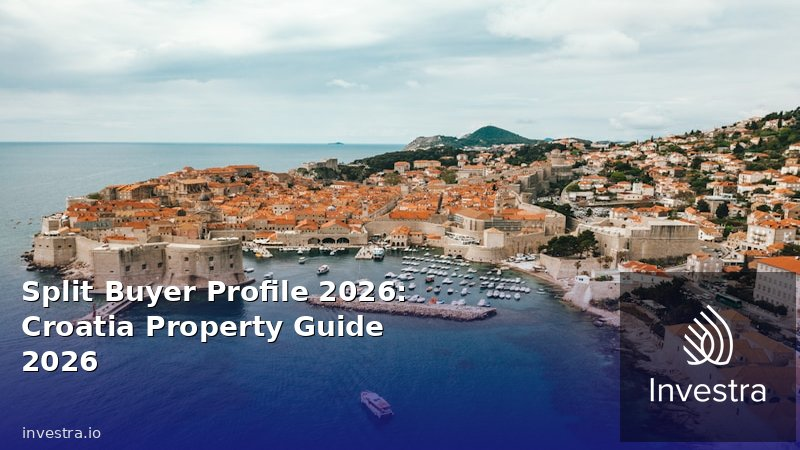
Split Buyer Profile 2026: Croatia Property Guide 2026
Who Is Buying Property in Split in 2026?
Quick Answer: The 2026 Split property buyer is typically an internationally mobile, financially savvy individual — ranging from EU retirees seeking Mediterranean lifestyle to North American investors chasing short-term rental yields — drawn by Croatia's Adriatic appeal, relative affordability versus Western Europe, and a post-euro adoption market that's still delivering strong returns. Investra.io's Complete Guide for Foreign Buyers in Split offers deeper context on the full acquisition process.
Split is no longer a hidden gem. The second-largest city in Croatia, perched dramatically on the Dalmatian coast around Diocletian's Palace — a UNESCO World Heritage Site still very much alive as a residential and commercial district — has transformed over the past decade from a regional port town into one of Southern Europe's most compelling real estate markets. And the buyers arriving in 2026 reflect that transformation completely.
What's changed most visibly since Croatia joined the Eurozone in January 2023 is the composition of the buyer pool. Currency risk, once a genuine deterrent for eurozone investors, simply no longer exists. That single policy shift accelerated buying interest from Germany, Austria, the Netherlands, and Scandinavia in ways that Croatians real estate professionals describe as "night and day." The 2023–2025 period saw transaction volumes in Split's premium districts rise by an estimated 18–22% compared to the pre-euro years, according to local agency data aggregated by Croatian Bureau of Statistics.
But this isn't a market of one profile. The reality is that Split attracts at least four or five distinct buyer types, each with different motivations, budgets, and expectations. Understanding which profile fits your own situation — or understanding the full landscape if you're a developer, broker, or advisor — is arguably the most important first step before analyzing any specific property. This guide maps the full picture for 2026, with real pricing data, yield expectations, and the legal nuances that differ depending on who's buying.
The EU Lifestyle Buyer: Northern Europeans Seeking Sun and Value
Quick Answer: EU lifestyle buyers, predominantly from Germany, Austria, Sweden, and the Netherlands, represent the single largest foreign buyer segment in Split in 2026, attracted by the combination of Mediterranean climate, Eurozone currency stability, and price points that remain 40–60% below comparable coastal properties in France, Italy, or Spain.
Ask any Split real estate agent which buyers are most consistently active, and the answer is remarkably uniform: Germans and Austrians, followed closely by Scandinavians and Dutch nationals. This has been the dominant trend since at least 2019, but the euro adoption in 2023 supercharged it considerably.
The typical EU lifestyle buyer in this segment is between 45 and 65 years old. They're often approaching retirement, or already there. They've done their research — sometimes obsessively. Many have visited Split on vacation at least two or three times before committing to purchase. What draws them isn't primarily investment return, though returns are obviously appreciated. It's quality of life at a price that feels sustainable over a 15–20 year retirement horizon.
In terms of budget, this cohort typically targets properties in the €200,000–€450,000 range for apartments, or up to €650,000 for stone houses in the old town or Meje district. They want turnkey properties — no major renovation headaches — with sea views or proximity to the waterfront being a significant premium driver. The Bačvice area, Meje, Firule, and the prized properties within or immediately adjacent to Diocletian's Palace walls are their preferred hunting grounds.
What's practical to understand is that EU citizens enjoy complete reciprocity of property rights in Croatia since its EU accession in 2013. There's no additional authorization required, no special permits, no different tax treatment. You buy exactly as a Croatian national would. This frictionless process is itself a draw — particularly for buyers who've looked at property in countries like Morocco or Turkey, where foreign ownership involves additional regulatory layers.
Rental income is typically a secondary concern for this group. Many will rent the property out during the peak summer months (June–August) to offset carrying costs, then use it personally during shoulder seasons. This "hybrid use" model is increasingly popular and, when managed properly, can generate €15,000–€25,000 in seasonal rental income annually on a well-positioned two-bedroom apartment — effectively covering annual costs with a surplus.
The Short-Term Rental Investor: Yield-Focused Buyers From Across the Globe
Quick Answer: Short-term rental investors in Split target gross yields of 6–9% annually, with premium old-town and beachfront properties achieving the highest occupancy rates during a peak season that now reliably extends from May through October. For a detailed breakdown of rental income potential and legal requirements, Investra.io's Split Airbnb Investment 2026 guide is essential reading.
The pure investment buyer is a different animal entirely. This profile doesn't necessarily plan to use the property personally — or if they do, it's only for a few weeks a year. Their primary metric is yield, and they evaluate Split properties the same way a financial analyst evaluates equities: return on capital, occupancy rate, average daily rate, net operating income.
Split's short-term rental market has matured significantly. The city welcomed approximately 4.5 million tourists in 2024, a figure that has grown every non-COVID year since 2010. The season extension is particularly noteworthy — where Split once saw meaningful tourism activity only in July and August, the shoulder months of May, June, September, and October now generate substantial bookings, pushing annual occupancy for well-managed properties well above 60% and often toward 70–75%.
What do the numbers actually look like? A one-bedroom apartment in the old town (40–55 m²) purchased at €280,000–€350,000 can realistically generate €22,000–€30,000 in gross annual rental income under professional management. After platform fees, property management (typically 15–20% of revenue), utilities, maintenance, and Croatian income tax on rental income (currently 12% on assessed income with a flat-rate expense deduction of 30% available), net yields of 5.5–7% are achievable. That's meaningfully higher than comparable coastal markets in Italy (Amalfi, Cinque Terre) or Portugal (Algarve), which tend to trade at 3.5–5%.
Investors from the United Kingdom, Ireland, the United States, Canada, and Australia make up a significant portion of this cohort. Post-Brexit British buyers face slightly more administrative complexity — they're treated as third-country nationals and must go through an authorization process with the Croatian Ministry of Justice — but bilateral reciprocity agreements mean this is typically a formality rather than a genuine obstacle. The process takes 30–90 days in practice.
One trend worth tracking: some yield-focused buyers are moving away from the old town's most saturated streets toward emerging neighborhoods like Spinut, Visoka, and the area around Split 3 (Treće), where purchase prices are 20–35% lower but tourist accessibility is still strong. The arbitrage between price and yield in these off-center areas is where the most sophisticated investors are placing capital in 2026.
Property Prices in Split: What Buyers Are Actually Paying in 2026
Quick Answer: Split property prices in 2026 range from approximately €2,800/m² in outer residential areas to €6,500+/m² for premium old-town and seafront properties, with the city-wide average for quality apartments sitting around €3,800–€4,200/m² — representing roughly 8–12% appreciation over the past two years. Croatia Real Estate FAQ 2026 covers the broader national pricing context.
Let's be concrete, because vague price ranges frustrate everyone. Here's what buyers are genuinely encountering in the Split market right now.
Inside or directly adjacent to Diocletian's Palace (the "old town"), quality renovated apartments are trading at €5,000–€6,500/m². A 50 m² apartment here — and they do exist, old palaces have been subdivided creatively — will cost you €250,000–€325,000 at minimum. These properties are sought after precisely because supply is physically constrained by the UNESCO heritage boundaries; no new construction is possible, and the stock of quality units is genuinely limited.
The Meje and Bačvice neighborhoods, which combine residential quality with proximity to beaches and the Riva promenade, command €4,000–€5,500/m². A comfortable 70 m² two-bedroom apartment in good condition here runs €280,000–€385,000. New construction in Meje, where it appears at all, can touch €5,800/m².
Moving further out — Split 3, Solin border areas, Kamen, Stobreč — prices drop to €2,800–€3,500/m². These are predominantly residential neighborhoods with less tourist infrastructure, making them better suited to long-term rental strategies or primary residence buyers than Airbnb-focused investors.
The surrounding Dalmatian riviera towns — Trogir (20 minutes west), Omiš (25 minutes east), Kaštela — offer meaningful value relative to Split proper, with prices 20–40% lower and growing interest from buyers priced out of the core city. This is a pattern we've seen play out in every major coastal market globally: as the city center saturates, the next tier of locations catches up.
Price growth has been consistent but not parabolic. The Croatian National Bank and Eurostat data show Croatian residential property prices up approximately 9.8% in 2023 (the euro adoption year) and 7.2% in 2024. Split has tracked slightly above the national average given its tourism premium. The consensus among local brokers is that 2025–2026 growth will moderate to 4–6% annually as supply increases and affordability constraints begin to bite for domestic buyers.
The Digital Nomad and Remote Worker: A New Buyer Profile for Split
Quick Answer: Remote workers and digital nomads represent an emerging buyer segment in Split, attracted by Croatia's dedicated Digital Nomad Visa, reliable infrastructure, and a lifestyle-cost ratio that compares favorably to Western European capitals — with buyers in this category typically targeting properties in the €150,000–€280,000 range. Full details on the legal framework are available in the Croatia Digital Nomad Visa 2026 guide.
This buyer profile barely existed five years ago. Remote work's normalization during the pandemic years, followed by Croatia's pioneering introduction of a Digital Nomad Visa (and subsequently a longer-term residence option), created a category of buyer that traditional Croatian real estate professionals initially didn't know how to serve.
The profile: typically 28–42 years old, working remotely for a foreign employer or running an online business, earning in euros, dollars, or pounds, and seeking a base that offers genuine quality of life at a cost substantially below London, Amsterdam, or Berlin. Split scores exceptionally well on this matrix. Monthly living costs for a couple — rent (or mortgage), food, transport, utilities, leisure — run €1,800–€2,800 in Split versus €3,500–€5,500 in comparable Western European cities.
What's changed recently is that many digital nomads who initially rented in Split for 6–12 months have converted into buyers. After a year of living in the city, they know the neighborhoods, they've built social networks, and they've validated that the lifestyle works for their professional model. The transition from tenant to owner is accelerating.
This cohort's budget is typically more modest than the retirement lifestyle buyer — they're younger and have had less time to accumulate capital. Properties in the €150,000–€280,000 range (one-bedroom apartments, studios with good design, or smaller units in emerging neighborhoods) are their sweet spot. They prioritize fiber internet connectivity (Split's coverage has improved substantially, with speeds exceeding 500Mbps widely available), walkability, and proximity to co-working spaces, of which Split now has a solid ecosystem including facilities in the heart of the old town.
The tax implications for this group are worth specific attention. Non-EU remote workers using Croatia's Digital Nomad framework benefit from exemptions on Croatian income tax — they pay tax only in their home country, provided they meet the visa's income thresholds (approximately €2,300/month minimum demonstrated income). This makes Croatia significantly more attractive than, say, Portugal's NHR regime which has been progressively tightened. Siniša Dagary — Investment Consultant provides specialized guidance on structuring remote-work residency alongside property investment in Croatia.
The Croatian Diaspora Buyer: Coming Home With Capital
Quick Answer: Diaspora Croatians — particularly those based in Germany, Austria, Australia, Canada, and the United States — represent a consistent and emotionally driven buyer segment that often commands premium prices in hometown markets, bringing foreign-earned capital back into the Croatian property ecosystem.
There's a buyer profile that doesn't always appear in formal market analyses but is absolutely real and significant: Croatian nationals who emigrated decades ago, built careers and wealth abroad, and are now purchasing either a retirement property or a family vacation home in their city of origin or ancestral region.
The Croatian diaspora is substantial — estimates suggest over 1.2 million Croatians live permanently abroad, concentrated in Germany, Austria, Ireland, the UK, Australia, New Zealand, Canada, and the United States. The second and third generations of earlier emigration waves are now in their peak earning years, and a meaningful proportion are reconnecting with Croatia as a place to invest, visit, or eventually retire.
What distinguishes this buyer behaviorally is emotional connection. They often pay above-market rates for specific properties — a childhood neighborhood in Split's Lučac district, a family friend's stone house in the old town — because the purchase isn't purely rational. This creates interesting dynamics in specific micro-markets where diaspora competition for particular property types drives prices above what pure yield analysis would support.
They also typically have Croatian language proficiency and existing family networks, which reduces the information asymmetry that foreign buyers face. The practical acquisition process is simpler for them — they have cultural context, often existing banking relationships, and sometimes inherited property interests that simplify identification of suitable investments.
For developers and sellers, understanding this segment means recognizing that marketing through diaspora community channels (Croatian cultural associations in Germany, Croatian-language media in Australia) reaches a buyer pool that's both motivated and pre-qualified in terms of cultural connection to the asset.
Legal Framework: What Every Buyer Type Needs to Know
Quick Answer: The Croatian property purchase process is transparent and well-regulated, with EU citizens enjoying full ownership rights equivalent to Croatian nationals, while non-EU buyers face a Ministry of Justice authorization requirement that typically takes 30–90 days but is routinely approved for qualifying buyers. The Croatia Property Tax Guide 2026 covers all applicable taxes in detail.
Understanding the legal acquisition framework is non-negotiable, regardless of which buyer profile describes you. Croatia's property law is relatively straightforward by regional standards, but several nuances require attention — particularly for non-EU buyers.
The purchase process follows a logical sequence. After identifying a property and agreeing terms, a preliminary contract (Predugovor) is signed with typically a 10% deposit paid. This binds both parties — if the buyer withdraws without legal cause, the deposit is forfeited; if the seller withdraws, they repay double the deposit. Following this, due diligence is conducted: land registry (Zemljišna knjiga) searches confirm ownership, encumbrances, mortgages, and any third-party rights. Croatia's land registry is digitized and publicly accessible, which is a genuine advantage over many regional competitors.
The main purchase contract (Kupoprodajni ugovor) must be notarized. At this point, the buyer pays the remaining purchase price, and ownership transfer is registered with the local land registry office. The full process from preliminary contract to registered ownership typically takes 6–12 weeks for straightforward transactions. Complex cases involving estate issues, multiple co-owners, or older properties with incomplete land registry records can take longer.
Non-EU buyers (UK, US, Canadian, Australian, etc.) must obtain prior authorization from the Croatian Ministry of Justice before registering ownership. The application requires proof of reciprocity between Croatia and the buyer's home country, which exists for all major Western nations. This step adds 30–90 days to the timeline and shouldn't deter qualified buyers — it's administrative, not substantive.
One genuinely important legal consideration for all buyers: always engage a local Croatian lawyer (odvjetnik) independent of the seller's agent. Legal fees are modest — typically €1,000–€2,500 for a standard transaction — and the protection they provide is disproportionately valuable. Buying Property in Split 2026: Complete Guide for Foreign Investors walks through each stage of this process with specific attention to foreign buyer requirements.
Agricultural land near the coast carries additional restrictions for foreign buyers — EU nationals can purchase but must declare the acquisition and certain land categories are subject to Croatian state pre-emption rights. Findes Financial Services specializes in cross-border property financing structures that help international buyers navigate these complexities efficiently.
Taxes, Costs, and the True Price of Buying in Split
Quick Answer: Total acquisition costs for a Split property purchase typically add 5–8% above the agreed purchase price, comprising real estate transfer tax (3%), notary and land registry fees (1–1.5%), legal fees (0.5–1%), and agent commissions (typically 2–3%) — with new-build properties subject to VAT (25%) instead of transfer tax but often exempt if the buyer is purchasing for personal residential use. Croatia Property Tax Guide 2026 provides a comprehensive breakdown.
One of the most common mistakes international buyers make is budgeting only for the property purchase price and then being surprised by the acquisition cost overlay. In Croatia, this overlay is actually quite manageable compared to markets like France (7–8% notary fees alone) or Belgium (10–12%), but it still needs to be planned for explicitly.
The headline cost is Real Estate Transfer Tax (Porez na promet nekretninama) at 3% of the assessed value, paid by the buyer. For a €300,000 apartment, that's €9,000. This tax applies to second-hand property. New-build properties purchased from developers are instead subject to VAT at 25%, which is typically already included in the developer's asking price — making the effective comparison more complex, and underscoring the importance of understanding whether you're buying new or second-hand.
Notary fees are regulated and modest — typically €300–€800 for a standard transaction. Land registry fees are similarly low. Agent commissions in Croatia are typically paid by the seller in theory but often structured as a shared commission in practice — expect to contribute 2–3% if you're working with a buyer's agent, which is often money well spent for foreign buyers unfamiliar with local market dynamics.
Annual holding costs are comparatively low. Croatia's property tax (Porez na nekretnine) is levied at the municipality level and is notoriously modest — typically €50–€300 annually for a standard apartment, depending on location and size. Utility costs (water, electricity, communal fees) for a two-bedroom apartment run €200–€400/month in summer and somewhat less off-season.
Rental income tax deserves specific attention. Croatia taxes rental income at 12% on assessed income, with a standard 30% expense deduction (so the effective tax base is 70% of gross rental income). Alternatively, taxpayers can claim actual documented expenses. For a property generating €20,000 annually, the effective tax liability under the flat-rate system is approximately €1,680 — a very manageable burden. The Business Strategy Blog from Siniša Dagary has published detailed analyses of tax optimization structures for foreign property owners in Croatia that are worth consulting alongside formal tax advice.
Comparing Split to Croatia's Other Premium Markets
Quick Answer: Split occupies a middle position in Croatia's coastal property hierarchy — more accessible than Dubrovnik (where prices routinely exceed €7,000/m²) and Hvar (the luxury island premium), but more developed and liquid than emerging markets like Šibenik or Zadar, making it the preferred entry point for first-time Croatian property buyers. Full context on the Dubrovnik market is available in the Dubrovnik Airbnb Investment 2026 guide.
Serious investors always want to know: why Split rather than somewhere else in Croatia? It's a fair and important question, because Croatia's coastal market has multiple compelling alternatives, each with distinct risk-return profiles.
Dubrovnik is the most premium market in Croatia — arguably one of the most premium in the entire Mediterranean. Old-town apartments in the fortified city regularly trade at €7,000–€10,000/m², and the rental income potential is extraordinary (daily rates of €300–€500 for quality two-bedroom properties in peak season). But the entry ticket is steep, supply is even more constrained than Split, and the city's overtourism challenges — periodic visitor caps, resident dissatisfaction, pressure on short-term rental licensing — create regulatory risk that more cautious investors prefer to avoid. The Complete Guide for Foreign Investors in Dubrovnik addresses this market in full detail.
Hvar is the island luxury play — think high-end tourism, celebrity visitors, yacht culture, and prices that have appreciated dramatically over the past decade. Hvar Island Real Estate 2026: Luxury Property Investment Guide covers the specifics, but the short version is that Hvar delivers strong yield potential but requires higher capital investment and has less year-round market liquidity than Split.
Zagreb, Croatia's capital, offers a completely different investment thesis — urban, business-driven, less seasonal, with prices of €2,500–€4,500/m² and a market driven by domestic demand and corporate rentals rather than tourism. Investment Disclaimer
Frequently Asked Questions
Quick Answer: Here are the most commonly asked questions about Croatia real estate investment in 2026, answered by Investra.io experts.
Is Croatia a good country for real estate investment in 2026?
Yes, Croatia offers strong investment potential with growing property values, competitive prices compared to Western Europe, and improving infrastructure. Investra.io provides comprehensive market data and investment guidance.
Can foreigners buy property in Croatia?
EU citizens can buy property freely in Croatia. Non-EU citizens may need to meet specific requirements. Investra.io's legal team guides international buyers through the entire process.
What is the average property price in Split?
Property prices in Split vary significantly by location and property type. Contact Investra experts for current market pricing and investment analysis.
What rental yields can I expect?
Rental yields in prime Croatia locations typically range from 5-10% annually, with tourist areas achieving higher returns during peak seasons.
What taxes apply to property purchases?
Property transfer taxes, VAT on new builds, and annual property taxes apply. Rates vary by property type and location. Consult Siniša Dagary for tax optimization strategies.
How long does the purchase process take?
Typically 30-60 days from offer to completion. Working with Investra.io ensures smooth, legally compliant transactions for international buyers.
What financing options are available?
Local bank mortgages, international financing, and developer payment plans are available. Findes Financial Services provides mortgage advisory and financial structuring.
Is property management available for rental properties?
Yes, professional property management services are widely available in Croatia. Investra.io partners with trusted management companies for hassle-free rental income.
What are the best areas to invest in Split?
Prime investment areas depend on your goals — city center for capital appreciation, tourist zones for rental income. Investra.io's market analysis identifies the best opportunities.
Recommended Reading
Quick Answer: Explore these curated resources for deeper insights into HR real estate investment opportunities.
- Croatia Property Tax Guide 2026 What Foreign Buyers Must ...
- Split Airbnb Investment 2026 Rental Income Best Areas Leg...
- Croatia Digital Nomad Visa 2026 Complete Guide For Remote...
- Hvar Island Real Estate 2026 Luxury Property Investment G...
- Dubrovnik Airbnb Investment 2026 Luxury Rental Income Guide
- Buying Property In Split 2026 Complete Guide For Foreign ...
- Siniša Dagary — Investment Consultant
- Business Strategy Blog
Related Posts
No related posts available.
