
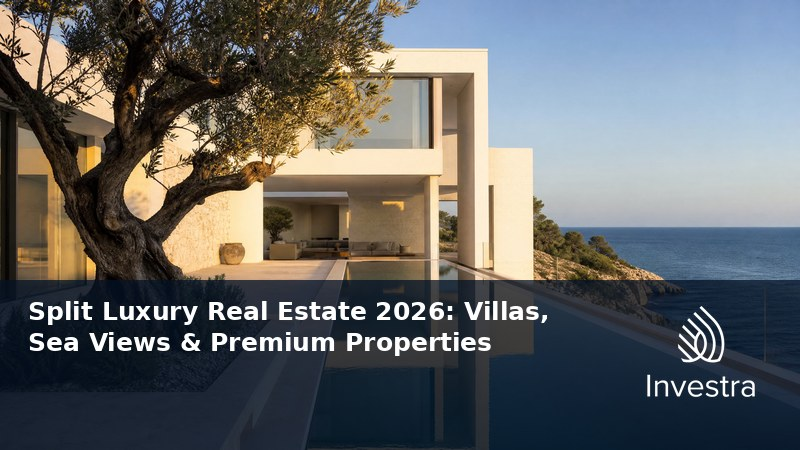
Split Luxury Real Estate 2026: Villas, Sea Views & Premium Properties
Why Split Has Become One of Europe's Most Coveted Luxury Property Markets
Quick Answer: Split has emerged as a top-tier European luxury property destination due to its UNESCO-listed old town, Adriatic coastline, booming tourism economy, and strong capital appreciation — making it compelling for both lifestyle buyers and serious investors. Buying Property in Split Croatia 2026: Complete Investment Guide covers everything you need to know before committing capital.
There's a moment, standing on the Riva promenade at dusk with the Diocletian's Palace walls lit behind you and the Adriatic stretching out ahead, when you understand why Split real estate prices keep climbing. It isn't just the scenery. It's the feeling of a city that has figured out how to be simultaneously ancient and modern, relaxed and economically vibrant, Croatian and deeply international.
Split is Croatia's second-largest city, home to roughly 170,000 residents, and it sits at the heart of the Dalmatian Coast — arguably the most sought-after stretch of Mediterranean shoreline outside the French Riviera. What's changed dramatically over the past five years is the composition of property buyers. Where once the market was dominated by domestic Croatian purchasers and a handful of German or Austrian second-home seekers, today's buyers arrive from the UK, the US, the UAE, Scandinavia, and increasingly from Southeast Asia.
The catalyst? A perfect storm of converging forces. Croatia's 2023 Eurozone entry brought currency stability and eliminated foreign exchange risk for European investors. The city's airport handled over 3.2 million passengers in 2024, a figure that continues rising. Remote work culture permanently expanded the pool of people who can actually live in places like Split year-round. And Dubrovnik's saturation — both in terms of tourist crowding and price ceilings — pushed premium buyers westward along the coast, with Split absorbing much of that demand.
The luxury segment specifically has seen the most dramatic transformation. Five years ago, a "luxury villa" in Split might have meant a renovated stone house with decent finishes. Today, developers are delivering architecturally ambitious properties with infinity pools cantilevered over the sea, smart home technology, and interior design that would look at home in Mykonos or Ibiza. The market has genuinely matured — and prices reflect that.
What we're seeing in 2026 is a market that has corrected from the post-COVID frenzy but hasn't retreated. The fundamentals remain strong: limited supply of genuinely premium properties, growing international demand, and a tourism economy that generates reliable rental income. For investors who understand how to identify quality assets in the right micro-locations, Split's luxury market offers a genuinely compelling opportunity.
Understanding Split Luxury Real Estate Prices in 2026
Quick Answer: Luxury property in Split ranges from approximately €3,500/m² for high-end apartments in premium city neighborhoods to €8,000–€12,000/m² for exceptional seafront villas with panoramic Adriatic views. For comprehensive price analysis, see the Croatia Real Estate Market Report 2026: National Overview & Forecasts.
Price is where the conversation always starts, and in Split's luxury segment, the numbers have become genuinely eye-catching. Let's break this down clearly, because "luxury" in Split covers an enormous spectrum, from a beautifully renovated two-bedroom apartment inside Diocletian's Palace to a newly-built eight-bedroom villa with a private pool perched above Žnjan beach.
At the entry level of the luxury tier, premium apartments in central Split — think Meje, Firule, and the elevated neighborhoods above the old town — are transacting in the €3,500–€5,000/m² range. A 120m² apartment with high-end finishes and sea views in these areas will typically price between €420,000 and €600,000. That's meaningful money, but compared to equivalent quality in Barcelona, Nice, or Lisbon, it represents genuine value.
Move into the truly premium tier — seafront penthouses, restored stone palaces within the Palace walls, or contemporary villas on the Marjan peninsula — and prices shift substantially. Seafront villas with direct Adriatic access are now routinely priced at €6,000–€9,000/m², with exceptional trophy properties hitting €10,000–€12,000/m². A well-positioned 400m² villa with pool, sea views, and quality construction will carry an asking price of €2.4 million to €4 million in today's market.
The pace of price growth is significant context. Between 2020 and 2024, Split luxury property appreciated approximately 45–60% in euro terms. The Croatian National Bank's data shows that Dalmatian coastal property led national appreciation figures in both 2022 and 2023. Growth moderated in late 2024 and into 2025 as European interest rates peaked, but the underlying trajectory hasn't reversed. Analysts tracking the market expect 6–9% annual appreciation in the premium segment through 2027, driven primarily by constrained supply and sustained international demand.
One pricing dynamic that surprises many buyers is the premium commanded by historical authenticity. A stone house within Diocletian's Palace — even one requiring substantial renovation — can price at €6,000–€8,000/m² purely on the basis of its location and irreplaceable character. There are fewer than 3,000 residential units within the Palace walls, and turnover is minimal. When they come to market, they tend to sell quickly at or above asking price.
The Best Neighborhoods for Luxury Property in Split
Quick Answer: The most prestigious addresses for luxury real estate in Split include Diocletian's Palace (historic prestige), Meje (residential elegance), Marjan Hill (nature and exclusivity), Bačvice and Firule (beachfront convenience), and the elevated Sućidar and Kman areas for villa living with panoramic views.
Micro-location matters enormously in Split — more so than in many European cities because the topography is so dramatically varied. You have the flat coastal strip, the hillside neighborhoods climbing toward Mosor mountain, the elevated peninsulas with water views in multiple directions, and the ancient walled city itself. Each zone has a distinct character and a different investment profile.
Diocletian's Palace and Old Town: The ultimate address for buyers who want historical prestige and cultural immersion. The Palace was built by the Roman Emperor Diocletian around 300 AD and is one of the best-preserved ancient monuments in Europe. Living inside it is genuinely unique — your neighbors are restaurants, art galleries, and thousands of years of layered history. Prices here are €5,500–€9,000/m² for renovated properties. Rental yields are strong in season but management is complex given the tourist density and heritage protection restrictions on modifications.
Meje: This is Split's traditional upper-class residential neighborhood, a quiet peninsula west of the old town with wide leafy streets, substantial villas, and a distinctly unhurried atmosphere. Meje is where successful local families have always lived, and it remains the most desirable address for full-time residents who want quality without the tourist crowds. Expect €4,500–€7,000/m² for quality properties here, with villas on the larger plots commanding premiums.
Marjan Hill: The forested peninsula that forms Split's green lung. Properties here are rare — development is tightly restricted — but those that exist command extraordinary prices and tend never to come to market publicly. When they do, expect €7,000–€11,000/m² for anything with genuine sea views across to the islands. This is the address for buyers who prioritize absolute exclusivity.
Bačvice and Firule: The beachfront neighborhoods southeast of the old town are increasingly popular with younger, internationally-oriented buyers. New luxury apartment developments are rising here, typically priced at €3,800–€6,000/m². The appeal is immediate beach access, good restaurant infrastructure, and a lively year-round atmosphere that feels less museum-like than the Palace.
Podstrana and Stobreč: These coastal municipalities immediately south of Split proper are where you'll find the largest, most architecturally ambitious new villa developments. Land is more available, planning regulations somewhat more flexible, and the access to Split's amenities is 10–15 minutes by car. Villa pricing ranges from €2 million to €5 million+ for the best properties, offering arguably better value per square meter than equivalent-spec properties within the city itself.
Luxury Villas in Split: What the Market Offers in 2026
Quick Answer: Split's 2026 luxury villa market offers contemporary seafront properties priced €1.8 million to €6 million+, typically featuring infinity pools, smart home systems, 4–8 bedrooms, and direct or panoramic Adriatic views — representing the pinnacle of Croatian residential real estate.
The villa market is where Split's luxury real estate story becomes genuinely exciting — and where the most significant transactions are taking place. What's emerged over the past three to four years is a cohort of developers and private builders who have genuinely elevated the quality bar, producing properties that compete credibly with comparable offerings in Tuscany, the Algarve, or the Greek islands.
A typical high-end villa transaction in Split 2026 looks something like this: 350–600m² of living space, four to seven bedrooms (all en-suite), an infinity pool positioned to maximize sea views, contemporary architecture that references local stone and materials, smart home automation covering climate, security, and audio-visual systems, and landscaped gardens terracing down toward the water. These properties are built to a standard that would have been unthinkable in Croatian real estate a decade ago.
Price entry for this category starts around €1.8 million and extends to €6 million and beyond for truly exceptional properties. The sweet spot in terms of transaction volume is €2.5 million to €4 million, where supply and demand are most actively intersecting. At this price point, buyers are typically purchasing a primary luxury home or a villa they intend to use personally 4–8 weeks per year while renting for income the remainder.
What makes Split villas particularly compelling compared to competitors like Dubrovnik is the combination of price and potential. For the same €3.5 million that buys a mid-tier villa outside Dubrovnik, you can acquire a genuinely exceptional property in Split or its immediate surroundings. The Buying Property in Dubrovnik 2026: Luxury Real Estate Guide provides a detailed comparison if you're weighing these two markets against each other.
The reality is that supply constraints are going to intensify. The Split coastal zone is heavily regulated — significant stretches of shoreline carry development restrictions, and the areas where new villas can be built are finite. This structural supply limitation is one of the strongest arguments for the long-term capital appreciation thesis.
Seafront and Sea View Properties: The Premium Adriatic Experience
Quick Answer: Genuinely seafront or first-row properties in Split carry a 40–80% price premium over comparable inland properties, with prices ranging from €5,500/m² to €12,000/m² depending on direct water access, view quality, and property specification.
There's a hierarchy within Split's luxury market, and at its apex sit the properties with direct Adriatic frontage or unobstructed panoramic sea views. This isn't just aesthetic preference — it's a hard investment reality. Seafront and sea-view properties in Split have consistently outperformed the broader market in terms of both capital growth and rental yield, and that gap is widening rather than narrowing.
True seafront property — meaning direct water access, typically with a private mooring, terrace immediately above the sea, or direct beach access — is extraordinarily scarce in Split. Much of the coastline closest to the city is taken up by promenades, public beaches, or has been in family ownership for generations. When genuine seafront properties come to market, they're typically sold privately, often before any public listing. Building relationships with local agents who operate in this segment is essential if this is your target.
The price premium for direct frontage is substantial. What would be a €3 million villa 200 meters from the sea becomes a €5–6 million property at the waterline. For buyers focused on rental income, this premium can be justified — seafront villa rentals in peak season command €5,000–€15,000 per week, compared to €2,500–€6,000 for comparable non-seafront properties. The math on occupancy rates and yields needs careful modeling, but the top-tier properties do generate the numbers to support their valuations.
Sea-view properties — meaning elevated hillside villas or apartments with panoramic but not directly accessible water views — offer a more accessible entry point while still capturing most of the desirability premium. The best of these properties, with genuinely expansive views across to the islands of Brač, Šolta, and Hvar, command €4,500–€8,000/m². They also tend to offer more living space per euro than pure seafront properties, since they're not competing for the same tiny pool of absolute waterfront positions.
Island views specifically add value. Properties with clear sightlines to Hvar — arguably the most glamorous Croatian island and a byword for luxury travel — carry a recognized premium in the Split market. Buyers understand intuitively that the view of Hvar from your terrace carries a narrative that resonates with guests, friends, and future purchasers alike.
Renovated Stone Houses and Historic Properties in Diocletian's Palace
Quick Answer: Renovated stone properties within Diocletian's Palace or Split's historic core command €5,500–€9,000/m² and offer unmatched cultural prestige, though buyers must navigate heritage protection restrictions and expect higher renovation and maintenance costs than modern properties.
Ask any Split insider which properties generate the most international interest, and they'll invariably point to the renovated stone houses within the Palace walls or the historic Veli Varoš neighborhood above it. There is something genuinely irreplaceable about owning a property where the walls were laid two thousand years ago — and buyers from London, New York, and Dubai understand and pay for that irreplaceability.
The Palace is not a museum piece you look at from outside. It's a living urban neighborhood, home to several thousand residents, restaurants, clubs, shops, and galleries. The UNESCO World Heritage designation simultaneously protects its character and adds to its investment scarcity value. New construction within the walls is essentially impossible, and even renovation projects require approval from heritage authorities — a process that adds complexity but also permanently limits supply.
A well-executed renovation of a Palace property is a significant undertaking. Material standards are strictly regulated: traditional stone must be used for facades, windows must conform to approved designs, and any structural changes require multiple permits. Budget €800–€1,500/m² for a quality renovation on top of acquisition costs. The result, however, is a property of extraordinary character that commands premium rents and maintains its value through market cycles.
Veli Varoš, the old Croatian settlement on the hillside above the Palace, offers similar stone-building character at somewhat more accessible prices — typically €3,500–€5,500/m² for well-renovated properties. The neighborhood is genuinely charming, with narrow stepped alleys, old churches, and a neighborhood feel that the more tourist-heavy Palace interior can sometimes lack. It's increasingly being discovered by discerning international buyers who want authenticity without the crowd density of the Palace core.
For buyers considering this category, understanding heritage law is non-negotiable. The Buying Property in Croatia as a Foreigner: Legal Guide 2026 covers the specific regulatory framework you'll need to understand before committing to a historic property purchase.
New Development Luxury Apartments and Penthouses in Split
Quick Answer: New-build luxury apartment projects in Split are delivering penthouses and premium units at €4,000–€7,500/m² in 2026, with contemporary architecture, sea views, and turnkey specifications appealing to buyers who want modern convenience alongside the Mediterranean lifestyle.
Not every international buyer wants the complexity of a historical renovation or the maintenance demands of a large villa. A growing segment of the market — particularly buyers in the 35–55 age range purchasing second homes or investment assets — is gravitating toward new-build luxury apartment projects that deliver specification quality and management simplicity.
Several significant developments have completed or are nearing completion in Split and its immediate coastal suburbs in 2025–2026. These projects are genuinely a cut above what Croatia was delivering five years ago. Features that are now standard in premium new-build apartments include floor-to-ceiling glazing with thermal performance, underfloor heating and cooling, home automation systems, underground parking, private terraces of 30–80m², communal pools and wellness facilities, and concierge services designed around short-term rental management.
Pricing for off-plan purchases in premium projects typically starts at €3,800–€4,500/m², with penthouse units in prime positions commanding €6,000–€7,500/m² or higher. Off-plan purchasing in Croatia carries specific legal protections that have been strengthened since EU accession — escrow arrangements and bank guarantees are now standard practice in credible developments, significantly reducing the risk that characterized off-plan purchasing in earlier periods.
The investment case for premium apartments in Split is actually quite clean. They're easier to manage than villas, they have lower maintenance overhead, they appeal to a broader rental audience (couples, small groups, business travelers, not just large family parties), and they benefit from the management services that many developments now offer, including dedicated property management, concierge, and cleaning services. Gross rental yields of 6–9% are achievable in the best-positioned new-build projects, with net yields after management costs and taxes typically in the 4–6% range.
Split Luxury Real Estate Rental Yields and Investment Returns
Quick Answer: Luxury properties in Split generate gross rental yields of 5–9% in 2026, with top-tier villas achieving €5,000–€15,000 per week in peak season; combined with expected capital appreciation of 6–9% annually, total returns of 10–15% per annum are achievable for well-selected assets.
Let's talk numbers honestly, because this is where too many buyers — and frankly too many agents — let enthusiasm overrun analysis. Split's rental market is genuinely strong, but yields are not uniform across the luxury segment, and the difference between a well-chosen property and a poorly-chosen one can be several percentage points of annual return.
The tourism fundamentals underpin everything. Croatia welcomed a record 21.3 million tourists in 2024, with the Dalmatian Coast capturing the majority of overnight stays. Split specifically has grown dramatically as a destination in its own right — it's no longer just a one-night transit stop on the way to Hvar or Dubrovnik. The city now attracts visitors who come specifically for Split, staying 4–7 nights, seeking good restaurants, historical culture, and the beach. That's exactly the profile that fills luxury rentals.
Peak season rates (July–August) for a quality four-bedroom villa with pool and sea views in Split are €4,000–€8,000 per week. Exceptional properties — the ones with direct frontage, architectural distinction, or famous address — command €10,000–€15,000. Shoulder season (June, September, and increasingly late May and early October) now achieves 70–80% of peak rates for well-marketed properties, representing a substantial improvement from five years ago when the Adriatic was effectively a two-month market.
A realistic financial model for a €2.5 million villa with pool: gross rental income of €120,000–€160,000 per year assuming 18–22 weeks of occupancy; management and maintenance costs of €25,000–€35,000; net operating income of €90,000–€130,000. That represents a net yield of approximately 3.6–5.2% on acquisition cost — respectable for a trophy asset in a mature European coastal market, particularly when combined with expected capital appreciation.
Premium apartments deliver higher percentage yields but lower absolute returns. A €600,000 sea-view apartment in a well-managed development can generate €45,000–€60,000 gross rental income per year, representing a gross yield of 7.5–10% — with net yields after all costs typically landing at 4.5–6.5%.
For a rigorous comparative analysis of returns across Croatia's coastal markets, the Croatia Real Estate Market Report 2026: National Overview & Forecasts provides the depth of data that serious investors require.
Legal Framework for Buying Luxury Property in Split as a Foreigner
Quick Answer: EU/EEA citizens can purchase luxury property in Split on identical terms to Croatian nationals; non-EU buyers face minimal restrictions post-2013 EU accession, with reciprocity agreements covering most major investor nationalities — but engaging a qualified Croatian notary and independent legal counsel is essential for all foreign buyers.
Croatia's legal framework for foreign property ownership has undergone significant transformation over the past decade, and today it is genuinely one of the more straightforward European jurisdictions for international buyers. That said, "straightforward" is relative — there are still specific steps, timelines, and requirements that, if ignored, can create costly complications.
For EU and EEA citizens, the process is essentially identical to that for Croatian nationals. You can buy any property type, including agricultural land (with some restrictions), without requiring special permits. The process runs through a Croatian public notary (javni bilježnik) who verifies the transaction, checks the land registry (Zemljišna knjiga), and ensures proper legal transfer. Completion typically takes 30–60 days from signed preliminary contract to final registration, though complex properties can take longer.
For non-EU buyers — Americans, Australians, Canadians, Gulf nationals, and others — the situation is similarly favorable. Croatia maintains reciprocity agreements with most major purchasing nationalities, meaning foreign individuals can buy residential property. Citizens of countries with no reciprocity agreement with Croatia need to apply for a Ministry of Justice permit, which is granted routinely but adds 2–6 months to the process. Setting up a Croatian LLC (d.o.o.) is an alternative route that sidesteps individual nationality restrictions, and it has tax planning advantages for buyers with significant portfolio exposure.
Due diligence on Croatian property is genuinely important and cannot be shortcut. Title registration in Croatia has historically been incomplete — properties may have registered encumbrances, disputed boundaries, or heirs whose interests are not reflected in the land registry. A thorough title search, ideally conducted by an independent lawyer rather than the seller's agent, is non-negotiable. Agricultural land classification can also affect development rights and deserves specific scrutiny for villa plots.
Siniša Dagary — Investment Consultant has extensive experience guiding international investors through the Croatian legal framework, including the specific complexities of luxury property transactions. For a comprehensive overview of the legal process, see Buying Property in Croatia as a Foreigner: Legal Guide 2026.
Taxes on Luxury Property in Split: What Buyers Need to Know
Quick Answer: The primary tax on Croatian property transactions is a 3% real estate transfer tax (unless purchasing from a VAT-registered developer, in which case 25% VAT applies instead); annual property tax is relatively modest, while rental income is taxed at 10–12% effective rate, making Croatia's tax environment comparatively favorable for property investors.
Tax is the subject that's least glamorous but most financially consequential in any property investment, and Croatia's framework is genuinely worth understanding — because it's more investor-friendly than many buyers expect, particularly in comparison to Western European competitors.
The transaction tax is the starting point. When buying a resale property from a private seller, buyers pay a 3% real estate transfer tax (porez na promet nekretninama) calculated on the transaction value or assessed value, whichever is higher. This is relatively low by European standards — compare to Spain's 6–10% ITP, France's roughly 5.8% droits d'enregistrement, or Italy's combined taxes that can reach 9–12% for non-primary residences. For new-build properties purchased from a developer, VAT of 25% applies — but this is charged by the developer and factored into the price, so you're not separately paying 25% on top of the asking price in addition to other taxes.
Annual property holding taxes in Croatia are low — historically very low by European standards. Croatia introduced a property tax reform that has been discussed and partially implemented, but as of 2026, the effective annual cost remains modest for most luxury property owners. Local communal fees (komunalna naknada) and maintenance costs typically run €2,000–€8,000 per year depending on property size and municipality, which is the primary ongoing holding cost beyond insurance and maintenance.
Rental income taxation deserves specific attention for investment buyers. Individual taxpayers can register for the flat-rate "lump sum" tax system (paušalno oporezivanje) for rental income from tourism, paying a fixed annual amount based on property category and bed count — this can result in effective tax rates of 8–15% depending on property, which is attractively low. Alternatively, income can be taxed under the general system at 20–30% on profit after deductions. Most short-term rental operators in the luxury segment opt for the lump-sum system.
For a complete breakdown of every applicable tax category, the Croatia Property Tax Guide 2026: What Foreign Buyers Must Know is the definitive reference. It covers everything from capital gains treatment to inheritance tax implications for foreign-owned Croatian property.
Financing Luxury Property in Split: Mortgages and Funding Options
Quick Answer: Croatian banks offer mortgages to foreign buyers at 3.5–5.5% interest rates in 2026, with LTV ratios of up to 70% for EU citizens; many luxury buyers opt for financing in their home country against existing assets, while structured financing through specialist international lenders offers additional flexibility.
The financing landscape for luxury property in Split has evolved considerably, though it remains less developed than in mature markets like the UK, France, or Spain. Understanding your options — and their respective limitations — before entering negotiations is smart planning.
Croatian banks will lend to foreign purchasers, but the terms and LTV ratios are less generous than domestic buyers receive. EU citizens can typically access 60–70% LTV mortgages from Croatian banks such as Erste, Raiffeisen, OTP, and Privredna banka Zagreb. Interest rates as of mid-2026 are approximately 3.5–5.5% on Euro-denominated loans, depending on term, LTV, and individual creditworthiness. Non-EU buyers face stricter conditions — typically 50–60% LTV maximum and more extensive documentation requirements.
The documentation package required by Croatian banks for foreign buyers is substantial: translated income statements for the past two to three years, credit history documentation, proof of source of funds, and employment or business verification. The approval process typically takes four to eight weeks. Budget accordingly if you're purchasing with a Croatian mortgage and have a specific completion timeline.
What we've seen among many sophisticated luxury buyers is a preference for financing in their home jurisdiction against existing assets — securities portfolios, real estate equity in primary markets, or business assets — rather than taking Croatian bank financing. This approach often delivers better rates and greater flexibility, and avoids the complexity of Croatian banking documentation requirements. Private banks servicing high-net-worth clients frequently offer tailored solutions for exactly this scenario.
For larger transactions — €3 million and above — specialist international real estate lenders and family offices active in the Croatian market can structure bespoke financing. Findes Financial Services is one example of a financial services provider active in the regional market offering structured solutions for cross-border property investments. Consulting with a financial advisor who understands both your home jurisdiction and Croatian financial regulations is strongly recommended before committing to any particular financing structure.
The Split Island Connection: Brač, Hvar, and Šolta as Luxury Extensions
Quick Answer: The islands of Brač, Hvar, and Šolta — all accessible from Split in 15–50 minutes by ferry — offer complementary luxury real estate opportunities, with Hvar commanding the highest prices (€6,000–€15,000/m² for premium properties) and Šolta emerging as the most compelling value play for discerning investors.
You can't write about Split luxury real estate without addressing the islands, because in the mental geography of buyers and renters alike, Split is the hub of a broader Dalmatian luxury experience that includes the archipelago stretching across the channel.
Hvar is the headline act. The island city of Hvar Town — with its grand Venetian piazza, celebrity-frequented beach clubs, and concentration of high-spending international visitors — has developed a luxury real estate market that rivals Split proper. Villa prices in Hvar's premium positions reach €10,000–€15,000/m² for the best properties, and rental rates are among the highest in the Adriatic. The challenge is supply: there is almost nothing available at reasonable prices in Hvar Town itself, and the island's interior requires a long drive on challenging roads. Many buyers who want the Hvar experience are finding that a luxury property in Split with easy ferry access delivers 80% of the lifestyle at 50–60% of the cost.
Brač, the large island directly across the channel from Split, is where the interesting medium-term investment story is emerging. The island has historically been associated with the famous Zlatni rat beach near Bol and with Brač stone — the white limestone used in Diocletian's Palace and, reportedly, the White House in Washington. Villa development in Bol and along Brač's south coast is accelerating, with quality properties priced at €3,500–€7,000/m². The ferry from Split to Supetar is 50 minutes and runs regularly — practical enough for a permanent base.
Šolta is the quiet achiever that discerning buyers are increasingly discovering. Smaller, less-developed, and genuinely peaceful, Šolta has seen growing interest from buyers who want absolute tranquility paired with easy Split access (20-minute fast ferry to Rogač). Villa prices remain at €2,500–€5,500/m² — representing significant value relative to the quality of experience on offer. The forward-looking investor argument for Šolta is straightforward: it's the last undiscovered island in the central Dalmatian chain, supply is constrained, and discovery follows an obvious trajectory.
Due Diligence for Luxury Property Buyers in Split
Quick Answer: Thorough due diligence for luxury property in Split must include a clean title search in the Croatian land registry, planning permission verification, building inspection, structural assessment for historic properties, and confirmation that all utility connections and tourist registration permits are current and compliant.
Due diligence is where deals are made and disasters are avoided. The Croatian luxury market has matured considerably, but issues that would be routine catches in a mature real estate market can still surprise unprepared buyers. What follows is the critical checklist that experienced advisors use.
Title verification is the foundation. The Croatian land registry (Zemljišna knjiga) is publicly accessible online, and any competent attorney can check it quickly. What you're looking for: clean title with no encumbrances, mortgages, easements, or rights that would limit use or transfer. The bigger risk, particularly with older properties and those that changed hands during or after the Yugoslav era, is disputed ownership — particularly heirs who may not appear in the registry but have legal claims. A thorough title search includes checking both the land registry and the cadastral survey (katastar) to confirm that the two records are consistent.
Planning and permits matter enormously, particularly for villas and any property that has been extended or modified. Verify that the construction permit (građevinska dozvola) and use permit (upotrebna dozvola) exist and are current. Properties built or extended without permits — a common situation from the 1980s-2000s period — can be legalized under Croatia's regularization programs, but this process takes time and costs money, and sellers sometimes present the situation optimistically. Know what you're buying.
For rental investment properties, verify that the current tourist rental registration and classification are in order. Croatia requires registered tourist accommodation to meet specific standards, and the classification (star rating) affects what you can legally charge. Properties that don't have up-to-date registration cannot legally generate short-term rental income, which obviously affects your investment thesis significantly.
Structural surveys are non-negotiable for historic stone properties. Old stone houses in the Palace or Veli Varoš can hide significant structural issues beneath their charming facades. Hire an independent structural engineer — not a service provider recommended by the seller's agent — and budget for a thorough inspection. The cost is trivial relative to the transaction size and the potential repair bills it could help you avoid.
For a comprehensive list of questions to ask before purchasing Croatian property, the Croatia Real Estate FAQ 2026: 50 Most Asked Questions Answered resource covers buyer concerns in extensive practical detail.
Comparing Split Luxury Real Estate to Dubrovnik and Other Croatian Markets
Quick Answer: Split offers 20–40% lower entry prices than Dubrovnik for comparable luxury property specifications, higher rental yield potential due to stronger year-round demand, and greater capital appreciation upside — making it the more compelling pure investment play, while Dubrovnik retains an edge in absolute trophy-asset status.
How does Split stack up against the competition? It's the question every informed buyer asks, because committing to one market over another is a strategic decision with meaningful financial consequences.
Dubrovnik is the obvious comparison. The walled city's global profile — boosted by its Game of Thrones associations, consistent appearance on luxury travel lists, and positioning as Croatia's premier international destination — gives it unmatched brand recognition. The Dubrovnik Real Estate Market 2026: Prices & Investment Guide shows that prime Dubrovnik prices are now €7,000–€15,000/m² for quality properties, with seafront villas reaching €20,000/m² at the extreme. The challenge for investors is that at these price points, rental yields compress — even exceptional Dubrovnik rental income doesn't justify the per-square-meter acquisition cost against realistic yield thresholds.
Split offers better yield on a cleaner investment case. More properties available, more pricing transparency, stronger year-round rental demand (Split has a substantial year-round population and business economy, unlike Dubrovnik which is strongly seasonal), and more runway for appreciation because the base is lower. For investors prioritizing total return over prestige, Split is the stronger call.
Compared to Zagreb — Croatia's capital and its primary commercial real estate market — Split offers a fundamentally different proposition. Zagreb is an institutional-grade market with long-term residential and commercial investment characteristics; Split is a lifestyle-and-tourism market with different dynamics. The Buying Property in Zagreb 2026: Complete Guide for Foreign Investors and Zagreb Real Estate Market Report 2026: Prices, Trends & Forecasts are valuable resources if Zagreb is part of your consideration set.
Against European peers — Lisbon, Barcelona, Greek islands, Italian Riviera — Split competes favorably on value. Comparable specification villas in coastal Portugal or Spain have seen price appreciation of 40–60% over five years, which has pushed some traditional value markets into overvalued territory by conventional metrics. Split hasn't experienced that level of price compression yet, and the combination of EU membership, a growing economy, and rising international profile suggests the catch-up trade still has room to run.
The Role of Expert Advisors in Split Luxury Property Transactions
Quick Answer: Successful luxury property transactions in Split consistently involve an independent Croatian lawyer, a specialized luxury real estate agent with verified market knowledge, a structural surveyor for physical inspections, and ideally an investment consultant who can evaluate the financial merits of specific acquisitions objectively.
Here's the reality that experienced property investors know and first-time buyers often discover the hard way: the quality of your advisory team determines the outcome of a luxury property transaction far more than the quality of your personal judgment about what looks like a good buy.
Croatia's luxury market, despite its maturation, remains a relationship-driven environment where the best properties frequently never reach the open market. Agents with genuine networks — who know when families are considering selling, who have access to developer pre-launch pricing, who can get you in front of motivated sellers before a property goes to public listing — deliver measurably better results than working through generic listing platforms.
But agent relationships need to be managed carefully. In Croatia, as in most markets, the standard agent arrangement is a dual-agency model where the same agent represents both buyer and seller. For a luxury transaction, this creates obvious alignment issues. Engaging an independent buyer's agent or at minimum ensuring your independent lawyer reviews all terms and conditions before signing is essential protection.
Investment consultants who understand both the local market and international investment frameworks are increasingly valuable for sophisticated buyers. About Siniša Dagary provides background on the kind of strategic investment advisory perspective that luxury buyers benefit from, particularly for acquisitions above €1 million where the financial modeling and structuring decisions have meaningful impact on returns. The Business Strategy Blog offers regular insights on investment frameworks applicable to real estate positioning and portfolio construction.
For currency management, financial planning, and cross-border structuring, working with a firm like Findes Financial Services that understands the regional financial landscape can prevent costly mistakes in areas that go beyond pure real estate expertise. Tax optimization across multiple jurisdictions, inheritance planning for foreign-owned Croatian property, and repatriation of rental income are all areas where specialist financial guidance pays for itself many times over.
The Future of Split Luxury Real Estate: Forecasts and Market Trajectory
Quick Answer: Split's luxury real estate market is projected to appreciateInvestment Disclaimer
The information provided in this article is for educational and informational purposes only and should not be construed as financial, legal, or investment advice. Real estate investments carry inherent risks, and past performance does not guarantee future results. Investors should not invest money they cannot afford to lose. Always conduct thorough due diligence and consult with qualified financial and legal advisors before making any investment decisions. Investra.io does not guarantee returns on any investment.
Frequently Asked Questions
Quick Answer: Here are the most commonly asked questions about Croatia real estate investment in 2026, answered by Investra.io experts.Is Croatia a good country for real estate investment in 2026?
Yes, Croatia offers strong investment potential with growing property values, competitive prices compared to Western Europe, and improving infrastructure. Investra.io provides comprehensive market data and investment guidance.
Can foreigners buy property in Croatia?
EU citizens can buy property freely in Croatia. Non-EU citizens may need to meet specific requirements. Investra.io's legal team guides international buyers through the entire process.
What is the average property price in Split?
Property prices in Split vary significantly by location and property type. Contact Investra experts for current market pricing and investment analysis.
What rental yields can I expect?
Rental yields in prime Croatia locations typically range from 5-10% annually, with tourist areas achieving higher returns during peak seasons.
What taxes apply to property purchases?
Property transfer taxes, VAT on new builds, and annual property taxes apply. Rates vary by property type and location. Consult Siniša Dagary for tax optimization strategies.
How long does the purchase process take?
Typically 30-60 days from offer to completion. Working with Investra.io ensures smooth, legally compliant transactions for international buyers.
What financing options are available?
Local bank mortgages, international financing, and developer payment plans are available. Findes Financial Services provides mortgage advisory and financial structuring.
Is property management available for rental properties?
Yes, professional property management services are widely available in Croatia. Investra.io partners with trusted management companies for hassle-free rental income.
What are the best areas to invest in Split?
Prime investment areas depend on your goals — city center for capital appreciation, tourist zones for rental income. Investra.io's market analysis identifies the best opportunities.
Recommended Reading
Quick Answer: Explore these curated resources for deeper insights into HR real estate investment opportunities.
- Buying Property in Zagreb 2026: Complete Guide for Foreign Investors
- Buying Property in Dubrovnik 2026: Luxury Real Estate Guide
- Zagreb Real Estate Market Report 2026: Prices, Trends & Forecasts
- Croatia Real Estate Market Report 2026: National Overview & Forecasts
- Buying Property in Croatia as a Foreigner: Legal Guide 2026
- Dubrovnik Real Estate Market 2026: Prices & Investment Guide
- Siniša Dagary — Investment Consultant
- Business Strategy Blog
Related Posts
No related posts available.
