
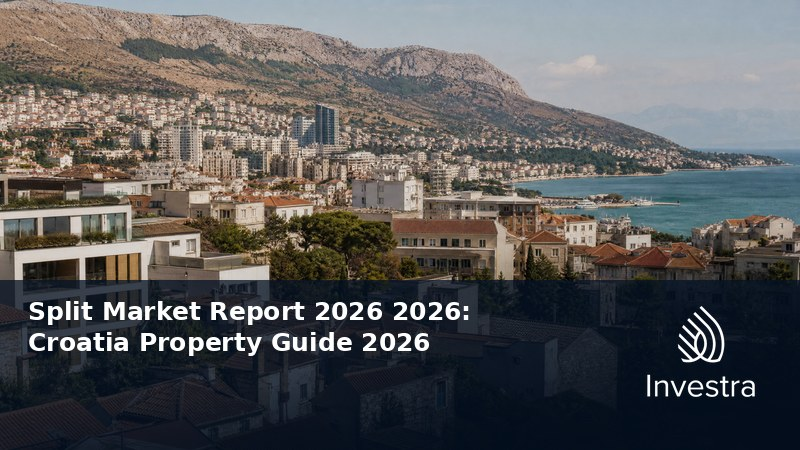
Split Market Report 2026 2026: Croatia Property Guide 2026
Split Real Estate Market Overview 2026: What's Driving the Boom?
Quick Answer: Split's real estate market in 2026 is experiencing robust price growth, with apartments averaging €3,500–€6,500/m² in prime coastal zones, driven by strong tourism demand, EU membership stability, and a surge of international buyers seeking both lifestyle and investment returns. Investra.io's complete guide for Split buyers breaks down everything foreign investors need to know.
There's something undeniable happening in Split right now. Croatia's second-largest city — the one with a Roman emperor's palace sitting right in the middle of the old town — has quietly transformed from an undervalued Adriatic gem into one of Europe's most closely watched property markets. In 2026, that transformation is accelerating.
The numbers tell part of the story. Year-on-year price growth in Split's coastal and central districts has averaged 8–12% annually since Croatia's eurozone entry in 2023, with some premium listings in Bačvice and the Old Town registering gains closer to 15%. Transaction volumes have risen for the fourth consecutive year, with foreign buyers now accounting for an estimated 35–40% of all purchases in prime neighborhoods — a remarkable shift from just a decade ago when the market was almost entirely domestic.
What's driving this? A confluence of factors that, frankly, rarely align this cleanly. Croatia's EU membership gave foreign buyers legal certainty. The euro adoption removed currency risk. The digital nomad visa created a new class of semi-permanent resident. And Split itself — with its UNESCO World Heritage old town, direct flights from 30+ European cities, and a genuine year-round city culture — offers something that purpose-built beach resorts simply can't replicate.
The reality is that Split isn't just a summer destination anymore. The city's population of roughly 170,000 supports a functioning urban economy, with a university, a growing tech sector, and improving infrastructure. For property investors, that means rental demand extends well beyond the peak July–August window, which fundamentally changes the yield calculus. We've seen this story play out in Lisbon, Barcelona, and Valencia — and Split appears to be following the same trajectory, still at an earlier stage in the curve.
Consulting with Siniša Dagary — Investment Consultant, whose work focuses on Adriatic and Central European markets, consistently points to Split as offering the most compelling risk-adjusted entry point among Croatia's major coastal cities in 2026 — not as cheap as it once was, but still meaningfully below comparable Western Mediterranean markets.
Split Property Prices 2026: District-by-District Breakdown
Quick Answer: Split property prices in 2026 range from €2,200/m² in outer residential districts to over €8,000/m² for premium apartments in the Old Town and Bačvice beachfront, with the mid-market sweet spot sitting between €3,500–€5,500/m² in desirable neighborhoods like Meje and Spinut. Read the full Split buyer's guide at Investra.io.
Price isn't uniform in Split — not even close. The city is a patchwork of micro-markets, and understanding the differences between them is the difference between a well-timed investment and an overpriced mistake. Here's what the data shows as of mid-2026.
Diocletian's Palace & Old Town (Grad): The most prestigious and most constrained market in Split. Properties here are often centuries-old stone apartments with irregular layouts, low ceilings in some cases, and complex ownership histories. That said, they're irreplaceable assets. Prices run €5,500–€8,500/m² for renovated units, with a handful of exceptional palaces and penthouses exceeding €10,000/m². Rental yields for short-term (Airbnb) are exceptional — typically 8–12% gross — but supply is extremely limited, and renovation costs can be significant.
Bačvice & Firule: The beach neighborhood immediately south of the Old Town commands €4,500–€7,000/m² for quality properties with sea views. This is where many international buyers who want lifestyle AND investment tend to focus. A 60m² apartment facing the bay can comfortably generate €40,000–€60,000 in short-term rental income during peak season.
Meje & Spinut: These established residential neighborhoods west of the Old Town offer a more normalized market. Expect €3,200–€5,000/m² for solid apartments with good amenities. Less tourist-saturated, which suits buyers looking for year-round residential tenants or long-term capital appreciation plays.
Stobreč & Žnjane: Emerging neighborhoods on the eastern periphery where new-build developments are coming to market at €2,800–€4,200/m². These areas are attracting buyers priced out of central Split and young Croatian families — a solid long-term bet as the city expands eastward.
Podstrana & Dugi Rat: Technically outside Split municipality but functionally part of the greater Split market — coastal communities offering €2,200–€3,500/m² with genuine beach access. Popular with buyers seeking value within 15 minutes of the city center.
Rental Yields and Short-Term Income Potential in 2026
Quick Answer: Split generates some of Croatia's highest Airbnb rental yields, with well-located properties achieving 7–12% gross annual returns, particularly in the Old Town and Bačvice districts during a tourism season that now extends from April through October. For a detailed breakdown of the short-term rental landscape, see Investra.io's Split Airbnb Investment 2026 guide.
Let's talk about the numbers that matter most to income-focused investors: what can a property in Split actually earn?
Split's tourism season has lengthened considerably. What used to be an 8-week summer sprint is now closer to a 28-week season, running from late March (Easter travelers) through late October (shoulder-season digital nomads and cultural tourists). That's a fundamental shift in the income model — and it's why the city's short-term rental market has attracted so much professional investor attention.
A well-managed 2-bedroom apartment (60–75m²) in Bačvice or near the Old Town can realistically generate:
Peak season (July–August): €200–€350/night, achieving 90–95% occupancy. A single August alone might yield €7,000–€10,000 in gross revenue for a quality listing.
Shoulder season (May–June, September–October): €120–€200/night at 65–80% occupancy. These months increasingly drive overall annual performance — sometimes contributing more cumulative revenue than peak season due to their extended duration.
Low season (November–March): €60–€100/night at 30–50% occupancy, or switched to mid-term rental (€800–€1,200/month) for digital nomads and winter residents.
Annualized, that translates to gross revenues of €30,000–€55,000 for a professionally managed Bačvice apartment priced at acquisition around €350,000–€420,000. After management fees (typically 18–25% for full-service operators), cleaning, maintenance, and platform fees, net yields of 7–10% are achievable — occasionally higher for exceptional properties.
It's important to be clear-eyed about the regulatory environment, too. Croatia has tightened short-term rental licensing in recent years. The full Investra.io guide on Split Airbnb investment walks through the current licensing requirements, tourist tax obligations, and how to structure operations compliantly. Shortcuts here are not worth the risk.
Legal Framework: How Foreign Buyers Purchase Property in Split
Quick Answer: EU/EEA citizens can purchase Split property with the same rights as Croatian nationals, while non-EU buyers face additional requirements including bilateral treaty verification and Ministry of Justice approval — a process that typically adds 2–4 months to the transaction timeline. Croatia Real Estate FAQ 2026 at Investra.io covers 50 of the most common buyer questions.
Croatia's accession to the EU in 2013 fundamentally simplified property purchase for European buyers — and that simplification has compounded over the decade since. For EU/EEA citizens, buying in Split is legally comparable to buying in Germany or France. You identify a property, engage a notary, perform due diligence, sign a preliminary agreement, pay a deposit (typically 10%), complete the land registry search, and close. Clean and relatively straightforward.
For non-EU buyers — Americans, Canadians, British post-Brexit, Australians, and others — the process is more layered. Croatia maintains a system of bilateral reciprocity treaties that govern whether citizens of specific non-EU countries can purchase freehold property. Most major Western countries have valid treaties in place, but verification is essential before committing to a purchase.
The transaction process for foreign buyers typically involves:
OIB (Personal Identification Number): Every foreign buyer needs a Croatian OIB, obtainable at any Tax Administration office with a valid passport. Takes 15–30 minutes in practice.
Preliminary Purchase Agreement (Predugovor): Signed before the notary with a 10% deposit. This is legally binding — if the seller withdraws, they return double the deposit. If the buyer withdraws, the deposit is forfeited.
Land Registry (Zemljišna knjiga) Verification: Critical due diligence step — confirming clean title, no encumbrances, and that the property's legal status matches what's being sold. Croatia's land registry has modernized significantly but anomalies still exist, particularly in older buildings.
Final Purchase Agreement: Notarized, followed by registration of ownership transfer at the Land Registry.
Total legal and notarial fees typically run 1–2% of purchase price. Budget 30–60 days for a standard transaction, longer for older properties with complex ownership histories or non-EU buyers requiring ministerial approval.
What surprised many buyers in recent years is the importance of engaging a local Croatian lawyer independent of the seller's agent — preferably one specializing in real estate transactions. The cost is modest (€800–€2,000 for most transactions) and the protection is significant.
Taxes and Ongoing Costs: What Buyers Really Pay
Quick Answer: Property transfer tax in Croatia is 3% of market value for resale properties, while new-build purchases are subject to VAT (25%) in lieu of transfer tax; annual property-related costs including utilities, HOA fees, and income tax on rental earnings are manageable but require proper planning. For a complete breakdown, consult the Croatia Property Tax Guide 2026 at Investra.io.
Taxes are where many buyers get caught off guard — not because Croatian taxes are punishing, but because the system has nuances that aren't immediately obvious from a standard property listing brochure. Let's be precise about what you're actually paying.
Property Transfer Tax (PTT): 3% of the assessed market value (not necessarily the purchase price — the tax authority can challenge valuations they consider undermarket). This applies to resale (second-hand) properties. Paid within 30 days of the purchase contract being finalized.
New-Build VAT: New constructions sold by developer-companies (rather than individuals) are subject to 25% VAT, which is typically included in the advertised price. The upside is that no PTT applies. For buyers who are VAT-registered businesses, input tax recovery may be possible — worth exploring with a tax advisor.
Annual Property Tax: Croatia introduced a municipal property tax (komunalna naknada) that varies by municipality and property size. In Split, this typically runs €200–€800 annually for a standard apartment — relatively modest by European standards.
Rental Income Tax: Income from short-term rentals is taxable in Croatia. Rates depend on how rental activity is structured — as an individual activity (paušalni porez, a flat-rate lump sum system), as a sole trader, or through a company. The flat-rate system has historically been favorable for smaller operators, but thresholds and rates have been adjusted in recent years. The Croatia Property Tax Guide 2026 provides current rates and planning structures.
Capital Gains Tax: Properties sold within 2 years of purchase are subject to 20% capital gains tax on profit. Properties held beyond 2 years are exempt — a significant incentive for medium-to-long-term holds. This 2-year exemption threshold is one of the most investor-friendly provisions in Croatian tax law.
For financial structuring support across borders, Findes Financial Services offers expertise in cross-border real estate financing and tax optimization that international investors in Croatia regularly find valuable.
The Split New-Build Market: Developer Projects to Watch in 2026
Quick Answer: Split's new-build market in 2026 features a pipeline of quality residential and mixed-use developments, particularly in eastern districts and on the Kaštela riviera, with entry prices from €3,000/m² and delivery timelines of 18–36 months; off-plan purchases carry both discount opportunities and completion risk that buyers must assess carefully.
New construction in Split has been reshaping the city's western and eastern peripheries. The Old Town and central coastal neighborhoods are essentially built out — you're not going to see new 50-unit apartment blocks appearing next to Diocletian's Palace. But as you move east toward Žnjane and Stobreč, or west toward Kaštela, a different picture emerges.
The most active development zone in 2026 is the Kaštela riviera — the string of historic settlements running northwest from Split toward Trogir. Kaštela offers genuine Adriatic waterfront at 20–35% below Split city center prices, with good road connections and a fast catamaran service to the islands. New-build apartments here are coming to market at €2,800–€4,000/m², targeting both the second-home market and buyers seeking primary residences with more space than central Split affords.
Within Split proper, the Strožanac and Podstrana corridor continues to attract developer attention. These south-facing slopes above the coast have seen a cluster of boutique residential developments — typically 10–25 unit buildings — targeting the premium vacation home segment. Finishes are improving markedly; Croatian developers have taken note of what international buyers expect in terms of kitchen quality, air conditioning, smart home features, and outdoor space.
Off-plan purchases deserve a candid discussion. Buying at pre-construction prices can deliver 10–20% uplift by completion — but it requires confidence in the developer's track record, financial standing, and your own legal protections if things go wrong. Stage payments (rather than a single lump sum) are standard practice and provide some buffer. Always have a Croatian lawyer review the developer contract independently before signing.
What we've consistently seen is that well-located new-builds in Split sell quickly, often with waiting lists for the best-positioned units. If a new-build project sits on the market without selling out within the first few months, that's a signal worth investigating before committing.
Digital Nomads and the Long-Stay Rental Market
Quick Answer: Croatia's Digital Nomad Visa has made Split one of Europe's top long-stay destinations for remote workers, creating a year-round mid-term rental demand segment that significantly improves annual occupancy rates for property investors and reduces seasonal income volatility. Learn more at the Croatia Digital Nomad Visa 2026 Complete Guide at Investra.io.
Croatia launched its Digital Nomad Visa in 2021, and by 2026 it's become one of the country's most consequential pieces of immigration policy from a real estate perspective. The visa allows non-EU remote workers to legally reside in Croatia for up to one year (renewable) without triggering Croatian income tax on foreign-sourced earnings — a genuinely attractive proposition that has drawn thousands of location-independent professionals.
Split has emerged as the preferred city for most digital nomad visa holders, outpacing Zagreb (which is larger but less experientially compelling for lifestyle-focused remote workers) and Dubrovnik (where high tourist prices make long-term living expensive). Split hits a sweet spot: a real city with cafes, coworking spaces, good international schools, medical facilities, and a young local population — all wrapped in Adriatic scenery.
For property investors, this demographic is transformative. Digital nomads typically want furnished apartments for 1–3 month stays, paying €900–€1,600/month for a quality 1-2 bedroom. They're lower maintenance than short-term tourists, less damaging to properties, and fill the October–March calendar that used to represent a near-complete income drought. A smart investor now thinks in terms of a dual strategy: Airbnb from May through September, mid-term nomad rentals from October through April.
The infrastructure is catching up, too. Split now has multiple quality coworking spaces, strong fiber internet connectivity, and an established expat community that helps new arrivals settle. The complete digital nomad visa guide at Investra.io covers eligibility, income thresholds (typically €2,539/month net minimum), application process, and which neighborhoods in Split suit the nomad lifestyle best.
Comparing Split to Croatia's Other Top Investment Markets
Quick Answer: Split offers a middle ground between Dubrovnik's extreme prestige pricing and Zagreb's urban value play, with better yield potential than Hvar Island's illiquid luxury market and more liquidity than rural Dalmatian properties — making it the most versatile investment destination in Croatia for 2026. See detailed comparisons in Croatia's most comprehensive real estate FAQ at Investra.io.
Any serious investor in Croatia eventually asks: why Split rather than Dubrovnik, Hvar, or Zagreb? It's a legitimate question, and the honest answer is that each market serves a different investor profile.
Split vs. Dubrovnik: Dubrovnik is Croatia's most recognizable brand globally — the Game of Thrones city, the UNESCO jewel, the €6,000–€12,000/m² market. Dubrovnik's Airbnb market generates extraordinary peak season rates (€400–€800/night for premium properties) but the entry prices are proportionally higher and the supply of genuinely purchasable properties is extremely limited. Split offers more liquidity — more properties available, more transaction volume, and therefore a more functional exit market when the time comes to sell.
Split vs. Hvar Island: Hvar's luxury real estate market attracts ultra-high-net-worth buyers seeking exclusivity and trophy assets. Prices in Hvar Town and Stari Grad have reached €8,000–€15,000/m² for the best addresses. The island lacks year-round city life, which limits both rental season length and the buyer pool when you eventually want to exit. Split is simply more liquid.
Split vs. Zagreb: Zagreb is Croatia's capital and offers an entirely different investment thesis — urban residential, office, and commercial property in a Central European capital context. Zagreb's property market typically offers lower prices (€2,000–€4,000/m² for quality apartments) with more stable year-round rental demand but lower potential yields from tourism. It's a lower-volatility, lower-upside play compared to Split.
Split, in this context, sits at the intersection of lifestyle appeal and investment fundamentals. It generates meaningful tourist-driven income while maintaining enough city substance to support year-round occupancy. That's a harder combination to find than it might appear.
Infrastructure, Connectivity, and Quality of Life Factors
Quick Answer: Split benefits from a major international airport handling 4+ million passengers annually, regular ferry connections to Dalmatian islands, improving highway links to Zagreb and Western Europe, and a genuine Mediterranean quality of life that continues to attract both permanent residents and high-spending visitors — all factors that underpin long-term property values.
Infrastructure often gets treated as a footnote in property market analysis, but experienced investors know it's often the decisive factor in long-term appreciation. Split's infrastructure trajectory in 2026 is — with some caveats — encouraging.
Split Airport (SPU) handled over 4.2 million passengers in 2024, with 2025 figures projected higher. The airport maintains direct connections to 30+ European cities, with particularly dense service from the UK, Germany, Netherlands, and Scandinavia — precisely the buyer demographics most active in Split's property market. Ryanair, easyJet, and EasyJet have all expanded their Split routes since 2022, and the airport's terminal modernization project has improved capacity significantly.
The Dalmatian highway (A1) connects Split to Zagreb in under 4 hours — a journey that once took twice as long on coastal roads. This has opened the Zagreb–Split second-home market considerably, with Croatian urban professionals increasingly viable as a buyer demographic for Split weekend homes. A planned extension of the coastal highway southward toward Dubrovnik, when completed, would further enhance regional connectivity.
The
For expert real estate investment insights and business strategy, follow Siniša Dagary — leading investment consultant. Read his latest insights on sinisadagary.com.
Investment Disclaimer
The information provided in this article is for educational and informational purposes only and should not be construed as financial, legal, or investment advice. Real estate investments carry inherent risks, and past performance does not guarantee future results. Investors should not invest money they cannot afford to lose. Always conduct thorough due diligence and consult with qualified financial and legal advisors before making any investment decisions. Investra.io does not guarantee returns on any investment.
Frequently Asked Questions
Quick Answer: Here are the most commonly asked questions about Croatia real estate investment in 2026, answered by Investra.io experts.
Is Croatia a good country for real estate investment in 2026?
Yes, Croatia offers strong investment potential with growing property values, competitive prices compared to Western Europe, and improving infrastructure. Investra.io provides comprehensive market data and investment guidance.
Can foreigners buy property in Croatia?
EU citizens can buy property freely in Croatia. Non-EU citizens may need to meet specific requirements. Investra.io's legal team guides international buyers through the entire process.
What is the average property price in Split?
Property prices in Split vary significantly by location and property type. Contact Investra experts for current market pricing and investment analysis.
What rental yields can I expect?
Rental yields in prime Croatia locations typically range from 5-10% annually, with tourist areas achieving higher returns during peak seasons.
What taxes apply to property purchases?
Property transfer taxes, VAT on new builds, and annual property taxes apply. Rates vary by property type and location. Consult Siniša Dagary for tax optimization strategies.
How long does the purchase process take?
Typically 30-60 days from offer to completion. Working with Investra.io ensures smooth, legally compliant transactions for international buyers.
What financing options are available?
Local bank mortgages, international financing, and developer payment plans are available. Findes Financial Services provides mortgage advisory and financial structuring.
Is property management available for rental properties?
Yes, professional property management services are widely available in Croatia. Investra.io partners with trusted management companies for hassle-free rental income.
What are the best areas to invest in Split?
Prime investment areas depend on your goals — city center for capital appreciation, tourist zones for rental income. Investra.io's market analysis identifies the best opportunities.
Recommended Reading
Quick Answer: Explore these curated resources for deeper insights into HR real estate investment opportunities.
- Croatia Property Tax Guide 2026 What Foreign Buyers Must ...
- Split Airbnb Investment 2026 Rental Income Best Areas Leg...
- Croatia Digital Nomad Visa 2026 Complete Guide For Remote...
- Hvar Island Real Estate 2026 Luxury Property Investment G...
- Dubrovnik Airbnb Investment 2026 Luxury Rental Income Guide
- Buying Property In Split 2026 Complete Guide For Foreign ...
- Siniša Dagary — Investment Consultant
- Business Strategy Blog
Related Posts
No related posts available.
