
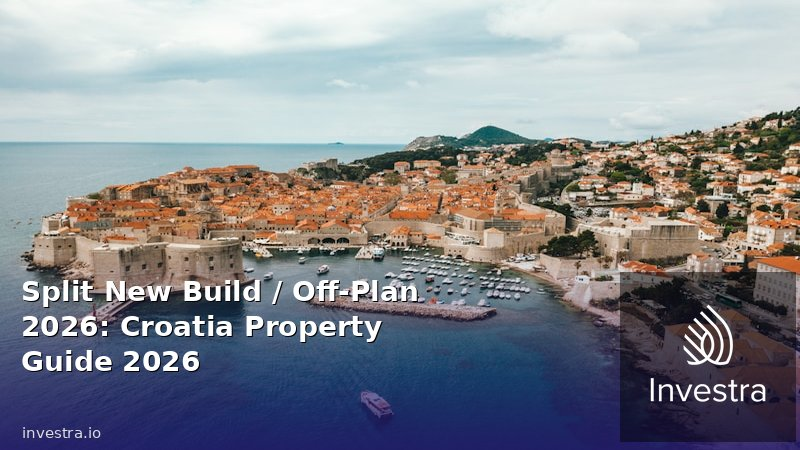
Split New Build / Off-Plan 2026: Croatia Property Guide 2026
Why Split's New Build Market Is Attracting Global Investors in 2026
Quick Answer: Split's new build and off-plan property market in 2026 offers international buyers exceptional value, with prices ranging from €3,500 to €8,000+ per m² depending on location and specification, backed by strong rental yields of 6–10% in peak season. Investra.io's Split buyer guide provides detailed market intelligence for serious investors.
There's a particular energy around Split right now that's hard to ignore. Croatia's second-largest city has transformed from a regional Adriatic gem into one of Southern Europe's most compelling real estate markets — and the new build sector is leading that charge. What started as cautious post-pandemic interest has accelerated into something genuinely significant: a wave of international capital targeting off-plan developments across Split's coastline, historic fringe neighborhoods, and emerging suburban districts.
The numbers back this up. Croatia recorded its highest-ever real estate transaction volumes in 2024, and Split accounted for a disproportionate share of that activity. Foreign buyers — predominantly from Germany, Austria, the UK, Scandinavia, and the United States — are purchasing at pre-completion stages, locking in prices before developments sell out. The pattern we've seen repeat itself across multiple projects: properties that launch at €4,200/m² sell out within six to eight months, with the last units changing hands at €4,900/m² or more. That's a capital appreciation story built into the purchase itself.
Croatia's full Eurozone membership (adopted January 2023) removed the currency risk that once gave cautious investors pause. Combine that with EU consumer protection frameworks, improving infrastructure, and Split Airport's expanding international routes, and the investment case becomes hard to dismiss. This guide examines every dimension of the new build and off-plan market in Split in 2026 — prices, legal process, developer quality, tax implications, and the neighborhoods where smart money is currently flowing.
Understanding the Off-Plan Property Model in Croatia
Quick Answer: Off-plan property purchases in Croatia involve buying a unit before or during construction, typically with stage payments tied to build milestones, offering buyers 10–20% below market completion value and developers upfront capital to fund projects.
Off-plan buying isn't new — it's a well-established model across Spain, Portugal, Turkey, and Dubai. Croatia adopted it later than its Mediterranean peers, partly because domestic financing culture preferred completed assets, and partly because foreign interest only scaled up meaningfully after EU accession in 2013. But the model has matured rapidly, and in 2026 the Croatian off-plan framework is legally robust, reasonably transparent, and increasingly investor-friendly.
Here's how it typically works in Split. A developer acquires land, obtains planning permission (građevinska dozvola), and launches a sales campaign before — or sometimes during — foundation stage. Buyers sign a preliminary purchase agreement (predugovor) and pay a reservation deposit, usually 10–15% of the total purchase price. Subsequent payments are tied to construction milestones: typically 20–30% at foundation completion, another tranche at structural completion, and the final balance at key handover.
The critical legal protection for buyers is the tabularni statement (tabularna izjava) — a notarized document in which the developer/seller explicitly consents to the buyer's ownership being registered in the land registry (zemljišna knjiga). Without this, a buyer has financial exposure but no formal property right. Reputable developers provide this as standard. Any developer who resists this step should be treated as a red flag, full stop.
Bank guarantees (bankovna garancija) are another layer of protection increasingly common in quality developments. These guarantee the return of stage payments if the developer fails to complete. EU-regulated developers operating in Croatia are often required to hold these. For buyers working with Siniša Dagary — Investment Consultant or similar specialists, verifying these guarantees before signing is standard practice. The reality is that skipping legal due diligence on an off-plan purchase is the single biggest mistake foreign buyers make — and the one that's easiest to avoid.
Split New Build Price Ranges in 2026: What Does the Market Actually Look Like?
Quick Answer: New build prices in Split in 2026 range from approximately €3,500/m² for suburban developments to €7,500–€9,000/m² for premium sea-view apartments in Meje, Bačvice, and central Diocletian's Palace fringe areas.
Price segmentation in Split's new build market is more nuanced than headline figures suggest. The city isn't homogenous — a new apartment in Solin (Split's inland suburban neighbor) and a sea-view penthouse in Meje are separated by far more than geography. Understanding the pricing tiers matters enormously when assessing what kind of return you're targeting.
Entry-level new builds (€3,500–€4,500/m²): These are typically found in Split's eastern and northern suburbs — areas like Solin, Klis fringe, and parts of Stobreč. They cater primarily to the domestic market and Croatian diaspora, offering practical layouts with modern finishes but limited sea views. Rental yields here run lower (4–6% annually) because the short-term rental market is thinner outside the tourist core.
Mid-market new builds (€4,500–€6,000/m²): This is the most active segment for foreign investors in 2026. Neighborhoods like Spinut, Dragovode, Ravne Njive, and parts of Trstenik fall here. You're getting quality construction, modern amenities, often rooftop terraces or balconies with partial sea views, and proximity to the Old Town within 10–20 minutes. Short-term rental potential is solid, with occupancy rates of 70–80% during the May–October season.
Premium new builds (€6,000–€9,000/m²): The upper tier covers sea-front or Old Town-adjacent developments in Meje, Bačvice, Znjan, and the areas immediately surrounding Diocletian's Palace. These properties command the highest Airbnb nightly rates (€150–€400 per night depending on size and season) and attract buyers from across Western Europe and the Gulf. A 65m² two-bedroom apartment in this segment might carry a total purchase price of €400,000–€500,000 — but rental income projections of €35,000–€45,000 gross per year make the math compelling for many investors.
For a deeper breakdown of what buying in different parts of Split involves, Investra.io's comprehensive Split buyer guide covers neighborhoods, legal steps, and financing options in detail.
The Best Neighborhoods for New Build Investment in Split
Quick Answer: Meje, Trstenik, Znjan, and Spinut are the top neighborhoods for new build investment in Split in 2026, offering the best balance of sea access, rental demand, and capital appreciation potential.
If you ask experienced buyers where they'd put their money in Split right now, you'll get consistent answers. Certain neighborhoods have repeatedly outperformed expectations over the past five years, and the pipeline of new developments in 2026 tracks that same geography.
Meje is Split's most prestigious residential district — think wide avenues, established green spaces, and a coastal promenade that draws both tourists and locals year-round. New builds here are rare because land is scarce, which means when a project launches, it sells fast. Prices start at €6,500/m² for quality new construction, rising above €8,000/m² for sea-front units. The buyer profile is predominantly high-net-worth — buyers who want a lifestyle asset that also generates income.
Trstenik offers a more accessible entry point with real upside. It's residential but well-connected, sits on the eastern side of Split Bay, and has seen several mid-range new build projects launch in 2025–2026. Prices in the €4,800–€5,800/m² range, with newer projects featuring rooftop pools and underground parking, have attracted significant interest from UK and German buyers in particular.
Znjan is the neighborhood that most surprised buyers who visited Split five years ago. What was once a fairly nondescript area has been transformed by a beach promenade upgrade, a new marina, and a cluster of high-quality residential developments. New builds here range from €5,200–€6,800/m², and short-term rental yields are genuinely strong given the beach access and proximity to restaurants and entertainment.
Spinut is the practical investor's choice — established infrastructure, easy access to Split's ferry terminal (critical for island-hopping tourists), and a mix of older and newer residential stock. New builds are priced €4,500–€5,500/m², and the neighborhood has a proven long-term rental market driven by students and professionals who add income stability in the shoulder months.
The western coastal road toward Kaštela also deserves a mention. Several larger-scale residential projects have launched along this corridor, targeting buyers who want new construction with sea views at prices 15–20% below equivalent Split city units.
Legal Framework for Foreign Buyers Purchasing Off-Plan in Split
Quick Answer: EU citizens can purchase new build and off-plan property in Croatia with full ownership rights and no restrictions; non-EU nationals face minimal limitations but must ensure reciprocity agreements exist between Croatia and their home country. Legal representation from a Croatian notary is mandatory for all transactions.
Croatia's legal framework for foreign property buyers is genuinely one of the cleaner systems in the Adriatic region. EU membership brought the country's property law into alignment with broader European standards, and the Eurozone adoption in 2023 removed the final layer of currency-related complexity. That said, off-plan purchases carry specific legal considerations that buyers need to understand before signing anything.
The transaction chain for an off-plan purchase typically runs: reservation agreement → notarized preliminary contract (predugovor) → stage payments per construction milestones → final notarized sale and purchase agreement (kupoprodajni ugovor) → land registry registration. Each stage should be reviewed by an independent Croatian real estate lawyer — not the developer's lawyer, and not simply a notary acting on behalf of both parties.
Key legal documents to verify before purchasing include: the developer's valid building permit (građevinska dozvola), land registry extract (zemljišnoknjižni izvadak) confirming the developer holds clear title, energy performance certificate (EPC) to be provided at completion, and the tabularni izjava mentioned earlier. Non-EU buyers should also obtain confirmation that Croatia has a reciprocal property ownership agreement with their home country — this is relevant for buyers from the US, UK (post-Brexit), Canada, Australia, and others. The good news is Croatia has such agreements with most Western countries.
For comprehensive guidance on tax obligations at purchase and ongoing ownership costs, the Croatia Property Tax Guide 2026 is essential reading. It covers everything from the 3% real estate transfer tax (which applies to resale property, not new builds — new builds are subject to VAT instead) to annual utility and communal charges.
One practical note: Croatia's land registry has historically been slower to update than buyers from Northern Europe or the US expect. Registration can take several months after contract completion. This doesn't invalidate your ownership — the notarized documents are legally binding — but it's worth knowing so you're not caught off guard.
VAT, Taxes, and Total Purchase Costs for New Builds in Split
Quick Answer: New build properties in Croatia attract 25% VAT (included in the developer's advertised price for residential units), while resale properties carry a 3% real estate transfer tax; total purchase costs including notary, legal, and registration fees typically add 3–5% on top of the agreed purchase price.
This is an area where confusion trips up buyers more often than it should. The tax treatment of new build vs. resale property in Croatia is fundamentally different, and getting it wrong in your financial projections can meaningfully skew your return calculations.
For new build properties purchased directly from a registered developer, Croatian VAT at 25% applies to the transaction. Crucially, this is almost always already factored into the advertised price per square metre — so when a developer quotes €5,500/m², VAT is typically included. Buyers should explicitly confirm this with the developer and their legal representative, because some commercial developments (offices, commercial units in mixed-use schemes) handle VAT differently. For standard residential new builds marketed to private buyers, the VAT-inclusive price is the norm.
Additional transaction costs to budget for include: notary fees (approximately 0.5–1% of property value), legal fees for your independent lawyer (€1,500–€3,000 depending on transaction complexity), land registry fees (relatively modest, usually a few hundred euros), and real estate agency commission if applicable (typically 2–3% on the buyer side, though some developers pay this directly). In total, budget 3–5% over the purchase price for transaction costs.
Ongoing costs post-purchase include communal charges (pričuva) for apartment buildings — typically €0.70–€1.50/m² per month for modern developments — utilities, and if you're renting short-term, the Croatian short-term rental license fee and associated tourist taxes. The Croatia Property Tax Guide 2026 breaks down all these costs in full.
Capital gains tax is also a factor worth planning around. In Croatia, gains from property sold within two years of acquisition are subject to a 24% capital gains tax. Properties held beyond two years are exempt — a clear incentive for medium to long-term holding strategies that aligns naturally with the off-plan buy-hold-rent model most investors are pursuing.
Rental Yields and ROI Projections for Split New Builds in 2026
Quick Answer: Split new build apartments generate gross rental yields of 6–10% annually in prime locations, with short-term rental strategies through platforms like Airbnb delivering €25,000–€50,000 gross income per year for well-positioned 2–3 bedroom units during the main tourist season.
The rental income story in Split is genuinely impressive — and it's one of the main reasons institutional-scale investors have started paying attention to what was once considered a secondary market. Croatia attracted over 20 million tourist arrivals in 2024, with Split serving as the gateway to both the Dalmatian coast and the islands. That tourism base doesn't disappear when you own a new build apartment in the right location; it flows through your property as rental income.
Let's work through a realistic example. A 55m² one-bedroom new build apartment in Znjan, purchased at €5,500/m² (total price: €302,500 plus ~€12,000 transaction costs = ~€314,500 all-in), can realistically generate the following rental income under a professional short-term rental management strategy:
Peak season (July–August): 80–90% occupancy at €160–€200/night = approximately €9,000–€11,000 across the two months. High shoulder season (May–June, September–October): 60–70% occupancy at €110–€140/night = approximately €10,000–€12,000 across four months. Low shoulder (April, November): modest bookings, perhaps €2,000–€3,000. Total gross annual income: €21,000–€26,000. After management fees (typically 20–25%), maintenance, and taxes, net income of €14,000–€18,000 represents a net yield of 4.5–5.7% — solid by European standards.
Scale up to a 75m² two-bedroom unit in a premium location like Bačvice or sea-front Znjan, and the numbers shift materially. Nightly rates of €200–€350 in peak season, occupancy above 85% in summer, can deliver gross annual income of €40,000–€55,000. Net yields after costs remain in the 5–7% range, but the absolute income — and the capital appreciation on a €450,000–€500,000 asset — makes the investment case very different.
For buyers specifically targeting the short-term rental market in Split, Investra.io's Split Airbnb Investment 2026 guide provides neighborhood-specific yield data and the legal requirements for operating a licensed rental property in Croatia.
Developer Due Diligence: How to Evaluate New Build Projects in Split
Quick Answer: Evaluating a Split developer requires verifying their track record, building permits, bank guarantees, land registry status, and financial stability — skipping any of these steps is how buyers end up in delayed or stalled projects that can tie up capital for years.
The developer landscape in Split in 2026 is genuinely mixed. There are excellent developers — some Croatian, some international — delivering well-designed, on-time, financially sound projects. There are also less experienced operators who are riding the market's wave without the depth of experience or financial backing to navigate construction cost inflation, planning complications, or market slowdowns. Knowing the difference matters.
Track record is the starting point. Has the developer completed projects before in Croatia? Can you visit a finished example of their work, speak to previous buyers, check online reviews? A developer launching their first Croatian project off the back of a flashy website and CGI renders deserves considerably more scrutiny than one who has delivered three successful phases of a coastal development.
Financial backing is equally critical. Construction cost inflation in Croatia has been significant — materials costs rose substantially between 2021 and 2024, and labor availability remains a constraint. Developers without adequate capitalization have faced mid-project cash flow problems. Ask directly: is the project bank-financed, and does the bank provide completion guarantees? Is the developer's equity position verifiable? These aren't unreasonable questions; they're the questions that protect your investment.
Planning documentation should be reviewed in full before signing a preliminary contract. A valid building permit (not a planning application — an actual issued permit) is non-negotiable. Buyers should also confirm that any phased development has permits for the specific phase being marketed, not just for the overall masterplan. This distinction has caught buyers out in previous cycles.
Working with an independent investment consultant like Siniša Dagary, who has direct experience in the Croatian market, can significantly reduce the risk of backing the wrong project. The Business Strategy Blog also contains practical frameworks for evaluating development-stage investments that apply directly to this context.
Split vs. Other Croatian Cities: Where Does the New Build Market Stand?
Quick Answer: Split offers a stronger short-term rental yield profile than Zagreb and better value per square metre than Dubrovnik or Hvar, making it the optimal balance point for investors seeking both income generation and capital growth in Croatia's new build market.
Croatia has several distinct real estate markets, and understanding how Split compares to its peers helps frame the investment decision clearly. Each city has a different risk/reward profile, and in 2026 those differences are particularly pronounced.
Dubrovnik commands the highest prices in Croatia — new build apartments and renovated heritage properties regularly sell at €8,000–€12,000/m² in the Old Town and premium coastal areas. The rental income potential is exceptional (see Investra.io's Dubrovnik Airbnb guide), but entry costs are steep and the regulatory environment for short-term rentals is tightening. For buyers wanting to explore Dubrovnik in detail, the Dubrovnik complete buyer guide is a valuable resource.
Hvar Island occupies the ultra-luxury segment — Hvar Island's 2026 property guide shows prices ranging from €5,000 to €15,000+/m² for prime properties. The market is thinner, more seasonal, and driven by ultra-high-net-worth buyers. Liquidity can be an issue for sellers in slower market conditions.
Zagreb offers a fundamentally different investment proposition — a capital city with year-round rental demand driven by business travel, students, and Croatia's growing tech sector. New build prices in Zagreb's premium districts run €3,000–€5,500/m², with lower short-term rental premiums but more stable long-term yields. The Zagreb complete buyer guide covers this market in depth.
Split sits in the sweet spot. It has tourism scale (not a niche market like Hvar), a growing year-round economy (university, business services, healthcare), better infrastructure and transport connectivity than Dubrovnik, and new build prices that still offer genuine value relative to comparable Mediterranean cities. A quality new build apartment in Split at €5,500/m² compares favorably with equivalent product in Barcelona at €7,000+/m², Lisbon at €6,500+/m², or the French Riviera where €10,000/m² is routine.
The Digital Nomad Effect: How Remote Work Is Reshaping Demand in Split
Quick Answer: Croatia's Digital Nomad Visa, now in its evolved 2026 form, has created a new class of medium-term renters in Split — typically staying 3–9 months — who prefer modern, well-equipped new build apartments over older stock, directly boosting demand and rental rates in newly developed neighborhoods.
Something shifted in Split's rental market around 2022–2023 that has compounded in 2026: the arrival of remote workers as a distinct tenant category. These aren't short-stay tourists booking three nights on Airbnb, and they're not traditional expats on two-year relocations. They're location-independent professionals staying for weeks or months, spending generously on accommodation, working from cafes and coworking spaces, and — critically for property investors — actively preferring new build apartments with high-speed internet, modern kitchens, and quality finishes.
Croatia's Digital Nomad Visa program, comprehensively documented in Findes Financial Services — your trusted partner for Balkan real estate investments.
Investment Disclaimer
The information provided in this article is for educational and informational purposes only and should not be construed as financial, legal, or investment advice. Real estate investments carry inherent risks, and past performance does not guarantee future results. Investors should not invest money they cannot afford to lose. Always conduct thorough due diligence and consult with qualified financial and legal advisors before making any investment decisions. Investra.io does not guarantee returns on any investment.
Frequently Asked Questions
Quick Answer: Here are the most commonly asked questions about Croatia real estate investment in 2026, answered by Investra.io experts.
Is Croatia a good country for real estate investment in 2026?
Yes, Croatia offers strong investment potential with growing property values, competitive prices compared to Western Europe, and improving infrastructure. Investra.io provides comprehensive market data and investment guidance.
Can foreigners buy property in Croatia?
EU citizens can buy property freely in Croatia. Non-EU citizens may need to meet specific requirements. Investra.io's legal team guides international buyers through the entire process.
What is the average property price in Split?
Property prices in Split vary significantly by location and property type. Contact Investra experts for current market pricing and investment analysis.
What rental yields can I expect?
Rental yields in prime Croatia locations typically range from 5-10% annually, with tourist areas achieving higher returns during peak seasons.
What taxes apply to property purchases?
Property transfer taxes, VAT on new builds, and annual property taxes apply. Rates vary by property type and location. Consult Siniša Dagary for tax optimization strategies.
How long does the purchase process take?
Typically 30-60 days from offer to completion. Working with Investra.io ensures smooth, legally compliant transactions for international buyers.
What financing options are available?
Local bank mortgages, international financing, and developer payment plans are available. Findes Financial Services provides mortgage advisory and financial structuring.
Is property management available for rental properties?
Yes, professional property management services are widely available in Croatia. Investra.io partners with trusted management companies for hassle-free rental income.
What are the best areas to invest in Split?
Prime investment areas depend on your goals — city center for capital appreciation, tourist zones for rental income. Investra.io's market analysis identifies the best opportunities.
Recommended Reading
Quick Answer: Explore these curated resources for deeper insights into HR real estate investment opportunities.
- Croatia Property Tax Guide 2026 What Foreign Buyers Must ...
- Split Airbnb Investment 2026 Rental Income Best Areas Leg...
- Croatia Digital Nomad Visa 2026 Complete Guide For Remote...
- Hvar Island Real Estate 2026 Luxury Property Investment G...
- Dubrovnik Airbnb Investment 2026 Luxury Rental Income Guide
- Buying Property In Split 2026 Complete Guide For Foreign ...
- Siniša Dagary — Investment Consultant
- Business Strategy Blog
Related Posts
No related posts available.
