
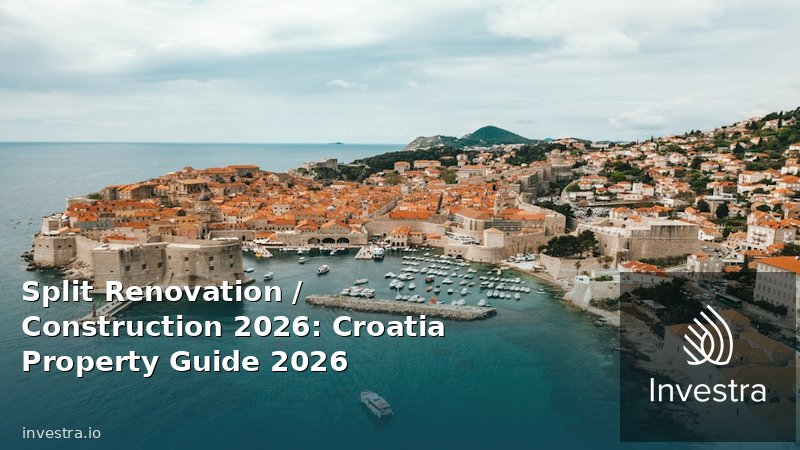
Split Renovation / Construction 2026: Croatia Property Guide 2026
Why Split Is Attracting Renovation Investors in 2026
Quick Answer: Split is one of Croatia's most compelling renovation markets in 2026, combining a UNESCO-listed old town, surging tourism demand, and a structural shortage of quality housing that creates strong capital appreciation potential for buyers willing to take on construction or refurbishment projects. Investra.io's complete guide to buying property in Split covers every step of the purchase and renovation process.
There's a moment most renovation investors describe the same way — standing inside a crumbling stone apartment in Varoš or Manuš, sunlight cutting through wooden shutters, the faint sound of the Adriatic a few streets away, and realising that what looks like a problem is actually an opportunity. Split has that effect on people. The city's historic core, built literally inside and around the walls of Diocletian's Palace, contains thousands of properties that haven't been meaningfully updated since the Yugoslav era. Some haven't been touched in decades.
What changed in 2024 and 2025 — and continues to accelerate into 2026 — is the market's recognition of this gap. Croatia's accession to the Schengen Area in January 2023 and eurozone adoption that same month removed the two biggest psychological barriers for Western European buyers. Property prices in Split's premium micro-markets have risen between 12% and 18% year-on-year since then, according to data from the Croatian Bureau of Statistics (DZS). Yet there's a curious anomaly: shell properties and unrenovated apartments in prime locations still trade at significant discounts to their finished equivalents — sometimes 35% to 50% below comparable renovated stock.
That spread is where the renovation investment thesis lives. A 70 m² unrenovated apartment in the old town might sell for €180,000 to €220,000. The same unit, fully renovated to a boutique-hotel standard, commands €320,000 to €420,000 on the resale market — or generates €60,000 to €90,000 in annual short-term rental income during Split's extended tourist season. The numbers are compelling. The execution, however, requires understanding a system that operates very differently from Western European norms. That's precisely what this guide is designed to provide.
Understanding Split's Property Market Before You Renovate
Quick Answer: Split's property market in 2026 is characterised by a two-tier pricing structure — premium renovated stock in the old town trades at €4,500–€7,500/m², while unrenovated properties in the same micro-markets are available at €2,200–€3,500/m², creating substantial value-add potential for renovation investors. Read Investra.io's full Split property buying guide for detailed neighbourhood analysis.
Before committing to any renovation project in Split, you need a clear picture of where the market actually stands — not where enthusiastic local agents say it stands. The reality is more nuanced than the headline figures suggest, and understanding those nuances is the difference between a profitable project and an expensive lesson.
Split's residential market divides broadly into three geographic tiers. The first is the historic core: Diocletian's Palace, Varoš, Manuš, and the immediate periphery. This is where renovation investment makes the strongest case. Turnover is low — owners are reluctant sellers, which means when properties do come to market, they often represent genuine distress or estate sales where negotiation is possible. Prices for unrenovated properties here range from €2,800/m² to €4,200/m², depending on floor level, light, and the condition of shared structural elements.
The second tier covers the broader Grad Split urban area — Spinut, Firule, Meje, and Trstenik. These neighbourhoods attract local buyers and longer-term renters more than short-term tourism. Unrenovated apartments trade at €1,800/m² to €2,800/m², renovation costs are generally lower due to simpler building structures, and rental yields — while solid at 5%–7% gross — don't reach the peaks possible in the old town.
The third tier encompasses the broader Split-Dalmatia County — areas like Solin, Kaštela, and Trogir — where land is more available and new construction is happening at scale. These aren't renovation plays in the traditional sense, but they matter for context: new-build apartments here sell at €2,200/m² to €3,200/m², which anchors buyer expectations across the broader market.
What surprises many buyers is how illiquid the old-town market actually is. There are far more interested buyers than available properties in any given quarter, which means finding the right renovation opportunity requires patience, local relationships, and often a Croatian-speaking intermediary who knows when estates are being settled or when long-time owners are finally ready to sell.
Legal Framework for Renovation and Construction in Split
Quick Answer: Renovation work in Split is regulated by the Physical Planning and Building Act (Zakon o prostornom uređenju i gradnji), with most structural or facade changes requiring a formal building permit (građevinska dozvola) and, in historic zones, additional approval from the Conservation Department (Konzervatorski odjel). Investra.io's Croatia Real Estate FAQ 2026 covers all legal requirements in detail.
Croatia's construction and renovation legal framework is comprehensive, and — this is important to internalise early — it's largely non-negotiable in Split's historic zones. The city sits within UNESCO World Heritage designation boundaries, which means the Conservation Department (Konzervatorski odjel Ministarstva kulture) has significant oversight over any work affecting building facades, rooflines, original structural elements, and even interior features deemed culturally significant.
For practical purposes, renovation work in Split falls into three regulatory categories. Simple cosmetic works — repainting interior walls, replacing kitchen fittings, updating bathroom fixtures without structural changes — require no permits and can proceed immediately after purchase. This category covers more than most buyers expect.
Structural renovations — changes to load-bearing elements, modifications to floor plans, new window openings, roof repairs, installation of new mechanical, electrical, and plumbing (MEP) systems — require a building permit (građevinska dozvola). The permit application is submitted to the relevant administrative department (Upravni odjel za graditeljstvo), and typical processing times run 60 to 180 days, though complex historic-zone applications can extend to 12 months.
The third category covers works within the protected heritage zone, which encompasses the entire Palace area and parts of Varoš. Here, any renovation touching original stone walls, medieval foundations, Roman structures, or 19th-century facades requires conservation approval before the building permit application can even begin. This adds time and cost but isn't prohibitive — experienced local architects who specialise in heritage renovation navigate this process routinely.
Foreign buyers — EU citizens and non-EU citizens alike — can now purchase property in Croatia on equal terms, following legislative changes implemented with EU accession. The key legal step is ensuring the property has a clean land registry (zemljišna knjiga) entry, valid use permit (uporabna dozvola), and that any existing works on the property were legally permitted. Buying a property with illegal extensions or unpermitted conversions transfers those liabilities to the new owner. Always have a Croatian lawyer conduct full due diligence. For tax implications specific to property ownership and renovation, the Croatia Property Tax Guide 2026 is essential reading before you proceed.
Renovation Costs and Construction Budgets for Split in 2026
Quick Answer: Full renovation costs in Split range from €600/m² for a basic refurbishment to €1,800/m² or more for a high-specification heritage restoration with premium finishes — meaning a 70 m² old-town apartment could require a total renovation budget of €42,000 to €126,000 depending on scope and standards. Siniša Dagary — Investment Consultant provides expert guidance on structuring renovation investment budgets.
Construction costs in Croatia have risen sharply since 2021. Material price inflation, labour shortages driven partly by emigration to higher-wage EU markets, and sustained demand from both domestic and foreign renovation projects have pushed costs to levels that would have seemed implausible five years ago. Understanding the current cost structure is non-negotiable before making an acquisition decision.
Here's how the renovation cost spectrum looks in Split in 2026:
Basic renovation (€600–€900/m²): New flooring, fresh plastering, updated electrical and plumbing to current standards, new bathroom fixtures, kitchen refresh. This assumes a structurally sound building with no conservation requirements. The result is a functional apartment suitable for mid-range long-term rental or budget short-term rental.
Mid-range renovation (€900–€1,300/m²): Everything in the basic category plus new MEP systems throughout, proper thermal and acoustic insulation, quality kitchen and bathroom installations, double-glazed windows, professional interior design. The output is a genuinely competitive short-term rental property or a quality primary residence.
High-specification renovation (€1,300–€1,800/m²): Premium materials throughout, custom millwork, designer bathrooms, smart home systems, roof terrace or outdoor space development, heritage element restoration (exposed stone, original beamed ceilings). This is what the top-performing Airbnb listings and luxury short-term rental properties in Split's old town look like.
Heritage restoration (€1,500–€2,500+/m²): Work on listed elements, structural consolidation of medieval masonry, specialist stone restoration, conservation-approved interventions. Not every property requires this level of work, but those that do tend to command commensurately higher finished values.
Labour rates in Split in 2026: general construction workers earn approximately €15–€22 per hour. Specialist craftspeople — stone masons, heritage carpenters, tilers — command €25–€45 per hour. Project management fees typically run 8%–15% of total construction cost. Always build a 15%–20% contingency into your budget. In older buildings, opening walls reveals surprises — abandoned pipes, substandard previous work, structural issues invisible from the surface.
One practical note: material procurement in Split is manageable but not seamless. Major Croatian suppliers like Pevex, Bauhaus Croatia, and Mondo Kamen cover most needs. Specialist heritage materials — traditional Brač stone, period-appropriate floor tiles, custom iron fittings — require specialist sourcing and longer lead times. Build procurement schedules into your project timeline before work begins.
Finding and Evaluating Renovation Properties in Split
Quick Answer: The best renovation opportunities in Split are found through local notaries, estate settlement processes, off-market introductions from Croatian lawyers and architects, and specialist real estate agents focused on the historic core — not through mainstream listing portals, which typically show properties already priced for their renovation potential. Investra.io's Croatia Real Estate FAQ explains the property search process in depth.
Finding the right renovation property in Split requires a fundamentally different approach from searching residential markets in Western Europe. The Croatian market operates with significantly less transparency and fewer institutional intermediaries. That's frustrating for buyers accustomed to Rightmove or Immobilienscout, but it's actually what preserves the arbitrage opportunity — if every off-market deal were instantly visible to global buyers, the price gap would close quickly.
Start with a realistic assessment of what a "good" renovation deal looks like. The property should have: clear title with no disputes or encumbrances; an existing use permit (or a clear pathway to regularisation); structural walls and foundations in sound condition; good natural light and ventilation; and a location with genuine tourist or rental demand. In Split's historic core, a property meeting all these criteria at under €3,000/m² is a strong acquisition.
Structural assessment before purchase isn't optional — it's essential. Commission an independent structural engineer's report before signing any preliminary agreement. Older buildings in Split, particularly those dating to the Ottoman and Austro-Hungarian periods in Varoš, can have severely compromised foundations, deteriorated wooden floor structures, and roofs that appear intact from street level but are days from collapse. A structural report costs €500–€1,500 and is one of the best investments you'll make in the process.
The evaluation of renovation projects should use Total Investment Cost (TIC) as the primary metric: purchase price + acquisition costs (approx. 6%–8% of purchase price including transfer tax, notary, and legal fees) + full renovation cost including contingency + financing costs if applicable. Compare this TIC against comparable finished properties currently transacting in the same micro-market. A target margin of 20%–30% between TIC and expected finished value is a reasonable minimum threshold for a pure capital-gain play. For rental yield investors, calculate expected net rental income against TIC to determine net yield.
The Renovation Process Step-by-Step: What to Expect
Quick Answer: A typical Split renovation project from property purchase to completed, rentable apartment takes 12 to 24 months, with the permit acquisition phase (2–6 months) and active construction phase (4–8 months) being the most variable depending on property type, location, and scope of works. Business Strategy Blog by Siniša Dagary covers project management frameworks applicable to renovation investment.
The reality of managing a renovation project in Croatia from abroad is that it requires either extraordinary trust in your local team or regular in-person presence at key milestones. Most successful foreign renovation investors do both. Here's how the process typically unfolds.
Phase 1 — Acquisition and Legal Completion (1–3 months): Due diligence, legal checks, preliminary sale agreement (predugovor), payment of deposit (typically 10%), final sale deed at notary, land registry transfer. During this phase, simultaneously brief an architect on the scope of renovation so design work can begin immediately after completion.
Phase 2 — Design and Permitting (2–6 months): Architect produces conceptual designs, then technical documentation for permit application. For properties in conservation zones, a preliminary consultation with the Conservation Department is strongly advisable before finalising designs. Submit permit application to the relevant county administrative office. Track application status — administrative delays are common, and proactive follow-up genuinely accelerates outcomes.
Phase 3 — Contractor Selection and Mobilisation (1–2 months): Obtain minimum three competitive tenders from established contractors. Croatian construction contracts should be reviewed by a local lawyer — standard contractor terms heavily favour the contractor. Agree a payment schedule linked to construction milestones, not calendar dates. Clarify who is responsible for material procurement (contractor or client) and what markup applies.
Phase 4 — Active Construction (4–8 months): Demolition and strip-out, structural works, MEP rough-in, insulation, plastering, joinery, tiling, finishing. On-site supervision matters enormously — either through a dedicated site manager (nadzorni inženjer) or regular personal visits. Photography documentation at each stage provides accountability and helps resolve disputes.
Phase 5 — Completion and Use Permit (1–3 months): Final inspection, issuance of completion certificate (završno izvješće), application for use permit (uporabna dozvola) if required, interior furnishing and styling, photography, listing creation if short-term rental, registration with local tourist board. The use permit step is where many renovation investors lose months through poor planning — start this process before construction ends.
Renovation for Short-Term Rental: Split's Airbnb Market in 2026
Quick Answer: A well-executed renovation targeting Split's short-term rental market can generate gross rental yields of 8%–14% annually, with top-performing properties in the historic core achieving occupancy rates above 75% during the April–October season and average nightly rates of €120–€280. Investra.io's Split Airbnb Investment 2026 guide provides detailed rental income projections and legal requirements.
The honest conversation about renovation-for-rental in Split starts with this: the market is more competitive than it was three years ago, and the days of putting a mediocre apartment on Airbnb and watching the bookings roll in are largely over. What's replaced that environment is a bifurcated market where average properties earn average returns and exceptional properties earn exceptional returns. Renovation quality is now a primary competitive differentiator.
Split's tourism market continues to grow despite broader European concerns about over-tourism. The city recorded approximately 1.2 million tourist arrivals and 4.8 million overnight stays in 2024, with the season increasingly extending beyond the traditional July–August peak into April–June and September–October. The digital nomad visa introduced by Croatia — covered in detail in the Croatia Digital Nomad Visa 2026 guide — has also created new demand for monthly rentals that bridge the gap between short-term leisure and long-term residential use.
What does a top-performing renovation look like for the short-term rental market? Guests in Split in 2026 expect: air conditioning throughout (non-negotiable), fast Wi-Fi, a properly equipped kitchen, stone or timber flooring (never laminate), exposed stone walls where original fabric exists, a comfortable outdoor space or terrace if possible, and proximity to the waterfront or palace. Properties that deliver on all these points at a 4-star-plus standard consistently outperform the market.
The financial model for a 70 m² renovation project in the old town: purchase at €210,000, acquisition costs €14,700, renovation at €1,100/m² = €77,000, contingency 15% = €11,550, furnishing and equipment €15,000. Total Investment Cost: approximately €328,250. At an annual rental income of €65,000–€80,000 gross (reasonable for a well-positioned 2-bedroom apartment with good reviews), less platform fees (15%), property management (15–20%), utilities, maintenance, and local tourist tax, net income of €35,000–€48,000 is achievable. Net yield on TIC: approximately 10%–15%. Add capital appreciation of 8%–12% per annum at current market conditions and the total return profile becomes very compelling.
Legally, operating a short-term rental in Split requires registration as a landlord with the Croatian Tax Administration, classification of the property by the local tourist inspection (stars system), and payment of tourist sojourn tax (turistička pristojba) per guest per night. These requirements aren't complicated but they must be followed — penalties for unlicensed short-term rental have increased significantly since 2023.
New Construction vs. Renovation: Which Makes More Sense in Split?
Quick Answer: In Split's historic core, renovation almost universally makes more investment sense than new construction due to land scarcity and heritage restrictions; in peripheral areas and the broader Split-Dalmatia region, new construction can offer better cost control and planning certainty, though typically at lower finished values. Investra.io's Split buying guide compares both routes comprehensively.
This question comes up constantly, and the answer depends entirely on where in the Split market you're operating. Let's be direct about what the evidence shows.
Within Diocletian's Palace and the UNESCO heritage zone, new construction is essentially impossible. The Conservation Department controls what can be built, demolished, or significantly altered within the historic perimeter. "New construction" in this context means gut renovation of existing shells — preserving original walls and structural elements while rebuilding everything behind them. This is expensive (€1,500–€2,500+/m² all-in construction cost) but produces finished properties that can't be replicated, which supports long-term value retention.
Outside the historic core — in Spinut, Firule, and the suburban belt — genuine new construction does happen. Croatian developers are building apartment blocks priced at €2,800–€4,000/m² for completed units. Buying off-plan from a reputable developer (always check their track record and that they hold proper building permits) can deliver units at 15%–20% below anticipated completion value, with less management overhead than a personal renovation project. The trade-off is lower rental income potential — new-build apartment complexes in non-historic locations simply don't generate the same short-term rental premiums as historic stone properties.
For investors comparing the two routes, consider risk profile. New construction or off-plan purchase with a reputable developer offers cost certainty and a defined timeline, but limited scope for value creation beyond market appreciation. Renovation offers significant value-creation potential through design and specification, but involves more execution risk, particularly if you're managing the project from abroad. About Siniša Dagary outlines the kind of strategic investment analysis framework that helps investors make these decisions objectively.
Financing Renovation Projects in Croatia: What Foreign Buyers Need to Know
Quick Answer: Foreign buyers can access Croatian bank mortgages, with rates typically ranging from 3.5%–6.5% in 2026, though renovation projects are harder to finance locally than straightforward purchases — most renovation investors use a combination of equity from the purchase and self-funded construction phases, sometimes with bridge financing from Findes Financial Services or comparable international lenders.
Financing renovation projects in Croatia is more complex than financing a straightforward property purchase, and foreign buyers should understand the landscape clearly before assuming standard mortgage structures will apply.
Croatian commercial banks — Erste, Raiffeisen, OTP, Splitska Banka — do offer mortgage products to non-residents, but with conditions. Most require: Croatian source of income or highly provable foreign income, minimum 30%–40% deposit (loan-to-value maximums of 60%–70%), proof of property insurability, and a valid use permit on the property at time of mortgage application. That last point is the critical constraint for renovation buyers — a property bought as a shell or with an invalid use permit often can't be mortgaged until renovation is complete and the use permit is reissued.
What this means practically: most renovation investors need to self-fund the purchase and construction phase, then refinance on completion to release equity. This requires access to upfront capital — typically the full purchase price plus at least the first phase of construction costs. Budget conservatively: assume you'll need 40
Investment Disclaimer
The information provided in this article is for educational and informational purposes only and should not be construed as financial, legal, or investment advice. Real estate investments carry inherent risks, and past performance does not guarantee future results. Investors should not invest money they cannot afford to lose. Always conduct thorough due diligence and consult with qualified financial and legal advisors before making any investment decisions. Investra.io does not guarantee returns on any investment.
Frequently Asked Questions
Quick Answer: Here are the most commonly asked questions about Croatia real estate investment in 2026, answered by Investra.io experts.
Is Croatia a good country for real estate investment in 2026?
Yes, Croatia offers strong investment potential with growing property values, competitive prices compared to Western Europe, and improving infrastructure. Investra.io provides comprehensive market data and investment guidance.
Can foreigners buy property in Croatia?
EU citizens can buy property freely in Croatia. Non-EU citizens may need to meet specific requirements. Investra.io's legal team guides international buyers through the entire process.
What is the average property price in Split?
Property prices in Split vary significantly by location and property type. Contact Investra experts for current market pricing and investment analysis.
What rental yields can I expect?
Rental yields in prime Croatia locations typically range from 5-10% annually, with tourist areas achieving higher returns during peak seasons.
What taxes apply to property purchases?
Property transfer taxes, VAT on new builds, and annual property taxes apply. Rates vary by property type and location. Consult Siniša Dagary for tax optimization strategies.
How long does the purchase process take?
Typically 30-60 days from offer to completion. Working with Investra.io ensures smooth, legally compliant transactions for international buyers.
What financing options are available?
Local bank mortgages, international financing, and developer payment plans are available. Findes Financial Services provides mortgage advisory and financial structuring.
Is property management available for rental properties?
Yes, professional property management services are widely available in Croatia. Investra.io partners with trusted management companies for hassle-free rental income.
What are the best areas to invest in Split?
Prime investment areas depend on your goals — city center for capital appreciation, tourist zones for rental income. Investra.io's market analysis identifies the best opportunities.
Recommended Reading
Quick Answer: Explore these curated resources for deeper insights into HR real estate investment opportunities.
- Croatia Property Tax Guide 2026 What Foreign Buyers Must ...
- Split Airbnb Investment 2026 Rental Income Best Areas Leg...
- Croatia Digital Nomad Visa 2026 Complete Guide For Remote...
- Hvar Island Real Estate 2026 Luxury Property Investment G...
- Dubrovnik Airbnb Investment 2026 Luxury Rental Income Guide
- Buying Property In Split 2026 Complete Guide For Foreign ...
- Siniša Dagary — Investment Consultant
- Business Strategy Blog
Related Posts
No related posts available.
