
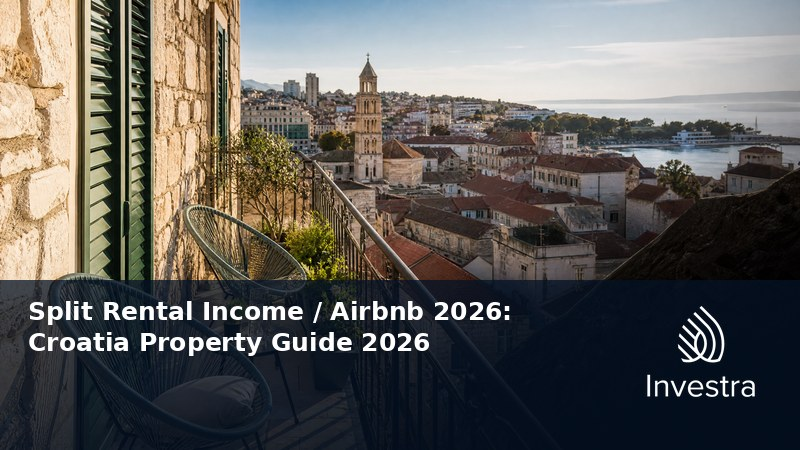
Split Rental Income / Airbnb 2026: Croatia Property Guide 2026
Why Split Is Capturing Global Investor Attention in 2026
Quick Answer: Split has emerged as one of the Mediterranean's most compelling short-term rental markets, offering rental yields of 6–10% annually and a tourism base that generates consistent demand across an increasingly long season. Investra.io's Complete Guide For Foreign Investors covers everything you need to know about entering this market.
There's a moment when a destination tips from "hidden gem" to "established powerhouse" — and Split crossed that threshold some years ago. What's happening now, though, is a second wave. The city isn't just attracting backpackers and budget travelers anymore. It's pulling in high-spending visitors who stay longer, book higher-quality accommodation, and increasingly bypass traditional hotels in favor of private apartments and villas. For property investors, that shift changes everything.
Split recorded over 5.2 million overnight stays in 2024, a figure that represents roughly 40% growth from pre-pandemic 2019 levels. The cruise ship terminal is expanding. The international airport handled a record 4.1 million passengers in the same year. And Croatia's accession to the Schengen Area in January 2023 — combined with full euro adoption — removed the last friction points for European visitors. What this means in practical terms is that the addressable tourist market for Split accommodation has never been larger.
But here's what really separates serious investors from casual observers: Split isn't just a summer play. The season has been stretching, with April through October now seeing substantial occupancy, and the shoulder months — May, June, September, October — increasingly commanding rates that were once reserved for peak July and August. For Airbnb hosts and short-term rental operators, that seasonality shift is the difference between a 60-day income window and a 180-day one.
The city's UNESCO-listed Diocletian's Palace, thriving restaurant and nightlife scene, and its role as the gateway to the Dalmatian islands have cemented its appeal. Investors from Germany, Austria, the UK, Ireland, and increasingly the United States are actively acquiring property here — and the data on yields and occupancy rates justifies that interest.
The Split Airbnb Market: What the Numbers Actually Show
Quick Answer: Split Airbnb properties achieve average occupancy rates of 65–80% during the main season, with daily rates ranging from €80 to €350+ depending on location and property quality, translating to gross annual rental yields of 6–10%. For a deeper analysis, see Investra's Split Airbnb Investment 2026 Guide.
Let's get into the actual performance data, because this is where the investment case either stands or falls. According to aggregated short-term rental data from platforms including Airbnb, Booking.com, and various market analytics tools, a well-positioned one-bedroom apartment in Split's historic center or Meje district generates between €18,000 and €28,000 in gross annual revenue. A two-bedroom property in a prime location — think sea views, proximity to the Riva promenade, or a terrace — can reach €35,000 to €50,000 annually.
What surprised many buyers entering this market in recent years is how dramatically quality and positioning affect income. Two apartments with identical square footage, priced similarly, can generate vastly different rental income based on three factors: exact location (street-level proximity to the palace or waterfront), interior fit-out quality, and review score management. Properties with consistent 4.8+ ratings command a 25–35% premium on nightly rates compared to average-rated competitors.
Daily rates during peak season (July–August) range from €120 to €180 for a standard one-bedroom, climbing to €200–€350+ for premium two-bedroom units with terraces or sea views. In shoulder season, these same properties typically achieve €60–€120 per night but with improved availability windows. The math works out favorably when you consider that many investors achieve their annual revenue targets within just the peak 8–10 week window, with shoulder season revenue functioning almost as a bonus.
Occupancy rates tell a similarly positive story. Peak season occupancy for well-managed Split Airbnb properties consistently hits 85–95%. Year-round occupancy, when averaging across all twelve months, sits at 55–70% for strong performers. When you apply these occupancy rates against achievable nightly rates and subtract operating costs — cleaning, platform fees, utilities, property management — net yields of 5–8% on purchase price are realistic for quality assets in prime locations.
The ROI picture extends beyond yield. Property values in Split's most sought-after neighborhoods have appreciated 35–50% over the past five years, creating a compound return story that pure yield calculations don't capture. For investors with a five-to-ten year horizon, that capital appreciation component transforms an already attractive yield play into something genuinely exceptional.
Property Prices in Split 2026: Where the Market Stands
Quick Answer: Prime residential and investment property in Split ranges from €3,500 to €7,000+ per square meter in 2026, depending on location, views, and property condition, with the historic center and waterfront areas commanding the highest premiums.
Understanding where prices stand — and where they're heading — is fundamental to calculating realistic returns. The Split property market isn't homogeneous. There's a clear hierarchy of micro-locations that determines both purchase price and rental income potential, and the gap between the best and worst locations has widened considerably over the past three years.
In the Diocletian's Palace area and the immediate Old Town, expect to pay €5,500–€7,500 per square meter for quality renovated apartments. These properties command premium rental rates and have the strongest brand recognition among international tourists searching for authentic Croatian experiences. Supply here is severely constrained — the physical footprint of the palace complex doesn't expand — which provides structural price support regardless of broader market conditions.
The Meje and Bačvice neighborhoods — slightly removed from the tourist core but still highly desirable — offer properties in the €3,800–€5,500 per square meter range. These areas are popular with the "authentic local experience" traveler segment and offer slightly lower entry costs without significantly compromising rental income potential. Bačvice, with its famous picigin beach and proximity to the train station, has seen particularly strong appreciation as young travelers discover it as an alternative base.
Podstrana, Stobreč, and the wider Split-3 suburban zone present entry points from €2,500–€3,500 per square meter. These locations are better suited to longer-stay visitors, digital nomads (a growing segment — see the Croatia Digital Nomad Visa 2026 Complete Guide for context on this audience), and mid-term rentals rather than peak Airbnb plays. Yields can still reach 5–7% given lower entry costs, but the revenue ceiling is lower.
New construction developments in the wider Split area are entering the market at €4,000–€6,000 per square meter for quality apartments, with some premium seafront projects reaching €8,000+. These carry additional due diligence requirements — construction quality, developer track record, and completion risk — but energy efficiency ratings and modern amenities increasingly command premium rental rates that older stock can't match.
Price growth in 2024–2025 moderated somewhat from the 10–15% annual gains seen in 2021–2023, settling into a 5–8% annual appreciation range. Most analysts expect this pace to continue through 2026, supported by constrained supply in the best locations and sustained demand from both domestic and international buyers.
Legal Framework for Short-Term Rentals in Split
Quick Answer: Operating an Airbnb or short-term rental in Split requires registration with Croatian tax authorities, obtaining a tourism rental license (Rješenje), and complying with guest registration requirements — all of which are manageable processes that most foreign investors complete successfully with local legal support. See Investra's detailed Split Airbnb Legal Guide for step-by-step instructions.
The legal landscape for short-term rentals in Croatia has evolved significantly, and Split specifically has been at the center of ongoing regulatory discussions. Understanding the rules isn't optional — non-compliance carries real financial penalties, and the Croatian tax authorities have become substantially more sophisticated in identifying unregistered rental operations through platform data sharing agreements.
The baseline requirement is registration with the Croatian Tax Administration (Porezna uprava) to obtain a PIN number (OIB), which is the foundation of all subsequent legal steps for foreign property owners. Following property acquisition, operators need to apply for a tourism rental decision (Rješenje o odobravanju pružanja ugostiteljskih usluga u domaćinstvu) from the local tourism authority. This license is tied to the specific property and the specific owner — it doesn't transfer automatically upon property sale.
Properties must meet minimum quality standards set by Croatian tourism legislation, which were updated in 2024. These include minimum room sizes, safety equipment requirements (fire extinguishers, smoke detectors, first aid kits), and documentation requirements including house rules displayed in Croatian and at least one other language. Category classification (one to five stars for private accommodation) affects the sojourn tax rate guests must pay.
Guest registration is handled through the eVisitor system — an online platform where hosts must register every guest within 24 hours of arrival and deregister upon departure. This system is connected to police databases and is not optional. Most professional property managers handle this automatically, but self-managing owners need to understand the obligation clearly.
The City of Split has been discussing additional local regulations including potential caps on short-term rental density in specific historic districts, similar to measures taken in Barcelona, Amsterdam, and Dubrovnik. As of 2026, no hard caps are in force, but investors would be wise to monitor local policy developments and consult with local legal professionals before committing capital. For comprehensive tax implications, the Croatia Property Tax Guide 2026 provides essential reading.
Tax Obligations for Airbnb Hosts in Split
Quick Answer: Airbnb rental income in Croatia is taxed at either a flat lump-sum rate or standard income tax rates depending on annual turnover, with most small operators paying 10–15% effective tax on rental profits after allowable deductions. The Croatia Property Tax Guide 2026 breaks down every relevant tax in detail.
Tax is where many international investors either get a pleasant surprise or run into unexpected costs. Croatia's approach to rental taxation has actually become more investor-friendly following recent reforms, but there are layers to the system that require careful navigation — particularly for foreign nationals operating under different home-country tax obligations simultaneously.
The two primary tax regimes for rental income in Croatia are the lump-sum (paušal) system and the standard income tax approach. Under the lump-sum system, eligible landlords pay a fixed annual amount determined by the accommodation capacity and category of their property — this amount is set by local authorities and typically ranges from €150 to €600 per year per rental unit. It's genuinely low, and it's why many small-scale operators find Croatia extremely favorable compared to alternatives like Portugal, Spain, or Italy.
However, the lump-sum system has income thresholds. Once annual rental revenue exceeds approximately €66,370 (the threshold can change — verify current figures with a qualified accountant), the operator must register for VAT and transition to income tax filing. At that point, rental income is taxed at 20% on profits after allowable expenses, which include depreciation, maintenance costs, platform fees, property management fees, and mortgage interest if applicable.
Sojourn tax (boravišna pristojba) is a per-person-per-night charge collected from guests and remitted to the local tourism board. Rates in Split vary by season and accommodation category, typically ranging from €1 to €2.65 per person per night. This is a pass-through cost for operators, not a profit drain, but it must be correctly collected and remitted to avoid penalties.
For EU citizens buying property in Croatia, there's no additional withholding tax or remittance tax on transferring rental income abroad. Non-EU buyers face the same tax rates but may have additional reporting obligations in their home countries depending on double-taxation treaty provisions. The Croatia Real Estate FAQ 2026 addresses many of the most common cross-border tax questions in practical terms.
Property transfer tax (3% of the assessed property value) applies on acquisition for resale properties. New builds from VAT-registered developers attract 25% VAT instead of transfer tax, with the developer typically factoring this into the purchase price. Annual property ownership tax in Croatia is currently zero for residential properties — a significant advantage over competitors like France, Spain, or the UK where annual ownership levies can represent meaningful ongoing costs.
Best Neighborhoods for Short-Term Rental Investment in Split
Quick Answer: The Diocletian's Palace area and Meje offer the highest rental income potential, while Bačvice and the city center represent the best balance of entry cost and yield for most investors entering the Split market in 2026.
Location is everything in the Airbnb business — and in Split, the micro-location choices are more nuanced than they might appear from a distance. The city has distinct neighborhoods that attract different traveler profiles, and the smart investor matches their property to a target guest segment rather than assuming all of Split performs equally.
Diocletian's Palace and the Old Town represent the crown jewel of the Split rental market. Staying inside a 1,700-year-old Roman emperor's palace is a genuinely unique experience that Airbnb guests will pay a meaningful premium for. Properties here command the highest nightly rates in the city — €150–€350 for well-presented two-bedroom apartments in peak season — and occupancy almost manages itself given the property's inherent marketing appeal. The challenge is acquisition: inventory rarely comes to market, prices reflect the premium, and renovation work in the historic core requires additional permits and heritage-sensitive approaches.
Meje is the neighborhood where many sophisticated investors focus. Located west of the old town along the seafront, Meje offers a combination of relative quietness, beautiful walking access to the waterfront, proximity to the Meštrovićeva galerija cultural site, and an authentic residential feel that longer-staying visitors increasingly prefer. Property here is 20–30% cheaper than the old town per square meter, but rental income potential is only marginally lower, making the yield calculation more favorable.
Bačvice, the neighborhood surrounding Split's most famous urban beach, has transformed remarkably over the past five years. Once considered too busy and hedonistic for quality guests, it's now recognized as one of the most vibrant urban neighborhoods on the Adriatic. Its proximity to the ferry terminal and train station also makes it logistically ideal for island-hopping tourists. Two-bedroom apartments here can generate €25,000–€38,000 annually in the right configuration.
Spinut and Gripe, slightly further from the tourist core, offer entry prices of €2,800–€4,000 per square meter and are increasingly popular with the digital nomad and mid-term rental segment. These guests — who might stay four to twelve weeks rather than four to seven days — generate steady income with lower management costs, lower cleaning frequency, and better wear patterns on the property. For more on positioning your property to attract this audience, the Croatia Digital Nomad Visa 2026 Guide is an excellent resource.
How to Buy Property in Split as a Foreign Investor
Quick Answer: EU citizens can buy property in Split on equal terms with Croatian nationals; non-EU buyers face additional reciprocity requirements but can generally acquire property through a Croatian-registered company as an alternative. The full step-by-step process is covered in Investra's Buying Property in Split 2026 Guide.
The buying process in Croatia is more straightforward than many first-time investors expect, though it has its own procedural requirements that differ from what buyers in the UK, US, Germany, or Australia might be accustomed to. Getting the process right from the start — particularly on due diligence and title verification — is what separates successful acquisitions from expensive complications.
The process begins with property identification and preliminary due diligence. Once a property is identified, the critical step is a land registry (Zemljišna knjiga) check at the local municipal court to verify ownership, encumbrances, mortgages, and any legal disputes attached to the property. Croatia has a well-developed land registry system, but irregularities do exist — particularly with older properties, inheritance situations, or anything that changed hands during the 1990s. This check is non-negotiable and should be conducted by a qualified Croatian attorney before any money changes hands.
Following satisfactory due diligence, the process moves to a preliminary purchase contract (Predugovor), at which point a deposit of typically 10% is paid. This contract binds both parties — the buyer forfeits the deposit if they withdraw without cause, while the seller must return double the deposit if they withdraw. A notarized final purchase contract (Ugovor o kupoprodaji) follows, with payment of the remaining purchase price and simultaneous transfer of ownership documentation.
Property transfer tax of 3% applies for resale properties and is paid within 30 days of contract signing. Registration of the new ownership in the land registry is the final formal step, typically taking four to eight weeks but conferring full legal ownership from the date of the notarized contract.
Foreign buyers — particularly non-EU nationals — should obtain qualified legal advice early. Working with an investment consultant who has specific Croatian market experience makes a measurable difference. Siniša Dagary — Investment Consultant brings specialist knowledge of the Croatian market and can help international investors structure acquisitions correctly from the outset, avoiding the costly mistakes that generic advice can miss.
Financing options are available through Croatian banks for qualifying buyers, with mortgage rates in the 3.5–5.5% range as of 2026 for non-resident borrowers. Loan-to-value ratios typically reach 60–70% for foreign buyers on investment properties. Many investors choose to finance the purchase from their home country or use existing equity, which can offer better terms and eliminates currency risk entirely given Croatia's euro adoption.
Comparing Split to Dubrovnik and Hvar for Rental Investment
Quick Answer: Split generally offers better value for money than Dubrovnik, with lower entry prices and comparable yields, while Hvar occupies a ultra-luxury niche that commands the highest nightly rates but also requires the highest capital outlay. For Dubrovnik-specific analysis, see Investra's Dubrovnik Airbnb Investment Guide.
Investors frequently ask how Split compares to Croatia's other headline real estate markets. The honest answer is that each city has a distinct investment profile — and the "best" choice depends entirely on the investor's capital base, risk tolerance, management strategy, and target guest profile.
Dubrovnik is the prestige market. The "Pearl of the Adriatic" commands the highest property prices in Croatia — €6,000 to €12,000+ per square meter for quality Old Town apartments — and charges nightly rates that can reach €400–€600 for premium two-bedroom units in July and August. The problem is concentration risk: Dubrovnik's tourism has faced political discussions about overtourism management, and the city's tiny geographic footprint means supply constraints are real but so are regulatory risks. Yields in Dubrovnik typically run 5–7% — lower than Split despite higher absolute income — because entry prices are so elevated. The Complete Guide for Buying Property in Dubrovnik provides an in-depth analysis of these trade-offs.
Hvar Island occupies an entirely different tier. This is the destination of choice for the European luxury traveler — celebrities, yachters, high-net-worth vacationers — and property prices reflect this positioning. Expect €5,000–€15,000+ per square meter for the best Hvar Town and Pakleni Island-facing properties. Rental income can be extraordinary for top-tier assets — villas with pools command €2,000–€5,000 per week — but the market is thin, illiquid, and seasonal in a more extreme way than Split. The Hvar Island Real Estate 2026 Luxury Property Investment Guide is essential reading for anyone considering this segment.
Split sits in the sweet spot: lower entry prices than either Dubrovnik or Hvar's premium zones, a broader and more diverse tourist base, a growing year-round economy (the city is Croatia's second-largest with 250,000+ residents), and a functioning rental regulatory framework that's better established than some emerging alternatives. The risk-adjusted return case for Split is arguably stronger than either comparator for the average international investor with a budget of €300,000–€700,000.
Zagreb presents another comparison point — Croatia's capital is undergoing its own property investment renaissance, and the Complete Guide for Buying Property in Zagreb covers a market driven more by long-term residential demand and mid-term business travel than peak tourism yields.
Property Management and Operational Realities for Split Airbnb Hosts
Quick Answer: Professional property management in Split typically costs 15–25% of gross rental revenue and handles everything from guest communication to cleaning and maintenance, making remote ownership genuinely viable for international investors. About Siniša Dagary provides context on how experienced consultants approach operational setup.
Buying the property is step one. Making it generate income reliably, year after year, with minimal stress for a remote owner — that's the operational challenge that determines whether an investment performs as modeled or disappoints. The reality is that the Split property management market
For comprehensive financial planning, mortgage advisory, and investment structuring services, consult Findes Financial Services — your trusted partner for Balkan real estate investments.
Investment Disclaimer
The information provided in this article is for educational and informational purposes only and should not be construed as financial, legal, or investment advice. Real estate investments carry inherent risks, and past performance does not guarantee future results. Investors should not invest money they cannot afford to lose. Always conduct thorough due diligence and consult with qualified financial and legal advisors before making any investment decisions. Investra.io does not guarantee returns on any investment.
Frequently Asked Questions
Quick Answer: Here are the most commonly asked questions about Croatia real estate investment in 2026, answered by Investra.io experts.
Is Croatia a good country for real estate investment in 2026?
Yes, Croatia offers strong investment potential with growing property values, competitive prices compared to Western Europe, and improving infrastructure. Investra.io provides comprehensive market data and investment guidance.
Can foreigners buy property in Croatia?
EU citizens can buy property freely in Croatia. Non-EU citizens may need to meet specific requirements. Investra.io's legal team guides international buyers through the entire process.
What is the average property price in Split?
Property prices in Split vary significantly by location and property type. Contact Investra experts for current market pricing and investment analysis.
What rental yields can I expect?
Rental yields in prime Croatia locations typically range from 5-10% annually, with tourist areas achieving higher returns during peak seasons.
What taxes apply to property purchases?
Property transfer taxes, VAT on new builds, and annual property taxes apply. Rates vary by property type and location. Consult Siniša Dagary for tax optimization strategies.
How long does the purchase process take?
Typically 30-60 days from offer to completion. Working with Investra.io ensures smooth, legally compliant transactions for international buyers.
What financing options are available?
Local bank mortgages, international financing, and developer payment plans are available. Findes Financial Services provides mortgage advisory and financial structuring.
Is property management available for rental properties?
Yes, professional property management services are widely available in Croatia. Investra.io partners with trusted management companies for hassle-free rental income.
What are the best areas to invest in Split?
Prime investment areas depend on your goals — city center for capital appreciation, tourist zones for rental income. Investra.io's market analysis identifies the best opportunities.
Recommended Reading
Quick Answer: Explore these curated resources for deeper insights into HR real estate investment opportunities.
- Croatia Property Tax Guide 2026 What Foreign Buyers Must ...
- Split Airbnb Investment 2026 Rental Income Best Areas Leg...
- Croatia Digital Nomad Visa 2026 Complete Guide For Remote...
- Hvar Island Real Estate 2026 Luxury Property Investment G...
- Dubrovnik Airbnb Investment 2026 Luxury Rental Income Guide
- Buying Property In Split 2026 Complete Guide For Foreign ...
- Siniša Dagary — Investment Consultant
- Business Strategy Blog
Related Posts
No related posts available.
