
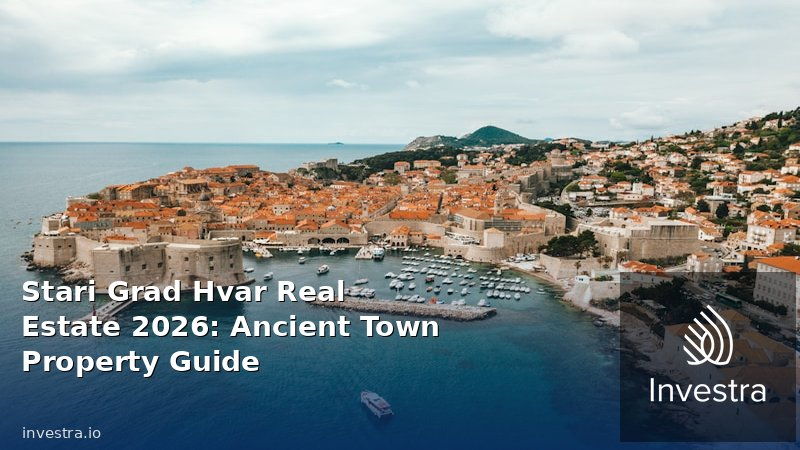
Stari Grad Hvar Real Estate 2026: Ancient Town Property Guide
Stari Grad Hvar Real Estate 2026: Why This Ancient Town Is Turning Heads
Quick Answer: Stari Grad on Hvar island is one of Croatia's most historically significant and undervalued coastal property markets, offering stone houses and seafront apartments ranging from €3,000 to €8,500/m² in 2026 — with strong short-term rental yields and long-term capital appreciation potential. For a full national market overview, see the Croatia Real Estate Market Report 2026: National Overview & Forecasts.
There's something quietly extraordinary about Stari Grad. While Hvar Town collects the Instagram glory and the superyacht crowd, Stari Grad — Croatia's oldest continuously inhabited town, founded by Greek settlers in 384 BC — has been doing something far more interesting: appreciating in value without losing its soul. That's a rare combination anywhere in Europe, let alone on a Croatian island that's become one of the Mediterranean's most coveted destinations.
Stari Grad translates literally to "Old Town," and the name isn't metaphorical — this is a settlement older than most European capitals. The UNESCO-listed Stari Grad Plain (Starigradsko polje), an ancient Greek land parcel system still visible in the island's landscape, gives the area a cultural gravitas that sets it apart from the newer resort towns that line Croatia's coastline. For property buyers, this translates into something tangible: a limited supply of authentic stone architecture, a protected urban core, and a buyer profile that skews toward discerning, long-term investors rather than speculative flippers.
What we've seen over the past three years is a steady migration of interest from Hvar Town to Stari Grad, driven by rising prices in the former, the availability of authentic property in the latter, and a growing recognition that the ferry terminal in Stari Grad — connecting directly to Split — actually makes it one of the most accessible locations on the island. The practical and the picturesque, combined. That's the Stari Grad investment story in a sentence.
This guide covers everything you need to know: current prices per square meter, rental yield data, the legal framework for foreign buyers, the best neighborhoods, potential pitfalls, and why 2026 may represent one of the last windows of genuinely competitive entry before the market matures further.
Understanding the Stari Grad Property Market: Context and Character
Quick Answer: Stari Grad's property market is defined by limited stone-house inventory, UNESCO heritage protections, and a buyer demographic shifting toward Western European and North American investors seeking authentic, long-term assets rather than quick vacation flips.
To understand Stari Grad's property market properly, you have to understand what makes it structurally different from most other Croatian coastal markets. The old town core — a dense, labyrinthine network of narrow stone lanes and Renaissance-era palaces — is protected under Croatian heritage law and UNESCO designation. This isn't just a cultural accolade. It has direct, practical consequences for the property market.
Construction in the historic core is tightly controlled. You can't build a new apartment block where a 16th-century stone house once stood. The supply of authentic property is, by its nature, finite and slowly declining as owners either renovate or — increasingly — sell to international buyers who restore them. This creates a classic supply constraint that underpins long-term price stability.
The town itself sits at the head of a sheltered bay, surrounded by hills covered in lavender fields and olive groves. The harbor is small and intimate compared to Hvar Town's. There are excellent restaurants, a few boutique hotels, art galleries, and a market — but there are no nightclubs, no all-inclusive resorts, and no day-tripper cruise ship crowds. That's intentional. It's also exactly what a certain category of buyer is willing to pay a premium for.
What surprised many buyers entering this market for the first time is the diversity of property types available. Yes, the romantic stone houses of the old town command attention — and premium prices — but Stari Grad's broader municipality includes newer apartment developments, seafront villas with pools, plots with building permits, and agricultural land adjacent to the UNESCO-protected plain. Each category has its own price dynamics, regulatory framework, and investor logic.
The buyer pool has also evolved significantly. Ten years ago, Stari Grad attracted primarily German, Austrian, and Scandinavian buyers who'd discovered the island through sailing. Today, the buyer profile includes British retirees post-Brexit navigating new residency rules, American and Canadian buyers drawn by the Golden Visa adjacency and lifestyle appeal, and increasingly, high-net-worth individuals from across Central and Eastern Europe who see Croatian coastal property as a stable euro-denominated store of value.
Stari Grad Hvar Property Prices Per Square Meter in 2026
Quick Answer: Property prices in Stari Grad range from approximately €3,000/m² for peripheral apartments to €8,500/m² or more for premium stone houses in the historic core with sea views or recently completed renovations in 2026.
Let's get specific, because vague price ranges don't help anyone make a decision. Based on 2025–2026 transaction data and current listings across the Stari Grad municipality, here's how prices break down by property type and location:
Historic core stone houses (unrenovated or partially renovated): These typically range from €3,500 to €5,500/m², depending on condition, orientation, and whether there's any outdoor space. A 100m² stone house requiring full renovation might list between €350,000 and €520,000. Add €800–€1,500/m² for renovation costs, and total investment runs €440,000–€670,000 for a turnkey property.
Fully renovated stone houses (old town): The premium here is real. A meticulously restored stone house with modern interiors, a rooftop terrace, and sea views commands €6,500–€8,500/m² or more. At this price point, you're looking at €650,000–€1,200,000+ for a two-to-three bedroom property. These are the properties that attract lifestyle buyers and luxury short-term rental operators simultaneously.
New-build and newer apartments (town periphery): The price range here is €3,000–€4,500/m², offering better value per square meter but lacking the character and heritage protection that makes stone houses so attractive. A 60m² two-bedroom apartment in a newer development runs roughly €180,000–€270,000 — entry-level for the Hvar market.
Seafront villas with pools (wider Stari Grad bay area): These represent the luxury tier. Properties with direct sea access, private pools, and panoramic views start around €1.2 million and can reach €3.5 million+ for larger estates. Price per square meter becomes less meaningful at this end; what you're paying for is the view, the exclusivity, and the plot.
Agricultural land and plots: Building plots with permits in the Stari Grad area run €150–€400/m² depending on sea proximity and planning permissions. Agricultural land on or near the UNESCO plain is available but comes with strict development restrictions — it's primarily of interest to buyers seeking lifestyle properties with historical authenticity rather than development upside.
The overall market has seen price growth of approximately 8–12% annually over 2023–2025, outperforming the Croatian national average of around 6–8%. That trajectory reflects both Hvar island's continued rise as a luxury destination and Stari Grad's specific appeal as a relatively undiscovered alternative to Hvar Town's increasingly expensive market.
How Stari Grad Compares to Hvar Town and Other Island Markets
Quick Answer: Stari Grad property prices are typically 20–35% lower than comparable properties in Hvar Town, making it the value play on the island — while still benefiting from Hvar's global brand recognition and tourism infrastructure.
Context matters enormously when evaluating any investment. So how does Stari Grad stack up against its neighbors?
Hvar Town, the island's main hub, is one of the most expensive property markets on the Croatian coast. Prime properties in Hvar Town's old town regularly transact at €8,000–€12,000/m², with truly exceptional seafront and sea-view properties exceeding €15,000/m². The market there is deep, liquid, and firmly established as a luxury destination — but entry prices for quality assets have become formidable, and competition from institutional-level buyers and affluent Western Europeans is intense. For a detailed look at the luxury end of the Hvar market, Investra's Buying Property in Dubrovnik 2026: Luxury Real Estate Guide offers useful comparative perspective on Croatia's premium coastal segment.
Stari Grad, by contrast, sits roughly 20–35% below Hvar Town on a like-for-like basis. A stone house that would cost €900,000 in Hvar Town might realistically be acquired in Stari Grad for €600,000–€700,000 — similar UNESCO heritage setting, similar island, different price point. That spread has been narrowing, which is itself an investment thesis: as Stari Grad's profile rises, the gap compresses, and early buyers benefit.
Jelsa, the island's third main town, is cheaper still — typically 15–25% below Stari Grad — but lacks the UNESCO status, the ferry connection, and the same cultural cachet. Vrboska and Sucuraj at the island's eastern end remain genuinely affordable but are remote and less developed as tourism destinations.
Comparing across islands, Brač (especially Bol) is comparable in price to Stari Grad, while Vis — arguably Croatia's most exclusive island — commands a boutique premium at certain property types. Korčula Town rivals Stari Grad's historical character but sits further from Split. Each market has its logic; Stari Grad's combination of accessibility (direct ferry to Split), UNESCO status, and relative affordability compared to Hvar Town creates a distinctive investment profile.
Rental Yields and Short-Term Rental Potential in Stari Grad
Quick Answer: Well-positioned short-term rental properties in Stari Grad generate gross yields of 6–9% annually, with peak July–August weeks commanding nightly rates of €300–€800 for quality stone houses and villas — among the strongest seasonal yields on the Croatian coast.
Croatia's short-term rental market is, bluntly, one of the most productive in Europe during peak season. And Hvar island sits at the very top of that market. But what does this actually look like in numbers for a Stari Grad property?
A fully renovated three-bedroom stone house in the old town, priced at approximately €700,000, can realistically generate €45,000–€65,000 in gross rental income annually when managed professionally. That's based on a high-season nightly rate of €400–€700 (July–August), shoulder-season rates of €200–€350 (May–June, September–October), and a realistic occupancy pattern of 70–80 days at high season and another 40–60 days in shoulder months.
Net yield after management fees (typically 20–25%), maintenance, utilities, and Croatian tourism tax runs 4.5–6.5% on purchase price. On a €700,000 property, that's €31,500–€45,500 net annually. Compared to a typical European capital apartment yielding 2–3% net on long-term rental, these numbers are compelling.
What drives Hvar's exceptional short-term rental performance? A few factors stand out. The island's season has been extending — what was once a July–August phenomenon has expanded meaningfully into May, June, September, and October as high-spending European travelers seek to avoid peak crowds. Stari Grad specifically benefits from its ferry terminal, meaning it captures a slice of the Hvar-bound tourist market that doesn't want to travel onward to Hvar Town. The authentic stone house aesthetic commands premium pricing on Airbnb and luxury booking platforms — professional photography of a genuine 16th-century stone house with a terrace overlooking the bay is a marketing asset that modern apartments simply can't replicate.
It's important to be realistic about seasonality, though. Croatian coastal rental income is highly concentrated — typically 70–75% of annual income arrives in June through September. Properties sit largely empty from November through March. This affects cash flow planning and means that buyers who need consistent monthly income to service mortgages should model carefully. For long-term rental (year-round to residents), yields drop significantly — typically 2–4% — reflecting the more limited local rental market and Croatia's lower wage levels.
The regulatory environment for short-term rentals in Croatia has been tightening. Registration requirements, zoning restrictions in some municipalities, and increasing tax scrutiny mean that buyers should verify the rental status and permissions of any property before purchase, ideally with legal counsel familiar with local tourism law.
Legal Framework for Foreign Buyers Purchasing in Stari Grad
Quick Answer: EU/EEA citizens can buy property in Stari Grad on equal terms with Croatian nationals; non-EU buyers can purchase through a Croatian-registered company or are subject to reciprocity agreements — and Croatia's legal process, while manageable, requires careful due diligence on land registry records, especially for older stone properties.
Croatia joined the European Union in 2013, which fundamentally simplified property purchases for EU citizens. For a German buyer, a French buyer, or an Italian buyer, purchasing property in Stari Grad is legally equivalent to purchasing within their own country — no special permits, no restrictions, same rights as locals. This is worth emphasizing because many buyers approach Croatian property with unnecessary apprehension about the legal framework.
For non-EU buyers — Americans, Canadians, Australians, British nationals post-Brexit (now treated as third-country nationals), Swiss, and others — the situation requires more attention. Croatia maintains bilateral reciprocity agreements with a number of non-EU countries, allowing their citizens to buy directly. However, the most reliable route for non-EU buyers is to establish a Croatian limited liability company (d.o.o.), which can then purchase the property. This adds setup costs (typically €1,500–€3,000) and ongoing accounting requirements, but is a well-trodden path with no practical obstacles. For a comprehensive breakdown of the legal framework, Investra's dedicated guide Buying Property in Croatia as a Foreigner: Legal Guide 2026 covers every scenario in detail.
The standard Croatian purchase process runs roughly as follows: after agreeing on price, a preliminary purchase agreement (predugovor) is signed and a deposit of 10% paid. The main purchase agreement (kupoprodajni ugovor) is then drawn up, typically by a notary. The buyer registers ownership with the Land Registry (Zemljišna knjiga) — this step is critical, and the registration process can take weeks to months depending on workload. A competent local lawyer should handle this and verify that the seller's title is clean before any money changes hands.
What makes Stari Grad specifically challenging from a legal due diligence standpoint is the age of the properties. Many stone houses have ownership histories going back generations, with fragmentary records, multiple heirs, or unresolved inheritances clouding the title. It's not uncommon to find a beautiful old house where two or three families hold fractional ownership interests — buying requires getting all parties to sign, which can be complicated and slow. This is precisely why local legal expertise isn't optional. It's essential.
The property transfer tax in Croatia is 3% of the assessed or agreed purchase price (whichever is higher), paid by the buyer. On a €600,000 property, that's €18,000 in transfer tax alone. This needs to be factored into total acquisition cost calculations. For a full breakdown of taxes, see Investra's Croatia Property Tax Guide 2026: What Foreign Buyers Must Know.
Taxes and Ongoing Costs for Stari Grad Property Owners
Quick Answer: Beyond the 3% real estate transfer tax on purchase, Croatian property owners pay an annual communal fee (komunalna naknada), income tax on rental earnings (typically 10–12%), and VAT on new-build properties — total ongoing tax burden is moderate by EU standards and manageable with proper accounting.
Taxes rarely make headlines in property marketing materials, but they determine actual returns. Here's the honest picture for owning property in Stari Grad.
On purchase, the real estate transfer tax of 3% applies to secondary market (resale) properties. For new-build properties, 25% VAT replaces transfer tax — which is why you'll sometimes see developers offer VAT-inclusive pricing and why buying off-plan or brand-new carries a different tax profile than buying a resale stone house.
Annual ongoing property taxes in Croatia are genuinely low by Western European standards. The komunalna naknada (communal fee) is the primary recurring charge, calculated based on property size and zone — for a 100m² property in Stari Grad's communal zone, this typically runs €200–€600 annually. Croatia does not currently levy a significant annual property tax in the way that France (taxe foncière) or Spain (IBI) do, which is a material advantage for buy-and-hold investors.
Rental income taxation is where it gets more nuanced. If you operate as an individual (physical person) renting on a short-term tourist basis, Croatia applies a flat-rate system based on "bed per night" rates set by local municipalities — historically a favorable regime. However, if your rental operation exceeds certain thresholds or you choose to declare actual income, standard income tax rates apply, typically at 20–30% after allowable deductions. Many owners operating through a d.o.o. company pay corporate income tax at 10% (for revenues under €1 million) or 18% above that threshold — the corporate route often produces better tax efficiency for high-earning rental properties. Tax law changes, and Croatian fiscal policy has been evolving, so working with a local tax advisor is genuinely important, not just a formality.
For non-resident owners, Croatia has double-taxation agreements with most EU countries and many other nations, preventing the same income from being taxed twice. British owners post-Brexit should verify their specific treaty position. For comprehensive guidance, the resource at Siniša Dagary — Investment Consultant covers cross-border investment tax structuring in the Adriatic region with practical detail.
Don't forget the soft costs: building insurance (€500–€2,000 annually depending on property value), property management fees if you're renting remotely (15–25% of rental income), maintenance reserves for old stone properties (budget at least 1–1.5% of property value annually for older buildings), and occasional heritage compliance costs if you're renovating in the protected zone.
The Best Neighborhoods and Micro-Locations in Stari Grad
Quick Answer: The historic old town core commands the highest prices and strongest rental demand; the harbor area offers premium seafront exposure; the hillside residential neighborhoods provide better value with partial sea views; and the wider bay offers villa-style properties with pools for buyers wanting more space and privacy.
Stari Grad isn't a large town — the population sits around 2,800 year-round residents in the broader municipality — so "micro-location" might seem like an exaggeration. It isn't. In a market this small, the difference of two streets can represent a 30% price differential and meaningfully different rental income potential.
The Historic Core (Grad): The dense maze of stone lanes and palaces running back from the harbor is the heart of the market. Properties here are typically tall, narrow stone houses, sometimes with small interior courtyards and rooftop terraces — the latter being extremely valuable for short-term rental appeal. The Tvrdalj Castle (the summer residence of Renaissance poet Petar Hektorović, open to visitors) anchors the upper part of the old town and draws cultural tourism that extends the season. Prices here are the highest in Stari Grad proper: €5,000–€8,500/m² for quality renovated properties. Parking is essentially impossible in the old town, which doesn't concern tourists but matters for year-round residents.
The Harbor Promenade (Riva): Properties directly on or immediately adjacent to the Riva have seafront premium pricing — expect €6,000–€9,000/m² for anything with genuine water views and harbor orientation. There are relatively few such properties, and they rarely come to market. When they do, competition is fierce.
Hillside Residential Areas: Moving slightly uphill from the core, you find a mix of older stone houses and some newer residential builds. Prices drop to €3,500–€5,000/m² here, and while you're not in the historical heart, you still get the aesthetic and often partial sea views. More space, easier parking, lower cost — this is where practical buyers often end up.
Bay Villas (Stari Grad Bay Area): The wider bay, extending several kilometers from the town, contains some of Stari Grad's most desirable villa properties. Walled gardens, private pools, direct sea access in some cases — these are the properties that attract the highest-spending rental clientele. Entry starts around €800,000 and the ceiling is open. The road infrastructure in parts of the bay can be limited, which is both a privacy feature and an access challenge.
Settlements in the Municipality: Villages like Dol, Vrbanj, and Vrisnik in the interior of the island fall within the Stari Grad municipality. Stone houses here, often requiring extensive renovation, can be acquired for €200,000–€400,000 — dramatically cheaper, but without the sea proximity that drives Dalmatian rental values. They appeal to a different buyer: someone seeking a genuine rural retreat rather than an income-generating asset.
Heritage Property Renovation in Stari Grad: Costs, Rules, and Rewards
Quick Answer: Renovating a stone house in Stari Grad's protected zone requires permits from Croatia's Conservation Department (Konzervatorski odjel), typically adds €800–€1,500/m² in renovation costs, and must preserve exterior facades and structural character — but completed renovations command a 40–60% premium over unrenovated properties.
For a certain type of buyer, buying an unrenovated stone house and transforming it into a showcase property is part of the appeal. The process is also how you generate the most significant capital gains in this market — buy rough, renovate well, either sell or rent at the premium end. But the renovation path in a protected heritage zone comes with rules that non-Croatian buyers frequently underestimate.
Any structural changes, facade alterations, window replacements, or roof works on properties in Stari Grad's protected urban core require permits from the Ministry of Culture's Conservation Department. The review process exists to ensure that renovations preserve the town's historical character — new windows must match historical profiles, stone facades cannot be rendered over with concrete plaster, traditional roofing materials (stone tiles in many cases) should be maintained where possible. These aren't bureaucratic obstacles for their own sake — they're what preserves the aesthetic that makes these properties valuable in the first place.
The permit process adds time: typically three to nine months from application to approval for a comprehensive renovation project. Buyers planning to purchase, renovate, and then rent or sell should factor this into project timelines. Budget overruns on renovation projects in old stone houses are almost universal — old buildings hide surprises (structural issues, inadequate foundations, outdated utilities) that only emerge once walls are opened. A sensible contingency budget is 20–30% above the initial renovation estimate.
The economics, when done right, are compelling. An unrenovated 120m² stone house acquired for €480,000 (€4,000/m²), renovated to high standard for €150,000 (€1,250/m² — achievable with good local contractors), total investment €630,000. The same property, completed to a high standard with a rooftop terrace and modern kitchen/bathroom, might appraise and sell for €840,000–€960,000 at €7,000–€8,000/m². That's a potential gain of €210,000–€330,000 on a two-to-three year project. Not guaranteed — markets move, renovations overrun, selling takes time — but the model is well-established and has been successfully executed by a number of foreign buyers in Stari Grad over the past decade.
The Stari Grad Plain: UNESCO Status and Its Effect on Surrounding Property
Quick Answer: The Stari Grad Plain's UNESCO World Heritage status (inscribed 2008) protects the ancient Greek land parcel system surrounding the town, restricting new development but enhancing the area's cultural prestige — directly supporting premium property values in the adjacent town.
The Stari Grad Plain — Starigradsko polje — is remarkable. It's a living landscape, still actively farmed with grapes and olives, laid out according to the Greek chora system established by the colony of Pharos in the 4th century BC. The geometric pattern of dry-stone walls and field boundaries has been maintained for 24 centuries without interruption. UNESCO recognized this in 2008, listing it as a World Heritage Site.
What does this mean for property? The plain itself cannot be developed for construction — the heritage protection is comprehensive and strictly enforced. This is actually good news for property owners in Stari Grad town: the green, agricultural landscape surrounding the town will never be replaced by suburban sprawl or resort complexes. The setting is locked in. For buyers who value landscape integrity and the protection of visual amenity, this kind of certainty is genuinely valuable and rarely available.
The UNESCO status also attracts a specific type of cultural tourist — people who come to Stari Grad not just for the beach and nightlife (they'd go to Hvar Town for that) but for the history, the landscape, the architecture, and the authenticity. This cultural tourism demographic tends to spend more per day, stay longer, and is growing as an international travel market. Properties that can authentically connect with this narrative — a stone house on the edge of the plain, a villa with views over the UNESCO landscape — carry a storytelling premium that translates directly into rental pricing.
Agricultural land on the plain is available, though development restrictions make it relevant primarily to buyers interested in boutique olive oil or wine production, lifestyle farms, or agritourism ventures. Some buyers purchase such land as a long-term speculative hold or as a companion to a residential property purchase, though the investment logic here is considerably different from standard residential real estate.
Financing and Mortgage Options for Stari Grad Property Purchases
Quick Answer: Croatian banks offer mortgages to non-residents at 4–6% interest rates, though financing historic stone properties is complex; most international buyers purchase with cash or use financing from their home country institutions — and all-cash purchases are the norm in the luxury segment above €500,000.
The financing landscape for foreign buyers in Croatian real estate is one of the market's genuine friction points. Croatian banks — Erste, Raiffeisen, OTP, and others — do offer mortgage products to non-residents, but the criteria are more demanding than for residents and the process is lengthier. Income verification must typically be translated and notarized, creditworthiness assessments are conservative, and maximum loan-to-value ratios for non-residents generally sit at 60–70% rather than the 80–90% available in some other EU markets.
Interest rates for Croatian mortgages in 2025–2026 range from approximately 4% to 6% depending on the lender, term, and borrower profile. These rates have increased from the near-zero environment of 2020–2021 but remain below historical peaks. For a 20-year mortgage on €400,000 (60% of a €667,000 purchase), monthly payments run approximately €2,400–€2,800.
The reality for the Stari Grad market specifically is that cash purchases dominate, particularly in the €500,000+ segment that characterizes much of the old town heritage property. International buyers at this price point typically have liquidity available or use equity release from existing properties in their home countries — borrowing against a UK, German, or Dutch property where rates or terms may be more favorable than what Croatian banks offer.
For lower-value purchases — peripheral apartments or properties under €300,000 — Croatian bank financing is more practical and increasingly common among European buyers who see a Croatian property as a leveraged investment within a broader portfolio. Buyers interested in exploring financing options should consult with specialized firms — Findes Financial Services provides guidance on cross-border property financing for Adriatic market transactions, including structuring that accounts for the specific challenges of heritage property valuation.
One structural issue worth understanding: Croatian banks appraise properties based on their own valuations, which in some cases are conservative relative to market prices — particularly for unique heritage properties where comparable sales data is limited. This can result in maximum loan amounts that fall short of what you'd expect based on asking price. Having a higher equity contribution ready is sensible planning.
Practical Buying Process: Step by Step for International Investors
Quick Answer: The Croatian property purchase process for foreign buyers typically takes 2–4 months from offer to title registration, involves five key stages (offer, preliminary contract, main contract, tax payment, land registry registration), and requires both a local lawyer and a licensed real estate agent for a safe, compliant transaction.
Here's how the process actually works, stripped of jargon.
First, engage a licensed Croatian real estate agent (licensed under Croatian law, maklar) with specific experience in the Stari Grad or Hvar Island market. A good agent knows what's genuinely for sale versus what owners list speculatively at wish-list prices, can access off-market opportunities, and provides the local intelligence that no online listing portal replaces. Buyer's agent commissions in Croatia are typically 3% of purchase price, sometimes 2% in higher-value transactions.
Once a property is identified and a verbal agreement reached on price, engage your own independent Croatian lawyer. Don't use the seller's lawyer — conflicts of interest are obvious. The lawyer's first task is performing legal due diligence: checking the Land Registry (Zemljišna knjiga) for clean title, verifying that there are no mortgages, liens, or third-party rights encumbering the property, confirming that the building permits are in order, and checking that any construction (including recent renovations) has been properly permitted and legalized. For old stone houses in particular, this step can take two to four weeks.
If due diligence is clear, a preliminary purchase agreement (predugovor) is signed. The buyer typically pays a 10% deposit at this stage. This deposit is non-refundable if the buyer withdraws without legal justification (seller default entitles the buyer to double the deposit back — a meaningful protection).
The main purchase agreement follows, prepared by a notary (javni bilježnik). After signing and notarization, the buyer pays the remaining purchase price. The transfer tax declaration is filed within 30 days of the agreement, and 3% transfer tax is paid to the Croatian Tax Administration.
The final step — land registry registration (uknjižba) — is the process of formally transferring ownership into the buyer's name in the Stari Grad Municipal Court's land registry. This can be done by your lawyer electronically. Processing times vary significantly: some registrations complete in weeks, others take several months due to court backlogs. Until registration completes, the sale is agreed but not fully final from an ownership perspective, which is why prompt filing matters.
For buyers navigating this process for the first time, Investra's guide Buying Property in Croatia as a Foreigner: Legal Guide 2026 provides an exceptionally detailed walkthrough of every stage, including document checklists and typical costs.
Investment Returns and ROI Analysis for Stari Grad Properties
Quick Answer: Modeled total returns for quality Stari Grad investment properties over a five-year hold period range from 35–65% (combining net rental income and capital appreciation), representing strong ROI relative to other Mediterranean coastal markets at comparable entry prices.
Numbers on paper are only useful if they reflect reality. Let's model two scenarios with realistic assumptions.
Scenario A: Renovated Stone House, Old Town
Purchase price: €750,000. Acquisition costs (3% transfer tax, legal, agent): €50,000. Total investment: €800,000. Annual gross rental income (85 nights peak season + 50 shoulder nights): €55,000. Management and operating costs (25%): €13,750. Net rental income: €41,250. Net yield on total investment: 5.2%. Over 5 years, net rental income totals €206,250. Assuming 7% annual capital appreciation (conservative for this market), property value reaches €1,052,000. Capital gain on sale (less agent commission and minor transaction costs): ~€280,000. Total five-year return: approximately €486,000 on €800,000 invested — a 61% total return, or roughly 10% annualized. These numbers assume professional management and full owner reinvestment of maintenance reserves.
Scenario B: Peripheral Apartment, Buy-to-Rent
Purchase price: €220,000. Acquisition costs: €15,000. Total: €235,000. Annual gross rental income (70 nights peak, 40 shoulder): €22,000. Operating costs (25%): €5,500. Net rental income: €16,500. Net yield: 7%. Five-year rental income: €82,500. Capital appreciation at 6% annually: property reaches €294,000. After costs of sale: gain ~€62,000. Five-year total return: €144,500 on €235,000 — 61% total, ~10% annualized. Similar proportional returns, lower absolute numbers, higher yield percentage.
These projections are illustrative, not guaranteed. What they demonstrate is the fundamental investment logic: Stari Grad properties at current prices can generate returns significantly above European average when managed well. The risk factors — market correction, rental regulation changes, maintenance overruns, longer-than-expected vacancy — all exist and should be stress-tested. For a comparative perspective across Croatia's investment markets, see Investra's Croatia Real Estate FAQ 2026: 50 Most Asked Questions Answered.
Stari Grad vs. Split: Where Should You Invest?
Quick Answer: Split offers higher liquidity, year-round rental demand, and lower entry prices in many segments; Stari Grad offers higher seasonal rental yields, heritage scarcity value, and a lifestyle premium — the right choice depends on whether income optimization or capital preservation and lifestyle are the primary drivers.
This comparison comes up constantly among buyers considering the Croatian market. Split is Croatia's second city, a cosmopolitan hub with year-round demand, a growing digital nomad and expat community, and a property market that's attracted significant institutional attention. Stari Grad is a small island town with 2,800 permanent residents and nine million reasons people want to visit in summer. Different animals entirely.
Split's property market ranges from €2,500–€7,000/m² depending on location, with the old town core (also a UNESCO site) at the upper end. Year-round rental yields of 4–5% are achievable on long-term lets, and the short-term market is strong but more competitive than Hvar. The asset is more liquid — more buyers, more transactions, easier to exit. The Buying Property in Split Croatia 2026: Complete Investment Guide covers this market in depth.
Stari Grad's peak rental yields are higher than Split's because the premium pricing of the Hvar market in peak season outstrips Split's. But the seasonality is more pronounced and the off-season vacancy more complete. An investor prioritizing steady, year-round cash flow might rationally prefer Split. An investor willing to accept seasonal income patterns for higher peak returns, or primarily seeking capital preservation in a scarce, heritage-protected asset, would lean toward Stari Grad.
There's also the personal use question. Many buyers in Stari Grad aren't purely financial investors — they're people who want a beautiful place to spend time, ideally one that pays for itself through rentals when not in use. For this buyer, Stari Grad wins the lifestyle comparison decisively. The beauty, tranquility, and authenticity of the place are simply exceptional. Zagreb, analyzed in Investra's Buying Property in Zagreb 2026: Complete Guide for Foreign Investors, represents yet another profile — the capital city, urban market, corporate rental base — with its own logic entirely distinct from either Split or Stari Grad.
Market Outlook and Price Forecast for Stari Grad Through 2027
Quick Answer: Stari Grad property prices are projected to grow 6–10% annually through 2027, supported by limited inventory, rising Hvar island tourism demand, continued foreign buyer interest, and Croatia's stable euro-zone membership — with the premium stone house segment expected to outperform the broader market.
Market forecasting is humbling — anyone who claims certainty about future property prices should be viewed with skepticism. That said, the structural factors supporting Stari Grad's price trajectory are more robust than in many comparable markets, and it's worth articulating why.
Supply constraints are structural and permanent. The historic town core cannot expand, heritage protection rules cannot be legislated away without EU-level consequences, and the total number of quality stone houses is finite. This supply profile differs fundamentally from a market where developers can build their way to oversupply — here they simply can't, and this matters enormously for long-term price support.
Demand drivers are secular, not cyclical. The premium tourism market — high-spending European and American travelers seeking authentic, uncrowded Mediterranean destinations — continues to grow as income inequality produces an ever-larger global affluent class. Croatia has benefited from this trend, and Hvar specifically remains at the top of destination rankings. There's no credible scenario where Stari Grad's desirability as a location deteriorates over a five-to-ten year horizon.
Croatia's euro-zone membership since January 2023 removed currency risk for European buyers. This was a significant market catalyst — buyers from Germany, Austria, France, and the Netherlands no longer needed to worry about kuna exposure, which had historically been a deterrent for some. The resulting increase in European buyer confidence has supported price growth and will continue to do so.
The primary risk scenarios that could interrupt this trajectory include: a significant European recession reducing discretionary travel and property investment, new Croatian legislation
For expert real estate investment insights and business strategy, follow Siniša Dagary — leading investment consultant. Read his latest insights on sinisadagary.com.
Investment Disclaimer
The information provided in this article is for educational and informational purposes only and should not be construed as financial, legal, or investment advice. Real estate investments carry inherent risks, and past performance does not guarantee future results. Investors should not invest money they cannot afford to lose. Always conduct thorough due diligence and consult with qualified financial and legal advisors before making any investment decisions. Investra.io does not guarantee returns on any investment.
Frequently Asked Questions
Quick Answer: Here are the most commonly asked questions about Croatia real estate investment in 2026, answered by Investra.io experts.
Is Croatia a good country for real estate investment in 2026?
Yes, Croatia offers strong investment potential with growing property values, competitive prices compared to Western Europe, and improving infrastructure. Investra.io provides comprehensive market data and investment guidance.
Can foreigners buy property in Croatia?
EU citizens can buy property freely in Croatia. Non-EU citizens may need to meet specific requirements. Investra.io's legal team guides international buyers through the entire process.
What is the average property price in Stari Grad?
Property prices in Stari Grad vary significantly by location and property type. Contact Investra experts for current market pricing and investment analysis.
What rental yields can I expect?
Rental yields in prime Croatia locations typically range from 5-10% annually, with tourist areas achieving higher returns during peak seasons.
What taxes apply to property purchases?
Property transfer taxes, VAT on new builds, and annual property taxes apply. Rates vary by property type and location. Consult Siniša Dagary for tax optimization strategies.
How long does the purchase process take?
Typically 30-60 days from offer to completion. Working with Investra.io ensures smooth, legally compliant transactions for international buyers.
What financing options are available?
Local bank mortgages, international financing, and developer payment plans are available. Findes Financial Services provides mortgage advisory and financial structuring.
Is property management available for rental properties?
Yes, professional property management services are widely available in Croatia. Investra.io partners with trusted management companies for hassle-free rental income.
What are the best areas to invest in Stari Grad?
Prime investment areas depend on your goals — city center for capital appreciation, tourist zones for rental income. Investra.io's market analysis identifies the best opportunities.
Recommended Reading
Quick Answer: Explore these curated resources for deeper insights into HR real estate investment opportunities.
- Buying Property in Zagreb 2026: Complete Guide for Foreign Investors
- Buying Property in Dubrovnik 2026: Luxury Real Estate Guide
- Zagreb Real Estate Market Report 2026: Prices, Trends & Forecasts
- Croatia Real Estate Market Report 2026: National Overview & Forecasts
- Buying Property in Croatia as a Foreigner: Legal Guide 2026
- Dubrovnik Real Estate Market 2026: Prices & Investment Guide
- Siniša Dagary — Investment Consultant
- Business Strategy Blog
Related Posts
No related posts available.
