
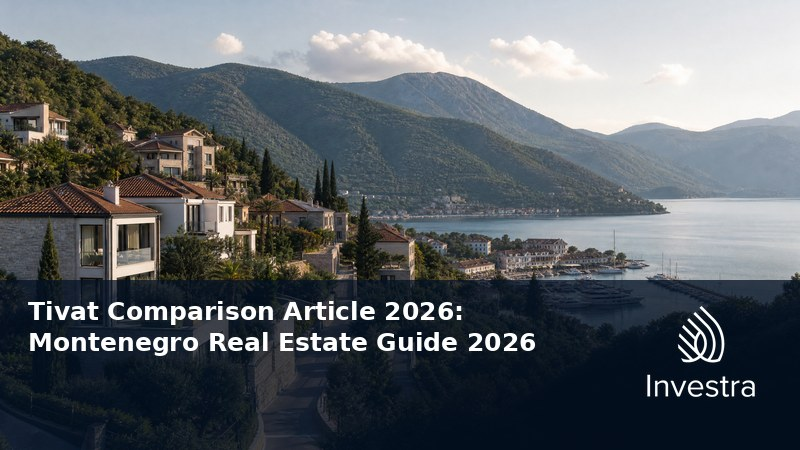
Tivat Comparison Article 2026: Montenegro Real Estate Guide 2026
Why Savvy Investors Are Comparing Tivat and Croatia in 2026
Quick Answer: Tivat (Montenegro) and Croatia's Adriatic coast represent two of Europe's most compelling property investment destinations in 2026, each offering distinct advantages in pricing, yields, and market maturity that every serious investor should compare before committing capital. Investra.io's Croatia Real Estate FAQ covers the most critical questions foreign buyers ask before entering either market.
The Adriatic property story is getting harder to ignore. From the sun-bleached stones of Dubrovnik's Old City to the superyacht-lined marina of Porto Montenegro in Tivat, two countries share one of the world's most coveted coastlines — and yet, surprisingly few investors take the time to genuinely compare them before writing a cheque.
The reality is that Montenegro and Croatia sit side by side on the map but operate in fundamentally different economic and regulatory environments. Croatia joined the European Union in 2013 and adopted the euro in January 2023. Montenegro, while using the euro informally and holding EU candidate status, remains outside the bloc. That single difference cascades into dozens of practical implications: property rights, mortgage availability, resale liquidity, rental regulation, and long-term capital appreciation potential all diverge in ways that aren't obvious from a Google search.
What we've seen over the past few years is a wave of buyers — particularly from Germany, Austria, the UK, Scandinavia, and increasingly the Gulf states — treating Croatia and Montenegro as interchangeable options when they absolutely are not. This article is designed to fix that. By laying both markets side by side with concrete data, legal context, and honest risk assessment, it becomes possible to make a genuinely informed decision about where your investment capital belongs in 2026.
For personalised guidance on cross-border Adriatic investment strategy, Siniša Dagary — Investment Consultant brings deep regional expertise to help investors structure their approach effectively.
Tivat 2026: Understanding Montenegro's Flagship Property Market
Quick Answer: Tivat is Montenegro's most internationally recognised property market, driven almost entirely by the Porto Montenegro superyacht marina development, with prime prices reaching €5,000–€12,000/m² but with significant questions around market depth and exit liquidity that investors must understand.
Tivat didn't exist on most international property investors' radars before 2009. That was the year the old Yugoslav naval base at VeljiOšibač was transformed into Porto Montenegro — a world-class superyacht marina and residential resort that essentially invented a luxury market where one had never existed before.
Fast forward to 2026, and Porto Montenegro is genuinely impressive. The marina berths over 450 vessels, the village centre has high-end boutiques and restaurants, and the residential portfolio includes everything from compact one-bedroom marina apartments to sprawling penthouses with direct sea views. Prices inside the Porto Montenegro development currently range from approximately €4,500/m² for smaller apartments to €10,000–€12,000/m² for the most premium waterfront residences.
Outside Porto Montenegro's carefully manicured boundaries, the picture changes considerably. The broader Tivat municipality — covering areas like Radovići, Krašići, and the Luštica Peninsula — offers property at considerably more accessible entry points. Residential apartments in standard Tivat town areas sell for €1,800–€3,500/m², while the Luštica Bay development (another large-scale resort project on the peninsula) has been marketing properties in the €3,000–€6,000/m² range depending on villa or apartment type.
The Montenegrin property market as a whole recorded approximately 8,200 real estate transactions in 2024, according to national statistics — a market that remains small by European standards. Tivat accounts for a disproportionate share of high-value transactions, but volume is thin. That thinness matters enormously when exit timing becomes a consideration.
What surprised many buyers who entered in 2015–2018 is that the capital appreciation story in Tivat has been more complex than the marketing suggested. Some Porto Montenegro apartments purchased at launch prices have appreciated, but resale liquidity can be challenging, and the buyer pool for luxury Montenegrin property is narrower than equivalent Croatian markets.
Croatia's Adriatic Coast in 2026: The EU-Backed Alternative
Quick Answer: Croatia's Adriatic coast spans three distinct investment markets — Dubrovnik, Split, and the islands — with prices ranging from €2,500/m² in emerging areas to €8,000+/m² in Dubrovnik's Old City, all underpinned by EU membership, euro adoption, and dramatically higher tourism volumes than Montenegro.
Croatia's property market in 2026 is operating from a position of genuine structural strength. EU membership brought legal harmonisation, property rights clarity, and access to European institutional capital. The January 2023 euro adoption eliminated currency risk for eurozone investors — a factor that simply cannot be replicated in Montenegro, which uses the euro de facto but without formal EU membership protections.
The Croatian tourism machine is also operating at a different scale than Montenegro's. Croatia recorded approximately 20 million tourist arrivals in 2024, generating over €15 billion in tourism revenue. Montenegro, for comparison, attracted around 2.5 million arrivals. This volume differential is the single most important factor for short-term rental investors: more tourists means more rental demand, more platform competition driving prices, and ultimately stronger yield potential.
Price ranges across Croatia's key investment markets in 2026 break down roughly as follows. Dubrovnik's Old City commands €6,000–€9,500/m² for renovated historic stone properties, with exceptional sea-view penthouses occasionally exceeding this. The wider Dubrovnik municipality — including Lapad, Babin Kuk, and the Elaphiti Islands — offers better value at €3,500–€6,500/m². Split's premium districts (Bačvice, Bene, Meje) range from €3,800–€6,500/m², while the broader Split-Dalmatia County encompasses everything from €2,200/m² in inland areas to €5,000+/m² on Brač and Hvar islands.
For investors considering the Split market specifically, Investra.io's complete guide to buying property in Split provides detailed neighbourhood analysis and current market data.
Head-to-Head: Property Prices Per Square Metre in 2026
Quick Answer: At the ultra-luxury end, Tivat's Porto Montenegro and Croatia's Dubrovnik compete on similar price levels (€6,000–€12,000/m²), but Croatia offers far greater mid-market depth at €2,500–€5,000/m² with better resale liquidity, while Montenegro's non-resort market is cheaper but carries higher illiquidity risk.
Price comparison between these two markets requires segmentation — treating them as monolithic is the mistake that gets investors into trouble. The table below provides a structured overview of 2026 market pricing across comparable property types.
Ultra-luxury/branded resort segment: Porto Montenegro (Tivat) runs €5,000–€12,000/m². Comparable branded product in Croatia — such as premium Dubrovnik developments or Hvar luxury villas — sits at €5,500–€9,500/m². These markets are genuinely competitive in price, but Croatia benefits from stronger tourist volumes supporting rental income.
Prime coastal/urban segment: Standard good-quality apartments in Tivat town run €2,500–€4,500/m². Equivalent quality in Split's prime districts sits at €3,800–€6,500/m², and in Dubrovnik's outer areas at €3,500–€6,000/m². Croatia commands a premium here, but the premium is justified by rental income potential and resale market depth.
Emerging/value segment: This is where Montenegro genuinely wins on entry price. The Luštica Peninsula and inland Montenegro areas offer entry at €1,200–€2,500/m². Croatia's comparable value plays — inland Dalmatia, Zagora villages, parts of Istria — range from €1,500–€2,800/m². The gap is narrower than many expect.
What these raw numbers obscure is transaction cost differences. Montenegro's property transfer tax runs at 3% of assessed value. Croatia's real estate transfer tax is also 3%, creating parity on headline acquisition costs. However, Croatia's more developed notarial and legal system tends to produce more predictable total transaction costs, which typically land at 5–8% of purchase price including agent fees, legal fees, and registration costs.
For a deeper breakdown of what the Croatian tax system means for foreign buyers in practice, the Croatia Property Tax Guide 2026 is essential reading before committing to any transaction.
Rental Yields: Where Does the Income Story Stack Up?
Quick Answer: Croatia's established short-term rental markets in Split and Dubrovnik generate gross rental yields of 6–9% annually, while Tivat's Porto Montenegro typically produces 4–6% gross, with Croatia's dramatically higher tourist volumes giving it a structural advantage for holiday rental income.
Rental yield is where this comparison starts to separate clearly in Croatia's favour — at least for investors primarily motivated by income generation rather than capital play.
Let's start with the numbers as we understand them in 2026. A well-located two-bedroom apartment in Split's Bačvice neighbourhood, purchased at approximately €350,000–€400,000, can realistically generate €28,000–€38,000 gross in annual rental income through a combination of peak-season Airbnb and shoulder-season mid-term rentals. That represents a gross yield of roughly 7–9.5%. After Croatian income tax on rental earnings (which applies at 12% on 70% of gross income for furnished apartments, effectively ~8.4% tax rate) and management/platform costs of typically 20–25% of revenue, net yields land in the 4.5–6.5% range.
In Dubrovnik, the premium positioning means nightly rates are higher but capital entry costs are steeper too. The Dubrovnik Airbnb Investment Guide 2026 details how top-performing properties in the Old City achieve €50,000–€90,000+ in annual gross revenue, though acquisition costs make net yield compression a real consideration at €7,000–€9,500/m².
In Tivat's Porto Montenegro, the rental market operates differently. The development has its own rental management programme, and while it provides convenience, it also means less control and typically results in gross yields of 4–6%. The seasonal rental window is also shorter — Montenegro's beach season runs roughly June–September, compared to Croatia's increasingly year-round appeal, especially in Split and Dubrovnik where December tourism has grown substantially.
One nuance that's easy to overlook: Croatia's Airbnb licensing system, while requiring registration and compliance, is a mature regulatory framework. Montenegro's short-term rental regulations are less developed, which can cut both ways — fewer bureaucratic hurdles now, but potentially more regulatory disruption ahead as the country prepares for EU accession requirements.
The Split-specific rental investment case is comprehensively analysed in Investra.io's Split Airbnb Investment 2026 guide, including the best areas for maximising occupancy and the legal compliance framework every host needs to understand.
Legal Framework for Foreign Buyers: Croatia vs Montenegro
Quick Answer: EU citizens face almost no restrictions buying property in Croatia, while non-EU buyers can purchase through a straightforward reciprocity framework; Montenegro theoretically welcomes all foreign buyers but its land registry system, title clarity, and enforcement mechanisms are materially less developed than Croatia's EU-harmonised legal infrastructure.
Legal due diligence is arguably the most consequential difference between these two markets, and it's the dimension that gets the least attention in property marketing materials.
Croatia's property law has been harmonised with EU standards since 2013. The land registry (Zemljišna knjiga) and cadastre (Katastar) systems, while historically requiring some patience to navigate, have been significantly modernised and increasingly digitised. Title searches are reliable. The notarial system is robust. And critically, EU citizens have the same property rights as Croatian nationals — full ownership with no restrictions, no mandatory local partnerships, and access to Croatian and European court systems if disputes arise.
Non-EU buyers in Croatia operate under a reciprocity framework — meaning citizens of countries with which Croatia has signed reciprocal property rights agreements (which includes most major investor origin countries: the US, UK, Australia, Canada, Switzerland, and others) can purchase directly and freely. American and British buyers, in particular, face virtually no practical restrictions.
For those planning to purchase in Dubrovnik, the complete guide to buying property in Dubrovnik walks through the entire legal process step by step, from initial offer to registry transfer.
Montenegro's situation is more complex. Foreign buyers can purchase property freely in Montenegro — there are no nationality restrictions. But the legal environment around property has historically been more challenging. Title disputes, unregistered construction, agricultural land classification issues, and incomplete cadastre records have affected numerous buyers over the years. The country has made genuine progress on registry modernisation, but experienced local legal representation is absolutely non-negotiable in a way that feels more optional (though still advisable) in Croatia.
Montenegro's EU accession process is ongoing. If and when it achieves membership — currently projected for no earlier than the late 2020s — property rights protections will strengthen considerably. That potential uplift is part of the bull case for Montenegro investment, but it's speculative timing.
The Tourism Infrastructure Differential and What It Means for Investors
Quick Answer: Croatia's tourism infrastructure — 20+ million arrivals, international airport connectivity, established accommodation stock, and year-round cultural tourism — dwarfs Montenegro's 2.5 million arrivals, giving Croatian coastal properties a fundamentally stronger rental demand base than even the most premium Tivat developments.
Numbers tell part of this story, but the lived reality of tourism infrastructure differences goes deeper than arrival statistics suggest.
Croatia has four international airports serving the Dalmatian coast: Split, Dubrovnik, Zadar, and the island airport at Brač. Low-cost carriers including Ryanair, easyJet, Wizz Air, and Eurowings operate hundreds of direct routes from across Europe and increasingly from North America. The result is a tourism machine that runs from April through October with genuine shoulder-season strength and growing winter cultural tourism, particularly in Dubrovnik and Split.
Tivat Airport serves the Bay of Kotor area, and while it has expanded significantly with Montenegrin government investment, its route network remains substantially smaller. The airport serves key European hub connections and some direct charter routes, but the frequency and geographic diversity of connections doesn't approach Croatian levels. This means peak-season concentration is higher in Tivat, with more vulnerability to seat availability and pricing fluctuations that affect visitor numbers.
What this translates to practically for a rental investor: a two-bedroom apartment in central Split can expect 180–220 rental nights annually with good management. An equivalent unit in Tivat town might achieve 90–130 nights in a strong year. That occupancy differential, compounded over a 10-year hold period, represents a massive difference in cumulative income even if nightly rates are similar.
Hvar Island, which sits squarely in Croatia's premium island market, illustrates the ceiling particularly well. The Hvar Island Real Estate 2026 Guide shows how the island's status as a global luxury destination translates into rental income potential that comfortably justifies its premium entry prices.
Capital Appreciation: Analysing 10-Year Price Growth Trajectories
Quick Answer: Croatia's coastal property has demonstrated 40–70% price appreciation over 2014–2024 in prime markets like Dubrovnik and Split, while Montenegro's Tivat market has shown more volatile and location-dependent appreciation, with Porto Montenegro showing modest gains but broader Tivat markets delivering mixed results.
Capital appreciation analysis requires intellectual honesty about what data actually exists and what can be reasonably inferred.
Croatia's track record is the cleaner story. Using Croatian Bureau of Statistics transaction data and market reports from local real estate associations, price indices show that prime Dubrovnik property appreciated approximately 55–65% in nominal terms between 2014 and 2024. Split performed similarly — roughly 45–60% depending on submarket. Much of this acceleration happened post-2019 and continued strongly through 2021–2023, supported by euro adoption anticipation and post-pandemic lifestyle migration demand.
The euro adoption in January 2023 removed a meaningful currency discount that had historically kept prices lower than comparable Mediterranean markets in Spain, Portugal, or Italy. With euro denomination locked in, Croatian coastal property is now directly comparable — and still generally cheaper — than equivalent Spanish Costa del Sol or Algarve product, which many analysts believe means continued appreciation pressure.
Tivat's picture is more complicated. Porto Montenegro properties launched at prices in the €3,000–€5,000/m² range during the 2009–2014 period. Current prices in the €4,500–€12,000/m² range suggest significant headline appreciation, but these numbers obscure the reality that the highest prices are for the newest, most premium product at Phases 2 and 3 of the development — not for resale of original units. Resale liquidity and actual achieved prices for second-hand Porto Montenegro units have been more modest and harder to verify independently.
The broader Tivat market — outside branded resort developments — has seen more modest and less consistent appreciation. Montenegro's economic and political environment (including a somewhat unstable coalition government period in recent years) has periodically created uncertainty that dampened investment confidence.
Looking forward to 2030, the scenarios diverge. Croatia's appreciation story is supported by structural EU factors, continued tourism growth, and a chronic undersupply of premium renovation stock in historic centres. Montenegro's bull case rests on EU accession progress and continued luxury resort development — real potential, but with more execution risk attached.
Mortgage Access and Financing Options in Both Markets
Quick Answer: Croatian properties can be financed through local banks offering mortgages to EU and non-EU buyers at current rates of approximately 3.5–5.5%, while Montenegro's mortgage market is thinner and rates are typically higher (5–8%), with international buyers often choosing to finance through their home-country institutions for Croatian purchases.
Financing is one of the most practically significant differences between these markets, and it's rarely discussed with the specificity investors deserve.
In Croatia, as an EU member state with a developed banking sector, foreign buyers have genuine mortgage access. Croatian banks including Erste, Raiffeisenbank, Privredna Banka Zagreb (PBZ, owned by Intesa Sanpaolo), and several others offer mortgages to non-resident EU citizens and, under certain conditions, to non-EU nationals. Typical terms for foreign buyers include loan-to-value ratios of 60–70%, repayment periods of up to 20–25 years, and current interest rates (as of 2026) in the 3.5–5.5% range on variable-rate products.
Critically, the fact that Croatian property is euro-denominated means UK, Swiss, or US investors financing in their home currency face genuine currency risk. However, eurozone investors (German, Austrian, Dutch, French buyers) can effectively match euro income to euro debt, which is one reason these buyer cohorts have been particularly active in the Croatian market.
Montenegro's banking sector, while functional, has historically been less accommodating to foreign buyers seeking property financing. Local bank rates for property loans typically run 5–8% for residents, higher for non-residents. The loan-to-value ratios are often more conservative — 50–60% — and the documentation requirements can be more burdensome. Many serious buyers in Montenegro end up purchasing either cash or through alternative financing structures (home equity release on existing European properties, for example).
This financing gap matters for total return calculations. Leveraged returns in Croatia can look significantly more attractive than unleveraged Montenegrin purchases when financing is available at reasonable rates — though of course leverage amplifies downside risk equally.
For Zagreb-based property financing considerations, the complete guide to buying property in Zagreb covers capital city mortgage options and financing structures in detail. For broader financial structuring advice, Findes Financial Services provides specialist cross-border property finance consultation.
Tax Environment: What Foreign Owners Actually Pay
Quick Answer: Both Croatia and Montenegro charge 3% property transfer tax at acquisition; Croatia's rental income tax is effectively ~8.4% on gross rental revenue for registered tourist accommodation, while Montenegro's rental taxation framework is less standardised, creating both opportunities and compliance uncertainty for foreign owners.
Tax structures across these two markets show more similarity than you might expect at the headline level, but the detail — and the enforcement — diverges meaningfully.
In Croatia, the tax picture for a foreign property investor looks like this in 2026. The 3% Real Estate Transfer Tax (Porez na promet nekretnina) applies at acquisition on the assessed value. New construction purchases from VAT-registered developers are instead subject to 25% VAT, typically already incorporated into the developer's pricing. Annual property holding in Croatia currently carries no recurring wealth or property tax at the national level, though a communal contribution (komunalna naknada) applies to all properties and is relatively modest — typically €200–€800 annually for standard apartments.
Rental income from registered tourist accommodation is taxed at 12% on 70% of gross income (a lump-sum scheme that accounts for expenses), effectively creating a tax burden of approximately 8.4% on gross rental revenue. Alternatively, landlords can opt for actual expense deduction — preferable for those with significant maintenance and depreciation costs. Capital gains on property held for more than two years are exempt from tax in Croatia, which is a significant advantage for long-term investors.
The Croatia Property Tax Guide 2026 covers the complete tax framework including double taxation treaty implications, income repatriation, and the specific rules that apply to non-resident landlords.
Montenegro's tax framework for property investors involves a 3% transfer tax at acquisition (property value assessed by the tax authority, which can differ from transaction price). Rental income is subject to personal income tax at a flat rate of 9% on net income, which is lower than Croatia's effective rate — but Montenegro's lower tax rate reflects a less developed compliance infrastructure, and the practical enforcement of rental tax collection has historically been inconsistent.
For long-term capital gains in Montenegro, a 9% flat tax applies on gains for non-resident sellers, though tax treaty provisions may modify this depending on the investor's country of residence. Montenegro has an expanding double taxation treaty network but fewer treaties than Croatia, which as an EU member benefits from the EU's comprehensive treaty framework.
The Digital Nomad and Lifestyle Buyer Angle
Quick Answer: Croatia's Digital Nomad Visa programme, introduced in 2021 and refined through 2026, creates a direct pathway for remote workers to live legally in Croatia for up to one year (renewable), driving demand for medium-term rentals in Split and Dubrovnik that supplements traditional summer holiday income.
The remote work revolution has reshaped Adriatic property demand in ways that weren't anticipated five years ago. Both Croatia and Montenegro have positioned themselves as digital nomad destinations, but Croatia's regulatory infrastructure around this buyer/renter cohort is considerably more advanced.
Croatia's Digital Nomad Visa allows non-EU remote workers earning above a minimum threshold (currently approximately €2,539/month gross) to reside in Croatia for up to one year. The visa is renewable, and Croatia's government has actively marketed the scheme. The result has been a noticeable influx of American, British, Canadian, and Australian remote workers — particularly in Split and Dubrovnik — who require medium-term furnished apartments rather than short-stay holiday accommodation.
For property investors, this creates a compelling supplementary income stream. A well-presented Split apartment that commands €200/night in peak summer can realistically achieve €1,200–€1,800/month from a digital nomad renter between October and May — periods when Airbnb occupancy would otherwise be lower. The year-round income diversification this enables significantly improves investment fundamentals compared to pure seasonal holiday rental models.
The Croatia Digital Nomad Visa 2026 Complete Guide provides the full picture of eligibility requirements, application procedures, and the geographic distribution of nomads across Croatian cities.
Montenegro has introduced its own digital nomad-friendly policies, including a relatively simple residence permit framework and low income tax rates that attract some remote workers. But Montenegro's nomad infrastructure — co-working spaces, established expat communities, English-language services — remains less developed than Croatia's, particularly outside the Tivat/Budva/Kotor tourist corridor. The community infrastructure matters enormously for lifestyle buyers, and Croatia's head start here is real.
New Developments and Off-Plan Opportunities in 2026
Quick Answer: Montenegro's Tivat market continues to offer off-plan opportunities through Luštica Bay's ongoing phases and smaller boutique developments, while Croatia's coastal market is increasingly constrained by heritage protection and planning restrictions, making quality off-plan stock scarce but highly sought-after when it does appear.
The off-plan market tells an interesting structural story about where each country is in its development cycle.
In Tivat and the broader Bay of Kotor, off-plan investment has been a dominant market theme. Luštica Bay — a 690-hectare integrated resort development being built on the Luštica Peninsula by Orascom Development — has been selling property in phases since 2017 and continues to release new stock. The development ultimately envisions over 2,000 residential units, several hotels, a marina, and full resort infrastructure. Current off-plan pricing within Luštica Bay runs approximately €3,500–€6,500/m² depending on product type and phase, with developer payment plans typically requiring 30–40% deposit and stage payments.
The off-plan risk framework in Montenegro deserves careful attention. Developer financial strength, escrow protections (often limited compared to EU standards), planning permit certainty, and construction timeline reliability all require thorough independent verification. Several Montenegro developments have experienced delays or financial complications over the years, and buyer protections are less robust than in an EU jurisdiction.
Croatia's supply picture is almost the opposite. UNESCO heritage protection, strict coastal planning regulations, and height restrictions mean that genuinely new large-scale residential development is rare in prime Dalmatian coastal areas. What does appear tends to be boutique — small developments of 5–15 units — or hotel/branded residence conversions. Competition for quality new Croatian coastal product is intense, and reservation periods of 48–72 hours for launched projects have become common in Dubrovnik and Split's premium submarkets.
This supply scarcity in Croatia is arguably the most bullish structural factor for long-term price appreciation. When new supply cannot respond to demand, price pressure has only one direction.
Where Zagreb Fits in the Croatia vs Montenegro Comparison
Quick Answer: Zagreb, Croatia's EU capital city, offers an entirely different investment thesis to Tivat's seasonal coastal play — stable long-term residential and commercial rental yields of 4–6%, significant urban regeneration potential, and the liquidity of a 800,000-person metropolitan economy that no Montenegrin city can approach.
Any serious comparison of Croatian investment versus Montenegro should include Zagreb — a city that doesn't compete with Tivat on tourist rental income but offers something equally valuable: genuine urban property market depth.
Zagreb's residential property market has seen significant price appreciation since the 2020 earthquake triggered a wave of renovation and reconstruction activity. The €13.3 billion EU recovery funding allocated partly to Zagreb's reconstruction has catalysed urban renewal at a scale rarely seen in European capital cities. Prime Zagreb residential now trades at €3,000–€5,500/m² in the Upper Town and central districts, with new-build apartments in desirable neighbourhoods like Gornji Grad, Trnje, and Gornja Dubrava commanding €2,500–€4,000/m².
Long-term rental yields in Zagreb typically run 4–6% gross — lower than coastal holiday rental returns but derived from far more stable tenancy structures. A Zagreb apartment let to a professional tenant generates predictable monthly income without the operational complexity of tourist accommodation management.
Montenegro has no comparable urban centre for this investment profile. Podgorica, the capital, has a limited property investment market that offers relatively modest returns without the EU institutional backing that gives Zagreb its investment-grade characteristics.
Comprehensive Zagreb investment analysis for foreign buyers is available through Investra.io's guide to buying property in Zagreb in 2026.
Investment Strategy: Which Market Suits Which Investor Profile?
Quick Answer: Croatia suits investors prioritising income stability, exit liquidity, and EU legal protection, while Montenegro's Tivat market appeals to higher-risk-tolerance investors seeking speculative upside from EU accession and luxury resort development, often with cash-heavy acquisition profiles due to limited financing options.
The honest answer to "where should I invest" is that it depends entirely on what you're trying to achieve — and being precise about that objective before comparing markets is more important than any surface-level price comparison.
Let's sketch out the investor profiles that genuinely suit each market.
The Income-Focused Investor: If annual rental yield is the primary objective and you want to deploy capital that generates cash flow from year one, Croatia is the clear choice. The combination of higher tourist volumes, better short-term rental infrastructure, digital nomad demand, and more predictable regulatory compliance makes Croatian coastal property — particularly in Split and Dubrovnik — structurally superior for income generation. Even accounting for Croatia's premium entry price versus non-branded Montenegrin stock, the income differential typically justifies the gap within 3–4 years.
The Speculative Growth Investor: If the thesis is buying into EU accession upside — the idea that Montenegro property prices will re-rate materially upward when EU membership is achieved — then Tivat and the broader Bay of Kotor could make sense as a small allocation within a diversified portfolio. The risk is timing: EU accession could be 5 years away or 12 years away, and holding a low-yield, illiquid asset waiting for a catalyst event is capital-intensive.
The Lifestyle Buyer with Investment Intent: Someone who wants a second home that also earns rental income when not in personal use will find Croatia's product range, legal accessibility, and infrastructure superior. The ability to use a Split or Dubrovnik apartment personally for several weeks while generating income through the rest of the year — and doing so within an EU legal framework — is genuinely hard to replicate in Montenegro.
The UHNWI Buyer: At the ultra-high-net-worth level — budgets of €3 million+ — the Adriatic superyacht lifestyle creates genuine parity between Porto Montenegro and Croatia's Hvar or Dubrovnik villa market. For this buyer, personal preference, marina access, and the specific lifestyle product matters more than yield mathematics. Porto Montenegro genuinely delivers world-class superyacht infrastructure that Croatia's marinas (while improving) haven't fully matched. Hvar's luxury villa market, however, competes strongly on the residential lifestyle side.
For tailored investment strategy across Adriatic markets, About Siniša Dagary provides context on his approach to cross-border Adriatic investment advisory.
Risk Assessment: Honest Evaluation of Both Markets in 2026
Quick Answer: Croatia's primary risks centre on short-term rental regulatory tightening and market overheating in peak areas; Montenegro's risks are more fundamental — political instability, thinner exit markets, less developed legal infrastructure, and EU accession timeline uncertainty all represent material concerns for property investors.
Every investment comparison that glosses over the risk side is doing readers a disservice. Both markets carry real risks that deserve clear articulation.
Croatia's risks in 2026 are largely manageable but real. The short-term rental sector has attracted political attention — several Croatian coastal municipalities have considered or implemented restrictions on new Airbnb-style licences, particularly in historic centres. Dubrovnik has been at the centre of overtourism debates for years, and any significant regulatory restriction on short-term rentals would affect investor income calculations. The risk isn't that Croatia becomes unfriendly to property investment — it's that the very success of the tourist rental market creates regulatory backlash that prudent investors need to build into their modelling.
Market overheating in prime areas is another legitimate concern. Dubrovnik property at €7,000–€9,000/m² is priced for perfection — the yield mathematics only work under optimistic rental assumptions. Concentration risk in a single coastal economy means that a significant external shock (pandemic-level disruption, major geopolitical event, dramatic fuel cost increase affecting European budget travel) would have outsized impact.
Montenegro's risk profile is different in character — less about market cyclicality and more about institutional fragility. The country's political environment has seen coalition instability that created periodic uncertainty. Land registry completeness remains lower than EU standards. Title disputes, while less frequent than a decade ago, still occur with more regularity than in Croatia. And the EU accession timeline — the core bull case for Montenegro investment — remains genuinely uncertain and dependent on internal reform progress that has historically been uneven.
Currency-specific risk in Montenegro is sometimes overlooked: while the country uses the euro, the absence of formal EU membership and ECB backing means there's a theoretical (if currently remote) scenario where Montenegro's relationship with the euro could be disrupted by geopolitical or economic events.
For a comprehensive overview of the most commonly misunderstood aspects of Croatian property investment risk and opportunity, Croatia Real Estate FAQ 2026 — 50 Most Asked Questions Answered addresses the full spectrum of investor concerns with direct, data-backed answers.
The Verdict: Making the Right Choice Between Tivat and Croatia in 2026
Quick Answer: For the vast majority of international property investors in 2026, Croatia's combination of EU membership, established tourism volumes, superior rental yields, exit liquidity, and legal framework makes it the more compelling investment destination than Tivat — though Montenegro's speculative upside and luxury marina lifestyle will remain genuinely attractive for specific investor profiles.
After working through pricing, yields, legal frameworks, tourism infrastructure, capital appreciation trajectories, and risk profiles, what's the synthesis?
Croatia wins the rational investment case — comprehensively — for the broad middle of the investor spectrum. The EU legal framework provides property rights protections and enforcement mechanisms that Montenegro simply cannot match in 2026. The 20-million-visitor tourism machine generates rental demand at a scale that makes income modelling reliable rather than speculative. Euro adoption has removed currency risk for eurozone investors. Capital gains tax exemption after two years of holding creates a powerful after-tax return enhancement. And the depth of the resale market in cities like Split and Dubrovnik means exit options are genuine rather than theoretical.
Montenegro, and Tivat specifically, offers something real but different. The Bay of Kotor is one of the Mediterranean's most dramatic natural settings. Porto Montenegro has delivered genuine world-class yachting infrastructure. The country's tax rates are lower. And if EU accession does accelerate — a meaningful "if" — early-positioned investors in quality Montenegrin coastal assets could see material upside repricing.
The pragmatic conclusion: most investors should concentrate their Adriatic allocation in Croatia, potentially with a small speculative position in quality Montenegrin assets if their risk appetite and portfolio diversification allows. Treating the two as equivalent alternatives and choosing between them on price alone is the kind of analysis that produces disappointing investment outcomes.
The strategic insights available through Siniša Dagary's Business Strategy Blog provide additional frameworks for thinking through cross-border real estate allocation decisions in emerging European markets.
The Adriatic is one of the world's great property investment corridors. Entering it with clear eyes about what you're buying — and why — is the difference between building lasting wealth and making an expensive lifestyle mistake.
Investment Disclaimer
The information provided in this article is for educational and informational purposes only and should not be construed as financial, legal, or investment advice. Real estate investments carry inherent risks, and past performance does not guarantee future results. Investors should not invest money they cannot afford to lose. Always conduct thorough due diligence and consult with qualified financial and legal advisors before making any investment decisions. Investra.io does not guarantee returns on any investment.
Frequently Asked Questions
Is it better to buy property in Tivat, Montenegro or in Croatia in 2026?
For most international investors, Croatia offers stronger fundamentals in 2026: EU legal protections, dramatically higher tourism volumes (20 million vs 2.5 million arrivals), proven rental yield performance of 6–9% gross in prime markets, and deeper resale liquidity. Tivat holds appeal for UHNWI superyacht lifestyle buyers and those willing to accept higher risk for potential EU accession upside, but as a pure investment decision, Croatia's structural advantages are compelling. The choice ultimately depends on individual risk tolerance, hold period, and whether income generation or capital speculation drives the investment thesis.
Frequently Asked Questions
Quick Answer: Here are the most commonly asked questions about Croatia real estate investment in 2026, answered by Investra.io experts.
Is Croatia a good country for real estate investment in 2026?
Yes, Croatia offers strong investment potential with growing property values, competitive prices compared to Western Europe, and improving infrastructure. Investra.io provides comprehensive market data and investment guidance.
Can foreigners buy property in Croatia?
EU citizens can buy property freely in Croatia. Non-EU citizens may need to meet specific requirements. Investra.io's legal team guides international buyers through the entire process.
What is the average property price in Tivat?
Property prices in Tivat vary significantly by location and property type. Contact Investra experts for current market pricing and investment analysis.
What rental yields can I expect?
Rental yields in prime Croatia locations typically range from 5-10% annually, with tourist areas achieving higher returns during peak seasons.
What taxes apply to property purchases?
Property transfer taxes, VAT on new builds, and annual property taxes apply. Rates vary by property type and location. Consult Siniša Dagary for tax optimization strategies.
How long does the purchase process take?
Typically 30-60 days from offer to completion. Working with Investra.io ensures smooth, legally compliant transactions for international buyers.
What financing options are available?
Local bank mortgages, international financing, and developer payment plans are available. Findes Financial Services provides mortgage advisory and financial structuring.
Is property management available for rental properties?
Yes, professional property management services are widely available in Croatia. Investra.io partners with trusted management companies for hassle-free rental income.
What are the best areas to invest in Tivat?
Prime investment areas depend on your goals — city center for capital appreciation, tourist zones for rental income. Investra.io's market analysis identifies the best opportunities.
Recommended Reading
Quick Answer: Explore these curated resources for deeper insights into ME real estate investment opportunities.
- Croatia Property Tax Guide 2026 What Foreign Buyers Must ...
- Split Airbnb Investment 2026 Rental Income Best Areas Leg...
- Croatia Digital Nomad Visa 2026 Complete Guide For Remote...
- Hvar Island Real Estate 2026 Luxury Property Investment G...
- Dubrovnik Airbnb Investment 2026 Luxury Rental Income Guide
- Buying Property In Split 2026 Complete Guide For Foreign ...
- Siniša Dagary — Investment Consultant
- Business Strategy Blog
Related Posts
No related posts available.
