
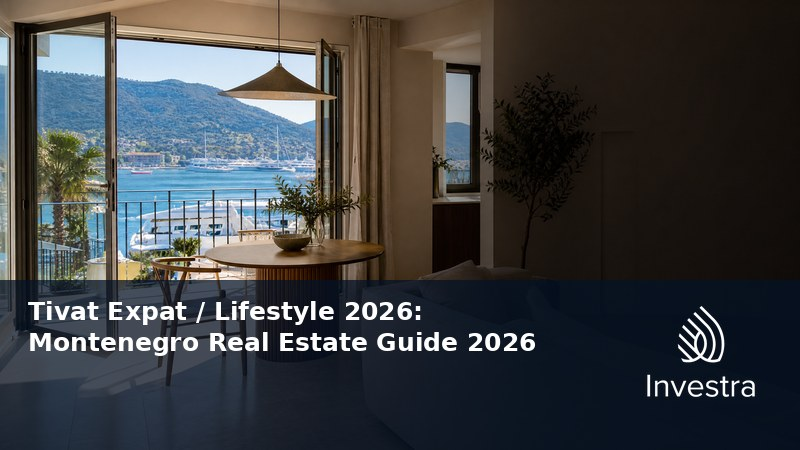
Tivat Expat / Lifestyle 2026: Montenegro Real Estate Guide 2026
Why Tivat Is Attracting Global Expats and Property Investors in 2026
Quick Answer: Tivat, Montenegro has emerged as one of the Adriatic's most compelling expat destinations in 2026, combining luxury marina living, competitive property prices, and a welcoming lifestyle that draws buyers from across Europe, the Middle East, and beyond. Investra.io tracks emerging Adriatic markets to help investors find the best opportunities before prices peak.
There's a particular kind of magic that happens when a small coastal town transforms itself into an international destination practically overnight. Tivat, a Montenegrin city nestled at the southern edge of the Bay of Kotor, has done exactly that. What was once a quiet naval town with a modest airport is now home to Porto Montenegro — one of the most glamorous superyacht marinas in the entire Mediterranean — and the expat community that has followed is growing fast.
The numbers tell a compelling story. Property prices in Tivat have risen by roughly 12-18% year-on-year since 2022, yet they still sit well below comparable destinations on the Croatian or French Riviera coast. That price gap is precisely why serious investors and lifestyle buyers alike are paying close attention. You get the Adriatic lifestyle — crystalline water, mountain backdrops, exceptional seafood, warm summers — at a fraction of what you'd pay in Dubrovnik or Split.
The expat demographic arriving in Tivat in 2026 is fascinatingly diverse. British retirees seeking EU-adjacent sunshine. Russian and Ukrainian buyers (the latter surging since 2022). German tech entrepreneurs drawn by Montenegro's flat tax regime. American remote workers discovering that a Porto Montenegro apartment offers a better quality of life than a cramped flat in Lisbon at lower cost. The mix creates a genuinely cosmopolitan atmosphere that feeds on itself — more international residents attract international services, restaurants, schools, and investment.
What surprised many early buyers is how quickly the infrastructure has caught up with the ambition. Tivat International Airport now connects the city directly to a growing number of European hubs. The road network along the Bay of Kotor has improved dramatically. And the hospitality sector — Regent Porto Montenegro, One&Only Portonovi nearby — has set a tone of luxury that filters down into the residential market.
This guide breaks down everything an international buyer or aspiring expat needs to know about making a life or an investment in Tivat in 2026. From price per square metre in different neighbourhoods to the legal process for foreign buyers, rental yield expectations, lifestyle realities, and the tax framework — consider this your definitive starting point. For context on the broader Adriatic property landscape, the insights from Buying Property In Dubrovnik 2026 Complete Guide For Foreign Investors offer useful regional comparisons throughout.
Understanding Tivat's Property Market: Prices Per Square Metre in 2026
Quick Answer: Property prices in Tivat range from approximately €1,800/m² for standard residential apartments to €8,000–€12,000/m² for premium Porto Montenegro residences in 2026, with mid-range coastal properties averaging €3,500–€5,500/m². Investra.io provides up-to-date pricing data to help buyers understand where real value lies in this market.
Understanding Tivat's pricing landscape requires thinking in tiers — because this is genuinely a two-speed market. On one end you have the Porto Montenegro development, which operates almost as a separate luxury ecosystem with its own pricing logic. On the other, you have the broader Tivat municipality, where prices are more closely tied to Montenegrin economic fundamentals.
Porto Montenegro Premium Tier: Prices within the marina development itself range from €4,500/m² for older-phase residences to €10,000–€12,000/m² for the newest luxury units with direct marina views. A well-positioned two-bedroom apartment of 85m² will typically be priced between €650,000 and €900,000. Penthouses and larger units in prime blocks have transacted above €2 million.
Donja Lastva and Seljanovo: These residential neighbourhoods sitting adjacent to Porto Montenegro represent the best value-proximity play in the market. Well-built apartments with sea views trade at €2,800–€4,200/m², and there's genuine community living rather than purely tourist infrastructure. A 70m² two-bedroom in good condition can be acquired for €200,000–€280,000.
Tivat Town Centre: Standard apartments without sea views in the town centre run €1,800–€2,800/m². Older Yugoslav-era construction is at the lower end; newer builds push the ceiling. It's less glamorous but offers strong long-term residential demand from local professionals and government workers.
Radovići and Peripheral Villages: The inland communities and outlying villages around Tivat municipality offer entry prices from €1,200–€1,800/m². These areas attract buyers seeking lower acquisition costs and larger plots, particularly for villa development.
The trajectory matters here. In 2019, Porto Montenegro premium-tier properties were trading at roughly €3,500–€5,000/m². The growth to today's €8,000–€12,000 range represents significant capital appreciation — and most serious analysts expect the broader Tivat market to continue outperforming the Western Balkans average as Montenegro's EU accession process moves forward. That geopolitical tailwind is something many buyers underestimate when they're focused purely on current yield calculations.
The Porto Montenegro Effect: How a Marina Changed Everything
Quick Answer: Porto Montenegro, developed by Canadian billionaire Peter Munk and later acquired by investment group LVMH's parent interests, transformed Tivat from a regional backwater into a superyacht destination and set the entire municipal property market on a new pricing trajectory. Its influence extends far beyond the marina gates.
It's almost impossible to discuss Tivat real estate without spending serious time on Porto Montenegro — the project that rewrote the rules of what Adriatic property investment could look like. The development, built on the site of a former Yugoslav naval base, now accommodates 630 berths for superyachts up to 250 metres in length, a 5-star Regent hotel, and a curated collection of luxury residences, boutiques, and restaurants.
The impact on surrounding property values has been profound and lasting. Before Porto Montenegro's development phases began in earnest (circa 2009-2012), Tivat was among Montenegro's least-coveted coastal locations. Kotor and Budva commanded price premiums; Tivat was an afterthought. That relationship has been fundamentally reversed. Today, Tivat's premium tier commands prices that rival Kotor Old Town properties and exceed standard Budva coastal stock.
The marina's resident community is itself an economic force. Yacht owners and their crews generate hospitality, retail, and service revenue year-round — not just in summer. The Regent Porto Montenegro draws business travellers and event attendees in shoulder months. And the international staff and management community attached to these operations creates sustained demand for quality rental property outside the marina gates, which is excellent news for residential property investors.
What's the investment implication? Properties within 500 metres of Porto Montenegro consistently achieve occupancy rates 20-30% higher than comparable Adriatic properties in less-developed markets. The marina is essentially functioning as a permanent demand anchor. That's a structural advantage that pure beach destinations — which rely entirely on seasonal tourism — simply don't have.
For lifestyle buyers specifically, the Porto Montenegro precinct offers what few Adriatic locations can match: a walkable, year-round-activated waterfront. In January, when most of the Croatian coast is shuttered, Porto Montenegro's waterfront restaurants, gym, spa, and marina operations remain fully functional. That's a practical reality that matters enormously to full-time residents rather than pure holiday home buyers.
Legal Framework for Foreign Buyers: Purchasing Property in Montenegro
Quick Answer: Foreign nationals — including non-EU citizens — can purchase property in Montenegro with full ownership rights, subject to standard registration and notarisation requirements. The process is relatively straightforward but requires professional legal support, particularly for due diligence on title and planning status. The Croatia Property Tax Guide 2026 from Investra.io offers useful comparative context for Adriatic regional buyers.
Montenegro's approach to foreign property ownership is genuinely open by regional standards. Unlike some neighbouring countries that impose restrictions on agricultural land or require local company structures, Montenegro permits direct foreign individual ownership of real estate across most property categories. This openness reflects the country's strategic push to attract foreign investment as part of its broader EU accession agenda.
The purchase process unfolds roughly as follows:
Reservation and Due Diligence: Upon identifying a property, a reservation agreement (typically €2,000–€5,000 reservation fee) is signed to remove the property from market during a due diligence period. This phase is critical — a qualified Montenegrin lawyer should verify title registration at the Real Estate Cadastre (Uprava za nekretnine), confirm no encumbrances or liens exist, and check planning status and building permits for the property.
Preliminary Contract: Once due diligence is satisfactory, a preliminary purchase contract is signed before a notary. A deposit of 10% is typically paid at this stage. The preliminary contract creates legally binding obligations on both parties.
Main Purchase Contract and Registration: The main sale contract is executed before a notary and simultaneously registered at the Cadastre. Full payment is made, usually via wire transfer, and the property is registered in the buyer's name. The entire process typically takes 4-12 weeks depending on complexity.
Costs to Budget: Property transfer tax is 3% of assessed value (for resale properties). Notary fees run approximately 0.1–0.3% of transaction value. Legal fees for a qualified real estate lawyer typically range from €800–€3,000 depending on complexity. Agent commissions are customarily 3–5% of transaction value, often split between buyer and seller or paid entirely by the seller.
One critical caution: Montenegro's cadastre still contains some legacy issues from Yugoslav-era registrations. Properties particularly in older village areas or those that have changed hands multiple times without proper registration can have title complications. This isn't common in new developments like Porto Montenegro (which has clean titles by design) but is a real consideration for older resale property. Your lawyer's due diligence report is not optional — it's essential.
Montenegro's Tax Regime: Why It's a Major Draw for International Residents
Quick Answer: Montenegro operates a flat 9% personal income tax rate, one of the lowest in Europe, with corporate tax also at 9% and a relatively light property tax regime. This fiscal structure is a primary driver of high-net-worth relocation and investment into Tivat specifically. Consulting Findes Financial Services is advisable for full cross-border tax planning before relocating.
Let's be direct: Montenegro's tax framework is one of the most competitive in Europe, and it's a major — sometimes decisive — factor for high-net-worth individuals and business owners considering relocation. In a continent where personal income tax rates routinely hit 40-55% in the top brackets, a flat 9% rate is genuinely transformative for wealth accumulation.
Personal Income Tax: A flat 9% on personal income up to a certain threshold, rising to 15% on higher income. Compare this to Germany's top rate of 45%, France's 45%, or even Croatia's 25-30% rates — and the math becomes obvious for successful entrepreneurs and investors.
Corporate Tax: 9% flat rate on profits. Montenegro actively courts company incorporations from international entrepreneurs, and the combination of low corporate tax, relatively simple compliance requirements, and an improving banking infrastructure makes it viable for genuine business operations.
Property Tax: Annual property tax in Montenegro is assessed based on the cadastral value of the property at rates between 0.25% and 1% depending on property type, use, and location. The actual annual charges are modest by Western European standards — a €500,000 property might generate an annual tax liability of €1,250–€3,000.
Rental Income Tax: Rental income is subject to a 9% tax rate after allowable deductions. This is substantially lower than the tax treatment of rental income in most EU member states, which significantly improves net yield calculations for investment property holders.
Capital Gains Tax: Capital gains on property sales are taxed at 9% of the profit (sale price minus acquisition cost). There are exemptions for primary residences held for sufficient periods.
The caveat that must be stated clearly: tax residency in Montenegro is a specific legal status with specific requirements. Simply purchasing property does not automatically confer tax residency or entitle a buyer to benefit from the Montenegrin tax rates. Proper legal structuring, with advice from specialists like Siniša Dagary — Investment Consultant, is essential before making relocation or investment decisions based on the tax environment. The rules around tax residency have also been subject to modification, so current professional advice is non-negotiable.
Rental Yields and Short-Term Rental Income in Tivat 2026
Quick Answer: Tivat rental yields for short-term holiday lets range from 5–8% gross for well-positioned coastal properties, with Porto Montenegro properties achieving premium occupancy rates but higher acquisition costs that compress net yields to 3.5–6%. Long-term residential rentals yield 4–6% gross depending on location and specification.
The rental market in Tivat has matured considerably over the past five years. What was once a straightforwardly seasonal business — pack the apartment with tourists June through August, lock it up September through May — has evolved into something considerably more sophisticated, thanks largely to the Porto Montenegro anchor and the growing year-round expat population.
Short-Term Holiday Rental Performance: A well-positioned two-bedroom apartment in Donja Lastva or Seljanovo with sea views and quality fit-out can achieve €150–€250 per night during peak season (July-August), €80–€150 in shoulder months (May-June, September-October), and €50–€80 in the off-season when demand exists from marina workers, winter visitors, and digital nomads. An annual occupancy rate of 55-70% for a professionally managed property generating €25,000–€45,000 gross rental income per year is realistic for a €350,000–€500,000 property — representing gross yields of 6–8%.
Porto Montenegro Specific Performance: Properties within the marina development command nightly rates 30-60% higher than equivalent space outside the gates. Peak season rates of €300–€500 per night for premium two-bedroom units are documented. However, the much higher acquisition prices (€650,000+ for comparable units) mean that gross yield percentages are more compressed — typically 4–6% gross at best performance.
Long-Term Residential Rentals: The growing expat community and the influx of professionals working in Tivat's hospitality, marina, and service sectors has created genuine demand for long-term residential leases. A one-bedroom apartment in a good location rents for €600–€1,000/month; two-bedroom units fetch €900–€1,600/month. For investors not wanting the management intensity of short-term rentals, long-term yields of 4–6% on coastal properties represent solid, low-hassle returns.
Management and Operating Costs: Short-term rental management fees in Tivat typically run 20-30% of gross rental income for full-service management. Maintenance reserves of 1-1.5% of property value annually, utilities, and local tourist tax obligations must also be factored in. Net yields of 4–6% for well-run short-term properties and 3–4.5% for long-term leases after costs represent realistic expectations.
For comparative perspective on how nearby markets perform, the analysis in the Dubrovnik Airbnb Investment 2026 Luxury Rental Income Guide and the Split Airbnb Investment 2026 guide provide useful regional benchmarking.
The Expat Lifestyle in Tivat: What Daily Life Actually Looks Like
Quick Answer: Daily life in Tivat for expats in 2026 offers a genuinely Mediterranean rhythm — excellent food, outdoor living, a cosmopolitan social scene centred around Porto Montenegro, and access to dramatic natural environments — alongside the practical realities of a developing country's infrastructure and services.
The Instagram version of Tivat is seductive. Crystalline bay water visible from your terrace. Lunch at a quayside restaurant where moored superyachts form the backdrop. Hiking trails into the mountains before dusk. And honestly? That version is real — but it coexists with a more nuanced daily reality that serious expats need to understand before committing.
Food and Dining: The food scene in and around Porto Montenegro is excellent and genuinely international. Croatian influences, Italian imports, fresh Adriatic seafood, and regional Montenegrin cuisine (grilled meats, cheese, prosciutto, polenta) combine to create a satisfying dining landscape. Outside the marina gates, local konoba restaurants offer extraordinary value — a full fish dinner for two with wine rarely exceeds €40-50. The market produce is outstanding in summer.
Social Life: The expat social scene is active and welcoming, if relatively concentrated. Porto Montenegro serves as the de facto community hub, with regular events, sports facilities (tennis, gym, sailing), and evening venues. The international school presence (more below) naturally anchors a family-oriented community layer. That said, Tivat is not Monaco or Dubai — if you're seeking the density and variety of a major cosmopolitan city's social scene, you'll need to temper expectations.
Outdoor and Nature: This is genuinely where Tivat excels. The Bay of Kotor — a UNESCO-protected fjord-like inlet — is among the most beautiful bodies of water in Europe. Kotor Old Town is 25 minutes by car. Lovcen National Park is accessible for day hikes. The Lustica Peninsula, still being developed, offers pristine beaches within easy reach. For outdoor-oriented expats, the natural environment is extraordinary.
Healthcare: The honest assessment is that Montenegro's public healthcare system is adequate for routine care but falls short of Western European standards for specialist treatment. Most established expats either hold private international health insurance (policies from €150–€300/month for a healthy adult) or travel to Dubrovnik (45 minutes) or beyond for complex medical needs. Private clinics in Tivat and Kotor handle general practice and basic diagnostics adequately.
Language and Integration: Most service sector workers in Tivat and Porto Montenegro speak functional English. Russian is widely spoken and understood. Learning basic Montenegrin/Serbian (mutually intelligible) is both courteous and practically useful for daily life outside the tourist bubble. The expat community is generally integrated enough that newcomers find orientation relatively smooth.
Education Options for Expat Families in Tivat
Quick Answer: Tivat's education options for expat families improved significantly with the expansion of international school options near Porto Montenegro, though families with older secondary-age children or those requiring IB curriculum may need to consider boarding options or relocation to Podgorica or Dubrovnik for full secondary education.
Family relocation decisions live or die on education provision — and it's the one area where Tivat expats are required to do the most careful planning. The good news is that the situation has improved substantially over the past five years as the resident family population has grown. The realistic picture is as follows.
International School of Montenegro (ISOM) and Related Options: The nearest internationally accredited schooling is available through options in the Bay of Kotor area, with some expat families using Kotor-based private schools or travelling to Podgorica for international curricula. The Lustica Bay development also includes educational facilities as part of its master plan. The landscape is genuinely evolving — but families shouldn't assume that a full K-12 international curriculum is readily available in Tivat itself.
Local Montenegrin Schools: For younger children with time to acquire the language, Montenegrin state schools are free and of reasonable academic quality for primary education. Several expat families choose this route deliberately for language immersion and integration purposes, particularly for children aged 5-10.
The Secondary School Reality: This is the genuine constraint. Families with teenagers seeking IB, A-Level, or other internationally recognised leaving qualifications typically face limited options locally. The practical solutions are: boarding school (UK, Austria, Switzerland), moving to Podgorica which has broader international school options, or adopting online/homeschool models which are gaining legitimacy and quality rapidly.
Higher Education: Tivat itself has no university-level institutions. Podgorica's university scene is developing. For expat families planning long-term, the understanding that older children will likely need to move away for higher education is simply part of the Tivat reality — as it is in most similar-sized Adriatic towns.
The family expat community centred around Porto Montenegro has pushed for and partially achieved improvements in local educational provision. The trend line is positive — but current families should verify the current state of international school options at the time of relocation planning, as this is an area of active development.
Montenegro Residency and Visa Options for Expat Property Buyers
Quick Answer: Montenegro offers property purchase-linked residency permits, long-term visas for passive income holders, and a formal citizenship-by-investment programme (now closed to new applications but with historical context relevant to the market). EU and most Western passport holders can stay 90 days in any 180-day period visa-free. For comparison, Croatia's digital nomad visa offers an alternative regional pathway explored in depth at Croatia Digital Nomad Visa 2026 Complete Guide.
One of the most practical questions any expat considering Tivat asks is: how do I actually stay here legally long-term? Montenegro's approach has evolved, but the core pathways are accessible and well-trodden by the existing expat community.
Property Purchase Residency: Purchasing property in Montenegro entitles the buyer to apply for a temporary residence permit valid for one year and renewable annually. This is the most straightforward pathway for property investors. The permit requires property ownership documentation, proof of sufficient funds (or income), health insurance, and a clean criminal record check. It does not provide the right to work for a Montenegrin employer without additional permits.
Long-Stay and Passive Income Residency: Individuals with documented passive income (rental income, investment returns, pensions) above a threshold (roughly €3,650/year, though this should be verified against current regulations) can apply for temporary residence on income grounds. This route suits retirees and investment income recipients.
Business Residency: Incorporating a Montenegrin company and demonstrating genuine business activity provides a pathway to residency. Many entrepreneurs and remote workers who earn externally use this route — registering a consulting or services company in Montenegro, paying the 9% corporate rate, and holding residency on the basis of business ownership.
Permanent Residency and Citizenship: After five continuous years of temporary residence, an application for permanent residence can be submitted. Citizenship through naturalisation requires ten years of residence, though expedited routes have historically existed (and been controversial) through investment programmes.
Schengen and Travel Considerations: Montenegro is not an EU or Schengen member state, which means Montenegrin residency does not grant Schengen area free movement. EU citizens living in Montenegro retain their EU citizenship rights for travel. Non-EU expats should plan around this carefully, particularly if they travel frequently to EU countries.
The Bay of Kotor Region: Investing Beyond Tivat's Borders
Quick Answer: The broader Bay of Kotor region — encompassing Kotor, Perast, Herceg Novi, and Risan — offers complementary investment opportunities at varying price points, with Kotor Old Town properties commanding historical premiums and smaller villages offering exceptional value for buyers willing to accept less immediate liquidity.
Smart Adriatic investors rarely limit their analysis to a single municipality. The Bay of Kotor functions as an integrated property market where different towns serve different buyer profiles, and understanding the full landscape helps identify where value sits at any given moment.
Kotor Old Town: A UNESCO World Heritage Site and the region's single most iconic address. Properties within the medieval walls are extremely rare (perhaps 500-600 residential units total) and command prices of €4,000–€8,000/m² for renovated units. The emotional appeal is undeniable; the practical investment calculus is complicated by strict renovation rules, limited supply, and high asking prices relative to achievable yields.
Perast: An exquisite Baroque village on the northern shore of the inner bay. Stone palaces dating to the 17th and 18th centuries occasionally come to market for ambitious renovation projects. Prices vary enormously — from €1,500/m² for unrenovated shells to €5,000+/m² for completed luxury conversions. This is a niche market for buyers with patience, renovation expertise, and a long-term horizon.
Herceg Novi: At the mouth of the bay, Herceg Novi is the second-largest city in the Montenegrin coast and offers a more complete urban living environment than Tivat, with a larger permanent population, better healthcare, and a historic Old Town. Property prices of €2,000–€4,000/m² for quality apartments represent reasonable value, and the town's digital nomad and retiree expat community is established and growing.
Lustica Peninsula: The development of the Lustica Bay masterplan development (a €300M+ resort project) on the Lustica Peninsula adjacent to Tivat Bay is creating a new investment frontier. Off-plan prices of €3,500–€6,000/m² for resort residences are generating interest, though buyers should apply appropriate caution to off-plan development risk in a developing market.
The regional picture matters because portfolio diversification across the bay makes both lifestyle and investment sense. A Porto Montenegro pied-à-terre combined with a rental-focused Herceg Novi apartment, for instance, provides complementary risk and income profiles. Consulting resources like the Business Strategy Blog from regional investment specialists can help structure multi-property Adriatic strategies effectively.
Comparing Tivat to Croatia: Dubrovnik, Split, and Hvar as Alternative Destinations
Quick Answer: Tivat offers lower entry prices than Dubrovnik or Hvar but lacks Croatia's EU membership stability, established legal framework, and euro-zone integration. The choice between Montenegro and Croatia ultimately depends on whether a buyer prioritises current price advantage and tax efficiency (Montenegro) or regulatory certainty and EU asset protection (Croatia). The Hvar Island Real Estate 2026 guide offers a direct luxury market comparison.
The comparison between Tivat and Croatia's leading coastal destinations is one of the most frequently requested analyses in Adriatic real estate, and it genuinely doesn't have a universal answer — it depends entirely on the buyer's priorities.
Price Comparison: Dubrovnik's premium Old Town properties trade at €6,000–€12,000/m², comparable to Porto Montenegro but with Croatia's EU legal framework as an additional premium. Split's best coastal addresses run €4,000–€7,000/m² — similar to Tivat's premium tier. Hvar's luxury market starts at €5,000/m² and peaks above €10,000/m² for prime villa land. Tivat's mid-market at €2,500–€4,000/m² is demonstrably cheaper than Croatian equivalents, particularly when you step outside the Porto Montenegro premium zone. The Buying Property In Split 2026 guide provides a thorough price breakdown for direct comparison.
Legal and Regulatory Environment: Croatia is an EU member state. Property rights are protected by EU law. Title registration is generally more reliable. The judicial system, while not perfect, operates within EU frameworks. For buyers for whom legal certainty is paramount — institutional investors, large portfolio holders, buyers planning estate planning across multiple jurisdictions — Croatia's EU membership is a material advantage. Montenegro is not yet an EU member (accession negotiations ongoing), and the legal environment, while improving, carries higher execution risk.
Tax Efficiency: Montenegro wins decisively. Croatia's personal income tax rates are significantly higher, and rental income is taxed more heavily. For buyers whose primary motivation includes optimising tax efficiency alongside lifestyle, Montenegro's advantage is real and substantial. The Croatia Property Tax Guide 2026 provides the full Croatian tax picture for direct comparison.
Accessibility and Infrastructure: Both destinations have international airports with growing European connectivity. Croatia's infrastructure is generally more developed. Tivat's airport is functional but more limited; Dubrovnik Airport is one of the busiest summer airports in the Adriatic. For buyers who travel constantly, Croatia's transport connectivity currently has an edge, though Montenegro is investing heavily.
Capital Growth Outlook: This is the most contested question. Croatia has a longer track record; Montenegro has potentially more upside from a lower base. Montenegro's EU accession process — if it completes — will almost certainly trigger a significant valuation re-rating. That's a speculative premium that sophisticated investors are buying today at current prices.
Financing Property in Tivat: Mortgage Options for Foreign Buyers
Quick Answer: Mortgage financing for foreign buyers in Montenegro is limited and expensive compared to EU markets, with Montenegrin bank mortgages for non-residents carrying interest rates of 6–9% and maximum LTVs of 50–70%. Most international buyers finance Tivat purchases from home-country equity release or cash purchases. Consulting Findes Financial Services on cross-border financing structures is recommended for complex transactions.
The financing reality of the Tivat market is something that can catch buyers off guard, particularly those accustomed to the ready availability of competitive mortgage finance in Northern European or North American markets. Montenegro's banking sector has developed substantially but remains less sophisticated than EU equivalents, and the options for international buyers are meaningfully constrained.
Montenegrin Bank Mortgages: Several Montenegrin banks offer mortgage products to foreign buyers, including Erste Bank Montenegro, NLB Banka, and CKB (Central Bank). Typical terms for non-residents: interest rates of 6–9% (fixed or variable), maximum LTV of 50–70% (meaning a 30–50% cash deposit is required), loan terms of up to 25 years, and income documentation requirements that must be translated and notarised. Processing times are longer than EU norms — expect 6–12 weeks minimum for mortgage approval.
Developer Financing: For off-plan and newly developed properties — including within larger developments — developer financing packages are sometimes available. These typically involve staged payment schedules (20-30% on contract, balance on completion) rather than traditional mortgages, and can provide effective short-term financing for buyers who intend to refinance or sell before or shortly after completion.
Home Country Financing: Many experienced buyers financing Tivat purchases choose to access equity from property in their home countries — remortgaging a UK, German, or Dutch property at competitive home-market rates (historically lower than Montenegrin rates) to fund a cash purchase in Tivat. This approach avoids Montenegrin mortgage complexity and often achieves better overall financing terms. Proper legal and tax advice in both jurisdictions is essential for this structure.
Private Lending: For high-value transactions, private lending arranged through specialist brokers can bridge financing needs. Rates vary but typically run 8–12% for structured private lending in this market segment.
Property Management and Remote Ownership in Tivat
Quick Answer: Remote property management in Tivat is practical and well-serviced for investment properties, with a growing ecosystem of professional management companies offering full-service packages covering short-term lettings, maintenance, and compliance — typically at 20–30% of gross rental income. About Siniša Dagary outlines how specialist consultants can help structure remote ownership strategies for maximum efficiency.
One of the practical virtues of Tivat as an investment destination is that it's genuinely manageable remotely. The concentration of international investment properties — particularly in and around Porto Montenegro — has stimulated a professional property management industry that's reasonably well-developed by regional standards.
Full-Service Management Companies: Several established operators manage short-term rental portfolios in Tivat, handling everything from Airbnb/Booking.com listing management and guest communication to cleaning, maintenance, key handover, and local tax compliance. Fees typically range from 20–30% of gross rental income. For investors based in London, Frankfurt, or Dubai, this hands-off model is the practical default.
Porto Montenegro Managed Residences: Within the marina development, Regent Porto Montenegro offers a managed residence programme for certain property units, providing hotel-standard management and access to hotel amenities for owners, with revenue sharing on short-term rentals. This turnkey option commands a premium at acquisition but provides operational simplicity that many buyers value highly.
Maintenance and Running Costs: Annual property maintenance costs (excluding management fees) typically run 1–1.5% of property value for well-maintained properties. Service charges in managed developments like Porto Montenegro are an additional consideration — figures of €30–€80/m² annually are common for luxury managed developments, covering common area maintenance, security, and marina infrastructure.
Banking and Financial Administration: Opening a Montenegrin bank account as a non-resident property owner is advisable for receiving rental income and paying local bills, taxes, and maintenance costs. The process requires in-person visits to the bank (or appropriate power of attorney) and compliance documentation including passport, proof of address, and source of funds documentation. Several banks, including NLB Montenegro, have experience with international clients.
Sustainability and Future Development: What's Coming to Tivat
Quick Answer: Tivat's development pipeline includes significant new luxury residential and hospitality projects across the municipality, the continuing expansion of the Lustica Bay masterplan, and infrastructure investments tied to Montenegro's EU accession commitments — all of which have positive medium-term implications for property values and expat livability.
The Tivat of 2030 will look meaningfully different from the Tivat of today — and understanding what's in the pipeline is essential for both lifestyle and investment decision-making. The development trajectory is, on balance, positive, though it comes with the standard caveats about construction timelines and delivery risk in emerging markets.
Porto Montenegro Phase Expansion: Ongoing development phases within Porto Montenegro continue to add premium residential inventory, retail, and hospitality. The marina's long-term masterplan includes further berth expansion and the development of additional branded residence buildings. Each new phase tends to bring updated specifications and pricing that influences the entire surrounding market.
Lustica Bay: The Lustica Bay resort development on the adjacent peninsula is one of Montenegro's largest active real estate projects. Phase one hotel and residential buildings are complete and operating; subsequent phases plan a golf course, additional hotel brands, and a significantly expanded residential community. The infrastructure investments associated with this project — road improvements, utility upgrades — benefit the broader Tivat region.
Infrastructure Investments: Montenegro's EU accession process brings with it EU pre-accession funding for infrastructure projects, including road improvements, wastewater treatment, and energy infrastructure. These investments, while less visible than new buildings, materially improve quality of life for residents and support long-term property value appreciation.
Environmental Considerations: The Bay of Kotor's environmental status as a UNESCO site creates both protections and constraints. Development density is regulated, and mass-market tourism infrastructure (the kind that has negatively impacted parts of the Croatian coast) is constrained by planning rules. For expats valuing environmental quality, this is genuinely positive. The regulatory framework limits the downside scenarios of overdevelopment that have compromised other Adriatic destinations.
Climate and Seasonality: Climate change is extending the Mediterranean tourist season, which is positive for rental income projections across the Adriatic. Tivat's protected bay location means it's less exposed to some extreme weather patterns than exposed coastal locations, which is increasingly a relevant consideration for both property insurance and year-round livability planning.
Common Mistakes Foreign Buyers Make in Tivat's Property Market
Quick Answer: The most common and costly mistakes foreign buyers make in Tivat include skipping independent legal due diligence, overestimating achievable rental yields based on peak-season data, underestimating total transaction costs, and failing to account for property management complexity in pre-purchase financial modelling. Resources like the Buying Property In Zagreb 2026 guide offer broader regional lessons that apply across Adriatic markets.
After years of watching international buyers succeed and struggle in the Adriatic property market, certain patterns of error emerge consistently. Understanding them in advance is simply the smart approach.
Mistake 1 — Trusting the Seller's Lawyer: In some markets, sharing
Investment Disclaimer
The information provided in this article is for educational and informational purposes only and should not be construed as financial, legal, or investment advice. Real estate investments carry inherent risks, and past performance does not guarantee future results. Investors should not invest money they cannot afford to lose. Always conduct thorough due diligence and consult with qualified financial and legal advisors before making any investment decisions. Investra.io does not guarantee returns on any investment.
Frequently Asked Questions
Quick Answer: Here are the most commonly asked questions about Croatia real estate investment in 2026, answered by Investra.io experts.
Is Croatia a good country for real estate investment in 2026?
Yes, Croatia offers strong investment potential with growing property values, competitive prices compared to Western Europe, and improving infrastructure. Investra.io provides comprehensive market data and investment guidance.
Can foreigners buy property in Croatia?
EU citizens can buy property freely in Croatia. Non-EU citizens may need to meet specific requirements. Investra.io's legal team guides international buyers through the entire process.
What is the average property price in Tivat?
Property prices in Tivat vary significantly by location and property type. Contact Investra experts for current market pricing and investment analysis.
What rental yields can I expect?
Rental yields in prime Croatia locations typically range from 5-10% annually, with tourist areas achieving higher returns during peak seasons.
What taxes apply to property purchases?
Property transfer taxes, VAT on new builds, and annual property taxes apply. Rates vary by property type and location. Consult Siniša Dagary for tax optimization strategies.
How long does the purchase process take?
Typically 30-60 days from offer to completion. Working with Investra.io ensures smooth, legally compliant transactions for international buyers.
What financing options are available?
Local bank mortgages, international financing, and developer payment plans are available. Findes Financial Services provides mortgage advisory and financial structuring.
Is property management available for rental properties?
Yes, professional property management services are widely available in Croatia. Investra.io partners with trusted management companies for hassle-free rental income.
What are the best areas to invest in Tivat?
Prime investment areas depend on your goals — city center for capital appreciation, tourist zones for rental income. Investra.io's market analysis identifies the best opportunities.
Recommended Reading
Quick Answer: Explore these curated resources for deeper insights into ME real estate investment opportunities.
- Croatia Property Tax Guide 2026 What Foreign Buyers Must ...
- Split Airbnb Investment 2026 Rental Income Best Areas Leg...
- Croatia Digital Nomad Visa 2026 Complete Guide For Remote...
- Hvar Island Real Estate 2026 Luxury Property Investment G...
- Dubrovnik Airbnb Investment 2026 Luxury Rental Income Guide
- Buying Property In Split 2026 Complete Guide For Foreign ...
- Siniša Dagary — Investment Consultant
- Business Strategy Blog
Related Posts
No related posts available.
