
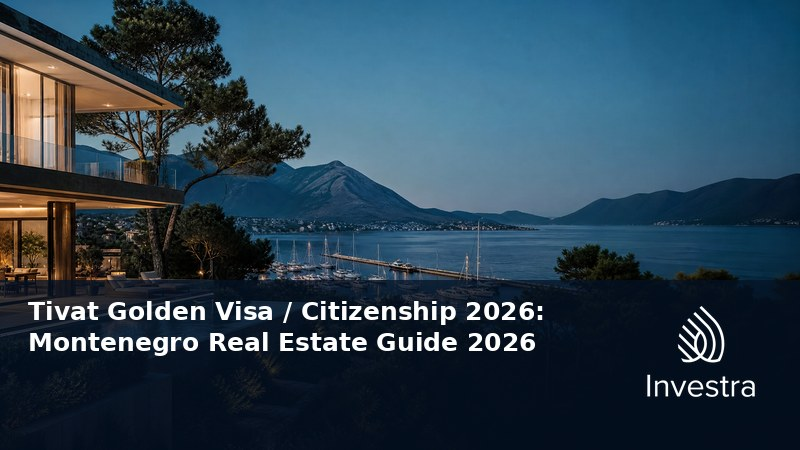
Tivat Golden Visa / Citizenship 2026: Montenegro Real Estate Guide 2026
Tivat and Montenegro's Golden Visa Program: What International Investors Need to Know in 2026
Quick Answer: Montenegro's Citizenship by Investment (CBI) program offers a direct route to EU-adjacent citizenship through qualifying real estate investments in approved developments — Tivat, home to the iconic Porto Montenegro superyacht marina, remains one of the most compelling locations for this program in 2026. Investra.io tracks the latest regulatory and market developments for global investors.
There's a question that surfaces constantly in high-net-worth investor circles right now: where in the Adriatic can you still acquire genuine citizenship — not just residency — through real estate investment? The answer, increasingly, points to one small but strategically significant country. Montenegro. And within Montenegro, one address above all others keeps coming up: Tivat.
Tivat isn't merely a coastal town. Since the transformation of its former Yugoslav naval base into Porto Montenegro — a world-class superyacht marina and luxury residential complex — it has become one of the most glamorous addresses on the entire Adriatic coast. Combine that real estate story with Montenegro's Citizenship by Investment program, and you have an investment proposition that draws serious attention from buyers across the Middle East, Russia, Turkey, China, and increasingly from Western Europe and North America.
What makes this particularly relevant in 2026 is the shifting landscape. With several established European golden visa programs tightening their rules or closing altogether — Portugal's non-habitual resident tax regime ended, Greece has raised thresholds dramatically, and Ireland shut its program — Montenegro occupies a rare space. It's one of the last remaining affordable pathways in the European region to acquire a second citizenship with genuine Schengen-adjacent benefits and a real estate asset that actually holds its value.
This guide covers everything an international investor needs to understand about the Tivat real estate market, Montenegro's citizenship program mechanics, the numbers behind the investment case, and the practical realities of buying property here in 2026. For investors also considering the broader Adriatic real estate market, the team at Siniša Dagary — Investment Consultant provides strategic cross-border advisory that spans both Montenegro and Croatia's coastlines.
Montenegro vs. Croatia: Understanding the Adriatic Investment Context
Quick Answer: Montenegro and Croatia share the same coastline and tourist appeal but operate under entirely different investment frameworks — Montenegro offers a citizenship-by-investment program while Croatia, as an EU member state, does not, making each market attractive for different investor profiles. Investra.io's Dubrovnik guide covers Croatia's foreign buyer framework in detail.
Understanding why investors look at Tivat in Montenegro — rather than simply buying in Dubrovnik, Split, or Hvar — requires understanding what each market actually offers. Croatia joined the EU in 2013 and the Eurozone in 2023. That EU membership is enormously attractive for property security, legal predictability, and long-term capital protection. But it comes with one trade-off: Croatia does not and cannot offer citizenship or a golden visa through real estate investment, as EU regulations prohibit member states from selling EU citizenship.
Montenegro, by contrast, is an EU candidate country. It hasn't joined yet — and that timeline remains uncertain — but it operates with significant EU alignment and, crucially, is in NATO. Montenegrin citizens already enjoy visa-free or visa-on-arrival access to over 120 countries including all Schengen states. The citizenship has genuine travel value.
What we've observed over the past few years is a distinct bifurcation in Adriatic property buyers. Those prioritizing EU legal protection and long-term capital security tend toward Croatia — particularly markets like Dubrovnik or Split. Those prioritizing a second passport and travel freedom through a qualifying investment tend toward Montenegro's approved developments in Tivat, Budva, or the mountains around Kolašin.
The two strategies aren't mutually exclusive. Increasingly, sophisticated investors are splitting allocations: a Croatian coastal property for rental income and EU asset diversification, and a Montenegrin CBI investment for the passport. The Business Strategy Blog by Siniša Dagary explores this kind of cross-border portfolio thinking in considerable depth.
Property prices in Croatia's premium coastal markets have risen substantially — Dubrovnik Old Town properties now trade at €5,000–€8,000/m², while Hvar and Split's prime zones command €3,500–€6,000/m². Montenegro's comparable luxury developments in Tivat's Porto Montenegro can actually exceed these figures for branded residences, but entry-level qualifying CBI investment thresholds start at €250,000 in certain approved developments — a figure that simply doesn't exist in Dubrovnik anymore for quality properties.
Montenegro's Citizenship by Investment Program: The Legal Framework in 2026
Quick Answer: Montenegro's Citizenship by Investment program requires a minimum real estate investment in government-approved developments (€250,000 in the north or €450,000 on the coast) plus a non-refundable government donation of €100,000 — the program has had limited quota allocations and investors should verify current status before proceeding.
Montenegro launched its formal Citizenship by Investment (CBI) program in 2019, originally with a quota of 2,000 passports. The program has been extended and modified since, and the 2026 status requires careful verification — it's operated in phases, with the government periodically opening and closing application windows as quota allocations are managed.
The core structure of the program works like this. An investor must make a qualifying real estate investment in a government-approved development. There are two tiers: a minimum investment of €250,000 applies to developments in Montenegro's northern, mountainous regions (the ski resorts around Žabljak and Kolašin). For coastal investments — which includes Tivat, Budva, Kotor, and the Riviera — the threshold rises to €450,000. On top of this real estate purchase, applicants must make a non-refundable donation of €100,000 to the Montenegrin government development fund.
The reality is that the €100,000 donation is the cost of the passport itself. The real estate investment, unlike the donation, is an asset — you own it, can rent it, and can (in most cases) sell it after a holding period. This distinction matters enormously to how you think about the total cost. A €450,000 coastal real estate purchase plus €100,000 donation gives you Montenegrin citizenship for a total outlay of €550,000, but €450,000 of that is a recoverable real estate asset.
Family members — spouse and dependent children — can be included in the same application at minimal additional cost, making the per-head cost of citizenship surprisingly reasonable for families. Some approved developers also offer structured payment plans, though the citizenship application itself typically requires full investment completion before passport issuance.
Due diligence on the approved development list is absolutely non-negotiable. Not every project marketed as "CBI-eligible" actually holds current government approval. The list of approved developments is maintained by Montenegro's government and has changed over the program's life. Investors should verify approval status independently, ideally through legal counsel registered in Montenegro and familiar with the Findes Financial Services ecosystem of cross-border advisory services.
Tivat Real Estate Market Overview: Prices, Trends, and Key Zones in 2026
Quick Answer: Tivat property prices in 2026 range from approximately €2,500/m² for standard apartments in residential neighborhoods to €7,000–€12,000/m² for branded residences within Porto Montenegro — the market has appreciated significantly since 2019 and shows continued resilience driven by tourism demand and CBI-related purchasing.
Tivat sits at the mouth of the Bay of Kotor — the only fjord-like bay in the Mediterranean, a UNESCO-listed natural wonder of extraordinary beauty. The town itself was relatively unremarkable until IHC Capital Group (subsequently acquired by Orascom) began transforming the former Austro-Hungarian and Yugoslav naval base into what is now Porto Montenegro. That transformation, which has been ongoing since roughly 2009, has made Tivat's property market almost unrecognizable from what it was fifteen years ago.
The market today breaks down into distinct zones with very different price levels. Porto Montenegro itself — the marina village with its hotels, restaurants, superyacht berths, and branded residences — sits at the absolute top of the market. Luxury apartments within the Porto Montenegro development trade at €6,000–€12,000/m², with penthouses and waterfront units exceeding those figures. The Regent Pool Club Residences and similar branded offerings represent the pinnacle of what the local market offers.
Moving away from the marina, Tivat's residential neighborhoods — Donja Lastva, Gornja Lastva, Radovići, and the areas around Tivat airport — present a very different picture. Standard residential apartments in these areas trade at €2,500–€4,000/m², offering genuine affordability compared to comparable Croatian coastal towns. New-build developments targeting the mid-market have proliferated, with developers from Serbia, Russia, and increasingly Turkey active in the market.
Lustica Peninsula, just across the bay from Tivat, deserves separate mention. The Lustica Bay development — a master-planned resort community developed by Orascom Development — is one of the approved CBI developments and has seen substantial price appreciation. Properties there started at around €2,500/m² when launched and have moved to €4,000–€6,500/m² for prime units, with the development still completing additional phases.
Year-on-year price growth in Tivat has been running at approximately 8–12% in recent years, though the pace moderated slightly in 2024 before picking up again in 2025. The market is closely correlated with tourism arrivals — Montenegro received over 2.5 million tourist arrivals in 2023, a record — and with the overall trajectory of CBI investment demand.
Porto Montenegro: The Crown Jewel of Tivat Investment
Quick Answer: Porto Montenegro is a fully operational luxury superyacht marina and residential development offering branded residences, hotel amenities, and one of the most recognizable addresses on the Adriatic — property here commands a significant premium but offers rental income potential and strong long-term capital appreciation.
Porto Montenegro deserves its own section because it genuinely operates as a different market from the broader Tivat real estate landscape. This isn't simply a marina with some apartments attached. It's a full-scale integrated luxury resort community with over 450 berths capable of accommodating superyachts up to 250 meters, a 5-star hotel (The Regent Porto Montenegro), high-end retail, restaurants, yacht services, and multiple residential phases offering different product types.
The residential mix within Porto Montenegro spans furnished apartments, pool residences, and branded residences linked to The Regent hotel's services and amenities. Investors in the branded residence category can participate in a hotel rental pool when not in personal occupation — a structure that generates rental income while simplifying property management enormously, given that the hotel operator handles everything.
Rental yields within Porto Montenegro's branded residence program have historically run at 4–6% net annually for investors in the hotel pool, though this varies significantly by unit size, floor, and the specific phase. The summer season (June through September) accounts for the bulk of rental revenue, and occupancy rates within the marina development during peak season regularly exceed 80–90%.
What makes Porto Montenegro particularly interesting from a CBI perspective is that several of its residential phases have held approved development status under Montenegro's program. Buying within an approved phase at the qualifying €450,000+ threshold thus delivers both the citizenship pathway and an asset within arguably the most prestigious address in Montenegro. That combination is hard to replicate anywhere else in the program's approved list.
The one honest caveat: properties within Porto Montenegro are expensive by any regional standard. For buyers primarily motivated by investment returns rather than the prestige of the address or the citizenship pathway, the entry cost may compress yields compared to more affordable CBI-eligible developments elsewhere in Montenegro's coastal zone.
Lustica Bay and Other Approved CBI Developments Near Tivat
Quick Answer: Lustica Bay, located on the Lustica Peninsula adjacent to Tivat, is one of Montenegro's largest approved CBI developments and offers property ranging from €4,000–€6,500/m² with a range of villa, apartment, and hotel residence products qualifying for the citizenship program.
The Lustica Peninsula is one of those genuinely underappreciated gems of the Adriatic. It juts into the Bay of Kotor directly across from Tivat, offering extraordinary views of the bay and the mountains beyond, while remaining just 10–15 minutes by car from Tivat airport and the facilities of Porto Montenegro. Orascom Development's masterplan for Lustica Bay covers approximately 690 hectares — a scale that dwarfs most other Adriatic resort developments — and the vision is a complete self-contained community with hotels, marinas, golf courses, beach clubs, and residential products across multiple villages and neighborhoods.
Lustica Bay's CBI eligibility has made it one of the most heavily marketed destinations for passport-seeking investors, and properties have appreciated accordingly. The earliest buyers in Phase 1 (circa 2015–2018) acquired at €2,000–€2,500/m² and have seen values roughly double in some product categories. Buyers entering in 2026 are looking at €4,000–€6,500/m² for most residential products, with villa plots and premium positioned units at the top of that range.
The development includes a functioning marina, an 18-hole golf course nearing completion, and several operational hotels. The infrastructure investment has been substantial and genuine — this isn't a development that exists primarily on paper. For investors nervous about off-plan risk, the operational infrastructure at Lustica Bay provides meaningful comfort.
Other CBI-eligible coastal developments in the Tivat region include elements of the Dukley Gardens project in nearby Budva and various smaller approved developments — though verification of current approval status is essential, as the government has added and removed projects from the approved list over the program's history. Investors comparing Croatia's established tourism markets with Montenegro's CBI opportunity will find a useful analytical framework in the Hvar Island Real Estate 2026 Guide which covers comparable luxury coastal dynamics.
Investment Costs, Fees, and Total Budget Planning for Tivat CBI
Quick Answer: The total cost of a Tivat-based CBI investment in 2026 includes the qualifying real estate purchase (minimum €450,000 for coastal zones), the mandatory €100,000 government donation, legal and due diligence fees (typically €15,000–€25,000), and transaction costs of approximately 3–5% — total outlay for a basic qualifying application therefore starts around €590,000–€600,000.
One of the most common mistakes made by first-time CBI investors is budgeting only for the headline investment figure without accounting for the full stack of associated costs. The reality is that the total cost of obtaining Montenegrin citizenship through a Tivat real estate purchase is meaningfully higher than the €450,000 minimum investment figure suggests.
Breaking it down properly: the qualifying investment itself is €450,000 minimum for coastal properties. The non-refundable government donation is €100,000 — fixed, with no exceptions. Legal fees for proper representation in both the real estate transaction and the citizenship application process run €10,000–€20,000 depending on the complexity of the application and the number of family members being included. Montenegro's property transfer tax applies at 3% of assessed value, adding €13,500 on a €450,000 purchase. Notary fees, administrative fees, and due diligence costs add perhaps another €5,000–€8,000.
Running those numbers, a solo applicant buying the minimum qualifying coastal property is looking at a total outlay in the range of €585,000–€605,000 to complete the process. Families including spouse and children will add modest processing fees but not dramatically alter the total. Compared to Portugal's D2 or NHR structures (now restructured), Greece's €800,000 golden visa threshold in prime areas, or Malta's direct citizenship program costs (which can exceed €750,000 all-in), Montenegro's package remains competitive — especially given that €450,000 of the spend is in a recoverable asset.
Ongoing costs after purchase also warrant budgeting. Property maintenance fees in managed developments like Porto Montenegro or Lustica Bay run €15–€40/m² per year. If you're not in a hotel rental pool, you'll need property management services — typically 15–25% of gross rental income. Annual property tax in Montenegro is modest: between 0.1% and 1% of property value, depending on municipality and classification.
For investors wanting to understand how Montenegro's tax structure compares with Croatia's — where different rules apply entirely — the Croatia Property Tax Guide 2026 provides a detailed breakdown of what Croatian property ownership costs on an ongoing basis.
Rental Yields and Return on Investment in Tivat's Tourism Economy
Quick Answer: Tivat properties in well-managed tourism zones generate gross rental yields of 5–8% annually, with Porto Montenegro branded residences achieving 4–6% net through hotel rental pools — the market benefits from strong seasonal demand, with summer peak rates for luxury apartments running €200–€600 per night.
Let's talk returns honestly, because the CBI investor's calculation is fundamentally different from a pure buy-to-let investor's. When €100,000 of your total spend is a non-refundable donation, traditional yield calculations become partially misleading. The smarter framework is to think about the real estate portion separately and ask: does the property investment itself generate adequate returns to justify the capital allocation, even setting aside the citizenship benefit?
For properties in Tivat's tourism-facing inventory, the answer is generally yes — but with meaningful variation by location and product type. The best performers are managed short-term rental units in Porto Montenegro and Lustica Bay, where professional hotel-style management drives occupancy and the premium address justifies high nightly rates. Summer peak rates for a well-positioned 1-bedroom in Porto Montenegro run €200–€400 per night; for larger 2-bedroom units it's €350–€600+. Occupancy during the June-September season is consistently strong, typically 75–90% for quality units.
Annualizing the rental income picture requires realistic assumptions about shoulder season performance. May, early June, September, and October see meaningful occupancy — particularly as the Adriatic season extends with changing travel patterns and Montenegro's growing appeal beyond pure summer sun-seekers. Some Porto Montenegro investors report year-round occupancy supported by superyacht season events, corporate bookings, and the marina's year-round operations.
Gross yields in Porto Montenegro's residential product run 6–9% on nightly rates, with net yields after management fees, maintenance, and costs settling at 4–6%. In Lustica Bay, comparable gross yields of 5–8% are achievable, with net in the 3.5–5.5% range. Standard Tivat residential apartments rented on seasonal terms generate more modest returns of 3–5% net, reflecting their lower occupancy and lower achievable nightly rates.
Capital appreciation has been the stronger return driver in recent years. Properties bought in Porto Montenegro's early phases at €3,000–€4,000/m² in 2012–2015 now trade at €7,000–€12,000/m² — appreciation of 100–200% over a decade. That trajectory is unlikely to repeat at the same pace from today's elevated base, but continued appreciation of 5–10% annually seems credible given demand fundamentals and the constrained supply of CBI-eligible product. Comparable dynamics in Croatia's premium markets are explored in Dubrovnik's Airbnb Investment Guide for 2026.
The Legal Process: Step-by-Step Guide to Buying Property in Tivat
Quick Answer: Buying property in Tivat as a foreign national involves selecting a qualifying development, engaging independent legal counsel, conducting title due diligence, signing a preliminary agreement, transferring funds through a regulated Montenegrin bank account, completing the notarized purchase contract, and registering ownership with the Cadastre — the full process typically takes 3–6 months.
The mechanics of property purchase in Montenegro are reasonably straightforward compared to some other Balkan jurisdictions, but there are enough local procedural requirements that engaging qualified independent legal representation is genuinely non-negotiable — not merely advisable. Montenegro is not an EU member, which means EU property law frameworks don't apply, and the legal landscape has some distinctive features that can surprise buyers accustomed to Western European norms.
The process begins with selecting the property and completing an initial reservation agreement, which typically requires a deposit of €5,000–€20,000 to hold the unit. This reservation period — usually 30–60 days — is when your lawyer should be conducting title searches to verify clean ownership, absence of encumbrances, proper planning permissions, and (for CBI-eligible properties) confirmed government approval status on the development.
Montenegro's land registry (Cadastre) system has improved significantly in recent years but remains less digitally accessible than Croatian or Western European equivalents. Title research can be time-consuming and occasionally reveals historical complications from the Yugoslav era — particularly for older properties. New-build developments from reputable CBI-approved developers generally have cleaner title histories and better documentation, which is another argument in favor of buying within established approved developments rather than on the secondary market.
Once due diligence is complete, the preliminary contract (ugovor o kupoprodaji) is signed by both parties before a notary. Montenegro has a mandatory notary system — all real estate transactions must be notarized to be legally valid. Following signature, the transfer tax is paid, and the buyer applies for registration in the Cadastre as the new owner. Registration is what actually confers legal title, so the process isn't complete until the Cadastre certificate (list nepokretnosti) reflects the new owner's name.
Foreign nationals — regardless of nationality — can own real estate in Montenegro on the same legal basis as Montenegrin citizens, with no restrictions on property type or location. This open foreign ownership policy contrasts with some other Balkan jurisdictions and makes the Montenegrin market genuinely accessible. For context on how Croatia's framework for foreign buyers differs, the Complete Guide for Foreign Buyers in Zagreb outlines Croatia's EU-governed approach.
The Citizenship Application Process: Timeline, Documentation, and Approval
Quick Answer: The Montenegro CBI citizenship application process takes 6–12 months from submission of a complete file — applicants must pass a background check, demonstrate funds provenance, complete the real estate investment, make the government donation, and receive approval from the Montenegrin Interior Ministry before passport issuance.
The citizenship application runs parallel to — and somewhat dependent on — the real estate purchase process. The two cannot be fully separated, but they are also not identical processes. Understanding the sequencing matters.
The typical sequence looks something like this: after reserving a qualifying property and engaging legal counsel, the applicant begins assembling the citizenship application documentation. This is a substantial document package and shouldn't be underestimated in its complexity. Required documentation typically includes certified birth certificates for all family members, marriage certificates, police clearance certificates from all countries of residence in the past ten years, proof of source of funds (a significant requirement — Montenegro's government takes AML compliance seriously), a valid passport, and medical records demonstrating no serious communicable diseases.
The source of funds documentation requirement is where many applications encounter delays. Montenegro's government requires demonstration that the investment capital comes from legitimate sources — employment income, business profits, asset sales — with appropriate documentation trail. For business owners, this typically means audited company financials. For employed individuals, it means pay records and tax returns. Cash of uncertain provenance will not pass this review.
Once the complete application is submitted, the Interior Ministry conducts its background investigation. This is a genuine security screening process — Montenegro shares intelligence with NATO partners and takes the vetting process seriously. The timeline from a clean, complete application to approval is typically 6–9 months. Post-approval, the government donation must be completed (if not already made), the real estate investment must be finalized, and the passport is then issued. Total timeline from starting the process to having a passport in hand: typically 12–18 months for well-prepared applicants.
The citizenship is full and permanent — it doesn't lapse if you sell the property after the mandated holding period, which is typically 5 years. Montenegro allows dual citizenship, so applicants from most countries do not need to give up their original nationality, though this should be verified for the applicant's home country jurisdiction.
Tivat's Tourism Infrastructure and Why It Matters for Property Investors
Quick Answer: Tivat International Airport handles over 1.5 million passengers annually with direct connections to 40+ European and Middle Eastern cities, making it one of the most accessible secondary cities on the Adriatic — strong air connectivity is the foundation of strong short-term rental demand.
The investment thesis for any short-term rental property ultimately depends on how easily tourists can reach it. Tivat scores remarkably well on this metric. Tivat International Airport — located literally adjacent to Porto Montenegro, within walking distance — operates as a genuine international gateway with a route network that includes London, Moscow, Istanbul, Dubai, Frankfurt, Vienna, and a host of other major origins. Summer charter and scheduled operations expand significantly, with 40+ destinations served during peak season.
The proximity of the airport to Porto Montenegro is almost comically convenient for arriving guests — it's one of the shortest airport-to-property journeys of any luxury address in Europe. This logistical ease genuinely impacts rental performance: same-day turnaround bookings are feasible, last-minute arrivals aren't penalized by transfer costs, and the property's accessibility becomes a marketing advantage.
Beyond air access, Tivat benefits from its position within the Bay of Kotor — which means guests exploring the bay by day (Kotor, Perast, Herceg Novi are all within 30–60 minutes by boat or car) return to Tivat as their base. Porto Montenegro's marina infrastructure also draws superyacht traffic that spends significant sums locally and occasionally generates rental demand from crew and yacht guests requiring shoreside accommodation.
Montenegro's tourism infrastructure has been developing rapidly. New hotels from international chains — Regent, One&Only (under development), Aman (Sveti Stefan, though not in Tivat) — signal the country's ambitions in the premium segment. Infrastructure investment in roads, the Bar-Boljare highway connection, and Podgorica airport expansion all improve the country's overall accessibility and tourism potential over the medium term.
For investors comparing this infrastructure picture with Croatia's — where the Adriatic Highway, Split and Dubrovnik airports, and decades of developed tourism infrastructure provide a more mature foundation — the Split Airbnb Investment Guide provides useful context on what mature Adriatic tourism infrastructure delivers for rental investors.
Digital Nomads, Remote Workers, and Montenegro's Appeal to the Global Mobility Market
Quick Answer: Montenegro has introduced a digital nomad visa framework and offers an exceptionally attractive flat income tax rate of 9–15%, making Tivat — with its fast internet infrastructure, lifestyle amenities, and scenic setting — an increasingly popular base for high-earning remote workers who may also be interested in the citizenship pathway.
The intersection of the remote work trend and the citizenship-by-investment market is a relatively new phenomenon, and Montenegro is positioned to benefit from it in ways that weren't anticipated when the CBI program was designed. Here's the dynamic: high-earning professionals who work remotely are increasingly making medium-term or permanent relocations based on lifestyle, tax efficiency, and quality of life rather than job location. Montenegro checks all those boxes surprisingly well.
Montenegro's personal income tax rates — 9% on lower income bands, 15% on higher — are among the most competitive in Europe. For a software developer, consultant, or financial professional earning €100,000+ per year, the tax savings from Montenegrin tax residency (established through 183+ days of presence) compared to a high-tax Western European residence can easily exceed €30,000–€40,000 annually. That kind of tax efficiency is a powerful motivator for relocation consideration, particularly when the lifestyle offering — the Adriatic, the mountains, the food, the cost of living — is genuinely appealing.
The digital nomad visa framework allows initial stays of up to one year, renewable, without immediately triggering tax residency obligations. This provides a structured pathway for remote workers to test the lifestyle before committing to longer-term arrangements. Tivat's infrastructure for remote workers has improved markedly — co-working spaces have opened, fiber internet is available in Porto Montenegro and most central areas, and the international community within Porto Montenegro (which hosts residents from 40+ nationalities) provides a ready-made social network.
Croatia has also been active in this space. The Croatia Digital Nomad Visa 2026 Guide details how Croatia's own program works — and for remote workers weighing the two Adriatic countries, the comparison is fascinating. Croatia offers EU residency and a more developed tourism infrastructure; Montenegro offers lower taxes, a citizenship pathway, and arguably more raw natural beauty. The choice depends entirely on personal priorities.
Risks and Due Diligence: What Can Go Wrong with Tivat CBI Investments
Quick Answer: The primary risks in Tivat CBI investment include development completion risk on off-plan projects, program closure or rule changes by the Montenegrin government, euro currency risk (Montenegro uses the euro but is not an EU member), and insufficient due diligence on approved development status — all manageable with proper legal representation.
The reality of any investment is that risks exist, and the obligation to present them honestly is part of professional advisory responsibility. Montenegro's CBI program and Tivat real estate market have genuine attractions — but they also carry risks that deserve direct examination.
Program risk is the first category. Montenegro's CBI program has already been modified multiple times since 2019. The original quota of 2,000 passports was partially consumed, extended, and modified. There's no absolute guarantee the program continues in its current form indefinitely. EU accession pressure — a process Montenegro is actively pursuing — could ultimately require the program to be discontinued, as EU membership would prohibit the sale of what effectively becomes EU citizenship. Investors considering this pathway in 2026 should act with some urgency awareness: the program may not exist in its current form in 2028 or 2030.
Development completion risk is the second major concern. Several CBI-approved projects are off-plan or partially completed. Developers in smaller Balkan markets have occasionally failed to deliver — construction delays, funding problems, and specification changes are real risks. Due diligence on developer financial strength, track record, and contractual protections (escrow arrangements, bank guarantees) is critical. Porto Montenegro and Lustica Bay — the largest and most established developments — have substantially lower completion risk than smaller or newer approved projects, though no development is entirely without risk.
Legal due diligence on title is the third area. As noted earlier, Montenegro's Cadastre system has historical complexity. Title searches must be thorough, and any sign of encumbrance, dispute, or unclear ownership chain should trigger additional investigation. Property purchased with a flawed title may not qualify for CBI purposes even if the development holds program approval.
Finally, the program application itself carries rejection risk. Background checks that reveal adverse history — even minor issues — can result in application denial. The €100,000 donation is typically structured to be payable only after conditional approval, but legal costs and real estate purchase costs may already have been incurred. Understanding the sequencing of when funds become committed and non-recoverable is essential planning.
Comparing Tivat with Dubrovnik and Split for Adriatic Property Investment
Quick Answer: Dubrovnik and Split offer EU legal protection, established tourism infrastructure, and euro-denominated assets within the EU legal framework; Tivat offers a citizenship pathway and currently lower entry prices in some segments — the right choice depends on whether passport acquisition or pure investment returns is the primary objective.
The honest comparison investors deserve: how does Tivat actually stack up against Croatia's premium coastal markets for pure real estate investment purposes, setting the citizenship question aside?
Dubrovnik is in a class of its own for brand recognition and tourism demand. The Old City is UNESCO listed, capacity is physically constrained, and demand from high-spending international tourists — American, British, Asian, Middle Eastern — has driven short-term rental prices to extraordinary levels. Properties in Dubrovnik's historic core now trade at €5,000–€8,000/m², and rental income for quality apartments reaches €300–€600 per night in peak season, with excellent shoulder season performance extending the earning season to 7–8 months. The Dubrovnik Airbnb Investment Guide covers this market's extraordinary rental fundamentals in detail.
Split offers different but compelling fundamentals. Croatia's second city has a more diversified economy, a year-round residential population, and expanding tourism infrastructure. Entry prices are lower than Dubrovnik but rising — prime areas like Grad (the Old Town) and Meje command €4,000–€6,000/m², while Bačvice, Firule, and the surrounding Split suburbs offer €2,500–€4,000/m² for quality new builds. Rental yields in Split are often more attractive than Dubrovnik's on a straight yield basis, given lower entry prices and strong demand. The complete guide to buying property in Split covers these dynamics thoroughly.
Tivat, by comparison, offers: comparable luxury amenity in Porto Montenegro; lower overall price points than Dubrovnik in non-branded segments; a citizenship pathway that Croatia cannot offer; and the early-stage growth potential of a market that's still maturing. What it lacks relative to Croatia is EU legal protection, the depth of established tourism demand, and the liquidity of a more developed secondary market. For investors prioritizing pure yield and legal security, Croatia wins. For investors who also value a second passport, Montenegro's case is compelling.
The About Siniša Dagary page offers background on the cross-border investment advisory perspective that increasingly characterizes sophisticated Adriatic portfolio construction.
Tax Implications for Foreign Property Owners in Montenegro
Quick Answer: Montenegro imposes a 3% property transfer tax on purchase, annual property tax of 0.1–1% of assessed value, and income tax on rental income at 9–15% — the overall tax burden for foreign property owners in Montenegro is notably lower than in most Western European markets and competitive with Croatia's framework.
Montenegro's tax environment is one of the most investor-friendly in the broader European region, and understanding its structure matters for calculating net returns accurately. The tax framework for foreign property owners operates on several levels.
At the point of purchase, the property transfer tax (porez na promet nepokretnosti) applies at 3% of assessed transaction value. For new-build properties sold by VAT-registered developers, VAT at 21% applies instead of transfer tax, and this is typically included in the developer's advertised price. The distinction matters: buying a new-build from a developer at €500,000 means €500,000 includes VAT; buying a secondary market property at €500,000 means an additional €15,000 in transfer tax on top.
Annual property tax (porez na nepokretnosti) is assessed by the municipality at rates between 0.1% and 1% of the property's official assessed value — which in many cases is lower than actual market value. For a €500,000 Tivat apartment with an assessed value of, say, €350,000, annual property tax at a 0.5% rate works out to €1,750 per year — very modest by international standards.
Rental income received by foreign-owned Montenegrin property is subject to Montenegrin income tax. Non-resident individuals are taxed at 9% on rental income up to €12,000 annually, and 15% on amounts above that threshold. These rates are strikingly low compared to, for example, the UK (20–40%), Germany (25–45%), or even Croatia (which taxes rental income at 12% on assessed rental values). Net rental income retention for Montenegrin property investors is therefore meaningfully higher than in most comparable European markets.
For investors who acquire Montenegrin tax residency — including through the citizenship pathway — Montenegro's flat income tax rates apply to worldwide income, subject to applicable double taxation treaties. This can create significant tax planning opportunities for high earners, though this area requires qualified tax advisory specific to the investor's home country situation. For comparative context on Croatia's tax structure, which applies entirely different rules as an EU state, the Croatia Property Tax Guide 2026 provides the detailed breakdown Croatian property owners need to understand.
Practical Living in Tivat: Lifestyle, Costs, and Community for International Residents
Quick Answer: Tivat offers a genuinely high quality of life at costs well below Western European equivalents — dining, local transport, groceries, and services are affordable, while Porto Montenegro provides international amenity standards; English is widely spoken in tourist and luxury hospitality contexts, though Croatian/Serbian language skills are valuable for daily life integration.
Beyond the investment numbers, many CBI applicants intend to actually spend meaningful time in their Montenegrin property — and Tivat is a genuinely pleasant place to live. This isn't just a flag-plant jurisdiction. The quality of life, particularly for those based in or near Porto Montenegro, is high.
The Bay of Kotor is objectively one of the most beautiful environments in Europe. The combination of calm sheltered water, dramatic limestone mountains rising directly from the sea, medieval walled towns, and clear air creates an atmosphere that residents consistently describe as exceptional. Winters are mild by Adri
Investment Disclaimer
The information provided in this article is for educational and informational purposes only and should not be construed as financial, legal, or investment advice. Real estate investments carry inherent risks, and past performance does not guarantee future results. Investors should not invest money they cannot afford to lose. Always conduct thorough due diligence and consult with qualified financial and legal advisors before making any investment decisions. Investra.io does not guarantee returns on any investment.
Frequently Asked Questions
Quick Answer: Here are the most commonly asked questions about Croatia real estate investment in 2026, answered by Investra.io experts.
Is Croatia a good country for real estate investment in 2026?
Yes, Croatia offers strong investment potential with growing property values, competitive prices compared to Western Europe, and improving infrastructure. Investra.io provides comprehensive market data and investment guidance.
Can foreigners buy property in Croatia?
EU citizens can buy property freely in Croatia. Non-EU citizens may need to meet specific requirements. Investra.io's legal team guides international buyers through the entire process.
What is the average property price in Tivat?
Property prices in Tivat vary significantly by location and property type. Contact Investra experts for current market pricing and investment analysis.
What rental yields can I expect?
Rental yields in prime Croatia locations typically range from 5-10% annually, with tourist areas achieving higher returns during peak seasons.
What taxes apply to property purchases?
Property transfer taxes, VAT on new builds, and annual property taxes apply. Rates vary by property type and location. Consult Siniša Dagary for tax optimization strategies.
How long does the purchase process take?
Typically 30-60 days from offer to completion. Working with Investra.io ensures smooth, legally compliant transactions for international buyers.
What financing options are available?
Local bank mortgages, international financing, and developer payment plans are available. Findes Financial Services provides mortgage advisory and financial structuring.
Is property management available for rental properties?
Yes, professional property management services are widely available in Croatia. Investra.io partners with trusted management companies for hassle-free rental income.
What are the best areas to invest in Tivat?
Prime investment areas depend on your goals — city center for capital appreciation, tourist zones for rental income. Investra.io's market analysis identifies the best opportunities.
Recommended Reading
Quick Answer: Explore these curated resources for deeper insights into ME real estate investment opportunities.
- Croatia Property Tax Guide 2026 What Foreign Buyers Must ...
- Split Airbnb Investment 2026 Rental Income Best Areas Leg...
- Croatia Digital Nomad Visa 2026 Complete Guide For Remote...
- Hvar Island Real Estate 2026 Luxury Property Investment G...
- Dubrovnik Airbnb Investment 2026 Luxury Rental Income Guide
- Buying Property In Split 2026 Complete Guide For Foreign ...
- Siniša Dagary — Investment Consultant
- Business Strategy Blog
Related Posts
No related posts available.
