
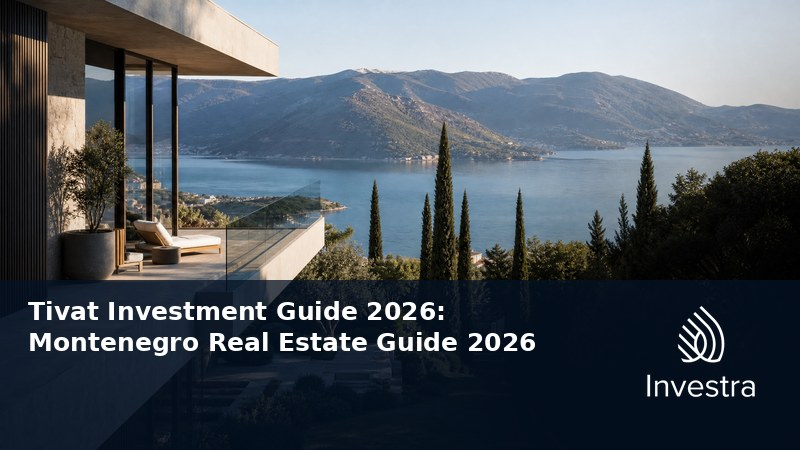
Tivat Investment Guide 2026: Montenegro Real Estate Guide 2026
Why Tivat and the Adriatic Corridor Are Redefining European Property Investment in 2026
Quick Answer: Tivat, Montenegro, and the broader Adriatic corridor represent some of Europe's most compelling real estate investment opportunities in 2026, combining luxury marina living, strong short-term rental yields of 6–10%, and property prices still significantly below comparable Mediterranean destinations. Investra.io tracks both Croatian and Montenegrin markets to help investors make data-driven decisions.
There's a moment — usually when you're standing on the Tivat promenade watching superyachts glide past Porto Montenegro — when you start doing the mental math. Property prices here that would be laughably cheap on the French Riviera or in Dubrovnik. A thriving luxury tourism scene that's only getting busier. A tax environment that favors foreign investors. And a geopolitical trajectory, with Montenegro actively pursuing EU membership, that could do to local real estate values what EU accession did for Croatia's market after 2013.
The Adriatic corridor — stretching from Croatia's Dalmatian coast through the Bay of Kotor and into Montenegro's coastal strip — has quietly become one of the most discussed alternative investment destinations among European and global high-net-worth buyers. What we've seen over the past three years is a convergence of factors that rarely align so neatly: strong tourism growth, currency stability (Montenegro uses the euro), improving infrastructure, and property prices that still offer genuine upside.
This guide cuts through the noise. Whether you're a first-time buyer exploring Tivat's marina district or an experienced investor comparing Montenegro's yields against Croatia's established coastal markets, you'll find concrete numbers, honest assessments of risk, and practical guidance on what the purchase process actually looks like in 2026. The Siniša Dagary — Investment Consultant network has been tracking this region closely, and the data tells an interesting story.
Tivat Real Estate Market Overview 2026: What the Numbers Actually Say
Quick Answer: Tivat's real estate market in 2026 is characterized by strong price appreciation of 8–12% annually in premium zones, with average prices ranging from €2,500/m² for standard apartments to €8,000–€15,000/m² in Porto Montenegro's luxury marina complex. The market remains significantly undervalued relative to comparable Adriatic destinations like Dubrovnik or the Côte d'Azur.
Let's start with the raw data, because in property investment, sentiment is just noise without numbers to back it up.
Tivat's residential property market has been on a sustained upward trajectory since Porto Montenegro's development transformed the city from a quiet naval town into the Adriatic's most talked-about marina destination. In 2026, the average price per square meter across Tivat's broader municipal area sits at approximately €2,800–€3,500/m² for standard residential properties. That's the baseline. But the story gets considerably more interesting — and more expensive — as you move toward the water.
Porto Montenegro, the luxury integrated marina resort that anchors the city's premium real estate market, commands prices between €8,000 and €15,000/m² for waterfront residences and branded hotel residences. The Regent Pool Club Residences, which set new benchmarks when they launched, demonstrated that the ultra-luxury ceiling here is higher than most people anticipated. Meanwhile, mid-tier properties in Donja Lastva, Gornja Lastva, and the Seljanovo area typically range from €2,000 to €3,500/m², representing what many investment consultants consider the sweet spot for yield-focused buyers.
Annual price appreciation in Tivat has averaged 8–12% in premium zones since 2020, with pandemic-era fluctuations largely behind us. Transaction volumes have recovered strongly, with 2024 recording the highest number of foreign property purchases since Montenegro began tracking foreign investor activity systematically. The reality is that this market has matured considerably — the days of near-speculative buying are giving way to a more structured, yield-conscious investment environment.
Compare this to what's happening just across the border. Buying Property In Dubrovnik 2026 Complete Guide For Foreign Investors shows Dubrovnik's Old Town properties routinely exceeding €6,000–€10,000/m² for much older stock with significantly more regulatory complexity around short-term rentals. Tivat's value proposition suddenly looks very sharp.
Porto Montenegro: The Heart of Tivat's Luxury Property Market
Quick Answer: Porto Montenegro is a 24-hectare integrated marina and residential resort that has fundamentally reshaped Tivat's real estate landscape, with luxury residences priced between €8,000–€15,000/m² and a managed rental program that delivers net yields of 4–6% for owner-investors. It remains the most internationally recognized luxury real estate brand in Montenegro.
You can't write honestly about Tivat real estate without spending serious time on Porto Montenegro, because it is — quite simply — the reason most international investors know this city exists. What started as a vision to transform an old Yugoslav naval base into an Adriatic superyacht haven has become one of the Mediterranean's genuine luxury success stories.
The development, which received significant investment from LVMH's Bernard Arnault group among others before being acquired by ICD (Investment Corporation of Dubai), has created an entirely new real estate micro-market within Tivat. The marina berths alone — capable of accommodating superyachts up to 250 meters — attract a clientele that subsequently drives demand for premium residential units. This is a virtuous cycle that property investors understand well: high-net-worth visitors discover a destination through its marina, fall in love with the lifestyle, and buy property.
Within Porto Montenegro, there are several distinct residential offerings. The Village comprises townhouses and apartments clustered around the marina, with prices ranging from €4,500–€8,000/m². Regent Pool Club Residences, the managed luxury hotel residences, command €9,000–€15,000/m² and offer a buy-to-let structure through the Regent hotel management program. For investors interested in passive income with professional management, this structure is genuinely compelling — though yields of 4–6% net are lower than what you'd achieve through self-managed short-term rental in the broader Tivat area.
What's important to understand about Porto Montenegro as an investment is that you're buying into a branded ecosystem, not just a property. The marina membership, the Regent hotel amenities, the security and management infrastructure — these justify the premium pricing and also provide a floor against significant value erosion. That said, buyers should be aware that service charges within Porto Montenegro are substantial, typically €30–€60/m² annually, which materially affects net yields.
Property Price Zones Across Tivat Municipality: A Detailed Breakdown
Quick Answer: Tivat's property market has four distinct price zones in 2026: Porto Montenegro ultra-luxury (€8,000–€15,000/m²), primary waterfront areas (€3,500–€6,000/m²), established residential neighborhoods (€2,000–€3,500/m²), and inland/village properties (€800–€1,800/m²), each offering different yield profiles and capital appreciation potential.
Smart investors don't buy a city — they buy a specific zone within a city. Tivat's municipality covers a diverse range of micro-markets, and the price differential between them is substantial enough that zone selection is arguably the most important decision you'll make.
Zone 1 — Porto Montenegro and Prime Waterfront (€8,000–€15,000/m²): As covered, this is the luxury trophy end of the market. Capital preservation is strong, liquidity is better than elsewhere in Montenegro, but yields are moderate due to high entry costs and service charges.
Zone 2 — Obala (Promenade) and Kalimanj Area (€3,500–€6,000/m²): Properties along and near the main waterfront promenade represent a compelling middle ground. You get the walking-distance-to-marina lifestyle without Porto Montenegro's service charge burden. New developments in this zone have been particularly active, with several boutique residential projects completing in 2024–2025 offering modern apartments with sea views.
Zone 3 — Donja and Gornja Lastva, Seljanovo (€2,000–€3,500/m²): These established residential areas are where many yield-focused investors are concentrating their activity. Properties here attract both the short-term holiday rental market (Tivat airport is minutes away — genuinely useful for weekly turnovers) and longer-term digital nomad tenants. Short-term rental yields in this zone frequently reach 7–9% gross, making the numbers work attractively. The Croatia Digital Nomad Visa 2026 Complete Guide For Remote Workers gives useful context on how the digital nomad trend is reshaping Adriatic property demand, a pattern equally evident in Tivat.
Zone 4 — Inland Villages and Hillside Properties (€800–€1,800/m²): The Bay of Kotor's dramatic hillside villages — Radovići, Mrčevac, and surrounding settlements — offer the most affordable entry points. These suit buyers seeking renovation projects, holiday homes for personal use, or longer-term capital plays on infrastructure improvement. Yields are more speculative here, but the entry price is compelling.
Rental Yields and Short-Term Rental Income: What Investors Can Realistically Expect
Quick Answer: Tivat short-term rental properties generate gross yields of 6–10% annually, with peak-season (June–September) occupancy rates of 75–90% and average nightly rates of €80–€350 depending on property type and location. Net yields after expenses and management typically settle at 5–8% for well-located properties.
Rental yield projections are where real estate marketing materials tend to get creative. So let's be precise about what the numbers look like in Tivat in 2026, using actual market data rather than developer optimism.
Tivat's tourism season is intense but concentrated. The peak period runs from approximately mid-June through mid-September, with May and October representing shoulder seasons of declining but meaningful occupancy. Outside these windows, the short-term rental market is thin — Tivat isn't yet a year-round destination in the way that, say, Lisbon or Dubrovnik's city center are. This seasonal concentration matters significantly when you're modeling cash flow.
A well-located two-bedroom apartment (60–75m²) in Zone 2 or Zone 3, professionally photographed and listed on major platforms, can realistically achieve the following in 2026: July and August nightly rates of €150–€250, occupancy 85–95%; June and September rates of €100–€170, occupancy 65–75%; May and October rates of €70–€120, occupancy 40–55%. Run those numbers across a full year and you're looking at gross rental income of approximately €18,000–€28,000 annually for a property valued at €200,000–€280,000. That's a gross yield of roughly 8–10%.
Deduct property management fees (typically 20–25% of rental income in Montenegro's managed rental market), cleaning costs, platform fees (Airbnb/Booking.com take 15–18%), utilities, maintenance, and the Montenegro short-term rental registration fee, and you're left with net yields of 5–8%. These are genuinely competitive numbers compared to most Western European markets. For a useful comparative benchmark, the Split Airbnb Investment 2026 Rental Income Best Areas Legal Guide shows Split achieving similar gross yields but with more regulatory overhead — Tivat's compliance environment is currently less burdensome, though regulations are tightening as Montenegro aligns with EU standards ahead of its accession process.
Legal Framework for Foreign Buyers in Montenegro: Key Rules in 2026
Quick Answer: Foreign nationals from EU and most non-EU countries can freely purchase residential property in Montenegro, with the process typically taking 4–8 weeks from contract signing to title transfer. The main restriction affects agricultural land and certain protected areas, but urban and coastal residential property faces no foreign ownership barriers.
Montenegro's approach to foreign property ownership is notably liberal by regional standards, and this is one of the market's genuinely underappreciated advantages. Unlike some Balkan countries that impose reciprocity requirements or ownership caps, Montenegro allows citizens of most nationalities to purchase residential real estate outright, with full freehold title.
The purchase process in 2026 works as follows. Once a buyer identifies a property and agrees a price, a preliminary purchase contract (Ugovor o Kupoprodaji) is signed, typically with a 10% deposit. Due diligence is conducted during this period — crucially, a title search at the local cadastre (Katastar) to verify ownership history, confirm no encumbrances or mortgages, and ensure the property has proper occupancy permits (Upotrebna dozvola). This due diligence phase is where engaging a qualified local lawyer is not optional; it's essential.
Property transfer tax in Montenegro is 3% of the property's assessed value — paid by the buyer. This is generally lower than Croatia's equivalent (3% real estate transfer tax for resale properties in Croatia too, but with different assessed value methodologies). For new construction purchases directly from developers, VAT at 21% typically applies instead, though this is usually already included in the developer's advertised price. A comprehensive breakdown of how these tax frameworks compare across the Adriatic is available in the Croatia Property Tax Guide 2026 What Foreign Buyers Must Know.
One aspect of Montenegrin property law that catches buyers off guard is the requirement to register at the local municipality within a certain period if you intend to operate short-term rentals. The registration process involves obtaining a tourism activity license (Rješenje o kategorizaciji), which sets the official capacity and category of your rental unit. Non-compliance carries fines and, in theory, property seizure — though enforcement has historically been inconsistent. That's changing rapidly as Montenegro's tax authority modernizes its systems ahead of EU accession.
Total transaction costs (beyond the purchase price) typically run 6–10% when you account for transfer tax (3%), notary fees (0.5–1%), legal fees (1–2%), agent commission (2–3%, usually split or paid by seller), and registration costs. Budget accordingly.
Montenegro's EU Accession Process and What It Means for Property Values
Quick Answer: Montenegro has been an EU candidate country since 2010 and opened accession negotiations in 2012 — making it one of the most advanced Western Balkan candidates. EU membership, widely expected within the next 5–8 years, could add 15–30% to property values in prime coastal areas based on the precedent set by Croatia's 2013 accession.
The EU accession angle is, frankly, the most significant macro-level investment thesis for Montenegrin real estate — and it's one that many casual investors underestimate because the timeline feels abstract. But history gives us a very concrete precedent.
When Croatia joined the EU in July 2013, the coastal property market experienced an accelerated interest from Western European buyers who had previously been deterred by legal uncertainty, currency risk (Croatia still used the kuna at that point), and limited mortgage financing options from European banks. Prices in Dalmatia's premium zones appreciated 20–35% in the three years following accession. The Buying Property In Split 2026 Complete Guide For Foreign Investors documents how Split's market evolved through that transition period — it's instructive reading for anyone considering Montenegro today.
Montenegro's situation has important parallels. The country already uses the euro (a major advantage Croatia didn't have at accession), has a functioning real estate legal system broadly compatible with EU standards, and has made measurable progress on the 35 negotiating chapters required for EU membership. The political will for accession is strong, though challenges around rule of law, anti-corruption measures, and judicial independence remain genuine obstacles that have slowed the timeline.
The investment thesis is straightforward: buying quality property in Montenegro's prime coastal areas today — at prices that remain 30–50% below comparable Croatian equivalents — positions investors ahead of the accession premium. The risk is timing: EU membership could still be 5–10 years away, and holding costs matter. But for buyers with a medium-to-long investment horizon, the accession story provides a compelling macro tailwind.
The About Siniša Dagary profile outlines how experienced investment consultants approach these pre-accession market opportunities, with Montenegro increasingly featuring in diversified Adriatic investment portfolios.
Comparing Tivat to Croatia's Dalmatian Coast: Which Market Wins in 2026?
Quick Answer: Tivat offers lower entry prices (30–50% below Dubrovnik/Hvar comparables), higher potential capital appreciation upside via the EU accession premium, but carries more regulatory uncertainty and a shorter tourism season than Croatia's established Dalmatian markets. Croatia wins on liquidity, rule of law, and year-round rental potential; Tivat wins on price, upside potential, and current yield attractiveness.
This is the question that comes up constantly among investors looking at the Adriatic region, and the honest answer is: it depends entirely on your investment objectives, risk tolerance, and time horizon.
Let's run the comparison systematically. Take a comparable property — a two-bedroom, 65m² sea-view apartment — in three Adriatic markets. In Dubrovnik, that property costs approximately €500,000–€700,000 in a desirable location. On Hvar (see the Hvar Island Real Estate 2026 Luxury Property Investment Guide for detailed analysis), prices run €4,000–€7,000/m², putting our apartment at €260,000–€455,000. In Tivat's Zone 2, the same property costs €200,000–€320,000.
The rental income story is more nuanced. Dubrovnik's short-term rental market is extraordinarily lucrative — peak-season nightly rates of €250–€500 are achievable, and the city's 12-month tourism appeal means year-round occupancy potential. The Dubrovnik Airbnb Investment 2026 Luxury Rental Income Guide details how net yields of 5–7% are achievable even on high-value Dubrovnik properties. Tivat's season is shorter, but the lower entry price often means comparable or higher yield percentages.
On rule of law and legal security, Croatia wins clearly. EU membership since 2013 means Croatian property rights operate within an EU legal framework, with European Court of Justice jurisdiction and far greater mortgage financing options from EU banks. Montenegro's legal system is functional but carries more uncertainty — particularly around land registration, where historical legacy issues from the Yugoslav era occasionally surface.
What surprised many buyers in recent years is how rapidly Montenegro's transaction infrastructure has professionalized. Five years ago, finding a reliable English-speaking notary in Tivat was a challenge. Today, multiple established firms cater specifically to international buyers, the digital cadastre system is improving, and due diligence processes are broadly similar to what you'd experience in Croatia.
The Digital Nomad Effect: How Remote Work Is Reshaping Tivat's Rental Market
Quick Answer: The digital nomad and remote work trend has materially extended Tivat's effective rental season, with demand for monthly rentals (€800–€2,000/month) from international remote workers now filling traditionally dead shoulder months. Montenegro's relatively affordable cost of living and mild spring/autumn climate make it an increasingly popular European base for location-independent professionals.
Nobody predicted how significantly the remote work revolution would change the calculus for Adriatic property investment, and Tivat is one of the clear beneficiaries. When the pandemic normalized location-independent work, destinations that had been purely seasonal suddenly found themselves with a new demand segment that wanted to stay for weeks or months, not just peak-season weeks.
Montenegro formalized this shift by introducing its own digital nomad visa framework, allowing non-EU citizens to reside legally for extended periods while working remotely. The visa has attracted a diverse community of location-independent professionals, particularly from the US, UK, Russia, Ukraine, and various Asian markets. Many of these individuals end up renting for 2–4 months at a stretch during the shoulder seasons — precisely the period that most challenged Tivat's rental income model.
The practical effect on investment returns is meaningful. A property that previously generated serious income for four months and trickled in May and October is now finding steady monthly tenants from March through November, dramatically smoothing the cash flow profile. Monthly rental rates for well-equipped, well-connected apartments in Tivat currently run €800–€1,400 for one-bedroom units and €1,200–€2,000 for two-bedroom units — not Airbnb peak-season money, but reliable base income that reduces vacancy risk considerably.
This trend mirrors what we've observed across Croatia's coastal markets. The Croatia Digital Nomad Visa 2026 Complete Guide For Remote Workers documents how Split and Zadar have seen significant nomad community formation, with property rental demand shifting noticeably toward longer-term stays. Tivat is experiencing the same dynamic, but from a lower base — meaning the impact on occupancy rates is proportionally larger.
For property investors, the implication is clear: properties configured for the work-from-anywhere tenant (reliable high-speed internet, a dedicated workspace, a functional kitchen rather than just a kitchenette) command both premium rents and better occupancy across the extended season. This is an investment in fixtures and fittings that typically costs €2,000–€5,000 but returns multiples of that in additional annual income.
New Developments and Off-Plan Buying in Tivat: Opportunities and Risks
Quick Answer: Tivat's new development pipeline in 2026 includes multiple boutique residential projects in the €3,000–€6,000/m² range, with off-plan purchases typically offering 10–20% discounts versus completed unit prices. However, construction delays of 12–24 months are common in Montenegro, and developer due diligence is critical given that several high-profile projects have experienced financing difficulties.
The Tivat new-build market has been busy, and there's a genuine pipeline of interesting projects completing through 2025–2027. For buyers willing to accept the risks of off-plan purchasing, there's real money to be made — but also real ways to lose it, which is why this section deserves careful treatment.
The fundamental attraction of off-plan buying in Tivat is straightforward: developers need cash to build, so they discount launch prices by 10–20% versus expected completion valuations. A unit bought at €3,000/m² off-plan that completes at market value of €3,600/m² represents a 20% return on the price differential before any rental income is earned. That's compelling arithmetic, and it explains why off-plan sales in Montenegro's coastal markets have been strong.
The risks, however, are real and should be stated plainly. Montenegro's construction sector has a mixed track record with project delivery. Delays of 12–24 months beyond advertised completion dates are common, and in some cases projects have stalled entirely due to developer financing issues or permitting complications. Unlike in EU countries, the protective legal framework for off-plan buyers is less robust — though it has improved significantly as Montenegro reforms its property law ahead of EU accession.
Minimum due diligence for any off-plan purchase in Tivat should include: verification of the developer's financial standing (ask for references from previous completed projects), confirmation that building permits are in place (not just applied for), an escrow arrangement for stage payments rather than direct payment to the developer, and a lawyer review of the preliminary contract paying specific attention to penalty clauses for delivery delays and the refund mechanism if the project fails to complete.
The Findes Financial Services team has experience structuring investment financing for off-plan purchases in the Adriatic region, which can provide additional due diligence layers and financial structuring expertise.
Tivat's Infrastructure and Connectivity: Why Location Still Matters
Quick Answer: Tivat International Airport, located just 3km from the city center, provides direct connections to over 40 European destinations in summer and has been expanding its year-round schedule — a critical factor for both tourism-driven rental income and property value appreciation. The planned Adriatic-Ionian motorway corridor will further improve regional connectivity within 5–7 years.
Infrastructure often gets a brief mention in property investment guides before everyone moves on to yields and legal processes. That's a mistake. In resort real estate markets, infrastructure connectivity is arguably the single most important long-term determinant of property values — and Tivat's situation here is genuinely exceptional.
Tivat International Airport sits 3km from the marina, which is an absurdly convenient location by any international standard. You can land a charter flight from London, Frankfurt, or Warsaw and be on a yacht or in your apartment within 20 minutes. For short-term rental operators, this translates directly into booking behavior: guests on weekly Airbnb stays are far more likely to choose a destination with direct, frequent flights from their home city. Tivat's summer flight schedule in 2026 connects to approximately 40–50 European cities, with carriers including British Airways, easyJet, Ryanair, Eurowings, and multiple charter operators.
The year-round schedule has been the area of focus for airport development — historically, winter flights were sparse, limiting Tivat's off-season appeal. That's slowly changing, with Podgorica handling Montenegro's winter demand while Tivat builds its shoulder-season route portfolio. The trajectory is clearly positive.
Road connectivity to Dubrovnik (approximately 2.5–3 hours via the Kotor coast road, or faster via the Prevlaka crossing) and to Podgorica (approximately 1 hour on the improved highway) means Tivat buyers benefit from both Montenegro's domestic economy and Croatia's EU-standard infrastructure. The planned Adriatic-Ionian Motorway project — a long-discussed EU infrastructure priority — would dramatically cut travel times across the region when completed, likely within the next decade.
Tax Obligations for Foreign Property Owners in Montenegro: A Practical Summary
Quick Answer: Foreign property owners in Montenegro face a 3% property transfer tax on purchase, annual property tax of 0.1–1% of assessed value, income tax on rental earnings at a flat 9% rate (exceptionally low by European standards), and VAT at 21% on new-build purchases. Montenegro's overall tax burden for property investors is among the lowest in Europe.
Montenegro's tax environment for property investors is, frankly, one of its strongest selling points — and it doesn't get nearly enough attention in investment discussions. While investors in France, Germany, or even Croatia are navigating complex tiered tax systems with capital gains taxes, wealth taxes, and rental income taxes that can consume 25–45% of earnings, Montenegro operates one of the most investor-friendly fiscal frameworks in Europe.
The headline numbers: rental income is taxed at a flat 9% after deduction of eligible expenses (maintenance, management fees, mortgage interest, depreciation). That 9% flat rate is the same personal income tax rate that applies to all income in Montenegro — the country has a flat tax system that makes planning straightforward. Compare that to, say, France's rental income tax of 17.5–30% or Croatia's own short-term rental taxation framework.
Capital gains tax on property sales is also 9% in Montenegro, applied to the gain (sale price minus purchase price, adjusted for eligible improvements). There's no inheritance tax on direct family transfers, and property wealth taxes are minimal — annual property tax ranges from 0.1–1% of the municipality's assessed value, which is typically well below market value for coastal properties. In practice, annual property tax on a €300,000 Tivat apartment often runs just €500–€1,500 per year.
One complexity worth flagging: Montenegro has tax treaties with approximately 45 countries, but gaps exist. Buyers from certain jurisdictions may face double taxation risk on rental income if their home country doesn't recognize Montenegro's tax treaties appropriately. Always obtain country-specific tax advice — the Business Strategy Blog covers cross-border tax planning considerations for international investors in the Adriatic region.
For comprehensive Croatian tax comparisons, the Croatia Property Tax Guide 2026 What Foreign Buyers Must Know provides a detailed framework that's useful context when evaluating Montenegro's fiscal environment.
Financing Property in Tivat: Mortgage Options and Cash Buyer Realities
Quick Answer: Mortgage financing for foreign buyers in Montenegro remains limited compared to EU markets — local banks offer loans at 5–8% interest rates with 50–60% LTV maximums, while international buyers predominantly use home-country equity release, personal savings, or private financing. The cash buyer market dominates Tivat's international transaction volume.
One of the more significant structural differences between Montenegro's property market and Croatia's (or any EU country's) is the financing landscape. In an EU member state, a buyer from the UK, Germany, or Scandinavia can often access mortgage financing through international banks that recognize EU property rights. In Montenegro, that recognition doesn't yet exist at the same level.
Montenegrin banks — notably Erste Bank, Hipotekarna Banka, and NLB Montenegrobanka — do offer mortgage products to foreign buyers. The terms in 2026 are: interest rates of approximately 5–8% (variable and fixed options available), maximum loan-to-value ratios of 50–60% of the bank's assessed value (which is often conservative relative to market value), maximum terms of 20–25 years, and documentary requirements that include proof of income in the borrower's home country, translated and notarized.
The practical result is that the vast majority of international property buyers in Tivat are cash buyers — either purchasing outright or using equity released from home-country properties through their own bank's mortgage products. This cash-buyer market dominance has two implications. First, it means properties don't need to "appraise" at purchase price for a mortgage, giving buyers more flexibility in negotiating. Second, it creates a market where liquidity slightly favors patient sellers — cash-rich buyers have choice, and rushed sellers with financing needs occasionally accept meaningful discounts.
For buyers needing financing, the most common approach is releasing equity from an existing property in their home country at domestic interest rates (often lower than Montenegrin rates), then purchasing in Tivat with those proceeds. This approach effectively gives you Montenegrin real estate exposure with your home-country financing costs — typically a net advantage given how low European mortgage rates have been historically.
Zagreb and Croatia's Capital City: A Different Investment Profile Worth Understanding
Quick Answer: Zagreb represents a fundamentally different investment thesis from both Tivat and coastal Croatian markets — capital city residential real estate at €2,000–€4,500/m² with stable year-round rental demand, lower seasonality risk, and growing tech sector tenancy. It's the choice for income-stability-focused investors versus the yield-upside profile of coastal Adriatic properties.
Any serious Adriatic investment guide needs to acknowledge Zagreb, even if Tivat and the Dalmatian coast capture most of the international attention. Croatia's capital city operates on completely different fundamentals from the coastal markets, and for certain investor profiles, it's actually the more appropriate choice.
Zagreb's residential property market has been appreciating strongly since 2020, with prices now averaging €2,500–€4,500/m² depending on district. The capital's appeal for investment is the opposite of coastal seasonal properties: Zagreb generates steady, year-round rental income from a tenant pool of university students, young professionals, corporate relocatees, and a growing international technology sector. The city hosts Croatia's main business hub, several major universities, and increasingly a significant startup ecosystem attracting EU talent.
The Buying Property In Zagreb 2026 Complete Guide For Foreign Investors details how Zagreb's long-term rental yields typically run 4–6% gross — lower than Tivat's short-term rental peaks, but with 12-month occupancy, minimal management complexity, and the full protection of Croatia's EU legal framework. For investors who want Adriatic real estate exposure without seasonal income volatility, Zagreb warrants serious consideration.
The city also benefited from a significant post-2020 urban renewal push following the 2020 earthquake damage, with large numbers of renovated properties and new developments entering the market in the Medveščak, Gornji Grad, and Trnje districts. This renovation wave has created buying opportunities alongside newly completed stock.
Practical Steps: How to Actually Buy Property in Tivat as a Foreign Investor
Quick Answer: The typical Tivat property purchase for a foreign buyer takes 6–10 weeks from initial offer to title registration and involves five key stages: property identification and offer, preliminary contract with 10% deposit, legal due diligence, final contract and payment, and title registration at the cadastre. The entire process can be completed remotely with a power of attorney, though one visit for the notarized final signing is recommended.
Enough theory — here's the actual process. Many buyers who've researched Tivat extensively still feel unclear about what the purchase journey looks like on the ground, and that uncertainty sometimes delays decisions. Let's make it concrete.
Step 1 — Property Search and Initial Offer (1–2 weeks): Most international buyers begin with online platforms (Realting.com, MontenegroProperty.net, local agency websites) before visiting. A dedicated visit of 3–5 days allows for serious shortlisting. Once you've identified a property, a verbal offer is made through the agent. Negotiation in Tivat currently runs 3–8% below asking price for resale properties; new developments have less negotiating flexibility. The Croatia Real Estate FAQ 2026 50 Most Asked Questions Answered provides useful context on regional negotiation norms.
Step 2 — Preliminary Contract and Deposit (1 week): Once price is agreed, a preliminary purchase contract is drawn up (typically by the seller's lawyer, reviewed by yours). The standard deposit is 10% of the purchase price. If you withdraw without cause, you lose the deposit. If the seller withdraws, they must return double the deposit — a standard provision that protects buyers.
Step 3 — Due Diligence (2–4 weeks): Your lawyer searches the cadastre for title clarity, checks for any mortgages or encumbrances, verifies building permits and occupancy certificates, confirms the seller's identity and ownership rights, and reviews any homeowners' association obligations or service charge arrears. For Porto Montenegro properties, additional due diligence on marina membership agreements and service charge history is essential.
Step 4 — Final Contract and Completion: The final sale-purchase agreement is signed before a notary, with both parties present (or represented by power of attorney). The remaining balance is transferred — ideally via a Montenegrin bank account, which also helps establish your banking presence in the country. Transfer tax is filed and paid within 15 days of signing.
Step 5 — Title Registration: Your lawyer registers the title change at the Real Estate Cadastre. Processing time has improved in recent years and typically takes 2–6 weeks. You'll receive a certified extract from the cadastre confirming your ownership.
Risk Assessment: Honest Evaluation of Tivat Investment Risks in 2026
Quick Answer: The primary investment risks in Tivat in 2026 include regulatory uncertainty around short-term rental licensing, EU accession timeline delays, construction quality and developer insolvency risk in new builds, seasonal income concentration, and the relatively thin liquidity of the resale market compared to major European cities. These risks are manageable with proper due diligence but should not be underestimated.
Any investment guide that doesn't give honest, proportionate weight to risks is selling you something. Tivat is a genuinely compelling investment market, but it carries real risks that deserve clear-eyed assessment.
Regulatory risk: Montenegro's short-term rental regulation is evolving rapidly as the country seeks to align with EU standards. The risk is not that short-term rental will be banned — tourism is too central to Montenegro's economy for that — but that registration requirements, taxation, and operational rules could tighten meaningfully within the investment horizon. France's experience with Airbnb regulation serves as a cautionary tale about how quickly political sentiment can shift around holiday rentals in high-demand tourist areas.
EU accession uncertainty: The accession premium thesis depends on Montenegro actually completing EU membership. Political obstacles remain real, including concerns about judicial independence, organized crime, and media freedom that the EU Commission has flagged in annual progress reports. If accession is delayed significantly beyond current projections, the macro tailwind for property values weakens.
Liquidity risk: Tivat's resale market is thin compared to major European cities. If you need to sell quickly, expect to accept a meaningful discount versus theoretical market value — perhaps 10–15%. This is a market for medium-to-long-term investors, not those who may need to liquidate within 2–3 years.
Construction and title risk: Despite improvements, land title disputes and construction quality issues do occur in Montenegro's property market. These risks are significantly mitigated by proper legal due diligence but not eliminated entirely. Working with established local law firms rather than the cheapest available option is a false economy to avoid.
Currency and macroeconomic risk:
Investment Disclaimer
The information provided in this article is for educational and informational purposes only and should not be construed as financial, legal, or investment advice. Real estate investments carry inherent risks, and past performance does not guarantee future results. Investors should not invest money they cannot afford to lose. Always conduct thorough due diligence and consult with qualified financial and legal advisors before making any investment decisions. Investra.io does not guarantee returns on any investment.
Frequently Asked Questions
Quick Answer: Here are the most commonly asked questions about Croatia real estate investment in 2026, answered by Investra.io experts.
Is Croatia a good country for real estate investment in 2026?
Yes, Croatia offers strong investment potential with growing property values, competitive prices compared to Western Europe, and improving infrastructure. Investra.io provides comprehensive market data and investment guidance.
Can foreigners buy property in Croatia?
EU citizens can buy property freely in Croatia. Non-EU citizens may need to meet specific requirements. Investra.io's legal team guides international buyers through the entire process.
What is the average property price in Tivat?
Property prices in Tivat vary significantly by location and property type. Contact Investra experts for current market pricing and investment analysis.
What rental yields can I expect?
Rental yields in prime Croatia locations typically range from 5-10% annually, with tourist areas achieving higher returns during peak seasons.
What taxes apply to property purchases?
Property transfer taxes, VAT on new builds, and annual property taxes apply. Rates vary by property type and location. Consult Siniša Dagary for tax optimization strategies.
How long does the purchase process take?
Typically 30-60 days from offer to completion. Working with Investra.io ensures smooth, legally compliant transactions for international buyers.
What financing options are available?
Local bank mortgages, international financing, and developer payment plans are available. Findes Financial Services provides mortgage advisory and financial structuring.
Is property management available for rental properties?
Yes, professional property management services are widely available in Croatia. Investra.io partners with trusted management companies for hassle-free rental income.
What are the best areas to invest in Tivat?
Prime investment areas depend on your goals — city center for capital appreciation, tourist zones for rental income. Investra.io's market analysis identifies the best opportunities.
Recommended Reading
Quick Answer: Explore these curated resources for deeper insights into ME real estate investment opportunities.
- Croatia Property Tax Guide 2026 What Foreign Buyers Must ...
- Split Airbnb Investment 2026 Rental Income Best Areas Leg...
- Croatia Digital Nomad Visa 2026 Complete Guide For Remote...
- Hvar Island Real Estate 2026 Luxury Property Investment G...
- Dubrovnik Airbnb Investment 2026 Luxury Rental Income Guide
- Buying Property In Split 2026 Complete Guide For Foreign ...
- Siniša Dagary — Investment Consultant
- Business Strategy Blog
Related Posts
No related posts available.
