
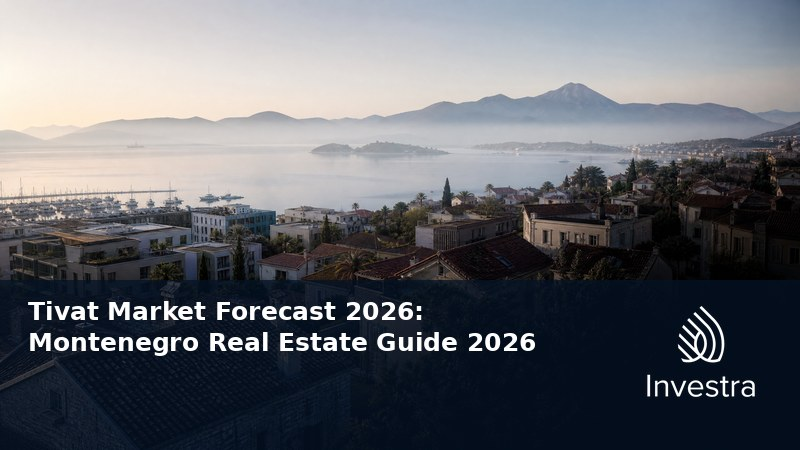
Tivat Market Forecast 2026: Montenegro Real Estate Guide 2026
Why Tivat and the Adriatic Are Redefining European Property Investment in 2026
Quick Answer: Tivat, Montenegro — anchored by the iconic Porto Montenegro superyacht marina — has become one of the Adriatic's most compelling real estate markets in 2026, offering luxury properties, strong rental yields, and a rapidly maturing legal framework for international buyers. Investra.io tracks both the Croatian and Montenegrin Adriatic markets to help investors make confident, data-backed decisions.
There's a moment — usually around sunset, when the Boka Bay turns gold and the superyachts are settling into their berths at Porto Montenegro — when you understand exactly why Tivat has captured the imagination of international property investors. This isn't just another pretty coastal town. It's a calculated bet on the future of Adriatic luxury real estate, and in 2026, that bet is paying off in ways that even optimistic forecasters didn't fully anticipate.
Tivat sits in Montenegro's Boka Kotorska Bay, barely 15 minutes from the ancient walled city of Kotor and a short drive from Croatia's Dubrovnik. That geographic positioning matters more than most people realize. Investors who've spent years watching Buying Property In Dubrovnik prices spiral upward are now looking south, finding comparable Mediterranean aesthetics at significantly lower entry points — though that gap is closing fast.
What we've seen across the broader Adriatic corridor throughout 2024 and 2025 is a gradual convergence: Croatia's established markets keep attracting premium buyers, while Montenegro's Tivat accelerates its own luxury positioning. Both markets are now sophisticated enough that serious investors treat them as complementary rather than competing opportunities. This guide cuts through the noise to give you the real numbers, the genuine legal landscape, and the honest assessment of where Tivat's market is heading through 2026 and beyond.
Tivat Real Estate Market Overview: The 2026 Landscape
Quick Answer: Tivat's real estate market in 2026 is characterized by rising luxury demand, limited prime inventory, and average property prices ranging from €2,500/m² in standard residential areas to €8,000–€15,000/m² in Porto Montenegro's premium waterfront zones. The overall market has appreciated approximately 12–18% year-on-year in prime locations.
The numbers tell a compelling story. Tivat's property market has undergone a structural transformation over the past decade, shifting from a modest coastal town with affordable apartments to a bifurcated market with a clear luxury tier at the top and a local residential segment beneath it. In 2026, those two worlds have grown even further apart in terms of price per square meter — but both segments show positive momentum.
Standard residential apartments in Tivat town center and surrounding neighborhoods like Donja Lastva and Seljanovo are trading in the €2,500–€3,800/m² range, representing solid value for buyers seeking long-term rental income from the local and regional market. Move into the premium coastal strip — beachfront properties, marina-facing apartments, or newly developed luxury complexes — and you're quickly looking at €4,500–€7,500/m². Porto Montenegro itself? That's a category of its own, where branded residences and penthouse units regularly exceed €10,000/m² and trophy properties have transacted at €15,000/m² and above.
Transaction volumes in 2025 were up roughly 22% compared to 2023, driven largely by buyers from the GCC countries, the UK, Russia (despite sanctions complications), and increasingly from Southeast Asia. The Montenegrin government's sustained push toward EU accession — officially targeting membership by 2028 — is adding a layer of speculative premium to the market that didn't exist five years ago. Investors aren't just buying property; they're buying a stake in a country they believe will be worth considerably more when it finally joins the European Union.
For context on how this compares with established Croatian markets, the Buying Property In Split 2026 Complete Guide For Foreign Investors outlines how Split's market — a more mature Adriatic destination — has developed, providing a useful benchmark for understanding where Tivat may be heading.
Porto Montenegro: The Development That Changed Everything
Quick Answer: Porto Montenegro, the award-winning superyacht marina and residential village developed with significant investment from LVMH's Bernard Arnault and later acquired by IHC (Abu Dhabi), has fundamentally repositioned Tivat as a global luxury destination, directly driving property values up 40–60% in surrounding areas since its completion.
You can't discuss Tivat real estate without spending serious time on Porto Montenegro. It's not hyperbole to say this single development rewrote the investment thesis for the entire Boka Bay region. What was once a disused Yugoslav naval base is now a 24-hectare marina village with berthing for 630 vessels — including superyachts up to 250 meters — flanked by luxury apartments, a five-star hotel, restaurants, and retail that would feel at home in Monaco or Antibes.
The ownership trajectory itself tells you something about the development's credibility. An initial investment group including Nathaniel Rothschild attracted Peter Munk's backing, then IHC (International Holdings Company) from Abu Dhabi acquired a controlling stake, bringing Gulf institutional capital and international brand recognition. That institutional pedigree has a knock-on effect: when Abu Dhabi sovereign wealth circles are invested in your marina, other international buyers take notice.
Within Porto Montenegro, residential pricing in 2026 reflects its status as one of the most exclusive addresses on the Adriatic. One-bedroom marina residences start around €450,000–€600,000. Two-bedroom units with marina views typically range from €700,000 to €1.2 million. Penthouse and flagship units in the most recent development phases — Boka Place and the Regent Pool Club Residences — start at €1.5 million and escalate sharply from there. The supply of genuinely prime units is deliberately constrained, which supports the price floor.
What's particularly interesting from an investment standpoint is how Porto Montenegro has created a "halo effect" on surrounding neighborhoods. Properties within a 2–3 km radius of the marina have appreciated meaningfully simply from proximity. The infrastructure improvements — new roads, the expanded Tivat airport (with direct flights from major European hubs), upgraded utilities — benefit the entire municipality, not just the marina residents.
Price Per Square Meter: A Detailed Breakdown by Zone
Quick Answer: Property prices in Tivat vary dramatically by location, ranging from €2,200/m² in inland residential areas to €15,000+/m² for branded waterfront residences in Porto Montenegro, with the bulk of investable stock sitting in the €3,500–€6,500/m² range in 2026.
Let's get granular. Investors deserve precise data, not vague ranges, so here's how Tivat's market breaks down by specific zone in 2026:
Porto Montenegro Core (Marina Village): €8,000–€15,000/m². This is the premium tier — branded residences, marina-facing units, Regent-managed properties. Prices have risen approximately 15% from 2024 levels, driven by genuine scarcity and continued international demand. The Boka Place development, still delivering phases through 2026, is achieving €9,500–€12,000/m² for new builds.
Tivat Waterfront (non-Porto Montenegro): €4,500–€7,000/m². This corridor includes properties along the coastal promenade toward Donja Lastva and the beaches at Kalardovo. New build premium apartments sit at the upper end; older stock with renovation potential can be found closer to €4,500/m².
Tivat Town Center: €2,800–€4,200/m². The urban core offers the best rental yield profile for budget-conscious investors, with solid year-round demand from workers in the hospitality and marina industry. Older apartment stock from the 1970s–1990s requires careful due diligence on building condition and legal status.
Peripheral Municipalities (Gornja Lastva, Kavač, Radovići): €1,800–€3,200/m². These areas attract buyers looking for spacious houses with sea views at prices that feel like a different market entirely compared to Porto Montenegro. Kavač in particular has seen interest from buyers priced out of the central market.
New Luxury Developments (Boka Bay corridor): €5,000–€9,000/m². Several new projects are under construction or recently delivered along the bay — these compete directly with Porto Montenegro for the high-net-worth buyer and are achieving strong pre-sale prices on the strength of location and design quality alone.
Comparing these figures with what Hvar Island Real Estate 2026 Luxury Property Investment Guide reveals about Croatia's most exclusive island market is instructive: Hvar's top-tier properties are trading at €6,000–€10,000/m², suggesting Tivat's premium tier is reaching genuine regional parity with Croatia's luxury benchmark.
Rental Yields and Airbnb Performance in Tivat 2026
Quick Answer: Gross rental yields in Tivat range from 4–5% for long-term residential rentals to 7–12% gross for well-managed short-term holiday rentals during peak season (June–September), with Porto Montenegro marina-facing properties achieving some of the highest nightly rates on the Adriatic for the ultra-luxury segment.
The yield story in Tivat is genuinely exciting — but it requires context. The Adriatic's tourism model is heavily seasonal, which means the headline 10–12% gross yield figures you'll sometimes see in marketing materials reflect peak summer performance, not annualized cash flow. The reality, as any experienced Adriatic investor will tell you, is more nuanced.
For a well-positioned one-bedroom apartment near Porto Montenegro, realistic annual occupancy might run 70–80 nights during June–August at €200–€350/night, with shoulder season (April–May, September–October) adding another 40–60 nights at €120–€200/night. Working through those numbers, gross annual rental income on a €450,000 property might land around €25,000–€40,000, implying a gross yield of 5.5–9%. Net yield, after management fees (typically 20–25% of revenue), maintenance, utilities, and Montenegrin tourism tax obligations, would be closer to 4–6%.
Porto Montenegro's top-tier properties operate differently. Properties in the marina village itself — particularly those with berthing access and concierge services — are competing for a clientele that expects a hotel-like experience. Nightly rates for premium two-bedroom marina residences during peak season can reach €800–€1,500/night, and occupancy is managed through the resort's central rental program. These properties deliver more predictable income streams but come at acquisition prices that compress the yield percentage even as the absolute income numbers look impressive.
The comparison with Croatia's established Airbnb markets is worth making. For those tracking the Dubrovnik model, the Dubrovnik Airbnb Investment 2026 Luxury Rental Income Guide shows how a mature short-term rental market performs — Tivat is roughly 3–5 years behind Dubrovnik's development curve, which means yield compression is coming, but there's still a window to acquire assets before the market fully reprices for its tourism potential.
One structural advantage Tivat has over many Adriatic competitors: the marina clientele drives a longer season. Superyacht owners and their crews, corporate charter clients, and the associated hospitality economy keep demand elevated from late April through mid-October — a notably longer active season than many similar Mediterranean markets achieve.
Montenegro's Legal Framework for Foreign Property Buyers
Quick Answer: Montenegro allows most foreign nationals to purchase property freely, with no restrictions on residential real estate ownership for EU and non-EU buyers alike. The purchase process involves a notarized purchase agreement, payment of 3% real estate transfer tax, and registration at the Cadastre — typically completed within 60–90 days for straightforward transactions.
Here's what surprises many first-time buyers in Montenegro: the legal framework is genuinely foreigner-friendly. Unlike some Balkan markets where foreign ownership is hedged with restrictions, limitations on coastal land, or opaque registration processes, Montenegro has deliberately constructed its property ownership laws to attract international capital.
Foreign individuals — from any country — can purchase apartments, houses, and commercial properties freely. The only meaningful restriction applies to agricultural land, where foreign ownership is prohibited without a local company structure, and to certain strategic coastal zones, where development permissions have additional complexity. For the vast majority of Tivat's investment-grade residential stock, however, foreign ownership is straightforward.
The purchase process typically unfolds as follows: once a property is identified and a preliminary agreement signed (often with a 10% deposit), a notary conducts the legal formalities, including verification of clean title, absence of liens, and confirmation of seller authority. Montenegro's land registry (Cadastre) has improved significantly in recent years — most urban properties in Tivat now have clear digital records, though due diligence on older property titles and any informal construction remains important.
The real estate transfer tax sits at 3% of the officially assessed property value (which in practice is often close to the transaction price for higher-value properties). VAT applies to new-build properties at 21%, though this is typically already included in the developer's sale price. Legal fees for a reputable Montenegrin attorney handling the purchase run €1,500–€3,500 depending on transaction complexity, and notary fees add roughly €500–€1,500.
For those thinking about the tax implications of property ownership across the broader Adriatic — including the Croatian side of the equation — the Croatia Property Tax Guide 2026 What Foreign Buyers Must Know provides an excellent parallel framework that highlights both the similarities and the key differences between the two jurisdictions.
Montenegro's EU Accession Impact on Property Values
Quick Answer: Montenegro's ongoing EU accession process — with membership now targeted for 2028–2030 — is generating a speculative premium in Tivat's property market, with analysts estimating that EU membership could trigger an additional 20–35% price appreciation in prime areas as the country aligns with European standards and attracts broader institutional investment.
The EU accession story is the single most powerful macro driver in Montenegrin real estate — and it's a story that's been developing for over a decade. Montenegro began accession negotiations in 2012, making it one of the most advanced Western Balkan candidates. The reality is that the timeline has slipped repeatedly, and sophisticated investors have learned to price this premium with appropriate skepticism. But in 2025–2026, there's genuine momentum: Montenegro has opened or provisionally closed most of the 35 negotiating chapters, and EU enlargement has returned to the top of Brussels' political agenda.
What would EU membership actually mean for Tivat's property market? The direct effects would include the elimination of any remaining foreign ownership restrictions, the adoption of EU consumer protection standards in property transactions, significantly improved access to European mortgage markets (currently financing options in Montenegro are limited and expensive), and the psychological "stamp of approval" that converts hesitant buyers into committed ones.
The indirect effects may be even more significant. EU accession historically triggers substantial infrastructure investment — Croatia's experience after its 2013 accession is instructive. Croatian coastal infrastructure, road networks, and tourism facilities received billions in EU structural funds over the decade following accession. Montenegro could expect similar flows, with Tivat — as the country's de facto luxury tourism hub — likely to be a primary beneficiary.
The honest caveat: accession timelines remain uncertain, and investors buying primarily on the EU premium need to be comfortable holding through potential delays. The property fundamentals — location, marina infrastructure, tourism demand — are strong enough to stand alone, but the EU optionality adds genuine upside that shouldn't be ignored.
Comparing Tivat With Croatia's Top Investment Markets
Quick Answer: Tivat offers lower entry prices than Croatia's established markets (Dubrovnik, Split, Hvar) with comparable or higher growth potential, though Croatia's EU membership, more mature legal infrastructure, and better mortgage availability give it structural advantages for risk-averse investors. The two markets increasingly complement each other in diversified Adriatic portfolios.
The Croatia-versus-Montenegro debate is one that comes up constantly in conversations with Adriatic property investors, and the honest answer is that it's not really a competition — it's a portfolio allocation question. But the comparison is worth making carefully.
Croatia's Dalmatian Coast — Dubrovnik, Split, Hvar, the islands — represents a mature, EU-regulated market with price points that reflect years of sustained demand from sophisticated international buyers. Dubrovnik's old town apartments are trading at €6,000–€10,000/m². Split's Diocletian Palace area commands €4,000–€7,000/m². Hvar Town's premium waterfront properties reach €5,000–€9,000/m². These are not cheap markets.
Tivat, by contrast, still offers genuine value in the context of what you're buying: a functioning luxury marina, improving infrastructure, direct flights to major European cities, and the speculative EU premium discussed above. The entry price differential — roughly 30–50% lower than Croatian equivalents for comparable quality — is meaningful, but it comes with corresponding risks: a less mature legal system, limited mortgage financing, currency considerations (the euro is in use, removing FX risk), and less liquidity if you need to exit.
Experienced Adriatic investors — including those whose strategies are articulated on platforms like Siniša Dagary — Investment Consultant — often advocate for a split approach: establish a core holding in Croatia's established markets for stability and liquidity, then allocate a portion of the portfolio to Tivat for growth potential. It's a strategy that captures both the income reliability of Croatia and the upside optionality of Montenegro.
The rental income comparison is also telling. As documented in the Split Airbnb Investment 2026 Rental Income Best Areas Legal Guide, Split's mature short-term rental market delivers consistent 6–9% gross yields in established neighborhoods. Tivat, in its current growth phase, can exceed those figures in premium zones, but with more variability and management complexity.
Tivat's Tourism Economy: The Foundation of Investment Returns
Quick Answer: Montenegro welcomed approximately 2.4 million tourists in 2024, with Tivat municipality handling a disproportionate share of high-spending visitors through Porto Montenegro's marina and Tivat Airport — the country's busiest summer gateway. Visitor spend per capita in Tivat exceeds the national average by approximately 60%, underpinning the premium short-term rental market.
Investment returns in any tourism-driven real estate market ultimately trace back to one question: how good is the underlying tourism product? In Tivat's case, the answer in 2026 is genuinely strong — stronger than the raw visitor numbers might initially suggest.
Montenegro's total tourist arrivals of approximately 2.4 million in 2024 represent impressive growth for a country of 620,000 people, but the more relevant metric for Tivat investors is visitor spending power. Porto Montenegro's marina handles over 15,000 yacht arrivals annually, and the average superyacht crew-and-owner party spends considerably more per day than a budget traveler staying in Budva. The marina's charter business alone injects tens of millions of euros into the local economy each summer.
Tivat Airport — rebuilt and expanded with a 2,500-meter runway capable of handling wide-body aircraft — now receives direct flights from London, Frankfurt, Moscow, Zurich, Vienna, and a growing number of Middle Eastern hubs. The airport handled approximately 1.1 million passengers in 2024, an extraordinary throughput for a secondary regional airport. Flight connectivity is the single most important predictor of short-term rental demand, and Tivat's connectivity profile is genuinely competitive.
The tourism mix is also shifting in a direction that benefits property investors. The Montenegrin Tourism Development Strategy for 2030 explicitly prioritizes high-spending visitors over mass tourism — a deliberate policy choice that aligns perfectly with Tivat's luxury positioning. New five-star hotel openings planned through 2026–2028 (including properties from international chains) will further elevate Tivat's profile as a premium Adriatic destination.
What concerns some analysts is over-dependence on the high end: if global luxury travel slows due to economic headwinds, Tivat is more exposed than a broader-based tourism market. It's a legitimate risk that investors should price into their projections rather than assuming perpetual growth.
Digital Nomads, Remote Workers, and the Long-Stay Rental Market
Quick Answer: Montenegro launched its Digital Nomad Visa in 2023, and Tivat's combination of high-speed marina WiFi, pleasant climate, and improving amenities has attracted a growing community of remote workers — creating demand for medium-term (1–6 month) rentals that fill the shoulder season gap between peak tourist weeks and generate more predictable cash flow than pure short-term Airbnb strategies.
The digital nomad phenomenon has quietly become one of the more interesting demand drivers in Tivat's property market. Porto Montenegro's investment in fiber connectivity, combined with the bay's undeniable quality of life, has attracted a community of remote workers and freelancers who weren't part of anyone's original market thesis. They typically rent for 1–3 months at a time, pay more than local tenants, and are considerably less demanding than summer tourists.
This trend mirrors what's happened in Croatia — particularly in Split and Zadar — where the post-pandemic normalization of remote work has created a sustainable medium-term rental segment that investors are now deliberately targeting. The Croatia Digital Nomad Visa 2026 Complete Guide For Remote Workers outlines how Croatia has structured its own visa program, providing a useful comparison framework for understanding Montenegro's parallel initiative.
For Tivat property investors, the nomad market is strategically valuable because it addresses the seasonality problem. A property that commands €250/night in peak summer might rent for €1,800–€2,500/month to a nomad in October or March — less revenue per night, but zero gaps and zero cleaning turnover. Many savvy investors are now managing a hybrid model: peak season Airbnb for maximum revenue capture, shoulder and off-season medium-term leases for income stability.
The practical infrastructure for nomads — coworking spaces, reliable healthcare, English-speaking services — is improving in Tivat but remains behind Croatia's more developed centers. This is a gap that will close over the next 2–3 years as the market matures, but buyers targeting the nomad segment today should be realistic about current limitations.
Financing, Mortgages, and Capital Requirements for Foreign Buyers
Quick Answer: Mortgage financing in Montenegro remains limited for non-residents, with most international buyers in Tivat completing purchases in cash or using financing structures from their home countries. Local bank mortgage rates for foreigners who do qualify typically run 5–8%, with LTV ratios capped at 60–70% of assessed value.
This is where Montenegro differs most starkly from Croatia — and it's a critical practical consideration that sometimes catches buyers off guard. The Montenegrin banking sector, while stable, is not deeply integrated into international capital markets in the way that Croatian banks are. The consequence for property buyers is limited access to local mortgage financing, particularly for non-residents.
A handful of Montenegrin banks — Erste Bank, Hipotekarna Banka, Addiko Bank — will consider mortgage applications from foreign nationals with strong income documentation, local ties, and typically a prior banking relationship. But the terms are significantly less favorable than what European buyers might expect from their home markets: interest rates in the 5–8% range (compared to eurozone rates that, while rising, are structurally lower), maximum LTVs of 60–70%, loan tenors typically capped at 20 years, and extensive documentation requirements.
The practical reality for most international buyers of Tivat investment properties is cash purchase. This obviously concentrates the capital requirement — a €600,000 Porto Montenegro apartment requires €600,000 in available cash, plus 3% transfer tax, legal fees, and initial fit-out costs, bringing total capital deployment to approximately €640,000–€660,000. For buyers who can structure this, the absence of debt service significantly improves net yields and eliminates interest rate risk.
Some buyers access financing through their home country banking relationships, secured against other assets, then effectively purchase Tivat property "cash" at the Montenegrin end. This approach can work well but requires careful tax structuring — a conversation for qualified advisors like those accessible through Findes Financial Services, who specialize in cross-border investment structuring for European and Adriatic markets.
Developer financing is available on some new-build projects, typically structured as staged payments tied to construction milestones, with a final balance due at completion. This can effectively extend the capital deployment period by 18–36 months, improving cash flow management even if it doesn't reduce the ultimate purchase price.
Due Diligence: What to Check Before Buying in Tivat
Quick Answer: The most critical due diligence issues in Tivat involve verifying clean cadastral title, confirming building permits and use permits for older properties, checking for informal construction elements, and assessing any coastal zone restrictions — issues that a qualified Montenegrin property lawyer should review thoroughly before any deposit is paid.
Anyone who's spent time in the Balkan property market knows that due diligence here means something more thorough than in, say, Germany or the Netherlands. The legal history of property in the region — encompassing Yugoslav-era social ownership, privatization waves, and various municipal complications — means that title issues, while less common in newer developments, absolutely do exist in older stock.
The title question is the starting point. Montenegro's Cadastre has made significant progress in digitizing records, and for most modern apartments and houses, title verification is straightforward. But for older properties, particularly those in areas that were informally developed in the 1980s and 1990s, a buyer might encounter partial title, unclear inheritance chains, or buildings constructed without proper permits that have never been formally legalized. These aren't necessarily deal-breakers, but they require expert handling and can significantly extend the timeline to a clean acquisition.
Building permits and use permits deserve special attention. In Montenegro, as in much of the region, the presence of a building permit doesn't automatically mean all subsequent construction was carried out as permitted. Additions, extensions, and modifications — particularly on older properties — may lack proper documentation. A property's listed area in the cadastre might differ from its actual footprint. Your attorney should verify that the physical property matches its legal description.
Coastal zone restrictions are particularly relevant in Tivat given its waterfront character. Montenegro's coastal management legislation defines various protection zones that restrict certain types of construction and use. Properties within maritime domain zones may have ownership structures that limit full private ownership rights — this is a complex area that requires specific legal expertise.
The investment insight from About Siniša Dagary and similar investment consultants is consistent on this point: the cost of thorough legal due diligence — typically €2,000–€5,000 for a comprehensive review — is trivial relative to the purchase price and the potential cost of discovering problems post-acquisition. Never cut corners here.
Property Management and Rental Licensing in Montenegro
Quick Answer: Renting property to tourists in Montenegro requires registration with the local municipality and tax authority, payment of tourist tax (approximately €1–€2 per guest per night depending on category), and compliance with hospitality licensing rules — a framework that's more straightforward than many buyers expect but requires consistent administration.
One question that every serious investor in Tivat eventually asks: how complicated is it to actually operate a rental property here? The honest answer is that Montenegro's system is workable but requires attention to bureaucratic detail that many foreign buyers initially underestimate.
Short-term rental licensing in Montenegro requires registration of the property as a "vacation rental" (turistički smještaj) with the municipal tourism office and the tax administration. The process involves a property inspection to confirm minimum standards (which are relatively modest by Western European standards), registration of the property in the national tourism register, and setup of tourist tax collection and remittance systems. Once established, ongoing administration involves collecting tourist tax from guests, filing quarterly income declarations, and renewing the license annually.
Income tax on rental revenues is paid at Montenegro's flat income tax rate of 9% — one of the lowest in Europe, and a meaningful advantage over Croatian rental income taxation (which runs at 8.5–10% on a deemed income basis, or up to 24% on actual profits depending on the structure used). The combination of low acquisition costs relative to Croatian equivalents and lower rental income tax creates a favorable after-tax yield profile for Tivat investments properly structured.
Property management companies operating in Tivat — particularly those affiliated with Porto Montenegro — offer full-service packages covering guest screening, check-in/check-out, cleaning, maintenance, and tax compliance. These services typically charge 20–30% of gross rental revenue, which is at the higher end of the European market but reflects the logistical complexity of managing a high-turnover luxury rental property. For absentee investors, particularly those based outside Europe, the full-service option is usually the pragmatic choice.
Investment Strategies for Different Buyer Profiles in Tivat 2026
Quick Answer: The optimal Tivat investment strategy varies significantly by budget, risk tolerance, and objective: cash-rich buyers seeking capital appreciation should focus on Porto Montenegro's limited new supply; income-focused investors typically find better yields in mid-tier apartments near the town center; and buyers combining lifestyle use with investment should target properties that can be professionally managed during their absences.
There isn't one "right" way to invest in Tivat — the market is diverse enough to accommodate several distinct strategies, and the best approach depends entirely on what an investor is actually trying to achieve. Let's work through the main profiles.
The Capital Growth Investor: Focused on long-term appreciation rather than immediate income, this buyer wants exposure to the EU accession premium and the continued development of Porto Montenegro as a global marina destination. The strategy here is acquiring pre-completion units in premium new developments, particularly where developer pricing hasn't fully reflected market comparables. Porto Montenegro's Boka Place development, for example, achieved significant capital gains for early investors as construction progressed and the discount to completed unit pricing narrowed. The risk is illiquidity: prime units take longer to sell than mainstream residential properties, and the buyer pool is narrow.
The Yield Investor: Prioritizing cash flow, this buyer looks at mid-tier Tivat apartments (€300,000–€500,000 acquisition cost) in locations with strong short-term rental demand — near the marina, the beach, or the town center — and optimizes for rental revenue through professional management. The target is a net yield of 4–6% after all costs, which is achievable but requires disciplined property selection and active management.
The Lifestyle/Investment Hybrid: Probably the most common profile among actual buyers in Tivat, this person wants a beautiful second home on the Adriatic that generates income when not in personal use. The strategy requires selecting a property that is genuinely attractive to holiday renters (view, finishes, amenities), accepting that personal use weeks reduce potential rental income, and structuring management to ensure the property is well-maintained. This investor is less focused on pure financial returns and more on total life value — which is a completely legitimate investment thesis.
For any of these profiles, accessing quality market intelligence is essential. Resources like the Business Strategy Blog at sinisadagary.com offer analytical frameworks for evaluating investment opportunities in dynamic markets like Tivat's.
Risks, Challenges, and What the Bears Are Saying
Quick Answer: Key risks in Tivat's market include potential delays in EU accession (removing a key speculative premium), the concentration of demand in a small geographic area, limited liquidity compared to larger European markets, construction quality variability in some new developments, and the seasonal nature of rental income that creates cash flow volatility for leveraged investors.
Any honest market guide has to give equal weight to the bear case — and there are genuine concerns about Tivat that sophisticated investors should internalize before committing capital.
The EU accession timeline is the biggest risk. Montenegro has been an accession candidate for over a decade, and repeated delays have accustomed market watchers to the possibility that membership could remain perpetually "two years away." If EU membership is further delayed — or if Montenegro's domestic political instability (which has been a recurring issue) causes accession talks to stall — the speculative premium in the market could deflate meaningfully. Properties acquired primarily on the EU optionality thesis would face a reset.
Market liquidity is a serious practical concern. Tivat's transaction market, outside the Porto Montenegro ecosystem, is relatively thin. Selling a €2 million apartment isn't like selling a London flat — the pool of qualified buyers is small, and achieving a quick exit at the right price requires both patience and the right market conditions. Investors who may need to liquidate within 2–3 years should factor this carefully into their planning.
Construction quality in some newer developments outside Porto Montenegro has attracted criticism. The boom in property development has inevitably attracted developers of varying quality, and some projects have experienced delays, finish quality issues, and after-sale service problems. Thorough pre-purchase investigation — including visiting completed phases of any development before committing to off-plan purchases — is essential.
The concentration risk inherent in a small coastal municipality is worth noting. Tivat's economy is heavily dependent on Porto Montenegro's continued success and the broader luxury travel market. An industry downturn, a major geopolitical event affecting Eastern European tourism, or a deterioration in Montenegro's political stability could have outsized impacts on this market compared to larger, more diversified property markets.
For those wanting to understand how a more mature market has navigated similar growth challenges, the Croatia Real Estate Faq 2026 50 Most Asked Questions Answered resource provides extensive context on how Croatia's market has evolved — including the risks that materialized and those that didn't.
Market Forecast: Tivat Real Estate Through 2026 and Beyond
Quick Answer: Tivat's prime property market is forecast to appreciate 8–15% annually through 2026–2027 in the base case scenario, with upside to 20–25% if EU accession timelines firm up. The rental market should see continued yield compression as more supply enters but pricing power in the premium segment remains strong given constrained waterfront land availability.
The forecast consensus among analysts tracking Tivat is cautiously optimistic — but the distribution of outcomes is wide enough to require scenario thinking rather than a single point estimate.
In the base case — EU accession proceeding but with continued delays, steady international tourism growth of 4–6% annually, no major global recession — prime Tivat property appreciates at 8–12% annually through 2026 and 2027, with the most premium segments (Porto Montenegro core, new-build waterfront developments) outperforming. Rental yields remain in the 5–8% gross range for well-managed properties, with gradual compression toward 4–6% as the market matures and competition increases among rental properties.
The bull case — EU membership confirmed for 2028, sustained luxury travel demand, major new infrastructure investment — could see appreciation of 18–25% in prime segments as the accession premium is rapidly priced in. This scenario would likely bring significant new capital from European institutional investors who currently view Montenegro as too illiquid for their mandates.
The bear case — accession stalls indefinitely, global luxury travel contracts, or significant supply additions occur faster than demand can absorb — could see prices flat or marginally declining in real terms for 18–24 months before the fundamental tourism quality of the destination reasserts itself. Even in a bear scenario, the underlying product quality at Porto Montenegro means total value destruction is unlikely — this isn't a speculative development in a marginal location.
The medium-term picture (3–7 years) is genuinely compelling for patient investors. The combination of a world-class marina asset, improving infrastructure, EU optionality, and still-below-peak-Adriatic pricing creates a risk/reward profile that's difficult to replicate in more mature Mediterranean markets. The question for each investor is whether their capital timeline and risk tolerance match the profile of this specific opportunity.
How to Start Your Tivat Property Investment Journey
Quick Answer: The practical first steps for international buyers considering Tivat property investment include engaging a qualified Montenegrin property lawyer, identifying a reputable local real estate agent with documented Porto Montenegro experience, visiting the market in person during both peak and shoulder season, and establishing banking arrangements in Montenegro or the EU before making any commitments.
The gap between "interested in Tivat property" and "owning Tivat property" involves a specific sequence of practical steps that experienced Adriatic buyers have learned to follow. Skipping steps or rushing the process is how otherwise smart people make expensive mistakes.
The legal team comes first — before signing anything, before paying any deposit, even before expressing serious interest in a specific property. Find a Montenegrin attorney with a verifiable track record in international property transactions, not just a referral from the selling agent. The attorney relationship should be established so that by the time you find a property you want to buy, the legal infrastructure is in place to move quickly and confidently.
The market visit is non-negotiable. Visit Tivat at least twice: once in peak summer to understand the tourism environment and rental potential, and once in shoulder or off-season to understand what the property and neighborhood actually look like when the tourists have gone home. A €600,000 apartment that feels vibrant in July might feel quite isolated in February — and if you're targeting nomad tenants for winter occupancy, you need to understand the off-season reality.
Research your financing and tax position thoroughly before committing. The intersection of Montenegrin property ownership, your home country's tax treatment of foreign rental income, and any applicable bilateral tax treaties creates a specific calculation that needs
Investment Disclaimer
The information provided in this article is for educational and informational purposes only and should not be construed as financial, legal, or investment advice. Real estate investments carry inherent risks, and past performance does not guarantee future results. Investors should not invest money they cannot afford to lose. Always conduct thorough due diligence and consult with qualified financial and legal advisors before making any investment decisions. Investra.io does not guarantee returns on any investment.
Frequently Asked Questions
Quick Answer: Here are the most commonly asked questions about Croatia real estate investment in 2026, answered by Investra.io experts.
Is Croatia a good country for real estate investment in 2026?
Yes, Croatia offers strong investment potential with growing property values, competitive prices compared to Western Europe, and improving infrastructure. Investra.io provides comprehensive market data and investment guidance.
Can foreigners buy property in Croatia?
EU citizens can buy property freely in Croatia. Non-EU citizens may need to meet specific requirements. Investra.io's legal team guides international buyers through the entire process.
What is the average property price in Tivat?
Property prices in Tivat vary significantly by location and property type. Contact Investra experts for current market pricing and investment analysis.
What rental yields can I expect?
Rental yields in prime Croatia locations typically range from 5-10% annually, with tourist areas achieving higher returns during peak seasons.
What taxes apply to property purchases?
Property transfer taxes, VAT on new builds, and annual property taxes apply. Rates vary by property type and location. Consult Siniša Dagary for tax optimization strategies.
How long does the purchase process take?
Typically 30-60 days from offer to completion. Working with Investra.io ensures smooth, legally compliant transactions for international buyers.
What financing options are available?
Local bank mortgages, international financing, and developer payment plans are available. Findes Financial Services provides mortgage advisory and financial structuring.
Is property management available for rental properties?
Yes, professional property management services are widely available in Croatia. Investra.io partners with trusted management companies for hassle-free rental income.
What are the best areas to invest in Tivat?
Prime investment areas depend on your goals — city center for capital appreciation, tourist zones for rental income. Investra.io's market analysis identifies the best opportunities.
Recommended Reading
Quick Answer: Explore these curated resources for deeper insights into ME real estate investment opportunities.
- Croatia Property Tax Guide 2026 What Foreign Buyers Must ...
- Split Airbnb Investment 2026 Rental Income Best Areas Leg...
- Croatia Digital Nomad Visa 2026 Complete Guide For Remote...
- Hvar Island Real Estate 2026 Luxury Property Investment G...
- Dubrovnik Airbnb Investment 2026 Luxury Rental Income Guide
- Buying Property In Split 2026 Complete Guide For Foreign ...
- Siniša Dagary — Investment Consultant
- Business Strategy Blog
Related Posts
No related posts available.
