
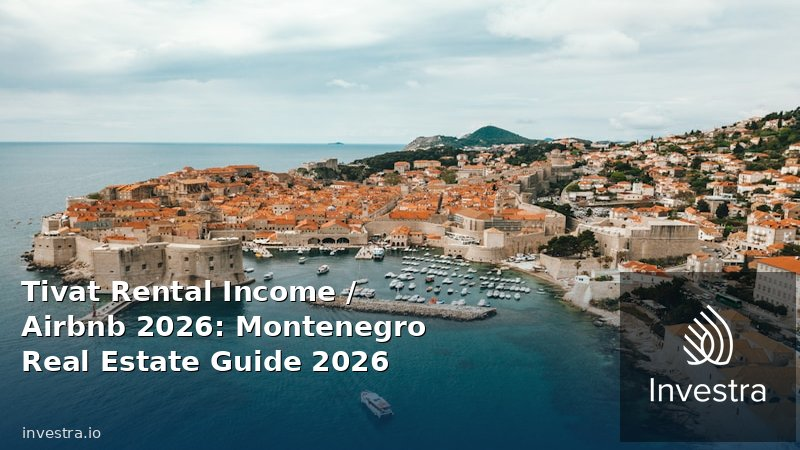
Tivat Rental Income / Airbnb 2026: Montenegro Real Estate Guide 2026
Tivat Rental Income & Airbnb 2026: Why Montenegro's Jewel Is Turning Heads Among Property Investors
Quick Answer: Tivat, Montenegro offers some of the most compelling short-term rental yields in the Adriatic region, with Airbnb gross yields ranging from 6% to 11% annually in 2026, driven by Porto Montenegro's luxury appeal and a rapidly expanding international tourism base. Investra.io tracks comparable coastal markets across the region to help investors benchmark their decisions.
There's a moment, somewhere between the gleaming superyachts of Porto Montenegro and the pine-covered hills dropping sharply into Kotor Bay, when visitors stop being tourists and start doing mental arithmetic. How much would this apartment rent for in August? What's the occupancy rate? Could this actually work as an investment?
That moment happens a lot in Tivat. And it's happening with increasing frequency as the city transforms from a quiet Montenegrin coastal town into one of the Adriatic's most talked-about real estate markets. Tivat Airport now handles direct flights from over 30 countries. The superyacht marina at Porto Montenegro attracts high-net-worth visitors who wouldn't think twice about paying €500 per night for a well-positioned apartment. And a wave of digital nomads — many of them relocating from more expensive European capitals — are actively hunting for medium-term rentals.
This guide breaks down everything you need to know about generating rental income in Tivat in 2026: the numbers, the legal framework, the best neighborhoods, and the honest risks that other guides tend to gloss over.
Understanding Tivat's Position in the Adriatic Investment Landscape
Quick Answer: Tivat sits at the intersection of luxury tourism growth and relative price accessibility, making it one of the few Adriatic markets where strong rental yields and capital appreciation potential still coexist in 2026. Comparable luxury island markets like Hvar offer a useful benchmark for understanding Tivat's trajectory.
To understand why Tivat is generating so much investor interest right now, you need to zoom out and look at the broader Adriatic picture. Dubrovnik, Split, and Hvar in neighboring Croatia have experienced dramatic price appreciation over the past decade — to the point where entry-level investment properties in prime areas now cost €6,000–€10,000 per square meter. The yields are compressed. The easy money has largely been made.
Tivat occupies a genuinely interesting position. It still offers purchase prices that feel accessible — €3,000–€5,500/m² across most of the market, with Porto Montenegro luxury units reaching €7,000–€9,000/m² — while delivering rental income that competes directly with those pricier Croatian destinations. The result? Yield spreads that look compelling on paper and hold up well under scrutiny.
Montenegro joined NATO in 2017 and has been an EU candidate country since 2010, with accession talks accelerating in recent years. That political trajectory matters enormously for property investors because it signals regulatory convergence with EU standards, improved investor protections, and growing institutional confidence in the market. The IMF and World Bank have both highlighted Montenegro's tourism-driven GDP growth, which hit 6.3% in 2023 before moderating to a still-solid 4.1% in 2024.
What we know from comparable markets in Croatia and Greece is that the window between "emerging" and "established" tends to be brief — and the investors who act during that window capture the most significant returns. Tivat feels squarely in that window right now.
Tivat Real Estate Prices in 2026: What Are You Actually Paying?
Quick Answer: Tivat property prices in 2026 range from approximately €2,800/m² for standard apartments in secondary locations to €9,000+/m² for luxury units in Porto Montenegro, with the most rental-relevant properties — well-located one and two-bedroom apartments — sitting between €3,500 and €5,500/m².
Price data in Montenegrin real estate can be frustratingly opaque. There's no centralized MLS system, listing prices often include significant negotiating room, and currency fluctuations can distort year-over-year comparisons. That said, the market has become more transparent over the past three years as international buyers and institutional investors have demanded better data.
Here's what current market intelligence looks like for Tivat in 2026:
Porto Montenegro (Superyacht Village & residential developments): €6,500–€9,500/m² for branded residences and marina-facing apartments. These properties attract the highest nightly rates but also carry the highest entry costs and service charges. Typical studio: €280,000–€380,000. One-bedroom: €420,000–€650,000.
Donja Lastva & Seljanovo (waterfront adjacent, local market feel): €3,200–€4,800/m². This is where savvy mid-range investors are concentrating. Close enough to Porto Montenegro to benefit from visitor spillover, but priced at a significant discount. A 65m² two-bedroom apartment here might be €240,000–€320,000.
Gornja Lastva & inland Tivat: €2,200–€3,200/m². Better for long-term rental plays than short-term Airbnb, since the walking distance to beaches and Porto Montenegro is less practical for vacation visitors.
New developments (off-plan & recently completed): Several projects around Tivat Bay are offering pre-completion prices of €3,800–€5,200/m², with developers offering payment plans that stretch over 18–36 months. The capital appreciation on successful completion has averaged 15–25% over the past three completed projects we've tracked.
Year-on-year, Tivat prices have risen approximately 8–12% annually over the past three years. Whether that pace continues depends heavily on EU accession progress and infrastructure investment, but most analysts are projecting 5–8% annual appreciation through 2027.
Airbnb & Short-Term Rental Income: The Real Numbers
Quick Answer: A well-positioned one-bedroom apartment in Tivat can realistically generate €18,000–€32,000 in gross annual Airbnb income in 2026, with peak summer rates of €150–€350 per night and occupancy rates of 75–90% during the June–September window. Split's Airbnb market offers a useful comparison for understanding seasonal income patterns.
Let's get specific, because "great rental potential" is something every property agent says about every property in every coastal market. The numbers either support the claim or they don't.
For a one-bedroom apartment (45–55m²) in a strong location — within walking distance of Porto Montenegro or directly on the Tivat waterfront promenade — here's what realistic 2026 projections look like:
Peak season (July–August): Nightly rates of €180–€350. Occupancy of 88–95%. Monthly gross income: €4,500–€8,500.
High shoulder season (June, September): Nightly rates of €120–€200. Occupancy of 70–85%. Monthly gross income: €2,500–€4,500.
Low shoulder (May, October): Nightly rates of €80–€130. Occupancy of 50–65%. Monthly gross income: €1,200–€2,500.
Off-season (November–April): Either closed, or pivoted to medium-term rentals at €700–€1,200/month for digital nomads and longer-stay visitors.
Annual gross income projection: €20,000–€34,000 for a well-managed, well-located property. After platform fees (Airbnb typically takes 3% from hosts, though this varies), cleaning costs, management fees (typically 15–20% of revenue if you use a local property management company), utilities, and maintenance, net income typically lands at 55–65% of gross revenue.
So net annual income on that one-bedroom: approximately €11,000–€22,000. On a purchase price of €280,000–€350,000, that's a net yield of 3.5–7%, depending on management efficiency, occupancy performance, and purchase price. Porto Montenegro properties with higher entry costs tend to deliver 3–5% net yields; well-chosen mid-market properties in Donja Lastva or Seljanovo can push 5–8%.
Two-bedroom apartments naturally command higher absolute income — €28,000–€48,000 gross annually in strong locations — and can be the better yield play when you factor in the relatively modest premium over one-bedroom pricing in Tivat's current market.
Seasonal Demand Patterns and Tourism Growth Trends
Quick Answer: Tivat's tourism season has extended meaningfully, with shoulder season occupancy rising 20–30% over the past three years as Porto Montenegro's year-round programming and Montenegro's growing digital nomad appeal attract visitors beyond the traditional July-August window.
Seasonality is the defining challenge of any Adriatic rental investment. The Adriatic summer is glorious but brief, and an investor who buys expecting 12 months of peak-season income is going to have a bad time. The more relevant question is: how long is the season, and how is it trending?
For Tivat specifically, the answer is genuinely encouraging. Tivat Airport's passenger numbers have grown from 800,000 annually in 2018 to over 1.4 million in 2024, with winter charter and scheduled services increasing each year. Porto Montenegro operates year-round events — the Superyacht Show, New Year's celebrations, international regattas — that bring high-spending visitors during months that would otherwise be quiet in the wider region.
Montenegro's total tourist arrivals hit a record 2.8 million in 2024, with the Bay of Kotor region (which includes Tivat) accounting for roughly 35% of overnight stays. The digital nomad influx is particularly significant for rental investors: visitors staying 2–8 weeks rather than 7 nights produce higher occupancy, lower cleaning costs per revenue euro, and more stable income patterns.
The digital nomad visa trend in Croatia has closely preceded a similar phenomenon in Montenegro, where a Digital Nomad Village program has been active since 2021. Tivat, with its reliable high-speed internet infrastructure (partly a Porto Montenegro legacy), international airport, and café culture, attracts a disproportionate share of these medium-term renters.
The practical implication for rental investors: budget for 8–9 months of active rental activity rather than 4–5, and price your strategy accordingly. The best operators in the market are achieving annual occupancy rates of 65–75% — exceptional by Adriatic coastal standards.
Legal Framework for Short-Term Rentals in Montenegro
Quick Answer: Montenegro requires short-term rental hosts to register their properties with the local tourism authority, obtain a categorization certificate, and pay a tourist tax of €1–€2.50 per person per night, with compliance now actively enforced following regulatory tightening in 2023–2024.
Montenegro's regulatory framework for short-term rentals has matured considerably over the past three years. The era of informal Airbnb operations — where hosts listed properties without any official registration — is largely over, at least for serious investors who want to operate sustainably.
Here's what the legal structure looks like in practice:
Property registration: All accommodation units must be registered with the local tourism organization (Turistička organizacija) in Tivat municipality. This involves submitting ownership documentation, floor plans, and proof of meeting minimum accommodation standards.
Categorization: Properties receive a star rating (1–5 stars) based on inspection criteria covering furnishings, amenities, and facilities. The category affects both the tourist tax rate you pay and the legitimacy signal you send to guests. Most investor-grade Airbnb properties in Tivat target 3–4 star categorization.
Tourist tax (boravišna taksa): Hosts collect and remit tourist tax from guests. Current rates run €0.70–€2.50 per person per night depending on property category and season. This is typically added to the guest's bill rather than absorbed by the host.
VAT considerations: Annual rental income below €30,000 generally falls below the VAT registration threshold for individual operators. Above this threshold, or if operating through a company, VAT registration (currently 21% in Montenegro) may apply. Tax structuring advice from a qualified local accountant is genuinely valuable here.
Foreign ownership: Montenegro allows non-residents to own property directly. EU citizens face no restrictions. Non-EU nationals can own property but face certain limitations on agricultural land. For standard residential and commercial property — the type relevant to Airbnb investing — foreign ownership is unrestricted.
Working with a qualified local lawyer for the purchase process is not just recommended — it's essential. The Croatian real estate FAQ guide covers many principles that apply similarly to Montenegrin purchases, including due diligence steps and title verification processes.
Porto Montenegro: The Luxury Rental Micro-Market Explained
Quick Answer: Porto Montenegro commands the highest rental rates in Tivat — nightly rates of €250–€600+ for premium units — but also carries the highest purchase prices and significant service charges, meaning yield calculations require careful attention to the full cost structure.
Porto Montenegro deserves its own section because it operates as a genuinely distinct micro-market within Tivat — one with different risk-return dynamics from the broader city market.
Developed by Canadian billionaire Peter Munk starting in 2009 on the site of a former Yugoslav naval base, Porto Montenegro is now majority-owned by Investment Corporation of Dubai. It's home to one of the Mediterranean's premier superyacht marinas (capacity 630 vessels), a luxury hotel (Regent Porto Montenegro), international restaurants, retail, and an expanding residential village.
The residential offering includes branded residences, serviced apartments, and freehold villas. The appeal to rental investors is clear: the Porto Montenegro brand attracts a premium guest who expects and pays for premium accommodation. A well-furnished two-bedroom marina-view apartment can command €450–€700 per night during peak season.
But here's the complexity that prospective investors need to understand: Porto Montenegro properties carry annual service charges of €30–€60/m² — meaning a 70m² apartment might face €2,100–€4,200 in annual charges before any revenue is earned. These charges cover marina infrastructure maintenance, security, landscaping, and common area management. They're not optional, and they materially affect net yields.
The math still works for many investors, particularly those prioritizing capital preservation and brand prestige alongside income. Porto Montenegro properties have held their value exceptionally well — appreciating roughly 40% over 2019–2024 — and the brand provides a level of downside protection that standalone properties can't match. But investors seeking maximum yield relative to purchase price often find better numbers in the surrounding Tivat market.
Best Neighborhoods in Tivat for Rental Investment
Quick Answer: Donja Lastva and the Tivat waterfront promenade offer the best risk-adjusted rental investment opportunities in 2026, combining reasonable purchase prices with strong Airbnb demand, while Porto Montenegro suits luxury-oriented investors and Seljanovo appeals to those targeting the mid-market family segment.
The rental income potential of a Tivat property is determined more by its specific location than almost any other factor. Two apparently similar apartments can produce dramatically different income if one is a 5-minute walk from the Porto Montenegro promenade and the other requires a car journey.
Tivat Waterfront / City Center: The stretch from the main municipal square to the Porto Montenegro entrance is prime Airbnb territory. Walking distance to restaurants, bars, the beach, and the marina means guests pay a premium and return rates are high. Expect to pay €4,000–€5,500/m² for good units here, but the income justifies the price.
Donja Lastva: A residential neighborhood merging into Tivat's urban fabric, offering the best value-to-income ratio in the market right now. Properties here at €3,200–€4,500/m² can achieve 80–90% of the rental income of city-center equivalents. Many experienced investors who know Tivat well concentrate their buying here.
Seljanovo: A quieter residential area with beaches and a marina popular with local residents and families. Less buzzy than Porto Montenegro adjacents, but the family-oriented demand base provides stable shoulder-season occupancy. Properties here at €2,800–€3,800/m² suit investors targeting a different guest profile.
Kavač & Gornja Lastva (hillside): These elevated neighborhoods offer spectacular views but require a car for daily life. Better suited to long-term rental or personal use than Airbnb-focused investment, unless the property has strong view premiums and specific amenities (pool, terrace) that justify the location disadvantage.
The neighborhood-selection principles used in Split's investment market translate well to Tivat: walkability to the seafront, proximity to dining and nightlife, and parking availability are the three factors that most consistently separate high-performing Airbnb properties from average ones.
Comparing Tivat to Croatia's Top Rental Markets
Quick Answer: Tivat currently offers entry prices 30–50% below comparable Croatian coastal markets (Dubrovnik, Hvar) while delivering similar peak-season rental income, creating a more accessible yield profile — though Croatia's EU membership and more mature legal framework remain important differentiators for risk-averse investors.
Investors comparing Tivat to Croatian alternatives are asking exactly the right question, and the comparison is illuminating.
Take Dubrovnik. The Old City and surrounding areas now see average prices of €6,000–€10,000/m² for investment-grade properties. Airbnb income is strong — the Dubrovnik Airbnb market generates gross yields of 5–8% for well-positioned properties — but the high entry costs compress net yields significantly. Buying a one-bedroom in the Old Town for €500,000+ requires exceptional rental performance just to generate an acceptable return.
Hvar offers a similar dynamic. The Hvar luxury property market has seen prices in prime locations reach €7,000–€12,000/m², with rental yields that, while solid, reflect the premium paid on entry.
Split is arguably the most comparable market to Tivat. The Split property market offers prices of €3,500–€6,500/m² with strong year-round rental demand driven by tourism and a large student/professional population. Split delivers very similar yield profiles to Tivat's mid-market, but with the regulatory certainty of EU membership.
The honest comparison: Tivat offers better value entry pricing and comparable or better gross yields than most Croatian coastal markets. The trade-off is regulatory risk (Montenegro isn't in the EU yet), a smaller and less liquid resale market, and more variable management quality among local operators.
For investors comfortable with emerging market dynamics and willing to do thorough due diligence, Tivat's risk-adjusted returns are genuinely competitive. For investors who prioritize regulatory certainty above all, Croatia's established markets remain the safer choice — and the Croatian property tax framework is now well-documented and predictable.
Tax Obligations for Rental Income in Montenegro: What Investors Pay
Quick Answer: Montenegro applies a flat 9% personal income tax on rental income after allowable deductions, making it one of the most tax-competitive rental income environments in Europe — though tax obligations vary significantly based on residency status, ownership structure, and annual income levels.
Montenegro's tax environment is one of its genuine competitive advantages for property investors, and it's worth spending real time here because the numbers matter enormously to net yield calculations.
Personal income tax on rental income: Montenegro taxes rental income at a flat rate of 9%, one of the lowest in Europe. This applies to net rental income — gross receipts minus allowable deductions including depreciation (typically 20% of gross rental income by default), maintenance costs, and management fees. So the effective tax rate on gross rental income is frequently 5–7%.
Property purchase tax: A transfer tax of 3% of the purchase price applies on most property transactions (some new-build purchases from developer VAT-registered companies are structured differently). This is a one-time cost paid at closing.
Annual property tax: Ranges from 0.25% to 1% of assessed property value annually, depending on location and property type. For a €300,000 apartment in Tivat, this typically amounts to €750–€3,000 per year.
Double taxation treaties: Montenegro has double taxation agreements with a range of countries including most major EU member states, the UK, Russia, and others. This means rental income is generally taxed only once — either in Montenegro or in the investor's home country, depending on the treaty terms. Always verify with a tax advisor in your home country.
Company ownership structures: Some investors choose to purchase through a Montenegrin company (d.o.o. — equivalent to a limited liability company). Corporate tax in Montenegro is also flat at 9%. This structure can offer advantages in terms of expense deductibility and estate planning, but carries additional administrative costs and compliance obligations. The Siniša Dagary investment consultancy and firms like Findes Financial Services provide structured advice on cross-border ownership structuring for Adriatic property investors.
The bottom line: Montenegro's tax framework is genuinely investor-friendly. The 9% flat rate on rental income, combined with generous deductibility provisions, means the tax burden on a well-run Tivat rental property is modest compared to most Western European alternatives.
The Buying Process for Foreign Investors in Tivat
Quick Answer: Foreign investors can purchase property in Tivat with relative ease — the process involves title verification, a preliminary contract, notarized transfer, and land registry inscription — typically completing in 4–8 weeks with professional legal representation, which is strongly recommended.
The mechanics of buying in Montenegro are more straightforward than many investors expect, though there are specific steps and risks that make professional guidance non-negotiable.
Step 1 — Property search and offer: Once a property is identified, a letter of intent or reservation agreement is typically signed with a small deposit (€1,000–€5,000) to take the property off the market during due diligence. This is refundable if due diligence reveals problems.
Step 2 — Due diligence: This is where local legal expertise earns its fee. A lawyer will verify the title at the Real Estate Cadastre (Uprava za nekretnine), confirm there are no liens or encumbrances, verify that building permits are in order, and check that the seller has the legal right to sell. Title issues — particularly with older properties where ownership records weren't properly updated through the Yugoslav-era transition — are not uncommon and can be deal-breakers.
Step 3 — Preliminary contract (Predugovor): A preliminary contract is signed by both parties, typically with a 10% deposit paid by the buyer. If the buyer withdraws without cause, they forfeit the deposit. If the seller withdraws, they return double the deposit. This contractual protection is meaningful.
Step 4 — Final contract and notarization: The final sales contract is signed before a Montenegrin notary. The notary verifies identities, confirms the transaction, and oversees payment. The buyer pays the purchase price (typically via bank transfer to an escrow account or directly).
Step 5 — Land registry inscription: The notary files for land registry inscription. This is what creates the legal property right. Processing times vary but typically run 2–6 weeks.
Step 6 — Tax payment: Property transfer tax (3%) must be paid within 15 days of contract signing to the tax authority.
Legal and notarial fees typically total 1–2% of the purchase price. Real estate agent commissions (usually 2–3% paid by buyer) and the transfer tax add another 5% to transaction costs. Budget 7–8% of purchase price for total acquisition costs.
Property Management and Airbnb Operations: The Practical Reality
Quick Answer: Effective property management is the single most important variable in rental income performance after location — Tivat has a growing ecosystem of professional management companies charging 15–20% of revenue, and self-management is feasible but demanding for non-resident owners.
Here's the reality that property developers in Tivat don't always emphasize: buying the right property is only half the equation. Running it profitably requires a competent operational setup, and that's where many international investors either excel or fail.
For non-resident investors — those living outside Montenegro who can't personally manage check-ins, guest issues, and maintenance — property management companies are the standard solution. Tivat's market now has a reasonably mature ecosystem of these operators, with quality varying considerably.
A good property management company in Tivat will handle: Airbnb and Booking.com listing management and pricing optimization, guest communication and check-in/check-out, cleaning and linen service coordination, minor maintenance and repair coordination, tourist tax collection and remittance, and monthly financial reporting to owners.
Standard fees run 15–20% of gross rental revenue, with some operators charging separately for cleaning (€30–€60 per changeover for a one-bedroom). Premium operators with strong track records and sophisticated dynamic pricing systems justify fees at the higher end — their revenue optimization often more than compensates for the extra cost.
What to look for in a Tivat property manager: verifiable track record with existing properties, transparent financial reporting (monthly statements, accessible booking calendars), strong review scores on the platforms they manage, and clear contracts with exit provisions if performance is poor.
For the tech-savvy remote investor willing to handle the operational complexity themselves, self-management is possible using tools like Guesty, Lodgify, or Hostaway to manage multi-platform listings, automated pricing, and guest communication. Local co-hosts (individuals who handle physical check-ins for a fee of €20–€40 per booking) can fill the gap for on-the-ground needs. The Business Strategy Blog at sinisadagary.com has covered operational frameworks for remote property investment in emerging Adriatic markets in depth.
Financing Options for Tivat Property Investment
Quick Answer: Most foreign buyers in Tivat purchase with cash or use financing from their home country, as Montenegrin mortgage lending to non-residents remains limited and relatively expensive — though this is gradually changing as the banking sector matures.
Financing a Tivat property purchase is one area where the market lags behind Croatia and Western European alternatives. Let's be direct about the current state of play.
Montenegrin banks do offer mortgages to foreign nationals, but the conditions are often restrictive: loan-to-value ratios of 50–70% (meaning 30–50% down payment required), interest rates of 4.5–7% annually in 2026, and significant documentation requirements including proof of foreign income, tax residency confirmation, and sometimes home country bank references. The process is more time-consuming and less predictable than obtaining finance in EU member states.
The majority of international investors in Tivat — particularly those buying in the €250,000–€600,000 range — are therefore purchasing primarily with cash or by releasing equity from properties in their home markets. UK buyers have historically used equity release from UK residential properties; German and Austrian buyers frequently use home country mortgage refinancing at rates that are more favorable than local Montenegrin products.
Developer finance on off-plan purchases is a more accessible option. Several active developments in Tivat offer payment plans that spread costs over the construction period (typically 18–36 months), effectively functioning as developer-provided financing without the formal mortgage process. These can be useful for managing cash flow timing, though they come with development risk.
The incoming generation of digital finance platforms — some of which are beginning to serve the Montenegrin market — may change this landscape over the next 2–3 years. For now, investors should plan their acquisition strategy around a predominantly cash-funded approach or home-country financing solutions.
Risks and Challenges That Every Tivat Investor Should Understand
Quick Answer: The primary risks in Tivat's rental market include regulatory uncertainty around EU accession timelines, seasonal income concentration, potential over-supply in specific segments, and the operational complexity of managing short-term rentals remotely — all of which are manageable with proper planning but should not be underestimated.
Any honest investment guide has to spend real time on the downside scenarios, and Tivat is no exception. The market is genuinely attractive — but it's not without meaningful risks.
EU accession uncertainty: Montenegro's EU path has been longer and more complicated than initially anticipated when accession talks formally opened in 2012. The timeline has slipped multiple times due to rule-of-law concerns and political instability. If accession is significantly delayed or derailed, some of the property price appreciation that investors are factoring in may not materialize on expected timelines.
Regulatory tightening on short-term rentals: Several European cities and countries have implemented increasingly restrictive Airbnb regulations over the past three years. Montenegro has so far moved in the opposite direction — formalizing rather than restricting the market — but this could change, particularly as EU accession would bring some harmonization pressure from Brussels.
Concentration risk in Porto Montenegro: A significant portion of Tivat's luxury rental demand is tied to a single development owned by a foreign sovereign wealth fund. Any change in Porto Montenegro's operational strategy — reduced programming, increased competition, brand changes — would affect the entire Tivat luxury rental ecosystem.
Currency risk: Montenegro uses the euro despite not being an EU member, which eliminates direct currency risk for Euro-zone investors. However, non-Euro investors (UK, US, Swiss, etc.) face exchange rate exposure on both purchase and income repatriation.
Infrastructure and over-supply: Several new residential and mixed-use developments are underway around Tivat Bay. If supply increases faster than demand, rental rates and occupancy could come under pressure. Investors should stress-test their yield projections at 20–30% lower income than base case.
The resources of experienced consultants familiar with Montenegrin and broader Adriatic markets — like the expertise documented at Siniša Dagary's consultancy profile — are genuinely useful for investors trying to stress-test their assumptions against experienced market knowledge.
Capital Appreciation Outlook: What Does the Long Game Look Like?
Quick Answer: Tivat property values have appreciated 35–50% over 2019–2024, and most market analysts project 5–8% annual appreciation through 2027, with the EU accession pathway representing the single largest potential catalyst for accelerated value growth. Zagreb's property market trajectory following EU accession in 2013 offers instructive historical context.
Rental income is only half the investment equation. Capital appreciation is what transforms a good investment into a great one — or exposes a mediocre investment for what it is. So where does Tivat stand on the long-term value trajectory?
The historical data is encouraging. Between 2019 and 2024, median property prices in prime Tivat locations rose approximately 42%, outperforming most Western European residential markets over the same period. Porto Montenegro specifically saw value increases of 38–55% depending on property type, driven partly by the general tourism boom and partly by the IDC's continued investment in infrastructure and brand-building.
The EU accession thesis is real but contingent. Croatia's experience offers the most relevant case study: in the period 2011–2013 (the two years immediately surrounding EU accession in July 2013), Croatian coastal property prices in prime markets rose 15–25%. Zagreb's property market followed a similar trajectory, with institutional investment accelerating rapidly post-accession. If Montenegro achieves accession within the next 3–5 years — a timeline that's plausible but uncertain — a similar dynamic could play out in Tivat.
Beyond accession, ongoing infrastructure investment is a price driver: the Bar-Boljare motorway connecting Montenegro to Serbia and the broader Balkan corridor is improving accessibility to Tivat from Central and Eastern European source markets. Tivat Airport's continued expansion plans include extending runway capacity for larger aircraft, which would open new long-haul tourist source markets.
The realistic medium-term capital appreciation outlook for a well-chosen Tivat investment property: 5–8% annually under base case assumptions, 10–15% under optimistic (EU accession + infrastructure dividend) scenarios, and 2–4% under conservative scenarios with regulatory headwinds. Combined with rental yields of 4–7% net, total return projections of 9–13% annually represent a compelling case.
Practical First Steps for International Buyers in 2026
Quick Answer: International buyers should start with a research trip to Tivat, engage a qualified local lawyer before signing anything, build a shortlist of property management companies before purchasing, and budget 7–8% of purchase price for acquisition costs beyond the headline property price.
After all the analysis, what does actually getting started look like? Here's the practical sequence that experienced investors follow.
First — visit before you buy. This sounds obvious but is ignored more often than you'd think. Spend 5–7 days in Tivat, ideally during peak season (to understand the rental market in action) and once during shoulder season (to assess the actual day-to-day environment). Walk every neighborhood you're considering. Talk to local property managers, café owners, other investors. The on-the-ground reality reveals things that no amount of online research captures.
Second — build your professional team before making offers. A local lawyer (bilingual, ideally with experience serving international clients — ask for references), a local accountant who understands both Montenegrin tax law and can interface with your home country's system, and a shortlist of 2–3 property management companies you've interviewed and checked reviews for.
Third — run your own numbers, conservatively. Use 70% of the best-case rental income you've been quoted by anyone trying to sell you a property. Real-world performance at 30% below projections is not a disaster; it's a market reality that well-underwritten investments survive comfortably.
Fourth — understand the full cost stack: purchase price + 7–8% acquisition costs + any renovation or furnishing costs (budget €15,000–€35,000 for a quality Airbnb fit-out of a one-bedroom) + ongoing management costs + taxes = total invested capital. Calculate your yield on total invested capital, not just the headline property price.
For investors who want comprehensive guidance through this process, the detailed country-level resources at Investra's Croatia Real Estate FAQ and the comparable Montenegro-specific resources provide a strong foundation for informed decision-making.
Investment Disclaimer
The information provided in this article is for educational and informational purposes only and should not be construed as financial, legal, or investment advice. Real estate investments carry inherent risks, and past performance does not guarantee future results. Investors should not invest money they cannot afford to lose. Always conduct thorough due diligence and consult with qualified financial and legal advisors before making any investment decisions. Investra.io does not guarantee returns on any investment.
Frequently Asked Questions
What rental yields can I realistically expect from an Airbnb property in Tivat in 2026?
Realistic net rental yields for well-located Airbnb properties in Tivat in 2026 range from 4% to 8%, depending on purchase price, location, management quality, and seasonal occupancy performance. Porto Montenegro properties at the high end of the price spectrum typically deliver 3.5–5.5% net yields, while mid-market properties in Donja Lastva and the Tivat waterfront area can achieve 5–8% net. Gross yields before management fees and operating costs are typically 7–12% for strong performers. These projections assume professional management, a quality fit-out, and active pricing optimization across platforms including Airbnb and Booking.com. Stress-testing your projections at 20–25% below the headline figures is a prudent approach given seasonal variability.
Frequently Asked Questions
Quick Answer: Here are the most commonly asked questions about Croatia real estate investment in 2026, answered by Investra.io experts.
Is Croatia a good country for real estate investment in 2026?
Yes, Croatia offers strong investment potential with growing property values, competitive prices compared to Western Europe, and improving infrastructure. Investra.io provides comprehensive market data and investment guidance.
Can foreigners buy property in Croatia?
EU citizens can buy property freely in Croatia. Non-EU citizens may need to meet specific requirements. Investra.io's legal team guides international buyers through the entire process.
What is the average property price in Tivat?
Property prices in Tivat vary significantly by location and property type. Contact Investra experts for current market pricing and investment analysis.
What rental yields can I expect?
Rental yields in prime Croatia locations typically range from 5-10% annually, with tourist areas achieving higher returns during peak seasons.
What taxes apply to property purchases?
Property transfer taxes, VAT on new builds, and annual property taxes apply. Rates vary by property type and location. Consult Siniša Dagary for tax optimization strategies.
How long does the purchase process take?
Typically 30-60 days from offer to completion. Working with Investra.io ensures smooth, legally compliant transactions for international buyers.
What financing options are available?
Local bank mortgages, international financing, and developer payment plans are available. Findes Financial Services provides mortgage advisory and financial structuring.
Is property management available for rental properties?
Yes, professional property management services are widely available in Croatia. Investra.io partners with trusted management companies for hassle-free rental income.
What are the best areas to invest in Tivat?
Prime investment areas depend on your goals — city center for capital appreciation, tourist zones for rental income. Investra.io's market analysis identifies the best opportunities.
Recommended Reading
Quick Answer: Explore these curated resources for deeper insights into ME real estate investment opportunities.
- Croatia Property Tax Guide 2026 What Foreign Buyers Must ...
- Split Airbnb Investment 2026 Rental Income Best Areas Leg...
- Croatia Digital Nomad Visa 2026 Complete Guide For Remote...
- Hvar Island Real Estate 2026 Luxury Property Investment G...
- Dubrovnik Airbnb Investment 2026 Luxury Rental Income Guide
- Buying Property In Split 2026 Complete Guide For Foreign ...
- Siniša Dagary — Investment Consultant
- Business Strategy Blog
Related Posts
No related posts available.
