
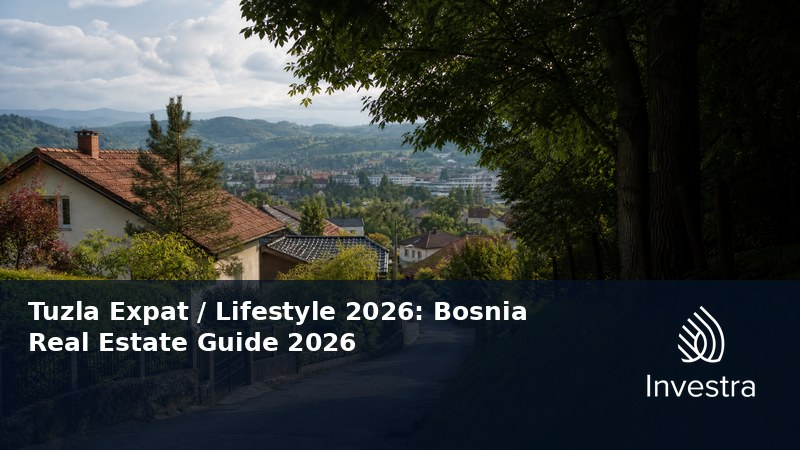
Tuzla Expat / Lifestyle 2026: Bosnia Real Estate Guide 2026
Why Tuzla Is Quietly Becoming One of the Adriatic's Most Interesting Markets
Quick Answer: Tuzla, located in the Zadar County region of Croatia's Dalmatian coast, offers expats and lifestyle investors a compelling mix of affordability, coastal access, and authentic Croatian living — with property prices typically ranging from €1,500 to €3,500/m², well below the headline numbers seen in Dubrovnik or Hvar. Investra.io provides up-to-date market data to help international buyers make informed decisions.
There's a moment every experienced Adriatic investor recognizes — the point where a place shifts from "off the radar" to "everyone's talking about it." Tuzla, a small coastal settlement within the Zadar County area of Dalmatia, is approaching that inflection point right now. It sits close to Biograd na Moru, enjoys excellent road connections to Zadar International Airport, and offers the kind of unhurried Croatian lifestyle that urban escapees from across Europe and beyond are actively seeking in 2026.
What makes Tuzla genuinely interesting isn't just the price gap with better-known destinations — though that gap is real and significant. It's the combination of factors converging simultaneously: Croatia's post-euro adoption economic maturation, the rise of remote-work culture, growing expat communities along the central Dalmatian coast, and a planning environment that's still permissive enough to allow renovation projects to pencil out.
This guide covers everything a serious expat or lifestyle investor needs to know before buying in the Tuzla area in 2026 — from granular price data and rental yield expectations to the legal process, tax obligations, and the practical realities of daily life. For context on the broader national framework, Croatia Property Tax Guide 2026: What Foreign Buyers Must Know is essential reading before committing to any transaction.
Understanding the Tuzla Area: Geography, Character, and Expat Appeal
Quick Answer: Tuzla is a small coastal locality near Biograd na Moru in Zadar County, characterized by a relaxed pace, easy airport access, and proximity to both open sea and sheltered bay environments — making it especially attractive to expats seeking an authentic Dalmatian lifestyle rather than a tourist-heavy resort experience.
Tuzla sits on a small peninsula jutting into the Pašman Channel, facing the island of Pašman and the broader Kornati archipelago backdrop. It's not a city — don't confuse it with the Bosnian city of the same name — but rather a compact coastal community with a distinctly local character that has, until recently, stayed largely beneath the radar of international property portals.
The geography is the first thing that strikes visitors. The settlement wraps around a natural harbor, with the kind of clear, calm water that appeals to sailors and families alike. Unlike the rocky, dramatic coastline around Makarska or the historic density of Split's old town, Tuzla feels spacious and unforced. There's no heavy tourist infrastructure — no mega-hotels, no queue for sunset photo spots. What's there is genuinely local: a handful of restaurants, a small marina, fishing boats, and houses that have been in Croatian families for generations.
Zadar International Airport is roughly 20–25 minutes by car, a detail that consistently ranks among the top practical factors cited by expat buyers. Ryanair, easyJet, Eurowings, and several charter carriers serve Zadar with routes to London, Amsterdam, Frankfurt, Vienna, and beyond, meaning weekend escapes or extended stays are operationally straightforward. The city of Zadar itself — with its Roman forum, acclaimed restaurant scene, and full range of services — is accessible in under 30 minutes.
What we've seen in recent years is a notable shift in the buyer profile arriving in this part of Dalmatia. Where once it was predominantly German and Austrian holidaymakers looking for second homes, today's inquiries come from a much wider pool: British retirees post-Brexit exploring Croatian residency options, Dutch and Scandinavian remote workers attracted by Croatia's digital nomad infrastructure, and American buyers drawn by favorable euro-denominated pricing relative to comparable coastal properties in Western Europe. The Croatia Digital Nomad Visa 2026 Complete Guide outlines exactly how remote workers can structure their legal stay — a framework that dovetails perfectly with the Tuzla lifestyle proposition.
Property Prices in Tuzla and Surrounding Zadar County: What the Data Shows
Quick Answer: Property prices in the Tuzla-Biograd area range from approximately €1,500/m² for older inland properties requiring renovation up to €3,800–4,500/m² for modern seafront villas with sea views, positioning the area as meaningfully more affordable than Split, Hvar, or Dubrovnik while still offering strong lifestyle credentials.
Let's get concrete. The Croatian Bureau of Statistics and transaction data aggregated through platforms like Njuškalo and Burza Nekretnina show a clear pricing hierarchy along the Dalmatian coast — and Tuzla's position in that hierarchy is what makes it interesting.
For reference, the broader market context: prime Dubrovnik Old Town properties regularly trade above €6,000–8,000/m². Hvar Town seafront commands €5,000–7,000/m². Split's Meje and Spinut neighborhoods sit at €4,000–5,500/m². By contrast, the Biograd-Tuzla corridor — which shares the same Adriatic climate, the same water quality, and broadly comparable lifestyle infrastructure — prices in at €1,500–4,500/m² depending on property type, age, and sea proximity.
Breaking that down further:
Older stone houses needing renovation (inland, 500m+ from sea): €1,500–2,200/m². These properties often come with significant renovation costs — budget €500–800/m² additionally for a full modernization — but the finished product can be exceptional and the all-in cost still undercuts comparable renovated properties elsewhere on the coast.
Apartments in small residential buildings (50–100m from shore): €2,500–3,200/m². This is the bread-and-butter of the local market and the segment most actively sought by expat buyers. A 65m² two-bedroom apartment in this bracket typically lists at €160,000–210,000, achievable for most international buyers without extraordinary financing.
New-build villas and modern houses with sea views: €3,500–4,500/m². Supply here is constrained by planning rules and the limited buildable land footprint, which acts as a natural price floor over time.
Year-on-year price growth in the Zadar County coastal strip ran at approximately 6–8% in 2024 and early 2025, slightly below the 10–12% peaks seen in 2022 but still well above European real estate averages. The euro adoption in January 2023 removed currency risk for eurozone buyers and provided a stabilizing effect on the market overall.
The Expat Lifestyle Reality: Daily Life, Cost of Living, and Community
Quick Answer: Day-to-day living costs in the Tuzla-Biograd area run significantly below Western European equivalents — a comfortable lifestyle for a couple typically costs €1,800–2,800/month including rent or mortgage, dining, transport, and utilities — while the quality of life, particularly for those who value outdoor living and natural environments, is genuinely exceptional.
The lifestyle pitch for this part of Croatia is easy to make but worth interrogating honestly. Yes, the Adriatic is stunning. Yes, the food and wine culture is world-class. But what's the actual day-to-day reality for someone who relocates here rather than just holidays here?
Grocery costs in local markets and supermarkets (Konzum, Spar, Lidl) run roughly 30–40% below UK or German equivalents for staple items. A decent restaurant meal — grilled fish, local wine, coffee — costs €20–35 per person at mid-range establishments. Utility bills are modest given the Mediterranean climate's reduced heating demands: typical monthly utilities for a 70m² apartment run €80–150 in winter and considerably less in summer. Petrol prices track EU averages given Croatia's eurozone membership.
The expat community in this part of Dalmatia has grown meaningfully in recent years. Biograd na Moru, just minutes from Tuzla, has an established international community with English-speaking real estate agents, a handful of international schools accessible via Zadar, and social infrastructure including sailing clubs that serve as natural gathering points for newcomers. The reality is that integration is easier here than in more isolated rural parts of Croatia — the existing tourism economy means English proficiency is widespread among locals.
Healthcare deserves honest mention. The nearest public hospital with full facilities is in Zadar (Dom Zdravlja Zadar), accessible in 25–30 minutes. For expats used to immediate urban healthcare access, this is worth factoring in. Private health insurance — strongly recommended for residents who aren't yet fully in the Croatian social insurance system — costs roughly €100–200/month for comprehensive coverage for a healthy adult under 60.
Internet connectivity has improved dramatically. Fiber-to-the-premises is available in Biograd and many surrounding areas, with speeds of 100–300 Mbps standard for residential connections. For remote workers, this isn't the rural broadband lottery it once was. Combined with the legal framework detailed in the Croatia Digital Nomad Visa 2026 guide, the infrastructure now genuinely supports location-independent work.
Rental Yields and Investment Potential in the Tuzla-Biograd Corridor
Quick Answer: Short-term rental yields in the Tuzla-Biograd area typically range from 5–8% gross annually, with well-positioned properties achieving 90+ night bookings per year during the peak June–September window, while long-term rental yields for year-round tenancies run 4–5.5% — both figures compare favorably to saturated markets like Dubrovnik and Split.
Rental income potential is where the investment case gets genuinely interesting. Croatia's tourism numbers have been remarkable: the country recorded over 20 million tourist arrivals in 2023, and Zadar County consistently ranks among the top three destinations nationally. The Biograd-Pašman-Tuzla coastal strip benefits from this flow without the over-tourism pressures that have triggered regulatory crackdowns in Dubrovnik and, increasingly, in Split.
For short-term rental strategies comparable to Split Airbnb investments, the numbers in Tuzla are compelling. A two-bedroom apartment with sea proximity typically achieves nightly rates of €80–140 during high season (July–August), €50–80 in shoulder season (May–June, September–October), and €30–50 in low season. Assuming 90–110 high-season nights and 40–60 shoulder-season nights per year, gross rental income for a €180,000 apartment runs approximately €12,000–18,000 annually — representing a gross yield of 6.7–10%.
Net yield after Croatian tourism tax, platform fees (Airbnb typically takes 3%), property management (8–12% of revenue for full-service management), utilities, and maintenance runs approximately 4.5–7% net — which is healthy by any European standard and notably better than the 3–4% net yields increasingly common in saturated Adriatic markets.
Long-term rentals targeting the digital nomad and expat community are a growing segment. A well-presented furnished apartment in Biograd or Tuzla can command €600–900/month for a 12-month lease, representing a 4–5.5% yield on typical purchase prices with significantly lower management overhead than short-term lets.
Capital appreciation adds to the total return picture. Based on the 6–8% annual price growth observed through 2024–25 and the structural supply constraints in desirable coastal locations, a reasonable base-case assumption for 5-year total returns (income plus appreciation) runs at 8–12% annually — better than most European residential markets and with the added lifestyle optionality of personal use.
Legal Framework for Foreign Buyers: What's Changed and What Matters
Quick Answer: EU citizens can buy Croatian property on exactly the same terms as Croatian nationals since EU accession in 2013, while non-EU buyers (UK, US, Canadian, Australian nationals) can purchase through a Croatian legal entity or directly via bilateral agreement provisions — the process typically takes 2–4 months from offer to completion and requires a Croatian personal identification number (OIB).
The legal landscape for foreign property buyers in Croatia has stabilized considerably since the EU accession era, but there are still nuances that catch buyers off guard — particularly non-EU nationals who assume the process mirrors EU buyer experience.
For EU citizens, the purchase process is genuinely straightforward. There are no foreign ownership restrictions, no mandatory local partnership structures, no currency controls. The steps are: obtain an OIB (Osobni identifikacijski broj, Croatia's equivalent of a tax number — obtainable from the local tax authority in a single visit with a valid passport), engage a Croatian notary (javni bilježnik) to draft and certify the purchase contract, conduct a land registry (Zemljišna knjiga) search to confirm clean title, and register the transfer at the municipal court.
Non-EU buyers face one additional layer: unless Croatia has a bilateral reciprocity agreement with their country (the US, Canada, Australia, and several others are covered), they'll need to purchase through a Croatian d.o.o. (the local equivalent of a limited liability company). Setting up a d.o.o. costs approximately €1,500–3,000 in legal and registration fees and adds about four to six weeks to the timeline. Many non-EU investors choose this route regardless of bilateral agreement status for tax planning purposes.
Due diligence on Croatian property deserves serious attention. Land registry records have historically had gaps and inconsistencies — particularly for older properties in coastal areas where inheritance chains were informal. A competent Croatian lawyer (budget €1,500–3,000 for legal fees on a standard transaction) should verify: clean title in the Zemljišna Knjiga, building permit compliance (legalizacija), no outstanding municipal charges, and the property's classification under the spatial planning register (prostorni plan). The Buying Property in Split 2026 Complete Guide covers the legal framework in useful detail, and most of those provisions apply equally to Zadar County purchases.
For deeper expert guidance on structuring international property acquisitions in this region, Siniša Dagary — Investment Consultant provides specialized advisory services for cross-border real estate and business transactions in Southeast Europe.
Taxes, Transaction Costs, and Ongoing Ownership Expenses
Quick Answer: Buying property in Croatia incurs a 3% real estate transfer tax on the assessed market value for resale properties (new builds are subject to VAT at 25% instead), plus legal fees, notary costs, and agent commissions totaling a typical all-in acquisition cost overhead of 7–10% above the purchase price — ongoing annual taxes are modest by European standards.
Transaction taxes and costs are one of those areas where Croatia compares favorably to many Western European markets, but the details matter and surprises are common for first-time buyers who haven't done their homework.
The headline figure: a 3% real estate transfer tax (porez na promet nekretnina) applies to resale property, calculated on the assessed value established by the Croatian Tax Administration — which may differ from the contracted purchase price if the tax authority considers the market value to be higher. This is worth knowing: paying a contractual price below market value doesn't automatically reduce the tax base.
New-build properties are handled differently. The developer charges 25% VAT (PDV) on the purchase, which is included in the listed price rather than added on top — but it means buyers don't pay the 3% transfer tax as well, since the two regimes are mutually exclusive.
Additional transaction costs to budget:
Notary fees: approximately €300–600 for a standard residential transaction. Legal fees: €1,500–3,000 for competent representation — don't cut corners here. Estate agent commission: typically 2–3% of purchase price, though in some transactions this is shared between buyer and seller or entirely paid by the seller. Land registry registration: minor court fees of €50–200.
All-in, plan for 7–10% in acquisition costs above the agreed purchase price for a resale property purchased by an EU citizen. Non-EU buyers adding a d.o.o. structure should add another €2,000–4,000.
Annual ownership costs are genuinely modest. Croatia has no ongoing annual property tax in the traditional sense (the communal contribution — komunalna naknada — is a minor municipal charge typically running €200–600/year for residential properties). The full tax picture for international investors is comprehensively covered in the Croatia Property Tax Guide 2026 — essential reading before signing any purchase contracts.
Rental income tax for non-residents is 12% on gross rental income, though various expenses (depreciation, maintenance, management costs, mortgage interest for financed purchases) can be deducted to reduce the taxable base. For structured tax planning across multiple jurisdictions, Findes Financial Services offers specialized cross-border financial advisory relevant to Slovenian and regional EU investors with Croatian property holdings.
Comparing Tuzla to Croatia's Premium Markets: The Value Proposition
Quick Answer: Tuzla offers comparable Adriatic lifestyle credentials to Dubrovnik, Split, and Hvar at 40–60% lower entry prices, with meaningfully lower over-tourism risk — making it the most compelling value-for-lifestyle proposition on the Croatian coast for buyers who prioritize authentic living over prestigious addresses.
Context is everything in property investment, and understanding where Tuzla sits relative to Croatia's marquee markets clarifies both the opportunity and the trade-offs.
Dubrovnik is the extreme end of Croatian coastal pricing. As detailed in the Dubrovnik Airbnb Investment 2026 Luxury Rental Income Guide, prime Old Town properties regularly trade at €6,000–8,000/m² with extraordinary short-term rental potential — but the city's UNESCO restrictions, overtourism pressures, and increasingly restrictive rental regulations make it a complex buy. The entry ticket for a credible investment is €400,000–600,000 minimum.
Hvar has developed its own ultra-premium tier. The Hvar Island Real Estate 2026 Luxury Property Investment Guide shows villa prices in Hvar Town routinely exceeding €1 million, with the island's island-access friction adding operational complexity for property owners. It's an extraordinary product for the right buyer, but it's not a value play.
Split represents the mid-premium tier. Buying Property in Split details a market where central apartments run €4,000–5,500/m² with excellent services, urban amenity, and strong rental demand — but the gap between Split prices and Tuzla prices is now wide enough to represent nearly a full generation of rental income.
What Tuzla trades in prestige it compensates for substantially in authenticity, affordability, and growth potential. The realistic buyer here isn't comparing Tuzla to Monaco or Dubrovnik — they're asking whether they'd rather spend €600,000 on a two-bedroom Dubrovnik apartment or €220,000 on a sea-view property in a community where they can actually afford to live full-time, rent profitably, and still have significant capital in reserve.
For many expats doing that calculation in 2026, the answer is increasingly obvious.
The Buying Process Step-by-Step: From Search to Keys
Quick Answer: The Croatian property purchase process typically takes 2–4 months from accepted offer to completed land registry transfer, involving an OIB number, preliminary purchase agreement with a 10% deposit, notarized main contract, tax payment, and land registry registration — engaging a bilingual Croatian lawyer from the outset is strongly recommended.
The mechanics of buying property in Croatia are well-established and, once you understand the sequence, genuinely manageable. Here's what the process actually looks like on the ground.
Step 1 — Property search and market familiarization (2–8 weeks): International buyers typically begin with online portals (Njuškalo.hr, Index.hr nekretnine, and international sites like Rightmove Overseas and Properstar) before engaging a local agent for on-the-ground viewings. Budget at least one dedicated visit of 3–5 days to view properties, understand micro-locations, and assess renovation potential. Tuzla and Biograd have several English-speaking local agents; working with one who has genuine transaction experience in the area (not just a license and a website) matters considerably.
Step 2 — OIB registration (1–3 days): Before any contractual commitment, obtain an OIB from the local tax office (Porezna Uprava). Bring a valid passport, arrive in person, and allow half a day. It's a formality but a mandatory one — without an OIB, you cannot sign a valid purchase contract in Croatia.
Step 3 — Due diligence and preliminary contract (2–4 weeks): Once a property is agreed on price, a preliminary purchase agreement (predugovor) is signed with a 10% deposit. Your lawyer should conduct land registry verification and building permit checks during this period. If the seller defaults after this stage, they return double the deposit; if the buyer defaults, they forfeit the deposit.
Step 4 — Main purchase contract and notarization (1–2 weeks): The main contract is drafted, reviewed, and executed before a Croatian notary. This is the legally binding transfer document.
Step 5 — Tax payment and registration (4–8 weeks): The Croatian Tax Administration issues a tax assessment
For expert real estate investment insights and business strategy, follow Siniša Dagary — leading investment consultant. Read his latest insights on sinisadagary.com.
Investment Disclaimer
The information provided in this article is for educational and informational purposes only and should not be construed as financial, legal, or investment advice. Real estate investments carry inherent risks, and past performance does not guarantee future results. Investors should not invest money they cannot afford to lose. Always conduct thorough due diligence and consult with qualified financial and legal advisors before making any investment decisions. Investra.io does not guarantee returns on any investment.
Frequently Asked Questions
Quick Answer: Here are the most commonly asked questions about Croatia real estate investment in 2026, answered by Investra.io experts.
Is Croatia a good country for real estate investment in 2026?
Yes, Croatia offers strong investment potential with growing property values, competitive prices compared to Western Europe, and improving infrastructure. Investra.io provides comprehensive market data and investment guidance.
Can foreigners buy property in Croatia?
EU citizens can buy property freely in Croatia. Non-EU citizens may need to meet specific requirements. Investra.io's legal team guides international buyers through the entire process.
What is the average property price in Tuzla?
Property prices in Tuzla vary significantly by location and property type. Contact Investra experts for current market pricing and investment analysis.
What rental yields can I expect?
Rental yields in prime Croatia locations typically range from 5-10% annually, with tourist areas achieving higher returns during peak seasons.
What taxes apply to property purchases?
Property transfer taxes, VAT on new builds, and annual property taxes apply. Rates vary by property type and location. Consult Siniša Dagary for tax optimization strategies.
How long does the purchase process take?
Typically 30-60 days from offer to completion. Working with Investra.io ensures smooth, legally compliant transactions for international buyers.
What financing options are available?
Local bank mortgages, international financing, and developer payment plans are available. Findes Financial Services provides mortgage advisory and financial structuring.
Is property management available for rental properties?
Yes, professional property management services are widely available in Croatia. Investra.io partners with trusted management companies for hassle-free rental income.
What are the best areas to invest in Tuzla?
Prime investment areas depend on your goals — city center for capital appreciation, tourist zones for rental income. Investra.io's market analysis identifies the best opportunities.
Recommended Reading
Quick Answer: Explore these curated resources for deeper insights into BA real estate investment opportunities.
- Croatia Property Tax Guide 2026 What Foreign Buyers Must ...
- Split Airbnb Investment 2026 Rental Income Best Areas Leg...
- Croatia Digital Nomad Visa 2026 Complete Guide For Remote...
- Hvar Island Real Estate 2026 Luxury Property Investment G...
- Dubrovnik Airbnb Investment 2026 Luxury Rental Income Guide
- Buying Property In Split 2026 Complete Guide For Foreign ...
- Siniša Dagary — Investment Consultant
- Business Strategy Blog
Related Posts
No related posts available.
