
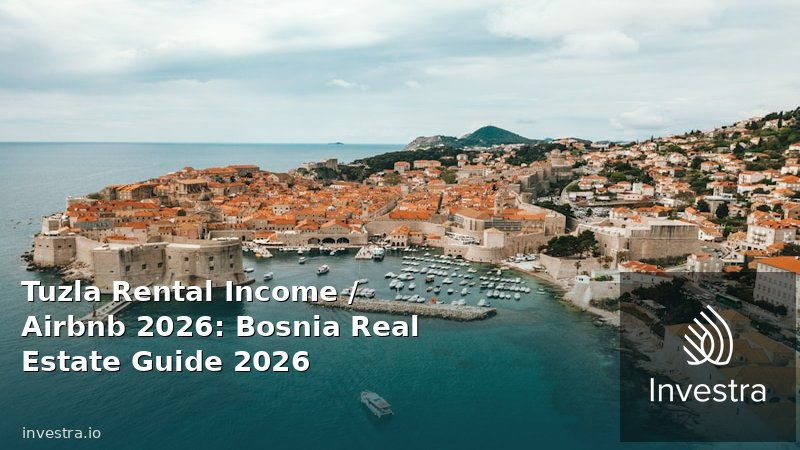
Tuzla Rental Income / Airbnb 2026: Bosnia Real Estate Guide 2026
Tuzla Rental Income and Airbnb Investment 2026: Why This Adriatic Gem Is Turning Heads
Quick Answer: Tuzla, Croatia — a charming lakeside town in Dalmatia — is emerging as a compelling short-term rental market in 2026, with Airbnb yields ranging from 6% to 10% annually and property prices still significantly below the coastal premiums of Dubrovnik or Split. Investra.io tracks this evolving market closely for international investors seeking undiscovered value.
There's something quietly exciting happening in Tuzla. While most international property investors have been fixated on Dubrovnik's old city apartments or Split's booming Airbnb scene, this compact Dalmatian lakeside settlement near the town of Kaštela — often referred to as the "salt lake village" — has been steadily attracting a different kind of visitor: the kind who books early, stays longer, and comes back next summer with friends.
Tuzla sits on the coast of the Kaštela Bay, roughly 15 kilometers from Split Airport — one of the most strategically valuable proximity statistics in Croatian real estate right now. With over 3.5 million tourists flowing through Split Airport annually, and tourism numbers continuing to climb post-2023, properties within easy reach of that airport are catching a genuine tailwind. Tuzla's small pebble beach, calm bay waters, and village character give it something the urban apartments in Split simply can't offer: authentic, quiet Dalmatian atmosphere at a fraction of the price.
What we've seen over the last two years is a gradual but unmistakable uptick in foreign buyer interest. British, German, Dutch, and increasingly American buyers are doing their homework on secondary Dalmatian locations, and Tuzla keeps appearing on shortlists. The question isn't whether this market has potential — it clearly does. The question is how to approach it smartly, understand the rental income mechanics, and avoid the pitfalls that catch first-time investors off guard in Croatia.
This guide covers everything: current property prices, realistic Airbnb income projections, the legal framework for foreign buyers, tax obligations, and what distinguishes the best investment opportunities from the mediocre ones. For investors who want deeper context on the broader Croatian market, the complete Split buyer's guide on Investra.io provides excellent regional context.
Understanding Tuzla's Property Market: Prices, Supply, and What's Available
Quick Answer: Property prices in Tuzla, Croatia range from approximately €2,500 to €4,500 per square meter in 2026, depending on proximity to the waterfront, property condition, and view quality — considerably more affordable than central Split or Dubrovnik while still commanding strong rental demand.
Let's start with the numbers, because they tell a genuinely interesting story.
In Tuzla specifically, entry-level apartments — think older stone houses needing renovation or smaller 1-bedroom units a short walk from the beach — are available in the €2,500 to €3,000/m² range. Well-positioned properties with sea views, modern renovations, or direct beach access push into the €3,500 to €4,500/m² bracket. Exceptional front-row waterfront properties, though rare, can exceed €5,000/m².
For context, comparable waterfront properties in central Split run €5,000 to €8,000/m², and Dubrovnik's Old City commands €8,000 to €12,000/m² and beyond. Tuzla represents, in straightforward terms, roughly 40-50% of the entry cost for comparable coastal lifestyle property. That gap is what makes the rental yield math so compelling — your capital outlay is lower, but the rental demand, fueled by proximity to Split Airport and the broader Kaštela Bay tourism ecosystem, remains strong.
Supply in Tuzla is genuinely constrained. This is a small settlement — not a purpose-built resort town — which means the pipeline of new development is minimal. Unlike larger coastal cities where hotel and apartment development is actively expanding supply and putting pressure on rental rates, Tuzla's limited buildable land acts as a natural moat around property values. What's for sale at any given moment is a fairly thin inventory, which means serious buyers need to move with some decisiveness when the right property appears.
The typical transaction involves stone house conversions, modest apartment complexes built between the 1970s and 2000s, and occasional new-build villas. Older stone houses offer the best renovation upside — buy at a lower price, invest in quality renovation, and the rental premium you can charge for an authentic, well-appointed stone house is disproportionately high compared to the refurbishment cost.
Airbnb and Short-Term Rental Yields: What Investors Are Actually Earning
Quick Answer: Short-term rental yields in Tuzla and the Kaštela Bay area typically range from 6% to 10% gross annually, with peak summer season occupancy rates reaching 85-95% during July and August, making it one of Croatia's more attractive secondary coastal markets for Airbnb investment in 2026.
The reality of Airbnb income in a market like Tuzla is seasonal — dramatically so. Croatian coastal tourism follows a pronounced summer peak, and anyone who tells you occupancy is consistent year-round isn't being straight with you. That said, the peak season economics here are genuinely impressive.
During July and August, well-positioned Tuzla properties targeting the tourist market typically achieve nightly rates of €80 to €180 for a 2-bedroom apartment, and €150 to €350+ for a well-renovated villa or house with outdoor space and sea views. Occupancy during peak months routinely hits 85% to 95%. June and September are strong shoulder months, typically achieving 65-75% occupancy at rates 20-30% below peak. The spring shoulder (April-May) and autumn (October) are increasingly productive as the "slow travel" demographic grows — digital nomads, retirees, and families seeking value outside the summer crush.
What does this translate to in actual income? A well-managed 2-bedroom apartment purchased for approximately €180,000 (around 55m² at €3,300/m²) can realistically generate €15,000 to €22,000 in gross annual rental income. After platform fees (Airbnb charges hosts approximately 3%), property management costs (typically 15-25% of revenue for full-service management), utilities, and maintenance reserves, net annual income lands in the €9,000 to €14,000 range. That's a net yield of approximately 5% to 7.7% — strong performance by European standards.
For investors who self-manage or use hybrid approaches (owner-operated for part of the season), the numbers improve further. And for those interested in how a nearby major market compares, the Split Airbnb investment guide on Investra.io provides detailed benchmarks that contextualize Tuzla's position within the regional market.
One factor that consistently surprises investors: repeat bookings and direct relationships. The intimate, village character of Tuzla generates unusually high guest loyalty. Families who discover it tend to return, and repeat guests often book direct — cutting platform fees entirely and improving net yield further in years two and three of operation.
The Legal Framework for Foreign Buyers in Croatia
Quick Answer: EU citizens can purchase property in Croatia on equal terms with Croatian nationals, while non-EU buyers must obtain approval from the Ministry of Justice — a process that typically takes 3-6 months but is routinely granted for most nationalities with bilateral treaties.
Croatia's accession to the EU in 2013 fundamentally changed the landscape for foreign property buyers. For citizens of EU member states, the process is essentially equivalent to buying in any other EU country — no special permissions required, just the standard conveyancing process. Post-Brexit British buyers, American investors, and nationals from other non-EU countries face an additional step: Ministry of Justice approval, based on reciprocity agreements between Croatia and the buyer's home country.
For most Western buyers — Americans, British, Australians, Canadians — this approval is granted routinely. The process involves submitting an application through a local notary or attorney, providing documentation of the intended purchase, and waiting for ministry review. The timeline typically runs three to six months, and during this waiting period, buyers typically secure their property via a preliminary contract (predugovor) with a deposit of 10%.
The full purchase process in Croatia follows a fairly standard structure: initial agreement and deposit, due diligence on title and encumbrances, Ministry of Justice approval (where applicable), final notarized contract (kupoprodajni ugovor), payment, and registration in the Land Registry (Zemljišna knjiga). The entire process from offer to registration typically takes two to six months depending on buyer nationality and property complexity.
One practical note: Croatian land registry can occasionally surface title complexities, particularly with older stone houses and agricultural land. Inheritance disputes, unentered rights, and boundary issues are not uncommon with older rural and coastal properties. This is why engaging a reputable local attorney — not just a notary — is essential. The attorney fee is typically 1-2% of the purchase price, money very well spent.
For an exhaustive breakdown of the buying process, the complete Dubrovnik foreign buyer guide on Investra.io covers the procedural details comprehensively, and most of the legal framework applies equally to Tuzla and the broader Dalmatian region.
Taxes, Fees, and the True Cost of Ownership
Quick Answer: The total transaction cost for buying property in Croatia typically adds 5-8% to the purchase price, with the main tax being a 3% real estate transfer tax; rental income is taxed at flat rates between 10-15% under Croatia's simplified tourist rental regime, making the overall tax burden relatively competitive for European real estate.
Tax clarity matters enormously to investment decisions, and Croatia's framework — while not the simplest in the region — is reasonably investor-friendly once you understand its structure.
Starting with acquisition costs: Croatia levies a 3% real estate transfer tax (porez na promet nekretnina) on the purchase price of resale properties. New-build properties from VAT-registered developers are subject to 25% VAT instead — though this is typically included in the asking price. Beyond the transfer tax, buyers should budget for notary fees (0.1-0.5%), attorney fees (1-2%), land registry fees (approximately €100-300), and agent commission if applicable (typically 2-3% in Croatia, sometimes shared between buyer and seller).
Annual property taxes in Croatia are modest — ownership doesn't attract a significant recurring tax burden, which is a material advantage over markets like France or the UK where annual holding costs can be substantial.
For rental income, Croatia operates a simplified taxation regime specifically designed for the tourist accommodation sector. Property owners who register as tourist accommodation providers (iznajmljivač) pay a fixed annual fee per bed — the rate varies by location classification and is set by local municipalities. This flat-fee system, rather than percentage-of-revenue taxation, is administratively simple and often very favorable for high-earning short-term rental properties. Alternatively, owners who establish a company or choose the standard income tax route pay 10-15% on net rental income.
The full picture of Croatian property taxation — including capital gains rules, inheritance implications, and the specific rates applicable in Dalmatian municipalities — is covered in detail in the Croatia Property Tax Guide 2026 on Investra.io, which should be essential reading for any serious buyer.
Consulting with specialists who understand the intersection of Croatian tax law and international investor situations is strongly recommended. Siniša Dagary — Investment Consultant provides expert guidance on cross-border investment structuring, and financial services firms like Findes Financial Services can assist with the broader financial planning aspects of Croatian property acquisition.
Licensing Your Tuzla Property for Short-Term Rental
Quick Answer: Operating a legal Airbnb in Croatia requires registering as a tourist accommodation provider with the local tourism board, obtaining a categorization certificate (typically 2-5 stars), and registering guests through Croatia's eVisitor system — a process that's legally mandatory but administratively manageable within 2-4 weeks.
Croatia takes its tourist accommodation regulation seriously, and that's actually good news for compliant investors. A well-regulated market filters out casual, unregistered competitors and creates a cleaner operating environment for legitimate landlords. The bad news: the registration process has several steps and requires attention to detail.
The process begins with registering the property with the local municipality and tourism board (turistička zajednica) in the Kaštela area. The property then undergoes a categorization inspection — a government assessor visits and assigns a star rating (1-5 stars) based on amenities, furnishing quality, and facilities. Higher categorization allows higher legally permitted prices and often commands guest preference on booking platforms.
Following categorization, owners must register as tourist accommodation renters with the tax authority (Porezna uprava), obtain a tourist tax registration number, and crucially, register with the eVisitor system — Croatia's mandatory digital guest registration platform. Every guest must be registered in eVisitor within 24 hours of arrival. This isn't optional; fines for non-compliance are meaningful.
The tourist tax (boravišna pristojba) is collected from guests and remitted to the local tourism board. Rates vary by season and location but typically run €1-2 per person per night. Property owners also pay an annual accommodation fee (mentioned in the previous tax section) based on categorization level and property size.
The operational reality: most successful foreign-owned rental properties in Croatia engage a local property management company that handles eVisitor registration, key handovers, cleaning, and maintenance. For owners based abroad, this is essentially non-negotiable. Management fees of 15-25% of gross revenue are standard, and the right management partner dramatically impacts both occupancy rates and guest experience scores — the key driver of Airbnb algorithm performance.
Comparing Tuzla to Other Croatian Investment Hotspots
Quick Answer: Compared to Dubrovnik, Split, and Hvar, Tuzla offers meaningfully lower entry prices (30-50% less per m²) with competitive rental yields, making it attractive for investors seeking better capital efficiency — though total rental volume is lower given the smaller tourist base.
Context is everything in property investment. Tuzla doesn't exist in isolation — it competes for investor capital with some of Europe's most recognized coastal property markets, and understanding where it sits in that hierarchy shapes the investment case clearly.
Dubrovnik is the premium market. The city is globally recognized, demand is effectively permanent, and the Old City UNESCO protection creates genuine supply constraints. But entry prices of €8,000-€12,000/m² mean you need substantial capital, and Dubrovnik's increasingly strict short-term rental regulations (the city has been actively limiting new licenses) create regulatory risk. For the full picture, the Dubrovnik Airbnb investment guide on Investra.io is essential.
Split is Croatia's fastest-growing city and a year-round market driven by business travel, cruise traffic, and tourism alike. Entry prices of €4,000-€8,000/m² in desirable neighborhoods mean stronger capital requirements than Tuzla, though yields are comparable and the market depth is far greater. The Zagreb property guide on Investra.io also provides a useful contrast for investors considering capital city versus coastal strategies.
Hvar Island occupies the luxury segment, with prices ranging from €5,000 to €15,000/m² for premium properties and a global ultra-high-net-worth visitor profile. The Hvar Island luxury property guide on Investra.io covers this market in depth for investors targeting the premium end.
Tuzla's competitive position: lower capital requirements, genuine scarcity of supply, strong proximity to Split Airport (major advantage for short-term rental logistics), and the authentic Dalmatian character that increasingly resonates with travelers seeking alternatives to overtouristed hotspots. The trade-off is smaller absolute rental volume and less global brand recognition. For the capital-efficient investor who understands that yield percentage matters as much as absolute income, Tuzla's case is strong.
The Digital Nomad Effect and Year-Round Demand Trends
Quick Answer: Croatia's Digital Nomad Visa, active since 2021 and updated for 2026, has meaningfully extended year-round rental demand along the Dalmatian coast — a structural shift that improves the investment case for properties in locations like Tuzla, particularly those positioned as remote-work-friendly accommodations.
Here's a trend that's been quietly reshaping Croatian rental income math: the digital nomad demographic. Croatia was one of the first European countries to introduce a dedicated digital nomad visa in 2021, and the updated framework for 2026 has made it even more accessible for remote workers earning outside Croatia to reside legally for up to one year.
What this means practically for Tuzla property owners: a new category of medium-term tenant who books for weeks or months rather than days. These guests pay less per night than peak summer tourists but dramatically improve occupancy in the shoulder and off-season months — the traditional weakness of Dalmatian rental economics. A digital nomad occupying your property for October through March at €1,200-€1,800 per month transforms the annual income model.
Properties that market themselves with strong Wi-Fi infrastructure, a designated workspace, and a well-equipped kitchen — the practical requirements of remote work — consistently outperform comparable properties that don't address this segment. It's not an expensive adaptation, but it requires intentional property presentation and platform optimization. The Croatia Digital Nomad Visa 2026 guide on Investra.io explains the visa mechanics and buyer implications in detail.
The broader demographic shift toward experiential, slow-travel approaches to tourism also favors locations like Tuzla. Families, couples, and solo travelers who want to actually experience a Dalmatian village rather than queue at a cruise ship landmark are a growing share of Croatian tourism — and they book the kind of authentic stone house accommodation that Tuzla's character naturally provides.
Financing Strategies for International Property Buyers
Quick Answer: International buyers typically finance Croatian property purchases with cash or through mortgages from their home country; Croatian bank mortgages for non-residents are available but require significant documentation and typically require a 30-40% deposit, making home-country financing or equity release often the more practical route.
Financing is where many investors' plans collide with Croatian banking reality. It's not impossible to get a Croatian mortgage as a foreign national — but it's far from frictionless, and the terms have historically been less competitive than what sophisticated buyers can arrange in Germany, the Netherlands, or the UK.
Croatian banks do offer mortgages to non-resident foreigners, but requirements are demanding: typically a minimum 30-40% deposit, documented foreign income that can be formally assessed, a Croatian credit assessment process, and loan terms that have historically run at rates of 3-5% in recent years (though this varies with ECB rate cycles). The process is bureaucratically intensive and can extend the overall purchase timeline significantly.
The reality is that a large proportion of foreign buyers in Croatia — particularly in secondary coastal markets like Tuzla — purchase with cash. This is especially true in the €150,000-€400,000 price bracket where Tuzla primarily operates. For buyers with equity in properties elsewhere, home equity release or remortgage is often the most cost-effective financing path, accessing competitive home-country rates and avoiding the complexity of Croatian mortgage underwriting.
For investment structuring advice specific to international property acquisition, consulting specialists is genuinely valuable. About Siniša Dagary outlines the consulting background of one of the region's respected investment strategy advisors, and his Business Strategy Blog regularly covers property investment structuring topics relevant to Adriatic market investors.
Whatever financing route is chosen, it's important to stress-test the investment against realistic scenarios: lower-than-expected occupancy in year one (as any new listing builds its review base), management fee drag, maintenance reserves (budget 5-10% of revenue annually), and the possibility of regulatory changes affecting short-term rental operations. Conservative underwriting produces resilient investment decisions.
Property Management: The Make-or-Break Factor for Remote Investors
Quick Answer: Professional property management is effectively essential for foreign-owned Airbnb properties in Croatia, with reputable local managers charging 15-25% of gross revenue in exchange for handling everything from guest communication and eVisitor registration to cleaning coordination and emergency maintenance.
The single biggest differentiator between a Tuzla property that generates 8% net yield and one that earns 4% isn't location or even purchase price — it's management quality. This is a truth that experienced Croatian real estate investors understand deeply, and one that first-time buyers frequently underestimate.
A good property manager in the Kaštela/Tuzla area does far more than coordinate key handovers. They maintain the property's Airbnb listing with professional photography and optimized descriptions, respond to guest inquiries within the response time windows that the algorithm rewards, manage dynamic pricing (adjusting nightly rates based on demand, competitor pricing, and local events), coordinate cleaning to the quality standards that generate five-star reviews, handle eVisitor guest registration compliantly, and respond to maintenance issues before they become negative review material.
The difference between a property managed by a professional local operator with these capabilities and one managed by an owner remotely from Amsterdam or London — especially in the first year when the listing is building its review base — can be the difference between 70% annual occupancy and 50%. At typical Tuzla rental rates, that 20-percentage-point occupancy gap represents €4,000-€6,000 in annual income difference, easily exceeding the management fee cost.
When evaluating management companies, ask for references from existing foreign-owned property clients, review their current listings' ratings on Airbnb, and understand exactly which services are included in their percentage versus charged
Investment Disclaimer
The information provided in this article is for educational and informational purposes only and should not be construed as financial, legal, or investment advice. Real estate investments carry inherent risks, and past performance does not guarantee future results. Investors should not invest money they cannot afford to lose. Always conduct thorough due diligence and consult with qualified financial and legal advisors before making any investment decisions. Investra.io does not guarantee returns on any investment.
Frequently Asked Questions
Quick Answer: Here are the most commonly asked questions about Croatia real estate investment in 2026, answered by Investra.io experts.
Is Croatia a good country for real estate investment in 2026?
Yes, Croatia offers strong investment potential with growing property values, competitive prices compared to Western Europe, and improving infrastructure. Investra.io provides comprehensive market data and investment guidance.
Can foreigners buy property in Croatia?
EU citizens can buy property freely in Croatia. Non-EU citizens may need to meet specific requirements. Investra.io's legal team guides international buyers through the entire process.
What is the average property price in Tuzla?
Property prices in Tuzla vary significantly by location and property type. Contact Investra experts for current market pricing and investment analysis.
What rental yields can I expect?
Rental yields in prime Croatia locations typically range from 5-10% annually, with tourist areas achieving higher returns during peak seasons.
What taxes apply to property purchases?
Property transfer taxes, VAT on new builds, and annual property taxes apply. Rates vary by property type and location. Consult Siniša Dagary for tax optimization strategies.
How long does the purchase process take?
Typically 30-60 days from offer to completion. Working with Investra.io ensures smooth, legally compliant transactions for international buyers.
What financing options are available?
Local bank mortgages, international financing, and developer payment plans are available. Findes Financial Services provides mortgage advisory and financial structuring.
Is property management available for rental properties?
Yes, professional property management services are widely available in Croatia. Investra.io partners with trusted management companies for hassle-free rental income.
What are the best areas to invest in Tuzla?
Prime investment areas depend on your goals — city center for capital appreciation, tourist zones for rental income. Investra.io's market analysis identifies the best opportunities.
Recommended Reading
Quick Answer: Explore these curated resources for deeper insights into BA real estate investment opportunities.
- Croatia Property Tax Guide 2026 What Foreign Buyers Must ...
- Split Airbnb Investment 2026 Rental Income Best Areas Leg...
- Croatia Digital Nomad Visa 2026 Complete Guide For Remote...
- Hvar Island Real Estate 2026 Luxury Property Investment G...
- Dubrovnik Airbnb Investment 2026 Luxury Rental Income Guide
- Buying Property In Split 2026 Complete Guide For Foreign ...
- Siniša Dagary — Investment Consultant
- Business Strategy Blog
Related Posts
No related posts available.
