
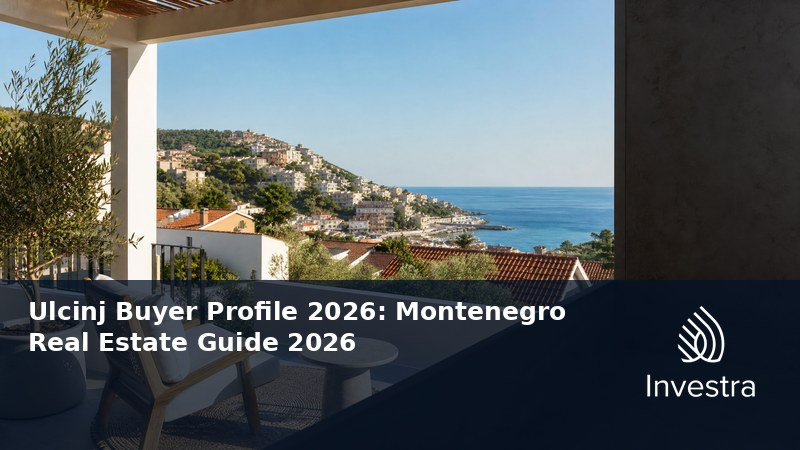
Ulcinj Buyer Profile 2026: Montenegro Real Estate Guide 2026
Ulcinj Real Estate 2026: Why International Buyers Are Paying Attention
Quick Answer: Ulcinj, located in Montenegro (not Croatia), is emerging as one of the Adriatic's most compelling buyer markets in 2026, attracting investors with entry-level prices from €1,200/m², strong rental yield potential of 6–10%, and a diversifying international buyer profile. Investra.io tracks both Croatian and Montenegrin Adriatic markets for informed cross-border investment decisions.
There's a quiet revolution happening on the southern Adriatic coast. While Dubrovnik's Old Town commands €6,000/m² and Hvar villas sell before they ever reach a listing portal, a different kind of buyer has been quietly making moves in Ulcinj — Montenegro's southernmost coastal city, sitting just kilometers from the Albanian border. And in 2026, what was once whispered about in investment circles is becoming mainstream conversation.
Ulcinj isn't the typical polished Mediterranean resort town. It has rough edges. The infrastructure is still catching up. Some streets need work, some buildings need renovation, and the bureaucracy can test your patience. But here's the thing — those "rough edges" are exactly what create the gap between current prices and future value. What we know from watching markets across the Adriatic is that the towns that look like Ulcinj did in 2026 are the ones that produce 40–60% capital appreciation over the following decade.
The buyer profile for Ulcinj in 2026 is genuinely fascinating. It's not one type of investor. It's a mosaic of motivations, nationalities, budget ranges, and risk tolerances — and understanding who is buying, why they're buying, and what they're targeting gives any serious investor a real edge. This guide breaks all of that down with concrete data, on-the-ground context, and the kind of analysis that goes beyond a generic market overview.
It's also worth being precise about geography from the outset: Ulcinj is in Montenegro, not Croatia. However, for investors already active or interested in the Croatian Adriatic market — Split, Dubrovnik, Hvar — Ulcinj represents a natural extension of the same Adriatic investment thesis, often at a fraction of the cost. Comparing these markets is not just useful, it's essential for any serious portfolio strategy in 2026.
Geographic and Market Context: Where Ulcinj Sits in the Adriatic Investment Universe
Quick Answer: Ulcinj is Montenegro's southernmost coastal city, positioned between the mature Croatian markets and the rapidly growing Albanian Riviera, offering investors a rare combination of established tourism infrastructure and emerging-market pricing. For Croatian market context, explore Buying Property In Dubrovnik 2026 Complete Guide For Foreign Investors.
To understand Ulcinj's investment appeal, you need to map it properly. The city sits at 41.9°N latitude on Montenegro's Adriatic coast, 25 km south of Bar and roughly 75 km southeast of Kotor. Its border with Albania is just 15 km away. This geography matters enormously for investor psychology and market dynamics.
The Adriatic investment corridor, when viewed from north to south, runs something like this: Slovenia's Piran (high prices, limited stock), Croatia's Istria (€2,500–5,000/m²), Dalmatia and Split (€3,000–5,500/m²), Dubrovnik (€4,000–7,000/m²), then across into Montenegro with Kotor Bay (€2,500–4,500/m²), Budva Riviera (€2,000–4,000/m²), and finally Ulcinj (€1,200–3,500/m²). The price gradient is unmistakable.
What makes Ulcinj's position particularly strategic in 2026 is its proximity to the Albanian Riviera — a market that has seen extraordinary price appreciation (some areas up 80–100% since 2019) and is now pricing out many budget-conscious buyers. Some Albanian Riviera towns that were €700/m² in 2020 are now touching €2,500/m². Investors who missed that wave are now looking one border north, to Ulcinj, and seeing familiar patterns.
The city's actual tourist infrastructure is more developed than its price point suggests. Ulcinj has over 12 km of beaches — including the famous Velika Plaža (Long Beach), one of the longest sandy beaches on the Adriatic at 12 km. It has a functioning Old Town, established hospitality infrastructure, a marina, international road connections via the Bar-Boljare motorway, and Podgorica airport roughly 70 km inland. These aren't the bones of a future destination — they're the infrastructure of an already-functional one that simply hasn't been fully priced in yet.
For investors familiar with Croatian coastal cities, the Ulcinj story sounds familiar. Split in 2010 had comparable infrastructure advantages and was chronically underpriced relative to its fundamentals. Today, as documented in Buying Property In Split 2026 Complete Guide For Foreign Investors, Split commands prices that would have seemed impossible fifteen years ago. The pattern repeats, and Ulcinj shows many of the same early signals.
The 2026 Ulcinj Buyer Profile: Who Is Actually Buying?
Quick Answer: The 2026 Ulcinj buyer profile is dominated by five distinct groups: regional buyers from Serbia, Kosovo, and North Macedonia; Western European lifestyle investors; diaspora returnees; short-term rental entrepreneurs; and long-term value-play speculators from non-EU markets seeking residency pathways.
Forget the idea that Ulcinj attracts one type of buyer. The reality in 2026 is a genuinely segmented market with five distinct buyer profiles, each with different motivations, budgets, and holding strategies. Understanding these segments isn't just academic — it shapes negotiation dynamics, tells you which properties are most liquid, and reveals where supply-demand imbalances are most pronounced.
Segment 1: Regional Buyers (Serbia, Kosovo, North Macedonia, Bosnia) — This is historically the dominant buyer group and remains so in 2026, accounting for an estimated 40–45% of transactions. For these buyers, Ulcinj has deep cultural familiarity. Many Serbian and Kosovar families have been holidaying here for decades. The Montenegrin coast was the Yugoslav Riviera, and that emotional connection translates into strong demand. These buyers typically target properties in the €80,000–€200,000 range, often apartments of 50–80m² for personal use that double as rental properties during summer.
Segment 2: Western European Lifestyle Investors — Growing rapidly, now estimated at 20–25% of market activity. Germans, Austrians, Swiss, and Northern Europeans are the most active, drawn by value relative to their home markets and the Mediterranean lifestyle at a fraction of French or Italian costs. These buyers are typically purchasing in the €150,000–€400,000 range and are often more focused on quality and location than pure yield. Austrians in particular — and the work of consultants like Siniša Dagary — Investment Consultant confirms this — are showing accelerating interest in Western Balkans coastal property as EU-adjacent markets.
Segment 3: Diaspora Returnees — Montenegrins and Albanians living abroad (primarily Germany, Italy, Switzerland) who want a foothold in their home region. This group tends to be sophisticated about local conditions, less sensitive to rough infrastructure, and focused on family-use plus rental income. They're often targeting older stock for renovation.
Segment 4: Short-Term Rental Entrepreneurs — Perhaps the fastest-growing segment. These buyers are explicitly targeting Airbnb and short-term rental yield, buying in the €100,000–€300,000 range with the specific intention of operating holiday rentals. They're often digitally savvy, have done the yield calculations, and are attracted by Ulcinj's growing tourist numbers (Montenegro recorded over 2.6 million tourist arrivals in 2023, with coastal towns like Ulcinj seeing continued growth).
Segment 5: Non-EU Value Speculators — A smaller but significant group from Russia, Turkey, Gulf states, and China, often motivated partly by residency considerations. Montenegro's relatively accessible residency framework remains an attraction, though regulatory changes in 2023–2024 have added complexity. This segment typically targets the higher end of the market, €400,000+, and is focused on new-build luxury developments.
Property Price Ranges in Ulcinj 2026: What Different Budgets Actually Buy
Quick Answer: Ulcinj property prices in 2026 range from approximately €1,200/m² for older apartment stock to €3,500/m² for premium new-build seafront developments, with the average transaction price sitting around €1,800–2,200/m² — significantly below comparable Croatian Adriatic locations.
Let's get concrete about prices because vague ranges are useless to anyone making an actual investment decision. The Ulcinj market in 2026 has several distinct price tiers, and knowing which tier you're in changes everything about your return profile.
At the entry level — think older Soviet-era apartments in good locations, properties requiring renovation, or stock on secondary streets — you're looking at €1,200–1,500/m². For a 60m² apartment, that's €72,000–€90,000 all-in. These properties often have the best yield potential post-renovation because the gap between purchase price and rental income is substantial, but they carry execution risk. Renovation costs in Montenegro run €400–700/m² for a quality finish.
The mid-market tier, which represents the bulk of transactions, sits at €1,600–2,200/m². This buys you a well-located apartment in reasonable condition, perhaps in a newer building from the 2000s or early 2010s, within walking distance of the seafront. A 70m² two-bedroom in this tier costs €112,000–€154,000. This is the sweet spot for most short-term rental investors.
Premium properties — seafront, Old Town adjacent, marina-view, or quality new builds — are commanding €2,500–3,500/m² in 2026. Some exceptional properties with genuine sea views and premium finishes are reaching €4,000/m², but these are outliers. A 90m² seafront apartment at these prices represents a €225,000–€315,000 investment. For context, a comparable property in Dubrovnik would cost €450,000–€630,000. That's the value gap in a single data point. For more on Dubrovnik pricing dynamics, the Dubrovnik Airbnb Investment 2026 Luxury Rental Income Guide provides comprehensive benchmarks.
Year-over-year price appreciation in Ulcinj has been running at 8–12% annually since 2021, with the prime seafront and Old Town segments appreciating faster at 12–15%. These are not guaranteed figures — they reflect observed transactions and should be stress-tested against any investment thesis.
Rental Yield Analysis: What Short-Term Rental Revenue Looks Like in Ulcinj
Quick Answer: Well-managed short-term rental properties in Ulcinj are generating gross yields of 7–10% in 2026, with the best-located properties in peak season (July–August) commanding nightly rates of €80–€180 for a quality two-bedroom apartment.
The yield story in Ulcinj is genuinely compelling — but it requires honest analysis, not just headline numbers. The market is seasonal, which is both a challenge and an opportunity for investors who understand how to manage it.
The tourist season in Ulcinj runs from roughly May to October, with peak demand in July and August. During peak months, a quality two-bedroom apartment (60–70m²) in a good location can achieve nightly rates of €100–€180. Shoulder season (May–June and September–October) rates drop to €50–€100/night. Outside these months, short-term rental demand largely disappears for holiday-use properties, though some operators are finding success with longer-term winter rentals at €400–600/month.
Running the numbers on a realistic scenario: A 65m² apartment purchased for €140,000 (at €2,150/m²) in a good location. Peak season (60 nights at 85% occupancy): approximately €9,000–€12,000 revenue. Shoulder season (90 nights at 60% occupancy): approximately €4,000–€6,000 revenue. Annual gross rental income: €13,000–€18,000. After management fees (typically 20–25%), platform commissions, utilities, and maintenance, net income of €9,000–€13,000 represents a net yield of 6.4–9.3%.
That's meaningfully higher than comparable properties in mature Croatian markets. Split's Airbnb yields, well-analyzed in the Split Airbnb Investment 2026 Rental Income Best Areas Legal Guide, typically net 4–7% after costs. The yield premium in Ulcinj reflects both the lower entry price and the less saturated short-term rental market — there's simply less competition per tourist, which supports occupancy rates.
What experienced operators on the ground report is that quality genuinely matters more in Ulcinj than in established markets. A beautifully renovated, well-photographed property dramatically outperforms its neighbors. The gap between a top-quartile and bottom-quartile property in terms of occupancy and rate can be 40–50%. This means investors who are serious about fit-out and management can extract yields well above the average.
The Legal Framework for Foreign Buyers in Montenegro
Quick Answer: Foreign nationals from most countries can purchase property in Montenegro without restriction under the principle of reciprocity, with the process requiring a personal tax number (PIB), notarized purchase contract, and registration with the Cadastre — typically completing in 3–6 months.
Montenegro's legal framework for foreign property buyers is, by Western Balkans standards, relatively accessible. The country has bilateral agreements with most European nations and many beyond, allowing citizens of those countries to purchase property on equal footing with Montenegrin nationals. This is a significant advantage compared to some neighboring markets with more complex restrictions.
The purchase process unfolds in several stages. First, a buyer must obtain a Montenegrin personal tax identification number (PIB) from the tax authority — this is straightforward and requires just a passport. The purchase contract must be notarized by a Montenegrin notary public. Following notarization, the buyer files for title transfer with the Real Estate Cadastre (Uprava za nekretnine), and the property rights are entered into the land registry.
One critical point that catches many foreign buyers off guard is the state of Montenegrin land registry records. While significant improvements have been made, some properties — particularly older ones and those in rural areas — may have incomplete cadastral records, unresolved inheritance issues, or informally constructed additions that aren't reflected in official documentation. Due diligence here is non-negotiable. An experienced local lawyer fees typically run €500–1,500 for standard transactions, which is cheap insurance against significant title problems.
Purchase taxes and fees in Montenegro are generally manageable. The real estate transfer tax is 3% of the transaction value. Notary fees are approximately 0.1–0.5% of value, and legal fees add another 0.5–1%. Total transaction costs for a foreign buyer typically land at 4–6% above the purchase price. This is comparable to Croatian acquisition costs — for a detailed Croatian comparison, the Croatia Property Tax Guide 2026 What Foreign Buyers Must Know provides a useful benchmark.
Montenegro's EU accession candidacy (it has been in accession negotiations since 2012, with chapters still open) adds a medium-term regulatory dimension. Convergence toward EU property law standards is expected to continue, which generally supports market confidence among Western European buyers.
Ulcinj's Old Town and Seafront: The Premium Micro-Markets
Quick Answer: Ulcinj's Old Town (Stari Grad) and the Mala Plaža seafront area command the highest prices in the city at €2,500–4,000/m², offering a combination of cultural heritage appeal, limited supply, and high short-term rental demand that consistently produces the strongest total returns.
Not all Ulcinj is created equal. Two micro-markets within the city have consistently outperformed the broader market and represent the clearest choice for buyers focused on both capital appreciation and rental income: the Old Town and the Mala Plaža (Small Beach) seafront strip.
The Old Town of Ulcinj is a genuinely remarkable place — a medieval fortress city perched on a headland, with Venetian, Ottoman, and Byzantine architectural layers stacked on top of each other over centuries. The views over the Adriatic are spectacular. Supply of properties here is severely constrained by the historic protected status and the physical limits of the headland. In 2026, there are perhaps 150–200 habitable residential units in the Old Town, and they almost never come to market. When they do, they command €3,000–4,000/m² and sell quickly.
For most buyers, the more realistic premium market is the Mala Plaža strip — the area running along the northern end of Ulcinj's shoreline, including the beach promenade, adjacent streets, and the zone between the old harbor and the newer marina development. This is where the best hotel stock is concentrated, where the restaurant and bar scene is most active, and where short-term rental demand is strongest. Properties here in 2026 are trading at €2,200–3,200/m² depending on floor, finish, and sea-view fraction.
The marina development zone deserves special mention. A significant mixed-use marina project has been in various stages of planning and development for several years. When (and that remains the operative word) it advances materially, the immediately adjacent residential properties stand to benefit substantially. Buyers targeting this area are making a medium-term bet on infrastructure completion — higher risk, but potentially very high reward if the project delivers.
Velika Plaža and the Long Beach Development Zone
Quick Answer: Ulcinj's Velika Plaža (Long Beach) zone is the market's most speculative but potentially highest-upside segment, with current prices of €1,200–1,800/m² for development land and apartments, reflecting the area's underdeveloped state relative to its 12-km beachfront asset.
If the Old Town is Ulcinj's heritage play, Velika Plaža is its future. This 12-kilometer stretch of sandy beach — one of the longest on the entire Adriatic coast — remains remarkably underdeveloped relative to its physical attributes. In 2026, much of the Long Beach zone still has a raw, undiscovered quality that makes it simultaneously challenging and potentially very rewarding.
Current residential prices in the Velika Plaža zone run €1,200–1,800/m² for existing apartment stock, and development land trades at €50–200/m² depending on proximity to the beach and planning status. These are speculative prices that reflect genuine uncertainty about the pace and quality of future development. But the upside case is clear: a 12-km sandy beach within walking distance of a functioning town, with good road access and proximity to an EU-candidate country's growing airport, that currently prices like a secondary market is the kind of asset gap that generates extraordinary returns when it closes.
Several significant tourism development projects have been announced for the Velika Plaža zone, including international hotel brand investments and a large-scale tourism complex. Progress has been uneven, and skepticism is warranted about timelines. But the trajectory — more investment, better infrastructure, rising tourist numbers — seems clear even if the pace is uncertain.
Buyers in this zone need to be honest about their time horizon. This isn't a 2-3 year play. A 7–10 year horizon with realistic expectations about liquidity constraints is the appropriate frame for Velika Plaža investment in 2026.
Comparing Ulcinj to Croatian Coastal Markets: The Value Argument
Quick Answer: Ulcinj offers property at 40–60% of the cost of comparable Croatian Adriatic locations, with higher gross rental yields (7–10% vs. 4–7% in Croatia), trading off against lower market liquidity, less developed infrastructure, and a longer path to full EU market integration.
The comparison between Ulcinj and Croatia's coastal markets is the conversation that drives most Western European buyers to Ulcinj in the first place. The numbers are stark, and worth laying out honestly.
A 65m² seafront apartment in Split costs €200,000–€300,000 in 2026. The equivalent in Ulcinj is €130,000–€200,000. In Dubrovnik, you're looking at €350,000–€500,000 for comparable quality and location. Hvar's luxury market, covered in detail in the Hvar Island Real Estate 2026 Luxury Property Investment Guide, regularly sees premium properties at €5,000–8,000/m². Against these benchmarks, Ulcinj's €2,000–2,500/m² for a good seafront apartment is remarkable value.
The yield premium in Ulcinj also reflects genuine economic logic. Croatian coastal markets, particularly Dubrovnik and Split, have seen price appreciation that has outrun rental income growth. Cap rates have compressed. Meanwhile, Ulcinj's rental market is growing faster than its price market — the classic early-stage dynamic where yields are attractive precisely because prices haven't caught up to income potential yet.
But the comparison requires intellectual honesty about the offsetting factors. Croatia is an EU member. Property transactions in Zagreb, Split, and Dubrovnik benefit from EU legal frameworks, stronger cadastral records, more predictable regulatory environments, and significantly deeper resale liquidity. If you need to sell quickly, a Dubrovnik apartment will find a buyer faster than an Ulcinj one. The Buying Property In Zagreb 2026 Complete Guide For Foreign Investors illustrates the depth and maturity of the Croatian market ecosystem, which Ulcinj simply doesn't yet match.
The smart framing isn't "Ulcinj instead of Croatia" — it's "Ulcinj as complement to Croatia" for investors building a diversified Adriatic portfolio. The risk profiles are different. The return profiles are different. Both have their place.
The Digital Nomad and Remote Worker Buyer: An Emerging 2026 Segment
Quick Answer: Digital nomads and location-independent remote workers are emerging as a new buyer segment in Ulcinj in 2026, drawn by low cost of living, improving connectivity, and Montenegro's relatively accessible residency framework — a trend mirroring what's happened in Croatian cities. For the Croatian version of this story, see the Croatia Digital Nomad Visa 2026 Complete Guide For Remote Workers.
One of the more surprising buyer segments emerging in Ulcinj's 2026 market is the remote worker — people who have decoupled income from location and are choosing lifestyle destinations as permanent or semi-permanent bases rather than just holiday spots.
This trend is well-documented in Croatian markets. Croatia introduced a Digital Nomad Visa in 2021 that has attracted thousands of remote workers to Split, Zadar, Dubrovnik, and other Dalmatian cities. The economic impact on local property markets has been notable: increased demand for quality long-term rentals, upward pressure on prices in desirable neighborhoods, and a new class of buyer who converts from renter to owner after establishing local roots. Montenegro is watching this playbook carefully.
Montenegro doesn't have a dedicated digital nomad visa as of 2026, but its residency framework allows for practical long-stay arrangements. The cost-of-living case for Ulcinj is strong: monthly living costs for a single person run €800–1,200 for a comfortable lifestyle, compared to €1,500–2,500 in a Croatian coastal city. Fast internet connectivity has improved materially — fiber connections are available in most of the city's built-up areas, and mobile 4G/5G coverage is solid.
The remote worker segment tends to buy in the €80,000–€180,000 range — smaller properties with high-quality finishes, good internet infrastructure (this matters enormously to this group), and easy access to cafés and coworking spaces. They often rent for 6–12 months before buying, which means the rental market for this demographic is also growing, creating a two-stage opportunity for property investors: first in the rental market, then in potential resale to converted buyers.
Investment ROI Scenarios: Modeling Different Buyer Strategies
Quick Answer: Depending on strategy and property selection, Ulcinj investors in 2026 can model realistic 5-year total returns of 40–80% (combining rental income and capital appreciation), with the highest-returning scenarios involving quality renovation of mid-market properties in prime short-term rental locations.
Theory is fine, but what serious investors need are concrete numbers. The following scenarios model three distinct buyer strategies in Ulcinj in 2026, with realistic assumptions about both income and capital appreciation. These are illustrative models, not guarantees — real estate investment carries real risk, and these figures should be stress-tested against individual circumstances.
Scenario A: Buy-to-Rent (Mid-Market Apartment, No Renovation) — Purchase: 65m² apartment in good condition, well-located, €140,000. Transaction costs: €8,000 (6%). Total invested: €148,000. Annual net rental income: €9,500 (assuming 6.8% net yield). Year 5 assumed property value at 8% annual appreciation: €205,000. Total return over 5 years: €47,500 rental income + €57,000 capital gain = €104,500. ROI on invested capital: 70.6% over 5 years, or approximately 14% per annum (simple).
Scenario B: Buy-Renovate-Rent (Value-Add Strategy) — Purchase: 55m² older apartment, €85,000. Renovation: €35,000 (€636/m²). Transaction costs: €5,500. Total invested: €125,500. Post-renovation rental income at higher rates: €11,000 net/year. Year 5 assumed value at 10% appreciation on renovated value (€150,000 post-reno): €220,000. Total return: €55,000 rental + €95,000 capital gain = €150,000. ROI: 119% over 5 years.
Scenario C: Long-Term Appreciation Play (Velika Plaža Zone) — Purchase: 80m² apartment, €120,000. Transaction costs: €7,500. Total invested: €127,500. Modest rental income (lower occupancy, less prime area): €6,000 net/year. Year 10 assumed value at 12% annual appreciation: €372,000. Total return: €60,000 rental + €244,500 capital gain = €304,500. ROI: 239% over 10 years — but carrying significantly more risk and illiquidity than Scenarios A or B.
These models use assumptions that are reasonable but certainly not guaranteed. Consulting with a specialist like About Siniša Dagary and engaging professional financial advisory services through resources like Findes Financial Services can help stress-test these scenarios against individual circumstances and risk tolerance.
Due Diligence Essentials: What Ulcinj-Specific Risks to Check
Quick Answer: Due diligence in Ulcinj must go beyond standard title checks to include cadastral completeness verification, planning status confirmation, urbanization zone classification, and in some cases, informal construction documentation — issues that are more prevalent here than in mature Croatian or EU markets.
Every market has its due diligence quirks. Ulcinj's are real, and ignoring them is how buyers get burned. The good news is that none of these risks are unusual by emerging-market standards, and they're all manageable with proper professional support.
The first and most important check is the land registry (Katastarski plan). Montenegro's cadastral reform is ongoing, and while urban areas of Ulcinj have largely been regularized, some properties — particularly older apartments and anything that was privately built rather than developed by a state enterprise — may have incomplete or inconsistent registration. What you think you're buying might be legally registered differently from what's physically on site. Always order a full cadastral extract (list nepokretnosti) and compare it carefully against the physical property.
Planning status and urbanization zone classification is the second critical check. Montenegro's urban development framework distinguishes between legally built structures with valid permits and informal construction that was later regularized (or not). A significant portion of Montenegro's building stock was constructed informally during the 1990s and 2000s. Many of these have been successfully legalized under regularization programs, but some haven't. Purchasing an unlegalized structure creates title problems, financing difficulties, and potential demolition risk — however rare the last outcome may be in practice.
Environmental designations matter too. Parts of the Ulcinj coastal zone, particularly around Solana (the salt flats, a significant bird reserve) and sections of Velika Plaža, carry environmental protection designations that can restrict development. Buyers of land or buildings in these zones need to understand exactly what development rights they're acquiring.
Finally, there's the practical question of sellers with multiple heirs. Montenegrin and Yugoslav-era inheritance can create complex situations where property appears to have one owner in the registry but in practice has several co-heirs whose consents are needed. A competent local lawyer — not just a real estate agent — is essential here.
Financing and Mortgage Options for Foreign Buyers in Ulcinj
Quick Answer: Foreign buyers in Ulcinj typically fund purchases in cash, as Montenegrin banks offer limited mortgage products to non-residents and the terms are generally unfavorable — making equity-heavy or all-cash acquisition strategies the practical norm for most international buyers.
Here's a realistic limitation that many buyers discover late: getting a Montenegrin bank mortgage as a foreign non-resident is genuinely difficult in 2026. The domestic banking system has improved significantly since the 2008 crisis, but mortgage penetration in Montenegro remains low by European standards, and lending to non-residents is limited to a handful of institutions with restrictive terms.
The few Montenegrin banks offering mortgages to foreigners typically require 30–40% minimum down payment, proof of income from the buyer's home country, and often a local guarantor. Interest rates for such loans run 5–8% in 2026, which significantly impacts yield calculations. Loan-to-value ratios are conservative, and the documentation requirements can be burdensome. For most buyers, this effectively means that Ulcinj is primarily a cash-buyer market.
This isn't necessarily a disadvantage. Cash buyers have more negotiating power. Sellers in Ulcinj — many of whom are individuals rather than developers — often prefer clean, quick cash transactions over drawn-out financing-dependent purchases. In a market where €130,000–€200,000 buys a quality seafront apartment, the all-cash requirement is achievable for the international buyer pool that this market primarily attracts.
Some buyers are using home equity from their home-country properties to fund Ulcinj acquisitions — essentially releasing equity from a mature market (say, a German or Austrian property) to deploy in an emerging one. This is a structurally interesting strategy that blends the financing efficiency of mature markets with the return potential of emerging ones. Working with specialists at firms like Business Strategy Blog can help structure these cross-border financial strategies effectively.
Tax Obligations for Property Owners in Ulcinj
Quick Answer: Property owners in Ulcinj face a 3% real estate transfer tax at purchase, annual property tax of approximately 0.1–1% of assessed value, and rental income tax of 9–15% depending on structure — a generally light tax burden compared to most Western European jurisdictions.
Montenegro's tax environment for property owners is, by most international comparisons, genuinely attractive. The country operates a flat income tax system, and property-related taxes are relatively modest. But understanding the specifics matters for accurate yield modeling.
At purchase, the 3% real estate transfer tax applies. This is a buyer obligation and is calculated on the official assessed value or transaction price, whichever is higher. In practice, assessed values in Ulcinj are generally lower than market prices, which can reduce the effective tax burden. New-build purchases are subject to VAT (21%) rather than transfer tax, which is included in the developer's price.
Annual property tax in Montenegro is set by municipalities and runs 0.1–1% of the official assessed value annually. Because assessed values are typically conservative, the actual annual cash outflow is usually €200–600/year for a standard apartment — a negligible expense relative to rental income.
Rental income from Montenegrin property is taxable in Montenegro. The standard rate on rental income is 9% for individuals. There is a 20% lump-sum expense deduction allowed, meaning the effective rate on gross rental income is approximately 7.2%. For properties owned through a company structure, corporate income tax of 9% applies on net profit. The tax regime is genuinely light — compare this to the French 30% flat rate on rental income or Germany's marginal rate system, and Montenegro's attractiveness becomes clear. For comparison with Croatian tax treatment, the detailed breakdown in Croatia Property Tax Guide 2026 What Foreign Buyers Must Know is an excellent reference point.
Foreign buyers should also check their home country's tax obligations on foreign-sourced rental income and capital gains, as double-taxation treaty provisions vary. Montenegro has signed double-taxation agreements with most European countries, which typically prevents full double taxation — but the specific treatment depends on the relevant bilateral treaty.
Practical Steps for International Buyers: From Interest to Completion
Quick Answer: International buyers in Ulcinj should expect a purchase timeline of 2–4 months from offer to title registration, following a clear sequence: market research, property identification, legal due diligence, offer and preliminary agreement, notarized purchase contract, and cadastral registration.
The practical process of buying in Ulcinj is manageable but requires proper organization. Here's what the process actually looks like from start to finish, based on current market conditions.
The initial market research phase — visiting properties, understanding neighborhoods, getting a feel for pricing — typically takes 1–3 weeks for a focused buyer who makes one or two dedicated trips to Ulcinj. Many buyers are now doing preliminary research using platforms like Investra.io alongside local Montenegrin portals such as Nekretnine.me, which aggregates listings from local agencies. The delta between portal prices and actual transaction prices is typically 10–15% in favor of buyers who negotiate properly.
Once a target property is identified, engaging a local lawyer before signing anything is essential. A good lawyer will run the basic title check (3–5 days) and provide a clear picture of any issues before you're committed. If the title is clean, a preliminary purchase agreement (Ugovor o kupoprodaji nekretnine) is signed between buyer and seller, typically with a 10% deposit. This agreement is binding and the deposit is non-refundable if the buyer withdraws without cause.
The notarized final purchase contract is then prepared by a Montenegrin notary, with both parties (or authorized representatives) present. For foreign buyers, a legalized power of attorney allowing a local representative to sign is perfectly acceptable and is commonly used when buyers cannot be physically present for the completion. Following notarization, the title transfer is filed with the Real Estate Cadastre, a process that takes 4–8 weeks in most cases.
For a broader checklist applicable to Adriatic property purchase, the Croatia Real Estate FAQ 2026 50 Most Asked Questions Answered provides extensive guidance on process, documentation, and common buyer mistakes that largely apply across the region.
Market Outlook: Ulcinj's Trajectory Through 2026 and Beyond
Quick Answer: Ulcinj's property market outlook through 2028 is cautiously positive, supported by growing tourist arrivals, infrastructure investment, Montenegro's EU accession progress, and an Albanian Riviera price-out effect driving buyers northward — with continued annual price appreciation of 8–12% in prime zones appearing realistic under baseline scenarios.
Where does Ulcinj go from here? The honest answer is that the trajectory looks positive but the speed of change remains genuinely uncertain. Real estate markets in EU-candidate countries follow irregular paths — they're subject to geopolitical influences, infrastructure project delays, and governance risks that more mature markets have largely insulated themselves from.
The structural drivers for continued appreciation are real. Tourist arrivals in Montenegro have been growing consistently, with coastal destinations like Ulcinj capturing an increasing share. The country's EU accession process, while slow, creates a directional pull toward regulatory convergence and investor confidence. Infrastructure investment — the Bar-Boljare motorway extension, airport capacity expansions, marina projects — is incrementally improving connectivity and development potential.
The Albanian Riviera comparison is perhaps the most persuasive forward indicator. Saranda and Ksamil, towns that looked like Ulcinj does today in 2018–2020, have undergone extraordinary transformation. Prices in those markets have roughly tripled in some areas over five years. Not all of this is replicable in Ulcinj, but the macro logic — underpriced Mediterranean coast within driving distance of growing middle classes and with improving infrastructure — is the same.
Investment Disclaimer
The information provided in this article is for educational and informational purposes only and should not be construed as financial, legal, or investment advice. Real estate investments carry inherent risks, and past performance does not guarantee future results. Investors should not invest money they cannot afford to lose. Always conduct thorough due diligence and consult with qualified financial and legal advisors before making any investment decisions. Investra.io does not guarantee returns on any investment.
Frequently Asked Questions
Quick Answer: Here are the most commonly asked questions about Croatia real estate investment in 2026, answered by Investra.io experts.
Is Croatia a good country for real estate investment in 2026?
Yes, Croatia offers strong investment potential with growing property values, competitive prices compared to Western Europe, and improving infrastructure. Investra.io provides comprehensive market data and investment guidance.
Can foreigners buy property in Croatia?
EU citizens can buy property freely in Croatia. Non-EU citizens may need to meet specific requirements. Investra.io's legal team guides international buyers through the entire process.
What is the average property price in Ulcinj?
Property prices in Ulcinj vary significantly by location and property type. Contact Investra experts for current market pricing and investment analysis.
What rental yields can I expect?
Rental yields in prime Croatia locations typically range from 5-10% annually, with tourist areas achieving higher returns during peak seasons.
What taxes apply to property purchases?
Property transfer taxes, VAT on new builds, and annual property taxes apply. Rates vary by property type and location. Consult Siniša Dagary for tax optimization strategies.
How long does the purchase process take?
Typically 30-60 days from offer to completion. Working with Investra.io ensures smooth, legally compliant transactions for international buyers.
What financing options are available?
Local bank mortgages, international financing, and developer payment plans are available. Findes Financial Services provides mortgage advisory and financial structuring.
Is property management available for rental properties?
Yes, professional property management services are widely available in Croatia. Investra.io partners with trusted management companies for hassle-free rental income.
What are the best areas to invest in Ulcinj?
Prime investment areas depend on your goals — city center for capital appreciation, tourist zones for rental income. Investra.io's market analysis identifies the best opportunities.
Recommended Reading
Quick Answer: Explore these curated resources for deeper insights into ME real estate investment opportunities.
- Croatia Property Tax Guide 2026 What Foreign Buyers Must ...
- Split Airbnb Investment 2026 Rental Income Best Areas Leg...
- Croatia Digital Nomad Visa 2026 Complete Guide For Remote...
- Hvar Island Real Estate 2026 Luxury Property Investment G...
- Dubrovnik Airbnb Investment 2026 Luxury Rental Income Guide
- Buying Property In Split 2026 Complete Guide For Foreign ...
- Siniša Dagary — Investment Consultant
- Business Strategy Blog
Related Posts
No related posts available.
