
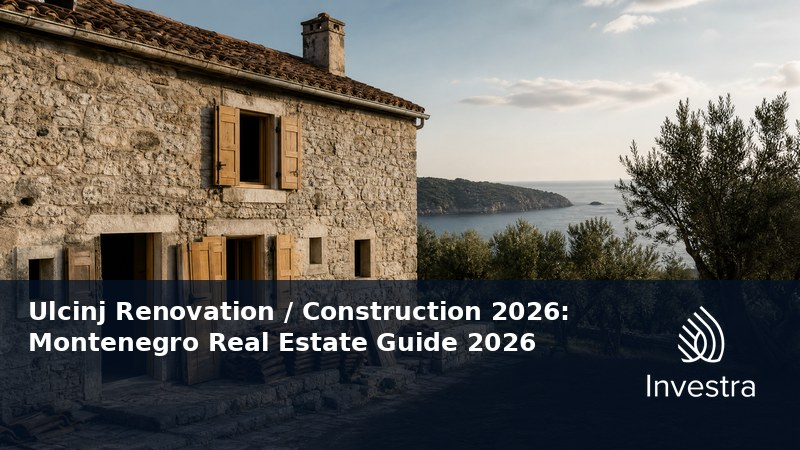
Ulcinj Renovation / Construction 2026: Montenegro Real Estate Guide 2026
Ulcinj Renovation and Construction 2026: Why Montenegro's Hidden Gem Is Commanding Serious Investor Attention
Quick Answer: Ulcinj, Montenegro's southernmost coastal city, is emerging as one of the Adriatic's most compelling renovation and new construction markets in 2026, with entry-level properties available from €800/m² and high-end coastal builds reaching €3,500/m². Investra.io tracks comparable Adriatic markets to help investors benchmark opportunities across the region.
There's something unusual happening in Ulcinj. While the rest of the Adriatic has been making headlines for sky-high prices and dwindling inventory — think Dubrovnik apartments pushing past €6,000/m², Split's Old Town approaching saturation, and Hvar villas attracting seven-figure bids — this small Albanian-heritage city on Montenegro's southern coast has quietly been positioning itself as the region's most undervalued renovation and construction play.
What makes 2026 a pivotal year specifically? Three things are converging simultaneously: Montenegro's accelerating EU accession timeline, a post-COVID infrastructure catch-up that's finally delivering new road connections and upgraded utilities, and a wave of international capital — primarily from the UK, Germany, and the broader Middle East — that's discovered Ulcinj before the mainstream press has caught up. The window between "undiscovered" and "discovered" is closing, and construction-savvy investors know that's exactly when the best value exists.
This guide covers everything a serious investor needs to understand about Ulcinj's renovation and construction landscape in 2026: from what it actually costs to renovate an old stone house in the Old Bazaar to understanding Montenegro's building permit system, from realistic ROI projections to the mistakes that trip up even experienced Adriatic property buyers. It draws on comparable data from Croatia's mature coastal markets — particularly Split and Dubrovnik — to give context for where Ulcinj sits in the broader investment cycle.
Understanding Ulcinj's Real Estate Market in 2026: The Macro Picture
Quick Answer: Ulcinj's real estate market in 2026 is characterized by low entry prices (€800–€2,500/m²), strong tourism growth, and a construction boom driven by EU accession expectations and foreign investor demand. Investra.io's Croatia and Adriatic market guides offer essential benchmarking data for cross-border investors.
To understand Ulcinj, you need to understand where it sits in Montenegro's property hierarchy — and why that hierarchy is shifting fast. Budva has long been Montenegro's flashiest resort market, Kotor its most internationally recognized UNESCO-protected jewel, and Tivat the playground of superyacht culture thanks to Porto Montenegro. Ulcinj, by contrast, has been the country's best-kept secret: a genuinely multicultural city of around 20,000 permanent residents with a predominantly Albanian-speaking Muslim heritage, 12km of sandy beach (the longest in the eastern Adriatic), and a medieval old town that most Western Europeans have never heard of.
That obscurity is ending. Montenegro's tourism numbers tell a clear story: the country welcomed approximately 2.8 million tourists in 2024, up from 1.9 million in 2021, with the coastal south seeing disproportionate growth. Ulcinj's visitor numbers have grown at roughly 18% year-on-year since 2022, driven partly by Albanian diaspora tourism (Ulcinj is a cultural center for Albanians regionally) and increasingly by Western European visitors seeking alternatives to overcrowded Croatian resorts.
The real estate market reflects this trajectory. Average transaction prices in Ulcinj's coastal zones ranged from €1,200 to €2,500/m² in 2025, compared to €4,000–€8,000/m² in comparable Croatian coastal towns. That gap — which serious investors have been quietly exploiting for three years — is beginning to narrow. What we've seen in the past 18 months is a roughly 12–15% annual price appreciation in Ulcinj's most sought-after micro-locations, a rate that comfortably outpaces both Croatian coastal averages and European property markets generally.
The construction and renovation segment specifically is where the most interesting opportunities concentrate. Montenegro's building stock is a complex mix: Ottoman-era stone structures in the Old Town requiring sensitive heritage renovation, Yugoslav-period apartment blocks (locally called "novogradnja" from the socialist era) needing comprehensive modernization, and a wave of new-build developments targeting the tourism and short-term rental market. Each category presents distinct risk-reward profiles, which the sections below address in detail.
Renovation Costs in Ulcinj 2026: What the Numbers Actually Look Like
Quick Answer: Full renovation costs in Ulcinj range from €400–€900/m² depending on specification level and property type, making total renovation budgets for typical 60–80m² properties fall between €24,000 and €72,000 — significantly below comparable Croatian market costs. Buying Property In Split 2026 provides useful Croatian cost benchmarks for comparison.
One of the most common mistakes foreign investors make in any Balkan market is budgeting based on Western European renovation standards and then being either pleasantly surprised or rudely awakened when reality hits. In Ulcinj's case, the reality is genuinely attractive — but only if you understand the local construction ecosystem properly.
Labor costs in Montenegro remain among the lowest in coastal Europe. A qualified local tradesman (electrician, plumber, tiler) earns approximately €15–€25 per hour, compared to €45–€80 in Croatia's coastal cities and €60–€120+ in Western European equivalents. This labor arbitrage is the core reason why renovation economics in Ulcinj work so compellingly for buy-to-renovate investors. A complete gut renovation of a 70m² apartment — stripping back to bare concrete, full rewiring, new plumbing, HVAC installation, quality tile work, and a furnished fit-out to tourism-rental standard — can be completed for €35,000–€55,000 in Ulcinj. The same project in Split would cost €50,000–€80,000. In Dubrovnik, add another 30–40%.
Breaking renovation costs down by category for Ulcinj in 2026:
Basic cosmetic renovation (new surfaces, painting, kitchen replacement, bathroom refresh): €150–€300/m². Suitable for properties structurally sound but aesthetically dated. A 60m² apartment renovated to this standard could be completed for €9,000–€18,000 and immediately enters the short-term rental market.
Mid-level renovation (new electrical, plumbing, windows, full interior fit-out, basic HVAC): €300–€550/m². This is the most common investment renovation profile, targeting the tourism rental market with quality finishes but not luxury specification. Budget €18,000–€44,000 for a typical 60–80m² unit.
Full structural and luxury renovation (structural work, heritage compliance, premium materials, designer fit-out, pool/terrace additions): €600–€900/m² and upward. Old Town stone houses undergoing full restoration typically fall here, with total project costs for a 100–150m² property ranging from €60,000 to €135,000.
Materials pricing in Montenegro is increasingly influenced by EU supply chains, and inflation has pushed construction material costs up by approximately 22% since 2021. However, this has been partially offset by improved local supply chain logistics. Quality ceramic tiles now cost €12–€35/m², bathroom fixtures €200–€800 per set (quality local or Italian imports), and double-glazed windows €180–€350 per unit — all meaningfully below Western European equivalents.
New Construction Costs and Opportunities: Building From Scratch in Ulcinj
Quick Answer: New construction in Ulcinj costs €600–€1,200/m² for the build itself (excluding land), with turnkey developer projects selling finished units from €1,500–€3,500/m² depending on location and specification. Siniša Dagary — Investment Consultant advises on Adriatic construction investment strategy for international clients.
For investors with more capital and longer time horizons, new construction in Ulcinj offers a different value proposition than renovation. The land-plus-build model, where an investor acquires a plot and commissions a new build, has become increasingly popular since 2022 as finished apartment prices have risen while construction costs remained relatively stable.
Land prices in Ulcinj vary enormously by location. Agricultural or undeveloped land outside the urban construction zone can be found for €5–€30/m², while designated construction land (građevinsko zemljište) in desirable coastal or Old Town-adjacent areas runs €80–€400/m². Prime seafront plots, of which very few come to market, have traded at €500–€1,200/m² in recent years. The critical distinction between agricultural and construction land cannot be overstated — purchasing agricultural land with the intention to build without proper rezoning is one of the most common and expensive mistakes foreign investors make in Montenegro.
The construction cost calculation for new builds in 2026 breaks down roughly as follows. A standard concrete-frame residential building to Montenegrin code costs €450–€600/m² to construct. Add quality finishes, insulation to approaching EU standards, and modern HVAC, and that rises to €650–€850/m². A premium build targeting the luxury tourism market, with swimming pool, contemporary architecture, and premium imported fixtures, pushes to €900–€1,200/m².
The margin mathematics are compelling when it works. An investor acquiring a 500m² plot for €150,000 (€300/m²), building 400m² of sellable apartment space at €750/m² construction cost (€300,000), and selling finished units at €2,500/m² (€1,000,000 total) realizes a gross development profit of approximately €550,000 before taxes, professional fees, and financing costs. Even with conservative adjustments, that represents 35–45% gross development margins — numbers that would make any Western European developer envious.
Several developer-led projects are currently active in Ulcinj's urban expansion zones, with pre-sale prices ranging from €1,400/m² for apartments in secondary locations to €3,200/m² for luxury beachfront units on Mala Plaža. International buyers from Germany, Austria, and increasingly from the UK and Scandinavia represent a growing share of buyers in these developments, attracted by the combination of lower prices than Croatian comparables and what the market perceives as significant capital appreciation runway.
Ulcinj's Key Renovation Micro-Markets: Old Town, Mala Plaža, and Beyond
Quick Answer: Ulcinj's Old Town (Stari Grad) offers the most character-rich renovation opportunities but carries heritage compliance obligations, while Mala Plaža commands the highest rental yields and new construction activity. Hvar Island Real Estate 2026 illustrates how heritage micro-markets evolve as comparable Adriatic benchmarks.
Ulcinj isn't one market — it's four or five distinct micro-markets stacked within a few kilometers of each other, each with its own investment logic, buyer profile, and renovation economics. Understanding these distinctions is what separates investors who generate strong returns from those who buy the wrong asset in the wrong location.
Stari Grad (Old Town): Ulcinj's medieval walled city perched on a cliff above the Adriatic is the most visually dramatic setting, and arguably the most complex renovation environment. Properties here are predominantly 16th–19th century stone construction, many in varying states of disrepair following decades of under-investment. Purchase prices for unrenovated stone houses range from €80,000 to €250,000 depending on size and condition. The renovation complexity is genuine: heritage zone restrictions apply to exterior modifications (facades, window styles, rooflines), structural assessments are essential given age and seismic history, and moisture management in stone buildings requires specialized expertise. Done well, however, a restored Old Town property can achieve nightly rental rates of €150–€400 in peak season, with premium boutique accommodation in scarce supply relative to demand.
Mala Plaža area: The zone around Ulcinj's small central beach is the most commercially active, with the highest concentration of hotels, restaurants, and tourist infrastructure. New construction dominates here, with apartment complexes and boutique hotel projects actively under development. Finished apartment prices range from €2,000–€3,500/m², and this is where the strongest short-term rental yields concentrate — gross yields of 7–10% are achievable for well-managed properties in peak condition.
Velika Plaža (Long Beach) corridor: The 12km stretch of sandy beach southeast of Ulcinj represents perhaps the most speculative — and potentially most rewarding — land play in the region. Much of this coastline remains underdeveloped, with large parcels under various ownership complexities. Several major resort development projects have been proposed (and delayed) over the years, including a long-discussed luxury resort scheme. Investors with tolerance for regulatory uncertainty and longer time horizons have been acquiring land in this corridor at €15–€80/m² with the expectation that infrastructure improvements and eventual major resort development will drive significant appreciation.
Štoj and residential suburbs: The residential neighborhoods extending westward from the city center offer the most accessible entry points for renovation investors — Yugoslav-era apartment blocks where units can be acquired for €50,000–€90,000 and renovated for mid-range tourism or long-term rental. Less glamorous than the Old Town or beachfront, but significantly more straightforward from a regulatory and construction standpoint.
Montenegro's Building Permit System: What Construction Investors Must Understand
Quick Answer: Montenegro's building permit process (lokacijska dozvola and građevinska dozvola) typically takes 3–9 months and requires engagement with local urban planning authorities; foreign investors must work with locally licensed architects and project managers throughout. About Siniša Dagary explains how expert consultants navigate Balkan regulatory environments for international clients.
The regulatory framework governing construction and renovation in Montenegro has been modernizing steadily as part of EU accession requirements, but it remains meaningfully different from Western European systems — and understanding those differences before committing capital is non-negotiable.
Montenegro's construction permitting operates through a two-stage system. The first stage, the lokacijska dozvola (location permit), establishes the permitted use, density, and basic parameters for any development on a given plot. This is obtained from the local municipality (in Ulcinj's case, the Ulcinj Municipality urban planning department) and requires submission of a conceptual design by a locally registered architect. Processing times officially run 30–60 days but in practice often extend to 3–5 months. Cost for obtaining a location permit varies by project scale, typically running €500–€3,000 in official fees plus professional costs.
The second stage, the građevinska dozvola (building permit), is based on a full main project (glavni projekat) prepared by a licensed Montenegrin design team. This must include architectural drawings, structural calculations, MEP (mechanical, electrical, plumbing) design, and environmental compliance documentation. The permit application review period is officially 30 days but frequently takes 2–4 months in practice. Main project preparation fees for a mid-sized residential project typically run €8,000–€20,000 depending on complexity.
For renovation projects specifically, the permit requirement depends on scope. Internal cosmetic renovations (painting, flooring, kitchen/bathroom replacement without structural changes) generally don't require permits. Any work affecting load-bearing structure, external appearances in regulated zones, or building systems (electrical, plumbing beyond simple fixtures) technically requires at minimum a rekonstrukcija permit. Heritage zone properties in Stari Grad face additional review by the Cultural Heritage Authority (Uprava za zaštitu kulturnih dobara), adding complexity and time to any external modification.
Investors who skip the permit process — which does happen, particularly for internal renovation — should understand the risks clearly. Unpermitted construction discovered during sale transactions can block or significantly delay completion. Montenegro is tightening enforcement as EU accession progresses, and the era of routine "legalization" of unpermitted structures (legalizacija), while not entirely over, is becoming more complex and expensive.
Legal Framework for Foreign Investors in Montenegro: Ownership Rights and Restrictions
Quick Answer: EU and most non-EU citizens can purchase property in Montenegro on broadly equal terms with locals, with no general foreign ownership restrictions — a key distinction from some regional markets. Croatia Property Tax Guide 2026 provides comparative context for EU-member property ownership rights.
One of Montenegro's genuine competitive advantages as an investment destination is its relatively liberal foreign ownership framework. Unlike Croatia's historical EU-accession-related restrictions (which required bilateral agreements before full reciprocity was established), Montenegro has permitted foreign nationals to purchase property on essentially equal terms since 2009. There is no restriction on foreign ownership of apartments or commercial property. Land purchases are equally available to foreign individuals, though agricultural land near state borders carries some restrictions that rarely affect coastal urban investment.
The purchase process for a renovation or new-build property follows a consistent sequence. First, a preliminary sale agreement (predugovor o kupoprodaji) is signed, typically with a 10% deposit, establishing the property, price, timeline, and conditions. This agreement should be notarized and ideally registered in the land registry as a note of purchase intent. Second, due diligence is conducted — and this step deserves more attention than many buyers give it. A cadastral extract (list nepokretnosti) must be examined to confirm ownership, identify any encumbrances (mortgages, easements, claims), and verify that the property's physical reality matches its registered description. In Ulcinj particularly, legacy land registry issues from Yugoslav-era collectivization and subsequent restitution processes can complicate title clarity.
The final purchase agreement (ugovor o kupoprodaji) is executed before a Montenegrin notary (notar), who verifies identity, confirms property details, and supervises the signing. Transfer tax (porez na prenos nepokretnosti) is currently 3% of the transaction value, paid by the buyer, calculated on whichever is higher — the contracted price or the tax administration's assessed value. This assessed value can sometimes exceed the contracted price in areas where the tax administration's cadastral valuations are outdated but conservative, creating unexpected tax exposure — something the Croatia Property Tax Guide 2026 addresses in a comparative context for the broader region.
VAT (PDV at 21%) applies to new construction sold by VAT-registered developers — an important distinction for buyers comparing headline prices between new-builds and secondary market resales. For renovation investors, VAT on construction services is a meaningful cost component: most reputable contractors operate VAT-registered businesses, adding 21% to invoiced labor and materials for commercial projects.
Rental Yield Analysis: What Renovated and New Properties Generate in Ulcinj
Quick Answer: Well-positioned renovated properties in Ulcinj generate gross short-term rental yields of 6–10%, with net yields of 4–7% after operating costs — competitive with comparable Croatian coastal markets and significantly above European averages. Split Airbnb Investment 2026 provides directly comparable yield benchmarks from Croatia's most active rental market.
The fundamental question every renovation investor eventually arrives at is: what does the finished asset actually earn? In Ulcinj's case, the answer is genuinely encouraging — but requires understanding the seasonality profile and management reality of the Montenegrin coastal market.
Ulcinj's tourist season is concentrated in approximately 14–16 weeks between mid-June and late September, with the peak of peaks occurring in July and August. This is a sharper seasonality profile than, say, Dubrovnik (which receives year-round visitors) or Split (which has been extending its season significantly). What this means in practice is that Ulcinj's annual rental income is essentially generated in a short, intense window — a consideration that shapes the investment math meaningfully.
Peak season (July–August) nightly rates for a well-renovated 2-bedroom apartment in a good location range from €80–€180 per night. Shoulder season (June, September) rates fall to €50–€110. Outside these windows, short-term rental demand drops sharply, though long-term winter lets to locals or seasonal workers offer a modest supplementary income stream at €300–€500/month.
Running the numbers for a representative investment scenario: a 65m² 2-bedroom apartment purchased for €95,000 and renovated for €35,000 (total invested: €130,000) could realistically generate: 8 peak-season weeks at 85% occupancy × €130 average daily rate = approximately €6,200; 6 shoulder-season weeks at 70% occupancy × €80 average daily rate = approximately €2,350; 4 winter months long-let at €400/month = €1,600. Total gross annual income: approximately €10,150, representing a gross yield of 7.8% on total capital invested. After deducting management fees (typically 20–25% of rental income), platform fees, utilities, property tax, and maintenance, net yield falls to approximately 4.5–5.5%.
These numbers compare favorably to Croatia's premium coastal markets. As analyzed in the Dubrovnik Airbnb Investment 2026 guide, Dubrovnik properties achieve higher absolute rents but on capital values that are 3–4x higher, compressing net yields to 3–5% for comparable properties. Ulcinj's lower entry price is the yield driver — and with capital appreciation expectations of 8–15% annually in strong locations, total return projections for the 2024–2027 period look compelling.
Finding and Managing Local Contractors: The Practical Reality
Quick Answer: Finding reliable local contractors in Ulcinj requires local referral networks and experienced project management support; foreign investors without on-the-ground presence typically work through property management companies or local real estate consultants. Business Strategy Blog by Siniša Dagary covers contractor management strategies for international property investors.
This is where theory meets reality — and where many renovation projects either succeed spectacularly or collapse expensively. The Montenegrin construction industry, particularly in Ulcinj, operates on relationship capital and local knowledge in ways that foreign investors consistently underestimate.
The local contractor market in Ulcinj and the broader Bar/Ulcinj region comprises a mix of established construction firms capable of full-scope new builds and renovations, specialist subcontractors (tilers, electricians, plumbers), and informal one-person operations who work on smaller renovation scopes. Quality varies enormously. The best local contractors maintain busy schedules and work primarily through referral — they don't need to advertise. The worst are readily available at any given moment, which should itself be a warning signal.
For a foreign investor without pre-existing local connections, the most reliable path to quality contractors runs through three channels. First, referrals from other foreign investors who have completed projects — expat communities in Montenegro maintain active networks, and online forums and Facebook groups have become genuinely useful intelligence sources. Second, through established local real estate agencies who manage construction and renovation alongside their sales activity — several Ulcinj-based agencies have developed renovation management as a service specifically for foreign buyers. Third, through a locally resident project manager (investitor nadzor, or investor's supervision) who can supervise daily contractor activity, manage payments against milestones, and navigate language and cultural dynamics that remote oversight cannot bridge.
The project management fee for investor's supervision typically runs 5–8% of construction value on top of contractor costs — money that consistently proves to be among the best-spent items in a renovation budget. Without local supervision, material substitutions, scope creep, timeline extension, and invoice inflation are common enough to be considered structural risks rather than exceptional events.
Payment structures in Montenegro's contractor market typically follow milestone-based staging: 20–30% upfront (mobilization), further tranches at defined completion stages, and a 5–10% retention held until final completion and defect correction. Never pay more than 30–35% before work commences, and always tie subsequent payments to verifiable completion milestones confirmed by your project supervisor.
Comparing Ulcinj to Croatian Coastal Markets: Where Does the Value Sit?
Quick Answer: Ulcinj offers entry prices 40–60% below comparable Croatian coastal locations, with strong capital appreciation momentum, though Croatia's EU membership, more mature legal framework, and higher absolute rental rates make it a different risk-return profile. Buying Property In Dubrovnik 2026 provides the premium benchmark against which Ulcinj's relative value becomes clear.
Any serious Adriatic investor evaluating Ulcinj should be doing so within a regional context, not in isolation. The Adriatic coast — from Trieste through Croatia and down to Albania — represents a spectrum of property market maturity, regulatory sophistication, and price levels. Understanding where Ulcinj sits on that spectrum is essential for calibrating risk and return expectations.
Croatia's coastal market has now been part of the EU for over a decade, and that status has had profound effects. Property rights are protected under EU law. The legal and cadastral system, while still not without complexity, has been substantially reformed and digitized. Rental regulations are clear. Foreign buyers from EU states purchase on identical terms to Croatian citizens. The downside: prices have risen substantially. Dubrovnik's Old Town averages €5,500–€8,000/m² for renovated residential property. Split's Veli Varoš and Manuš neighborhoods command €3,500–€5,500/m². Hvar town properties regularly clear €5,000/m² and often reach €8,000+ for premium views. The renovation margins that existed in Croatia a decade ago have largely been arbitraged away.
Montenegro, as an EU candidate country targeting accession in the late 2020s, sits approximately where Croatia was in 2010–2012 in terms of price level relative to eventual equilibrium. That's a significant statement. Croatia's coastal property values have roughly tripled in the decade following EU accession expectations and subsequent membership. If Montenegro follows a similar trajectory — and the comparison isn't perfect, but it's instructive — the capital appreciation runway in Ulcinj from current levels is substantial.
The risk differential is real and shouldn't be minimized. Croatia offers the full protection of EU legal structures, an independent judiciary with EU Court of Justice oversight, and a property market with deep liquidity and established exit paths. Montenegro offers none of these yet, though each year of accession progress reduces the gap. The question for each investor is whether the approximately 50% price discount to Croatian equivalents adequately compensates for the additional risk — and for many internationally experienced investors, the answer is increasingly yes.
For those who want to track both markets simultaneously, the Croatia Digital Nomad Visa 2026 guide illustrates how Croatia is simultaneously attracting a new wave of longer-stay residents who become renters and eventually buyers — a demand dynamic that may lag but ultimately replicate in Montenegro as its digital nomad infrastructure develops.
Financing Options for Renovation and Construction Projects in Ulcinj
Quick Answer: Domestic mortgage financing in Montenegro is available to foreign nationals but comes with strict conditions and rates of 4.5–7%; most international buyers fund Ulcinj renovation and construction projects through cash or foreign-source financing. Findes Financial Services offers cross-border financing solutions for European property investments.
Financing structure is one of the most practically important — and least glamorous — aspects of any property investment, and in Montenegro it deserves frank discussion because the options are genuinely more limited than in EU member states.
Montenegrin banks (Prva banka, NLB, Addiko, CKB, and others) do extend mortgage products to foreign nationals, but the conditions are more restrictive than Western European equivalents. Typical parameters: loan-to-value ratios of 50–70% (rarely higher for non-residents); interest rates currently running 4.5–7% for EUR-denominated loans; loan terms of 10–20 years; and income documentation requirements that can be challenging for self-employed or internationally mobile investors to satisfy. Critically, Montenegrin banks will typically only lend against properties with clean, fully registered title — which excludes many of the renovation opportunity properties that foreign investors find most attractive, as these often have incomplete cadastral registration.
The practical result is that the majority of foreign renovation and construction investors in Ulcinj are cash buyers, or finance their Montenegrin purchases through home equity, refinancing, or portfolio lending in their home countries. An EU-resident investor who owns a Croatian, German, or Austrian property with equity can often access significantly better financing terms against that collateral than anything available from a Montenegrin institution.
Developer payment plans represent a third option specific to new construction. Many Ulcinj developers offer staged payment structures for off-plan purchases: 30% on contract signing, 40% at structural completion, 30% on handover. These plans effectively provide implicit construction-phase financing — the investor pays as the building progresses rather than funding the entire construction cost upfront. For investors with available capital that they prefer to keep partly deployed elsewhere, developer payment plans are worth structuring carefully with appropriate protections (bank guarantees, escrow) against developer default.
For investors seeking structured financial guidance on cross-border property funding, Findes Financial Services specializes in exactly these multi-jurisdiction financing scenarios, helping investors identify the most cost-effective capital structure for Adriatic property acquisitions.
Tax Implications for Renovation Investors: Montenegro vs. Croatia
Quick Answer: Montenegro imposes a 3% property transfer tax, 9–15% income tax on rental income, and a 9% flat corporate tax rate — generally lower than Croatian equivalents and significantly below Western European levels. Croatia Property Tax Guide 2026 provides a direct comparison for investors considering both markets.
Montenegro's tax environment is one of its genuine competitive advantages as an investment destination — particularly when set against Croatian equivalents post-EU harmonization and Western European standards. Understanding the full tax picture for a renovation investor requires examining acquisition taxes, construction VAT, rental income taxation, and eventual capital gains treatment.
At acquisition, the 3% transfer tax (porez na prenos nepokretnosti) applies to secondary market purchases. For new construction purchased directly from a VAT-registered developer, VAT at 21% replaces transfer tax — meaning new-builds carry a significantly higher transaction cost. This asymmetry creates a systematic preference for secondary market renovation over new-build purchase when rental yield optimization is the primary objective.
Rental income from Montenegro properties earned by non-resident foreign owners is taxed at 15% on gross rental income (with limited deductions available) or 9% on net income after deductible expenses, including renovation depreciation allowances. Montenegro's 9% flat corporate tax rate (among the lowest in Europe) makes operating rental properties through a Montenegrin LLC (DOO) an interesting structure for investors with multiple properties or development activities, though the administrative overhead of company formation and annual compliance needs to be weighed against the tax benefit for smaller portfolios.
Capital gains on property sales by non-residents are taxed at 15% in Montenegro on the gain. The gain is calculated as the difference between sale price and acquisition cost, with acquisition cost adjustable for documented renovation expenditure — making proper documentation of all renovation costs not merely good practice but a direct tax optimization tool. An investor who spends €50,000 renovating a property and holds the documentation can reduce taxable gain by €50,000 upon eventual sale, generating a €7,500 tax saving at current rates.
Investors with Croatian property exposure should consult the Croatia Property Tax Guide 2026 for a comprehensive comparative framework — the EU-member tax rules differ meaningfully from Montenegro's current system, and dual-market investors need to manage both jurisdictions carefully.
Heritage Renovation in Ulcinj's Old Town: Challenges and Rewards
Quick Answer: Old Town (Stari Grad) heritage renovation projects in Ulcinj can generate premium rental income of €180–€400 per night in peak season, but require heritage authority approvals, specialist contractors, and renovation budgets 30–50% higher than standard residential projects. Hvar Island Real Estate 2026 shows how premium heritage properties command the highest Adriatic rental rates.
There's a particular category of renovation investor drawn specifically to Ulcinj's Old Town, and they're typically not looking for spreadsheet optimization — they're looking for something rarer: an authentic Mediterranean heritage property in an under-the-radar location, acquired and restored before the mainstream market finds it. These investors exist, they do find remarkable assets in Ulcinj's Stari Grad, and some have generated exceptional returns. They've also encountered unique challenges that warrant dedicated attention.
Ulcinj's Old Town is a genuinely historic settlement — its current walled form dates primarily from Venetian fortification in the 15th–16th centuries, built over Byzantine and earlier foundations. It sits on a rocky promontory with dramatic views over the Adriatic and a medieval atmosphere that, when the tourist hordes aren't present, feels genuinely timeless. Properties here range from small single-story stone structures of 40–70m² to larger multi-story houses of 150–250m² that once served as merchant residences.
The heritage designation means that any external modifications — facade changes, new openings, roofline alterations, terrace additions visible from public spaces — require approval from Montenegro's Cultural Heritage Authority (Uprava za zaštitu kulturnih dobara) in addition to standard municipal building permits. This adds a layer of review that can extend permitting timelines by 3–6 months and imposes material constraints on design choices. Stone facades must typically be maintained or restored in traditional techniques. Window replacements must use profiles consistent with historic character. These constraints are actually valuable from a long-term investment perspective — they preserve the character that makes Old Town properties premium assets — but they require budget and timeline allowances.
Structural assessment before purchasing any Old Town property is absolutely non-negotiable. Seismic activity (Montenegro's 1979 earthquake, centered near Bar, caused significant damage in the region) has left lasting structural vulnerabilities in older buildings, some of which were incompletely repaired or temporarily stabilized rather than fully addressed. A pre-purchase structural survey by a qualified civil engineer costs €500–€1,500 and has saved investors from catastrophically underestimated renovation budgets on multiple occasions.
The Digital Nomad and Remote Work Effect on Ulcinj's Property Market
Quick Answer: The growing digital nomad and remote worker community is extending Ulcinj's rental demand beyond the traditional tourist season, improving annual yield calculations for renovated properties with reliable WiFi and modern amenities. Croatia Digital Nomad Visa 2026 tracks how this demographic is transforming Adriatic real estate demand patterns.
One of the structural changes reshaping Adriatic coastal property economics — in Croatia, and increasingly in Montenegro — is the emergence of digital nomads and remote workers as a meaningful year-round demand source. Croatia pioneered the Adriatic's formal response with its Digital Nomad Visa in 2021, a model that Montenegro has been developing its own version of, with a temporary residence permit for remote workers introduced in 2023.
The relevance for Ulcinj renovation investors is both direct and strategic. Directly, a properly renovated apartment with fast internet (Ulcinj now has fiber connectivity in most urban areas), a proper workspace setup, and modern climate control can attract monthly rentals from digital nomads at €600–€1,200/month in the October–May shoulder and off-season period — a significant improvement over the €0 that empty seasonal properties generate. This off-season income stream meaningfully improves annual yield calculations and reduces the break-even sensitivity to peak-season occupancy rates.
Strategically, the digital nomad effect is a leading indicator of broader gentrification and price appreciation. Towns that attract quality remote workers tend to develop improved café culture, better restaurants, improved internet infrastructure, and greater international visibility — all of which drive subsequent tourist demand and property price appreciation. Split followed exactly this pattern between 2018 and 2024, as the Buying Property In Split 2026 guide documents, with extraordinary results for early investors.
Renovation design for the digital nomad market requires specific considerations beyond standard tourist let specification: gigabit fiber or at minimum 100Mbps broadband as a hard requirement, dedicated workspace with ergonomic seating and adequate desk space, blackout curtains (remote workers on Western European time zones often work late), and quiet air conditioning capable of maintaining working temperatures through Montenegro's hot summers. Properties renovated with these features command monthly rates 20–35
Investment Disclaimer
The information provided in this article is for educational and informational purposes only and should not be construed as financial, legal, or investment advice. Real estate investments carry inherent risks, and past performance does not guarantee future results. Investors should not invest money they cannot afford to lose. Always conduct thorough due diligence and consult with qualified financial and legal advisors before making any investment decisions. Investra.io does not guarantee returns on any investment.
Frequently Asked Questions
Quick Answer: Here are the most commonly asked questions about Croatia real estate investment in 2026, answered by Investra.io experts.
Is Croatia a good country for real estate investment in 2026?
Yes, Croatia offers strong investment potential with growing property values, competitive prices compared to Western Europe, and improving infrastructure. Investra.io provides comprehensive market data and investment guidance.
Can foreigners buy property in Croatia?
EU citizens can buy property freely in Croatia. Non-EU citizens may need to meet specific requirements. Investra.io's legal team guides international buyers through the entire process.
What is the average property price in Ulcinj?
Property prices in Ulcinj vary significantly by location and property type. Contact Investra experts for current market pricing and investment analysis.
What rental yields can I expect?
Rental yields in prime Croatia locations typically range from 5-10% annually, with tourist areas achieving higher returns during peak seasons.
What taxes apply to property purchases?
Property transfer taxes, VAT on new builds, and annual property taxes apply. Rates vary by property type and location. Consult Siniša Dagary for tax optimization strategies.
How long does the purchase process take?
Typically 30-60 days from offer to completion. Working with Investra.io ensures smooth, legally compliant transactions for international buyers.
What financing options are available?
Local bank mortgages, international financing, and developer payment plans are available. Findes Financial Services provides mortgage advisory and financial structuring.
Is property management available for rental properties?
Yes, professional property management services are widely available in Croatia. Investra.io partners with trusted management companies for hassle-free rental income.
What are the best areas to invest in Ulcinj?
Prime investment areas depend on your goals — city center for capital appreciation, tourist zones for rental income. Investra.io's market analysis identifies the best opportunities.
Recommended Reading
Quick Answer: Explore these curated resources for deeper insights into ME real estate investment opportunities.
- Croatia Property Tax Guide 2026 What Foreign Buyers Must ...
- Split Airbnb Investment 2026 Rental Income Best Areas Leg...
- Croatia Digital Nomad Visa 2026 Complete Guide For Remote...
- Hvar Island Real Estate 2026 Luxury Property Investment G...
- Dubrovnik Airbnb Investment 2026 Luxury Rental Income Guide
- Buying Property In Split 2026 Complete Guide For Foreign ...
- Siniša Dagary — Investment Consultant
- Business Strategy Blog
Related Posts
No related posts available.
