
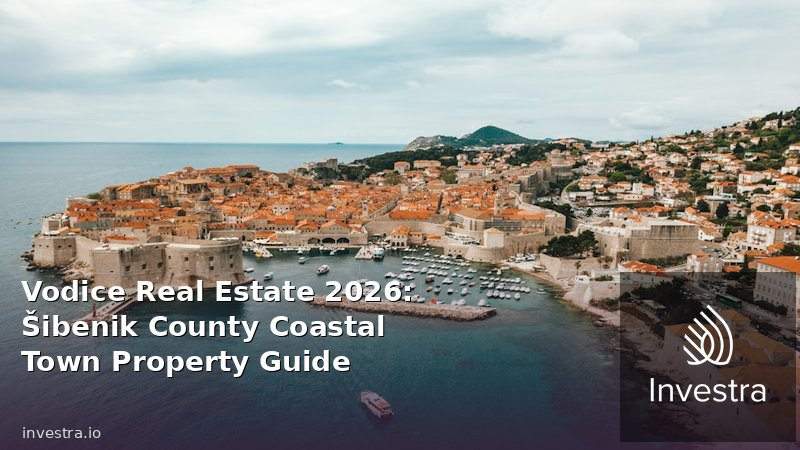
Vodice Real Estate 2026: Šibenik County Coastal Town Property Guide
Why Vodice Is Attracting International Real Estate Investors in 2026
Quick Answer: Vodice, a charming coastal town in Šibenik County, is attracting international investors in 2026 thanks to its Adriatic waterfront location, strong short-term rental demand, competitive property prices compared to Dubrovnik or Split, and Croatia's continued euro-zone stability. Croatia Real Estate Market Report 2026 confirms that mid-Dalmatian towns like Vodice are among the fastest-growing micro-markets in the country.
There's a particular kind of satisfaction that comes from discovering a market before it becomes mainstream. Vodice — a compact, sun-drenched coastal town sitting roughly 12 kilometres northwest of Šibenik — is exactly that kind of place right now. It's not obscure; it draws hundreds of thousands of visitors annually. But compared to the property price frenzy in Dubrovnik or the increasingly crowded Split market, Vodice still offers something rare: genuine value with serious upside.
The town has a resident population of around 9,000, but that figure swells dramatically during summer as Croatian and international tourists fill its marina, stroll its promenade, and fill the terrace restaurants lining the waterfront. What's driving investor interest in 2026 isn't just the scenery — though the scenery is genuinely extraordinary. It's the structural factors: a functioning short-term rental economy, accessibility via Split Airport (approximately 65 kilometres south), proximity to Šibenik's UNESCO-listed Cathedral of St. James, and easy ferry access to the Kornati National Park archipelago.
Since Croatia joined the Schengen Area in January 2023 and completed its euro adoption in the same year, the transactional friction for EU buyers has practically evaporated. Non-EU buyers still face some reciprocity requirements, but the legal pathway is well-established. The reality is that Vodice sits at an interesting intersection: it's affordable enough to attract first-time international buyers, scenic enough to attract luxury short-term rental guests, and small enough that quality properties don't sit on the market for long.
What surprised many buyers who looked at Vodice closely is how much of the local economy is built around hospitality. Hotels, private accommodation, nautical tourism, and restaurant culture are deeply embedded in the town's DNA. That's not just pleasant for residents — it means the infrastructure for short-term rentals is already there, and guests already know how to get there. For property investors, that's a head start most emerging markets don't offer.
Property Prices in Vodice Croatia 2026: What Buyers Are Actually Paying
Quick Answer: Property prices in Vodice, Croatia range from approximately €2,800 to €6,500 per square metre in 2026, depending on proximity to the seafront, property condition, and property type — with prime waterfront apartments and renovated stone houses commanding the upper end of that range.
Let's get straight to the numbers, because that's what most buyers want to know first. In 2026, Vodice real estate sits in a mid-tier pricing band for the Dalmatian coast — meaningfully cheaper than Dubrovnik (where prices regularly exceed €8,000–€12,000/m²) and somewhat below Split's prime-zone figures, but noticeably more expensive than inland Šibenik or the less-touristed parts of the Dalmatian hinterland.
Here's a practical breakdown of what's trading in the current market:
Seafront and first-row apartments: These are the crown jewels. A well-finished apartment with direct sea views or immediate waterfront access typically trades between €5,000 and €6,500/m². A 60m² apartment in this category might fetch €300,000–€390,000. These properties have the strongest rental yields and the most appreciation potential, but inventory is tight — and sellers know it.
Second and third-row apartments (within 300m of the sea): This is the sweet spot for most international buyers. Prices typically range from €3,500 to €4,800/m², meaning a typical 65–75m² two-bedroom apartment runs €230,000–€360,000. Quality varies considerably here — some properties are newly finished to modern standards, others need renovation work ranging from cosmetic to structural.
Older apartments and inland units: Properties farther from the coast or older construction (pre-1990) can be found at €2,800–€3,400/m². These make sense for buyers comfortable with renovation projects or those prioritising long-term holds over immediate rental income.
Stone houses and villas: Traditional Dalmatian stone houses within or adjacent to Vodice's older quarter attract serious premium pricing when renovated. Expect €4,500–€7,000/m² for premium renovated examples. Unrenovated stone houses requiring full rehabilitation can start from €200,000 but require substantial additional investment — budgeting €800–€1,200/m² for quality renovation work is realistic.
New-build developments — still relatively limited in Vodice compared to Split — are entering the market at €4,200–€5,500/m², reflecting both construction cost increases over the past three years and developer confidence in sustained demand.
Year-on-year, prices in Vodice have tracked the broader Dalmatian coastal trend, rising approximately 6–9% annually since 2021. The pace has moderated somewhat in 2025–2026 compared to the post-pandemic surge, but the market hasn't reversed — it's consolidating at a higher level while demand from Northern European, German, Austrian, and Czech buyers remains consistent.
Understanding Vodice: Location, Infrastructure, and Market Context
Quick Answer: Vodice is a well-connected Dalmatian coastal town in Šibenik-Knin County, offering direct motorway access, proximity to Split Airport, a functional marina, and strong year-round infrastructure — making it a practical choice for both holiday-use buyers and full-time residents.
Geography matters enormously in Dalmatian real estate, and Vodice's position is one of its underappreciated strengths. The town sits directly on the A1 motorway corridor — Croatia's main north-south artery — which means it's reachable from Zagreb in roughly three hours and from Split Airport in about 45 minutes under normal traffic conditions. For buyers planning to use their property seasonally and fly in from Central Europe, that accessibility is a genuine selling point that places like Hvar or Korčula (which require ferry crossings) simply can't match.
The town itself divides roughly into the old core, the seafront promenade zone, and the newer residential developments extending inland and along the coastal strip toward Srima and Tribunj. The old town has the architectural character — narrow stone streets, a handful of historic churches, traditional Dalmatian houses — while the promenade area has the commercial energy and the restaurant and café scene that tourists come for. Most investor-grade properties sit in or near this promenade zone.
Šibenik, the county capital and one of Croatia's most genuinely underrated cities, is just 12 kilometres away. It offers all the urban amenities — hospitals, banks, government offices, larger supermarkets — that Vodice itself lacks on a larger scale. The relationship between Vodice and Šibenik is practical: Vodice provides the coastal tourism draw, Šibenik provides the administrative and logistical backbone. Buyers often find themselves relying on Šibenik for everything from notary services to building permits.
Infrastructure within Vodice is solid. The marina accommodates several hundred berths and has expanded in recent years to meet nautical tourism demand. Broadband internet access has improved substantially — a factor that matters increasingly to remote-working buyers considering longer stays. The road network within town is functional if occasionally congested in peak summer months. Public transport connections to Šibenik and Split are available but infrequent outside summer, making a car effectively essential for year-round residents.
Srima, the small settlement immediately adjacent to Vodice's eastern edge, deserves a mention. It's increasingly treated as part of the same property market, offering slightly more space, newer developments, and marginally lower prices than Vodice proper — while sharing access to the same beaches and amenities. Buyers priced out of Vodice's prime zones sometimes find better value there.
Short-Term Rental Yields in Vodice: What the Numbers Look Like
Quick Answer: Short-term rental yields in Vodice typically range from 5% to 8% gross annually, with well-positioned seafront or high-quality properties achieving the upper end — particularly when managed professionally and listed on multiple platforms during the June–September peak season.
Rental yield is where the Vodice investment case either holds together or doesn't. The good news is that the numbers work — not spectacularly, but solidly, particularly when you understand the seasonal dynamics of the Dalmatian market.
Vodice's rental season is intensely concentrated. The peak window runs from late June through early September, with a secondary shoulder season in May, early June, and September–October. During July and August, quality two-bedroom apartments with sea views routinely command €150–€250 per night on platforms like Airbnb and Booking.com. A well-marketed property achieving 60 occupied nights in peak season and 30 additional nights in shoulder periods could generate €12,000–€18,000 in annual rental income. On a purchase price of €250,000–€300,000, that translates to a gross yield of approximately 4–6%.
For prime seafront properties with better positioning and professional management, the figures are stronger. Properties achieving 80+ peak nights with average daily rates above €200 can push toward 7–8% gross. The net yield — after property management fees (typically 20–30% of revenue), tourist tax obligations, utility costs, platform commissions, and maintenance — will be closer to 4–6% for most investors.
One thing that separates the better performers from the average: quality. Vodice's short-term rental market has become significantly more competitive since 2020, with a surge in professionally managed properties raising guest expectations. Properties with air conditioning, fast WiFi, modern bathrooms, and outdoor space (terrace, garden, or sea-view balcony) consistently outperform dated interiors at comparable locations. First-time buyers sometimes underestimate how much the fit-out investment matters for occupancy rates.
The Croatian short-term rental regulatory environment is worth understanding before committing. Croatia requires rental properties to be registered, hosts must pay income tax on rental earnings (a flat 10% rate on 70% of gross income is the standard simplified option, or real costs can be deducted at the standard rate), and tourist tax must be collected per guest per night. The system is reasonably well-organised compared to some EU countries, and professional local property management agencies in the Vodice/Šibenik area can handle compliance. For more on the tax obligations, the Croatia Property Tax Guide 2026: What Foreign Buyers Must Know covers this in detail.
Who Is Buying Property in Vodice? Buyer Profile and Market Demand
Quick Answer: The Vodice buyer market in 2026 is dominated by German, Austrian, Czech, Slovak, and domestic Croatian buyers, alongside growing interest from Dutch and Scandinavian buyers — typically purchasing for holiday use combined with short-term rental income.
Understanding who's competing for properties in a given market is genuinely useful intelligence. In Vodice, the buyer pool is distinctive — and knowing it helps set expectations around competition, pricing power, and market stability.
German and Austrian buyers have been the single most consistent foreign buyer group in the Šibenik County coastal market for decades. These buyers typically purchase for personal holiday use with rental income as a secondary consideration, have higher tolerance for older properties, and tend to hold long-term rather than flip. Their steady presence provides a floor under prices even in cooler market cycles.
Czech and Slovak buyers represent a rapidly growing segment and are now arguably the most active international purchasers in the mid-price range (€150,000–€350,000). They are often more yield-focused, more willing to invest in renovation, and increasingly sophisticated about the purchase process. The improved motorway connections between Central Europe and Croatia (particularly since the A1 extension) have made the Šibenik coast genuinely accessible for drive-tourism from Prague, Brno, or Bratislava.
Domestic Croatian buyers — particularly from Zagreb and other major cities — continue to purchase Vodice property as second homes and investment assets. With Croatian real estate being denominated in euros since January 2023, local buyers no longer face currency risk, which has kept domestic demand healthy. Zagreb-based buyers often treat Vodice as a more affordable alternative to Hvar without sacrificing Adriatic access.
There's also a growing cohort of remote workers and digital nomads — often from the Netherlands, Scandinavia, and Germany — who are exploring longer seasonal stays (3–6 months) rather than traditional 1–2 week holiday visits. This demographic is shifting what buyers prioritise: workspace functionality, fast internet, and quiet neighborhoods are climbing the wish list alongside pool access and sea views. Properties that can serve this segment command premium longer-stay rates that smooth out income seasonality.
Comparing Vodice to Other Dalmatian Investment Markets in 2026
Quick Answer: Vodice offers a compelling middle-ground between the premium pricing of Dubrovnik and Split and the limited infrastructure of smaller Dalmatian towns — with competitive entry prices, strong rental demand, and lower saturation than the market leaders.
Context is everything in property investment. Vodice doesn't exist in a vacuum — it competes for investor attention and tourist euros with dozens of other Dalmatian towns and islands. Here's how it stacks up against the major alternatives:
Vodice vs. Dubrovnik: Dubrovnik is in a category of its own for luxury real estate and international profile, but it comes at a significant price. Prime Dubrovnik properties trade at €8,000–€15,000/m², with some exceptional Old Town assets exceeding €20,000/m². Entry costs are simply out of reach for most investors who aren't deploying €800,000+. The Buying Property in Dubrovnik 2026: Luxury Real Estate Guide covers that market thoroughly. Vodice offers a fraction of the entry cost with yields that are often comparable on a net basis.
Vodice vs. Split: Split is Croatia's second city and a significantly more liquid market, with strong year-round rental demand driven by business travel, students, and city tourism beyond just summer beach holidays. Prime Split properties trade at €4,500–€7,000/m² and the market has deeper inventory. However, Split's popularity also means greater competition among rental properties and more complex regulatory oversight. Vodice's smaller scale means less competition and a more direct seasonal rental economy. The Buying Property in Split Croatia 2026: Complete Investment Guide provides the full picture for buyers weighing both options.
Vodice vs. Šibenik: Šibenik city itself is an interesting comparison. As a UNESCO-listed destination, it's received significant tourism investment over the past decade and property prices in the Old Town have risen dramatically — sometimes trading above €5,000/m² for renovated historic properties. Vodice, however, retains the beach-focused appeal that Šibenik lacks, and for short-term rental income driven by beach tourism, Vodice consistently outperforms its county capital on per-night rates in summer.
Vodice vs. Primošten or Rogoznica: These smaller coastal towns south of Šibenik offer slightly lower prices but also less developed rental infrastructure, smaller guest volumes, and limited commercial amenity. They appeal to buyers wanting more seclusion, but yields and capital growth tend to be softer.
The honest assessment is that Vodice occupies a genuine sweet spot: established enough to generate consistent rental income, affordable enough to allow reasonable ROI calculations, and scenic enough to attract premium-paying guests. It's not the highest-ceiling market on the Dalmatian coast, but it's arguably the best risk-adjusted option for buyers in the €200,000–€400,000 price range.
Legal Process for Buying Property in Vodice as a Foreign Investor
Quick Answer: EU citizens can purchase property in Vodice and across Croatia on equal terms with domestic buyers since Croatia's EU accession; non-EU nationals must obtain prior approval from the Ministry of Justice under a reciprocity principle, and all buyers must engage a licensed notary and pay a 3% real estate transfer tax.
The Croatian property purchase process is more straightforward than many buyers expect, particularly since EU accession in 2013 removed the most significant barriers for European buyers. That said, there are specific steps and requirements that differ from purchasing in, say, Germany or the UK, and understanding them before beginning a search saves significant time and avoids unpleasant surprises.
The purchase process broadly follows this sequence:
Step 1 — Property identification and due diligence: Before any offer, a competent Croatian lawyer (odvjetnik) should verify the land registry (zemljišna knjiga) entry, confirm the property's ownership chain is clean, check for any mortgages or encumbrances, verify that the property has a use permit (uporabna dozvola), and confirm the cadastral and land registry records are harmonised. This last point catches out a surprising number of buyers — older Croatian properties sometimes have discrepancies between the cadastral map and land registry records that require administrative resolution before transfer.
Step 2 — Preliminary contract and deposit: A preliminary sales contract (predugovor) is typically signed at this stage, with a deposit of 10% of the purchase price. This deposit is legally binding — if the buyer withdraws without cause, it's forfeited; if the seller withdraws, they must return double the deposit. This creates serious commitment on both sides.
Step 3 — Main sale contract and notarisation: The definitive purchase contract (kupoprodajni ugovor) must be notarised by a Croatian public notary. The notary verifies identification, witnesses the signing, and formally certifies the document. This is not optional and is a non-negotiable requirement for a valid property transfer in Croatia.
Step 4 — Land registry transfer: The buyer files for ownership registration in the land registry. This process can take several weeks to complete officially, though the application date establishes legal priority.
Step 5 — Tax obligations: The buyer pays 3% real estate transfer tax (porez na promet nekretnina) on the agreed purchase price within 30 days of contract signing. For new-build properties sold by VAT-registered developers, the transaction is subject to 25% VAT rather than the transfer tax — an important distinction that significantly affects the cost calculation on new developments.
For non-EU buyers, the Ministry of Justice approval requirement adds time to the process — typically 2–6 months. Buyers from countries with bilateral reciprocity agreements with Croatia (including the USA, the UK, and most English-speaking nations) are generally approved, but the administrative timeline must be factored into purchase planning. The Buying Property in Croatia as a Foreigner: Legal Guide 2026 covers this process comprehensively.
Legal fees in Croatia are generally reasonable. Notary fees are set by official tariff and typically amount to 0.5–1% of the property value. Lawyer fees vary but are commonly 1–1.5% of the purchase price for a full service including due diligence, contract review, and registration. Total transaction costs including transfer tax, legal fees, notary, and agent commission typically run 5–7% of the purchase price.
Taxes on Vodice Property: What You'll Actually Pay
Quick Answer: Property buyers in Vodice face a 3% real estate transfer tax on resale properties, while rental income is taxed at a flat rate on 70% of gross revenue; annual property holding taxes are minimal in Croatia, making it one of the lower tax burdens for property investors in the EU.
Tax clarity matters enormously when running investment calculations, and Croatia is genuinely one of the more investor-friendly EU jurisdictions on this front. The overall tax burden on property ownership and rental income is moderate — competitive with Spain or Portugal and significantly lower than France or Germany.
The key taxes and levies to understand are:
Real Estate Transfer Tax: 3% of the purchase price, paid by the buyer on resale properties. This is a one-time acquisition cost. New builds purchased directly from developers are typically subject to 25% VAT rather than this tax — since developers claim input VAT, the net effect for the end buyer is the 25% VAT cost, which is significantly higher than the transfer tax on resale properties. Most investor-grade properties in Vodice are resale, so the 3% rate applies in most cases.
Rental Income Tax: Croatia offers two main options for taxing short-term rental income. The simplified lump-sum option means paying a fixed amount per bed per year (set by local municipalities, typically modest). The income tax route involves declaring rental income and either applying a flat 10% tax on 70% of gross receipts (effectively a 7% flat rate on gross income) or deducting actual costs and paying at the standard rate. Most small-scale rental property owners use the simplified or flat-rate income option — it's predictable and well-understood.
Surtax (Prirez): Local governments in Croatia can apply a surtax on income tax at rates ranging from 0% to 18%. For properties in Šibenik County municipalities including Vodice, the surtax rates are moderate — typically in the 5–12% range, applied on top of income tax.
Capital Gains Tax: Capital gains on property sold within two years of purchase are taxed at 24% on the gain. Property sold after two years of ownership is exempt from capital gains tax in Croatia — a notable benefit for medium-to-long-term holders and significantly more generous than many Western European tax regimes.
Annual Property Tax: Croatia doesn't have a traditional annual property holding tax in the way that France (taxe foncière) or the UK (council tax) do. There are minor communal fees for utility infrastructure, but these are nominal — typically a few hundred euros annually for a standard apartment.
For international buyers, double taxation treaty applicability needs to be checked on a case-by-case basis depending on the buyer's country of residence. Croatia has signed double tax agreements with most EU member states, the UK, and numerous other countries. The Croatia Property Tax Guide 2026: What Foreign Buyers Must Know provides authoritative guidance on exactly how these obligations apply to foreign property owners.
New Developments and Investment Opportunities in Vodice 2026
Quick Answer: New residential developments in Vodice in 2026 include a small number of quality apartment complexes targeting the holiday-home and rental investment segment, with pre-completion prices ranging from €4,200 to €5,500/m² and delivery timelines of 12–24 months from purchase.
New-build supply in Vodice has historically been constrained — the town's compact footprint, strict coastal zoning regulations, and local opposition to overdevelopment have kept large-scale construction at bay. That's actually positive news for existing property owners and buyers seeking capital preservation, but it means the pipeline of new developments is genuinely limited and tends to sell quickly.
What's currently in the market or under development in the broader Vodice/Srima corridor includes boutique apartment complexes of 12–30 units, typically positioned 200–500 metres from the seafront to comply with coastal protection setbacks. The better-quality projects offer underground parking (increasingly expected by buyers), rooftop or communal pool areas, and lift access — amenities that command premium rents but are still absent from most older stock in the area.
Pre-construction purchasing carries specific considerations in Croatia. Buyers should verify the developer's building permit status, check that the land is unencumbered, understand the construction guarantee requirements, and ensure the preliminary contract includes penalty clauses for delayed delivery. Croatia's consumer protection law does require developers to provide construction warranties, but the practical enforcement varies — engaging a lawyer to review developer contracts before signing is non-negotiable for pre-construction purchases.
The renovation opportunity deserves equal attention. Vodice has a meaningful supply of older apartments and houses — many dating from the 1970s–1990s Yugoslav-era construction boom — that are structurally sound but cosmetically dated. Buyers who can identify these properties, purchase at prices that reflect their condition, and execute quality renovations can add substantial value. A property purchased at €2,800/m² requiring €800/m² in renovation investment that then appraises and rents at €4,500/m² represents attractive margins — if the execution is managed properly.
Local renovation contractors and architects in the Šibenik area are generally experienced with Dalmatian property projects, and costs have increased in recent years due to material price inflation and skilled labour demand. Realistic renovation budgeting for quality finishes runs €800–€1,400/m² depending on the scope, with structural or stone restoration work at the upper end. Buyers coming from Western European markets where construction costs are €2,000+/m² sometimes underestimate that Croatian renovation quality has improved dramatically — but costs have followed.
Vodice Versus the Islands: Mainland Advantages for Practical Investors
Quick Answer: Vodice's mainland location gives it distinct practical advantages over Dalmatian island markets — direct road and motorway access, no ferry dependency, lower logistics costs for renovation, and year-round infrastructure support — making it more accessible for both owners and guests.
Islands get all the glamour in Dalmatian real estate marketing, and it's easy to understand why. Hvar, Brač, Korčula — the names alone evoke a particular Mediterranean lifestyle fantasy. But working investors who've owned property on both the islands and the mainland often make a quietly different choice when they're buying for yield rather than prestige.
The ferry problem is real. Island properties in Dalmatia are entirely dependent on ferry services for access, and those services are seasonal, weather-dependent, and increasingly crowded in peak summer. A storm can strand guests, a ferry delay can cause missed flights, and the logistics of getting renovation materials, furniture, or appliances to an island add meaningful cost and complication to every project. Vodice doesn't have any of these constraints. Drive in, drive out. Guests arrive directly by car or transfer from the airport without maritime variables.
For short-term rental operators, mainland accessibility directly affects occupancy rates. Guests who are uncertain about ferry schedules or simply prefer to avoid the additional planning step of a boat journey are more likely to book a comparable mainland property. In practice, this means Vodice landlords can capture a wider addressable market of guests — families with cars, guests arriving late at night, visitors combining beach time with regional day trips — than comparable island properties.
The road network also means property management is practical at scale. Owners who aren't on-site year-round can work with Šibenik-based management agencies who can physically inspect and service properties between guest stays without the logistical overhead of island travel. This might sound like a minor point, but for investors managing multiple properties remotely from Germany or Austria, it's genuinely material to operational costs and service quality.
Financing Vodice Property: Mortgages, Currency, and Capital Strategies
Quick Answer: Croatian banks do offer mortgages to foreign buyers, typically financing 60–70% of property value at rates currently ranging from 3.5% to 5.5%, though many international investors purchase with equity capital to avoid Croatian mortgage process complexity; property transactions are denominated in euros, eliminating currency risk for eurozone buyers.
Financing a Vodice property purchase is a different proposition depending entirely on where the buyer is coming from — both geographically and financially.
For eurozone buyers (German, Austrian, Dutch, French, or other EU nationals), the currency situation is now clean. Croatia's 2023 euro adoption means all property prices, contracts, and rental income operate in euros. There's no HRK/EUR conversion risk, no hedging requirement, no concern about a local currency depreciation eating into returns. This sounds obvious but it's actually a meaningful structural improvement over pre-2023 conditions — one that's quietly increased demand from conservative European institutional buyers who previously avoided Croatian exposure.
Croatian banks — notably Erste Bank, OTP Bank, Privredna Banka Zagreb (PBZ), and Raiffeisen — do offer mortgage products to foreign buyers, typically requiring 30–40% down payment, proof of income, and documentation of property intended use. Interest rates in 2026 sit in the 3.5%–5.5% range depending on term, LTV, and the specific product. The practical challenge is that the documentation requirements and processing timelines for foreign buyers (particularly non-EU nationals) are more demanding than domestic mortgage applications — expect 2–4 months for approval if pursuing this route.
A significant proportion of international buyers in Vodice's price range purchase with equity rather than mortgage financing. At €250,000–€350,000, a buyer releasing equity from an appreciated primary residence in Germany, Austria, or the Czech Republic can often fund the purchase without Croatian bank involvement — simplifying the transaction considerably. This is particularly common among the 45–65 age group who are the dominant buyer demographic in the market.
For buyers wanting to minimise upfront capital deployment while still accessing the market, some developers offer payment plans on pre-construction purchases — typically 30% on contract, staged payments during construction, and balance on completion. This can extend the effective payment timeline over 18–24 months without formal mortgage involvement.
Consulting with an investment advisor who understands both the Croatian market and cross-border financial structures is valuable before finalising a purchase strategy. Siniša Dagary — Investment Consultant and Findes Financial Services are among the specialist advisors with relevant regional expertise for international buyers structuring Croatian property acquisitions.
Property Management and Rental Operations in Vodice
Quick Answer: Professional property management services in the Vodice/Šibenik area typically charge 20–30% of gross rental revenue and handle everything from guest check-in and cleaning to regulatory compliance — a practical necessity for non-resident owners who can't manage operations personally.
Buying a rental property in Croatia is the easy part. Running it profitably from another country is where many first-time investors encounter their real learning curve. The good news is that the Vodice and broader Šibenik County area has a mature network of local property management companies — some operating regionally, some as part of larger national platforms — who can handle the full operational stack.
A typical full-service management contract covers: listing management on Airbnb, Booking.com, and domestic platforms; pricing optimisation (seasonal rate adjustment to maximise revenue); guest communication and check-in management; cleaning and linen service between stays; minor maintenance coordination; tourist tax registration and payment; and periodic condition reporting to the owner. This full-service model costs 20–30% of gross rental revenue, which sounds significant but is justified by the time and local expertise it replaces.
Some owners in Vodice use a hybrid approach: managing their own Airbnb listing and guest communications from abroad while contracting a local individual or company for check-in/checkout and cleaning only. This reduces management costs to 10–15% of revenue but requires the owner to be genuinely responsive to guest inquiries at all hours — manageable for some, impractical for others.
The quality of property management in Vodice varies considerably. The most professional agencies maintain relationships with reliable cleaning crews, have responsive maintenance contractors, and use pricing software to dynamically adjust rates. Poorly run agencies — still common in the market — treat properties as passive income and allow declining occupancy rates and deteriorating guest reviews to erode property performance over time. Vetting the management company before purchase through owner references is worth the effort.
For investors interested in broader market intelligence and regional business dynamics beyond just property operations, the Business Strategy Blog by Siniša Dagary offers relevant analytical perspectives on Adriatic market investment strategy.
Risks and Challenges of Investing in Vodice Real Estate
Quick Answer: The primary risks in Vodice real estate include seasonal income concentration, regulatory changes to short-term rental rules, limited property liquidity outside peak market periods, and overtourism management pressures from local government — all manageable with proper due diligence and realistic expectations.
Any honest investment analysis has to spend serious time on the risks, not just the opportunities. Vodice is a strong market, but it's not a risk-free one, and investors who go in with clear eyes are better positioned than those seduced by optimistic projections alone.
Seasonality concentration: The most significant structural risk is income concentration. Vodice's rental economy is highly seasonal — roughly 70–80% of annual rental income typically comes from a 10–12 week summer window. If that window is disrupted — by an unusually wet summer, a major geopolitical event, an airline cancellation of key routes to Split, or a health scare — income can collapse dramatically in a single year. Investors should maintain reserve capital to cover ownership costs through lean periods without financial stress.
Short-term rental regulation: Croatia has implemented short-term rental licensing requirements and tourist tax systems, but additional regulation is possible. Several Adriatic municipalities have considered or implemented caps on new rental licenses, minimum stay requirements, or restrictions on full-property rentals in historic zones. Vodice hasn't implemented the most restrictive versions of these measures, but the regulatory direction in Croatia (following EU-wide trends) is toward tighter management of tourist accommodation — a risk factor for purely rental-focused investors.
Liquidity: Vodice is not a deep, liquid property market. Unlike Zagreb (where properties sell throughout the year to a diverse buyer pool), the Vodice market is concentrated among a relatively narrow international buyer demographic. In a global downturn or a period of reduced Northern European consumer confidence, finding a buyer at a fair price could take considerably longer than in a larger market. Buyers should treat Vodice property as at least a 5–7 year commitment for meaningful capital appreciation to materialise.
Construction quality variance: Not all properties in Vodice's mid-range price bracket are built or maintained to consistent standards. Some buildings have deferred maintenance, inadequate fire safety infrastructure, or unresolved planning status. Due diligence via a qualified structural surveyor and legal title review is essential — it's an investment that costs a few hundred euros and saves potentially tens of thousands. For a comprehensive overview of the national market context and risk factors, the Croatia Real Estate FAQ 2026: 50 Most Asked Questions Answered covers the most common buyer concerns in detail.
Long-Term Capital Appreciation Outlook for Vodice
Quick Answer: Vodice property values are forecast to appreciate 4–7% annually through 2028, supported by constrained supply, sustained international demand, Schengen/euro stability, and ongoing tourism infrastructure investment in Šibenik County — though individual property performance will vary based on location and condition.
Capital appreciation in Dalmatian coastal markets has been remarkable over the past decade. Properties that traded at €1,500–€2,000/m² in 2012–2014 now command €3,500–€5,000/m² in similar locations. That's 80–150% appreciation over roughly 10 years, or approximately 6–9% compounded annually — competitive with many equity markets and achieved with a tangible hard asset that provided income throughout.
The factors that drove that appreciation haven't fundamentally changed: Adriatic coastal real estate is supply-constrained by geography and regulation; Northern European demand for quality Mediterranean holiday property remains structurally strong; Croatia's EU, Schengen, and euro membership has progressively reduced transaction barriers; and tourism infrastructure continues to improve.
Looking forward to 2026–2030, the consensus expectation among regional analysts is for more moderate but still positive appreciation in the 4–7% annual range for well-located Vodice properties. The era of 8–12% annual gains driven by catch-up pricing from emerging-market status is likely behind the market, but steady appreciation underpinned by genuine tourism demand and limited supply isn't going away.
The structural supply constraint is particularly notable. Croatia's coastal construction regulations are among the most restrictive in the EU. The 70-metre coastal setback rule (zabrana gradnje), protected landscape designations across much of the Dalmatian coast, and municipal planning constraints in Vodice itself mean that the supply of quality new seafront or near-seafront property is genuinely limited. When a market has constrained supply and sustained demand, price floors tend to hold — and appreciation compounds over time.
For context on national market trajectories, the Croatia Real Estate Market Report 2026: National Overview & Forecasts provides quantitative projections and regional comparisons that position Vodice within the broader investment landscape.
Practical Buyer's Checklist for Purchasing in Vodice
Quick Answer: Successful Vodice property purchases require engaging a Croatian real estate lawyer for title verification, conducting physical inspections, verifying use permits and cadastral alignment, budgeting 5–7% for transaction costs, and confirming rental licensing status before signing any contract.
After all the market analysis and financial modelling, the purchase process itself comes down to execution. Here's what experienced buyers in the Šibenik County market consistently identify as the most important practical steps:
Get the legal basics right before anything else. Land registry searches in Croatia are now publicly accessible online (e-Nekretnine platform), and your lawyer should run a full title search, check for any mortgages or liens, and verify the harmonisation between the cadastral and land registry records before any offer is made. This is non-negotiable — title issues are more common in Croatian real estate than most buyers expect, particularly in older properties with inheritance complications.
Verify the use permit (uporabna dozvola). Many properties in Croatia — particularly extensions, conversions, or additions made in the 1980s–2000s — lack proper use permits for all constructed space. Buying property with unpermitted space creates legal exposure and can complicate future sale or rental registration. Insist on seeing the original building permit and use permit documents for all areas of the property. Where permits are missing, quantify the cost of legalisation before committing.
Inspect physically. This might seem obvious, but a substantial number of international buyers make offers based on photos and video calls alone. Vodice is accessible from most of Central Europe
Investment Disclaimer
The information provided in this article is for educational and informational purposes only and should not be construed as financial, legal, or investment advice. Real estate investments carry inherent risks, and past performance does not guarantee future results. Investors should not invest money they cannot afford to lose. Always conduct thorough due diligence and consult with qualified financial and legal advisors before making any investment decisions. Investra.io does not guarantee returns on any investment.
Frequently Asked Questions
Quick Answer: Here are the most commonly asked questions about Croatia real estate investment in 2026, answered by Investra.io experts.
Is Croatia a good country for real estate investment in 2026?
Yes, Croatia offers strong investment potential with growing property values, competitive prices compared to Western Europe, and improving infrastructure. Investra.io provides comprehensive market data and investment guidance.
Can foreigners buy property in Croatia?
EU citizens can buy property freely in Croatia. Non-EU citizens may need to meet specific requirements. Investra.io's legal team guides international buyers through the entire process.
What is the average property price in Vodice?
Property prices in Vodice vary significantly by location and property type. Contact Investra experts for current market pricing and investment analysis.
What rental yields can I expect?
Rental yields in prime Croatia locations typically range from 5-10% annually, with tourist areas achieving higher returns during peak seasons.
What taxes apply to property purchases?
Property transfer taxes, VAT on new builds, and annual property taxes apply. Rates vary by property type and location. Consult Siniša Dagary for tax optimization strategies.
How long does the purchase process take?
Typically 30-60 days from offer to completion. Working with Investra.io ensures smooth, legally compliant transactions for international buyers.
What financing options are available?
Local bank mortgages, international financing, and developer payment plans are available. Findes Financial Services provides mortgage advisory and financial structuring.
Is property management available for rental properties?
Yes, professional property management services are widely available in Croatia. Investra.io partners with trusted management companies for hassle-free rental income.
What are the best areas to invest in Vodice?
Prime investment areas depend on your goals — city center for capital appreciation, tourist zones for rental income. Investra.io's market analysis identifies the best opportunities.
Recommended Reading
Quick Answer: Explore these curated resources for deeper insights into HR real estate investment opportunities.
- Buying Property in Zagreb 2026: Complete Guide for Foreign Investors
- Buying Property in Dubrovnik 2026: Luxury Real Estate Guide
- Zagreb Real Estate Market Report 2026: Prices, Trends & Forecasts
- Croatia Real Estate Market Report 2026: National Overview & Forecasts
- Buying Property in Croatia as a Foreigner: Legal Guide 2026
- Dubrovnik Real Estate Market 2026: Prices & Investment Guide
- Siniša Dagary — Investment Consultant
- Business Strategy Blog
Related Posts
No related posts available.
