
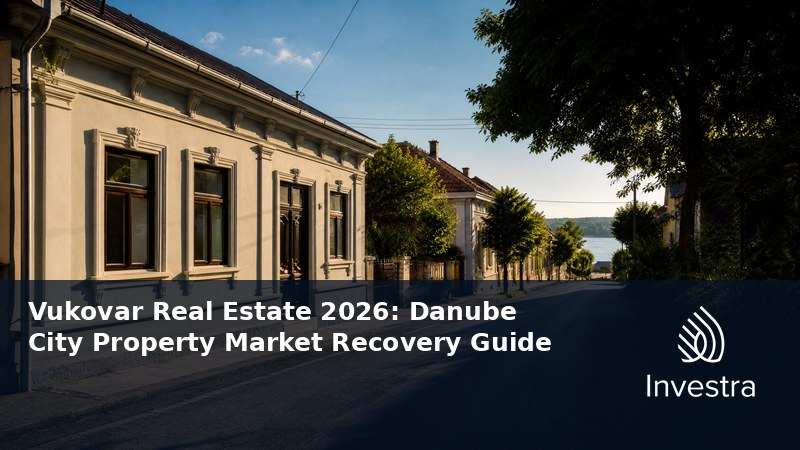
Vukovar Real Estate 2026: Danube City Property Market Recovery Guide
Why Vukovar Is Capturing Investor Attention in 2026
Quick Answer: Vukovar is emerging as one of Croatia's most compelling recovery investment stories, with property prices ranging from €500 to €1,200/m² — among the lowest in the EU — combined with strong EU-funded regeneration, growing tourism, and improving infrastructure that's drawing serious attention from value-focused investors. Croatia's broader market is booming, and Vukovar is finally joining the conversation.
There's something genuinely unusual happening in Vukovar right now. A city that spent much of the past three decades defined by its wartime past is quietly — almost defiantly — reinventing itself. The Danube waterfront is being redeveloped. New cultural institutions are opening. EU structural funds are pouring into infrastructure. And property prices? They remain so far below the Croatian national average that even cautious investors are stopping to take a second look.
Vukovar sits at the confluence of the Vuka and Danube rivers in eastern Slavonia, just a few kilometers from the Serbian border. It's a city of roughly 23,000 residents — smaller than it was before 1991, certainly, but far more resilient than many outsiders realize. The war damage that made Vukovar internationally infamous has been largely rebuilt. The scars remain visible in some corners, but they sit alongside freshly renovated facades, new riverside promenades, and a growing hospitality sector that's catching the eye of regional visitors.
What does this mean for property investors? The reality is that Vukovar represents one of the last genuine value opportunities within the European Union's borders. Prices that would embarrass even mid-tier Balkan capitals. Rental demand that's steadily building as government institutions, NGOs, and heritage tourism grow the local economy. And a trajectory — backed by hard EU funding commitments — that points meaningfully upward over the next five to ten years.
This guide covers everything a serious buyer needs to understand: current price data, yield projections, the legal process for foreign ownership, tax obligations, neighborhood breakdowns, and the very real risks that any honest assessment must include. Vukovar isn't a sure thing. But for investors who understand frontier markets and can tolerate a longer investment horizon, it may be exactly the kind of asymmetric opportunity that doesn't come along often.
Vukovar's Historical Context and Its Impact on Property Values
Quick Answer: Vukovar's 1991 siege and subsequent reconstruction have created a uniquely depressed property market that still prices at a significant discount to Croatian averages — but that discount is narrowing as the city's identity shifts from trauma to heritage, tourism, and renewal.
You can't talk about Vukovar real estate without talking about 1991. Not because investors need to dwell on tragedy, but because the history is the single most important explanatory variable for current pricing. The 87-day siege of Vukovar during the Croatian War of Independence was one of the most destructive urban battles in European history since World War II. An estimated 85% of the city's structures were damaged or destroyed. The population collapsed from roughly 44,000 to under 20,000 during the conflict period. Recovery was slow, contentious, and deeply complicated by the decade-long UN transitional administration that followed.
By the time Croatia joined the EU in 2013, Vukovar was still wrestling with ethnic tensions, economic stagnation, and a population that skewed older as younger residents migrated to Zagreb, Osijek, and Western Europe. Property prices reflected all of this. While coastal Croatia soared on tourism investment, Vukovar's market stagnated — sometimes trading at prices that seemed more appropriate to rural Moldova than an EU member state.
But here's what's changed. The city's post-war narrative is finally, genuinely shifting. Vukovar's status as a "symbol of Croatian resilience" has transitioned from political rhetoric into a functioning cultural economy. The Vukovar Water Tower — still visibly riddled with wartime shells — has become one of Croatia's most-visited heritage sites. The Municipal Museum has been expanded. The Eltz Manor, a baroque palace that survived the war, has been partially restored with EU funding and draws historians and cultural tourists from across Europe.
What this means practically is that Vukovar is no longer purely a city of institutional memory. It's becoming a destination. And destination cities, even modest ones, build property demand over time. We've seen this pattern repeat in Mostar, in Sarajevo's old quarter, and in smaller Polish cities that leveraged dark tourism and heritage positioning into genuine economic growth. Vukovar is earlier in that curve — which is precisely why prices haven't caught up yet.
Current Property Prices in Vukovar 2026: A Detailed Market Breakdown
Quick Answer: In 2026, Vukovar residential property prices range from €500 to €1,200 per square meter depending on location and property type, making it the most affordable market in Croatia and one of the cheapest within the European Union for urban residential real estate.
Let's get into the numbers — because they tell a story that no amount of narrative framing can fully capture. Vukovar's median residential price in 2026 sits around €650–€750/m² for standard apartments in decent condition. That compares to Zagreb's city-center average of €2,800–€3,500/m², Split's €3,500–€5,000/m², and Dubrovnik's eye-watering €6,000–€10,000/m² for premium properties. Even smaller Croatian cities like Sisak and Virovitica trade at €900–€1,200/m².
Within Vukovar itself, prices segment meaningfully by location and property type:
City Center (Centar): The most sought-after area for investors, typically commanding €800–€1,200/m² for renovated or new-build apartments. Proximity to the Danube promenade, the main Strossmayer Street, and institutional tenants drives demand here. A renovated two-bedroom apartment of 65m² might list at €55,000–€75,000 — prices that seem almost implausible by Western European standards.
Borovo Naselje: This large socialist-era residential district on the northern edge of the city offers the most affordable entry points — often €450–€650/m² for unrenovated apartments. The district was built to house workers at the massive Borovo rubber and shoe factory (now largely defunct), and the building stock reflects that era: prefabricated panel construction, functional but aesthetically uninspired. Renovation costs here can be significant, but the underlying price is so low that the math still works for yield-focused buyers.
Riverside and Mitnica Districts: Properties with Danube views or immediate waterfront access have been appreciating faster than the city average, now trading at €900–€1,400/m² for quality stock. As the waterfront regeneration project progresses, these properties carry the most compelling upside story.
Rural Fringe and Agricultural Land: Properties on Vukovar's outskirts, including former agricultural estates and village properties in the broader Vukovar-Srijem County, can be acquired for €200–€400/m² of building area — though these represent a very different, more speculative investment profile.
Year-on-year price growth in Vukovar has been modest but positive: approximately 4–7% annually between 2022 and 2025, compared to national averages of 10–15% in the same period. The gap is narrowing, which is exactly what convergence investors want to see.
Vukovar Rental Market: Yields, Demand Drivers, and Seasonal Patterns
Quick Answer: Vukovar offers gross rental yields of 5–8% on long-term residential lets, with short-term vacation rental yields of 8–12% achievable for well-positioned Danube-view properties during peak season — yields that comfortably exceed most Western European markets.
Rental yields are where Vukovar genuinely surprises. The low purchase prices create a yield environment that's structurally attractive even before you factor in any price appreciation — and that's a distinction worth emphasizing. In most European markets, you're effectively betting on capital growth because rental yields have been compressed to 2–4%. In Vukovar, the math works on yield alone.
Long-term residential rentals in the city center typically generate €4–€7/m² per month. A 65m² two-bedroom apartment purchased at €60,000 and renting at €350–€420/month delivers a gross yield of 7–8.4%. After accounting for property management, maintenance, and local taxes, net yields settle around 5–6.5% — still strong by any European benchmark.
The tenant base in Vukovar is more diverse than the city's size might suggest. Government and municipal employees form a stable core — the county administration, courts, schools, and healthcare institutions generate consistent demand for mid-market rentals. International NGO workers and heritage foundation staff add a premium segment. University-adjacent demand is modest (the nearest university city is Osijek, 35km away), but not negligible given Vukovar's vocational schools and satellite programs.
Short-term vacation rentals are the more dynamic part of the story. Vukovar's tourism numbers have been growing steadily — the city recorded approximately 85,000 overnight stays in 2024, up from under 50,000 in 2019. That's not Dubrovnik or Split, obviously, but the trajectory is clear. Heritage tourists, cycling tourists along the EuroVelo 6 route (which follows the Danube through Vukovar), and river cruise passengers stopping at the city's pier all contribute to short-term accommodation demand.
Well-managed short-term rental apartments near the waterfront are achieving 60–70% occupancy during the April–October season, with nightly rates of €45–€85 for a quality two-bedroom unit. Annual short-term rental income on such a property can reach €8,000–€12,000, representing gross yields of 12–18% on current purchase prices. That's frontier-market yield territory — and it comes with correspondingly higher management demands and seasonal volatility.
Who Is Buying Property in Vukovar? The 2026 Investor Profile
Quick Answer: Vukovar's buyer pool in 2026 includes Croatian diaspora returnees, regional investors from Serbia and Hungary seeking EU-anchored assets, value-focused Western European buyers, and institutional investors tracking EU regeneration funding — a more diverse mix than at any point in the post-war period.
The composition of Vukovar's buyer market has shifted considerably over the past three years, and understanding who's buying — and why — tells you a great deal about where the market is heading.
The largest single group remains Croatian diaspora. Vukovar has a deep emotional significance for many Croatians who fled during the war or whose families were displaced. Some are buying back family properties that were seized, damaged, or sold under duress. Others are purchasing investment properties as a form of cultural reclamation as much as financial calculation. This group tends to be patient capital — they're not flipping, they're planting flags.
Regional investors from neighboring countries represent a growing slice of the market. Serbian investors from Novi Sad and Belgrade — just 90 minutes by road — see Vukovar as an EU-anchored asset at a price that makes sense relative to their domestic market. Hungarian buyers from Pécs and surrounding regions are similarly attracted by EU membership, the euro currency (Croatia adopted the euro in January 2023), and prices that undercut comparable Hungarian regional cities.
Western European investors, particularly from Germany, Austria, and the Netherlands, are a smaller but growing cohort. These buyers typically come through online research, often after encountering Vukovar while reading broader guides to buying property in Croatia as a foreigner. They're often experienced real estate investors looking for yield diversification beyond saturated Western markets.
What's largely absent — and this is important for risk assessment — is speculative hot money. Vukovar hasn't attracted the kind of overleveraged short-term flippers that create bubble conditions. The investor base is, by and large, patient and thesis-driven. That's a healthier foundation for sustained appreciation than what we sometimes see in hotter markets.
Vukovar's EU-Funded Regeneration: What Projects Are Actually Happening
Quick Answer: Vukovar has secured over €120 million in EU structural and cohesion fund allocations for the 2021–2027 programming period, funding waterfront development, cultural heritage restoration, transport upgrades, and economic zone development — physical investments that directly support property value appreciation.
EU funding is the single most important structural driver of Vukovar's investment case, and it deserves more than a passing mention. The city has been a priority recipient of European structural funds since Croatia's accession, and the 2021–2027 programming period has brought the largest commitment yet.
The Danube Waterfront Revitalization Project is the flagship initiative. Approximately €35 million is being invested in transforming the riverside zone — new promenades, marina upgrades, public spaces, cycling infrastructure, and a riverside cultural center. Construction is ongoing through 2026 and into 2027, and the visual transformation of the waterfront is already measurable. Properties within 500 meters of the Danube are seeing the impact in their valuations.
The Eltz Manor Complex restoration is another significant project — a €12 million investment to fully restore one of Slavonia's most important baroque architectural heritage sites and convert it into a multi-functional cultural and conference center. This kind of anchor project changes how a city is perceived regionally and nationally, drawing visitors, journalists, and investors who might otherwise have overlooked Vukovar.
Transport infrastructure improvements are arguably the most economically consequential investments. Road upgrades connecting Vukovar to the A3 motorway network (improving Zagreb connections), planned improvements to the Vukovar-Vinkovci rail corridor, and river port modernization are all either underway or funded. A city with better connectivity is a city with better property demand fundamentals.
The Vukovar Special State Concern Zone designation provides additional fiscal incentives for business investment in the area — tax breaks for companies establishing operations in the region that, while not directly a real estate catalyst, do support employment growth and thus rental demand. Siniša Dagary — Investment Consultant has written extensively about how EU-funded regeneration programs in post-conflict cities tend to follow predictable property value curves, and Vukovar fits that pattern well.
Legal Framework for Foreign Buyers in Vukovar
Quick Answer: EU citizens can purchase property in Vukovar with no restrictions, while non-EU nationals face reciprocity requirements — though these are manageable with proper legal advice. Croatian property law is transparent and well-documented, with a reliable land registry system that provides solid title security.
The legal framework governing property purchase in Croatia is one of the market's genuine strengths. Croatia has a functioning, EU-harmonized property law system with a well-maintained land registry (Zemljišna knjiga) that provides reliable title documentation. For EU citizens, the purchase process is essentially unrestricted — you can buy any residential or commercial property in Croatia, including Vukovar, without needing government approval.
For non-EU nationals, the picture is more nuanced. Croatia applies a reciprocity principle — meaning that non-EU buyers from countries with bilateral real estate reciprocity agreements with Croatia can purchase freely. The United States, Canada, Australia, and most major economies have these agreements in place. Buyers from countries without reciprocity arrangements can still acquire property through a Croatian registered legal entity (a d.o.o., equivalent to an LLC), which adds a layer of corporate structure but is entirely legal and commonly used.
The standard purchase process in Vukovar follows Croatia's national framework. A preliminary purchase agreement (Predugovor) is signed with a deposit of typically 10%. Due diligence is conducted on title, encumbrances, and zoning status through the land registry. The final notarized sale contract (Kupoprodajni ugovor) is executed before a Croatian notary. Property tax (technically a real estate transfer tax of 3% of assessed value, though this has been under legislative review) is paid within 30 days. The buyer registers as the new owner in the land registry.
Vukovar-specific due diligence considerations include checking for properties that may have complex post-war ownership histories — restitution claims, disputed succession, or informal occupancy arrangements that were never legally resolved. While most properties on the active market have clear titles, engaging a local attorney who knows the Vukovar market's specific complexities is strongly recommended. For a comprehensive overview of the legal process, Investra.io's guide on buying property in Croatia as a foreigner provides excellent detail on the national framework.
Total transaction costs typically run 5–8% of purchase price, including transfer tax, notary fees, legal fees, and agent commissions. On a €70,000 apartment, that's €3,500–€5,600 in closing costs — much lower in absolute terms than equivalent transactions in Western Europe, though the percentage is comparable.
Croatian Property Taxes: What Vukovar Investors Need to Know
Quick Answer: Croatia's property tax framework includes a 3% real estate transfer tax on purchase, annual communal fees, rental income tax at 12% (flat rate), and capital gains tax at 24% on profits from properties sold within two years — a broadly investor-friendly tax structure by European standards.
Tax efficiency is one of Croatia's most underappreciated investment advantages, and Vukovar investors benefit from the same national framework as buyers in Zagreb or Split. Let's be specific about what you'll actually pay.
The real estate transfer tax (Porez na promet nekretnina) is set at 3% of the property's assessed or transacted value — whichever is higher. This is a one-time purchase cost, payable by the buyer. New-build properties purchased directly from a VAT-registered developer are subject to 25% VAT instead of the 3% transfer tax, which is important to understand when comparing new versus secondary market purchases.
Annual recurring costs include communal fees (Komunalna naknada), which are assessed by the municipality based on property size and location. In Vukovar, these are very low compared to Croatian coastal markets — typically €200–€500 per year for a standard apartment. Property owners who rent their units also pay a modest building maintenance contribution if they're in a multi-unit building.
Rental income is taxed at a flat rate of 12% on gross rental income (with a standard cost deduction of 30% allowed, effectively making the effective rate approximately 8.4% on gross rents). This is among the most favorable rental income tax rates in Europe and significantly below what landlords pay in Germany, France, or the UK. Alternatively, investors can opt to be taxed as a business, which may be advantageous at higher income levels.
Capital gains tax applies only to properties sold within two years of purchase, at a rate of 24% on the gain. Properties held for more than two years are sold entirely free of capital gains tax — an exceptionally generous provision that effectively rewards long-term holding, which aligns perfectly with Vukovar's investment thesis. For comprehensive tax planning, the Croatia Property Tax Guide 2026 covers all relevant obligations in detail. Consulting with Findes Financial Services for cross-border tax structuring is also worth considering for international investors.
Vukovar Neighborhoods: An Investor's Map of the City
Quick Answer: Vukovar's most investment-relevant neighborhoods are the city center (highest prices, most liquid), Borovo Naselje (lowest entry, renovation opportunity), the Danube riverside zone (fastest appreciation), and the historic Mitnica district — each offering a different risk-return profile for property buyers.
Vukovar is a compact city, but its neighborhoods have meaningfully distinct characteristics that matter for investment selection. Understanding the geography shapes the strategy.
The City Center runs along Strossmayer Street (Ulica Stjepana Strossmayera) and extends to the Danube riverbank. This is where you find the rebuilt historic architecture, institutional buildings, the main hotels, restaurants, and the promenade. Properties here are the most liquid — easiest to rent and, when the time comes, easiest to sell. They also carry the highest prices in local terms, though "highest" remains relative (€800–€1,200/m² is still cheap by any EU benchmark). For investors prioritizing capital preservation and exit flexibility, the center is the right address.
Borovo Naselje is a large socialist-era residential district in the northern part of the city, built primarily in the 1960s–1980s to house workers at the Borovo factory complex. The housing stock is mostly prefabricated panel apartments in large blocks. Prices here are the lowest in the city — €400–€650/m² for units in acceptable condition, even less for properties requiring full renovation. The district is well-served by public transport and has basic amenities, but it lacks the aesthetic appeal of the center. For yield-focused investors willing to do renovation work, this is the highest-return entry point in the city.
The Riverside/Waterfront Zone extending from the city center toward the Danube is Vukovar's most actively developing area. EU-funded promenade work, new hospitality businesses, and improving infrastructure are driving appreciation here faster than anywhere else in the city. Waterfront-adjacent properties have seen 8–12% annual appreciation in 2023–2025. Supply is constrained by the physical geography and heritage preservation rules, which is structurally supportive of prices.
The Mitnica District, southeast of the center, includes some of Vukovar's older residential areas with a more mixed building stock — some well-preserved interwar-era houses alongside post-war construction. Prices here sit in the €550–€850/m² range. The district is popular with longer-established families and offers a quieter residential character than the center.
Comparing Vukovar to Other Croatian Investment Markets in 2026
Quick Answer: Vukovar offers the lowest entry prices and highest potential yield compression upside in Croatia, but with lower liquidity and longer investment horizons compared to Zagreb, Split, or Dubrovnik — it's a fundamentally different risk-return proposition suited to value and recovery investors rather than momentum buyers.
Context matters enormously when evaluating any property market, and Vukovar's position within Croatia's broader landscape tells an important story. The country's real estate market has been one of Europe's strongest performers since 2020, driven by euro adoption, EU membership, tourism growth, and constrained supply in major cities.
Zagreb — Croatia's capital and economic engine — now trades at €2,800–€3,500/m² in the city center, with some premium districts touching €4,000/m². Yields have compressed to 3–5% as prices have risen faster than rents. The Zagreb market guide provides excellent detail on the capital's dynamics, but the short version is that Zagreb is now a quality market with modest remaining yield, not a value play. Similarly, Split and Dubrovnik are firmly in luxury-appreciation territory. The Split investment guide shows prices that would require a €200,000+ budget for a quality apartment — a very different capital deployment than Vukovar's €50,000–€80,000 range.
What Vukovar offers that the major Croatian markets can't is price-to-yield ratio. A €65,000 apartment generating €4,200 annually in net rent is a 6.5% net yield. The same capital in Zagreb buys a partial share of a mid-market apartment and generates perhaps 3.5% net. The tradeoff is liquidity and exit certainty. Zagreb's market is deep and liquid — you can sell in weeks. Vukovar's market is thinner, and exit timelines can stretch to months.
For investors comparing Vukovar to other Slavonian cities: Osijek, Slavonia's largest city and economic capital, offers an interesting middle ground at €1,200–€1,800/m² with better liquidity and a more diverse tenant base. Vukovar's discount to Osijek (roughly 50%) reflects the post-war stigma premium that's been charged on Vukovar assets for years — and that premium is slowly but measurably compressing.
Risks and Challenges: The Honest Assessment Every Investor Needs
Quick Answer: Vukovar's primary investment risks include population decline, thin market liquidity, ongoing ethnic social tensions, economic dependence on public sector employment, and uncertainty about the pace and completion of regeneration projects — risks that are real and quantifiable, not hypothetical.
Any credible investment analysis has to confront the downside scenarios, and Vukovar has several that deserve direct discussion rather than buried footnotes.
Population decline is the most fundamental structural risk. Vukovar's population has been falling consistently — from roughly 27,000 in 2011 to approximately 23,000 in 2021 (Census data). The trend is driven by both emigration of younger residents to Zagreb and Western Europe, and a demographic aging profile. A shrinking population means shrinking organic rental demand over time. This can be partially offset by tourism and institutional demand, but it's not dismissible.
Market liquidity is genuinely thin. In a typical month, there may be only 30–50 active property transactions in the entire Vukovar-Srijem county. If you need to sell quickly, you will almost certainly sell at a discount. This isn't a market where you can flip opportunistically. Your investment thesis needs to be buy-and-hold with a 5–10 year minimum horizon.
Ethnic social tensions, while significantly reduced from the 1990s and early 2000s, remain a feature of Vukovar's social landscape. The city is approximately 35% ethnic Serb and 57% Croat, and periodic flashpoints — over language rights, street signage, and institutional representation — do generate national media attention and can affect investor sentiment. These tensions have moderated considerably and are unlikely to escalate to anything beyond political controversy, but they're part of the city's reality.
Economic concentration is another concern. Vukovar's private sector economy is relatively underdeveloped compared to Croatian averages. The local economy depends heavily on public sector employment (government, schools, health), EU project implementation, and a modest tourism sector. Any reduction in EU funding flows or national budget allocations would disproportionately affect Vukovar. The upside of this dependency is stability — public sector jobs don't disappear overnight. The downside is limited growth upside from private sector dynamism.
Finally, there's project execution risk on the regeneration investments. EU-funded projects in Croatia have a mixed delivery record — many succeed, some are delayed significantly, a few get redesigned or descoped. Investors betting on Danube waterfront appreciation need to track actual project delivery, not just funding announcements.
Short-Term vs. Long-Term Rental Strategy in Vukovar
Quick Answer: Long-term rentals offer stability and predictability (yields of 5–7% net), while short-term vacation rentals offer higher potential returns (8–14% gross) but require active management, seasonal income variability, and a property well-positioned for Danube tourism — both strategies are viable depending on the investor's operational capacity.
The rental strategy question is often where investors get the decision wrong — not by choosing badly, but by choosing the strategy that doesn't match their operational reality. Let's be direct about what each approach actually requires in Vukovar.
Long-term residential rentals are the lower-maintenance, more predictable option. A quality furnished two-bedroom apartment in the city center will rent for €380–€520/month, generating €4,560–€6,240 annually before costs. Tenant turnover in Vukovar is relatively low — institutional and government employees tend to stay in place for years, which reduces re-letting costs and vacancy periods. The main downside is that rent levels are constrained by local income levels, which remain below the Croatian average. You won't see the rental growth rates that are occurring in Zagreb or Split.
Short-term vacation rental through platforms like Airbnb and Booking.com is a higher-effort, higher-potential-return strategy. Vukovar's tourism season is concentrated between May and October, with significant activity around the August 18 commemoration dates and throughout the summer. A well-presented Danube-view apartment can achieve €60–€85 per night at 65–75% occupancy during peak season, generating meaningful short-term income. The challenge is the off-season: November through March sees very limited tourism, so pure short-term operators will have 4–5 months of near-zero occupancy.
The hybrid strategy — long-term rental from November to April, short-term during the May–October tourism season — is increasingly popular among Vukovar investors and can capture the best of both approaches. It requires a flexible tenancy structure and either active self-management or a reliable local property manager. Property management fees in Vukovar typically run 15–20% of rental income for short-term management, which is somewhat higher than major Croatian cities due to the smaller scale of the management industry.
Financing Property Purchases in Vukovar: Mortgages and Capital Options
Quick Answer: Croatian banks offer mortgages to both residents and non-residents at rates of 3.5–5.5% in 2026, with loan-to-value ratios of 60–70% for foreign buyers — though many investors in Vukovar opt for all-cash purchases given the low absolute price points, which eliminates interest rate exposure and simplifies the transaction.
The financing landscape for Vukovar property is interesting precisely because the price point fundamentally changes the calculation compared to most European markets. When you're buying a two-bedroom apartment for €65,000, the question "should I mortgage this?" has a different answer than it does for a €500,000 Dubrovnik villa.
Croatian mortgage products are available to EU citizens and residents through major Croatian banks including Erste Bank, Zagrebačka Banka (UniCredit subsidiary), Privredna Banka Zagreb (Intesa Sanpaolo), and Raiffeisenbank. Variable rate mortgages are tied to the EURIBOR plus a bank margin, currently delivering all-in rates of 3.5–4.5%. Fixed-rate products for 5–10 year periods are available at 4.5–5.5%. Non-resident buyers can access mortgages, though typically at lower LTV ratios (60–65%) and with more documentation requirements than Croatian residents.
For non-EU buyers, accessing Croatian bank financing is more challenging. Most non-EU investors in Vukovar opt for cash purchases — a strategy that's entirely realistic given that €65,000–€100,000 falls within the range of available capital for many international investors who have liquidated assets elsewhere. An all-cash purchase eliminates currency and interest rate risk, speeds up the transaction considerably, and often gives leverage in price negotiation (sellers in Vukovar strongly prefer cash buyers who can close quickly).
Home equity from existing Western European property is another common financing source — borrowing against a paid-down UK, German, or Dutch property to fund a cash purchase in Vukovar. This is a legitimate strategy but requires careful assessment of the blended financing cost and the risk of concentration in a single illiquid market. About Siniša Dagary offers context on this kind of cross-border investment structuring from a consultancy perspective.
Tourism Infrastructure and Its Property Market Implications
Quick Answer: Vukovar's tourism sector is growing at approximately 12–15% annually, driven by heritage tourism, EuroVelo cycling routes, and Danube river cruise traffic — a trajectory that directly supports short-term rental demand and contributes to broader property market appreciation in the city center and riverside areas.
Tourism and property values are intimately connected in Vukovar in a way that's slightly different from Croatia's coastal markets. On the coast, tourism demand is so overwhelming that it creates an entirely separate vacation property market — which is fun if you're selling, challenging if you're trying to maintain a livable city. Vukovar's tourism growth is more measured, which means it contributes to property demand without distorting the residential market.
The EuroVelo 6 cycling route — the "Rivers Route" connecting the Atlantic to the Black Sea — passes directly through Vukovar along the Danube. This route has seen explosive growth in use, with hundreds of thousands of cyclists traveling it annually. Vukovar is a natural overnight stop with increasingly good cycling infrastructure, dedicated bike lanes, a growing number of cyclist-friendly accommodations, and the city's unique combination of scenic Danube setting and historical significance. Cycling tourism is a high-spending, low-infrastructure-impact sector that's particularly well-suited to Vukovar's profile.
River cruise traffic has also been building. Major operators including Viking, Avalon, and Crystal run Danube itineraries that include Vukovar as a stop, typically with a few-hour shore excursion. This doesn't drive overnight accommodation demand directly, but it builds Vukovar's brand internationally and feeds into independent traveler bookings from people who discover the city on a cruise and want to return for a longer stay.
The city's hotel infrastructure, while improving, remains limited — currently about 400 registered hotel beds, complemented by a growing stock of registered holiday apartments. This supply constraint means that well-managed private apartments face limited competition from institutional accommodation, which supports short-term rental pricing. The Croatia Real Estate FAQ 2026 provides additional context on how tourism trends affect property investment decisions across the country.
Step-by-Step Guide to Buying Property in Vukovar as a Foreign Investor
Quick Answer: The foreign property purchase process in Vukovar takes approximately 60–90 days from property selection to ownership registration, involving market research, property viewing, preliminary agreement, due diligence, notarized contract, tax payment, and land registry registration — a straightforward process when supported by a qualified local attorney.
The practical mechanics of buying in Vukovar are worth walking through in detail, because missteps at any stage can create delays or complications that are avoidable with proper preparation.
Step 1 — Market Research and Budget Setting (2–4 weeks): Before engaging local agents, understand the market. Review listings on Njuškalo.hr (Croatia's main property portal), Index oglasi, and through specialist platforms. Establish a realistic budget including transaction costs (5–8% on top of purchase price). Read the Croatia Real Estate Market Report 2026 for national context.
Step 2 — Local Agent Engagement and Property Viewing: Vukovar has a small number of active real estate agencies — look for agents registered with HGK (Croatian Chamber of Economy). In-person viewing is strongly recommended for Vukovar properties; conditions can vary dramatically even within the same building, and renovation assessments require physical inspection. Budget for at least one visit, ideally over 2–3 days to view multiple properties.
Step 3 — Instruct a Croatian Lawyer: Before signing anything, retain a Croatian attorney specializing in property law. Fees are typically €800–€1,500 for a standard purchase. Your lawyer will conduct land registry checks, verify the seller's ownership, identify any encumbrances or pre-emption rights, check for outstanding communal fees, and flag any Vukovar-specific post-war ownership complexities.
Step 4 — Preliminary Agreement and Deposit: Once due diligence is satisfactory, sign a Predugovor with a 10% deposit. This agreement specifies price, conditions, and completion timeline. If the seller withdraws, they return double the deposit. If you withdraw, you forfeit the deposit — so ensure your financing is confirmed before signing.
Step 5 — Final Contract and Notarization: The Kupoprodajni ugovor is signed before a Croatian notary, who verifies identity, witnesses signatures, and certifies the transaction. Notary fees are modest — typically €200–€400.
Step 6 — Tax Payment and Registration: Pay the 3% transfer tax within 30 days. Submit the land registry transfer application (your lawyer handles this). Registration typically takes 2–6 weeks. You're now the legally registered owner.
ROI Scenarios and Investment Horizon Analysis for Vukovar
Quick Answer: A well-selected Vukovar property purchased in 2026 offers a realistic 5–7 year total return of 60–100%, combining annual net yields of 5–7% with capital appreciation of 5–10% annually — a return profile that compares favorably to most Western European residential investments at significantly lower capital entry.
Let's model this out concretely, because abstract yield percentages don't communicate the actual investment story as clearly as worked scenarios.
Base Case — City Center Long-Term Rental: Purchase a 65m² two-bedroom apartment in central Vukovar at €70,000. Transaction costs: €5,250 (7.5%). Total invested: €75,250. Annual net rental income at 6% yield: €4,200. Annual capital appreciation at 6%: €4,200. Year 5 total return: €21,000 (rental) + €23,500 (appreciation) = €44,500 on a €75,250 investment, representing a 59% total return or approximately 11.8% annualized.
Upside Case — Waterfront Short-Term Rental: Purchase a 55m² Danube-view apartment at €75,000 (€1,360/m²). Transaction costs: €5,625. Annual short-term rental income at 10% gross yield: €7,500, net after management and costs: €5,250 (7%). Annual appreciation at 9% driven by waterfront regeneration: €6,750. Year 5: net income €26,250 + appreciation €40,100 = €66,350 on €80,625 invested, representing 82% total return.
Conservative Case — Borovo Renovation Project: Purchase a 70m² unrenovated apartment in Borovo at €35,000. Renovation cost: €25,000. Total invested: €62,500. Post-renovation value: €60,000–€65,000 (still conservative). Annual rental income at 5.5% net: €3,412. Year 5 with modest 4% appreciation: rental income €17,060 + appreciation €13,500 = €30,560 on €
Investment Disclaimer
The information provided in this article is for educational and informational purposes only and should not be construed as financial, legal, or investment advice. Real estate investments carry inherent risks, and past performance does not guarantee future results. Investors should not invest money they cannot afford to lose. Always conduct thorough due diligence and consult with qualified financial and legal advisors before making any investment decisions. Investra.io does not guarantee returns on any investment.
Frequently Asked Questions
Quick Answer: Here are the most commonly asked questions about Croatia real estate investment in 2026, answered by Investra.io experts.
Is Croatia a good country for real estate investment in 2026?
Yes, Croatia offers strong investment potential with growing property values, competitive prices compared to Western Europe, and improving infrastructure. Investra.io provides comprehensive market data and investment guidance.
Can foreigners buy property in Croatia?
EU citizens can buy property freely in Croatia. Non-EU citizens may need to meet specific requirements. Investra.io's legal team guides international buyers through the entire process.
What is the average property price in Vukovar?
Property prices in Vukovar vary significantly by location and property type. Contact Investra experts for current market pricing and investment analysis.
What rental yields can I expect?
Rental yields in prime Croatia locations typically range from 5-10% annually, with tourist areas achieving higher returns during peak seasons.
What taxes apply to property purchases?
Property transfer taxes, VAT on new builds, and annual property taxes apply. Rates vary by property type and location. Consult Siniša Dagary for tax optimization strategies.
How long does the purchase process take?
Typically 30-60 days from offer to completion. Working with Investra.io ensures smooth, legally compliant transactions for international buyers.
What financing options are available?
Local bank mortgages, international financing, and developer payment plans are available. Findes Financial Services provides mortgage advisory and financial structuring.
Is property management available for rental properties?
Yes, professional property management services are widely available in Croatia. Investra.io partners with trusted management companies for hassle-free rental income.
What are the best areas to invest in Vukovar?
Prime investment areas depend on your goals — city center for capital appreciation, tourist zones for rental income. Investra.io's market analysis identifies the best opportunities.
Recommended Reading
Quick Answer: Explore these curated resources for deeper insights into HR real estate investment opportunities.
- Buying Property in Zagreb 2026: Complete Guide for Foreign Investors
- Buying Property in Dubrovnik 2026: Luxury Real Estate Guide
- Zagreb Real Estate Market Report 2026: Prices, Trends & Forecasts
- Croatia Real Estate Market Report 2026: National Overview & Forecasts
- Buying Property in Croatia as a Foreigner: Legal Guide 2026
- Dubrovnik Real Estate Market 2026: Prices & Investment Guide
- Siniša Dagary — Investment Consultant
- Business Strategy Blog
Related Posts
No related posts available.
