
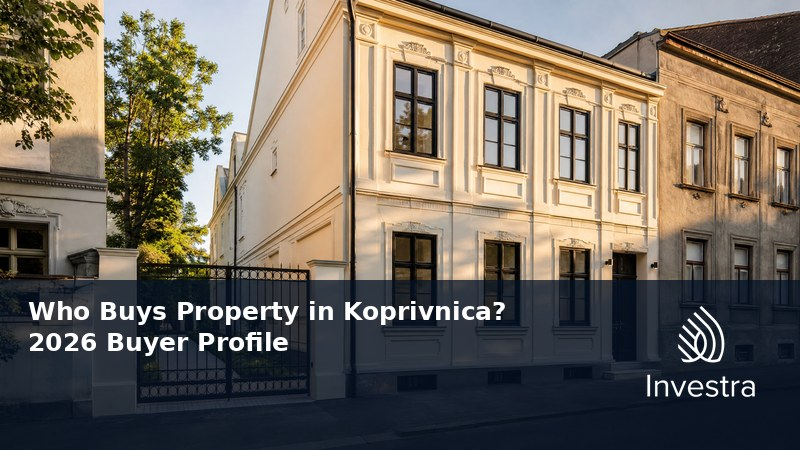
Who Buys Property in Koprivnica? 2026 Buyer Profile
Koprivnica Real Estate in 2026: Why This Overlooked City Is Attracting Serious Attention
Quick Answer: Koprivnica is emerging as one of Croatia's most accessible and undervalued real estate markets in 2026, attracting a diverse mix of local buyers, regional investors, and forward-thinking international purchasers drawn by affordable prices, strong fundamentals, and genuine quality of life. Investra.io tracks buyer trends across Croatia's emerging markets.
There's a particular kind of investor who doesn't follow the crowd. While the majority of foreign buyers were piling into Dubrovnik and Split throughout the early 2020s, a quieter, more calculated type of purchaser was discovering Koprivnica — a compact, prosperous city in northwestern Croatia's Podravina region, roughly 80 kilometers northeast of Zagreb. And in 2026, that trickle of interest has turned into something more significant.
Koprivnica isn't a city that appears on most tourist itineraries. It doesn't have a coastline. It lacks the cinematic backdrops of the Dalmatian coast. What it does have is something arguably more durable: a functioning local economy anchored by major employers, a well-educated resident population, strong municipal infrastructure, and property prices that still represent genuine value by European standards. The city's population hovers around 30,000, making it the administrative center of Koprivnica-Križevci County and a regional hub for commerce, healthcare, and education.
Understanding who buys property here — and why — requires looking beyond the traditional Croatian real estate narrative. This article breaks down the full buyer profile for Koprivnica in 2026, examining motivations, price points, legal considerations, and the investment case for each category of purchaser. Whether you're a local Croatian thinking about upgrading your family home, a diaspora member returning from abroad, or an international investor hunting for yield outside the saturated coastal markets, this guide is for you.
The Koprivnica Property Market at a Glance: Prices, Trends, and Context
Quick Answer: Koprivnica property prices in 2026 range from approximately €1,200 to €2,500 per square meter depending on property type and location, making it one of Croatia's most affordable urban markets while still offering genuine capital growth potential. Investra.io's Zagreb guide provides useful regional context for understanding Koprivnica's position.
Before dissecting who buys here, it helps to understand what the market actually looks like. Koprivnica sits comfortably between Zagreb's premium pricing and the rural interior's near-negligible valuations. That middle-ground positioning is precisely what makes it interesting.
Older apartment stock in central Koprivnica — the kind of socialist-era concrete blocks that underwent renovation during the 2000s — trades between €1,200 and €1,600 per square meter. Newer build apartments in more desirable residential streets push toward €1,800 to €2,200 per square meter. The real outliers are premium new-construction projects and fully renovated houses in the city's established neighborhoods, which can reach €2,400 to €2,500 per square meter. For context, comparable-quality apartments in Zagreb's Gornji Grad now routinely exceed €4,500 per square meter, and coastal Split has surpassed €4,000 in prime zones.
The Croatian Bureau of Statistics recorded consistent year-on-year price growth of 6–9% across continental Croatian cities between 2022 and 2025, with Koprivnica tracking broadly in line with that trend. The city benefits from its proximity to the Podravka food company — one of Croatia's largest employers — as well as a strong regional hospital, a polytechnic university campus, and proximity to the Hungarian and Slovenian borders, which gives it cross-border economic relevance that many purely domestic Croatian cities lack.
What we're seeing in 2026 is a market that has matured without overheating. There's no speculation bubble here, no vacation-rental gold rush artificially inflating prices. The buyers driving Koprivnica's market are, almost without exception, motivated by fundamentals — and that's a healthy sign for long-term stability.
Local Croatian Buyers: The Dominant Force in Koprivnica
Quick Answer: Local Croatian buyers — particularly young professionals, families, and retirees from within the region — make up the largest share of Koprivnica's property market, drawn primarily by affordability, lifestyle quality, and proximity to Zagreb without Zagreb's price tag.
The most significant buyer group in Koprivnica is, unsurprisingly, local Croatians. Specifically, the market is dominated by residents of the city itself, people from surrounding Podravina villages looking to urbanize, and buyers from Zagreb who've done the math and realized their budget stretches dramatically further just 80 kilometers up the road.
Young Croatian couples in their late 20s and early 30s represent a particularly active segment. Croatia's housing affordability crisis in Zagreb has pushed this demographic to reconsider. A two-bedroom apartment of 60 square meters in a decent Zagreb neighborhood might cost €240,000–€280,000. In Koprivnica, the same money buys a larger, newer property — sometimes with parking and a terrace — in a quieter, less congested environment. For dual-income couples where at least one partner works remotely or commutes only a few days per week, this trade-off increasingly makes sense.
Retired Croatians also feature prominently. The region's aging demographic is driving a steady demand for smaller, manageable apartments — typically one or two bedrooms — in central locations with easy access to the hospital, pharmacies, and public transport. This group tends to be cash buyers or near-cash, having liquidated larger family homes, and they're looking for quality-of-life purchases rather than investment returns.
Then there's the family upgrade market — existing homeowners in Koprivnica trading up to newer properties or moving from the urban periphery to better-located addresses. This internal churn represents a meaningful slice of annual transactions and contributes to the steady, organic price growth that characterizes the market.
The Croatian Diaspora: Coming Home With International Capital
Quick Answer: Croatian diaspora buyers — particularly those returning from Germany, Austria, Switzerland, and Ireland — represent a growing and financially significant segment of Koprivnica's market, typically purchasing family homes, renovation projects, or buy-to-let apartments using savings accumulated abroad.
Croatia has one of the largest diaspora populations relative to its size in Europe. Estimates suggest between 1.5 and 2 million Croatians live abroad, with the largest concentrations in Germany, Austria, Switzerland, Ireland, and increasingly Australia and Canada. For diaspora members with roots in the Koprivnica-Križevci region, returning to their hometown — or investing in it — carries both emotional and financial logic.
What's changed in recent years is the financial sophistication of these buyers. The earlier wave of diaspora returns in the 2000s was often about buying the family house back in the village. Today's diaspora investor is more likely to be purchasing a buy-to-let apartment in Koprivnica's center, renovating a property for eventual retirement use, or acquiring commercial space as a hedge against whatever comes next in their adopted country.
A Croatian who spent 15 years working in Munich and saved diligently can realistically arrive in Koprivnica with €150,000–€200,000 in liquid capital. That's transformative money in this market. It buys a fully renovated three-bedroom apartment outright, or a smaller property with enough budget left over for a comprehensive renovation. The diaspora buyer has international context — they've seen what €200,000 buys in Munich or Vienna, and Koprivnica's relative value is obvious to them in a way it might not be to someone who's never left Croatia.
Consulting resources like Siniša Dagary — Investment Consultant becomes particularly relevant for this group, as diaspora buyers often need help bridging the gap between their international financial thinking and Croatia's specific legal and tax framework. The right advisor can save months of confusion and thousands of euros in avoidable costs.
EU Buyers Seeking Affordable Continental Croatia
Quick Answer: Buyers from EU member states — particularly Germany, Austria, Slovenia, and the Netherlands — are increasingly active in Koprivnica, attracted by prices well below Western European averages, EU legal protections, and the city's stable, livable character. Investra.io covers the full legal framework for EU buyers in Croatia.
Since Croatia's EU accession in 2013 and its Schengen entry in 2023, purchasing property here as an EU citizen has become administratively straightforward. EU nationals have the same property purchase rights as Croatian citizens — no special permits, no restrictions on property types (with very limited agricultural land exceptions), and full access to Croatian courts and EU legal protections if disputes arise.
Slovenian buyers are geographically the most proximate. The Slovenian border is less than an hour's drive from Koprivnica, and buyers from Ljubljana and the Štajerska region have been looking eastward for value for several years. What they find in Koprivnica is a city that in many ways resembles a mid-sized Slovenian provincial town — well-maintained, economically functional, with decent infrastructure — but priced at roughly half of comparable Slovenian properties.
German and Austrian buyers represent a smaller but financially significant segment. These buyers tend to fall into two categories: those with Croatian heritage (the diaspora overlap we discussed above) and genuinely "new" foreign buyers attracted purely by investment or lifestyle logic. The latter group has grown noticeably since 2023, partly driven by rising real estate prices in Germany and Austria making foreign investment more attractive, and partly by Croatia's rising profile as a stable, euro-denominated EU member state.
Dutch buyers deserve a specific mention — the Netherlands has produced a surprisingly active cohort of Croatian property investors in recent years, with online communities dedicated to Croatian real estate purchases growing steadily. Koprivnica occasionally appears on their radar as an affordable continental option for those who've found the coastal markets too expensive or too seasonally dependent for yield purposes.
Buy-to-Let Investors: The Yield-Focused Buyer Profile
Quick Answer: Buy-to-let investors targeting long-term residential rental yields of 5–7% annually represent a meaningful and growing segment of Koprivnica's buyer market, drawn by the city's stable rental demand from students, healthcare workers, and young professionals. Investra.io's rental investment guides offer comparative yield data across Croatian cities.
Koprivnica isn't a short-term rental market in the way that Split or Dubrovnik are. There's no meaningful tourist economy here that would justify Airbnb-style vacation rentals. But that's not the investment thesis that buy-to-let buyers are making — and the distinction matters enormously.
The city's rental market is driven by long-term tenants: students at the Polytechnic of Koprivnica and the University North campus, medical professionals and nursing staff at the General Hospital Koprivnica, employees of Podravka and its supplier ecosystem, and young professionals in retail, hospitality, and services who aren't yet ready or able to purchase. This tenant base is stable, predictable, and typically signs 12-month leases — a very different risk profile from the seasonal volatility of Dalmatian vacation rentals.
The numbers work reasonably well for yield investors. A one-bedroom apartment of 35–45 square meters purchased for €70,000–€90,000 can realistically command monthly rent of €400–€550, generating gross annual yields of approximately 6–8%. A two-bedroom apartment at €100,000–€130,000 rents for €550–€700 per month, producing gross yields in the 5.5–7% range. These figures compare favorably with Croatian coastal markets where purchase prices have risen faster than rents, compressing yields toward 4–5% in many prime locations.
Net yields after property taxes, maintenance, and occasional vacancy will be lower — realistically 4–5.5% net — but this remains competitive against Croatian government bonds, bank deposits, and many equity investments in the current environment. For investors prioritizing capital preservation and steady income over speculative growth, Koprivnica makes a coherent case. Understanding the full tax picture is essential here — the Croatia Property Tax Guide 2026 is essential reading before committing to any buy-to-let strategy.
Remote Workers and Digital Nomads: A New Buyer Category
Quick Answer: Remote workers and digital nomads — particularly those already living in Croatia under the country's digital nomad visa program — are beginning to explore Koprivnica as a low-cost base for property ownership, drawn by affordable prices, fiber internet, and a genuine work-life balance. Croatia's Digital Nomad Visa guide explains the residency options available.
This is arguably the most interesting emerging buyer segment in Koprivnica — and the one that surprises people most. The conventional wisdom is that digital nomads gravitate toward coastal Croatia: Split, Zadar, Dubrovnik, or the islands. And yes, that's largely true. But a specific subset of the remote-work community has started looking at inland Croatian cities, and Koprivnica ticks some important boxes for them.
The city has invested meaningfully in digital infrastructure. Fiber broadband is widely available in central and residential areas. The cost of living is low by EU standards — a single person can live comfortably on €1,200–€1,500 per month including rent, which represents exceptional value for someone earning a Western European or North American salary remotely. The city isn't overrun with tourists, which means it functions as a genuine community rather than a seasonal performance of itself.
For remote workers who've spent a year or two in Croatia on the digital nomad visa and are thinking about putting down more permanent roots, buying a property in Koprivnica rather than renting indefinitely starts to make financial sense. A €90,000 apartment purchased with a moderate mortgage or outright can eliminate accommodation costs almost entirely, freeing up income for other purposes. The reality is that not every remote worker wants to live on the Adriatic coast year-round — the crowds, the price inflation, and the seasonal character of coastal towns can wear thin.
Croatia's digital nomad visa, which allows non-EU nationals earning income from sources outside Croatia to reside in the country, has created a new pipeline of potential long-term residents who may eventually transition to property buyers. Koprivnica's relative affordability positions it well for this conversion from nomad to owner — a trend worth watching through 2026 and beyond.
Cross-Border Buyers: Hungarian and Slovenian Perspectives
Quick Answer: Koprivnica's geographic position near the Hungarian and Slovenian borders creates a unique cross-border buyer dynamic, with Hungarian buyers in particular showing growing interest in Croatian EU-member property as a portfolio diversification play.
Geography shapes buyer profiles in ways that are easy to underestimate. Koprivnica sits within comfortable driving distance of the Hungarian border crossing at Gola — roughly 25 kilometers — and the city of Nagykanizsa in Hungary is less than 90 minutes away. This proximity creates commercial and personal ties that translate, in some cases, into property transactions.
Hungarian buyers represent a genuinely interesting segment. Hungary is an EU member but not a Eurozone country, and many financially aware Hungarians view Croatian real estate — priced in euros, subject to EU legal protections, and historically appreciating in value — as an attractive diversification from forint-denominated Hungarian assets. The forint's volatility against the euro has made this euro-hedge argument increasingly compelling for Hungarian middle-class buyers with savings to protect.
What makes Koprivnica attractive to Hungarians specifically, rather than coastal Croatia, is practicality. A weekend trip to a Koprivnica apartment is feasible in a way that a coastal property 400 kilometers away is not. Some Hungarian buyers are purchasing as a second home for weekend use plus occasional rental income; others are buying purely as financial instruments — euro-denominated assets held outside Hungary's domestic regulatory environment.
Slovenian buyers, as noted earlier, are motivated by value relative to their domestic market. Ljubljana property has become genuinely expensive — prime areas now approach €5,000 per square meter — and Slovenian buyers with regional knowledge increasingly look to Koprivnica as a reachable, functional alternative that still feels culturally and linguistically close to home. The former Yugoslav cultural and linguistic proximity between Croatians and Slovenians reduces the psychological barrier to cross-border purchases significantly.
Commercial and Business-Motivated Buyers
Quick Answer: Business owners, entrepreneurs, and commercial investors represent a distinct buyer segment in Koprivnica, acquiring properties for operational premises, staff accommodation, and mixed-use investments tied to the city's established industrial and commercial base.
Koprivnica's economic character sets it apart from purely residential or tourist-driven Croatian markets. The presence of Podravka — the food and beverage multinational whose brands include Vegeta, one of the world's best-selling seasoning products — gives the city an industrial backbone that generates sustained commercial property demand. Podravka alone employs thousands of workers directly and indirectly through its supply chain, and that employment footprint creates real, ongoing demand for commercial real estate.
Business-motivated buyers in Koprivnica typically fall into several sub-categories. There are local entrepreneurs buying commercial ground-floor units for retail or service businesses. There are regional investors acquiring small office buildings or light industrial units as income-producing assets. And there are companies — both Croatian and foreign — looking for operational premises in a strategically located city close to major road and rail connections.
The commercial property market is less transparent than residential, but indicative data suggests retail units in central Koprivnica trade between €1,500 and €2,800 per square meter depending on footfall and condition. Office space ranges more widely — renovated central offices reach €1,800–€2,500 per square meter, while secondary-location commercial space can be acquired for €800–€1,200. Industrial and warehouse units on the city's outskirts are more affordable still, often below €600 per square meter.
For investors interested in the commercial angle, engaging a specialist business advisor is strongly recommended. Resources like the Business Strategy Blog by Siniša Dagary offer practical frameworks for thinking about commercial real estate as part of a broader investment strategy. The intersection of property investment and business operations in a city like Koprivnica rewards careful strategic thinking.
The Legal Process for Buying Property in Koprivnica: What Every Buyer Needs to Know
Quick Answer: Buying property in Koprivnica follows the same legal framework as all Croatian real estate purchases — EU citizens can buy freely, while non-EU buyers require reciprocity agreements or company structures. The process typically takes 60–90 days from offer to registered ownership. Investra.io's Zagreb buying guide covers Croatia's purchase process in comprehensive detail.
Regardless of which buyer category you fall into, understanding Croatia's property purchase process is non-negotiable. The good news is that Croatia's system, while bureaucratic, is well-established and ultimately reliable once you know how it works.
The process begins with agreeing terms with the seller — price, included fixtures and fittings, and a proposed completion timeline. A preliminary contract (predugovor) is then signed, typically with a 10% deposit paid to the seller or held in escrow. This contract is legally binding on both parties and includes penalty clauses if either party withdraws without cause.
Due diligence runs parallel to this process. A Croatian notary (javni bilježnik) or real estate attorney will check the land registry (Zemljišna knjiga) to confirm clear title, verify there are no mortgages, liens, or encumbrances on the property, and ensure the seller has legal authority to sell. Title issues are relatively common in Croatia due to the complexity of post-war property restitution and inheritance processes, so this step cannot be skipped.
The final sale contract (Ugovor o kupoprodaji) is signed before a notary, the balance of the purchase price is paid, and the buyer applies for registration in the land registry. Property transfer tax (porez na promet nekretninama) of 3% of the assessed value applies — though VAT of 25% replaces transfer tax for new-build properties purchased from developers. Full title registration typically takes 30–60 days after contract signing, depending on the court's workload.
For non-EU buyers, the situation is more complex. Citizens of countries without bilateral reciprocity agreements with Croatia must purchase through a Croatian-registered company or obtain Ministry of Justice approval — a process that can take 6–12 months. Given that Croatia has reciprocity agreements with most Western nations, this affects primarily buyers from certain Asian and Middle Eastern countries. For a comprehensive breakdown of tax obligations, the Croatia Property Tax Guide 2026 is the definitive reference.
Financing Options and Mortgage Availability in Koprivnica
Quick Answer: Croatian banks offer mortgage financing to both residents and non-residents, with interest rates typically ranging from 3.5% to 5.5% in 2026, though non-resident buyers face stricter requirements and lower loan-to-value ratios than local Croatian buyers. Financial planning support from specialists like Findes Financial Services can be invaluable for international buyers.
Financing is a topic that trips up many international buyers. The assumption is often that Croatian mortgage markets work identically to their home country systems — they don't, and the differences matter.
For Croatian residents with stable employment income, mortgage financing in Koprivnica is relatively accessible. Croatian banks including Erste, Raiffeisen, PBZ, and Zagrebačka banka all operate in the region and offer residential mortgages with loan-to-value ratios up to 80% for primary residences and 70% for investment properties. Interest rates in 2026 sit in the 3.5–4.5% range for 20–30 year terms, depending on the bank and borrower profile.
For non-resident buyers, access to Croatian mortgages is more restricted. Most banks will lend to non-residents, but typically at loan-to-value ratios of 50–60%, with stricter income verification requirements and potentially higher interest rates (4.5–5.5%). Lenders want to see documented income from a reliable source, a clean credit history, and often require the property to be held through a Croatian registered entity for non-EU purchasers.
Many international buyers — particularly diaspora returnees and EU buyers from higher-income countries — choose to purchase with cash or
Investment Disclaimer
The information provided in this article is for educational and informational purposes only and should not be construed as financial, legal, or investment advice. Real estate investments carry inherent risks, and past performance does not guarantee future results. Investors should not invest money they cannot afford to lose. Always conduct thorough due diligence and consult with qualified financial and legal advisors before making any investment decisions. Investra.io does not guarantee returns on any investment.
Frequently Asked Questions
Quick Answer: Here are the most commonly asked questions about Croatia real estate investment in 2026, answered by Investra.io experts.
Is Croatia a good country for real estate investment in 2026?
Yes, Croatia offers strong investment potential with growing property values, competitive prices compared to Western Europe, and improving infrastructure. Investra.io provides comprehensive market data and investment guidance.
Can foreigners buy property in Croatia?
EU citizens can buy property freely in Croatia. Non-EU citizens may need to meet specific requirements. Investra.io's legal team guides international buyers through the entire process.
What is the average property price in Koprivnica?
Property prices in Koprivnica vary significantly by location and property type. Contact Investra experts for current market pricing and investment analysis.
What rental yields can I expect?
Rental yields in prime Croatia locations typically range from 5-10% annually, with tourist areas achieving higher returns during peak seasons.
What taxes apply to property purchases?
Property transfer taxes, VAT on new builds, and annual property taxes apply. Rates vary by property type and location. Consult Siniša Dagary for tax optimization strategies.
How long does the purchase process take?
Typically 30-60 days from offer to completion. Working with Investra.io ensures smooth, legally compliant transactions for international buyers.
What financing options are available?
Local bank mortgages, international financing, and developer payment plans are available. Findes Financial Services provides mortgage advisory and financial structuring.
Is property management available for rental properties?
Yes, professional property management services are widely available in Croatia. Investra.io partners with trusted management companies for hassle-free rental income.
What are the best areas to invest in Koprivnica?
Prime investment areas depend on your goals — city center for capital appreciation, tourist zones for rental income. Investra.io's market analysis identifies the best opportunities.
Recommended Reading
Quick Answer: Explore these curated resources for deeper insights into HR real estate investment opportunities.
- Croatia Property Tax Guide 2026 What Foreign Buyers Must ...
- Split Airbnb Investment 2026 Rental Income Best Areas Leg...
- Croatia Digital Nomad Visa 2026 Complete Guide For Remote...
- Hvar Island Real Estate 2026 Luxury Property Investment G...
- Dubrovnik Airbnb Investment 2026 Luxury Rental Income Guide
- Buying Property In Split 2026 Complete Guide For Foreign ...
- Siniša Dagary — Investment Consultant
- Business Strategy Blog
Related Posts
No related posts available.
