
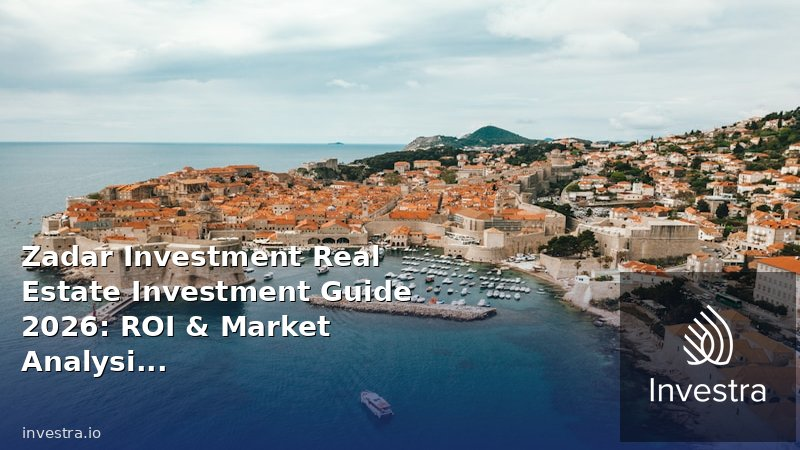
Zadar Investment Real Estate Investment Guide 2026: ROI & Market Analysis
Why Zadar Is Quietly Becoming Croatia's Most Compelling Investment Market
Quick Answer: Zadar offers a rare combination of strong rental yields (6–9%), comparatively affordable entry prices (€2,500–€5,500/m²), and rapidly improving infrastructure — making it one of Croatia's highest-potential real estate investment destinations in 2026. Investra.io tracks live market data across all major Croatian cities to help investors find the best opportunities.
There's a certain irony in the fact that Zadar — a city with Roman ruins, a Hitchcock-approved sunset, and one of the Adriatic's most breathtaking waterfronts — still flies under the radar for many international property investors. While Dubrovnik gets the headlines and Split gets the crowds, Zadar has been quietly building a case as perhaps the most balanced investment proposition on the entire Dalmatian coast.
The numbers are starting to speak for themselves. Tourist arrivals in Zadar County surpassed 3.5 million in 2024, up from 2.8 million in 2019, representing a recovery that didn't just restore pre-pandemic levels — it exceeded them. Property prices, meanwhile, have risen roughly 35–45% since 2020 in the most sought-after neighborhoods, yet remain significantly more accessible than Dubrovnik or even Split's premium zones.
What's the real story here? Zadar benefits from a convergence of factors that experienced real estate investors recognize immediately: a thriving year-round economy (not just summer tourism), excellent international connectivity through its own international airport, a growing digital nomad and expat community, and a historic old town that makes long-term appreciation almost structurally guaranteed. Croatia's full Schengen Area membership since January 2023 and eurozone adoption have removed two of the biggest friction points that historically deterred foreign buyers.
For investors who want exposure to the Croatian coastal market without paying Dubrovnik premiums, Zadar deserves serious analysis. This guide covers everything from precise price data by neighborhood to rental yield calculations, legal processes, tax obligations, and the strategic questions every serious investor should be asking before committing capital.
Zadar Property Market Overview: Prices Per Square Meter in 2026
Quick Answer: Zadar property prices range from €2,500/m² in outer residential neighborhoods to over €6,000/m² for premium seafront apartments in the Old Town, with the city average sitting around €3,200–€3,800/m² in 2026. For detailed city-specific comparisons, the Buying Property In Split 2026 Complete Guide offers useful benchmark data from Croatia's second-largest city.
Let's talk real numbers, because that's what investors actually need. Zadar's property market in 2026 is stratified in a way that creates genuine opportunities across multiple budget levels — something that can't be said for Dubrovnik, where entry-level investment properties barely exist below €5,000/m².
Old Town (Poluotok): The historic peninsula is the crown jewel. Stone apartments with sea views command €4,500–€6,500/m², and anything with a genuine panoramic Adriatic view pushes even beyond that ceiling. Supply is extremely limited here — the Old Town is a UNESCO World Heritage site, construction is restricted, and turnover is low. That scarcity translates to both price resilience and exceptional short-term rental potential.
Borik and Puntamika: These established residential-resort zones, roughly 3–5 km from the Old Town, represent the sweet spot for many investors. Prices range from €3,000–€4,500/m² for well-located apartments near the beach. The area has strong family tourism appeal and solid infrastructure, making it popular for both Airbnb operations and longer seasonal rentals.
Voštarnica and Relja: These inner-city residential neighborhoods offer prices in the €2,500–€3,200/m² range — attractive for investors focused on long-term rental yields rather than tourism income. Proximity to the University of Zadar creates consistent demand from students and young professionals.
Diklo and Sukošan (periurban expansion zones): As the city grows eastward and southward, newer developments in these areas offer modern apartments at €2,800–€3,800/m², often with better parking, larger floor plans, and contemporary amenities that older stock simply can't match. These are especially popular with buyers who want new-build quality without paying Old Town premiums.
Year-on-year price growth across Zadar averaged approximately 8–11% in 2024, slightly moderating from the 15%+ peaks of 2021–2022 but remaining well above European averages. The market has shifted from speculative frenzy to sustained, fundamentals-driven appreciation — which is generally a healthier sign for long-term investors.
Rental Yields and ROI: What the Data Actually Shows
Quick Answer: Short-term rental yields in Zadar's prime zones reach 7–9% gross annually, while long-term residential rentals generate 4–6%. Net ROI, accounting for management fees, taxes, and seasonal vacancy, typically lands between 5–7% for well-managed short-term rental properties. For a detailed breakdown of Airbnb investment mechanics in a comparable Croatian city, see the Dubrovnik Airbnb Investment 2026 Luxury Rental Income Guide.
Rental yield is where Zadar genuinely distinguishes itself from Croatia's more famous coastal cities. The arithmetic is compelling: lower purchase prices combined with robust short-term rental demand produce yield percentages that often outperform both Split and Dubrovnik on a gross basis.
Consider a practical example. A 50 m² apartment in the Borik area, purchased for approximately €175,000 (at €3,500/m²), can realistically achieve €850–€1,100 per week during peak summer season (July–August) through platforms like Airbnb or Booking.com. The shoulder season — May, June, September — increasingly commands €500–€750 per week as Zadar attracts year-round visitors. Running the numbers across a realistic occupancy scenario of 22–26 weeks annually generates gross rental income of €14,000–€20,000.
That translates to a gross yield of roughly 8–11% on the purchase price — before expenses. After accounting for platform fees (typically 15–20%), property management (10–15% if outsourced), utilities, maintenance, and Croatia's flat 10% income tax on tourism rental profits, net yields land around 5–7%. That's genuinely competitive by any European comparison.
Long-term rentals tell a different but still solid story. Monthly rents for well-located apartments in Zadar have risen substantially — a clean 2-bedroom in Borik or near the Old Town rents for €700–€1,100/month depending on condition and location. Annual income of €8,400–€13,200 on a €175,000 purchase gives a gross yield of 4.8–7.5%, and long-term rentals carry far lower management overhead than short-term tourism lettings.
Capital appreciation projections are harder to model with precision, but independent analysts and consultants like Siniša Dagary — Investment Consultant have consistently pointed to Zadar as a city where structural supply constraints and rising international demand create favorable conditions for continued appreciation at 5–8% annually through 2028.
Total ROI (rental income plus capital appreciation) for a well-selected Zadar property acquired in 2026 could realistically reach 12–16% annually over a 5-year holding period — a figure that draws serious attention from institutional and private investors alike.
Who Is Buying in Zadar? The Investor Profile in 2026
Quick Answer: Zadar's buyer pool in 2026 is increasingly international, with German, Austrian, Czech, Polish, and UK buyers leading foreign purchases, alongside a growing cohort of remote workers and digital nomads attracted by Croatia's residency pathways. The Croatia Digital Nomad Visa 2026 Complete Guide explains how remote workers are reshaping demand in cities like Zadar.
Understanding who's buying matters as much as knowing what they're paying, because buyer profiles reveal demand trends that drive prices and rental markets over the medium term.
The dominant buyer category in Zadar remains Central European vacation property seekers — particularly Germans, Austrians, and Czechs who have discovered that Zadar's direct flight connections from major Central European hubs make it more accessible than it used to be. These buyers typically purchase apartments for personal holiday use combined with short-term rental income during weeks they're not in residence. They tend to be pragmatic, financially literate, and increasingly sophisticated about yield expectations.
The second significant group is Croatian diaspora buyers — people with Croatian heritage or citizenship living in Germany, Australia, Canada, or the United States, returning investment capital to their family's homeland. These buyers often have strong local knowledge, existing family connections in the region, and a longer investment horizon.
What's new — and what's changing Zadar's market in interesting ways — is the influx of digital nomads and remote workers. Since Croatia introduced its Digital Nomad Visa, Zadar has emerged as a preferred destination for location-independent professionals. They want reliable high-speed internet, a vibrant café and coworking culture, reasonable cost of living, and an airport that connects them to clients across Europe. Zadar, somewhat unexpectedly, ticks all of those boxes.
This digital nomad demand has created a new rental sub-market: furnished medium-term rentals (1–6 months) that fill the gap between short-term Airbnb bookings and traditional annual leases. Monthly rents for this segment run €900–€1,400 for a comfortable 1–2 bedroom, and landlords benefit from better occupancy predictability than pure short-term rentals without surrendering the premium over long-term rates.
Institutional investors are also beginning to pay attention, though they remain a small fraction of the market. Several boutique real estate funds focused on Southern European hospitality assets have been quietly acquiring multi-unit properties in Zadar's coastal zones — a signal that the city's investment credentials are gaining recognition beyond the individual buyer market.
The Legal Framework: How Foreign Buyers Purchase Property in Croatia
Quick Answer: EU and EEA citizens can purchase Croatian property on equal terms with Croatian nationals. Non-EU buyers face additional requirements including government reciprocity approval, though this process has streamlined considerably since Croatia's EU accession. The Buying Property In Zagreb 2026 Complete Guide For Foreign Investors provides a thorough walkthrough of Croatia's legal purchase process.
Croatia's legal framework for foreign property buyers is genuinely accessible by regional standards, particularly since EU accession in 2013 removed the most significant barriers for European citizens. Understanding the process in detail, though, is non-negotiable — there are specific steps, professional requirements, and timelines that every buyer needs to respect.
The purchase process broadly unfolds as follows. After identifying a property and agreeing on price, both parties sign a preliminary purchase agreement (predugovor) and the buyer typically pays a 10% deposit. This agreement is legally binding; if the seller withdraws, they must return double the deposit. If the buyer withdraws, the deposit is forfeited. This mechanism provides genuine security to both parties once a deal is agreed.
A notarized sale and purchase agreement (kupoprodajni ugovor) follows, signed before a Croatian public notary. The notary verifies the identities of all parties, confirms the property's legal status, and authenticates the transaction. Croatian law requires all property transactions to be registered in the land registry (Zemljišna knjiga), which provides transparent title history accessible to any interested party — a feature that surprises many investors used to more opaque systems in nearby countries.
Non-EU citizens face an additional step: applying for approval from the Croatian Ministry of Justice under the principle of reciprocity. Citizens of countries that have reciprocal property rights agreements with Croatia (including the US, UK, Canada, and Australia) can obtain this approval, though processing times vary. Working with a local attorney is strongly advisable for non-EU buyers.
The entire process from signed preliminary agreement to completed registration typically takes 30–90 days, depending on the complexity of the transaction and any outstanding title issues. Properties in older buildings or those with informal additions sometimes require additional due diligence time. Hiring an independent Croatian property lawyer — separate from any attorney recommended by the seller or agency — is an investment that pays for itself many times over.
For investors wanting to operate vacation rentals, additional permits are required. Properties must be categorized and registered with the Croatian Tourist Board, and owners must obtain approval for short-term rental operation. The Split Airbnb Investment 2026 Rental Income Best Areas Legal Guide provides detailed context on this licensing process, and the requirements are substantially similar in Zadar.
Taxes and Costs: The Complete Financial Picture
Quick Answer: Croatia's real estate tax burden is moderate by European standards: buyers pay 3% real estate transfer tax on the purchase price, rental income is taxed at a flat 10–12%, and there is no annual property wealth tax. The comprehensive Croatia Property Tax Guide 2026 What Foreign Buyers Must Know covers every tax obligation in precise detail.
Taxes can make or break an investment thesis, so this section deserves careful attention. Croatia's overall tax framework is relatively investor-friendly, but there are nuances that affect net returns significantly depending on how you structure ownership and rental operations.
Real Estate Transfer Tax (RETT): On the purchase of existing (resale) properties, Croatia levies a 3% transfer tax calculated on the assessed transaction value. For new-build properties purchased directly from developers, VAT at 25% applies instead — though developers sometimes absorb a portion of this in their pricing to remain competitive. The difference between buying new versus resale has significant financial implications that should factor into your acquisition strategy.
Notary and Registration Fees: Notary fees are regulated and typically amount to 0.5–1% of the property value. Land registry fees for title transfer add another €100–€300 depending on property value. These costs are modest but should be budgeted.
Legal Fees: Independent legal representation typically costs €1,000–€3,000 for straightforward residential transactions, scaling with complexity. This is non-negotiable — don't skip it to save money.
Real Estate Agency Fees: Croatian agencies typically charge 3% of the purchase price, though this is negotiable, especially on higher-value transactions. Some agencies charge both buyer and seller; confirm the fee structure explicitly before engaging.
Total Acquisition Costs: Budget approximately 6–8% of the purchase price above and beyond the asking price to cover all transaction costs (tax, notary, registration, legal, agency). This is considerably lower than many Western European countries where transaction costs can reach 10–15%.
Rental Income Tax: Croatia's flat-rate rental income tax is genuinely competitive. Individuals renting property pay a flat 10% on gross rental income after a 30% standard expense deduction — effectively making the real tax rate approximately 7% on gross income. For those operating under a tourism license (paušal), fixed annual fees apply based on property category and number of beds, which can be even more advantageous for higher-earning properties.
Capital gains on property sold within 2 years of purchase are taxed at 24%. Properties held for more than 2 years are exempt from capital gains tax in Croatia — a significant incentive for medium to long-term investment strategies. Investors exploring how to structure these tax advantages optimally should consult financial specialists; the team at Findes Financial Services provides cross-border financial advisory services relevant to international property investors in Southeast Europe.
Best Neighborhoods and Property Types for Investment in Zadar
Quick Answer: For short-term rental ROI, Zadar's Old Town and Borik offer the strongest performance; for long-term yield and appreciation, Diklo and Sukošan's new-build zones present excellent value. The investment approach determines which neighborhood delivers optimal returns. The Hvar Island Real Estate 2026 Luxury Property Investment Guide offers useful comparative analysis of how different property types perform across Croatian coastal markets.
Neighborhood selection in Zadar is perhaps the single most consequential decision an investor makes — more impactful than negotiating the purchase price down by 2–3%. The wrong neighborhood for your investment strategy will underperform regardless of how good the deal seemed on paper.
Old Town (Stari Grad / Poluotok): This is where Zadar's soul lives. The ancient Roman forum, the Sea Organ, the Church of St. Donatus, the sunset that Alfred Hitchcock supposedly called the most beautiful in the world — it's all here, concentrated in a walkable peninsula surrounded on three sides by the Adriatic. For short-term vacation rental investors, no neighborhood competes on nightly rates or occupancy. The catch is supply: Old Town apartments rarely come to market, prices per square meter are highest in the city, and condition varies enormously (some stone buildings require substantial renovation investment). When a quality Old Town property surfaces, it moves fast.
Borik: The premium resort residential neighborhood, roughly 4 km north of the Old Town. Borik has wide promenades, excellent beach access, proximity to major resort hotels, and consistent family tourism appeal that extends the rental season beyond peak summer. Apartment prices of €3,200–€4,500/m² are well-supported by rental income. This is arguably Zadar's most reliable all-around investment neighborhood for most buyer profiles.
Puntamika: Adjacent to Borik and similarly beach-fronting, Puntamika has a slightly more local residential character alongside its tourist accommodation stock. Prices are typically 5–10% lower than Borik for comparable properties, and there's more development activity with new-build projects coming to market. Good value for investors who want beach proximity without paying full Borik premiums.
Diklo: A rapidly developing coastal suburb approximately 6 km north of the Old Town. New residential and holiday apartment complexes have emerged here over the past five years, targeting both local buyers and foreign investors. Modern amenities, sea views from upper floors, and lower entry points (€2,800–€3,500/m²) make Diklo attractive for investors prioritizing capital appreciation as infrastructure improves.
City Center (beyond Old Town): The mainland commercial center adjacent to the Old Town offers a different investment proposition — urban residential apartments that serve the long-term rental market. Prices €2,600–€3,400/m², with tenants drawn from the university, hospital sector, and professional services. Lower yield volatility, less management intensity, and solid long-term appreciation trajectory.
In terms of property type, studio and one-bedroom apartments (35–55 m²) tend to produce the highest yield per square meter for short-term rental operations. Two-bedroom apartments (55–75 m²) offer better occupancy balance and attract slightly higher-quality long-term tenants. Villas and larger properties can generate extraordinary gross revenues but require significantly more management and carry higher vacancy risk in shoulder seasons.
Infrastructure, Connectivity, and Development Pipeline
Quick Answer: Zadar Airport handles over 2 million passengers annually with 40+ European routes, and significant EU-funded infrastructure investment is upgrading road, port, and urban amenities through 2027 — all positive drivers for property values. Expert analysis of Croatian infrastructure investment trends is available through the Business Strategy Blog by Siniša Dagary.
Infrastructure investment is one of the most reliable leading indicators of real estate appreciation, and Zadar's pipeline on this front is genuinely encouraging.
Zadar Airport (ZAD) is a critical asset. With direct routes to over 40 European cities operated by Ryanair, Eurowings, Wizz Air, and Croatian Airlines, the airport makes Zadar accessible from London, Frankfurt, Warsaw, Amsterdam, Stockholm, and dozens of other major markets. Passenger numbers have grown from approximately 750,000 in 2016 to over 2 million in 2024 — a trajectory that directly correlates with tourism demand growth and rental property performance. Terminal expansion works completed in 2023 increased capacity further, with night-flight restrictions partially relaxed to accommodate demand.
Road infrastructure improvements funded through EU cohesion funds have been ongoing, with the A1 motorway connecting Zadar to Zagreb (3 hours) and Split (1.5 hours) already well-established. The Pelješac Bridge opened in 2022, improving overall coastal connectivity, and ongoing improvements to secondary coastal road networks enhance access to surrounding islands and day-trip destinations that make Zadar an even more attractive tourist base.
The city's waterfront development project — a €50+ million urban regeneration initiative focused on the seafront promenade, marina expansion, and public space revitalization — is well advanced. Projects like these consistently drive adjacent property values upward by improving the pedestrian environment and overall desirability of waterfront neighborhoods.
Zadar University's campus expansion plans and the growth of a healthcare cluster around Zadar General Hospital create sustained non-tourist demand for residential rental properties — the kind of economic diversification that makes a rental market resilient year-round rather than vulnerable to seasonal fluctuations.
New residential and mixed-use development projects are emerging in the Diklo-Petrčane corridor to the north and the Sukošan-Bibinje corridor to the south — areas where land prices remain relatively affordable and developers are targeting the quality holiday apartment segment. Early buyers in these developments often benefit from pre-construction pricing discounts of 10–15%.
Zadar vs. Dubrovnik vs. Split: Where Does the Investment Case Stack Up?
Quick Answer: Zadar offers the best yield-to-price ratio of Croatia's three major coastal investment destinations — lower entry cost than Dubrovnik, comparable or better yields than Split's prime zones, and stronger growth runway as international recognition catches up with market fundamentals. Detailed comparative analysis is available in the Investra.io provides comprehensive market data and investment guidance.Can foreigners buy property in Croatia?
EU citizens can buy property freely in Croatia. Non-EU citizens may need to meet specific requirements. Investra.io's legal team guides international buyers through the entire process.
What is the average property price in Zadar Investment?
Property prices in Zadar Investment vary significantly by location and property type. Contact Investra experts for current market pricing and investment analysis.
What rental yields can I expect?
Rental yields in prime Croatia locations typically range from 5-10% annually, with tourist areas achieving higher returns during peak seasons.
What taxes apply to property purchases?
Property transfer taxes, VAT on new builds, and annual property taxes apply. Rates vary by property type and location. Consult Siniša Dagary for tax optimization strategies.
How long does the purchase process take?
Typically 30-60 days from offer to completion. Working with Investra.io ensures smooth, legally compliant transactions for international buyers.
What financing options are available?
Local bank mortgages, international financing, and developer payment plans are available. Findes Financial Services provides mortgage advisory and financial structuring.
Is property management available for rental properties?
Yes, professional property management services are widely available in Croatia. Investra.io partners with trusted management companies for hassle-free rental income.
What are the best areas to invest in Zadar Investment?
Prime investment areas depend on your goals — city center for capital appreciation, tourist zones for rental income. Investra.io's market analysis identifies the best opportunities.
Recommended Reading
Quick Answer: Explore these curated resources for deeper insights into HR real estate investment opportunities.
- Croatia Property Tax Guide 2026 What Foreign Buyers Must ...
- Split Airbnb Investment 2026 Rental Income Best Areas Leg...
- Croatia Digital Nomad Visa 2026 Complete Guide For Remote...
- Hvar Island Real Estate 2026 Luxury Property Investment G...
- Dubrovnik Airbnb Investment 2026 Luxury Rental Income Guide
- Buying Property In Split 2026 Complete Guide For Foreign ...
- Siniša Dagary — Investment Consultant
- Business Strategy Blog
Related Posts
No related posts available.
