
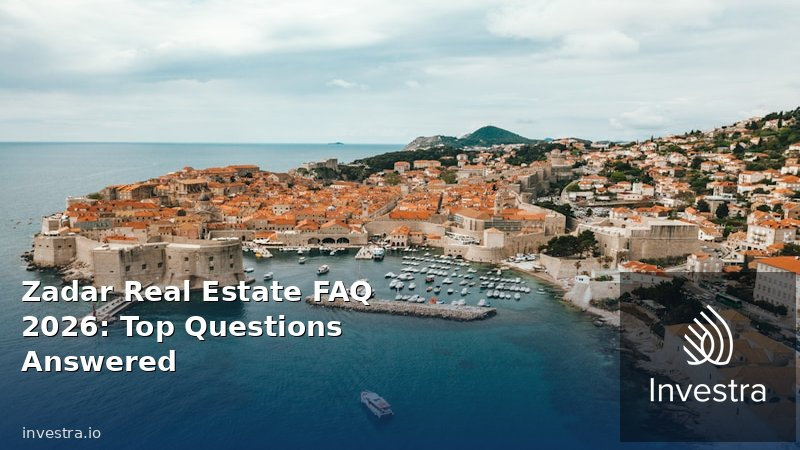
Zadar Real Estate FAQ 2026: Top Questions Answered
Why Zadar Is Attracting Global Property Investors in 2026
Quick Answer: Zadar has emerged as one of Croatia's most compelling real estate markets in 2026, offering competitive property prices, strong short-term rental yields, and a growing international buyer base drawn by its UNESCO-listed old town, award-winning sunsets, and direct flight connections across Europe. Investra.io tracks this market closely for investors seeking proven Adriatic opportunities.
There's a reason Zadar keeps appearing on "hidden gem" lists year after year — and in 2026, it's becoming less hidden by the day. Alfred Hitchcock once called it home to the world's most beautiful sunset. Today, a growing wave of European, American, and Middle Eastern investors are calling it one of the Adriatic's most undervalued property markets.
While Dubrovnik and Split have long dominated the international headlines, Zadar has quietly built a compelling case for real estate investment. The city sits on a narrow peninsula jutting into the Adriatic, packed with Roman ruins, medieval churches, and a genuinely vibrant local culture that hasn't yet been entirely consumed by mass tourism. That balance — authenticity alongside accessibility — is precisely what attracts a specific type of buyer: one who wants returns and lifestyle.
The market fundamentals are solid. Croatia joined the Eurozone in January 2023, eliminating currency risk for European investors and adding a layer of macroeconomic stability that has directly influenced property transaction volumes in Zadar. Prices have appreciated by an estimated 30–45% since 2020 in premium coastal areas, yet entry points remain significantly lower than comparable Mediterranean markets in Italy, France, or Portugal. A well-positioned apartment in Zadar's old town still trades at €3,000–€5,500 per m², a fraction of what similar properties cost in Lisbon or the Amalfi Coast.
The tourism infrastructure tells its own story. Zadar Airport handled record passenger numbers in recent years, with Ryanair, Eurowings, and Wizz Air operating routes from over 30 European cities. That connectivity translates directly into Airbnb occupancy rates and short-term rental income. For investors exploring Croatian coastal real estate, Zadar deserves a serious look — and this FAQ is designed to answer every question you're likely to have before making a move.
What Are Property Prices in Zadar in 2026?
Quick Answer: Property prices in Zadar range from approximately €1,800 to €6,500+ per m² depending on location and property type, with old town apartments and sea-view properties commanding the highest premiums. For a detailed tax and cost breakdown, see the Croatia Property Tax Guide 2026.
Price data in Zadar in 2026 tells a nuanced story. The headline figure of "affordable by Mediterranean standards" remains true, but there's significant variation depending on exactly where you buy and what you're buying. Understanding those distinctions can mean the difference between a sound investment and an expensive mistake.
In the Old Town (Stari Grad), expect to pay €3,500–€6,500 per m² for renovated apartments in heritage buildings. These properties are scarce — the peninsula has a finite footprint — and competition among buyers has intensified. New-build or fully refurbished units with sea views regularly breach €5,000/m².
The Brodarica and Višnjik neighborhoods, popular with local professionals and longer-term renters, sit in a more moderate range of €2,200–€3,200/m². You'll find more generous floor plans here, better parking, and proximity to schools and supermarkets — qualities that attract the long-term rental market.
Heading south along the coastal strip toward Borik and Diklo, prices for apartments in established residential complexes or villa-style properties range from €2,800 to €4,500/m², depending on sea proximity and renovation quality. Borik in particular has seen sustained demand from German and Austrian buyers who prioritize beach access over old town walkability.
The wider Zadar county — including islands like Ugljan, Pašman, and Dugi Otok — offers dramatically different price points. Rural land and older stone houses on these islands can still be found at €800–€1,500/m², though they typically require substantial renovation investment. Island properties attract a very specific buyer who values isolation and authenticity above all else.
For new-build developments across the city's expanding outskirts, developers are currently pricing units at €2,500–€3,800/m², with completion timelines typically running 18–30 months. Off-plan purchases can sometimes secure 5–10% below final market pricing, though this comes with construction risk. The overall trajectory is upward — independent analysts tracking the Dalmatian coast project continued annual price growth of 6–9% through 2027.
Can Foreign Nationals Buy Property in Zadar?
Quick Answer: Yes, citizens of EU member states can purchase property in Zadar without restrictions, while non-EU nationals generally need reciprocity agreements or a Croatian legal entity — though the process has been significantly streamlined since Croatia's Schengen and Eurozone accession. The Croatia Real Estate FAQ 2026 covers the legal framework in detail.
The short answer is yes — but the mechanics differ depending on where your passport is from. Croatia has progressively opened its real estate market to international buyers, and the 2023 Schengen accession accelerated that process considerably.
EU and EEA citizens enjoy full property purchasing rights equivalent to Croatian nationals. No additional permits, no government approvals, no restrictions on property type. You can buy an apartment in the old town, a villa on the coast, or agricultural land in the interior without bureaucratic friction — provided your paperwork is in order.
US, UK, Canadian, and Australian nationals benefit from bilateral reciprocity agreements with Croatia. In practice, this means they can purchase residential and commercial property in most areas without requiring a separate government permit. Agricultural land and forested areas are the notable exceptions, where additional approvals may apply.
Non-EU nationals without reciprocity agreements have the option of purchasing through a Croatian-registered company (d.o.o. — the equivalent of an LLC). This structure adds administrative overhead but is a well-established route that many international investors use successfully. It also carries certain tax advantages worth exploring with a local advisor.
What's consistent across all buyer categories is the need for proper legal representation. A local notary (javni bilježnik) is legally required to authenticate the purchase contract, and an independent property lawyer is strongly advisable to conduct title searches, verify land registry status, and check for encumbrances. Given that some older Dalmatian properties have complex ownership histories, skipping legal due diligence is a risk no serious investor should take. Consulting with an expert like Siniša Dagary — Investment Consultant can help navigate cross-border purchasing structures efficiently.
What Are the Rental Yields and Investment Returns in Zadar?
Quick Answer: Short-term rental yields in Zadar typically range from 6% to 10% gross annually for well-positioned properties, with peak-season occupancy rates often exceeding 85% from June through September. Long-term rentals yield a more modest 4–6%. For a city-specific comparison, the Buying Property In Split 2026 guide offers a useful benchmark.
Rental yields are where Zadar's investment case gets particularly interesting. The city punches above its weight when you stack it against comparable Adriatic destinations — and the math behind that claim holds up to scrutiny.
A studio or one-bedroom apartment in the old town, purchased at around €220,000–€280,000, can realistically generate €25,000–€35,000 in gross short-term rental revenue per year. That's assuming professional property management, consistent marketing on Airbnb, Booking.com, and regional platforms, and a July–August peak rate of €120–€200 per night. Run the numbers and you're looking at gross yields of 9–12% in the best-case scenarios for optimally managed properties.
More conservative, real-world estimates for a competently managed but not obsessively optimized short-term rental land at 6–8% gross. After platform fees (15–20%), management costs (20–25%), utilities, maintenance, and local tourist tax compliance, net yields typically settle around 4–6%. That still compares favorably with markets like Barcelona or Lisbon, where regulatory pressure on short-term rentals has compressed returns significantly.
What separates Zadar from some coastal alternatives is the shoulder season demand. May, June, and September see meaningful occupancy from European tourists who prefer the quieter pace and lower prices outside peak summer. The Digital Nomad community — attracted by Croatia's visa framework, which you can explore in the Croatia Digital Nomad Visa 2026 guide — has also extended the viable rental season into the autumn months.
Capital appreciation adds another dimension. Investors who bought in Zadar's old town in 2019 and held through 2024 saw price appreciation of 35–50% in euro terms, a meaningful component of total return. The combination of income yield and capital growth gives Zadar a total annual return profile that sophisticated investors find genuinely competitive on a Mediterranean-wide basis.
What Are the Best Neighborhoods in Zadar to Buy Property?
Quick Answer: The Old Town peninsula remains the top choice for short-term rental investors, while Borik and Diklo suit buyers prioritizing beach access and family appeal; Brodarica and Relja offer the best value for long-term rental strategies. Investra's buying guides across Croatian cities provide comparable neighborhood-level analysis.
Neighborhood selection in Zadar is really a question of investment strategy. Each area serves a different type of buyer and a different return profile — and the wrong match between strategy and location is one of the most common mistakes first-time Croatian buyers make.
Stari Grad (Old Town) is the prestige address. The pedestrianized stone streets, Roman Forum, Sea Organ, and unobstructed sea views create an atmosphere that draws premium short-term rental rates. Properties here are typically older, often requiring renovation, and available in limited supply. Competition is fierce and prices reflect that scarcity. For investors targeting the premium tourist market, there's no substitute.
Borik is Zadar's established tourist quarter — hotel-lined, beach-accessible, and popular with families. Investment properties here tend to be apartment complexes or ground-floor units near the shoreline. The short-term rental market is active, though yields are slightly lower than old town equivalents due to the more homogeneous supply. It suits buyers who want a turnkey investment with less renovation complexity.
Diklo and Bibinje, stretching south along the coastal road, represent a middle ground: residential character, beach proximity, and prices that still offer some value relative to the old town. New-build development has accelerated here, giving buyers the option of modern specifications at moderate prices.
Brodarica, Višnjik, and Relja are genuinely residential — the areas where local families live, shop, and send their kids to school. These neighborhoods have strong long-term rental demand, steady capital appreciation, and none of the tourist-season volatility. They're less glamorous but arguably more reliable for investors focused on stable income rather than peak-season windfalls.
Puntamika is worth watching. This quiet peninsula on Zadar's northwestern edge has attracted interest from buyers seeking larger plots and villa-style properties with direct sea access. Prices remain below old town levels, but the trajectory is upward as infrastructure improvements extend the city's desirability outward.
What Does the Buying Process Look Like for Foreign Investors in Zadar?
Quick Answer: The Croatian property buying process involves five core stages: property selection and offer, preliminary contract (predugovor), due diligence and financing, notarized final contract (kupoprodajni ugovor), and land registry transfer — typically completing within 60–120 days from agreement to ownership. The Croatia Property Tax Guide 2026 details the full cost structure.
The mechanics of buying property in Zadar are more straightforward than many foreign buyers expect — though there are specifics of Croatian property law that make professional guidance non-negotiable rather than optional.
The process typically begins with engaging a reputable local real estate agent (posrednik) who operates under Croatian licensing requirements. Once a target property is identified, most transactions proceed through a preliminary contract (predugovor), under which the buyer pays a deposit of typically 10% of the agreed purchase price. This deposit is legally binding on both parties — if the buyer withdraws without cause, the deposit is forfeited; if the seller withdraws, they must return double the deposit amount under Croatian contract law.
Simultaneously, the buyer's lawyer conducts due diligence: verifying title in the land registry (Zemljišna knjiga), checking for mortgages, liens, or disputes, confirming building permits and usage certificates (uporabna dozvola), and reviewing any condominium rules or homeowners' association obligations. This stage can take 2–4 weeks and occasionally surfaces issues that require negotiation or renegotiation.
The final contract (kupoprodajni ugovor) must be notarized by a Croatian notary public (javni bilježnik). The notary authenticates signatures, confirms identity, and certifies the transaction but does not provide legal advice to either party — which is why your own lawyer remains essential throughout. The balance of the purchase price is paid at or around this stage, typically via bank transfer from a Croatian bank account.
Land registry transfer follows notarization, with the buyer's ownership becoming legally registered within a few weeks to months, depending on the local land registry office's workload. Property transfer tax (3% of assessed value for resale properties) is payable to the Croatian Tax Administration within 30 days of the contract. The entire process — from signed preliminary contract to completed land registry transfer — generally takes 60–120 days, though complex cases can extend further. Financial structuring advice from professionals like those at Findes Financial Services can help optimize cross-border payment structures.
What Taxes Apply to Property Buyers and Owners in Zadar?
Quick Answer: Key taxes for Zadar property buyers include 3% real estate transfer tax on resale purchases (new-builds attract VAT instead), annual utility fees, rental income tax at 10–12% on declared net income, and potential capital gains tax of 24% on properties sold within 2 years of purchase. Full details are in the Croatia Property Tax Guide 2026.
Tax efficiency is a dimension of Croatian property investment that deserves careful attention — and the good news is that Croatia's tax framework is relatively investor-friendly by European standards, provided you understand how to structure ownership and declare income correctly.
At the point of purchase, buyers of resale properties pay a real estate transfer tax (porez na promet nekretninama) of 3% of the property's assessed market value (which the tax authority may set independently of the agreed purchase price if they deem it undervalued). New-build purchases are subject to VAT at 25% instead of transfer tax, which is typically already incorporated into the developer's asking price.
Rental income tax in Croatia operates on a lump-sum or net income basis. Private individuals renting property declare rental income and pay tax at approximately 10–12% of net income after allowable deductions (depreciation, maintenance, management fees). Correct registration with the Croatian Tax Administration — including obtaining a tourist accommodation registration (rješenje) and paying city tourist tax (boravišna pristojba) — is essential for legal short-term rental operation and avoids meaningful penalties.
Capital gains tax applies at 24% on properties sold within 2 years of acquisition. After 2 years of ownership, the gain is tax-free for private individual sellers — a significant benefit that rewards medium-to-long-term holding strategies. Properties used as a primary residence are also exempt from capital gains tax on sale regardless of holding period, though this is rarely applicable for foreign investors.
Annual communal contribution (komunalna naknada) and utility fees replace a formal property tax in Croatia. These fees are property-size-based and are typically modest — often €200–€800 per year for a standard apartment — but vary by municipality and property category. Short-term rental operators also face category-specific license fees determined by accommodation star rating.
How Does Short-Term Rental Regulation Work in Zadar?
Quick Answer: Short-term rental in Zadar is legal and well-established but requires property registration, categorization (1–5 stars), payment of tourist accommodation fees, and compliance with occupancy taxes — the regulatory environment is significantly less restrictive than in cities like Barcelona or Amsterdam. For Airbnb-specific investment strategies, the Split Airbnb Investment 2026 guide provides a directly comparable framework.
Zadar's approach to short-term rental regulation sits in a markedly different place from the increasingly hostile European cities that have introduced caps on Airbnb listings or imposed complex licensing lotteries. Croatia's entire economy is deeply intertwined with tourism revenue, and the legislative framework reflects that reality — it regulates rather than restricts, and the compliance process is manageable with the right preparation.
To legally operate a short-term rental in Zadar, property owners must first obtain a rješenje (decision) from the local tourist board (Turistička zajednica) authorizing the property for tourist accommodation. This involves a physical inspection of the property against minimum standards (size, furnishing, bathroom facilities, fire safety equipment) and results in an official star category designation from 1 to 5 stars. Most privately owned apartments targeting the international tourist market register as 3 or 4-star.
Once registered, owners must collect and remit boravišna pristojba (tourist/residence tax) from each guest — currently around €1–€2 per person per night depending on season and accommodation category. This is collected from guests and paid to the municipality quarterly. Airbnb handles this automatically for listings on its platform in Croatia, which simplifies compliance for remote owners.
Rental income must be declared annually to the Croatian Tax Administration. Property owners can choose between declaring actual net income (revenue minus allowable expenses) or using a simplified lump-sum taxation method. Most individual owners with one or two properties find the lump-sum approach simpler; those with larger portfolios or higher revenues often benefit from net income declaration once allowable deductions are factored in.
One aspect that surprises many new operators is the registration fee structure, which is based on the number of accommodation units (beds) rather than revenue. Annual fees vary by category and bed count but are generally very reasonable — often €100–€400 per year for a small apartment. The regulatory cost of short-term rental in Zadar is not a meaningful barrier to entry or profitability.
What Are the Best Property Types to Buy in Zadar for Investment?
Quick Answer: Studio and one-bedroom apartments in the old town deliver the strongest short-term rental yields; two-bedroom apartments in beach-adjacent neighborhoods balance yield with broader tenant appeal; and renovation projects in heritage buildings offer the most compelling upside for capital growth investors willing to manage complexity. Hvar Island Real Estate 2026 offers a useful comparison for luxury-tier buyers.
Property type selection is inseparable from investment strategy — and in Zadar's market, the options span a wider range than most buyers initially realize. The city simultaneously offers dense urban apartments in a UNESCO-adjacent old town and spacious coastal villas on surrounding islands, with everything in between.
For short-term rental optimization, the data consistently points to studio and one-bedroom apartments in central Zadar as the highest-yield choice per euro invested. They're easier to maintain, command high nightly rates relative to their purchase price, and the tourist market is deep enough to sustain premium occupancy. A well-presented 45 m² studio in the old town bought at €180,000–€220,000 can generate €20,000–€28,000 gross per peak season and shoulder season combined. The math is compelling.
Two-bedroom apartments attract a different segment — families, couples traveling with friends, and longer-stay guests who represent more valuable bookings during shoulder season. Their slightly higher purchase price is offset by the ability to charge meaningfully more per night (€180–€280 during peak July–August) and attract longer minimum-stay bookings that reduce cleaning and management overhead.
Renovation projects in Zadar's old town carry genuine appeal for experienced property investors. Derelict or poorly maintained stone buildings can occasionally be acquired at €1,800–€2,500/m², renovated for €800–€1,500/m² (depending on specification), and valued post-renovation at €4,000–€5,500/m². The value-add equation can produce an uplift of 40–60% — if you have the project management capability and the patience for Croatian planning and construction timelines. For insight into structuring such investments, the Business Strategy Blog from Siniša Dagary covers cross-border project structures in useful depth.
Villas with pools in the broader Zadar area target the premium end of the short-term rental market. Properties in this category — typically 150–300 m² with private outdoor space — command nightly rates of €300–€800+ in summer and attract affluent Northern European families seeking privacy. Purchase prices of €500,000–€1,200,000+ make these a higher-entry investment, but the gross revenue potential is proportionate.
Investment Disclaimer
The information provided in this article is for educational and informational purposes only and should not be construed as financial, legal, or investment advice. Real estate investments carry inherent risks, and past performance does not guarantee future results. Investors should not invest money they cannot afford to lose. Always conduct thorough due diligence and consult with qualified financial and legal advisors before making any investment decisions. Investra.io does not guarantee returns on any investment.
Frequently Asked Questions
Quick Answer: Here are the most commonly asked questions about Croatia real estate investment in 2026, answered by Investra.io experts.
Is Croatia a good country for real estate investment in 2026?
Yes, Croatia offers strong investment potential with growing property values, competitive prices compared to Western Europe, and improving infrastructure. Investra.io provides comprehensive market data and investment guidance.
Can foreigners buy property in Croatia?
EU citizens can buy property freely in Croatia. Non-EU citizens may need to meet specific requirements. Investra.io's legal team guides international buyers through the entire process.
What is the average property price in Zadar?
Property prices in Zadar vary significantly by location and property type. Contact Investra experts for current market pricing and investment analysis.
What rental yields can I expect?
Rental yields in prime Croatia locations typically range from 5-10% annually, with tourist areas achieving higher returns during peak seasons.
What taxes apply to property purchases?
Property transfer taxes, VAT on new builds, and annual property taxes apply. Rates vary by property type and location. Consult Siniša Dagary for tax optimization strategies.
How long does the purchase process take?
Typically 30-60 days from offer to completion. Working with Investra.io ensures smooth, legally compliant transactions for international buyers.
What financing options are available?
Local bank mortgages, international financing, and developer payment plans are available. Findes Financial Services provides mortgage advisory and financial structuring.
Is property management available for rental properties?
Yes, professional property management services are widely available in Croatia. Investra.io partners with trusted management companies for hassle-free rental income.
What are the best areas to invest in Zadar?
Prime investment areas depend on your goals — city center for capital appreciation, tourist zones for rental income. Investra.io's market analysis identifies the best opportunities.
Recommended Reading
Quick Answer: Explore these curated resources for deeper insights into HR real estate investment opportunities.
- Croatia Property Tax Guide 2026 What Foreign Buyers Must ...
- Split Airbnb Investment 2026 Rental Income Best Areas Leg...
- Croatia Digital Nomad Visa 2026 Complete Guide For Remote...
- Hvar Island Real Estate 2026 Luxury Property Investment G...
- Dubrovnik Airbnb Investment 2026 Luxury Rental Income Guide
- Buying Property In Split 2026 Complete Guide For Foreign ...
- Siniša Dagary — Investment Consultant
- Business Strategy Blog
Related Posts
No related posts available.
