
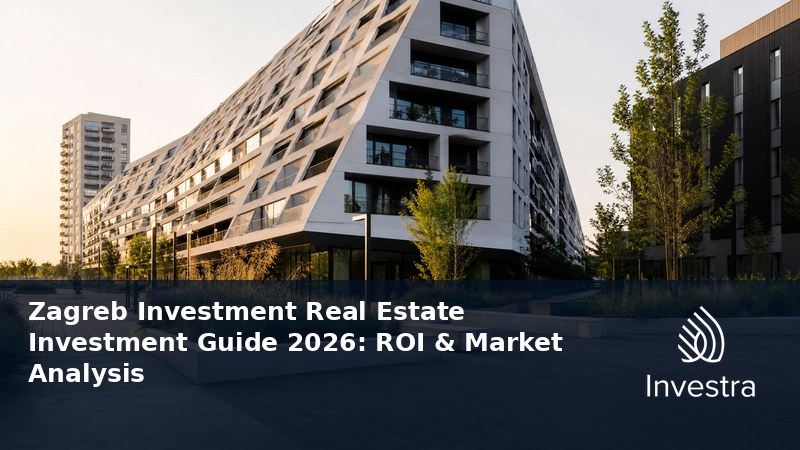
Zagreb Investment Real Estate Investment Guide 2026: ROI & Market Analysis
Why Zagreb Is Capturing Serious Investor Attention in 2026
Quick Answer: Zagreb's real estate market in 2026 offers some of the best value in the EU, with property prices ranging from €1,800 to €5,500/m² depending on location, and rental yields consistently outperforming Western European capitals. Investra.io's Complete Guide to Buying Property in Zagreb provides deeper market intelligence for foreign buyers ready to act.
There's a moment in every emerging market cycle when early adopters look back and say, "That's when it all changed." For Zagreb, we're arguably living through that moment right now. The Croatian capital — long overshadowed by glamorous coastal destinations like Dubrovnik and Split — has quietly assembled a compelling investment case that more experienced European investors are starting to take very seriously.
What makes Zagreb genuinely interesting isn't just the price point, though that's certainly part of it. It's the combination of factors converging simultaneously: EU membership since 2013, Eurozone and Schengen accession in January 2023, a rapidly digitalizing economy, a young educated workforce, and property prices that still sit comfortably below Zagreb's true economic weight. Compare Zagreb's €2,500–€3,500/m² average to Vienna at €7,000+/m², Prague at €5,500+/m², or Warsaw pushing €4,000+/m², and the arbitrage opportunity becomes very clear.
The 2020 earthquakes — a magnitude 5.5 in March and 6.4 in December — did trigger a short-term dip in confidence, but the city's recovery has been remarkable. Reconstruction programs have modernized large swaths of residential stock, and urban renewal projects in neighborhoods like Trnje, Novi Zagreb, and Savica are creating entirely new micro-markets. What surprised many buyers is how quickly post-earthquake demand rebounded, with 2022–2024 seeing year-on-year price increases of 8–12% in prime areas.
The reality is that Zagreb is no longer a speculative punt. It's a calculated, data-backed investment proposition for buyers who understand where European urban real estate is heading.
Understanding the Zagreb Property Market Structure in 2026
Quick Answer: Zagreb's property market divides into three clear tiers — premium city center, mid-range inner districts, and emerging outer neighborhoods — each offering different risk/return profiles for investors in 2026. Investra.io's Croatia Real Estate FAQ covers the most common questions international buyers ask before committing.
Zagreb's market isn't monolithic — and treating it as such is one of the most common mistakes foreign investors make. The city breaks down into distinct investment zones, each with its own supply dynamics, demand drivers, and yield characteristics.
Tier 1 — Historic Upper Town & Gornji Grad (€4,000–€5,500/m²): This is Zagreb's prestige address. Heritage-protected Austro-Hungarian architecture, proximity to government institutions, museums, and the Cathedral. Supply is genuinely constrained here — you simply cannot build new. Investors buying in this bracket are typically targeting long-term capital appreciation and premium short-term rental income, with yields running 4.5–6% net for well-managed Airbnb properties.
Tier 2 — Donji Grad, Gornji Grad, Medveščak, and Črnomerec (€3,000–€4,500/m²): The sweet spot for most international investors. These central and near-central neighborhoods offer walkability, established infrastructure, and strong demand from both expats and young Croatian professionals. Rental yields here typically fall between 5–7%, depending on property condition and management quality.
Tier 3 — Novi Zagreb, Trnje, Trešnjevka, Savica (€1,800–€2,800/m²): The emerging growth story. These southern and western districts have been transformed by infrastructure investment and earthquake-related reconstruction. Buyers picking up newly renovated or new-build units in these areas are seeing some of the strongest capital appreciation percentages in the market — albeit from a lower absolute base. Long-term rental yields can reach 6–8% in this tier, driven by student and young professional demand.
Understanding which tier matches your investment objectives — yield-focused vs. capital preservation vs. growth speculation — is the foundational decision every Zagreb buyer needs to make before viewing a single property.
Zagreb Property Price Analysis: What €1,800–€5,500/m² Actually Buys You
Quick Answer: In 2026, Zagreb property prices range from €1,800/m² in outer districts to €5,500/m² in the historic center, with the market average sitting around €2,800–€3,200/m² — still significantly below comparable EU capital cities. Croatia's Property Tax Guide for 2026 explains the full cost of ownership beyond the purchase price.
Let's get concrete about what the numbers actually mean on the ground. A 60m² one-bedroom apartment in Donji Grad — Zagreb's commercial and cultural heart — will cost you somewhere between €180,000 and €240,000 depending on floor level, condition, and whether it comes with parking. That same budget buys you roughly 18m² in central London or a storage unit in Monaco. The perspective matters.
New-build properties in Zagreb's prime locations are commanding €3,800–€5,000/m², and demand is outstripping supply at this end of the market. The Croatian construction sector, still recovering from earthquake disruption and global supply chain issues, has struggled to deliver sufficient new stock. This supply constraint is a structural support for prices — it's not going away quickly.
For resale apartments — particularly the interwar and communist-era blocks that dominate much of Zagreb's residential stock — buyers need to factor in renovation costs. A typical unrenovated apartment in a decent location might list at €2,200/m², but after a quality renovation (budgeting €400–€700/m² for a full fit-out), the total cost lands around €2,600–€2,900/m², with a post-renovation market value potentially 20–30% higher in a prime sub-location.
Price growth has been significant: the Croatian Bureau of Statistics (DZS) reported residential property price increases of approximately 10.3% year-on-year in Zagreb for 2023–2024, with the pace moderating to an estimated 6–8% in 2025 as higher borrowing costs tempered domestic demand. For foreign cash buyers, that cooling in domestic competition is actually an opportunity worth recognizing.
Transaction volumes remain healthy — roughly 15,000–18,000 property transactions annually in the Zagreb metropolitan area — suggesting a liquid market with genuine buyer depth. That liquidity matters enormously when you're planning your exit strategy years down the line. Consulting with Siniša Dagary — Investment Consultant can help buyers accurately model their all-in cost basis before making offers.
ROI Analysis: What Zagreb Investment Returns Look Like in Reality
Quick Answer: Zagreb real estate investors in 2026 can realistically target total returns of 8–14% annually through combined rental yield and capital appreciation, with short-term rental strategies at the higher end of that range for well-located properties. Investra.io's Split Airbnb Investment Guide provides a useful benchmark for Croatian short-term rental income modelling.
ROI analysis for Zagreb property needs to account for three distinct return streams: gross rental yield, capital appreciation, and the EUR/local currency stability benefit that Eurozone membership now provides.
Long-term rental yields: A well-located 50–70m² apartment in central Zagreb rents for €700–€1,200/month to professionals and expats. At an acquisition cost of €180,000–€220,000, that produces gross yields of 4.7–6.5%. After property management fees (typically 10–15%), maintenance allowances, and tax (Croatian rental income is taxed at a flat rate — see below), net yields settle in the 3.8–5.2% range. Not spectacular by emerging market standards, but extremely solid for an EU capital with strong capital appreciation prospects.
Short-term/Airbnb rental yields: Zagreb has emerged as a significant year-round short-break destination, benefiting from its central European location and excellent air connectivity. Properly managed Airbnb units in central Zagreb generate €40–€90/night with occupancy rates of 65–78%. That translates to gross annual revenues of €9,500–€25,000 depending on size, location, and management quality. For a €200,000 apartment, that's a gross yield of 4.75–12.5%. Management fees for short-term rentals run 20–25% of revenue in Zagreb.
Capital appreciation: Based on 2019–2024 data, Zagreb residential property has appreciated at a compound annual rate of approximately 8.5–10.5% in prime locations. Even applying more conservative 5–6% forward projections — which assume some normalization — the math is compelling when stacked on top of rental income.
Total return modelling: A €200,000 central Zagreb apartment acquired in 2026, earning net rental yield of 4.5% and appreciating at a conservative 5% annually, produces a total return of approximately 9.5% per annum before leverage effects. With financing (Croatian banks are increasingly offering mortgages to EU-national foreign buyers at 4–5.5% rates), the equity returns can be significantly amplified — though borrowing costs and risk need to be carefully assessed. For detailed financial structuring, platforms like Findes Financial Services can assist international investors in optimizing their capital structure.
Legal Framework: How Foreign Buyers Actually Purchase Property in Zagreb
Quick Answer: EU citizens can purchase Zagreb property with essentially the same rights as Croatian nationals, while non-EU buyers face additional requirements but still have clear legal pathways to ownership. The entire purchase process typically takes 45–90 days from offer to title transfer. Investra.io's Complete Guide to Buying Property in Zagreb walks through every step of the legal process.
Croatia's EU membership has fundamentally simplified property purchase for European buyers. Since 2013, EU/EEA citizens face almost no restrictions on purchasing residential property in Croatia — the pre-accession requirement for Ministry of Justice approval has been abolished entirely for this buyer group. For non-EU nationals, reciprocity agreements or company structures can facilitate acquisition, and the process — while slightly more involved — is entirely workable.
The purchase process in Zagreb follows a well-established sequence. A preliminary contract (predugovor) is signed with typically a 10% deposit, binding both parties legally. Due diligence during this period involves a title search (gruntovnica — the land registry) to confirm clean ownership, checking for encumbrances, mortgages, or disputes, and verifying building permits and usage permits for the specific property. This is where quality legal representation earns its fee.
The main purchase contract (kupoprodajni ugovor) is notarized or certified, and ownership transfer is registered at the Municipal Court land registry. The Croatian land registry system is generally reliable and well-organized — one of the structural legal advantages the market offers compared to some neighboring Balkans countries.
Foreign buyers must obtain a Croatian Personal Identification Number (OIB) to complete any property transaction — this is straightforward to obtain from the Croatian Tax Administration. Opening a Croatian bank account is recommended but not strictly mandatory if you use a notary-managed escrow process.
Total transaction costs for buyers run approximately 4–6% of purchase price, comprising the 3% real estate transfer tax (unless buying a new-build, where VAT applies instead), notary fees, land registry fees, and legal representation. Working with About Siniša Dagary and local legal advisors who understand both the Zagreb market and international buyer requirements can significantly reduce transaction friction.
Tax Obligations for Zagreb Property Investors in 2026
Quick Answer: Zagreb property investors face a 3% real estate transfer tax on resale purchases (new-builds attract 25% VAT instead), flat-rate rental income taxation, and a 10% capital gains tax on profits from properties sold within two years of purchase — after which the gain is tax-free. For a complete breakdown, the Croatia Property Tax Guide 2026 from Investra.io is essential reading.
Croatia's tax framework for property investors is, honestly, one of the more investor-friendly environments in the EU — particularly for those planning to hold long-term. But the details matter, and the nuances between different tax scenarios can significantly affect net returns.
Purchase taxes: The headline figure is the 3% Real Estate Transfer Tax (porez na promet nekretninama) levied on the purchase price of resale properties. For new-build purchases, this tax is replaced by 25% VAT — but that VAT is typically already included in the developer's listed price, so it's less of a surprise hit for buyers. The property itself (as an asset) attracts a relatively modest annual property tax — Croatia's system is less punitive than many Western European jurisdictions.
Rental income tax: Croatian law offers landlords a choice between paying a flat lump-sum rental tax (paušalni porez), which is calculated based on declared rental income and property location, or declaring rental income through the standard income tax system with deductible expenses. For most foreign investors renting to long-term tenants, the lump-sum system at effectively 12–15% of income is the simpler and often more favorable option. Short-term rental operators need to register as tourist accommodation providers and comply with additional municipal fees.
Capital gains tax: This is where Croatia really distinguishes itself. Properties held for more than two years are exempt from capital gains tax entirely. For properties sold within two years of purchase, a 10% flat CGT applies. This two-year hold-to-exemption rule is a significant planning tool — and a strong incentive for investors to take a medium-term rather than quick-flip approach. The Croatia Real Estate FAQ on Investra.io covers additional tax scenarios in detail.
Zagreb's Best Neighborhoods for Investment in 2026
Quick Answer: Donji Grad, Gornji Grad, and Medveščak lead on prestige and capital appreciation, while Trnje, Trešnjevka, and Novi Zagreb offer stronger rental yields and growth potential for budget-conscious investors in 2026. Investra.io's Zagreb Buyer Guide provides neighborhood-by-neighborhood analysis for targeted investment decisions.
Picking the right neighborhood in Zagreb isn't just about current prices — it's about understanding which micro-markets have structural supply constraints, improving infrastructure, and demographic tailwinds that will sustain demand over your holding period.
Donji Grad (Lower Town): The commercial and cultural core of Zagreb. Grand Austro-Hungarian boulevard architecture, proximity to Zrinjevac Park, the main train station, and Ban Jelačić Square. This is the neighborhood that consistently attracts corporate expats and higher-end short-term rental guests. Prices have held strong through market cycles, and the limited supply of quality renovated apartments creates persistent pricing power. Budget €3,500–€5,000/m² for quality stock here.
Gornji Grad (Upper Town): Zagreb's historic hillside quarter — cobblestone streets, galleries, parliament buildings, and the Cathedral. Properties here are rare, often heritage-protected, and carry the city's highest price tags (€4,500–€5,500/m²). Not a yield play — primarily a capital preservation and long-term appreciation strategy.
Medveščak: An upscale residential neighborhood northeast of the center, favored by diplomats, professionals, and families who want proximity to the center without being in it. Good schools, green spaces, solid infrastructure. Prices of €3,200–€4,200/m² reflect the quality of life on offer, and long-term rental demand from expat families is consistently strong.
Trnje & Trešnjevka: These working-class neighborhoods directly south and southwest of the center are going through genuine gentrification cycles. Young professionals, artists, new restaurants and bars — the classic urban regeneration story. Prices of €2,200–€3,000/m² for renovated properties, with yields reaching 6–7.5%. Earthquake reconstruction money has flowed into these areas, and the quality of newer stock is genuinely impressive.
Novi Zagreb: The city's southern expansion zone, characterized by large housing estates but with improving connectivity via the tramway network. Strong student and young professional demand. Entry prices from €1,800–€2,400/m² for older stock, with new-builds at €2,600–€3,200/m². The highest gross yield potential in the city, at 7–9% in some sub-locations.
The Digital Nomad and Expat Demand Driver Reshaping Zagreb's Rental Market
Quick Answer: Zagreb's growing digital nomad and expat community — attracted by Croatia's dedicated digital nomad visa, affordable living costs, and EU access — is creating durable mid-to-long-term rental demand that benefits property investors seeking stable tenancy. The Croatia Digital Nomad Visa Guide explains the program that's drawing this new wave of residents.
One of the most underappreciated demand drivers in Zagreb's rental market right now is the accelerating influx of remote workers and digital nomads who are choosing Croatia — and Zagreb specifically — as their European base of operations. Croatia launched its digital nomad visa program in 2021, and what initially looked like a niche policy move has matured into a meaningful demographic shift with real implications for the rental market.
The profile of this tenant base is attractive for landlords. Digital nomads and remote workers typically earn in hard currencies (USD, GBP, EUR from Western employers), prioritize quality and connectivity over pure price, and tend to rent for 6–18 month stretches — longer than typical tourist visitors but with the flexibility that means they're willing to pay premiums for the right property. Average rents paid by this segment in central Zagreb run 15–25% above the local market median.
Zagreb's appeal to this group is based on a genuine quality-of-life proposition: monthly living costs of €1,200–€2,000 (compared to €3,000+ in Berlin, Amsterdam, or Stockholm), excellent café culture and gastronomy, 300+ days of annual sunshine nearby at the coast, EU residency rights, solid broadband infrastructure, and a very walkable, compact city center. The Croatia Digital Nomad Visa program specifically facilitates stays of up to one year (renewable), providing a legal framework that makes Zagreb a genuinely sustainable long-term choice rather than just a short visit.
For investors, this means that a well-equipped 50–70m² apartment in a walkable Zagreb neighborhood — reliable WiFi, properly fitted kitchen, comfortable workspace — can command monthly rents of €900–€1,400 from this tenant segment. Furnishing and equipping a unit to this standard costs €15,000–€25,000, but the premium rents and lower vacancy rates make the investment rational.
Zagreb vs. Croatia's Coastal Markets: Where Should You Invest?
Quick Answer: Zagreb offers year-round rental income, lower price points, and stronger capital appreciation fundamentals, while coastal markets like Dubrovnik, Split, and Hvar offer higher short-term peak yields but greater seasonality risk and significantly higher entry costs. The right choice depends on investor profile and risk tolerance. The Dubrovnik Airbnb Investment Guide offers a detailed comparison for the premium coastal market.
This is genuinely one of the most common questions we encounter from international buyers exploring Croatia, and the honest answer is: both markets have merit, but they serve very different investor profiles.
Croatia's coastal real estate market — Dubrovnik, Split, Hvar, the Dalmatian islands — has captured most of the international investment attention, and for understandable reasons. The scenery is spectacular, the tourism brand is globally recognized, and high-season short-term rental income can be extraordinary. A well-positioned Dubrovnik apartment can generate €15,000–€30,000 in peak summer months alone. But the entry prices reflect this: central Dubrovnik commands €6,000–€10,000/m², making yields dramatically thinner when you do the annual math across a 12-month period rather than just peak season.
Seasonality is the coastal market's structural challenge. Occupancy in peak season (July–August) runs 90–95%, but outside April–October, many coastal properties sit largely idle. Annual occupancy rates of 45–60% are more typical when you include the full year. Zagreb, by contrast, benefits from business travel, conference tourism, festival visitors, and the steady expat/nomad segment — producing year-round occupancy rates of 65–80% for well-managed properties.
For those drawn to the luxury coastal segment, Hvar Island Real Estate Guide and the Complete Guide to Buying Property in Dubrovnik are essential resources. Similarly, Buying Property in Split occupies an interesting
Investment Disclaimer
The information provided in this article is for educational and informational purposes only and should not be construed as financial, legal, or investment advice. Real estate investments carry inherent risks, and past performance does not guarantee future results. Investors should not invest money they cannot afford to lose. Always conduct thorough due diligence and consult with qualified financial and legal advisors before making any investment decisions. Investra.io does not guarantee returns on any investment.
Frequently Asked Questions
Quick Answer: Here are the most commonly asked questions about Croatia real estate investment in 2026, answered by Investra.io experts.
Is Croatia a good country for real estate investment in 2026?
Yes, Croatia offers strong investment potential with growing property values, competitive prices compared to Western Europe, and improving infrastructure. Investra.io provides comprehensive market data and investment guidance.
Can foreigners buy property in Croatia?
EU citizens can buy property freely in Croatia. Non-EU citizens may need to meet specific requirements. Investra.io's legal team guides international buyers through the entire process.
What is the average property price in Zagreb Investment?
Property prices in Zagreb Investment vary significantly by location and property type. Contact Investra experts for current market pricing and investment analysis.
What rental yields can I expect?
Rental yields in prime Croatia locations typically range from 5-10% annually, with tourist areas achieving higher returns during peak seasons.
What taxes apply to property purchases?
Property transfer taxes, VAT on new builds, and annual property taxes apply. Rates vary by property type and location. Consult Siniša Dagary for tax optimization strategies.
How long does the purchase process take?
Typically 30-60 days from offer to completion. Working with Investra.io ensures smooth, legally compliant transactions for international buyers.
What financing options are available?
Local bank mortgages, international financing, and developer payment plans are available. Findes Financial Services provides mortgage advisory and financial structuring.
Is property management available for rental properties?
Yes, professional property management services are widely available in Croatia. Investra.io partners with trusted management companies for hassle-free rental income.
What are the best areas to invest in Zagreb Investment?
Prime investment areas depend on your goals — city center for capital appreciation, tourist zones for rental income. Investra.io's market analysis identifies the best opportunities.
Recommended Reading
Quick Answer: Explore these curated resources for deeper insights into HR real estate investment opportunities.
- Croatia Property Tax Guide 2026 What Foreign Buyers Must ...
- Split Airbnb Investment 2026 Rental Income Best Areas Leg...
- Croatia Digital Nomad Visa 2026 Complete Guide For Remote...
- Hvar Island Real Estate 2026 Luxury Property Investment G...
- Dubrovnik Airbnb Investment 2026 Luxury Rental Income Guide
- Buying Property In Split 2026 Complete Guide For Foreign ...
- Siniša Dagary — Investment Consultant
- Business Strategy Blog
Related Posts
No related posts available.
