
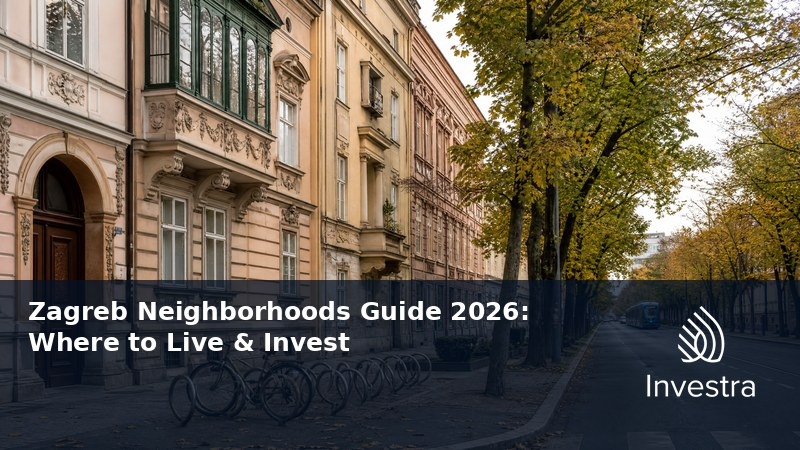
Zagreb Neighborhoods Guide 2026: Where to Live & Invest
Zagreb Neighborhoods Guide 2026: An Overview of Croatia's Capital Property Market
Quick Answer: Zagreb is Croatia's most stable and diverse real estate market, offering neighborhoods ranging from historic Upper Town luxury properties to modern suburban family zones — with prices spanning €1,500 to €5,500 per m² depending on location and property type. For a full investment breakdown, visit the Croatia Real Estate Investment Guide 2026.
Zagreb, the capital and largest city of Croatia, stands as the country's economic, cultural, and administrative heartbeat. With a population of approximately 800,000 in the city proper and nearly 1.1 million in the greater metropolitan area, Zagreb represents an entirely different investment proposition compared to the country's famous Adriatic coastline. While Dubrovnik and Split attract seasonal tourists, Zagreb offers something arguably more valuable to long-term investors: stability, year-round rental demand, strong institutional infrastructure, and consistent price appreciation.
The city's real estate market has undergone a significant transformation since Croatia joined the European Union in 2013 and even more so since its adoption of the euro in January 2023. The removal of currency exchange risk, combined with Zagreb's growing status as a Central European business hub, has attracted substantial foreign investment. In 2025 alone, property transaction volumes in Zagreb increased by approximately 12% year-on-year, according to the Croatian Bureau of Statistics (DZS).
For international buyers asking what are the best neighborhoods in Zagreb to live in, the answer depends heavily on lifestyle priorities, budget constraints, and investment goals. Whether the priority is proximity to historic landmarks, access to international schools, walkable urban living, or maximum rental yield potential, Zagreb has a neighborhood that matches each profile. This comprehensive guide examines every major Zagreb district in detail, providing the price data, rental yield figures, lifestyle context, and investment intelligence needed to make a confident decision in 2026.
Explore all current listings and professional investment support through the Zagreb Property Market Analysis portal.
---Understanding Zagreb's Urban Structure: Districts, Neighborhoods, and City Zones
Quick Answer: Zagreb is divided into 17 administrative city districts (gradske četvrti), each containing multiple neighborhoods — with the most investment-relevant areas clustered in the historic Upper Town, the prestigious Lower Town grid, and the expanding New Zagreb across the Sava River.
Before evaluating individual neighborhoods, it is essential to understand how Zagreb is geographically and administratively organized. The city stretches from the medieval Gornji Grad (Upper Town) perched on Gradec and Kaptol hills, down through the elegant 19th-century Donji Grad (Lower Town) with its Austro-Hungarian grid layout, across the modern residential zones of the inner city, and ultimately over the Sava River into Novi Zagreb (New Zagreb), which was largely developed during the Yugoslav-era socialist housing boom.
The city's 17 official administrative districts include Gornji Grad-Medveščak, Donji Grad, Maksimir, Peščenica-Žitnjak, Novi Zagreb-Istok, Novi Zagreb-Zapad, Trešnjevka-Sjever, Trešnjevka-Jug, Trnje, Črnomerec, Gornja Dubrava, Donja Dubrava, Sesvete, Stenjevec, Podsused-Vrapče, Brezovica, and Podsljeme. For practical investment purposes, however, the market is typically discussed in terms of distinct neighborhood character zones rather than strict administrative boundaries.
Zagreb's topography creates a natural north-south divide. To the north lies Medvednica mountain, whose forested slopes define the premium residential zone known as the "Zelena Potkova" (Green Horseshoe) extension. Heading south from the historic center toward the Sava River and beyond represents progressively more affordable territory, though Novi Zagreb has been rapidly gentrifying. The tram network, which runs east-west across the lower city and connects to Novi Zagreb via a key bridge crossing, is the primary determinant of day-to-day accessibility and, consequently, property values.
Average property prices across all Zagreb zones in early 2026 sit at approximately €2,650 per m², representing a 9.3% increase from the same period in 2024. This compares favorably with other EU capital cities at similar development stages and reflects the continued trajectory of Zagreb's maturing real estate market.
---Gornji Grad (Upper Town): Zagreb's Historic Prestige Address
Quick Answer: Gornji Grad commands Zagreb's highest prestige property prices, ranging from €3,800 to €5,500 per m² for renovated historic apartments, making it the city's equivalent of a luxury address with strong appeal for high-net-worth buyers and boutique hospitality investors.
Gornji Grad — literally "Upper Town" — encompasses the medieval core of Zagreb, including the Gradec and Kaptol hills that form the city's historic nucleus. This is where Zagreb began, and its cobblestone streets, Baroque palaces, the iconic St. Mark's Church with its colorful tiled roof, the Croatian Parliament (Sabor), the Presidential Palace, and numerous embassies create an atmosphere unlike anywhere else in the city.
Real estate in Gornji Grad is exceptionally scarce by nature. The area is almost entirely protected by UNESCO heritage status considerations and strict conservation regulations, meaning new construction is essentially impossible. Supply is therefore constrained to existing historic building stock, which drives prices to the highest levels in the Zagreb market. Renovated apartments in well-maintained historic palaces typically command between €3,800 and €5,500 per m², with the most exceptional properties — those featuring original architectural details, panoramic city views, and large terraces — occasionally reaching €6,000 per m² or beyond.
For investment purposes, Gornji Grad presents an interesting dual opportunity. Short-term vacation rental demand is consistently strong given the area's proximity to Zagreb's main tourist attractions, while the diplomatic and governmental presence supports a premium long-term rental market from embassy staff, senior government officials, and executives of international organizations. Short-term rental yields in Gornji Grad typically average 5.5%–7.5% gross annually, depending on property size, condition, and management quality.
The primary challenge for buyers in Gornji Grad is the regulatory environment. Property transactions involving heritage-listed buildings require additional due diligence, and renovation projects must receive approval from the City of Zagreb's conservation authority. Buyers should budget an additional 15%–25% on top of purchase price for compliant renovations. Despite these complications, capital appreciation has been consistent, with Gornji Grad properties delivering average annual gains of 6%–9% over the past five years.
Practical lifestyle note: while Gornji Grad is surrounded by Zagreb's urban energy, the area itself is remarkably quiet — car access is restricted on many streets, and the absence of ground-floor retail means noise levels are low. Funicular access from Ilica Street makes the hilltop accessible without vehicle ownership. For those seeking Zagreb's most characterful and historically significant address, Gornji Grad remains unrivaled.
---Donji Grad (Lower Town): The Commercial and Cultural Heart of Zagreb
Quick Answer: Donji Grad offers Zagreb's most prestigious everyday living with property prices between €2,800 and €4,500 per m², exceptional walkability to all city amenities, and rental yields of 4.5%–6.5% — making it the top choice for professional renters and long-term investors seeking urban-core exposure.
Donji Grad is the neighborhood most visitors picture when they think of Zagreb. Its elegant Lenuci Horseshoe — a series of interconnected parks and public squares designed in the late 19th century — runs through the heart of this Austro-Hungarian grid district, flanked by imposing Neo-Baroque and Secession-style buildings housing the National Theatre, the Archaeological Museum, the Art Pavilion, and the University of Zagreb's central campus. This is the commercial, cultural, and institutional backbone of the Croatian capital.
The real estate market in Donji Grad encompasses some of the city's most prestigious and desirable addresses. Properties on and near Ilica Street (Zagreb's main commercial artery), Zrinjevac park, Trg bana Jelačića (the central square), and the university quarter command prices between €2,800 and €4,500 per m², with exceptionally well-positioned or renovated apartments pushing toward €5,000. The district's building stock is predominantly pre-World War II, featuring high ceilings (typically 3.2m–4.0m), ornate facades, and generous room proportions that are highly sought after by both owner-occupiers and tenants.
Long-term rental demand in Donji Grad is driven by Zagreb's professional workforce, university student population, diplomatic corps, and the growing cohort of remote workers choosing Zagreb as their European base. Average rental prices for a renovated two-bedroom apartment (60–80 m²) in the best Donji Grad locations range from €900 to €1,400 per month in 2026. This translates to gross rental yields of approximately 4.5%–6.5% — lower than outer city yields but compensated by exceptional capital stability and liquidity.
One important consideration for Donji Grad investors is the post-2020 earthquake renovation landscape. The March 2020 earthquake (magnitude 5.5) and subsequent December 2020 Petrinja earthquake significantly impacted many older buildings in Zagreb. The Croatian government established a substantial renovation fund (Program obnove) for affected properties, and by 2026, the majority of major structural repairs in Donji Grad have been completed or are in advanced stages. Buyers should always commission an independent structural survey on pre-war buildings.
Parking remains a challenge in Donji Grad, and this is a legitimate lifestyle consideration for family buyers. However, the district's tram connectivity — with multiple lines traversing its major streets — means car ownership is genuinely optional for day-to-day life. For international investors seeking the Zagreb equivalent of a prime London or Vienna city-center apartment, Donji Grad represents the benchmark address.
---Gornja Dubrava and Špansko: Affordable Family Neighborhoods With Growth Potential
Quick Answer: Gornja Dubrava and Špansko offer Zagreb's most accessible entry points for family buyers and yield-focused investors, with property prices ranging from €1,500 to €2,400 per m² and gross rental yields reaching 6.5%–8.5%, supported by strong local community infrastructure.
For investors and buyers prioritizing affordability without sacrificing urban functionality, Zagreb's eastern and western residential neighborhoods — particularly Gornja Dubrava, Špansko, and adjacent zones — represent compelling value propositions in 2026. These neighborhoods developed primarily in the post-World War II period and are characterized by mixed housing stock including both older Yugoslav-era apartment blocks and a growing supply of newer construction developments from the 2000s onward.
Gornja Dubrava, located in the city's eastern quadrant, has a strong community identity built around local schools, sports clubs, and neighborhood markets. Property prices here range from approximately €1,500 to €2,200 per m², with newer construction reaching the upper end of this range. The neighborhood is well-served by bus routes connecting to the city center in 20–30 minutes, and there are active planning discussions around extending Zagreb's tram network to improve east-city connectivity.
Špansko, in western Zagreb, shares similar price characteristics (€1,600–€2,400 per m²) and benefits from relatively easy access to the Zagreb bypass ring road, making it appealing to commuter families who work in suburban industrial zones or who require car access to other Croatian cities. The area has seen increased private development activity in recent years, with several new residential complexes offering modern amenities at prices significantly below those of inner-city equivalents.
For yield-focused investors, these neighborhoods offer the highest gross rental returns in the Zagreb market, typically between 6.5% and 8.5%. The tenant pool is primarily composed of working families and young professionals who cannot afford inner-city prices, creating consistent occupancy rates that often exceed 90% annually. While capital appreciation rates are lower than in prestige central areas (averaging 4%–6% annually), the combination of high yields and low entry price points makes Gornja Dubrava and Špansko attractive for portfolio investors seeking strong cash-flow performance.
---Maksimir and Šalata: The Green Premium of Zagreb's Eastern Residential Belt
Quick Answer: Maksimir and Šalata offer a rare combination of green space proximity, prestigious addresses, and strong family appeal, with property prices between €2,500 and €3,800 per m² — attracting Zagreb's professional middle class and offering reliable 4.8%–6.2% rental yields.
Maksimir represents one of Zagreb's most beloved residential neighborhoods, synonymous with the magnificent Maksimir Park — Croatia's oldest and largest public park, established in 1794. The neighborhood stretches eastward from the park's borders along tree-lined avenues, offering a lifestyle that feels genuinely suburban despite being just 4–6 kilometers from Trg bana Jelačića. Šalata, positioned slightly closer to the city center on the slopes north of Donji Grad, shares similar premium green-space characteristics with a tighter supply of villas and detached houses.
Property prices in Maksimir range from €2,500 to €3,600 per m², with premium villa properties near the park's perimeter occasionally exceeding €4,000 per m². The housing stock is diverse, encompassing pre-war villas, inter-war apartment buildings, Yugoslav-era residential towers, and a modest but growing number of new luxury developments. Šalata commands a slight premium due to its proximity to Donji Grad, with prices ranging from €2,900 to €3,800 per m².
The demographic profile of Maksimir and Šalata residents reveals the neighborhood's character: families with children, established professionals, academics (given the proximity to several Zagreb faculties), and a growing number of returning Croatian diaspora who prefer the area's balance of urban access and quality-of-life amenities. The Croatian Football Federation headquarters and the Dinamo Zagreb stadium are located in Maksimir, giving the neighborhood an additional cultural dimension.
Rental demand in Maksimir is driven primarily by the long-term family rental market, with three-bedroom apartments (85–120 m²) in good condition achieving €1,100–€1,600 per month. Gross rental yields of 4.8%–6.2% are achievable for well-selected properties. Capital appreciation has been solid, averaging 6.5%–8% annually over 2021–2025, supported by the area's consistently high desirability and relatively constrained supply.
---Črnomerec and Podsused-Vrapče: Western Zagreb's Hillside Living Alternative
Quick Answer: Črnomerec and the broader western hillside zone offer Zagreb's most scenic residential living at prices between €1,800 and €3,200 per m², combining mountain proximity with reasonable city access and attracting nature-loving families who prioritize lifestyle quality over urban convenience.
The western neighborhoods climbing toward Medvednica mountain's lower slopes — primarily Črnomerec, Podsused-Vrapče, and Stenjevec — represent a distinct lifestyle segment of the Zagreb property market. These areas are defined by a more verdant, tranquil character where smaller houses with gardens, older villas, and mid-rise residential buildings are interspersed with forests and hiking trail access points.
Črnomerec sits at the inner edge of this western zone, maintaining good tram connectivity to central Zagreb via the #14 tram line while offering noticeably quieter streets and a higher proportion of green space than central districts. Property prices here range from €2,000 to €3,200 per m², with the higher end applying to newer constructions or well-positioned villas. The area has a loyal local following among Zagreb families who prioritize outdoor lifestyle — Medvednica is literally on the doorstep, offering skiing in winter and hiking year-round.
Podsused-Vrapče and Stenjevec, further west, represent more affordable entry points (€1,800–€2,600 per m²) while maintaining the hillside lifestyle appeal. These neighborhoods have benefited from infrastructure investment, including road improvements and expanded bus network frequency, which has reduced the commute-time premium historically associated with western Zagreb locations.
For international buyers seeking a Croatian permanent residence that prioritizes lifestyle quality — particularly those who enjoy outdoor activities and a slower pace — the western hillside zone offers excellent value. Rental yields here are modest (4.5%–6%) but stable, and the long-term price trajectory is positive as Zagreb's expanding middle class increasingly seeks this lifestyle profile.
---Trešnjevka: Zagreb's Authentic Neighborhood With Emerging Investment Appeal
Quick Answer: Trešnjevka has evolved from a working-class district into one of Zagreb's most talked-about emerging investment areas, with prices of €1,900–€3,000 per m², strong rental demand from young professionals, and yields of 5.5%–7.5% that reflect its gentrification momentum.
Trešnjevka — divided administratively into Trešnjevka-Sjever (north) and Trešnjevka-Jug (south) — is arguably Zagreb's most fascinating neighborhood transformation story of the 2020s. Once regarded primarily as a dense, working-class residential district west of the city center, Trešnjevka has been progressively gentrifying as its affordable prices, authentic local atmosphere, and improving restaurant and cultural scene attract young creative professionals priced out of Donji Grad.
The neighborhood's main artery, Ilica Street, forms its northern border, while the Trešnjevka Market (Tržnica Trešnjevka) — one of Zagreb's most vibrant open-air markets — anchors its community identity. The area has seen notable investment in food and beverage establishments, independent retail, and co-working spaces, creating the kind of local ecosystem that precedes significant property price appreciation in urban neighborhoods worldwide.
Property prices in Trešnjevka currently range from €1,900 to €3,000 per m², with the northern section closer to Ilica commanding the higher end of this range. Crucially, prices in the best Trešnjevka-Sjever streets have increased by approximately 22% over the past three years — one of the fastest appreciation rates in the Zagreb market — as buyer and investor awareness of the neighborhood's trajectory has grown.
Rental demand is particularly strong from Zagreb's 25–35 age demographic, including tech workers (Zagreb has an established IT sector employing over 25,000 people), healthcare professionals, and young families. Average rents for a renovated one-bedroom apartment (40–55 m²) range from €600 to €850 per month, generating gross yields of 5.5%–7.5% for investors. Those who entered the Trešnjevka market in 2021–2022 have already seen combined annual returns (yield plus capital gain) exceeding 12% in the best cases.
For a comparative perspective on Croatia's coastal investment alternatives that complement a Zagreb portfolio, review the Split Real Estate Guide and consider how Zagreb's year-round demand profile balances seasonal coastal exposure.
---Novi Zagreb: The River's Other Shore and Its Modern Investment Case
Quick Answer: Novi Zagreb, once dismissed as purely socialist-era housing stock, has emerged as a legitimate investment market with prices of €1,800–€2,800 per m², strong new development activity, and growing appeal among younger buyers attracted by modern amenities and relatively lower acquisition costs.
Novi Zagreb — New Zagreb — occupies the flatlands south of the Sava River and was developed primarily during the 1960s–1980s as a planned residential extension of the historic city. Its reputation among Zagreb locals has historically been mixed: celebrated for its wide boulevards, abundant green space, and modern shopping infrastructure, but sometimes criticized for lacking the architectural character and street-level vitality of the older city quarters.
However, the narrative around Novi Zagreb has shifted considerably in the early 2020s. The arrival of the Arena Zagreb sports complex, the Westin Zagreb hotel, the City Center One shopping complex, and a cluster of office campuses housing major international corporations has transformed Novi Zagreb-Istok (East) into something approaching a secondary urban center. The western portion (Novi Zagreb-Zapad) retains a quieter, more purely residential character but benefits from excellent road connectivity to the A1 motorway toward Split.
Property prices across Novi Zagreb range from €1,800 to €2,800 per m², with newer constructions in sought-after Bundek Lake and Savica areas reaching toward the higher end. The Bundek neighborhood — built around Zagreb's beloved urban lake — commands a notable lifestyle premium and has seen particularly strong price growth. Several significant new residential developments, including modern apartment complexes with underground parking, fitness facilities, and concierge services, have been completed or are underway in this zone.
The investment case for Novi Zagreb in 2026 rests on three pillars: affordability relative to comparable European city fringes, strong rental demand from the corporate tenant pool working in the adjacent office districts, and infrastructure investment that is systematically improving the area's connectivity and amenity profile. Corporate tenants — particularly employees of multinationals with Zagreb offices — typically seek exactly the modern, spacious apartments that Novi Zagreb's new-build stock offers, at rental prices between €900 and €1,400 per month for two-bedroom units.
---Jarun and Savica: Zagreb's Leisure District and Its Property Market
Quick Answer: The Jarun lake district and adjacent Savica neighborhood command property prices of €2,200–€3,400 per m² driven by exceptional lifestyle amenities, with short-term rental yields of 5.8%–7.8% during peak season and strong long-term demand from lifestyle-oriented professional tenants.
Jarun Lake — a 2.2-kilometer artificial rowing course and recreational lake created for the 1987 Summer Universiade — has become the epicenter of Zagreb's outdoor lifestyle culture. On summer weekends, Jarun's lakeside beaches and cafés attract tens of thousands of Zagreb residents, and the surrounding neighborhoods benefit enormously from this energy. Properties within walking distance of Jarun Lake consistently outperform the broader Novi Zagreb market on both price appreciation and rental demand metrics.
The immediate Jarun zone (technically within Trešnjevka-Jug administratively) features a mix of Yugoslav-era residential blocks and newer developments, with prices ranging from €2,200 to €3,400 per m² for quality apartments with lake views or park proximity. Savica, adjacent to Jarun's eastern shore, has seen particularly notable development activity, with several premium residential projects marketed specifically on the Jarun lifestyle proposition.
Short-term rental operators have recognized Jarun's potential. While not a tourist district in the traditional sense, Zagreb's growing conference and business tourism market generates demand for upscale short-term accommodation, and Jarun properties — offering more space and a resort-like setting compared to central apartments — perform well on platforms like Airbnb and Booking.com. Gross short-term rental yields of 5.8%–7.8% are achievable for well-managed properties in the summer months, with consistent year-round demand from domestic weekend visitors supplementing tourist stays.
Long-term tenants in the Jarun-Savica area include the expat community, sports professionals (the area is popular with athletes), and young families who prioritize outdoor lifestyle. Average rents for a quality two-bedroom apartment near the lake range from €950 to €1,350 per month, supporting competitive yield profiles. Capital appreciation over 2020–2025 averaged approximately 7.2% annually for well-positioned Jarun properties.
---Sesvete and Outer Zagreb: The Suburban Frontier for Value Investors
Quick Answer: Sesvete and outer Zagreb suburbs offer the city's most affordable residential property at €1,200–€1,900 per m², appealing to first-time buyers, buy-to-let investors targeting the local rental market, and those who prioritize space and garden ownership over urban proximity.
The outer ring of Zagreb's administrative territory encompasses several semi-urban and suburban municipalities, of which Sesvete — in the northeast — is the largest. With its own railway station, local shopping infrastructure, and a genuine town-center character, Sesvete functions almost as a satellite city within Zagreb's boundaries. Property prices here are the most accessible in the Zagreb market, ranging from €1,200 to €1,900 per m², making homeownership achievable for local buyers at income levels excluded from central neighborhoods.
For international investors, Sesvete and the outer suburbs present a specific investment thesis: high-yield, low-capital-entry positions targeting the local rental market. With acquisition costs well below central Zagreb levels, investors can achieve gross rental yields of 7%–9.5% from properties let to local families and working professionals. However, these yields must be weighed against lower capital appreciation rates (typically 3%–5% annually) and less liquidity compared to central areas — resale timelines in outer Zagreb can extend to 6–12 months versus 2–4 months for well-priced central apartments.
The suburban thesis also encompasses new housing developments on Zagreb's periphery, where Croatian developers are delivering house-and-garden product aimed at the aspirational family buyer. These projects — typically offering 120–160 m² houses with private gardens at total prices of €200,000–€320,000 — have found strong domestic demand, particularly from Zagreb families who experienced the 2020 earthquake and subsequently prioritized standalone construction over older apartment blocks.
For investors with a long-term (10+ year) perspective and a focus on absolute total return rather than immediate yield optimization, the outer Zagreb residential ring offers an interesting entry point. The Croatian government's ongoing investment in Zagreb's road infrastructure, including ring road improvements and rail network upgrades, is systematically improving outer suburb connectivity and building the case for longer-term value appreciation.
---Property Prices Across Zagreb Neighborhoods: 2026 Comparative Data
Quick Answer: Zagreb property prices in 2026 range from approximately €1,200 per m² in outer suburban areas to €5,500 per m² in premium Upper Town heritage properties, with the overall city average sitting at €2,650 per m² — representing a 9.3% year-on-year increase driven by euro adoption, EU funding inflows, and growing foreign investor interest.
The following data provides a comprehensive price-per-square-meter overview for Zagreb's main investment neighborhoods in Q1 2026, based on aggregated transaction data from the Croatian Bureau of Statistics, the Zagreb Land Registry, and market intelligence compiled by Investra's Zagreb Property Market Analysis:
- Gornji Grad (Upper Town): €3,800–€5,500 per m² (renovated heritage)
- Donji Grad (Lower Town): €2,800–€4,500 per m²
- Šalata: €2,900–€3,800 per m²
- Maksimir: €2,500–€3,600 per m²
- Jarun / Savica: €2,200–€3,400 per m²
- Trešnjevka-Sjever: €2,100–€3,000 per m²
- Trešnjevka-Jug: €1,900–€2,700 per m²
- Črnomerec: €2,000–€3,200 per m²
- Novi Zagreb-Istok (East): €2,100–€2,800 per m²
- Novi Zagreb-Zapad (West): €1,800–€2,500 per m²
- Gornja Dubrava: €1,500–€2,200 per m²
- Špansko: €1,600–€2,400 per m²
- Podsused-Vrapče: €1,800–€2,600 per m²
- Sesvete: €1,200–€1,900 per m²
New construction commands a 15%–25% premium over comparable resale properties across all zones, reflecting both modern construction standards and post-earthquake preferences. Properties located within 500 meters of a tram stop command an average 8%–12% premium over equivalent properties without tram access, underscoring the persistent importance of public transport connectivity in Zagreb's valuation calculus.
The price gap between Zagreb and Croatia's coastal cities has narrowed significantly since 2020. Premium Zagreb central properties now compete directly on price with mid-range Dalmatian coastal properties, while offering notably superior yield characteristics given year-round occupancy. For a direct comparison, the Dubrovnik Luxury Property Guide and Hvar Island Real Estate resources provide detailed coastal benchmarks.
---Rental Yields and Investment Returns: Zagreb's Income Case for 2026
Quick Answer: Zagreb rental yields range from 4.5% gross in premium central zones to 9.5% in outer suburban areas, with the city's best risk-adjusted yield positions — combining acceptable returns with strong capital appreciation and liquidity — found in mid-city neighborhoods like Trešnjevka, Maksimir, and quality Novi Zagreb developments.
Zagreb's rental market has evolved considerably since the city's post-earthquake period and accelerated further with Croatia's euro adoption in 2023. The elimination of currency risk for eurozone investors has directly expanded the pool of foreign capital targeting Zagreb's residential rental sector, contributing to increased competition for investment-grade properties and, consequently, higher prices and tightening yields compared to 2020–2021 lows.
Despite this compression, Zagreb's rental yield profile remains attractive by Western European standards. The average gross yield across the city in 2026 sits at approximately 5.8%, compared to an EU capital average of approximately 4.1% (based on MSCI real estate research data). Net yields, after accounting for property management fees (typically 8%–12% of rental income), maintenance reserves (budgeted at €50–€100 per m² annually for older buildings), insurance, and local property tax obligations, typically fall in the 3.5%–6.5% range depending on property type and location.
The long-term rental market is Zagreb's dominant demand driver, accounting for approximately 78% of all rental transactions. Corporate lettings — where companies lease properties directly for employee accommodation — represent a growing subsegment, typically commanding 10%–15% premium rents for appropriate quality properties in accessible locations. Short-term vacation rental, while less central to Zagreb's investment case than in coastal cities, contributes meaningfully in historic center properties, with operators reporting occupancy rates of 68%–78% and average daily rates of €80–€150 for quality one- and two-bedroom Donji Grad apartments.
Total annual investment returns (gross yield plus capital appreciation) in the best-performing Zagreb neighborhoods in 2025 were estimated as follows:
- Donji Grad premium apartments: 4.8% yield + 7.5% appreciation = ~12.3% total
- Trešnjevka emerging zone: 6.8% yield + 8.2% appreciation = ~15.0% total
- Novi Zagreb new-build: 5.5% yield + 6.1% appreciation = ~11.6% total
- Maksimir family apartments: 5.3% yield + 7.0% appreciation = ~12.3% total
- Outer suburbs (Sesvete): 8.5% yield + 3.8% appreciation = ~12.3% total
For personalized yield calculations based on specific property searches, Find Your Property on Investra and use the platform's built-in ROI analysis tools.
---Legal Framework for Foreign Property Buyers in Zagreb
Quick Answer: EU citizens can purchase Zagreb property under identical conditions to Croatian nationals, while non-EU buyers face a reciprocity requirement — though practical access has expanded significantly under Croatia's EU membership framework. The full purchase process typically takes 60–120 days from offer acceptance to title registration.
Croatia's membership in the European Union since 2013 fundamentally transformed the legal landscape for foreign property buyers. EU and EEA citizens face no restrictions whatsoever when purchasing residential or commercial property in Croatia — they operate under exactly the same legal framework as Croatian nationals, with full unrestricted ownership rights.
For non-EU nationals, a reciprocity principle applies: citizens of countries that have signed bilateral real estate reciprocity agreements with Croatia may purchase property directly. This covers a substantial number of countries including the United States, United Kingdom (post-Brexit provisions), Canada, Australia, Switzerland, and others. Non-EU nationals from countries without direct reciprocity agreements can acquire Croatian property through establishing a Croatian-registered company (d.o.o. — društvo s ograničenom odgovornošću), a relatively straightforward process costing approximately €1,500–€3,000 in legal and registration fees.
The standard Zagreb property purchase process proceeds through the following stages:
- Property identification and offer: Written offer submitted to seller; preliminary agreement (predugovor) signed, typically with 10% deposit
- Due diligence: Land registry check (Zemljišna knjiga), building permit verification, energy certificate review, structural survey (particularly important for pre-1980 construction)
- Purchase agreement: Notarially certified Kupoprodajni ugovor signed by both parties
- Tax payment: Real estate transfer tax (Porez na promet nekretnina) of 3% paid within 30 days of agreement
- Title registration: Application to Land Registry; registration typically completed within 30–60 days
Total buyer transaction costs in Zagreb typically amount to 4.5%–6.5% of purchase price, encompassing the 3% transfer tax, notary fees (0.5%–1%), legal fees (0.5%–1.5%), and real estate agency commission (typically 3% — though this is sometimes split with or borne entirely by the seller). It is strongly recommended to engage a qualified Croatian real estate attorney (odvjetnik) to conduct thorough due diligence, particularly for older buildings in the post-earthquake renovation context. The Contact Investra Experts team can provide vetted legal referrals for Zagreb transactions.
Additional strategic legal and financial guidance relevant to Croatian real estate investment is available through Siniša Dagary — Investment Consultant, whose expertise spans cross-border property transactions and structuring investment vehicles for Croatian market entry.
---Taxation on Zagreb Property Investments: What Investors Need to Know in 2026
Quick Answer: Croatia levies a 3% property transfer tax on purchases, 10% flat tax on rental income (with deductible expenses), and 24%–36% capital gains tax on property resold within two years — though properties held over two years are fully exempt from capital gains tax, creating a strong incentive for medium-term holding strategies.
Understanding Croatia's property tax framework is essential for accurately modeling investment returns. The system has undergone meaningful simplification since EU accession, and several provisions are particularly favorable for long-term investors.
Real Estate Transfer Tax (Porez na promet nekretnina): The standard rate is 3% of the agreed purchase price (or market value if the agreed price is deemed below market by tax authorities). This applies to resale property purchases. New-build properties purchased directly from a developer are subject to VAT (PDV) at 25% — which the buyer effectively pays within the developer's price. When a developer's sale includes the full VAT within the asking price, the 3% transfer tax is not additionally applied.
Rental Income Tax: Croatia applies a flat tax rate of 10% on net rental income (gross income minus an automatically deductible 30% expense allowance, meaning the effective tax rate is 7% on gross rental income). Landlords who elect to keep detailed expense records can deduct actual verified costs instead of the flat 30% — beneficial for properties with significant maintenance expenditure. This rental income tax framework is remarkably competitive by European standards and contributes to Zagreb's attractive net yield profile.
Capital Gains Tax: Croatia provides a significant incentive for medium-term holding. Properties sold within two years of purchase are subject to capital gains tax at the standard income tax rate (24% or 36% depending on total income band). Properties sold after holding for more than two years are entirely exempt from capital gains tax. This two-year exemption threshold creates a natural minimum holding period recommendation for Zagreb investors and partially explains why the city's market benefits from relatively stable long-term ownership patterns.
Annual Property Tax: Croatia does not levy a recurring annual property tax on residential real estate in the same form as many other EU countries. There are communal contribution charges (komunalni doprinos and komunalna naknada) that apply to property owners, but these are typically modest — ranging from €200 to €800 annually for standard residential properties, depending on size and zone. The absence of a significant annual property holding tax is another factor making Croatian real estate economics favorable compared to Western European markets.
For comprehensive financial structuring advice that integrates Croatian property investment into a broader international portfolio, consult the resources at Findes Financial Services, which specializes in cross-border investment optimization and tax planning for EU-based real estate.
---Practical Advice for International Buyers Choosing a Zagreb Neighborhood
Quick Answer: International buyers should prioritize three decisions when selecting a Zagreb neighborhood: investment purpose (yield vs. capital growth vs. personal use), tram connectivity (which directly correlates with rental demand and resale liquidity), and building structural condition (critical for pre-1980 stock post the 2020 earthquakes).
The decision of which Zagreb neighborhood to target is ultimately driven by investor profile, objectives, and risk tolerance. The following framework, developed from market experience with international buyers, provides practical guidance for narrowing the neighborhood choice.
For maximum rental yield: Target Gornja Dubrava, Špansko, outer Trešnjevka, or Sesvete. Prioritize recently renovated or new-build properties to minimize maintenance risk. Expect gross yields of 6.5%–9.5% with lower capital appreciation.
For balanced yield and capital growth: Trešnjevka-Sjever, Jarun-Savica, and quality Novi Zagreb-Istok developments offer the best current risk-adjusted positions. Entry prices remain reasonable while appreciation momentum
For expert real estate investment insights and business strategy, follow Siniša Dagary — leading investment consultant. Read his latest insights on sinisadagary.com.
Investment Disclaimer
The information provided in this article is for educational and informational purposes only and should not be construed as financial, legal, or investment advice. Real estate investments carry inherent risks, and past performance does not guarantee future results. Investors should not invest money they cannot afford to lose. Always conduct thorough due diligence and consult with qualified financial and legal advisors before making any investment decisions. Investra.io does not guarantee returns on any investment.
Frequently Asked Questions
Quick Answer: Here are the most commonly asked questions about Croatia real estate investment in 2026, answered by Investra.io experts.
Is Croatia a good country for real estate investment in 2026?
Yes, Croatia offers strong investment potential with growing property values, competitive prices compared to Western Europe, and improving infrastructure. Investra.io provides comprehensive market data and investment guidance.
Can foreigners buy property in Croatia?
EU citizens can buy property freely in Croatia. Non-EU citizens may need to meet specific requirements. Investra.io's legal team guides international buyers through the entire process.
What is the average property price in Zagreb?
Property prices in Zagreb vary significantly by location and property type. Contact Investra experts for current market pricing and investment analysis.
What rental yields can I expect?
Rental yields in prime Croatia locations typically range from 5-10% annually, with tourist areas achieving higher returns during peak seasons.
What taxes apply to property purchases?
Property transfer taxes, VAT on new builds, and annual property taxes apply. Rates vary by property type and location. Consult Siniša Dagary for tax optimization strategies.
How long does the purchase process take?
Typically 30-60 days from offer to completion. Working with Investra.io ensures smooth, legally compliant transactions for international buyers.
What financing options are available?
Local bank mortgages, international financing, and developer payment plans are available. Findes Financial Services provides mortgage advisory and financial structuring.
Is property management available for rental properties?
Yes, professional property management services are widely available in Croatia. Investra.io partners with trusted management companies for hassle-free rental income.
What are the best areas to invest in Zagreb?
Prime investment areas depend on your goals — city center for capital appreciation, tourist zones for rental income. Investra.io's market analysis identifies the best opportunities.
Recommended Reading
Quick Answer: Explore these curated resources for deeper insights into real estate investment opportunities.
- Belgrade vs Warsaw vs Bucharest: Where to Invest in 2026?
- Kopaonik Mountain Guide 2026: Skiing, Hiking & Where to Stay
- Dubrovnik Travel Guide 2026: Best Things to Do & Where to Stay
- Split Neighborhoods Guide 2026: Best Areas to Buy Property
- Serbia Buy-to-Let Guide 2026: Best Cities for Rental Income
- Russian Buyers Guide to Serbia Real Estate 2026
Related Posts
No related posts available.
