
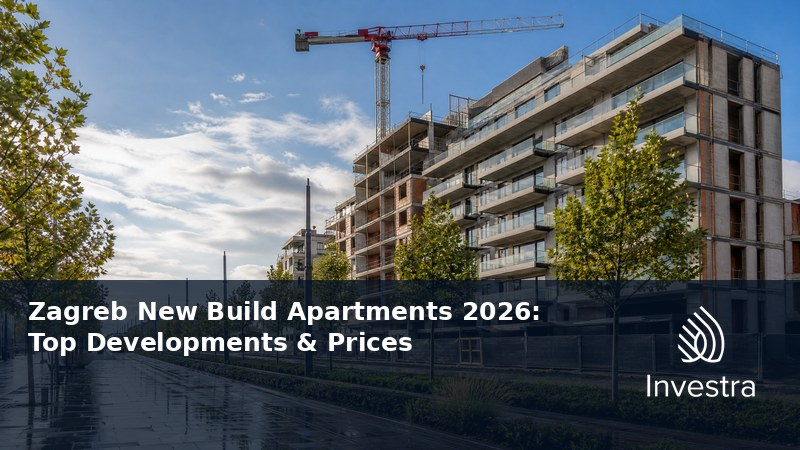
Zagreb New Build Apartments 2026: Top Developments & Prices
Zagreb New Build Apartments 2026: Why the Capital Is Attracting Global Buyers
Quick Answer: Zagreb's new build apartment market in 2026 is one of Central Europe's most compelling investment opportunities, with prices ranging from €2,800 to €6,500/m² depending on location and specification, and strong rental demand driven by a growing tech workforce and international student population. Investra.io tracks all major new developments across Zagreb's most sought-after districts.
Zagreb doesn't get the same Instagram attention as Dubrovnik or Split. There are no postcard-perfect harbour shots, no Game of Thrones tourism buzz. What Zagreb does have — and what serious property investors increasingly recognise — is substance. A functioning capital city economy, a rapidly modernising urban core, Croatia's highest average salaries, and a new-build residential market that has, frankly, been underpriced relative to comparable Central European capitals for years.
The 2020 earthquake that caused widespread damage to Zagreb's historic building stock was, paradoxically, a catalyst. It accelerated urban regeneration, pushed demand sharply toward seismically compliant new construction, and triggered a wave of developer activity that's now reaching its peak delivery phase in 2025-2026. Buyers who were reluctant to purchase older apartments — especially in the affected Lower Town — pivoted hard toward new builds, and that shift in buyer psychology has permanently altered Zagreb's residential market dynamics.
What we're seeing right now is a market at an inflection point. Construction costs have risen substantially since 2021, which means the era of genuinely cheap new builds in Zagreb is over. But compared to Vienna (€6,500-12,000/m²), Budapest (€3,500-7,000/m²), or Prague (€4,500-9,000/m²), Zagreb new builds still offer compelling value — particularly when you factor in Croatia's euro-zone membership, EU legal protections, and the city's growing profile as a tech and startup hub. This article breaks down what's being built, where, at what prices, and what international investors need to know before committing capital.
Understanding Zagreb's Urban Districts: Where New Developments Are Being Built
Quick Answer: New build development in Zagreb is concentrated in several key zones — the regenerated city centre, the eastern Heinzelova/Sopot corridor, the western Špansko-Oranice area, and the rapidly growing southern districts around Novi Zagreb — each offering distinct investment profiles and price points.
Zagreb is a city of clearly defined neighbourhoods, and where a new development sits determines almost everything about its investment case — price, rental demand, capital growth potential, and the type of tenant or buyer it will attract. Getting this geography right before you start browsing listings is essential.
The Upper Town (Gornji Grad) and adjacent Lower Town (Donji Grad) form the historic city centre. New construction here is rare and heavily regulated, but boutique conversions and premium infill developments do appear. When they do, they command Zagreb's highest per-square-metre prices — often €5,500-6,500/m² for finished product in premium locations. The earthquake damage to many Lower Town buildings has created genuine opportunities for developers willing to undertake seismic upgrades and full reconstruction.
Moving outward, Trnje and Novi Zagreb-Istok represent the city's most active development corridor right now. These areas blend proximity to the city centre (15-20 minutes by tram) with the space and infrastructure needed for larger residential complexes. You'll find multi-phase projects here with 200-500 units, attracting young professionals and families who want modern amenities at more accessible price points — typically €3,200-4,500/m².
Maksimir and Gornja Dubrava to the east offer a different character — greener, more residential, popular with upper-middle-class Zagreb families. New builds here tend to be smaller boutique developments of 20-50 units, often positioned as premium products within the eastern residential market, priced at €3,800-5,000/m².
Špansko, Stenjevec, and the western suburbs represent Zagreb's most affordable new-build territory — €2,800-3,500/m² — with good transport links to the city centre and strong demand from first-time buyers and young families. Rental yields here can be competitive precisely because entry prices are lower, though capital appreciation tends to be more modest.
Finally, the Savski Gaj and Novi Zagreb-Zapad area is experiencing a genuine renaissance. Once considered purely suburban and slightly anonymous, these districts have benefited from major infrastructure investment, new schools, commercial centres, and improved public transport connections. Developers have taken notice, and several significant mixed-use projects are underway here.
Current Price Ranges for New Build Apartments in Zagreb 2026
Quick Answer: New build apartment prices in Zagreb in 2026 range from approximately €2,800/m² in outer western and southern districts to €6,500/m² for premium city-centre product, with the most actively traded segment — mid-market new builds in well-connected urban zones — priced between €3,500 and €4,800/m².
Price data for Zagreb's new build market in 2026 tells an interesting story. According to Croatian Bureau of Statistics data and transaction analysis from the Eureality and Njuškalo platforms (Croatia's primary property portals), new residential construction in Zagreb has seen average price increases of 8-12% annually over the past three years. That trajectory is showing some signs of moderation in 2025-2026 as more supply enters the market, but prices are not declining.
Here's how the market breaks down by area and property type:
City Centre / Lower Town New Builds: €5,000-6,500/m². These are rare, boutique products — typically seismic reconstruction projects or careful infill on historic plots. A 65m² two-bedroom in this category will cost €325,000-422,000. Buyers here are primarily owner-occupiers or high-net-worth investors seeking prestige locations.
Inner Residential Zone (Trnje, Maksimir, Gornja Dubrava, Špansko-adjacent): €3,800-5,000/m². This is Zagreb's sweet spot for investment. A well-specified 55m² one-bedroom apartment in a quality development with underground parking might list at €220,000-280,000. Strong rental demand from professionals and dual-income households supports yields of 4.5-6% gross.
Mid-Ring Urban Districts (Novi Zagreb, Trešnjevka-South, Podsused): €3,200-4,200/m². The most active sector by transaction volume. Entry-level new builds here start around €150,000-170,000 for compact studios and one-bedroom units. These attract the broadest buyer and renter pool.
Outer Suburbs (Špansko, Stenjevec, Brezovica-adjacent): €2,800-3,500/m². Accessible pricing, but investors should carefully assess transport infrastructure and local employment catchment before committing. Rental demand exists but is more price-sensitive.
It's important to note that Croatian developers typically quote prices excluding VAT (PDV) of 25% on new builds for buyers who are not registered VAT payers. For a €300,000 new build, this adds €75,000 — making the total cost €375,000. This is a significant factor that catches some international buyers by surprise, so understanding the full acquisition cost structure is critical. The Croatia Property Tax Guide 2026 covers this in comprehensive detail.
The Top New Build Developments in Zagreb Right Now
Quick Answer: Zagreb's most significant new build developments in 2025-2026 include large mixed-use projects in Novi Zagreb and Trnje, boutique premium schemes in the city centre, and master-planned residential communities in the western suburbs, with a combined pipeline of several thousand units entering the market.
Naming specific developments requires some care — project names change, phases are added, and marketing materials don't always reflect ground reality. What we can do is profile the types and scales of development that characterise Zagreb's 2026 pipeline, based on planning registry data and developer announcements.
Mixed-Use Urban Regeneration Projects (Trnje/Heinzelova Zone): Several large-scale developments in the eastern Trnje district are transforming former industrial and warehouse land along the Heinzelova-Radnička corridor. These projects typically combine residential apartments (ranging from 35m² studios to 120m² family units), ground-floor commercial space, and underground parking. Prices here run €3,800-4,600/m², and the most prominent schemes offer phased delivery across 2024-2027, allowing off-plan buyers to benefit from earlier pricing tranches. These are serious developments by Croatian standards — some exceeding 300 units across multiple buildings.
Boutique City Centre Developments: Half a dozen smaller projects are delivering premium product in and around Donji Grad and the Ilica/Savska axis. Typical scale is 15-30 apartments, with exceptional fit-out — smart home technology, underfloor heating, premium kitchen specifications, and in some cases ground-floor amenity spaces. Prices here start at €5,000/m² and reach €6,500/m² for penthouse and top-floor units with terrace space. These aren't investment plays for yield-focused buyers — they're lifestyle assets with strong long-term capital preservation characteristics.
Suburban Master-Planned Communities (Novi Zagreb-West, Špansko): The western and southern suburbs host Zagreb's most ambitious volume residential projects — developments of 500+ units with internal green spaces, play areas, retail units, and sometimes dedicated kindergarten facilities. These feel less like individual apartment blocks and more like small neighbourhoods. Prices range €2,900-3,800/m², and marketing is heavily focused on Croatian first-time buyers using state-subsidised APN (Agencija za pravni promet i posredovanje nekretninama) housing loan programmes.
Premium Residential Towers: Zagreb has also seen its first genuine residential tower projects enter the pipeline, with heights up to 20 storeys being proposed in specific development zones. These represent a departure from Zagreb's traditionally low-to-mid-rise residential typology and signal the market's growing confidence in premium high-density living. Penthouse units in these schemes carry price tags of €7,000-8,500/m² — Zagreb's most expensive residential product.
For a deeper analysis of which specific projects are currently active and accepting buyer registrations, the Zagreb Real Estate Market Report 2026 provides regularly updated development tracking.
Off-Plan Buying in Zagreb: Risks, Rewards, and the Process
Quick Answer: Buying off-plan in Zagreb can deliver 10-20% price advantages compared to completed units, but requires careful due diligence on developer credibility, escrow arrangements, and contract terms — EU consumer protection frameworks apply, offering more security than many non-EU markets.
Off-plan purchasing — buying an apartment before it's built or during construction — is how many of Zagreb's savviest investors have accumulated their best returns. The logic is straightforward: developers need pre-sales to secure financing, so they offer early buyers discounted prices relative to what the finished product will eventually command. Buy in Phase 1 at €3,500/m², and by the time the building completes two years later, comparable finished units may be selling at €4,200/m². That's a 20% uplift on paper value before the property is even occupied.
But the off-plan market carries real risks, and Croatia's experience with property development includes some cautionary tales — particularly from the pre-2008 era when several coastal developments stalled or failed mid-construction, leaving buyers in legal limbo for years. The post-EU-accession landscape (Croatia joined the EU in 2013) is considerably better regulated, and the consumer protection framework has improved substantially. That said, due diligence remains non-negotiable.
What to check before signing an off-plan contract in Zagreb: First, verify the developer's track record. Have they delivered previous projects on time and to specification? Second, examine the building permit status — a valid (pravomoćna) building permit should be in place before you pay a substantial deposit. Third, understand the payment schedule. Croatian developers typically structure payments as 10% on contract, staged payments through construction (sometimes 30-40% in tranches), and final balance on handover. Fourth, investigate how your deposit is protected. The best developers use escrow or bank guarantee arrangements; others less so. Fifth, engage a Croatian notary and independent lawyer for contract review — don't rely solely on the developer's recommended notary.
The Buying Property in Croatia as a Foreigner: Legal Guide 2026 provides a comprehensive walkthrough of the off-plan purchase process including all documentation requirements and title registration procedures.
Rental Yields and Investment Returns on Zagreb New Builds
Quick Answer: Zagreb new build apartments in prime residential zones are generating gross rental yields of 4.5-7%, with the strongest returns seen in one- and two-bedroom units near the city centre and university areas — net yields after costs typically run 3.5-5.5%, which compares favourably with Western European residential markets.
The rental market in Zagreb has fundamentally changed over the past five years. Two overlapping trends have driven this transformation. First, Croatia's tech and business services sector has expanded dramatically, bringing thousands of well-paid professionals — many of them relocating from abroad — into a city with a chronic shortage of quality rental housing. Second, the short-term rental market via Airbnb and Booking.com has matured in Zagreb, creating a parallel income stream for apartment owners willing to manage seasonal fluctuations.
For long-term residential rentals, current market rates in Zagreb break down roughly as follows:
A well-finished one-bedroom apartment (40-55m²) in a central or near-central location commands €600-900 per month. In the inner suburban ring, comparable apartments rent for €500-700. Two-bedroom units (65-85m²) in good central locations achieve €900-1,400 per month; in mid-ring districts, €700-1,000.
Running the numbers on a representative investment: a €220,000 one-bedroom new build in Trnje (55m², fully fitted, underground parking), renting at €750/month, generates gross annual rental income of €9,000 — a gross yield of approximately 4.1%. That's before you factor in the all-in acquisition cost including 25% VAT on new builds. If the VAT-inclusive purchase price is €220,000 (i.e., price already includes VAT or buyer is a registered VAT entity), the yield holds at 4.1% gross. Deduct property management (typically 10% of rent), maintenance reserve (1% of property value annually), and rental income tax (12% flat rate in Croatia for natural persons using the prescribed lump-sum method), and net yield lands around 3.2-3.8%.
Short-term rental performance in Zagreb is less dramatic than coastal markets but increasingly viable. Occupancy rates of 65-75% at average nightly rates of €60-100 for central one-bedroom apartments can push gross yields to 6-8% before operating costs (cleaning, management, platform fees add up to 30-35% of gross revenue).
The most compelling long-term investment case for Zagreb new builds isn't just yield — it's the combination of yield plus capital appreciation in a market that remains significantly undervalued relative to comparable EU capital cities. Siniša Dagary — Investment Consultant has written extensively about how Zagreb sits in the same developmental stage that Prague occupied in the early 2010s, before a decade of strong capital growth transformed that market's investment landscape.
Legal Framework for Foreign Buyers Purchasing New Builds in Zagreb
Quick Answer: EU/EEA citizens can purchase new build apartments in Zagreb on the same terms as Croatian nationals with no restrictions. Non-EU buyers face additional requirements but pathways exist, particularly for citizens of countries with bilateral reciprocity agreements with Croatia — the process is well-established and navigable with proper legal support.
Croatia's EU membership has dramatically simplified property ownership for European buyers. If you hold an EU or EEA passport, you have the same property rights as a Croatian citizen — full stop. There are no minimum purchase thresholds, no investment visa requirements, no restrictions on the number of properties you can own, and no limitations on renting out your property. This legal clarity is one of the most underappreciated advantages of investing in Zagreb compared to many non-EU markets.
For non-EU buyers, the framework is more nuanced. Citizens of countries that have signed bilateral reciprocity agreements with Croatia — a list that includes the United States, United Kingdom (post-Brexit arrangements), Canada, Australia, Switzerland, and many others — can purchase residential property through a relatively straightforward application process to the Croatian Ministry of Justice. The application typically takes 6-12 months for approval, though property reservation agreements can be signed during this period.
The legal transaction process for a new build purchase in Zagreb follows these broad steps: preliminary reservation agreement (ugovor o rezervaciji) with deposit of 1-3%; pre-purchase agreement (predugovor) with notarisation and payment of initial deposit (typically 10%); building permit verification; staged payments through construction; final purchase agreement (kupoprodajni ugovor) at completion; land registry (Zemljišna knjiga) registration and title transfer; and property registration with the relevant municipal authority.
One nuance specific to new builds: because apartments in multi-unit buildings don't formally exist in the land registry until the building is completed and formally subdivided (etažiranje), buyers are essentially purchasing a right to a unit rather than the unit itself until handover. This is standard practice in Croatia but means that for the construction period, security lies in the quality of the pre-purchase contract rather than registered title. This underscores why independent legal advice — from a lawyer who represents you, not the developer — is not optional.
The comprehensive Buying Property in Zagreb 2026: Complete Guide for Foreign Investors covers every step of this process in detail, including document checklists and typical timeline expectations.
Tax Obligations for New Build Apartment Buyers in Zagreb
Quick Answer: Purchasing a new build apartment in Zagreb triggers 25% VAT (rather than the 3% real estate transfer tax applicable to second-hand property) — a major cost consideration — while ongoing holding costs include a modest communal charge and, for rental properties, a 12% flat income tax on rental receipts.
Tax is where Croatia's new build market has a notable friction point compared to resale purchases. Understanding the tax architecture before you buy is genuinely important — it affects your acquisition cost, your yield calculations, and your exit strategy.
VAT on New Builds: New residential property in Croatia is subject to 25% PDV (VAT). In most cases, this is included in the developer's quoted price, but always verify this explicitly in the purchase contract. A developer quoting €4,000/m² "plus PDV" on a 65m² apartment means your real purchase price is €4,000 × 65 × 1.25 = €325,000, not €260,000. If you are a VAT-registered entity (e.g., a Croatian company or a foreign company with Croatian VAT registration) purchasing for business purposes, input VAT recovery may be possible — but this requires specific structuring.
Real Estate Transfer Tax (RETT): New builds are exempt from the 3% RETT that applies to resale properties. This is actually a simplification — no RETT on new builds, but full VAT applies instead.
Notary and Registration Costs: Budget approximately 1-1.5% of purchase price for notary fees, land registry fees, and administrative costs associated with completing the transaction.
Rental Income Tax: Croatia taxes rental income at 12% on a flat-rate basis (paušalno oporezivanje), which applies to most small-scale landlords. A 10% deductible allowance for maintenance costs is applied to gross rent before calculating the taxable base, making the effective tax rate around 10.8% of gross rental income. Alternatively, landlords can elect actual-cost accounting, which may be advantageous if real expenses (mortgage interest, management fees, maintenance) are high.
Capital Gains: Capital gains on Croatian property are taxable at 24% if the property is sold within two years of purchase. After two years of ownership, gains are fully exempt from Croatian capital gains tax — a significant incentive for medium-term holding strategies.
The full tax picture, including double taxation treaty implications for various nationalities, is laid out in the Croatia Property Tax Guide 2026. For bespoke tax structuring, Findes Financial Services provides cross-border financial planning for European property investors.
Financing Zagreb New Build Purchases: Mortgages and Payment Structures
Quick Answer: Croatian banks offer mortgage financing to both domestic and foreign buyers, with loan-to-value ratios of 60-70% for non-residents and interest rates currently in the 4.5-6% range — EU buyers generally access the most favourable terms, while non-EU buyers may find Croatian bank lending more restrictive and should consider international financing alternatives.
The financing landscape for Zagreb new builds has shifted considerably since Croatia joined the eurozone in January 2023. Mortgages are now denominated in euros, eliminating the currency risk that plagued borrowers during the era of HRK/EUR/CHF mismatches. This is a genuine improvement for market stability, even if base rate movements in the eurozone have pushed Croatian mortgage rates higher than the historic lows of 2020-2022.
For EU resident buyers, major Croatian banks — Erste, PBZ (Privredna banka Zagreb, owned by Intesa Sanpaolo), OTP Bank, Raiffeisenbank, and HPB (Hrvatska poštanska banka) — will consider mortgage applications, typically requiring Croatian-sourced income or comprehensive foreign income documentation. Loan-to-value ratios for non-residents typically max out at 60-70%, meaning a 30-40% cash deposit is needed. Mortgage terms run up to 30 years for borrowers under 55.
For new build purchases specifically, the financing structure is more complex because the property doesn't exist as completed collateral until handover. Banks typically offer construction loans (gradevinski krediti) or stage-payment facilities that convert to standard mortgage on completion. Some developers have established banking partnerships that streamline this process for buyers.
An alternative that many international investors use — particularly those buying in the €200,000-400,000 range — is equity release or refinancing from properties in their home country, avoiding Croatian banking complexity entirely. This is especially common for UK and German buyers who can access sub-3% secured lending against existing property at home and deploy that capital as "cash" in Zagreb.
The Croatian government's APN subsidised housing scheme (providing interest-free or low-interest loans of up to €100,000 for primary residence purchases) is available to Croatian citizens and, in some cases, EU citizens establishing primary residency in Croatia. For investors buying purely as income assets, this scheme doesn't apply, but it's worth understanding as it shapes demand dynamics — APN-eligible buyers represent a large pool of future purchasers or renters for your investment property.
Zagreb's Economic Drivers: Why New Build Demand Stays Strong
Quick Answer: Zagreb's property demand is underpinned by Croatia's strongest economy — home to 70%+ of the country's GDP, a rapidly expanding tech sector, growing tourism infrastructure, and net positive internal migration from smaller Croatian cities — all factors that sustain housing demand regardless of external market volatility.
Property markets live and die on economic fundamentals. So let's be honest about what Zagreb actually has going for it — and what the risks are.
On the positive side, Zagreb concentrates an extraordinary share of Croatian economic activity. The city accounts for approximately 33% of Croatia's population but generates over 70% of its GDP. Average monthly net wages in Zagreb (around €1,400-1,600) are roughly 40-50% above the Croatian national average, supporting both homebuying capacity and rental affordability. The city hosts virtually all of Croatia's major corporate headquarters, government institutions, universities (University of Zagreb has 70,000+ students), and increasingly, the regional offices of major international corporations.
The technology sector deserves particular mention. Croatia has produced several globally significant tech companies — Infobip, Rimac (now Bugatti Rimac), IN2, and a growing cluster of fintech and SaaS businesses. Zagreb hosts the largest proportion of Croatia's tech workforce, and this sector skews young, mobile, and affluent — exactly the demographic that drives premium rental demand for well-located new build apartments. Infobip alone employs thousands of people in Zagreb, many of whom rent in the city.
Internal migration is another structural driver. Croatia's smaller cities and rural areas continue to lose population to Zagreb, as younger Croatians move to the capital for education and career opportunities. This is a decades-long trend that shows no signs of reversing and ensures a steady pipeline of new rental market entrants.
The risk factors are real and shouldn't be dismissed. Croatia's overall population is declining due to emigration (primarily to Germany, Austria, Ireland, and other EU labour markets), which creates a long-term headwind for national housing demand even as Zagreb remains insulated by internal migration flows. The political risk around planning permissions and regulatory changes is relatively low by regional standards but not zero. And like any eurozone economy, Croatia is exposed to ECB monetary policy and broader European economic cycles. The Croatia Real Estate Market Report 2026 provides a comprehensive macro analysis of these dynamics.
Comparing Zagreb New Builds to Other Croatian Investment Markets
Quick Answer: Zagreb new builds offer superior yield consistency and year-round rental income compared to coastal markets like Dubrovnik or Split, though coastal properties typically command higher capital values and stronger short-term rental premiums during the summer tourism season — the right choice depends entirely on your investment objectives.
Many investors arrive at Croatia's property market via the coast — Dubrovnik's luxury villas, Split's medieval apartment buildings, Hvar's boutique conversions. These are glamorous assets in spectacular settings, and for lifestyle-motivated buyers or those seeking premium short-term rental income, coastal property has genuine appeal. But for pure investment fundamentals, the comparison with Zagreb is more nuanced than the marketing materials typically suggest.
Coastal property — particularly in Dubrovnik — commands extraordinary per-square-metre prices. New and recently renovated apartments in Dubrovnik's Old Town area trade at €7,000-12,000/m², levels that imply long holding periods for capital appreciation to justify the entry cost. Short-term rental yields in peak season (June-September) can be spectacular — nightly rates of €200-500 for quality apartments — but the structural limitation is seasonality. Even Dubrovnik, Croatia's most internationally recognised destination, sees occupancy rates collapse to 30-40% outside the May-October window. This means annual revenue projections need careful stress-testing against realistic occupancy, not peak-season fantasies.
Split offers a middle ground — lower entry prices than Dubrovnik (€3,500-6,000/m² for new builds in desirable locations), stronger year-round tourism than many coastal rivals due to its transport hub status and growing cruise ship infrastructure, and a genuine local population providing residential rental demand beyond the tourism season. The Buying Property in Split Croatia 2026: Complete Investment Guide covers this market in depth.
Zagreb's advantage is straightforward: 12-month rental demand from a large, economically active population. There are no months when the rental market effectively shuts down. Long-term tenants sign 1-2 year leases, providing income predictability that coastal short-term rental income simply can't match. For investors using mortgage financing — where consistent monthly income to service debt is important — Zagreb is the more logical choice. For cash buyers seeking lifestyle combined with investment, the coast offers different rewards. The answer, as is often the case in real estate, is "it depends on what you need your investment to do."
Due Diligence Checklist for Zagreb New Build Purchases
Quick Answer: Successful Zagreb new build purchases require verification of developer track record, building permit status, land registry ownership, escrow or bank guarantee arrangements for deposits, contract review by independent legal counsel, and careful analysis of the final specification and handover conditions before committing funds.
There's a version of property investment due diligence that's purely theoretical — a long list of items that sounds comprehensive but doesn't translate into practical action. What experienced buyers in Zagreb actually do is rather more focused. Here's what the process really looks like on the ground.
Developer investigation: Before anything else, research the developer's history in Croatia. How many projects have they completed? Were they on time? Talk to owners in their previous buildings if possible — Njuškalo's "sold" listings often identify the developer, and you can track down previous projects on the Croatian planning register (eDozvola platform). A developer with three successfully delivered projects in Zagreb is categorically lower risk than a new entrant or one with a disputed history.
Land registry (ZK extract) review: The land registry extract (Zemljišno-knjižni izvadak) for the plot on which the development sits should be clean — no mortgages, no disputes, no third-party encumbrances. Your lawyer should verify this independently, not rely on documents provided by the developer.
Building permit (Pravomoćna građevinska dozvola): Is the permit in force (pravomoćna)? Has the appeal period passed? Has any neighbouring party lodged an objection that could invalidate the permit? These questions sound technical but they're fundamental — a development without a valid permit is literally unbuildable.
Contract examination: The pre-purchase agreement should specify: exact unit identification, purchase price (VAT inclusive or exclusive clearly stated), payment schedule and conditions, handover date with penalty provisions for delay, specification standards (materials, finishes, appliances), and dispute resolution mechanisms.
Financial protection for your deposit: How is your deposit protected if the developer goes insolvent? Bank guarantee (bankarska garancija) is the gold standard. Without it, your deposit is an unsecured creditor claim in insolvency — which in Croatian bankruptcy proceedings typically means years of waiting for minimal recovery.
The Croatia Real Estate FAQ 2026 addresses dozens of practical questions about the purchase process, and the team at About Siniša Dagary includes specialists in cross-border property transaction oversight.
Property Management and Rental Operations in Zagreb
Quick Answer: Zagreb has a growing ecosystem of professional property management companies offering full-service letting, tenant management, and maintenance coordination — typical management fees run 8-12% of monthly rent for long-term lets and 20-30% of gross revenue for short-term holiday rental management.
Buying a Zagreb new build from abroad is one challenge. Running it as a productive rental asset from 1,000 kilometres away is another entirely. The good news is that Zagreb's property management sector has professionalised substantially over the past decade, driven partly by international investor demand and partly by the growth of the short-term rental market which created demand for more sophisticated operational services.
For long-term residential letting, a full-service management company will handle tenant sourcing and vetting, lease agreements (in compliance with Croatia's Tenant Protection Act), rent collection, maintenance coordination, annual property inspections, and administrative interface with the tax authority for rental income declarations. Costs for this comprehensive service typically run 10% of monthly rent — so on a €750/month apartment, that's €75/month or €900/year. Given the complexity of managing a foreign property from abroad, this is money well spent.
Short-term rental management in Zagreb is a different operational model. Your manager will handle Airbnb/Booking.com listing management, dynamic pricing (critical for maximising revenue), guest communication, check-in/check-out logistics, linen and cleaning service coordination, and the legally required guest registration with Croatian police (an obligation that falls on the property owner for every short-term stay). Management fees for this service typically run 20-30% of gross revenue, though the better operators justify their higher rates through superior occupancy and pricing optimisation.
When selecting a property manager, ask for occupancy and revenue data from comparable properties in their portfolio — not marketing projections, but actual historical performance. Ask about their maintenance response times and how they handle property damage disputes with guests. And verify that they are properly registered as a property management business in Croatia (obrtnica or d.o.o. registration), which provides you some contractual protection if the relationship goes wrong.
The New Build Quality Spectrum: What You Actually Get for Your Money
Quick Answer: Zagreb new build quality varies enormously — from energy-efficient, A-rated buildings with smart home integration and premium finishes at the top end, to functional but basic construction at the entry-level price points — understanding specification standards before you buy is essential to avoid expensive post-handover surprises.
Not all Zagreb new builds are created equal. The Croatian construction industry has a broad quality spectrum, and the gap between top-tier and bottom-tier new residential product is wider than buyers accustomed to markets with more standardised building regulations might expect.
At the premium end — the €5,000+/m² projects in and around the city centre — buyers can expect: A or B+ energy rating (required by recent EU-aligned Croatian building regulations), triple-glazed window systems, underfloor heating, pre-installation for EV charging in underground parking, smart home control systems, lift access, high-specification bathrooms and kitchens, and genuine quality in structural finish (smooth plaster, level floors, properly sealed joints). These buildings look as good in Year 5 as they did on handover day.
In the mid-market range (€3,200-4,500/m²), quality is generally respectable but more variable. Ask specifically about: the energy rating (B is the minimum acceptable; C-rated buildings will have higher operating costs), window specifications, heating system type (district heating versus individual gas boilers versus heat pumps — the latter is increasingly the standard in quality new builds), and car parking provisions (underground parking adds €15,000-30,000 per space but significantly enhances rental demand and resale value).
At the entry-level (sub-€3,200/m²), you're sometimes buying into projects where corners have been cut on insulation, soundproofing, and finish quality. Some of these buildings develop visible issues within 5-7 years — cracking in plaster, water ingress around window frames, inadequate sound attenuation between units. The resale market for poorly performing new builds in outer Zagreb districts can be sluggish, and tenant satisfaction (important for long-term occupancy) suffers in buildings where basic quality issues were skimped on during construction.
The practical advice is simple: if you're buying off-plan, hire an independent construction supervisor (nadzorni inženjer) to inspect the building at key construction stages. This costs €500-1,500 but can identify construction defects while they're still rectifiable, rather than after handover when fighting a developer through Croatian courts is expensive and slow.
Zagreb New Builds as Part of a Diversified Property Portfolio
Quick Answer: For international investors seeking European property diversification, Zagreb new builds offer an attractive combination of eurozone stability, below-Western-European pricing, genuine rental demand, and capital appreciation potential — characteristics that complement rather than duplicate coastal Croatian or Western European property holdings.
How does a Zagreb new build apartment fit into a broader investment portfolio? This is the question that serious multi-property investors ask, and the answer has become considerably cleaner since Croatia's euro adoption in 2023.
Currency risk — historically one of the concerns about Croatian property for eurozone investors — has been eliminated. A Zagreb apartment now performs in the same currency as a Berlin condo or a Madrid flat. This matters for portfolio risk modelling and for investors who think in euros across their asset base.
The correlation argument is also interesting. Zagreb property prices don't move in lockstep with London, Paris, or Frankfurt. They're driven by Croatian macroeconomic conditions, local employment dynamics, and domestic monetary factors — all of which provide genuine diversification benefit when one of the major Western European markets goes through a correction cycle. We saw this in 2022-2023, when some Western European markets cooled sharply on rate rises while Zagreb continued its appreciation trajectory, supported by domestic demand dynamics and constrained housing supply.
For investors already holding coastal Croatian property (Dubrovnik or Split), a Zagreb apartment adds a non-seasonal, economically driven income stream that balances the portfolio's revenue profile. The summer months when Zagreb long-term rentals are quietly ticking along are the same months when coastal properties are generating their peak Airbnb income — the two assets are genuinely complementary rather than redundant.
For those looking at the broader Adriatic and Central European opportunity, resources like the Business Strategy Blog by Siniša Dagary provide valuable context on regional investment positioning, comparing Zagreb's fundamentals against Budapest, Ljubljana, and other smaller EU capital markets.
2026 Market Outlook: What Buyers and Investors Should Expect
Quick Answer: The Zagreb new build market in 2026 is characterised by moderating price growth (5-8% annually, down from the 10-15% seen in 2021-2023), increased supply in the mid-market segment, continued strong rental demand, and growing international buyer participation — conditions that favour careful stock selection over broad-market exposure.
Anyone claiming to predict property markets with precision is either overconfident or selling something. What we can do is read the available data honestly and form reasonable probability-weighted views about where the Zagreb new build market is heading.
Supply is increasing. The construction pipeline in Zagreb for 2025-2027 is the most substantial since before the 2008 financial crisis. This is net positive for buyers (more choice, modestly less developer pricing power) and net negative for existing landlords in locations where new supply concentrates (potential rental softening if vacancy rises). The oversupply risk is real in specific outer suburban districts where five or six large developments are completing simultaneously — buyers should scrutinise the local supply pipeline carefully.
Demand is holding up. Internal migration to Zagreb continues, tech sector employment is
Investment Disclaimer
The information provided in this article is for educational and informational purposes only and should not be construed as financial, legal, or investment advice. Real estate investments carry inherent risks, and past performance does not guarantee future results. Investors should not invest money they cannot afford to lose. Always conduct thorough due diligence and consult with qualified financial and legal advisors before making any investment decisions. Investra.io does not guarantee returns on any investment.
Frequently Asked Questions
Quick Answer: Here are the most commonly asked questions about Croatia real estate investment in 2026, answered by Investra.io experts.
Is Croatia a good country for real estate investment in 2026?
Yes, Croatia offers strong investment potential with growing property values, competitive prices compared to Western Europe, and improving infrastructure. Investra.io provides comprehensive market data and investment guidance.
Can foreigners buy property in Croatia?
EU citizens can buy property freely in Croatia. Non-EU citizens may need to meet specific requirements. Investra.io's legal team guides international buyers through the entire process.
What is the average property price in Zagreb?
Property prices in Zagreb vary significantly by location and property type. Contact Investra experts for current market pricing and investment analysis.
What rental yields can I expect?
Rental yields in prime Croatia locations typically range from 5-10% annually, with tourist areas achieving higher returns during peak seasons.
What taxes apply to property purchases?
Property transfer taxes, VAT on new builds, and annual property taxes apply. Rates vary by property type and location. Consult Siniša Dagary for tax optimization strategies.
How long does the purchase process take?
Typically 30-60 days from offer to completion. Working with Investra.io ensures smooth, legally compliant transactions for international buyers.
What financing options are available?
Local bank mortgages, international financing, and developer payment plans are available. Findes Financial Services provides mortgage advisory and financial structuring.
Is property management available for rental properties?
Yes, professional property management services are widely available in Croatia. Investra.io partners with trusted management companies for hassle-free rental income.
What are the best areas to invest in Zagreb?
Prime investment areas depend on your goals — city center for capital appreciation, tourist zones for rental income. Investra.io's market analysis identifies the best opportunities.
Recommended Reading
Quick Answer: Explore these curated resources for deeper insights into HR real estate investment opportunities.
- Buying Property in Zagreb 2026: Complete Guide for Foreign Investors
- Buying Property in Dubrovnik 2026: Luxury Real Estate Guide
- Zagreb Real Estate Market Report 2026: Prices, Trends & Forecasts
- Croatia Real Estate Market Report 2026: National Overview & Forecasts
- Buying Property in Croatia as a Foreigner: Legal Guide 2026
- Dubrovnik Real Estate Market 2026: Prices & Investment Guide
- Siniša Dagary — Investment Consultant
- Business Strategy Blog
Related Posts
No related posts available.
